JOST A MON

The idle ramblings of a Jack of some trades, Master of none

Sep 22, 2013

At Pop Tate's Modern

Poor joke, that there title. I wandered about the Tate Modern gallery a bit ago and saw some stuff that can never be unseen. When I recovered my wits, I staggered into adjoining rooms where surrealism and Russian revolutionary posters clashed against constructivism and post-Impressionism and several other -isms that did little to restore my tissues. But there were two (or possibly three) pieces that were quite impressive and had somehow slipped my attention the last time I visited.

First was geometry dissed by tumbleweed as visualised by the German artist Gego (Gertrud Goldschmidt, 1912-1994). 
Untitled, by Gego (1977).
Untitled, by Gego. (1977).
Gego had a serious problem with idealism, especially that portrayed geometrically. Hence these modular shapes cast about the floor.

Then I saw this frenzied relief by Sergio Camargo (1930-1990). This Franco-Brazilian sculptor envisaged a synthesis of material roughness and artistic craft by using wood in a relief suggestive of crystal growth. More geometric obsession but with the added dimension of light-and-shadow play. I can tell you little more.
Large Split Relief No. 34/4/74, by Sergio Camargo (1964-65)
Large Split Relief No. 34/4/74, by Sergio Camargo. (1964-65).
And, lastly, I saw Fred Wilson's exploration of racial identity, appropriation and myth, titled Grey Area (Black Version) (1993). Among African Americans there seems to be a perception that Nefertiti was a Black African queen, although, of course, historians are not as sure. Fred Wilson wanted to point out these obscurities and he did so by reproducing multiple copies of an ancient Egyptian bust of Nefertiti.
Grey Area (Black Version) by Fred Wilson (1993)
Grey Area (Black Version), by Fred Wilson. (1993).
As I was heading down one of the long escalators in the museum, I was struck by a translucent shield that partially reflected the escalators and allowed the people behind it to be seen. When I say 'struck', I don't mean 'struck', but 'struck', don't you know. I call this wonderful piece of dynamic photography Verisimilitude. Observe the interplay between the perpendicular and the transverse, the clean lines of the escalator and the intangibility of the reflection, the acceleration of the women straining to exit the premises and the concentrated communication of the other women. Note as well the juxtaposition of the mythical against the charitable, with the pudding melting off the sightless woman's head onto the donation cabinet beneath. Feel free to be awed and to acclaim. 

Reflections
Verisimilitude, by Fëanor. (2013).

Aug 27, 2013

Suspense

As day dawned, very early,
it came about as he expected:
this goddess encountered him,
as he placed himself at the front of the pool.
She came, naked of her clothing,
letting her hair down

At this climactic moment, the papyrus has been erased. (From the "Herdsman's Tale", a Middle Kingdom work from ancient Egypt.)

Aug 7, 2013

Ancient History on TV

There's been a veritable spate of TV programmes on Ancient Rome lately. Just a week or so ago was Caligula by the lovely Mary Beard. This overlapped historically (and a little bit thematically) with Catharine Edwards' Mothers, Murderers and Mistresses: Empresses of Ancient Rome. Three months ago was Margaret Mountford's Pompeii: The Mystery of the People Frozen in Time, and that was an update on Mary Beard's programme on Pompeii (Life and Death in a Roman Town) from about two-and-a-half years earlier. Last year, we were treated to a series on the religions of Rome (pagan, Christian, Papish) by Simon Sebag Montefiore, as well as a search for its forgotten ruins (amphitheatres, canals, forts, lost cities) with Dan Snow. We've had a three-parter called Treasures of Ancient Rome hosted by Alastair Sooke, which shows us that the Romans may have been famed for murther and engineering, but that they were great artists as well. Mary Beard, too, has been extra busy, because her show on the lives of common Romans (Meet the Romans) was also shown last year.

There have been two programmes on Hadrian and his wall (in the Timewatch series of 2007, and by Dan Snow the following year). There have been several programmes on gladiators (Gladiator Graveyard), most recently in Timewatch again (2007), as well as one from 2003 titled The Colosseum: Rome's Arena of Death. Terry Jones explored the cultures of Rome's contemporaries - the people the Romans liked to call Barbarians (2006). More ambitious than all of these was a six-parter titled Ancient Rome: The Rise and Fall of an Empire also in 2006.

And these are just the BBC programmes. The other channels have not been negligent. Channel 5 has done its bit to promote the imperium (programmes on Julius Caesar and gladiators) as well as Channel 4 with its various Time Team digs uncovering Roman Britain.

You get the drift. Serious obsession with the Romans in these here British Isles. That's all right, it's all classical history and good fun.

So what do these programmes cover? Blood and sensation (peacetime and wartime) and some religion and art. Where are the stories of republican Rome? How did the Romans become a superpower? Where's Roman science? Engineering? Literary Rome? Mercantile Rome? 

Classical history, of course, includes the Greeks. Here too we have rich amounts of programming (although nowhere in the league of the Romans). There's the usual stuff - Troy, Sparta, Athens, the battles against the Persians. Luckily there's also been some delightful programmes on Greek science (Aristotle, the Antikythera mechanism), as well as a recent cultural round-up by Michael Scott. But, again, it appears we are fated to see the same tired topics repeated over and over.

Can't we have some coverage of the post-Alexandrian Hellenic world? It extended to north-west India and lasted for centuries, brilliant blends of local cultures with that of the Greeks. What about Ptolemaic Egypt? And, again, mercantile Greece? Or its amazing scientific achievements? True, some of its mathematics was covered by Marcus du Sautoy, and some of its optics by Simon Schaffer. But there's a  world of Greek thought just waiting to be shown on TV, surely.

There's more to Ancient Egypt than the Pyramids and King Tut, too. A nice recent programme was on the reconstruction of a boat supposedly sent by Queen Hatshepsut to Punt - although nobody really knows where Punt is. Another one was on the search for Rameses's lost city. (These searches for lost cities always seem to be high on a TV programmer's agenda.)

But there's far more to ancient history! The decipherment of ancient scripts? (You could do a nice programme of about an hour on the topic, using the epic of Gilgamesh as focus. Or an entire series, using a great text from each of the ancient civilisations. How about six parts - Sumer, Egypt, China, India, Maya, and the earliest alphabet (was it Phoenician?)) The hunt for the historical Hanging Garden of Babylon? Again, a stirring subject, with much controversy and any amount of to-ing and fro-ing amongst the historians. What about the spread of Hindu and Buddhist culture out of India? I don't think I've seen much about the Persians (although I recall there was some chatter when the British Museum organised its massive exhibition a few years ago). There could even be a kind of thematic coverage of great thinkers and philosophers - toss Confucius, Buddha, Mahavira, Zoroaster, and a couple of Greeks into the mix - and compare and contrast! I could go on and on.

I've been in this country for ten years, and I've found the quality of its public broadcasting superb, a true wonder. Now if only its coverage would widen.

May 29, 2011

Coffee, the Right Way

In 1854, John Henry Wilton published a book titled The First Crime; Or True Friendship, which, he claimed, was upon the importunations of his friends who wished to learn all about his peripatetic life. I haven't read the book, but this passage seems par for its course.
Harry stopped short the tale, and bid Bothwick and his friend partake of some refreshment. " Come," said he, "let us have a cup of mocha, friends. Mr. Wilding," added Harry, "you must be getting peckish; allow me to offer you a cup of coffee and a crust. I'll answer for both being good, for the bread is home-made, and the coffee Richard makes himself in the best style, for he has had much practice ; I taught him myself. The method I learnt in Turkey and France. The Arabs have a mode of making coffee that I don't like. They, like the Egyptians, boil it until it is quite thick, and to me unpleasant. I am very particular as to the way my coffee is made, and have, after much trouble, succeeded in hitting upon an excellent method. I carry with me my own apparatus to make it, which may be called eccentricity. Well, be it so; nevertheless, I do, for I despise nine-tenths of the coffee, or coloured water called coffee, one generally meets with in travelling; for I hold it that a cup of really good coffee is one of the greatest luxuries."
So there you go. Travel might broaden one's mind, but not if one's a Victorian gentleman, full of oneself and the supposed superiority of one's civilisation.

Welcome, folks, to the LXXVII edition of the Mathematics Blog Carnival. We have a wide-ranging litany of articles, although - despite our best efforts - not seventy-seven of them. Still, quite a few to whet an appetite or three.

According to custom, we must start with the oddities of the number. Instead, we'll just intersperse the facts amongst the various articles.

77 is a deficient number.

Sol Lederman presents Curve stitching with Mathematica posted at Playing With Mathematica.
Meanwhile, does anyone remember the NBC adventure series 'The Tales of the 77th Bengal Lancers'?
Ever heard of curves with infinite perimeter and zero area? Read That's Impossible! One Giant Nerdgasm at Consumed By Wanderlust.
And, of course, Jesus of Nazareth is supposed to be of the 77th generation from Adam.
What does the Great Pyramid tell us about ancient Egyptian mathematics? Dave Richeson reveals an interesting consequence in Division by Zero.
77 is evil.
Alexander Bogomolny presents Areas on the Graphs of Power Functions posted at CTK Insights.
77 is also vile!
At Travels in a Mathematical World,  Peter Rowlett presents a collection of podcasts and videos from the Math/Maths Week 2010, and from Young Researchers in Mathematics 2011.
77 is the number of digits of the 12th perfect number. Somewhat uncannily, 77 also is the number of integer partitions of the number 12.
Mike Croucher ponders whether graphical calculators have outlived their usefulness at Walking Randomly.
77 is the sum of three squares, 42 + 52 + 62, as well as the sum of the first eight prime numbers.
Speaking of calculators, did you know you could multiply on your fingers? I didn't, but Math and Multimedia reveals some tricks.
77 is the atomic number of the element iridium. Does anyone remember Motorola's ill-fated ventured of the same name that was supposed to revolutionise global telecommunications?
While the little folk do elementary mathematics on their fingers, the powerhouses of the discipline get their breakthroughs at the most peculiar places and moments in time. Dick Lipton lists some of them in Godel's Lost Letter and P = NP.
77 is the largest number that cannot be written as a sum of distinct numbers whose reciprocals sum to 1.
Pat Ballew highlights the quotation 'old mathematicians don't die, they just go off on a tangent', and illustrates nicely the properties of tangents to a cubic at Pat's Blog.
77 is not a sum of two squares - but it is a sum of 2 squares!
At Short Sharp Science, Catherine de Lange reveals how tattoos (unsightly at the best of times, heheh) become even unsightlier with age. Mathematicians have developed a model that describes the aging of tattoos. (Do you think the picture below looks like a tattoo of 77? No? Dash it.)
And IT History has a little piece on the beginnings of computer user groups - all the way back in 1952!


Speaking of beginnings, it's the centenary of IBM. Take a look at this celebratory post at Antipodes: Reflections from an Australian Expatriate in France?

"Wannabe professional gambler" Zac mixes up probability and ethical humanism in his post Gambling Theory at Zac Sky.

SquareCircleZ ponders what is the correct graph of arccot(x)?

Alex Bellos discovers that there are more to triangle centres than he had previously imagined (and revealed to us in his book Alex's Adventures in Numberland).

Roice has some clever Geodesic Saddles.

And Joe Manausa shows how Tallahassee residents need to wait till 2018 for their house prices to return to equilibrium in his case study. Long time to wait, eh?

And just so that we Anglospeakers don't feel too alone, we are pleased to reveal that the Spanish blogosphere has its own Carnival of Mathematics. The latest installment is by Juan Martínez-Tébar Giménez at Los Matemáticos no son gente seria, and it showcases entertaining pieces on, among a couple of dozen other things, Tartaglia and Cardano, the Nash conjecture, the decipherment of a wartime diary, and the centenary of the Royal Spanish Mathematical Society.

That's it for this month, people. Please do take a look at our sister carnival - Math Teachers at Play -  and also note that you can follow the Carnival of Math on Twitter: @Carnivalofmath. The next Carnival of Mathematics should come up around Jun 3, 2011. Please send in your submissions here.

Apr 26, 2011

Carnivalesque 73

Welcome, folks, to the seventy-third Carnivalesque, the Ancient/Modern edition of the popular History blog carnival. Thanks to all those who contributed and sent suggestions.

To start with, take a look at this timeline (timelines being some sort of minor addiction for me) of historical events that occurred in years ending in 73. Trite, eh? There’s considerable uncertainty about the older dates, of course, but if there’s at least one source that speculates an event occurred in such a year, well, I’ve bunged it in.

Events in the years before Christ (or Common Era, to be less religious) appear against negative numbers in this timeline. If you click on any of the titles, a little window should open up with some extra information.


This is the week after Easter, and so a light Christian history thread runs through this carnival. But fear not – there’s lots of other stuff to whet your secular appetites.

And so, to begin:

Africa


Kemsit, the Nubian queen of the Egyptian King Mentuhotep II (2061-2010 B.C.), and her servants; from a painting in her tomb chamber wall; Metropolitan Museum of Art, New York; from Naville, The XI Dynasty Temples at Deir el-Bahri III (London: Egypt Exploration Fund, 1913), pl 3.
Kemsit, the Nubian queen of the Egyptian King Mentuhotep II (2061-2010 B.C.), and her servants; from a painting in her tomb chamber wall
Would you be willing to trek across the Egyptian desert all the way to Chad? Even today it’s a perilous journey, and yet there’s evidence that the Pharaoh Mentuhotep II (2061-2010 BC) organised an expedition to that western land. Read about it in Owen Jarus’ post in Unreported Heritage News.


*********


Europe


Around 3500 BC, the Neolithic inhabitants of the island of Jersey built a worship mound that came to be known as La Hougue Bie. Millennia later, a church was built atop it. The Neolithic mound was equinoctically aligned, and it turns out so is the church. Alun Salt tells the story.

You may have seen some racy news recently - First Gay Caveman Found! - etc. Bunkum. The Corded Ware (2900-2500 BC) burial site near Prague was not of cavemen; rather it's of pre-Bronze Age farmers.  Why do they think it was a gay caveman? John Hawks does a spot of debunking.


If you have wondered why Isocrates (436-338 BC) is not as well-known as, say, Plato, wonder no more. Michael Anderson has the scuttlebutt in his Ancient History Blog.

How likely is it that a list of survivors of the Battle of Marathon survived to this day? Or that such a list ever existed? Rogueclassicism has an overview of the affair of the Marathon tablet (403 BC ?) and its epigraphy.

What do Nerva, Trajan, Hadrian, Antoninus Pius, and Marcus Aurelius have in common? Adrian Murdoch’s series of podcasts on Gibbons’ “five good emperors” (AD 96-180) reveals all that you  might want to know. Get them at his blog Bread and Circuses.

Ivan Bilibin's Illustration to the Lay of Igor's Campaign (from Wikimedia Commons)
‘In AD 1185, as the Kievan Rus Empire was starting to deteriorate, a little known prince on the eastern Russian borders led his outnumbered men into battle against Mongolian invaders, the Polovtsians (Kumans). This battle and its aftermath would become the topic of the Russian literary epic, “The Lay of Igor’s Campaign.”’ Seesaw discusses the battle, the epic and its musical successors in Russia, Past and Present.


St. John of Nepomuk, Charles Bridge, Prague
St. John of Nepomuk, Charles Bridge, Prague by dlnwelch, on Flickr

If you wander about the Upper Palatinate in Germany, you might find yourself wondering – as Patrick Shrier did – why there are statues of St John of Nepomuk (d. 1398) on nearly every bridge in sight. What’s a Czech saint doing in Germany? Shrier investigates and reports in Patrick’s Military History Blog.


A oft-repeated statement is that the famous vegetarian Leonardo da Vinci (1452 - 1519) was 'ahead of his time' in sundry disciplines. While this may be somewhat true of his art, it doesn't apply to his technical work, says Thony C. in the Renaissance Mathematicus.

There’s no end to weirdness in Europe, and Vlad the Impaler is about as weird as a historical character can get. Soon after taking up the throne of Wallachia (1457), he invited the nobility to an Easter feast and – well, Executed Today has the story.

'Tis the 550th anniversary of the Battle of Towton (1461) - one among many in the Wars of the Roses in sunny England - and there are no pictorial representations extant of that battle. So what was Sheila Corr to do when she had to provide a suitable illustration for an article in History Today? Find out here.


Speaking some more of seriously weird things: there was much faith in putting one’s fate in the hands of chance (or God) – even secular arguments were sought to be settled by means of trial by fire. One of the last such trials occurred in Florence in 1498, as Beachcombing’s Bizarre History Blog reports in Barbecuing Friars in Late Medieval Florence.


*********

Middle-East


While it’s widely believed that the Abrahamic faiths are monotheistic, there is considerable evidence that Judaism, the oldest of them, was initially polytheistic. JK at Varnam explains the ins and outs of how god became God and acquired a wife, and other gods were consigned to oblivion (c. 8th century BC)

What’s up with physicists thinking they can contribute to historical analysis? Surely the age of the dilettante is past? Jona Lendering in New at LacusCurtius & Livius excoriates Colin Humphreys for his claim that Christ’s Last Supper took place on a Wednesday, and not – as historians agree – on Maundy Tuesday. “The trouble with the Jaubert-Humphreys Thesis is that it solves a problem that does not exist by using a method that is self-contradictory…Unfortunately, this is not an innocent, funny story about scientists who should not pretend they are historians.”

In the early days of Christianity, Easter was the chief religious festival. Birthdays were considered a pagan relic. So how did Christmas become the important festival it is today? Ranjith Kollanur explains in his blog A View From My Disjointed Laptop.

European depiction of the Persian (Iranian) doctor Al-Razi, in Gerardus Cremonensis "Recueil des traités de médecine" 1250-1260. (Wikimedia Commons)
European depiction of the Persian doctor Al-Razi, in Gerardus Cremonensis "Recueil des traités de médecine", 1250-1260. (Wikimedia Commons)
When and where was the definitive recognition of smallpox made? In Persia around AD 900, a medic called al-Razi wrote a treatise named al-Judari wa al-Hasbah (On Smallpox and Measles). Lapham’s Quarterly blog has a small write-up.

*********

Asia

74,000 years ago, human beings were passing the Malay peninsula on their great migration across the planet. Archaeological digs in Perak revealed a sumptuous burial of a man, which showed that Malaysia was no civilisational backwater. Judith Weingarten has the story of the digs and the feisty woman who conducted the research in her blog Zenobia: Empress of the East.


According to the Vedas, a mighty river called the Saraswati flowed through the plains of north India. There have been efforts to identify this river - which no longer exists (in its original size, at least) - and there are controversies galore about its history. Researchers in geology, linguistics, archaeology, history, and climate science have contributed, and Michel Danino has a post discussing some of this interdisciplinary work.

Emperor Wu dispatching Zhang Qian to Central Asia from 138 to 126 BCE, Mogao Caves mural, 618-712 CE (Wikimedia Commons)
Emperor Wu dispatching Zhang Qian to Central Asia (138 to 126 BCE), Mogao Caves mural, 618-712 CE (Wikimedia Commons)
Tired of horsemen attacking his villages, kidnapping the women and killing the men, and realising that they were untouchable until he obtained a powerful cavalry, in 103 BC the Chinese emperor Wu sent a taskforce to the land of the Wusun to bring back the heavenly horse. Heather Pringle tells the story and its later ramifications.

Japanese samurai boarding Yuan ships in 1281 (Wikimedia Commons)
In AD 1281, Kublai Khan sent a fleet to invade Japan. 730 years later, the History Channel purported to explain it all to unsuspecting aficionados of popular history.  Learn what really happened, and why you shouldn’t trust (ever!) the History Channel - in this piece by Tatsunoshi in Shogun-Ki.


*********

The Americas

Funerary Mask, 9th-11th century Peru; (Lambayeque) Hammered gold with cinnabar and copper overlays, cinnabar; H. 11 1/2 in. (29.2 cm) Gift and Bequest of Alice K. Bache, 1974, 1977 (1974.271.35) (Wikimedia Commons)
Funerary Mask, 9th-11th century Peru; (Lambayeque) Hammered gold with cinnabar and copper overlays, cinnabar;  (Wikimedia Commons)
From the 8th century AD, the Lambayeque culture flourished in northern Peru. Like their more famous successors, the Incas, these were a people wont to fertility rituals and human sacrifices. How about combining the two by sacrificing women? Monty’s World has the story.

Archaeologists long thought that the cultures of Central America and North America had little or no interaction. Now it appears that there may have been thriving trade between them, lasting as long as five centuries from AD 900. The Pueblos of southwest USA drank cacao, which they could only have got from Mesoamerica. As Gregory LeFever reports in his blog Ancient Tides, they would have paid for the cacao with turquoise.

The 400-breasted Mayahuel Aztec Goddess of the maguey or agave (Wikimedia Commons)
Why not ponder the fate of the Aztecs (13th – 16th centuries) and their rabbits? Even before the sanguinary and Easter-loving Spaniards turned up at their doorstep, they celebrated the bunny by naming a day in its honour. And they got as drunk as 400 rabbits. Say what? Judugrovee reveals the story in the blog The Complete Mesoamerica … and more.

*********

And, to round things off, interdisciplinaryment:

Art

When a snake escaped the Bronx Zoo a few days ago, a contest was announced in some papers to name her. Why not Wadjet? Here’s a post by Madeleine Cody in the Brooklyn Museum’s blog about the ancient Egyptian snake goddess, her history, her mythology and some of the art based on her.

Have you heard of the Codex Aureus? It’s a beautiful 10th century parchment manuscript featuring the four gospels. Peacay at the ever wonderful BibliOdyssey has the scoop.

Allegoric figure of Fortitude from the Four Virtues by unknown artist (also attributed to Botticelli), c. 1490, fresco, Castle Chapel, Esztergom
Lovely Renaissance frescoes (1460s) were found in Esztergom, in Hungary. Zsombor Jékely in Medieval Hungary investigates - are they really by Botticelli?

Untitled, by Jan van Eyck (or Portrait of Giovanni Arnolfini and his Wife) (Wikimedia Commons)
And we have another question: Is Van Eyck’s painting titled Arnolfini Portrait (1434) meant to portray Arnolfini’s wife? Considering there were five Arnolfinis in Bruges at the time, and we aren’t even sure which Arnolfini commissioned the painting, this might appear to be a fraught query. Alberti’s Window has a report.

*********

A Review or Two

Ever wondered about water and windmills? In Medieval History Geek, Curt Emanuel posts a review of Wind and Water in the Middle Ages: Fluid Technologies from Antiquity to the Renaissance. |The book is a scholarly compendium in ‘three general thematic sections with three papers having an archaeological focus, five concentrating on how mills "worked"; not physically but rather how they and their uses were integrated into society. The final three papers discuss how mills and milling were viewed by contemporaries through an examination of art and literature.’

While one Goth sacked Ancient Rome, a Vandal was its saviours. How’s that, you ask? That helpful Vandal was Stilicho. In Armarium Magnum, Tim O’Neill reviews at length a recent book by Ian Hughes titled Stilicho: The Vandal Who Saved Rome.

*********

That’s all for now, folks. Hope you enjoyed this round-up. The host of the next edition of this carnival will be announced shortly at the Carnivalesque website, and here’s a heads-up: it will cater to the Early Modern period, that is, AD 1500-1800.

After Charles Darwin's publication of the theory of evolution, many scientists took up the mathematical study of racial differences in mankind. Given large datasets compiled by anthropologists of measurements made of a wide variety of peoples, the question was to determine if there were objective metrics by which people could be classified into races. Such investigations were not only intellectual, but also in many cases driven by notions of racial superiority and eugenics.

The measurements themselves were copious and exhaustive, incorporating - for the head alone, for example - such characteristics as cephalic index, head length, head breadth, nasal length, nasal breadth, and nasal index. Simple statistics such as the average and the standard deviation were clearly not sufficient to distinguish between one group and another, particularly when the measurement error alone resulted in overlapping values for two classes. In a brilliant series of papers published in a new journal called Biometrika, Karl Pearson and associates showed there were multidimensional measures whereby anthropological data could be analysed. More specifically, they could be used to 'assess similarity or dissimilarity between two populations' 1.


An example of a prevalent question at the time was whether Ancient Egyptians had any social affinity with Hindus. Some researchers had claimed that the physical resemblance between the two peoples implied a partial colonisation from one country to the other. Karl Pearson introduced the coefficient of racial likeness, or CRL, to analyse this issue, 'one of the first quantitative procedures to measure the admixture proportions, or the proportions which 'hybrid' populations derive from their various ancestors'2.


Given two populations of size n and n', with the mean of the ith measurement in the first population mi, and that in the second population m'i, and si2 the pooled variance in the ith measurements, the CRL C is given by:


Almost immediately, the CRL was used by M. L. Tildesley in her analysis of Burmese craniums in 19213. Shortly thereafter, critiques of the methodology began to appear in the literature - not only by anthropologists but also statisticians. A chief criticism was that the method assumed that the various metrics (e.g. head length, head weight, nose length) were independent of each other, a rather generous assumption. Another complaint was that the CRL was dependent on the sample size of observations, and that it provided only a degree of certainty that there was divergence between the groups, but could not quantify exactly how much divergence there was.


In 1925, an Indian statistician named P. C. Mahalanobis began an investigation into the question of racial differentiation in his native state of Bengal. He looked at the results of an anthropometric survey of Anglo-Indians (people of mixed European and Indian ancestry) conducted in 1891 to answer (in his words) the following questions:
How are these 200 Anglo-Indians in Calcutta related to the different caste-groups in Bengal? Are they more closely allied with the Hindus or the Mohammedans? Do they show a greater affinity with the higher castes of Bengal or with the lower castes? ... 4
In order not to be swayed by size differences in the various characteristics he used, Mahalanobis computed standardised values for them.
The characteristics differed by scale and variability. That is, Mahalanobis might have considered a half-inch difference in nasal length between two groups of skulls a significant difference whereas he considered the same difference in head length to be insignificant. Mahalanobis normalized differences in each characteristic by the characteristic’s standard deviation and then squared and summed the normalized differences, thus generating one composite distance measure that was invariant to the variability of each dimension. 5
This first Mahalanobis metric suffered from the same defect as Pearson's as it didn't consider the correlation between the various characteristics. In 1936, he introduced his famous concept of statistical differentiation that came to be known after him, the Mahalanobis distance.


If the human skull can be described by n characteristics that are measurable, an individual's skull can be represented as an n-dimensional vector. Now take a set of measurements belonging to one anthropological unit (say, Calcutta Brahmins), and compute its centre, or mean vector m, and its covariance matrix S. Then, if we want to classify a hitherto unclassified skull measurement y, what we do is compute its Mahalanobis distance D from the Calcutta Brahmin set's centre:


And we compute the distance against the centres of other classes, say, Calcutta Muslims or lower castes, and we decide that our unknown skull falls into that class from which it has the least distance D.


To simplify, assume that a skull can be characterised by two metrics, skull length and skull breadth. Then each skull can be represented by a point in two-dimensional space. If we plot our data of Calcutta Brahmin skulls and Calcutta Muslim skulls, we might find (if these are indeed two distinct anthropological classes) that our graph has two distinct clusters in it (Figure 1 from Kritzman and Li (reference below)):


In Kritzman and Li's words, then:
Suppose we compare a skull of unknown origin, represented by the square in Figure 1, with the two groups and categorize it. In terms of Euclidean distance, it lies closer to the center of Group 2 than to the center of Group 1. The Mahalanobis distance, however, would consider this skull more similar to Group 1 because its characteristics are less unusual in light of the more inclusive scatter plot of Group 1’s characteristics.
So what did Mahalanobis conclude from his investigation? First of all, he said, the Anglo-Indians in his sample derived (on the Indian side) from Biharis, Lepchas (of Sikkim), possibly from the Punjab, and none at all from the Northwest Frontier or the Chotanagpur tribals. He also noted that they seemed to derive from unions of higher-caste Indians and Europeans, adding that 'cultural status evidently played a large part in determining Indo-European Union.'


From a broader investigation into the anthropological classes of Bengal, Mahalanobis was able to arrive conclude: 
Summing up we find that intermixture within Bengal, i.e. intra-provincial intermixture has varied with the degree of cultural proximity, so that for Brahmins the amount of intermixture with other castes has been in proportion to the social standing of the caste concerned. Influence from outside Bengal, i.e., inter-provincial intermixture has followed two well-defined and clearly distinguished streams, one from the castes of Northern India (chiefly from Bihar and the Punjab) and the other from the aboriginal tribes of Chotanagpur. The influence of the Northern Indian castes decreases and that of the aboriginal tribes of Chotanagpur increases as we go down to the social scale... . None of the castes analysed here show much resemblence with any of the aboriginal tribes of the east... . Mohammedans (also) show a highly mixed character. They appear to be originally largely derived from Bihar but have intermixed extensively in Bengal; they do not show any resemblance with the Punjab Pathans. 6
As it happens, not all the anthropological conclusions of that 1925 paper are held valid today. Mahalanobis was correct in his assertion that Bengal Brahmins resemble other Bengal castes more than Brahmins elsewhere in India. However, later datasets have invalidated his claim that only the Brahmins among the people of Bengal have admixtures from the Punjab. 'Moreover, as far as the Anglo-Indian community is concerned, it is now believed that Mahalanobis had probably confined his study to a sample from the upper stratum of the community, and hence his conclusion of resemblance to upper caste Hindus is applicable to the upper class Anglo-Indians only'. 7


These days, Mahalanobis is venerated by many people not for his anthropological research or its conclusions; rather, it is the methodology he developed that is considered his greatest contributions to the sum of human knowledge. Even today, the Mahalanobis distance is part of the armoury of every scientist who needs to classify multidimensional data. As you can probably infer from the reference list, this includes not just statisticians, but also anthropologists, social scientists, and financial engineers. 


Quite a lot of good, in short, has come out of what once was eugenics research.


References


1. S. Dasgupta, "Evolution of the D2-Statistic of Mahalanobis", Sankhyā: The Indian Journal of Statistics, 1993, Special Volume 55, Series A, Pt 3, p 442.
2. M. Tapper, In the Blood: Sickle Cell Anemia and the Politics of Race, University of Pennsylvania Press, 1999.
3. M. L. Tildesley, "A First Study of the Burmese Skull", Biometrika, 13, 1921, 247-251
4. P. C. Mahalanobis, "Analysis of Race-mixture in Bengal", Journal of the Asiatic Society of Bengal, 23, 301-333.
5. M. Kritzman and Yuanzhen Li, "Skulls, Financial Turbulence, and Risk Management", Financial Analysts Journal, 66(5), 2010.
6. S. Dasgupta, as above, p 447.
7. J. K. Ghosh, "Mahalanobis and the Art and Science of Statistics: The Early Days", Indian Journal of History of Science, 29(1), 1994.

Okay, this is too funny not to pass along. None of it is mine, and the commentary is ‘as is’.

"So just to outline here – these are makeshift helmets made by the Egyptians whilst scrapping in their current predicament. I shall guide you through these pieces of registered army kit thus:
ATT00001
Your classic 1979 ‘Tribottle rag’ helmet – a must in any type of combat

ATT00002
A late 80’s ‘boxhat’. The bloke next to him doesn’t appear too sure of its effectiveness

ATT00003
A renaissance period piece of brickwear teamed with a black and cream scarf. Textbook

ATT00004
I’m not sure that tuna sarnie he is about to lob is gonna cause to much destruction. Old skool 80’s broken bin helmet. I personally love the fact he needs to lift it up to see – does he spend the rest of the time walking in to things??

ATT00005
Textbook saucepaning with lifejacket combo. He does not take, ANY!!

ATT00006
I literally have no idea what this is.

ATT00007
And the winner by 100 miles. This bloke is going to war with 2 baguettes strapped to his ears and a ham salad roll sellotaped to his forehead. I’d def wanna be behind him if someone lobs a load of bricks at me."

Aug 30, 2009

Astronomer Priests

Why, goes the question, would there have been astronomy in ancient times? Everyone then thought that the sky was Heaven, and that it was filled with mysterious creatures. Stories about these creatures and their doings formed our earliest myths. Was there any connection at all between this early mysticism and the beginnings of astronomy? Behind these tales of gods and monsters, was there a glimpse of divine reason?

When our ancestors gazed into the night sky, they saw more than stars. They saw heavenly creatures and terrible beasts whose moods could shape their lives and fortunes. These heavenly denizens were feared and worshipped by the ancients, who recorded their stories of love and war, jealousy and revenge. These stories are nowadays dismissed as fairy tales, but Dr Allan Chapman believes they are the earliest records of astronomical observation, and do much more than expected in explaining the beginnings of human civilization.
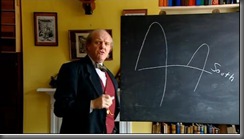
001 One of the oldest scientific instruments known to man is Stonehenge, a millennia-old collection of rocks assembled to mark the summer solstice – the longest day of the year. The builders of Stonehenge knew that the length of the day, as measured by the arc described by the sun on its path across the sky, was a function of the season. In winter, the sun would describe a short arc, not rising too high above the horizon (right-hand arc in figure); in summer, however, the arc was much larger, resulting in a longer trajectory, and hence the longer day (left-hand arc in figure). They therefore oriented their monument in the direction of the midsummer sunrise, and that would then act as a natural marker of time and season.

We know almost nothing about the people who built Stonehenge. We know nothing about why they built the monument; we know nothing of their beliefs. So the Druids who assemble each year at Stonehenge to indulge their rituals and mystical mumbo jumbo are enacting a modern fantasy. But we know far more about another ancient culture, and we might profit from an investigation into their astronomical achievements.

002 Ancient Egypt. The adulation and adoration for Stonehenge is nothing compared to the fascination New Age religionists have for the Pyramids. When in the 19th century, European archaeologists rediscovered the civilization of this ancient land, the imagination of the Victorians ran riot. Who could have built these vast monuments, and who could have designed them in this strange way? Fortunately, unlike the builders of Stonehenge, the builders of the Great Pyramids left written records. So we know that the people who designed these structures were priests, and we know that the gods they worshipped inhabited the skies. And we know that the most important of these Gods was Ra.

At the beginning of time there was boundless chaos and out of this chaos came Ra, not begotten of any father, not conceived of any mother. Of his own volition, he gave himself a body and entered into active existence. The demiurge, the supreme being, the quintessence of all the forces and elements of nature! Praise to thee, oh Ra, exalted power and lord of the hidden circles!
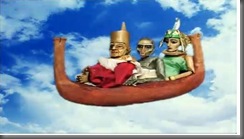
009 royal barge Remarkably, the doings of Ra perform the same function as those of the stones of Stonehenge, for like the stones, these myths refer to important astronomical events. To see how, we must decipher one of the most important of Egyptian myths, that of Ra and the beautiful goddess Nut. It is said that at the beginning of time, Ra took hold of his phallus in his hand and ejaculated the gods Tefnut and Shu, and from them came the star-spangled goddess Nut, whose beautiful naked body straddled the sky. We are told that at the dawn of each day, Nut gives birth to Ra from her blood red birth canal; across the day, Ra sails on his royal barge over Nut’s back, accompanied by Thoth and Ma’at, of whom more later. At night Nut, whom the Egyptians call ‘the sow that eats her own piglets’, swallows Ra, and the cycle of the day is complete.003 ra from nut
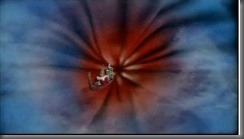
So what does this have to astronomy? Well, Ra is the Sun God, and his journey across Nut’s back is the path taken by the sun across the sky. The Sun represented light and dark, hot and cold, life and death, and defined the cardinal points of the compass – North, South, East, West. And when it came up in the morning, the deep dark was banished, and light was cast over the land of Egypt.

We should not be surprised that so many ancient peoples worshipped the Sun. Its appearance every morning represented the victory of day over night, life over death, good over evil. But why did the Ancient Egyptians believe that the Sun was swallowed by a giant woman who later gave birth to him? The story of Ra and Nut is not just a description of the daily journey of the Sun – it is also a clever way of representing the position of the Sun in the sky at different times of the year.

004 nut milky way For the Egyptians, Nut represented the Milky Way. Strangely enough, this hazy spread of stars does appear to bear the shape of a woman arching her back over the horizon (see picture, left). Next, the Egyptian astronomers realised that at the spring equinox the Sun rode to a point corresponding to Nut’s mouth, and moved over the next nine months through her body to be born, nine months after the equinox, at a point corresponding to her birth canal (see picture, right). For the Egyptians, this period of nine months was self-evidently the period of gestation of a human being; added to that fact was their belief that a woman conceives through her mouth, and suddenly the myth of Ra and Nut makes a lot more sense.005 sun thru milky way

The myth of Ra and Nut, then, helped the Egyptians mark two points in their year: the vernal equinox and the mid-winter solstice. But decoding the myth raises further questions: why did they want to mark these points of the year? And why did they worship the objects in the sky as Gods?

Historians are loath to accept any astronomical significance to ancient monuments (New Age nonsense, they scoff), but Allan Chapman believes that it is difficult to understand the purpose of such edifices as the Great Pyramids without recourse to astronomy. The steps leading to the tomb of Cheops in the greatest of the pyramids rises at a particular angle, and while it’s true that this angle has little significance today, we must remember (as historians often tend to forget) that the positions of the stars in the heavens are not fixed for all eternity. They have, in fact, moved in the 4500 years since the construction of the Pyramids. It is possible to calculate what the steps would have pointed towards at the time of the construction – they pointed at a very significant part of the night sky, which the astronomer priests of Egypt associated with Heaven.

They had observed that there was a small group of stars that did not rise, travel across the sky, and set as the other stars did. The Northern circumpolar stars were always visible. These are the stars we call the Great Bear. The Egyptians called them Ikhemusek – the Ones Not Knowing Destruction.

With the Ancient Egyptians we see for the first time the idea of a Heaven in the skies, and this heaven was populated by a bizarre collection of gods and goddesses that they associated with the stars and planets. When they looked at the planet Mercury, the Egyptians imagined the god Seth, the evil god of chaos and destruction. When they observed the planet Venus, they thought of Isis, the lovely goddess of fertility. And when they looked upon red Mars, they imagined they were charting the progress of angry Horus, the falcon-headed son of Isis. 

If we visit the tombs of the ancient Egyptians we see that they are covered with strange incantations to the great Gods, with symbols for the moon and stars and the planets. But why should the priests of the land have been so fixated with astronomical bodies? To understand, we need to acquaint ourselves with the daily rhythms of life in Egypt, lives that were so intimately connected to the mighty river Nile.

Egypt was one of the world’s first agricultural civilisations, and its fortunes, thus, were related to those of the immensely long river that flowed through it. Farming requires planning: you need to know when to sow, when to reap, and you need to know when the river will burst its banks and cover the plain with fertile mud. For all this, you need a concept of time.

To make use of the Nile’s life-giving properties in the dreary desert of Egypt, it was vital for the farmers to know when the river was about to flood. For them, an ability to measure time was literally a matter of life and death, and it was to the gods in the sky that they turned to for help. The use of astronomy in the all-important prediction of the annual inundation of the Nile can be seen in that myth of drunkenness and murder involving the seductive goddess Hathor. Hathor, also known as the star-spangled heavenly cow, was a seductive courtesan and dancer, and also, herself, a lover of the great Ra. We are told of a time when the divine Ra had grown old and dribbled at the mouth, and was mocked by mortal men and women. He summoned the other gods and goddesses to his great house, and spoke to them of the evil words used against him. It was decided that the Eye of Ra should go forth on Hathor and destroy all those who had spoken ill of him. Hathor rampaged throughout Egypt, putting the insolent mortals to the sword. The savage massacre continued until there were hardly any humans left. But Ra realised that Hathor had to be stopped in order to preserve humanity. So he made seven thousand pots of beer and poured them into the Nile. The river rose, flooding the land around, and Hathor noticed her lovely reflection in the rising waters and knelt before the Nile to drink. She drank and drank, until the river subsided, and by the time she had drunk all the seven thousand pots of beer, she was in no condition to kill any more.

The Ancient Egyptians connoted the Sun with Ra, who grows feeble as the summer comes to an end. Hathor they associated with what they called the Dog Star, or Sirius, the brightest star in the sky. Sometime in 3500 BC, it was observed that there was a time of the year when Sirius rose just before the Sun at dawn. This event, it was further noted, presaged the annual flooding of the Nile. By charting the progress of the divine gods, the Egyptians realised they could predict momentous events on Earth, such as the passing of the seasons and the floods of their life-giving river. The acts of the gods had direct consequences on their lives, and that is why it was necessary to worship these gods.

But Ra and Hathor only told the time two or three times a year. The Egyptians needed to tell time at greater frequency than this, and they turned to the wisest of the gods for assistance. Thoth, who accompanied Ra in his royal barge across the day, was the god of wisdom and time. He was depicted with an ibis-head crowned by the rising moon, and this is no accident. The moon, realised the priests of Egypt, was an uncannily regular timekeeper. Over its period of 28 days, it waxed and waned, and its phases had bearings on events on Earth – the tides, for example, or the menstrual cycle of women. And as far as we know, the Egyptians were the first people to divide the year into months, and this was such an important innovation that the moon-god, Thoth, became one of their most revered divinities. And although Ra the Sun was the creator, Thoth the Moon was the controller of the Universe.

But there is a problem. The sun governs the year, the moon controls the month, but there is no satisfyingly regular relation between the length of the month and that of the year. The Egyptians had other difficulties: they didn’t know exactly how long a year was, or when it began and ended. The most important myths of these people, therefore, dealt with their efforts to mark out astronomical time.

Initially, for instance, the astronomer priests believed that the solar year was 360 days long (which, indeed, is the origin of our 360-degree circle). But this  error meant that their seasons began to gradually slip out of line, forcing them to adjust their calendars every few years. Finally, they realised that they needed to increase their reckoning of the year by five days, and this realisation manifested itself in yet another myth of revenge and jealousy.

We are told that the beauteous goddess of the Milky Way, Nut, fell in love with her brother, the Earth god Geb, whom the Egyptians depicted as a bird. But when Nut began to make love to Geb, who should appear but her husband, the great god Ra? Trembling with jealous rage, Ra put a curse on his cheating wife: she would be unable to bear children on any day of the year. The clever Nut realised she could get around this curse by extending the number of days in the year, and to achieve this, she seduced Thoth. After having his wicked way with her, Thoth agreed to help, and oddly enough, began a game of draughts with the goddess Isis, wife of Osiris, whose death marked the shortest day of the year. To the Egyptians, draughts charted the movements of the stars and were much used in astrology; indeed, Thoth himself is said to have invented the board. Unsurprisingly, Thoth was able to defeat Isis and claimed the extra five days as his prize, which Nut then used to give birth to five children; and so it was that the ancient Egyptians became the first people to use a 365-day calendar.

Why did the Egyptians require precision to within a day? Farmers only need accuracy up to the seasons, but the civilisation they wrought had need for far finer details in time. The priests were not just astronomers and religious figures; they were also administrators who needed to organise the business of state. They needed to calculate taxes and pay workers; they needed to agree contracts and arrange building work. These people needed to know what day it was. Such was the sophistication of this culture that they needed to measure time in units smaller than a day! Again the Egyptians found the metronome for such time in the heavens, and again they depicted its discovery in their sagas.

Once again, we have a story of Ra and Nut. Every night when Ra was swallowed by Nut, he was transformed into Osiris, the ram-headed god of the dead. As Osiris, he was forced to sail down the Tuapt, the dangerous river that flows through Nut, passing through twelve gates where the powers of evil congregated to thwart him in his progress. Osiris had to defeat living mummies and the terrifying snake demon with twelve human heads on its back, until in the morning he re-emerged as Ra from the birth canal of Nut.
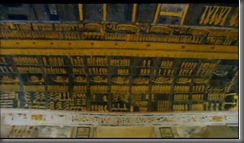
006 nut rameses VI The story of the twelve gates played an important part in Egyptian mythology, as can be seen, for example, in the superb burial chamber of Rameses VI in the Valley of the Kings. A fresco on the ceiling shows the entire legend in spectacular detail: the golden naked body of Nut in a double line across the sky, one side of her representing day, the other night. We see the evening sun entering her mouth and winding its way through her body. The twelve gates through which Osiris must pass are marked by twelve solar discs. At the end of the journey, we see him emerge again as Ra, triumphant in the dawn.

007 zodiac So what is the astronomical significance of these twelve gates? Well, each gate was a star, used by the priesthood to mark time. If they looked at the eastern sky at any period of time, they would see different stars rising and setting, each one following the other and making a great arc across the sky. At first, the Egyptians divided their sky into 18 divisions of the night, each one marked by a star, but they found that at dusk and dawn they lost several of these stars to the twilight. So they ended up using twelve bright stars, which divided the sky into twelve equal sections of darkness; by seein which star was rising, they could tell which gate Osiris was encountering at that point in time, and how many more he had to pass through before being reborn in the glory of the dawn sky. 

The priests didn’t stop measuring time at dawn; instead, they developed water clock to continue the division of the daytime into twelfths. Thus they became known as the Overseers of the Hours. And here we have the origin of our 24-hour day: twelve-hour night and twelve-hour day. For the Egyptians, the hours were a wondrous thing.

The conquest of time is one of the cornerstones of our civilization, for it allows us to reckon our seasons, grow our food, and order our lives. Astronomical timekeeping in Egypt, then, was not incidental to daily life. It was vital.

But we must remember that to the Egyptians the gods were not mere artefacts of astronomy. They were powerful beings that imposed morality and ethics, whose actions had direct consequences on their daily lives. One of the most bizarre of the myths recounts the battle between Order and Chaos, something that was of supreme relevance to the Egyptians’ existence and prosperity, and their fear that Chaos was an ever-present and lurking danger.

Chaos, the Egyptians knew, was a constant threat. There was natural chaos: disease, famine. There was social chaos: criminals, wars and invasions. Bad monarchs meant that there was no justice in the land. Chaos was personified by Seth, the god of destruction and disorder. We are told that Osiris was killed by Seth who hacked his body and scattered the pieces throughout Egypt. Isis, his wife, was distraught because his death meant that she would have no son to inherit Osiris’s kingdom, which would then fall to Seth. So she went in search of the pieces of her husband so that she might conceive from his reconstructed body. Unfortunately, Seth had thrown Osiris’s phallus into the Nile where it had been eaten by a fish. Nevertheless, Isis was able to construct another phallus from the parts of Osiris’s body she found, and with that was able to conceive a new Sun God, Horus. Horus tried to reconcile the warring gods and Seth invited him to his house. When Seth saw Horus, he became aroused and tried to violate the falcon-headed god. He failed in his attempt, but accidentally ejaculated into the hand of Horus. Horus ran to his mother to complain of his violation; outraged, Isis grabbed a sword and hacked off her son’s polluted hand and threw it into the Nile. She constructed a new hand for Horus and excited him sexually and collected his seed in a pot and secretly went to the house of Seth where she discovered some cabbages and poured the seed onto them. Ignorant Seth ate the cabbages and became pregnant with the child of Horus. Now Thoth, as governor of the living sky gods, entered the story. He summoned Seth and Horus to him to attempt to reconcile the two. He ordered that the child growing within Seth should come forth, and come forth he did, a new planetary disk, child of light and dark. Before Seth could claim suzerainty over the disc, Thoth wrestled it away from him, and triumphantly placed it on his own head.
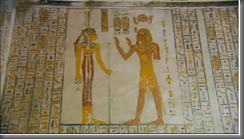
008This is a story of the battle between good and evil, and light and dark, and order and chaos, in which good only wins because of the intervention of Thoth, the moon god. Egyptians described the moon poetically as the child of light and dark, it dispels the dark night with light, and as the primary clock in the sky, imposes order on chaos. Thoth himself as governor of the gods imposed logical order upon stellar and planetary movements, and thus became the Egyptian god of logic and numbers and reckoning as well as language. He was held in special reverence, and they called him the Prince of Books and the Lord of Truth.

Astronomy was religion for the Egyptians because of the deep connection that they saw between events in the heavens and the consequences on Earth. They wished to bring the order and reason and truth they saw in the heavens down to earth and make it a living moral force in their own lives. Indeed, they had a goddess whose special task this was. She was the goddess Ma’at, the third traveller in Ra’s royal barge across the sky. Ma’at was a goddess of paramount importance to the Egyptians. When a king ruled in Ma’at’s name, there was peace and prosperity and order in the land. The Pharaohs had to earn the blessing of Ma’at by governing with the same logic and law on earth that they could see manifest in the heavens.

Today we have driven a wedge between religion and science. Religion is about good and evil, whereas Science is about cold facts and truths. But the astronomer priests of antiquity perhaps recognised better than us that the ability to understand the patterns of nature, and to use this knowledge for our own ends is what protects us from Chaos. This kind of knowledge is not neutral. It is a force for good. 

[From Allan Chapman’s series on Channel 4 – Gods in the Sky]