JOST A MON

The idle ramblings of a Jack of some trades, Master of none

In August this year, Seoul will host the latest International Congress of Mathematicians. It's that quadrennial time when gossips begin to natter about Fields Medallists. A lot of people are talking up Manjul Bhargava. It is his last chance to win - by the time the next ICM comes around he will be older than 40. I'm hoping at least one woman will be awarded the prize this time.

In the run-up to the last ICM (in Hyderabad), I'd blogged about potential candidates for that year. None of them won. I hope to profile a few new names ahead of this year's ICM.

One that has popped up (new to me, at least) is Laure Saint-Raymond. Here is a loose translation of an interview that appeared a few days ago in Le Journal: "Laure Saint-Raymond, la boss des maths", by Louise Mussat (April 28, 2014).
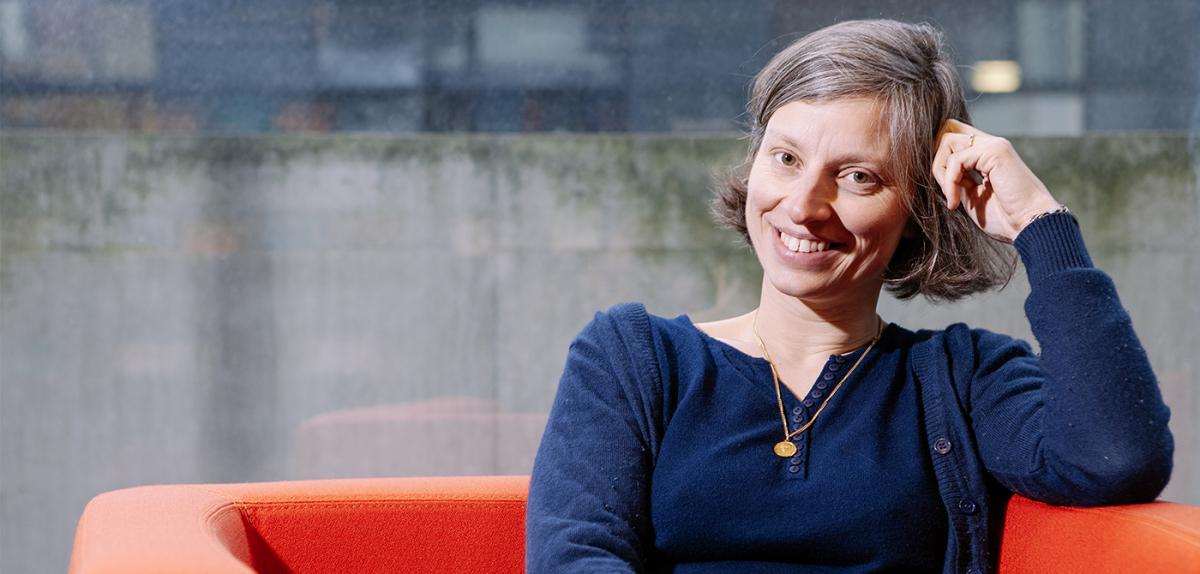

Elected to the Academy of Sciences in December 2013, this top-flight researcher will participate at the International Congress of Mathematicians in Seoul in August.

The blackboard that stretches across one of the walls of her office at the École normale supérieure (ENS) is whitened by clouds of intertwined mysterious symbols. These are equations, and they are unsurprising - Laure Saint-Raymond is a mathematician, a pearl in
her field of partial differential equations applied to problems of physics. A winner of the European Mathematical Society's Prize in 2008 and of the Joliot-Curie "Young Woman Scientist" award in 2011, she was elected to the Academy of Sciences when she was 38 years old, the youngest ever. And in August she will present a lecture in Seoul at the ICM, an unmissable event that attracts thousands of mathematicians every four years, during which the famous Fields medals are awarded.

Stratospheric Research

What does the daily life of a top mathematician look like? Wracking one's brains before a sheet of blank paper before scribbling equations on a blackboard? "Not exactly!" says this energetic researcher, smiling. "I spend a lot of time teaching, attending seminars, trawling the literature to help me keep abreast of what is happening, and communicating the results of my own research. But thinking in front of a blackboard is part of my work, and most of the time it's with my team. It's the creative phase, a mutual game during which we sometimes find nothing or sometimes not what we were looking for!"

What Laure Saint-Raymond seeks with her collaborators is to capture physical phenomena with mathematics. "My training in physics helps me to better understand the language of physicists and exchange ideas and develop an intuition for the phenomena we are trying to describe," she says. That was the year she graduated with a degree in applied mathematics from the University of Paris VI, the same year she obtained her degree in plasma physics.

All these strings to her bow have enabled her to tackle a tricky problem, first posed in 1900 and still unresolved: how does one effect a transition from a physical model to another, less complex and less precise? The scientist explains, "When we are in the presence of a rarefied gas, for example in the Earth's upper atmosphere, and we want to simulate the re-entry of a spacecraft, we use the so-called kinetic theory in which the state of the gas is characterised by a function of several variables, such as time as well as the positions of the atoms." Meanwhile, to describe the behaviour of gases around us, infinitely denser in atoms, it suffices to use a model wherein all the atoms are considered as a single continuous medium.

"What interests me is to understand how one moves from one to the other of these models: is there a smooth transition or, on the contrary, is there a discontinuity between the two descriptions which renders them both invalid in the intermediate regime?" says Laure Saint-Raymond.

Fundamental and stratospheric, this mathematics nevertheless has some physical applications: they allow us to understand better the entanglement phenomena at diferent scales of time and space, and to better account for the observed air flow around an aircraft, for example, or the formation of persistent whirlpools in the ocean.

From the Cello to the Sciences

Laure Saint-Raymond readily admits: as a child or a teenager, she had no particular attraction for mathematics. Her main thing was the cello. Then in high school, equations finally overcame the scales. "I had a facility with maths and physics, and my parents, both maths teachers, undoubtedly influenced my change in direction."

As a newly-minted bachelor in mathematics, she found the arms of the engineering industry extending towards her. However, she chose research, it being "intellectually more stimulating". In 1994, she joined the ENS where she began work on her thesis under the supervision of François Golse on the "kinetic theory of gases". To be clear: on mathematics applied to the movements of gases. Recruited by the CNRS in 2000, she spent two years as a Research Fellow before being appointed as a professor at the University of Paris VI. In 2007, she obtained a secondment at the ENS where she was made director of the department of Analysis. Currently, she is the deputy director of the Department of Mathematics and its Applications.

An exceptional journey

Her exceptional and rapid-as-lighting journey demands respect as it has happened in a largely male-dominated universe. "That is irrelevant," she counters. "My being a woman has never been a handicap, I have never been a victim of discrimination. And to do research today, it is no easier for a boy than for a girl, it's difficult for both: young people don't obtain a job till after several years of post-doctoral work, which, in some disciplines, means they have to wait till nearly 35 years of age before they are in a stable situation and able to start a family..."

Still, says Laure Saint-Raymond, her eyes shining and with enthusiasm in her voice, the game is worth the effort. "I will no doubt make a lot more money in the industry, but one's work cannot be reduced to a mere salary. Not one of my days as a teacher-researcher is like any other, and at the ENS, I have the immense freedom to conduct research that I want to do, and I enjoy myself thoroughly. This is priceless."

When she is not playing with partial differential equations, or not coaching one of her students, or not tutoring one of her six children (five boys and one girl, aged between 4 and 14 years!), Laure Saint-Raymond escapes to the mountains. Skiing in the winter or hiking in the summer, whichever, the key is to be outdoors all the time. "I really need to recharge my batteries, to disconnect completely from work, to return to the office with new ideas," she admits, and returns to whitening her blackboard again.

Aug 23, 2010

Sindhis Again?

Looks like our good people of Sindh are suddenly in the news again - this time with their astute mathematical skills in the problems of optimal transport! Here's an excerpt from a recent post by Tim Gowers who was attending the International Congress of Mathematicians at Hyderabad (note: not the one in Sindh):

I’m not going to try to explain Villani’s work beyond this. Let me just mention a few random things from what Yau said, and some even more random thoughts that I had during the talk. One of the latter was that amongst the other mathematicians Yau mentioned were Cergignani, who conjectured that the decay to global equilibrium of, I think, solutions to the Boltzmann equation is exponentially fast, Toscani, who proved with Villani that this conjecture is almost always (in a certain precise sense)correct (which was interesting as there are counterexamples due to Bobylev and Cergignani himself), and Gualdani, whose role in the story I did not write down and have forgotten. Could there be a pattern here?
Okay, just kidding. It's a slow evening.

Aug 19, 2010

Fields Medals 2010

Now that the four latest Fields medallists have been announced, the popular bit of the International Congress of Mathematicians is over and the technical bits begin. Desis and women have to wait a bit longer for their first Fields awardee, but the Vietnamese must be over the moon. Ngô Bảo Châu has won, while the usual Russian and French contingent has been satisfied by Stanislav Smirnov and Cédric Villani respectively. Rounding up the quartet is Elon Lindenstrauss from Israel.

The announcer of these prizes, whose name I didn't catch, quipped weakly that Villani was a real French (as opposed to Châu who works in France), and that you could tell from his last name that Smirnov is Russian (albeit based in Switzerland).

Once again the
Langlands program comes up trumps in Ngô Bảo Châu's work; Smirnov's contributions are in mathematical physics and analysis; Lindenstrauss has applied ergodic theory to classical number theory; and Villani's work is in mass transport (which, contrary to what you might imagine, has little to do with either the London Underground or imprisonment in the Andamans), an active field contributing to plasma physics.

Congratulations to all of them.

Aug 3, 2010

Fielders To Watch?

To be invited to speak at the International Congress of Mathematicians is a great honour, and to be forty years of age or younger is doubly impressive, for it means that you might be very well in with a chance to win the Fields Medal. I thought I might scan through the list of speakers at the ICM 2010 site and see who the young guns are. In particular, I thought I'd focus on the women.

Now, at the absolute top rank of mathematics, there have been historically very few women. Think about this: between the first ICM and the first address by a woman, almost 30 years passed. Then another 60-odd years went by until Karen Uhlenbeck spoke at ICM 1990.

Fortunately, though, this is all changing. And so it is heartening indeed to see women's names pop up in this list. Even more wondrously, these young scientists are not restricted to the traditional powerhouses of mathematics - Russia, France, USA. You'll find Iranians and Spaniards and Taiwanese as well.

So here goes.

Maryam Mirzakhani: this mathematician from Iran, now based in the USA, is doubly honoured - she addresses a session in Topology as well as Dynamical Systems. Like several previous winners of the Fields Medal, she was very successful in her youth at the International Mathematics Olympiad. More recently, she was awarded the Blumenthal Award (2009), which is awarded quadrennially, and is for the best PhD thesis published in preceding four years. Her work - among others - is in the geometric structures and their deformations in all sorts of spaces, and she brings in an interdisciplinary approach to solving problems in the field, by using insights from combinatorics and mathematical physics.

Irit Dinur: is a theoretical computer scientist from Israel, where she has been working on problems in proof theory - how to establish formally that a proof is correct? In particular, by making random inspections of a formally written-out proof, is it possible to verify it? This is a deep problem in theoretical computer science, with a fundamental result (that it is, indeed, possible) established in 1992. She was able to establish a much simpler and radically new proof of this theorem in 2005, which has resulted in fresh pastures for investigation. As we know, it's not enough to solve a problem - what's better is to do so in such a way that a whole new domain of research opens up, with exciting new possibilities. Dinur has done this with aplomb. And so there's some gossip that she might win the Rolf Nevanlinna Prize (which is also awarded quadrennially at an ICM) for the applications of mathematics in the information sciences.

Sophie Morel: is from France, and her PhD thesis was an important development in the Langlands Program, solving a problem that had remained open for over twenty years. (You may recall that Laurent Lafforgue won the Fields Medal in 2002 for his contributions in this area.) This is cutting-edge work at the intersection of number theory and algebraic geometry. She was made a full professor of mathematics at Harvard last year, a notably rare and distinguished achievement made especially so when you realise that she's the first woman to be tenured in mathematics at that university! To boot, she is a skilled polyglot, conversant in French, English, Russian, German, Spanish, and now learning Korean.

Chiu-Chu Liu: is a mathematical physicist from Taiwan. She, again, is a multidisciplinarian, combining techniques from topology, differential geometry, and algebraic geometry to answer open problems in theoretical physics. In particular, her work in establishing the Marino-Vafa conjecture has been well-recognised. This has deep ramifications in string theory.

Anna Erschler: is a Russian mathematician based in France. Along with Mirzakhani, she too has two addresses at the ICM (Probability and Geometry). Her work is at the conjunction of probability and group theory.

Isabel Fernández: is a Spanish professor of mathematics at the University of Seville, and has received much attention in her native country for being the first ever Spanish woman to be invited to an ICM. Her work has been termed, loosely, soap-bubble geometry, because she investigates the geometric properties of curved objects. It is at once a classical field in mathematics, but equally cutting-edge, combining results from differential equations, complex analysis and variational calculus. Interestingly, her work has found immediate practical application in architecture, notably at the Olympic stadium in Munich, where surfaces she studied have been found to be light-weight, use little by way of materials, and are notably resilient. And, having solved one of the open major problems in the field - minimal surfaces in homogeneous spaces - the invitation to the ICM celebrates her achievement (to be sure, with her colleague Paul Mira).

Catharina Stroppel: is a German mathematician, winner of the 2007 Whitehead prize for her work in representation theory and its applications to low-dimensional topology.

Marianna Csörnyei: is Hungarian, another Whitehead prizewinner (2002), and works in geometric measure theory. "Central to her work is the analysis of viable definitions of ‘negligible’ in the context of infinite-dimensional situations, with a view to applications in non-linear geometric functional analysis. Technically difficult, the judges described her work as characterised by the ‘startling nature of many of her results’. A particularly ‘spectacular achievement’ highlighted was her proof that the three main notions of ‘negligibility’ coincide, and her revelation of delicate phenomena in the theory of Lipschitz quotients even in the finite dimensional case." (from here)

Nalini Anantharaman: is French; her work is in mathematical physics, and she attempts to answer questions about the phenomenon of dispersion: "A wave propagates in a closed cavity. It will bounce off the walls. I'm trying to understand how it will dissolve: will it remain compartmentalized, contained in a portion of the cavity or will it be dispersed throughout the cavity?" (from here) One of her major contributions is in quantum chaos, where she established some results supporting the Quantum Unique Ergodicity Conjecture.

Katrin Wendland: is German; her work is in mathematical physics, particularly in the nature of particles. Notably, she "constructed a large class of examples of mirror symmetry using orbifold methods and Kummer K3 surfaces" (from here) Her research also unfolds deep connections between non-commutative geometry and algebraic geometry, and she has many contributions in topological quantum field theories.

Dorit Aharonov: is an Israeli computer scientist. In 2005, she was profiled in Nature. One of her major achievements was to show that even in the presence of interfering noise, a quantum computer could still achieve reliable results. Because quantum computers require considerable isolation from their surroundings (the 'quantum processors' should not interact with their surroundings, or the resultant errors will rapidly degrade the computation), it was thought that these would remain theoretical curiosities. Her work in quantum error correction went a long way in establishing the domain as technologically viable. In addition, she has worked in the quantum scale problem - why do quantum effects manifest only at subatomic levels but appear to vanish at human scales? "Aharonov showed that for many noisy quantum systems, there is a level of noise above which a transition to classical behaviour is inevitable. Such transitions are much sharper than expected from other theories that predict a gradual shift away from quantum behaviour."

Hopefully, at least one of them wins the medal.

The third meeting

Venue – Independent University of Moscow. November 2002.

There were three of us in the meeting with Laurent Lafforgue, with the interpreter Darya Sisoeva helping out.

OO: Monsieur Lafforgue, you are well-known as a patriot of French culture and language. You know several languages, including Russian, and have always defended the right of mathematicians to communicate in scientific circles in their native tongues. This position – is it the result of reflection, or a fruit of family upbringing?

LL: Since childhood, books have been the most important part of my life. From early on, I began to read not only French but also Russian literature. In fact, till I was about twenty years old, my main occupation was literature. I was also interested in history, which kindled in me an interest in other cultures. I didn’t plan on taking up mathematics as a career. I had a very good education, and I had a wide ranges of choices on what to do next. But I’m Parisian, and I wanted to remain in Paris, and so at the age of 19, I joined the École Normale Supérieure– the best school for mathematics and physics, completely unaware of my future career as a researcher. Only in the second year did I realise that I was attracted so much to mathematics. I began to read the works of Grothendieck – he is a French mathematician, and founder of algebraic geometry. That’s when I began my interest in algebraic geometry, because I found in it the sort of beauty that had always appealed to me in literature. I have always thought that in mathematics there’s a deep link to literature, just as with history. After all, mathematics is a collective endeavour. And if I count for something in mathematics, then surely I count for something in the historical process as well.

OO: Is there anyone you would like to share your success with?

LL: Certainly. There are people who supported me in my most difficult moments. In addition, having spent six years at University and in graduate school, when I was unable to write my thesis, I was admitted into a research group with some fellow investigators. Still, for two years I had no serious results to show. I was getting paid, but I just couldn’t complete my dissertation. This wasn’t the best time of my life. But the head of my group, Luc Illusie, not only believed in me but also took charge of my situation, and offered to change my supervisor. Now I understand that I just wasn’t interested in working on old themes. If you don’t like what you are doing, you can’t come up with any beauty in your work. Thus I got a new supervisor, Gerard Laumon,  who then took charge of my fate.

He gave me a new topic, and things improved – I began to get good results. My supervisor, despite being a famous mathematician, took a lot of interest in me, uncaring of his own time. I owe him personally no less than I do professionally.  And the next topic, the one for which I won the prize, was one he founded. But even here, things were not simple. I worked on the subject for six years, and as my research concluded and I began to present expository lectures on my work, I realised that I had somewhere along the line committed an error.

This was a deeply tragic moment in my work, because the error cast doubt on my entire research. I have to say that at that time not only my supervisor, but also all my colleagues at University understood the gravity of the situation that I found myself in, and all of them supported me. All of them.

OO: Are you from an academic family?

LL: My grandparents were uneducated, and my parents are physicists. I have two younger brothers, both of whom are mathematicians. One is a researcher, and the other a teacher.

OO: In earlier times, during the USSR, there were widely distributed scientific family dynasties. Following a career in science didn’t bring much by way of material gain, but much honour and respect. But in the last fifteen years, the situation has changed dramatically. How does a mathematician feel about himself in France? Is there a problem of ‘brain drain’ in your country?

LL: French scientists receive good money, albeit less than in the US, but overall they do lead good lives. Importantly, in France we have very strong mathematical schools and many famous universities. There isn’t much of a brain drain because the majority of French mathematicians want to work in their own country. Nor is there much unemployment because there are lots of places open to researchers. So we have not only Russian mathematicians visiting us, but also Americans. They are happy to lose monetarily because they are attracted by the high scientific level.

Undoubtedly, France has not been unaffected by the changes that have occurred throughout the world: the undervaluing of intellectual capability. Our youth prefers to entertain itself. They prefer sport or show-business, anything other than science. And that’s a pity. Young people do not want to occupy themselves with anything intellectual because there are no guarantees of any material fortune. But I have always sought beauty. In the beginning, in literature and poetry, then in history. I realised very late that in mathematics too there is an equal beauty. If you work in the fields of scientific discovery, this is always interesting. I felt this most keenly in the university when all around me were so many bright people, all of whom were inventing, discovering something new.

OO: In Russia, we have a joke: “An American university is where Russian instructors teach mathematics to Chinese students.” Don’t you think that in coming years, Russia might stop supplying mathematical brainpower, and the arena will be left open to that other scientific superpower, namely China?

LL: Of course, having been in Beijing, I am able to assess the level of state support for science. But I think such pessimistic forecasts are premature. In Russia, despite the poor funding for science, mathematics cannot really die out – after all, for seventy years, the Russian school has been the strongest. And other countries, too, won’t let Russian mathematics die out. For example, the Independent Mathematical Institute where we are now has been financed by the US.

OO: Our interview with Vladimir Voevodsky ended with his apocalyptic predictions about the future of mathematics in general as a fundamental science. In this regard, are you an optimist or a pessimist?

LL: As you prefer… Voevodsky is a representative of the American mathematical scholarship. That is a completely different world; true, they are paid a lot, but intellect in the US has never been particularly valued. My prognosis is more optimistic. Science with such a long history cannot die, and people will continue their researches. On my own part, I have two themes that will over the next thirty years interest a lot of people.

OO: Are you ready to return to this debate in thirty years?

LL: If we live that long.

[I translated loosely from Olga Orlova's piece on Polit.Ru. It appears that in 2002, when she first wrote it up to link with the International Congress of Mathematicians at Beijing, the journal that had commissioned it, 'New Model', went out of business without publishing it. She and her editors decided that the content was still relevant in 2006, when the Perelman story was appearing in the world's press in the run-up to the ICM in Madrid. The previous parts are here and here.]

The second meeting

Venue – A Moscow Kitchen. October 2002.

Vladimir Voevodsky came to the interview not alone, announcing from the entrance that his prize should be shared with three people, of whom he couldn’t bring along the first and the third, but he had managed to snare the second.

VV: Let me introduce you: this is Yuri Shabat, Professor at the Moscow State University. If I make a mistake in something, he’ll correct me.

OO: And who is the first person?

VV: Well, actually even before him were the dinosaurs. When I was really little, I loved dinosaurs. And then books on chemistry began to fall into my hands; my mum brought them, she was a chemist. From theory I soon moved onto practice, and there were explosions in the bathroom, after which there were experiments with electricity, and then, going backwards, theoretical physics, which my father, a physicist, introduced me to. When I was seriously ill with pneumonia, my father’s friend Oleg Sheremetyev brought me a Rubik’s cube to distract me. There were no published solutions to the puzzle at the time, and I killed two days to crack it on my own. And then Oleg and I went on to solve more complicated mathematical puzzles. Oleg used to spend much time those days teaching mathematics to kids at the Pioneers Palace. He was the first to show me that mathematics could be interesting of itself, in a very pure sense.

OO: Volodya, you finished high school but you do not have a degree. Does that mean, by Russian standards, that you are under-educated?

VV: I was rusticated from Moscow University for academic failure. I was already interested in algebraic geometry, but attending classes seemed like such a waste of time. I took a break from academics, and began an apprenticeship at a vocational school where kids were being taught programming. One day, I found some scrap paper on a table with formulae scribbled over it – and immediately realised that there was someone around who thought just like me. I was overjoyed and went in search of the owner of that paper. And that’s how I found Yura Shabat. He didn’t deny it. “Yes,” he said, “These are my papers. So what?” Well, I said, I have also been thinking along those lines. It was very important to me that I had found him.

YS: Yes, and after that, we worked for a long time together.

OO: So what attracted you to algebraic geometry?

VV: Purely subjective factors, I have to say. At the time, algebraic geometry was being done by interesting people, such as Shafarevich.

OO: And how did the move to America come about?

VV: Even after returning to academics, I still wouldn’t attend classes. In 1989, then, obviously, everything collapsed, and such formalities as degrees seemed quite useless. After Yura Shabat, I began to work with Misha Kapranov, and we published several papers. Then he went off to graduate school in the States, talked about our work, and thanks to him, I became a graduate student at Harvard.

OO: Your relationship with America, it appears, was not entirely idyllic?

VV: To be honest, America impressed me at once. On the very first day I arrived at Harvard, I was handed keys to an apartment, to an office, and a cheque for a thousand dollars. And I was a mere graduate student! At the time, there were many Russian mathematicians on the faculty. Dmitri Kazhdan was Dean. I need to share my prize with him as well.  He and his colleagues supported me at a period when I could no longer live in Russia, and I was still new to America. I remember, during my first Christmas in Boston, I got drunk and wandered into a black ghetto. There I was robbed, beaten and hurled into the snow. This, of course, added to my discomfort; but I was deeply anguished, missing Moscow, and thinking how much I hated their Christmas. I wanted my New Year [My note: Russians celebrate New Year rather than Christmas], with a fir tree and my mum and presents. I went to Professor Joseph Bernstein, and said to him – I can’t stay here. He answered me in one sentence, “Well, if it’s so bad for you here, then go home.” I am eternally grateful to him for this. I went to Moscow for four months, and he covered up for me, saved my fellowship and stipend. Then I returned and lived for a few months in my office, writing up my dissertation quickly. When I went in the mornings to brush my teeth in my sweat-pants, students would be coming into the department and looking askance at me. But Dean Kazhdan gave me the possibility to complete my work in peace. So I got my doctorate, but without any college degree either from Russia or America.

OO: Was such an option open to you in Russia?

VV: Formally, it wasn’t prohibited, but it is clear that the entire procedure would have been much harder, and taken much longer. There have been earlier precedents, but in my opinion, perhaps more often in the pre-war days than today.

OO: Setting aside material comforts, what distinguishes a scientist’s life in Russia from that in America?

VV: Everything. It’s a different professional environment. In my own field, there are ten times as many people working in America. There is the corresponding level of competition. In Russia there is no direct relationship between a scientist’s academic success and financial situation. If a person is comes up with an extraordinary idea, then everybody says, ‘Praise God, we are happy,’ but his salary is not going to go up from tomorrow. In America, it is likely to increase; but if you prove something interesting with your colleagues, at once the question arises – who did what first? Because the prizes have to be divided. In Russia, when people think up the same idea simultaneously, it is rather nice. There’s a professional collegiality. But in the US, this would decrease the material consequences of a scientific achievement. Although I have to say that in mathematics this is not as strongly felt as in biology, chemistry or medicine.

OO: Besides science, you have always had a wide range of interests. You have travelled the world, kept up your interest in history, followed politics. You live in the US, your wife is Egyptian, and you have friends of various religious persuasions. You have, perhaps, a nuanced view of events in the world.

VV: Undoubtedly, I have a cosmopolitan regard of current events as I do constantly listen to views of people from different sides of the barricades. And it is not difficult for me to note that not all of them are true. No less, it is evident nuclear weapons that used to be so difficult to obtain, will become quite common. And I don’t see any reasons that can stop those people who want to use them. Clearly, nuclear war awaits us in the coming decades. On the other hand, in American scientific journals, such as Science, I regularly read that its consequences are not as scary as we might imagine.

OO: Well, thanks for the consoling thought… And what will happen to mathematics in these projections?

VV: Nothing good is going to happen to mathematics, even if there’s no nuclear war in the near future. Mathematics has developed over a long time with lots of intensive research. But today’s mathematics requires immensely larger resources: of people, time, and money. You understand, in modern science we have a situation where the amount of time a person has to spend just to bring himself up to speed with an open problem is unacceptably long. I cannot explain - even to a very good student in his final year at University – the details of my work! Today, new people find it harder and harder to engage in the scientific process. I think it’s a bad sign. If mathematics does not turn to the practical needs of mankind, in fifty years it will no longer be in any form we can recognise.

YS: Well, here I’d like to object. I am well acquainted with the history of mathematics, and can say that apocalyptic predictions of its demise are not new. But mathematics, paradoxically, has always evolved in an irrational fashion. Its history is very similar to that of poetry. In some periods there is a crisis, and then there’s a period of barely discernible development in new directions, and then there’s a powerful creative explosion. Forecasting this systematically is impossible. I think than in fifty years mathematics will still exist as a fully-fledged science.

VV: Shall we bet on it? Let’s meet in thirty years, say, and examine the situation. We won’t wait fifty years – who knows if we’ll live that long?

Vladimir and Yuri made the wager, I excused myself. Time passed.

[To be continued.]

[I translated loosely from Olga Orlova's piece on Polit.Ru. It appears that in 2002, when she first wrote it up to link with the International Congress of Mathematicians at Beijing, the journal that had commissioned it, 'New Model', went out of business without publishing it. She and her editors decided that the content was still relevant in 2006, when the Perelman story was appearing in the world's press in the run-up to the ICM in Madrid. The first part is here.]

The first meeting.

Venue - Beijing, August 2002.

We met up with Vladimir Voevodsky and Laurent Lafforgue at the International Congress of Mathematicians - the pre-eminent event in the world of mathematics. The Congress is nothing less than a hybrid between the Olympics and the Nobel Prizes. What it has in common with the former is its quadrennial occurrence, and to present at it is as much an honour as it is for a sportsman to win a medal at the Olympics. And like the Nobel it confers an award, the Fields Medal, which is possibly the greatest prize in mathematics.

We may never learn what occasioned Alfred Nobel so much dislike: mathematics as a discipline, or mathematicians as a community. One thing is for sure, though: he did not declare any share of the prize to mathematicians that might enhance either their prestige or their financial status. Nobel laureates quickly become stars on TV and radio, their bank accounts bulging to the tune of several trailing zeroes; for the rest of their lives, they enjoy the fruit of their labour. Fields medallists, though, are known chiefly to their colleagues, and the prize money itself is so modest that they scarcely have enough to purchase a middling automobile. In addition, there is a severe restriction: the prize can be won only by a mathematician not older than 40 years of age. But none of this diminishes any of the scientific work that is nominated for it. And so the professionals in their thousands descend upon the Congress from all parts of the world, reminiscent of warriors who congregated to measure themselves against each other in ancient times.

In 2002, the Congress held in Beijing was unusual in two ways. It was the first time since the inception of the Fields Medal in 1932 that it was being held in China. Secondly, it was the first time that the prize was being awarded only to two mathematicians, not four as was the usual practice. [My note: this is not true. The first five ICMs had only two prizewinners each, as did the one in 1974.] The quality of achievement of these two men was considered so high that it had been impossible to find another pair equally eminent.

In Beijing, the event had assumed a national importance. I suppose this was no different from the way we conducted the International Festival of Youth in Moscow in 1957. On all TV and radio stations, they transmitted live broadcasts of the events unfolding at the mathematical institute where the Congress was hosted. All manner of strangers, in the markets, on the streets, in the shops, came up and welcomed us when they noticed the badge we wore with the ICM logo. And the prizes themselves were awarded in the great hall of the Chinese parliament by the President, Jiang Zemin. At the centre of all the attention, of course, were two young light-haired Europeans, who looked so alike to the President that he mixed up the medals, and didn't at once realise with whom he should standing to be photographed.

[I translated loosely from Olga Orlova's piece on Polit.Ru. It appears that in 2002, when she first wrote it up to link with the International Congress of Mathematicians at Beijing, the journal that had commissioned it, 'New Model', went out of business without publishing it. She and her editors decided that the content was still relevant in 2006, when the Perelman story was appearing in the world's press in the run-up to the ICM in Madrid.]

In 2006, excitement spilled out of the mathematical community and into the world at large. Scuttlebutt had reached hoi polloi that one of the very giants of mathematics was going to refuse to accept its greatest prizes. In a world where recognition of one's peers is a large part for the reason to exist, this abnegation was nothing short of breathtaking.

Over a period of months between 2002 and 2003, Grigori Perelman had posted three papers on ArXiv that disposed of one of the outstanding problems in mathematics, the Poincare Conjecture. His solution was verified by several other topologists, and it was pretty much taken for granted that the Fields Medal in 2006 would be his for the taking.

Except that Perelman went into seclusion, refused all awards, and pretty much severed contact with his colleagues. For years since, various people tried to approach him to persuade him to return to the fold, or at least accept some tangible form of recognition or the other. He declined everything.

Marcus du Sautoy, in one of his recent TV programmes on mathematics, went to St. Petersburg, and rang Perelman's doorbell. He hoped Perelman might respond to a fellow mathematician, even if he avoided the general public or the press. Sadly, though, Perelman didn't answer the bell. His rift from the community appeared total.

Meanwhile, the Clay Institute was hoping that Perelman would accept the Millennium Prize for solving the Poincare problem, or at least state what he'd like done with the million dollars that came with the prize. Earlier this month, Perelman broke his silence. Here's what he said (in loose translation from the Russian):
I refused the prize. You know that I had many reasons to go that way or another. That is why I took so long to decide. Briefly, there was one chief reason: my opposition to the organisation of the mathematical community. I do not like their decisions, and I consider them unfair. I think that the contribution by Richard Hamilton to the solution of this problem is no less than mine.
Perelman's colleagues believe that he is completely entitled to the honour. Equally, they respect his decision not to accept the Clay Prize. William Thurston, who did so much of the foundational work on the Poincare conjecture and its generalisation, said of Perelman:
Perelman's aversion to public spectacle and to riches is mystifying to many. I have not talked to him about it and I can certainly not speak for him, but I want to say I have complete empathy and admiration for his inner strength and clarity, to be able to know and hold true to himself. Our true needs are deeper – yet in our modern society most of us reflexively and relentlessly pursue wealth, consumer goods and admiration. We have learned from Perelman's mathematics. Perhaps we should also pause to reflect on ourselves and learn from Perelman's attitude toward life.


Check out the following:

1. Sylvia Nasar, David Gruber, "Manifold Destiny", New Yorker, Aug 28, 2006.
2. Interfax, "Последнее "нет" доктора Перельмана", Jul 1, 2010.
3. 'Thomas Paine', "Some Laudations", Libertarianoid blog, Jun 11, 2010.

Jul 26, 2010

Fields! Fields!

In the last mathematical post, I mentioned fields and Deligne. The latter worked on the former, and subsequently won an eponymous award. And so it is time to turn our faces towards John Charles Fields who, by dint of much hard work and perseverance, managed to unify the worlds of mathematics that had been undone by war. The Fields Medal (named, obviously, after JCF) is now considered mathematics' highest honour. Awarded to the finest mathematicians under the age of 40, the next lot of medals will be announced at the 2010 International Congress of Mathematicians in a few weeks' time.

Now I have to say that I don't know too many practising mathematicians. Out of my undergraduate class of about 20 students, as far as I am aware, only three stuck to the field. One is an applied mathematician, another is a teacher, and a third is a pure mathematician. This is not to say that Indians have been laggards at this most intellectual of disciplines. Indeed, from ancient times onwards, the contributions of the Indians have been invaluable and manifold. Somehow, though, no Indian has ever won the Fields Medal.

That may be about to change. Indeed, I hope it does. The next ICM is to be held in Hyderabad, and promises to be a beaut. It is, in fact, only the third time the ICM has been held in Asia, and considering the event occurs every four years, it has been a long wait.

There's the usual politicking that happens behind closed doors, no doubt, about who should receive the Fields Medal. Previous awardees end up in the organisational committees and they might be, however unconsciously, biased towards their students. And so there's a preponderance of European and North American winners. After all, those are the great centres of mathematical research on the planet today.

A few years ago, I recall it was common knowledge in mathematical circles that the odds were on such luminaries as Kontsevich and Borcherds to win the award. And that is exactly what transpired. This time around, there are whispers that Manjul Bhargava might stand a good chance.

Even if he doesn't, we desis needn't despair.
The film The Lord of the Rings had to wait a while before winning a Best Picture Oscar. Bhargava is still quite young, and will remain eligible for the award at the next Congress as well. Properly, he is a Canadian, and will be the first Canadian to win if he does. But he is also of desi origin! And so we too await his ascendancy with bated breath.

Over the period leading up to the next International Congress of Mathematicians at Hyderabad in August, I'm planning to post the occasional article on this mathematician and that result. It's all very stirring, full of vigour and life and spirit.

To start with, take a look at the logo of this congress:


Do you recognise the formula?


It's Ramanujan's conjecture, which I mentioned in a previous article.

How about that, then? The ICM is coming to India for the first time, and what better forum to showcase one of India's greatest geniuses?

Watch this space.