JOST A MON

The idle ramblings of a Jack of some trades, Master of none

Jul 7, 2017

Overheard XXIV

Green blonde: Hello darling! How was the weekend?

Blue blonde: Oh, well, we went drinking on Friday, and I was so hungover on Saturday.

GB: Oh yah, yah, I don't mind coming into work hungover, but on Saturday? It's a no, no. How was Hamburg?

BB: Oh, the usual. There was some terror thing and the hotel was barricaded and we couldn't enter, and we said, "We don't care - we just want a room!"

GB: God, yah, these disruptions are the worst! I was in Mykonos and wanted to go to Santorini, and everybody was on strike. No boats anywhere. We had to go the long way around. And Santorini - have you been? What an overrated place? Sure it's got the best sunsets ever, but the sea is rough, the beach is horrible, the food is lousy. People who say Santorini is amazing are those who've never seen anything better.

BB: Yah, yah. How was your weekend?

GB: Well, it was my sister-in-law's birthday so we all went to this Russian restaurant in Knightsbridge. It was gorgeous, and the food was amazing. You simply have to go. It was great, the staff was excellent, we had a great time. Then we went to Annabel's and closed the place down.

BB: Ah, nice! So are we on for tennis next week?

GB: Yah, yah.

BB: Watch out, she wants to get off.

GB: How do you get on in Germany? Do you speak German?

BB: Well, I studied it for many years and I can get by, but Hamburg's a bit bleh, Munich is so much nicer.

GB: Yah, I love Munich.

BB: Do you speak German?

GB: Well, in school we had four languages offered, German, Spanish, French and Russian, so of course one had to do Russian.

BB: I looked at Russian for a bit. I learned the letters and all, so I can read it but I can't understand it. It's a nice language.

GB: For sure. And in that Russian restaurant, even the toilets, you know, the restrooms, they were dreamy. You really should go. They had recordings of folk tales playing over the speakers, in a real Russian manner, sing-song, you know, 'И Бабушка сказала...'

BB: Where was it again?

GB: Knightsbridge. I really recommend it.

BB: Cool. So are we on for tennis next week?

GB: Yah, yah. Oh, isn't this your stop?

BB: Yah, yah. Bye, darling.

GB: Bye, darling, see you next week.

Nov 29, 2016

Impatience

This morning I was frustrated to find that the entry gates at the local railways station were blocked by milling commuters. One woman kept touching her Oyster card to the reader and it kept beeping back to her without letting her through.

In some impatience, I said, 'Wait till the light turns yellow.'

'I did,' she said, 'And it turns red.'

I reached across her to brandish my Oyster card at the reader, just as its indicator light flashed yellow.

It turned red. So did I. The gate remained resolutely shut.

The woman grinned at me.

'That will teach me to pontificate,' I said.

We stood there alternating Oyster cards at the reader while the queue behind us grew and grew. 

'Oh dear,' I said, and moved to another line.

Just then the gate opened and the woman nipped through.

Nov 15, 2016

Liddles

My good friend Guru mentioned Swapna Liddle and I sat up.

Do you know she organises heritage walks in Delhi? he said.

She was our senior at College, he added.

I've heard the name, I said, but only because I read Madhulika Liddle's blog.

Sister? he said.

Quite possibly, I said.

Small world, he said.

****

When we were at Khan Market, we stopped to look at books at Faqirchand and Sons. A genial proprietor sat behind the desk at the entrance.

Do you have Madhulika Liddle's The Englishman's Cameo? I said.

Madhulika Liddle, Madhulika Liddle, he muttered and scratched his chin.

Book came out a few years ago, no? he said.

I nodded.

Oye, Suresh, he called. (Or Chotu. Or possibly Desai.) An assistant looked up.

Do you remember Madhulika Liddle? he said.

Suresh shook his head.

Sure you do, urged the proprietor. She gave a talk here. Just a few years ago.

Chotu shook his head again.

Yaar, history type book, prompted the proprietor.

Desai went back to his shelving.

Romance, no? the proprietor said to me.

Historical crime fiction, I said.

Yes, I remember, he said.

He looked into the distance.

So, do you have the book? I said.

No, he said.

Jul 3, 2016

Stereotypes

You know what they say about Americans abroad: if the locals don't understand what they say, they speak louder and louder... In English. But check this:

We took our leave of Sóstófürdő with a modest lunch. In the square where the pub was, a wilds how advertising Sprite. Gangsta rap over loudspeakers while Hungarian kids on skateboards slalomed in and out of giant green bottles imagining themselves black brothers. At a table nearby, the father of the family called to the waiter in Polish,"Kotlet scshabowy z fryktami! Veal cutlet with fries! Veal cutlet, dummy!" No matter how much the man raised his voice, however, the Hungarian dummy didn't understand a word.

From Andrzej Stasiuk, The Road to Babadag: Travels in the Other Europe.

Jun 3, 2016

Bedford in Bordeaux

We look, we inhale, we draw in our mouthful: we chew, we think. It is a slow process… utterly absorbing and near an ordeal — the raw tannin puckers the inside of the cheeks, rasps the throat like claws, while at the kernel one finds a notion of… what? Texture, structure, multiplicities of scents…
Sybille Bedford, Pleasures and Landscapes.

So, 2015 is over. This was the year my blogging ground to a halt, my habits became even more sedentary, my achievements negligible, and my travels were to Orlando, for heaven's sake. Another year like that and I might as well throw in a nearby towel and take up life on some bend in a river, pondering the existence of fish.

To be honest, this year is not off on the thumpingest of starts. My washing machine conked out and the delivery guys of a new one couldn't install it. My patience with incompetence is also thinning. I've been lugging heaps of apparel to a laundrette and obtaining a renewed appreciation for subcontinental people who breaks stones with clothes. At the same time, various neighbours and municipal councillors have been casting beady eyes on a bit of renovation we're planning. I have half a mind to invite some illegals to occupy the jungly garden at the back and encourage them to throw nightly parties just to keep the neighbours bright and interested.

******

The reading was down on the previous three years. I managed 118 books. In this I'm way behind that powerhouse, M. Orthofer, doyen of the Complete Review, who polishes off probably three hundred books a year and manages to review ⅔ of them.

Some books were brilliant and others were absolute dogs. This is no news.

But here are some stats to start off:

Fiction - 80%
Women authors - 30%
Translations - 43%
Countries (non-English) - 14
Languages other than English - 25

My first Basque translation, I think, and my first book by an Eritrean author. And my first Dogri and Rajasthani translations.

LanguageCount
French6
German4
Italian4
Russian4
Spanish4
Arabic3
Portuguese3
Finnish2
Hebrew2
Polish2
Swedish2
Assamese1
Basque1
Catalan1
Czech1
Dogri1
Dutch1
Gujarati1
Korean1
Oriya1
Rajasthani1
Slovenian1
Turkish1
Urdu1
*******

For a quick roundup of recommended titles, I start with non-fiction.

Catherine Merridale, Red Fortress: The Secret Heart of Russia's History: a riveting account of the Moscow Kremlin, from its earliest to latest incarnations, and the worrisomely brutal types that lived in it, destroyed it, refashioned it, and bent it to their own interpretations of history.

Caleb Scharf, The Copernicus Complex: The Quest for Our Cosmic (In)Significance: what an incredible repositioning of the human experience bang into the centre of the Universe! One of the biggest advances of science has been the demotion of humanity and the Earth from their egocentric position in the cosmos and the realisation that in almost every respect and at every scale of the Universe, we are negligible and not special. But Scharf reveals the latest thinking in cosmology and quantum physics that shows this 'Copernican' principle needs to be modified in the light of all sorts of special events that should have taken place for the Universe to be as it is, for the solar system to have developed, and for our remarkable appearance at a particular juncture in time when we can actually learn something of the Universe. Superb.

Mariusz Szczygieł, Gottland : Mostly True Stories from Half of Czechoslovakia: Indians would no doubt fondly recall Bata, that ever-present purveyor of shoes. The story of his ruthless rise to power is well told in this Polish author's superb collection of essays (translated by Antonia Lloyd-Jones) on lesser-known aspects of Czechoslovakia's Communist and capitalist avatars. As a fellow Iron Curtain survivor, his insights into the paranoia and delusions of the Czechs are sympathetic, accurate and mordant.

Jan Zalasiewicz and Mark Williams, Ocean Worlds: The story of seas on Earth and other planets: a wonderful, detailed and erudite study of what water means for a planet, how it gets there, what happens to it, how it escapes it, and - the atmosphere! plate tectonics! evolution! life! extraterrestrial worlds! It's all mind-blowing and absolutely superb.

I should mention Peter Frankopan's The Silk Roads: A New History of the World, which was a best-seller in India, if less covered in the mainstream press in the UK: although it purports to be a non-Eurocentric perspective of world history, to me it did seem more like a study of the effects of the rest of the world on Europe than a proper history of that rest of the world. I'm not putting it very well, but ultimately it disappointed me for its lack of coverage of enormous swathes of the planet - Africa and Latin America were almost completely ignored, and Oceania and China were given rather short shrift. There was much talk of trade links but very little of scientific and cultural cross-pollination. I suspect a properly non-Eurocentric world history can be fashioned from this one, using its superb bibliography, which by itself is worth the price of the book.

*******

Now a bit of fiction.

When I read bildungsromans like Stefanie de Velasco's Tiger Milk, it occurs to me I completely missed out during my teen years. No sneaking out of the house at odd hours, no wild parties, no unprotected sex with people with mid-life crises, no adulterated liquors, no drugs, no creativity. Damn. I was a nerd, so that might explain much of the relative joylessness, but the young girls in this German novel (translated by Tim Mohr) are bright and sensitive and yet get into such heaps of self-inflicted tribulations, I'm glad (in retrospect) I grew up completely boring.

Alena Graedon has fashioned a very scary near future in The Word Exchange where people's addictions to their smart devices and information retrieval via instant Google searches can be co-opted for profit by private enterprises. Already there's research showing people think they're smarter than they are because they can look up facts on the internet, and simultaneously there's a devaluation of people and cultures that are not present on the web (note the widespread consequences of gender and cultural biases in Wikipedia). Graedon's dystopia is only slightly incredible but it's frightening - grab it for some sleepless nights of worry.

The Sudanese writer Amir Tag Elsir's Arabic novel African Titanics (translated by Charis Bredin and Emily Danby) is the story of desperate emigrants trying every way to get to Europe. Topical, of course, but adumbrated by the stories they tell each other, this book lends another perspective to the horrors of their crossing.

(I'm in awe of Charis Bredin, who I think is still a student and yet she has a couple of translations published already. In awe and deeply envious.)

I was so taken up by Esmahan Aykol's Baksheesh, (translated by Ruth Whitehouse), one of her series of crime novels featuring Kati Hirschel, a feisty Istanbullu detective-book-shop owner, that I went and created a Wikipedia article for the author.

What is the use of those obscene Emiratis and Saudis and Qataris who do nothing of any artistic or scientific consequence with their immense wealth, in comparison to the indigent Egyptians and Maghrebis and Syrians? Take the writer Ali Al-Muqri's Hurma (translated T. M. Aplin) - what an insight into the lives of Yemeni women and their desperate attempts to take ownership of themselves in a claustrophobically patriarchal and hypocritical society.

I should also mention Jacob and Dulce, a bitingly satirical dissection of Indo-Portuguese life in Goa in those pre-Independence days by Gip (nom-de-plume of Francisco João da Costa; translated by Alvaro Noronha da Costa), one of the very few really readable translations from the Sahitya Akademi.

And finally the sharply observed short stories of Ahmed Essop, South-African writer of Indian origin, Hajji Musa and the Hindu Fire-walker are well worth the read.

*******

Have a superb 2016, folks.

Mar 19, 2015

My Neck of the Woods

Liverpool Street Station, by Ebbe Sadolin (via Spitalfields Life.)

Jan 21, 2015

Big Red Train Food

In 1926, the European correspondent for the Chicago Daily News, Junius Wood, travelled on the Trans-Siberian railway. He had this to say about the cuisine on board:
At 3.30 p.m. a plate of soup appeared - greasy hot water poured over cold pieces of fish that had been cooked earlier in bulk. The next course was pre-cooked cauliflower warmed with a sauce of unknown texture. Roast veal, cooked weeks earlier and now dry and hard, smothered in warm brown gravy, without vegetables, was the main course.
(It was not that much different on some of the trains when Christian Wolmar, author of To the Edge of the World: The Story of the Trans-Siberian Express, the World's Greatest Railroad (from where I got the above quote) travelled on the line in 2012.)

Dec 6, 2014

A Parisian Put-Down

Enrique Vila-Matas wrote a fictionalised biography of his younger (somewhat exaggerated) self in Paris, Never Any End to Paris, in which he tried hard to emulate his hero Ernest Hemingway, to be poor and happy, to learn to write, to see the world in the light of his master. Instead, he was poor, desperately unhappy, and the paucity of his achievement was laid bare when he met Javier Grandes at a bar, who merrily said he was slow off the mark becoming a writer.
What I mean is you're slow compared to Boris Vian. At your age, he was already nearly dead, but he'd written about five hundred songs, three hundred poems, I don't know how many novels, fifty stage plays, eight operas, one and a half thousand music reviews. And that's not all, he used and abused the trumpet. And he was a great nighthawk, who used to flit from the Bar Vert to La Rhumerie Martiniquaise, from Tabou to Petit Saint-Benoit, from Trois Canettes to Vieux Colombier daily. Two marriages, I don't know how many kids, an engineering degree, thousands of conversations with the waiters at the Balzar, a thousand transgressions, he wore out the needles on the record players at the local rich kids' bashes, and well, anyway, I don't need to tell you.
Who could handle such frankness? Enrique was crushed, "practically destroyed, as if I'd lost a thousand games of pinball."

****


Cave Tabou, Paris
The Cave Tabou that Grandes mentioned was jazz club frequented by Boris Vian's circle as well a bunch of journalists and existentialists in St Germain-des-Prés. As Vian said, "Very quickly, the Tabou has become a center of organized madness. Let's be frank, none of the clubs that followed could recreate that incredible atmosphere, and Tabou itself, alas! could not retain it for very long... it was impossible." It was here that a reporter overheard Juliette Greco say, "We are all existentialists" and the expressive coinage was born. Juliette Greco was a brunette, but the poet Anne-Marie Cazalis was a redhead, and the two of them were frequently in the club, listening to Vian's jazz.


Greco and Cazalis

****


La Rhumerie Martiniquaise was another existentialist and jazz haunt in St Germain-des-Prés. Besides Vian, the likes of Georges Bataille, Henri Salvador, Antonin Artaud, Marcel Aymé, Man Ray, Aimé Césaire were to be found here. If high intellectualism was not your thing, you could splurge on the finest Antillean rums here.


La Rhumerie Martiniquaise in 1955.

On the train the other day it was crowded as ever and I didn't have space to read my book so I looked about and I saw a smartly dressed woman sitting with a large stack of papers with dense writing on them. I realised then that I was not bad at all at reading upside down. That is to say, I wasn't upside down, but the writing on the woman's papers was upside down. To me, that is. What I read was her to-do list.
Wash my hair 
Sort out clothes in my bedroom 
Leave out Italian hw and dictionary 
Set alarm for early departure 
Hang out washing and fold aired clothes 
Get room ready for M______ 
Leave out L___ kick boxing gear and my singing stuff 
Don't set house alarm 
Fill in parent day for L___ ice skating trip 
Book annual leave for Christmas 
Speak to mum re: dates 
Check out kami sparling blog post 
Locate video of dancing priests

Impressive stuff, eh? Now I need to find that dancing priests video. Oh, and figure out who kami sparling is.

Sep 9, 2014

Cloudy in Cornwall

Recently the wife and I spent a long weekend in Cornwall to celebrate our fourteenth wedding anniversary. Imagine our surprise when one of the staff in the hotel's restaurant turned out to be a Malayali girl. Born in Vienna to parents from Kottayam, she was spending the summer waitressing on an internship for her high school diploma in tourism. I didn't know there were any Malayalis in Vienna, said the wife. No, no, said the girl. There are lots.

She told us she spoke Malayalam reasonably well, albeit mixed up with German, in which language she was most fluent. She did not say 'albeit.' She pronounced the word Malayalam with a rather exaggerated roll of the Ls. Her English was decent, even if with a noticeable accent. In her school, she said, English was obligatory, while French and Spanish were the other two languages she learned. Wowza, we said, five languages! She smiled modestly. Her Spanish was not good, she confessed.

We asked her how she spent her time off work. There was little in that Cornish village to excite a teenager. She said she would go for hikes. We said we went on hikes. She said she took boat trips to the local big town. We also took boats, we said, but had to admit we hadn't been to that particular town. She said she was looking forward to finishing her stint so she could visit London. We live in London, we said.

****

Remarkably, we had decent weather for three out of the four days we stayed. Long walks along the river brought us to medieval churches, each prettier than a picture. There were stately homes belonging to sundry ancient families. There were beaches. We were told we might see dolphins or basking sharks in the tidal estuary. We didn't. We trudged up headlands of peninsulas and down emblazoned paths. We also had some fine ice cream.

The food was mighty fine, I'm glad to report. Even the vegetarian couldn't complain. I had every variety of fish. Brill. Sole. Bass. Cod. Herring. I might even have had a pilchard or two. A crab gave up its existence to feed me. I salute you, crab, even if I'm no fan of crustaceans.

****

At one steep descent to a beach there was a sign saying that winter storms had eroded the path, which was no longer safe to use. A boy and a girl jumped over a gate and sped down to the beach. Their father was curiously unbothered. When I pointed out the sign, he said in posh tones, Ah, that notice is just a suggestion. 

****

A little fellow, not more than three years old, came scarpering out and said to me, do you want to see something? He set off at high speed down a path and disappeared into the distance. I went after him and saw him climbing up onto a bench at a look-out. There was a gap between the bench and the roof of the look-out. He put one leg into it. Had he gone through it, he would have fallen a few hundred feet onto the rocks below. I would not have reached him in time. He changed his mind and came back down.

I'm still shaken, a week later.

****

The boy, staying back in London with his grandparents, said he missed us dreadfully, and called us twice a day. He asked if he could join us on our next trip to Cornwall, and insisted that we stay in the same hotel, so he could also enjoy the ice cream, the chatter with the Malayali girl, the hikes, and the dolphins. He was not pleased to be left behind, he said, when his parents were having fun by themselves. We are a family, he said, and should enjoy ourselves together.

****

On our way back to London our train developed a fault with its brakes. So in addition to the inexpressible tedium of any return journey was added a wholly frustrating half an hour delay. To boot, I ran out of books to read. So I spent some time typing out this post on our decrepit iPad. It is no fun typing on an iPad, I can tell you that much.

Aug 21, 2014

Hrabal Pub Crawl

The Circle Line Pub Crawl is one of the most famous antics in the binge-drinking business. You have a pint of beer, choose a station on London Underground's Circle Line, choose a direction in which to take the train, get off at the next station, find a pub, have a pint, get back on the Circle Line, repeat - till all 27 stations are complete and 28 pints have been downed. 

The Circle Line, of course, is a misnomer these days. A little while ago, instead of the circular loop it had been running on for decades, it became a yo-yo. Still, the pub crawl remains an important rite of passage for Antipodeans with more bravado than sense. I'm looking at you, Andy.

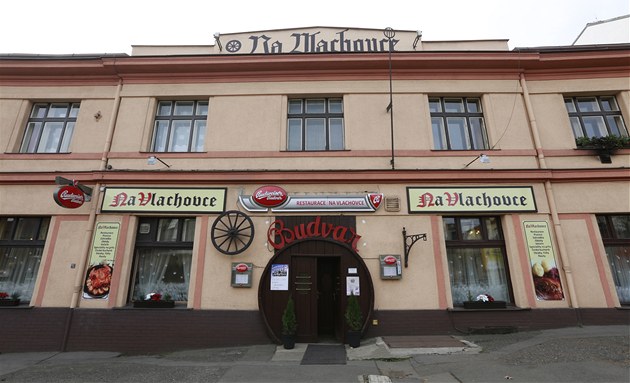
Now, were you to find yourself in Prague - another great city for beer - you can try to repeat  Haňťa's drinking escapade. Bohumil Hrabal's hero from Too Loud A Solitude starts the Grand Slalom, a course he and his friend had attempted many times before but successfully only once.
It was so long ago I had forgotten most of the course, so my friend, whose name I had also forgotten, launched into an impassioned description of it to win me over: we'd start off at the Vlachovska and move on to the Little Horn, then down to Paradise Lost and then to Myler's and the Coat of Arms, and at each place we'd order only a large beer, because we had to have time to make it to Jarolímek and Ládá's and round the bend to the Charles IV and, after a detour down to the World Cafeteria, we'd go over to Hausmann's and the Brewery, and then across the tracks to the Good King Wenceslas and on to Pudil's or Krofta's, and finally Douda's or the Mercury before coming into the home stretch at the Palmovka or Scholler's Cafeteria, and if it wasn't too late, we'd cross the finish line at either Horký's or the Town of Rokycany. Running through the course, he clung to me drunkenly, but I finally shook him off and left Čížek's, crossing the luxuriant periwinkle patches of Charles Square, where the sun worshipers had moved from benches that were now in the shade to benches that were now in the setting sun. On my way back to the Black Brewery I had a glass of rum and then a beer and then another rum. Not until we are totally crushed do we show what we are made of.
Vlachovka restaurant, pub, winery

So after weeks of abstention, I dropped by Dark Sugars, a mighty fine chocolatier on Brick Lane. The genial man behind the counter made me a quick hot chocolate and topped it off with a palmful of slivers of dark and brown chocolate. While I stood there salivating, a woman walked in and said she wanted to get a selection of salty caramel chocs.

'Which box shall I put them in?' she said.

'Whichever you like, dear,' said the genial man.'You spend your life trying to convince men they needn't tell you what to do. So don't let me tell you what to do.'

Giggles all around.

*****

I grabbed a salmon beigel and a salami beigel from the Beigel shop. £2.40 for a fine meal.


*****

The reason I went to Brick Lane was not to go to Brick Lane - because, really, Brick Lane is a bit of a sham show, especially its southern end - but rather because I was at the Calvert 22, a gallery of Russian and Eastern European works. This is in Shoreditch, and on my way back to the office, I sauntered down Brick Lane. Calvert 22 were hosting an exhibition of photographs (titled Close and Far) by Prokudin-Gorsky along with works by a bunch of modern photographers. I took a cursory look at the modern works, but spent more time admiring Prokudin-Gorsky.

What a chap. He spent years on the Czar's commission, travelling back and forth and up and down the mighty empire, snapping away at people and buildings and landscapes. Many of these areas haven't been photographed since, and many of the monuments were destroyed in subsequent wars and Communist depredations. He used a colour methodology of his own making, and produced vibrant polychrome pictures that look like they might have been taken yesterday.

The exhibition ends today, August 17, so I dare say most of you will miss it.

Apr 22, 2014

Serenity Now

I just got back from an Easter long weekend in Venice. What I have to say has already been said a few hundred times. And yet I will say it. I will not leave it unsaid.

Restaurants take a cover charge and a service charge for possibly the worst meals in Italy. The Rialto district is not less crowded than San Marco, and neither is the Dorsoduro. No bridge is ever without gawkers. Paul & Shark Yachting have nothing to do with yachting or sharks, and do not own the gondolas, despite their everpresent logos - they merely sponsor the gondoliers. The canals are stinky. Crabs living in them try desperately to get out and are pushed back in by gondoliers and tourists. There are far too many tourists. It must be miserable to live in such a gorgeous city and to be crushed and outpriced by the visiting millions. The Ca' D'Oro is excellent. Do grab some VizioVirtù chocolate. The Bangladeshis selling laser pens and the Africans selling fake Prada handbags (in front of the Prada store - how cunning)  are ubiquitous and persistent. The vaporettos are a good way to get around - but expensive. The gelato is a rip-off. You have to pay to enter almost every church. Despite signs everywhere warning tourists on pain of fines against feeding pigeons, they will feed pigeons. There are almost as many pigeons as tourists. Venice is a sinkhole of allergens.

A friend said, 'You are a tourist yourself, so don't whine.' 

We took a walk early in the morning before the hordes descended upon the streets. This is truly a time of beauty. The winged lions take on a benevolent aspect. The lapping of the waters against the embankments are quietly soothing. Even the seagulls have retreated. We can see why Venice has been called the Most Serene. 

But at around 9am, it is as though a starter's bell has gone off. Suddenly the place heaves. Sweaty and loud bodies push each other around. There are loud calls in Russian and American and French and Japanese. We begin to shuffle because we can longer walk apace. Claustrophobia beckons. Venice is now impossible.

Dec 13, 2013

Lost and Found Moolah

So do you remember that time I found a few twenties lying in the toilet at Starbucks? Well, the other day the we were on the Underground and we found a twenty lying between our seats. As the train had emptied before we boarded, it wasn't clear who had left the moolah. We decided to hand in the note to a Responsible Person at the end of our journey.

The guard at the ticket turnstile said he couldn't accept any lost and found, and directed us to the ticket counter. The ticketcounterwallah questioned us closely - where? why? how? what? 

Then he said, 'You know that this will just go into the company coffers.'

'But what if the person who lost the money wants to get it back?' we asked, naifs that we are.

'They will have to sort it out with the company,' replied the ticketcounterwallah, and issued us with a receipt.

So this appears to be Southwest Trains policy, then. Any money turned in as lost-and-found shores up the corporate balance sheet. Nice one.

******

Speaking of lost and found moolah, a while ago the Euromillions lottery had a bumper jackpot. Nearly a couple hundred million quid, you know, chump change for the average oligarch. A few of us at work decided to form a syndicate. We each put in ten pounds and bought £200 worth of tickets and sat back awaiting the end of our working lives.

On the momentous day of the jackpot, we found we had won - wait for it, wait for it - £25.

The lottery rolled over to an even more humungous sum and we bought £26 worth of tickets. This time our winnings were even more impressive - £10. 

We bought some Haribos with the amount and ruined our teeth.

[Loosely translated from the original Russian. 1]

In 1721, in the newly established imperial capital of St Petersburg, a school of Slavonic studies was set up in the Monastery of Alexander Nevsky. This, the precursor of the Theological Academy of St. Petersburg, had twenty-six students, several of whom were foreigners and one an 'Indian'. 2

It is unlikely that this novice arrived at the banks of the Neva directly from India. Rather, the student  most probably came from Astrakhan, which at the time was a trading entrepôt in which dwelt Russians, Tatars, Indians, Armenians, Persians and Kalmyks.  From the 18th century onwards there were factories organised in this city, where caravan, river and marine merchant routes met, run by various nationalities who maintained their residences in the centre of the White City. To this day there survives an Indian courtyard in Astrakhan, which was built in the early 19th century over what previously used to be stone guest-houses that had been in an Asiatic style reminiscent of the Spassky monastery dating from 1625. 3

In the 19th century, representatives of the Russian Orthodox church began the revival of ties with the old eastern churches of the Near East: the Armenian, Coptic and Ethiopian. This prompted ambassadors from the Syrian Orthodox church of South India to meet their Russian counterpart in Constantinople in 1851. But the Crimean war (1853-56) interrupted the discussions for closer ties with the Orthodoxy.

Still, the Indian Christians did not lose their interest in the Orthodox faith. In 1898, in the Turkestan Gazette  № 88, appeared a letter from A. I. Vygornitsky, a Russian traveller who had visited one of the major cities of South India. He described how during one of his stays he was approached by several local residents who said that the Archbishop of the whole of South India would like to meet him as he could be of assistance, given that he had ties to St. Petersburg.4

'I never had connections to St. Petersburg,' the traveller went on to write, 'but I at once took a rickshaw to go to the Archbishop's house.' The Archbishop was expecting Vygornitsky, and was accompanied by his assistant, a doctor at law. After exchanging pleasantries, the Archbishop made his request in the following words: 'In India, especially in the south, there are many Christians of the Antiochian church, founded by St. Thomas. The followers of this church do not recognise the supremacy of the Pope. They have their own Archbishop appointed by the Antiochian Church, but over time it is becoming harder and harder to appoint the Archbishop, because the Antiochian Church does not have enough people who could occupy the post in India. It may be that the Indians will be left without a pastor, and our church is in danger of falling into Catholicism, especially as even now the Catholics are attempting to swallow her up.' 5

Then the Archbishop added that, bearing in mind these circumstances, he and his flock of fifteen thousand souls had decided to become Orthodox, which they had familiarised themselves with from conversations with priests of the visiting merchant marine. 6

The trader, of course, knew that the British rulers of India would not tolerate any interference in the religious practices of their subjects, but he promised to convey the Archbishop's request to the relevant authorities in St. Petersburg. 'With joy, I gathered all the papers from my friends, and three days later, voyaged to Russia, having finished my travels in India to my satisfaction.' 7

From a theological point of view, there were no obstacles to the accession of the Indian Christians to Orthodoxy. After all, in the same year of 1898, on the feast of Annunciation (March 25) in the Holy Trinity Cathedral of the Alexander Nevsky Monastery in St. Petersburg took place the ceremonial union of the Syro-Persian (Assyrian) Church of Mar Jonah (representing several hundred Assyrian families that lived in northern Turkey and Iran, lands bordering Russia) with the Orthodox Church. Russian missionaries were despatched to the Assyrians to educate them in Orthodoxy; the missions continued successfully until the first World War, and even for some time after the beginning of hostilities.

As for the Indian request, there wasn't much coverage in the popular press of the time. Even the Orthodox journal that reprinted the Turkestan gazette's article merely stated in an editorial comment 'It would be interesting to have information on the further progress of the case.' 8 The answer might be found in the archives of the Holy Synod, but it can be assumed that the Russian government did not want to worsen relations with Great Britain, and for political reasons did not set in motion the request of the Indian Christians.

Following the First World War and the social upheaval in Russia, the Indians broke off their negotiations with the Russian Orthodox Church. These ties were resumed in the early 1930s thanks to the efforts of Russian Christians who found themselves exiled from their homeland.


References
  1. Архимандрит Августин (Никитин), Русский миссионер в Индии, Россия в красках.
  2. Ilarion Chistovich (1857), St. Petersburg Theological Academy. St.Petersburg. p. 11.
  3. Klyucharev Chronicle, Astrakhan, 1887. (Quoted in A. I. Yukht, 'An Indian Colony in Astrakhan', Questions of History, Number 3. 1857.)
  4. A. I. Vygornitsky (1898), 'The desire of Indian Christians to unite with the Russian Church', Orthodox Evangelist, № 24. p. 361.
  5. ibid. p. 362.
  6. ibid. p. 362.
  7. ibid. p. 363.
  8. ibid. p. 363.

When the BBC World Book Club polled its listeners for whom they'd most like to have at their monthly programme, Neil Gaiman was by some miles ahead of the runner-up. Today he was interviewed at BBC House in London, and I was there amidst the clamouring throng. 

The format is fairly standard. Gaiman is introduced briefly. He reads an excerpt from his novel American Gods. He takes a few questions. He reads a bit more. He takes a few more questions. He reads another excerpt. He is witty and urbane. He is kind and attentive. It is all excellent fun.

A brief intro to the book: a convict called Shadow is released from jail and finds his wife is dead. Not knowing what to do with himself, he is roped in as a flunky and bodyguard to a mysterious one-eyed gent called Wednesday, who, it turns out, is the Norse god Odin in a seriously diminished form. Odin wants to rouse the other old gods who were brought to America by their believers and then left high, dry, unworshipped and powerless as those believers died and they were forgotten. Arrayed against the old god are the new ones - all shiny, sparkling, the gods of media and technology and transport.

There are questions from the studio audience. There are questions posted on the programme's Facebook page. There are questions called in from Australia and Norway and California. There are questions from Twitter.

When was he inspired to write the book? Well, he says, it is something he can date very accurately because he was in Iceland one summer years ago, and he thought he would write till it turned dark, but the hours went by and at 3am he found it had merely dimmed outside ('yeah, you're ahead of me here') so he went for a walk and there was nobody around and everything was closed, except a tourist office which he entered to find a diorama of the explorations of Leif Ericsson, and the thought struck him - what if Leif and the Vikings took their gods with them to the new world, and over the years forgot them?

A fan-girl from London (via Mumbai) asks why he chose Kali as one of the dispossessed gods in his book. He loves Kali, replies Gaiman. She is fun. She is a goddess of destruction, but also of the wheel of life. How can you not love a goddess with a necklace of skulls? 

Did Gaiman not realise that Mamaji, as she is addressed in the novel, means 'uncle'? Yes, he says. He originally had her down as Mataji, but an Indian friend of his told him that he had read an American book in which Kali was addressed (wrongly, but so unabashedly Americanly) as Mamaji, and so Gaiman decides to use that epithet.

One of the things that interested him when he wrote the book, says Gaiman, is the exploration of gods who may be venerated in other countries but have been devalued or forgotten and replaced by other gods in America. Kali is one such, he says, and he can imagine how a manifestation of hers outside India can be reduced in power and glory.

There is a god in the book, says someone, who is forgotten by the hero as soon as he is seen. Could this be Agni? Gaiman declines to answer. It is a secret to be revealed in the next book of the sequence, he says.

Is Gaiman a believer? He is a 'possibilist', he says, quoting someone or the other. Although raised a Jew, he is not really a theist. He finds that he believes intensely in something only when he is writing about it. At this point he continues to be fascinated by the Norse gods, he says, and finds himself returning over and over again to the subject. They are the only pantheon he knows of whose destruction is written in the legends. These are tragic gods because they know they will die and yet have to continue to go about their mighty lives as though they are immortal. 

Anansi appears in American Gods, says someone. Is this the same Anansi as in the West African god of Anansi Boys? It is the same character, but the latter book is otherwise completely disjunct from the former, says Gaiman.

Speaking of gods, someone said, why were the main ones so conspicuous missing? Jehovah and Allah (and Buddha, adds Gaiman). He offers an analogy. If you are writing about the low-life and dregs of society, would you involve the President? 

HBO recently announced a forthcoming production of American Gods. Without getting into casting details, does Gaiman see any particular actor in any particular role? Gaiman is happy to reveal that the character of Odin was very much driven by the actor Rip Torn whom he met once. Rip, he says, had a wide smile that didn't quite appear genuine and an aggressively forthright manner, just the sort of frightening face a once proud and now diminished god on a crusade would have. Rip Torn was in Beastmaster, of course (not that I have seen either the man or the film), and it seems fitting that such a manifestly scary individual should inspire Gaiman.

Of course, the main character, Shadow, is the one everyone's interested in. Some people feel that he is really not a scary individual despite being depicted as a hulk with a commanding presence. Gaiman thinks Shadow is very closed and keeps a tight lid on his emotion because were he to lose control, the damage around him would be grave. Shadow is inspired by yet another pal of Gaiman's, a fellow who was tiny when young and often bullied, and then became massive in his teens, and the former bullies now could do nothing to him. He would stay quiet and observant, and people would think him stupid but as he was huge, nobody could actually say anything. Shadow, says Gaiman, is the same.

Gaiman has many friends. Tori Amos is one. He travelled with her to her farmstead where he saw an enormous tree, the biggest walnut tree ever, and he thought to himself that it would serve admirably as the equivalent of Yggdrasil. Shadow is tied up to one such tree for nine days and nights in one of the more harrowing portions of American Gods.

Speaking of Tori Amos, Gaiman was once pressured by his French publisher into attending a book signing in Alsace. When he arrived, nobody turned up to get their copies signed. The publisher shrugged Gallically and said something about Tori Amos. Everyone laughs. I should have listened more carefully.

What gods would he introduce in a sequel? He thinks he would do well to look into the gods of social networking, says Gaiman. They are gods for whom sacrifices are continuously being made. You could say the same about a god of television, he adds. After all what you sacrifice to that god is time.

Gaiman says that American Gods in many ways is a book of its era, which is 1999. There are references in it to things that no longer exist. Imagine the terror of the new gods, he says. They are powerful now and in the flower of their puissance, but their presence on the stage of worship is ephemeral. Fads that fuel them come and go. How jealous of the older dying gods would they be?  They had lasted so much longer.

I have not read the book. I might, one day. I would have liked to ask a question, though. But as I do not think of a single question while the programme records, I find I am keen to ask two when I'm on the train home.

Gaiman's book for him is more a road trip across America than an exploration of theological issues. But if he wants to explore the soul of such a deeply religious country surely the idea of gods diminishing is a contradiction?

And from my own experience of life in the US, it occurs to me that there is not one manifestation of any god. There is a free market in gods. For every interpretation of Jesus you can imagine, there's a church you can join. Did Gaiman think there was an equally interesting exploration of America to be had through the multiple avatars of the same god fighting it out for survival?

Unlike the Indian fan-girl who was rushing to yet another appearance of Neil Gaiman immediately after the BBC recording, I doubt I'll run into the author again. I daresay these questions will remain unanswered.

Wow, this is tiring work. I'm among the Ws and is there any end in sight? Yes, there is, but it appears as though the final push is beyond my puff. So it is with a glad cry that I pounce on two little books - non-fiction - on the London Underground. And another on black holes and the history of the Universe. Non-fiction after this serious overdose of fiction is so welcome.

*****

But I might as well do a brief round-up of some of the better books in this inside straight to the finish line. Véronique Tadjo, a writer from the Ivory Coast, has written As the Crow Flies, a series of impressionist passages. A woman has an affair with her friend's husband which is discovered only after she breaks it off with the man. A beggar attacks a child whom he suspects of malign influence in a fit far more violent than territoriality. An actress in a wandering troupe obsesses over the leader. The impressions are vivid and surreal as the narrative voice switches between persons. Tadjo said she could have written a story that had a beginning and an end, but life is filled with fleeting interactions.


*****

If you've ever wondered what your fate might have been like had you been talented and imaginative and filled with a yen to improve yourself but you had been saddled with alcoholic and semi-criminal families, you can learn all about it from two books, one superb and the other less so: Dmitri Verhulst's The Misfortunates and Justin Torres' We the Animals. In short, you end up alienated from your families no matter how much you love each other. But the paths to this alienation are many: education, sexuality, misunderstanding. In Verhulst's case, a savvy social worker cut through the obfuscation of his family to separate him from their criminality. In Torres' book, the incendiary writings in his diary discovered by his family propel him out of their orbit. In both cases, the gap between them and their loved ones is of heartbreaking proportions, and only gets wider as the years go by.


*****

Trust the nobility to come up with sexual deviance. de Sade gave his name to one kind, and Leopold Ritter von Sacher-Masoch to another. See if you can guess what the latter is. His Venus in Furs is supposedly the first in Western literature (to go by the blurb, the only literature - as though the Japanese, to take another culture, hadn't come up with similar ideas aeons earlier) to portray this proclivity. It's a somewhat tedious read, seriously dated (written in the 1870s as one in a series). But it hasn't lost its grip on popular culture: Wikipedia avers that in the last three years alone it has been staged several times, in New York and London, and Roman Polanski's had a go at it as well.


*****

It's a real pain that I couldn't find any authors with names starting with X or Y to add to my list. It's not that there aren't any, but they are verbose.


Apr 29, 2013

Shoreditch Walk

Going to the dentist is a famously hesitant and curiously unfulfilling venture (unless you have cavities, heh), so I figured I might as well take a nice walk around the East End once I was done. I meandered a roundabout course that finished up at Nicholas Hawksmoor's lovely Christchurch Spitalfields where I was waylaid by a buzzing crowd of young 'uns from a local primary school. I had been taking pictures all along but when I got home, I forgot to upload them onto my computer, and days later I formatted the flash card, and whoosh, they all disappeared. Tragic, I call it.

The walk began at Cheshire St., once a hub of the industrial East End, sadly reduced in the 1970s, and then rising phoenix-like to provide accommodations to a burgeoning service industry. Among the bigwigs of the older incarnation of the street was Lipton Tea.

Tea Building, Cheshire Street, 1973. (From here.)

One of the most famous landmarks of the East End and pride of Cheshire Street is the Repton Boxing Club, training ground for many indigent boys in the pugilistic arts. Repton is a public school in Derbyshire which started this club in 1884 to support the poorer members of society. [Since then it has become probably the top boxing club in the country, although when I walked by, there was not a boxer to be seen. The whole place, to wit, was empty of life.] The club only moved to these premises about forty years ago.

Tony Burns, a boxing coach at Repton Boxing Club, said of his youth:
When I was a kid you either kicked a ball or you hit someone. So, when I was twelve, I became a boxer. My mum died when I was a kid and if you lived in a place like this years ago, you was very fortunate to have a loving family. We all lived in Bacon St and Charlie Burns was the eldest, and they was a pain in the arse that family, but when I boxed all the family and friends would come, so I used to have quite a following. [1]
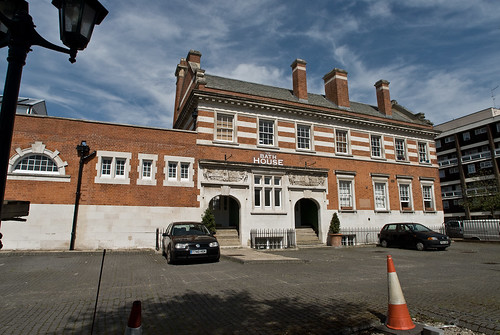
Right next to the club - in fact, they're all in the same building - is the Bethnal Green Bath House. This was built in 1899 as a public bath and laundry. At the time, hardly any of the local houses had baths, so this was in the public interest. The building was part of a complex that included the Ramsay Street School. [2] Currently it's a block of apartments. I wonder if there are still smells from the chlorinated and sulphurated days of yore.

Bethnal Green Bath House
Cheshire Street Bath House
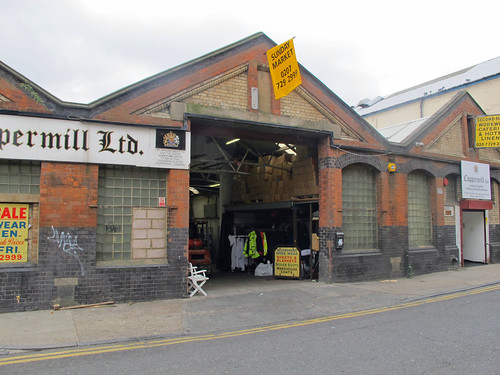
Walking a bit on, I came across a set of warehouses below railway tracks. One of them, Coppermill Ltd., has a Royal Warrant and deals with industrial cleaning cloths. It has been around for about a century. Victorian warehouses have a strange charm about them, especially those beneath tracks. Many of them in other parts of the city have been converted to art studios and cafes and restaurants, but this one retains its original function.
The best thing about this scruffy building is the Royal Warrant sign.
Coppermill Ltd., Shoreditch.

Cheshire Street was also the site of an installation art exhibition by Martin Creed (the chap who turned a light off and on and won a Turner Prize [3]) a few years ago. The Hauser & Wirth Coppermill was the venue; to be honest, I don't think I noticed the building as I walked by.

A little further on, on St Matthew's Row, is a pub: Carpenter's Arms. It is said that it was bought by the notorious gangsters, the Kray brothers, for their mother. Ostensibly the bar surface was a coffin lid - but who knows for sure?

Carpenter's Arms, Shoreditch.
Truman's Pubs owned this and several other pubs all around the East End. Some of the others have been demolished. [4]

The wonders of Cheshire street don't stop here - I came across the wonderfully monickered Duke of Uke. What do you think this is? A ukulele store, no less. Bertram Wooster would be so pleased. Till recently, this emporium used to be on Hanbury Street, a few blocks away; this latest venue should bring in the punters all agog with excitement.

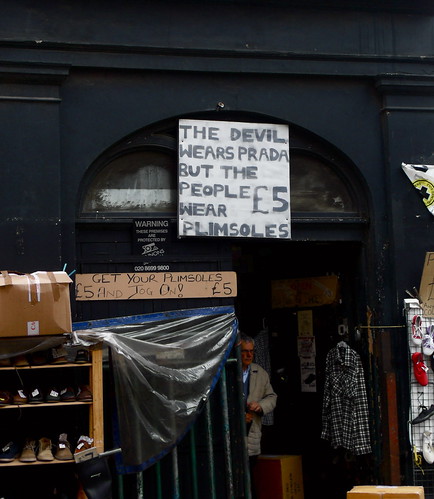
Next, I saw a rather clever sign: The Devil Wears Prada but the People Wear £5 Plimsolls. There were boots and boots galore. This was the Blackman's store.

The Devil Wears Prada, But the People Wear Plimsoles

Then there's a fashion store by Dragana Perisic. I went in thinking I might grab a little something for the wife, and then I walked right out.

Dragana Perisic's fashion store on Cheshire St.
No, this woman was not there at the time.

A few minutes' walk away is Brick Lane, as grotty and edgy a street as you might want. It has some of the most disgusting curries in the world and fine beigels, but also a fascinating multicultural history going back centuries. Huguenots, Jews, cockneys, Bengalis, weavers, streetwalkers, murderers, noncorformists, anarchists, racists - there has been a constant turnover in the social mix here going back to the 1500s.
Brick Lane 1932 © Tower Hamlets Local History Library and Archives

Just off Brick Lane is Pedley Street, on which I saw a graffito of the Queen reading. Drat, I can't find an image of this - it is a circular picture on the side of a building.

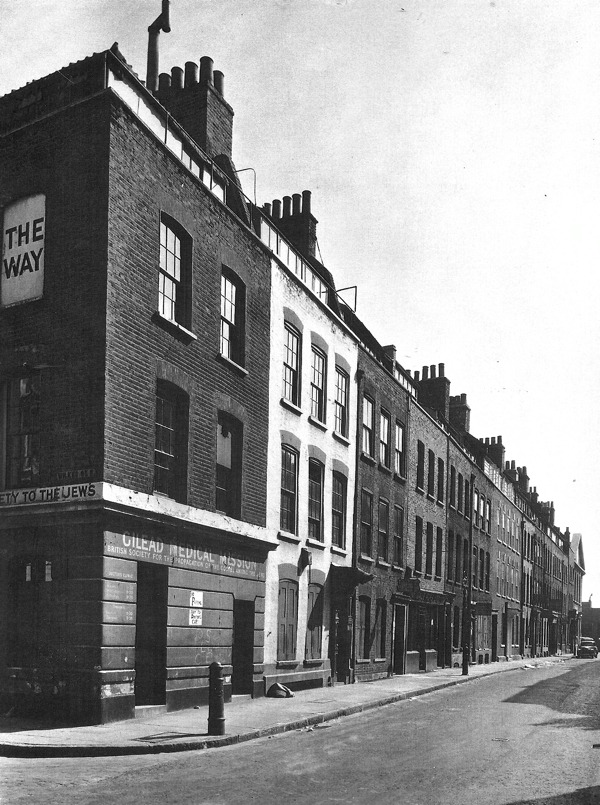
15 & 17 Fournier Street: Mission of Christianity to the Jews (1878-1947)


Next was Fournier Street, on which once Jack the Ripper romped. Today it is the site of the studio of the remarkable artists Gilbert and George, and the renovated 18th century building that once housed a joiner and then became a mission to convert Jews to Christianity at the end of the 19th century. [5] The most famous building here, of course, is the wonderful Hawksmoor Christ Church, which occupies the western end of the street.
Christ Church Spitalfields
Christ Church, Spitalfields, by Mr_Zephyr on Flickr.


References:
  1. "Tony Burns, Boxing Coach", in Spitalfields Life.
  2. Stephen Levrant, "Proposed internal alterations and change of use - Bath House Cheshire Street", Tower Hamlets council.
  3. Hazel, "Martin Creed at Hauser & Wirth Coppermill", Londonist, May 9, 2007.
  4. Duncan Richards, "Truman's East End Pub Archive", Design Department Store, Sep 5, 2011.
  5. "All Change at 15 & 17 Fournier St", in Spitalfields Life.

Apr 13, 2013

Overheard XXI

10 am. 
Southwest train to Reading. 
A young blonde with oversized black glasses, a muddy skirt, a backpack, a mobile phone and a seriously posh accent.

'Oh, Catherine, I am so hungover. We had about ten bottles of wine and several shots, and I feel like shit.'

'Yes, he was! I don't know if he said it because he was wasted, but he said that he has been in love with me for two years.'

'Oh no, I'm like, you can't be serious, really? ... Yeah. Yeah. Besotted with me.'

'Well, no, I had no idea, and I'm not even sure if it's 'cos he was so drunk. But then he said, "Why else would I take you to a Michelin-star restaurant?"'

'Yeah, he did, we went to a Michelin-star restaurant. But I'm like, "It's because you lost the bet." He bet me I wouldn't get a First, but I did, so he took me to the restaurant. That's what I said, and he's like, "No, that's not why I took you there."

'Yeah, that's what he said... "You're so pretty and so smart. I mean, you're so intelligent," he said.'

'That other girl was there. You know, the one I hate. One of the guys went over to chat to her, but she was really grim. I was like, "God, I kissed him a year ago, get over it."'

'Oh, and his senior officer came over, and he was so hot. He was flirting with me, and I was so wasted I couldn't even flirt back, but I really wanted to, 'cos he was so hot.'

'Like a major or something.'

'Yeah, they start as second lieutenant, and then I think they become captain, then major.'

'No, there are private ranks and officer ranks.'

'You have to do 14 weeks' basic training to be a private.'

'Yeah, I stayed over in Sandhurst in the junior officers' dorms. I'm on my way back home now. The bugle went off like at 7 in the morning, and I was wrecked, and then the soldiers, like, set off the fire alarm, and we had to leave the building.'

'Oh God, Catherine, I am so muddy, I didn't even shower, and I smoked so much last night. Yeah, and when my hair falls over my face, all that stale smoke smell... God, it's grim. Oh God, Catherine, I'm so hungover, I just want to get to bed and die.'

'So how is your family?'

'Really, she's totally, like, your Cordelia.'

'Yeah, but just because she's dead doesn't mean her ideas are. To say that the ideas died with her is just so ... so fallacious. I didn't really like her.'

Impressive, eh? Oxford-type, I think. Posh. Hot soldiers besotted with her. Shakespeare. Dislike of Maggie Thatcher. A First. Yup, pretty and smart.