Myriads of maple leaves
upon myriads of maple leaves
silhouetted against the bridge,
a few sails return late in the dusk.

 How do I miss you?

 My thoughts run like
the water in the West River,
flowing eastward, never-ending,
day and night
Yu Xuanji (844?-871?), Tang dynasty poet and courtesan
I was reading Kirmen Uribe's novel Bilbao - New York - Bilbao, translated from the Basque into English by Elizabeth Macklin, when I encountered the following poem:
Naine on vesi – selge,
Puhas ja igavene.

Mehed on maitseained
sajandi supi sees.
This is not Basque! It's Estonian, and it's by the poet Doris Kareva, whom Uribe met at a poetry symposium, which meeting he describes in the book. The poem itself has been translated by Kareva and Andres Aule, a lovely little piece:
Woman is water — clear,
pure and eternal.

Men are the spices
in the century’s soup.
There's a book recently published in Russia, titled Литературный авангард русского Парижа. 1920—1926. История. Хроника. Антология. Документы. Written by Leonid Livak and Andrei Ustinov, it is 992 pages of history, chronicles, anthologies and documents pertaining to the great Russian diaspora in Paris between 1920-1926. By all accounts (including this review, by Vasily Molodyakov, from which I've shamelessly and poorly translated this article), it is a tour-de-force, a seminal work, a book that shreds the usual templates of study of emigre Russian literature.
What sort of avant-garde? the Soviets would say. Sure, a bunch of Russians legged it after the Revolution - some to Berlin initially, and then to Paris - and they may have written a thing or two. Bunin, Kuprin, Shmelev, Zaitsev, Aldanov... The Soviets claimed that the real literature remained in Russia. The emigres were undeserving pretenders filled with nostalgia for their homeland; talented painters bemoaned their exile or returned with tails between their legs; the youth there was effete. The Soviets would bring up Marina Tsvetaeva, that most avant-garde of poets: what did emigration do for her?
Viktor Bart, Sergei Romov, Konstantin Tereshkovich. Founders of the group "Через" (1923).
The emigres would counter that the Soviets had defiled the avant-garde. The diaspora carried with it the forces of Russian tradition and the legacy of its great classical literature. The youth may quest for modernity, but the majority of them prefer to follow the great preceptors. Those who behave are published in "Modern Notes", while those who don't appear in "Numbers". This version of the argument is canonised by Adamovich and Gleb Struve after the second world war. The other version, that emigre literature is weak and ineffectual, and that the real literature is in Russia, is canonised in the English-language "Modern Russian Literature" by Marc Slonim.
"Merry Dynamite", manuscript by Dovid Knut. 1923.
So why do we have a thousand-page exposition from Livak and Ustinov? Well, for one thing, it illuminates little-known aspects of the Russian emigre experience, not just artistic but also literary. It overturns the myth of the absence of the avant-garde abroad, or of its marginalisation or insignificance. The Russian avant-garde was active, visible, powerful: "Gataparak", "The Palace of Poets", the Union of Russian Artists in France. But until 1924, the literary life of the Russian youth in Paris had three characteristic features: 1) an absence of anti-Soviet sentiment among the organisers and participants in the artistic groups; 2) a markedly pronounced popularity of the Soviet avant-garde in literature (Futurism) and art (Constructivism); and 3) close ties with the French Dadaist movement." (page 16).
Portrait of Mikhail Larionov by Man Ray. (1922-23).
The book also disposes of the myth that Russian Paris was somehow lesser than the Russian Berlin in 1921-23. The two capitals were not in opposition to each other; rather they were in consonance. And how could they not be, given that the same personages drove the avant-garde in both places?
Who were these people? You can learn nearly everything you might ever want about them, because nearly 3/4 of the book is comprised of the texts of the heroes of the avant-garde, the poetry and experimental prose of ten authors: Valentin Parnakh, Sergei Sharshun, Mark Talov, Georgi Evangulov, Alexander Ginger, Dovid Knut, Boris Bozhnev, Boris Poplavsky, Ilya Zdanevich and Vladimir Sveshnikov. Some of the text has appeared in print before, but gathered in one place, they offer a wonderful view. Another 250 pages deal with manifestoes, essays, letters as well as a reprint of all four volumes of the rare journal "Udar" ("Impact") by Sergei Romov. This sort of a Russian diaspora we haven't known. And such a Russian avant-garde we haven't known.
When I was in school, Hindi was my Achilles heel - I could barely make head or tail of it, and the insistence on the Sanskritised variety confused me even further. We covered quite a bit of poetry those days, poetry that was occasionally melodic, occasionally ancient, and occasionally a bit moral. Here's one that suddenly came back to me recently, and the only reason it came back to me (because, to be sure, I've put all matters of Hindi education to a dark and undusted corner of my mind) is that Dusted Off mentioned it during her coverage of little-known ruins in Delhi.
बुरा जो देखन मैं चला
बुरा ना मिलिया कोय
जो दिल खोजा आपना
मुझसा बुरा ना कोय
By Abdur Rahim Khan-e-Khanan (1556-1626), general and poet, a Navratan of Akbar.
"When I set out to look for evil, I found no-one wicked. When I searched my own heart, I found there was none as evil as I."
when I hear
the word
culture,
I reach
for a gun

the gun plays
a major role in
contemporary
art

with a gun
artists
paint pictures

with a gun
poets
draw poems

musicians
gather consonances
with the gun

filmmakers
with a gun
shoot
eminent
movies

maybe
even I
can
with the aid of a gun
extract
something
from myself.
An extract from the poem by the Ryazanian poet Alexei Kolchev who died in 2013. (Via Colta.ru.)
The falcon soaring in
the sky with red laser beam
eyes catches sight of
a helpless pigeon.

Its prey flapping faster and
faster until the falcon grabs the prey
with another falcon eating the smaller
falcon eating the pigeon.

    The hunter is the hunted.
Although the darkness of the evening conceals
                               your sweet form
(Lithe lightning dormant in the seams of the
                               purple storm cloud!)
O quailing beauty, you forget how your
                               fragrant wreath and
Clear-tinkling anklets as you merge with the
                               night you reveal.
“King, your daughter doesn’t teach me, and your wives are silent!
Feed me, Kubja! Why are the princes and their friends not eating today?”
Set free by travelers from his cage, looking at the paintings one by one
On the roof of your enemy’s palace, thus speaks the royal parrot.
From the Kavyaprakasa (Light on Poetry) of Mammata (c. 11th – 12th cent. A.D.)
   Seda ma lauluna lõksutelen
Võõraste kuulijate kõrva;
Armsamad kevadised kaimud
Varisenud mulla alla,
   Kuhu mu lusti lõõritusi,
Kurvastuse kukutusi,
Ihkava meele igatsusi
Koolja kuulmesse ei kosta.
   Üksinda, lindu, laulan ma lusti,
Kukun üksi kurba kägu,
Häälitsen üksi igatsusi,
Kuni närtsin nurmedella.
These are lines from the opening invocation, Soovituseks, of the Estonian epic poem Kalevipoeg, by Friedrich Reinhold Kreutzwald.
I will sing these out as a song,
into the ears of listening strangers,
my springtime companions
are settled beneath the soil,

to where my hoping rhymes
my sad trilling
the yearnings of a mournful spirit
cannot be heard by the dead.

Alone, a bird, I sing out
I trill alone, a poor cuckoo,
I give voice to my yearnings
until I wither on the meadow.
As day dawned, very early,
it came about as he expected:
this goddess encountered him,
as he placed himself at the front of the pool.
She came, naked of her clothing,
letting her hair down
At this climactic moment, the papyrus has been erased. (From the "Herdsman's Tale", a Middle Kingdom work from ancient Egypt.)
Es war ein Land, - wir liebten dies Land, -
Aber Grauen sank drüber wie Dünensand.
Verweht wie im Bruch des Elches Spur
Ist die Fährte von Mensch und Kreatur, -
Sie erstarrten im Schnee, sie verglühten im Brand,
Sie verdarben im Elend in Feindesland,
Sie liegen tief auf der Ostsee Grund,
Flut wäscht ihr Gebein in Bucht und Sund,
Sie schlafen in Jütlands sandigem Schoß, -
Und wir letzten treiben heimatlos,
Tang nach dem Sturm, Herbstlaub im Wind, -
Vater, Du weißt, wie einsam wir sind!
Nie zu klagen war unsre Art,
Du gabst und Du nahmst, - doch Dein Joch drückt hart!
Vergib, wenn das Herz, das sich Dir ergibt,
Nicht vergißt, was zu sehr es geliebt.
Agnes Miegel (1876-1964), Prussian poet, expelled from Königsberg, wrote refugee poems collected in a book called You are Still Part of Me.
Once there was a land - how dearly did we love it -
Yet waves of horror rolled over it, as dunes of sand.
Vanished as the elk's trail in marsh and meadow
Is every trace of man and beast.
Frozen in the snow, consumed in the flames,
Miserably they wasted in enemy hands.
How deep they lie under the Baltic's waves,
Their bones awash in bays and straits.
They sleep upon Jutland's sandy bosom, -
And we, the last of our kind, wander homeless,
Strewn about like seaweed afrer the storm,
Driven aimlessly like the autumn leaves, -
Heavenly Father, You alone know our desolation!
Góralu, czy ci nie żal
Odchodzić od stron ojczystych,
Świerkowych lasów i hal
I tych potoków srebrzystych?
Góralu, czy ci nie żal,
Góralu, wracaj do hal!
A Galician song of lamentation on the agony of the émigré, a Goral (hillbilly) forced to leave home to support his family.
Oh, Gooral, are you not weeping
to walk from your own native land,
from the pine trees, mountains and pastures,
from the silver torrent's bright strand
Oh, Gooral, are you not weeping?
Oh, Gooral, come back to home!
Blayb gezunt mir, Kroke!
Blayb zhe mir gezunt.
S'vart di fur geshpant shayn fur mayn hoyz
S'traybt der wild soyne,
Vi m'traybt a hunt,
Mit akhzoriyes mikh fun dir aroys.
Mordechai Gebirtig (1877-1942), Yiddish poet and songwriter from Kraków.
Farewell for me, my Kraków!
Farewell, my country.
The harnessed cart is waiting outside.
The wild enemy
is driving me out like a dog
to destinies unknown.
Part of the rising nationalism in Europe comprised in the insistence on a glorious past, often identified with great historical civilisations. The Aryans, of course, were a prime candidate for any people seeking an illustrious antecedence. The Hungarians had several models, chief among them Attila the Hun; among the others were the ancient Hindus. And so we have the 1909 tapestry by Sándor Nagy titled Sakuntala, which symbolically combines the Magyar notion of the deer as a holy symbol with that of King Dushyant's chase of the animal that led him to Sakuntala. [1]
Nagy was quite fixated on deer - he also depicted the beast in a frieze and on stained glass in the Veszprém Theatre, as well as a tapestry of the goddess Ildikó (1908).
Others have been fascinated with Kalidasa' tale of the unfortunate Sakuntala. Nikolai Karamzin, the great Russian historian, translated the tale into his language, claiming that it was a literature for the world. Here he was joining the likes of Goethe, Schelling, Herder, William Jones and de Chézy, in celebrating the great poem. Indeed, Abhijñānaśākuntalam was incredibly popular - nearly 10% of all works translated from Indian literature into Russian between 1792-1965 were of it! [2]
It's not just the Hungarians who were inspired by Sakuntala. Camille Claudel sculpted the remarkable 'Çacountala' or 'L'Abandon ou Vertumne et Pomone' between 1886 and 1905. It received much attention, and was kept in storage for several years. Claudel, of course, was channelling her own passion for Auguste Rodin. From Çacountala, she made subsequent variations, one of which is this lovely Vertumnus and Pomona:
L'Abandon ou Vertumne et Pomone, by Camille Claudel.
Closer to India, a Nepali artist delicately painted scenes from the play onto a wooden manuscript cover. Below is a small scene from it. This appears to be the only surviving manuscript cover for a purely secular work, and although there were some reservations over the identification of this work with Kalidasa's Sakuntala, a discovery in the 1980s of a mate to this cover completed the identification. [3]
Ink and colour on wood, manuscript cover from Nepal.
In India, Raja Ravi Varma's Sakuntala cycle is well-known. Here is the lady with her friends:
Shakuntala looking back to glimpse Dushyanta, by Raja Ravi Varma.
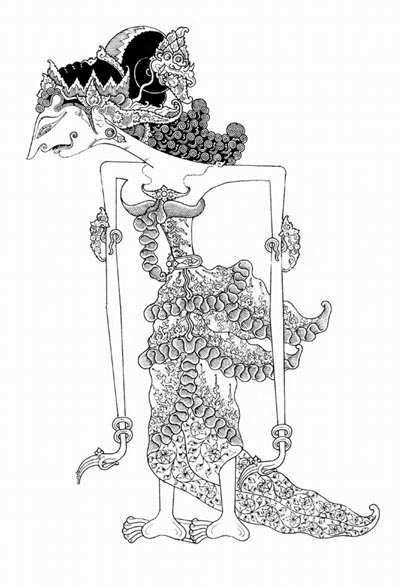
Meanwhile, music and dance saw their own manifestations of the gorgeous Sakuntala. Below is an example of Indonesian wayang (shadow-theatre) which is usually set to music. While there is evidence of indigenous story-telling predating the arrival of Hindu traders in the first century AD, much of the wayang oeuvre consists of tales from the great Hindu epics. Kisah Sakuntala, Ibu Kandung Bharata (or, The Tale of Sakuntala, the mother of Bharata) is one in the repertoire.
Sakuntala (Indonesian wayang)
One of Franz Schubert's operas is Sakontala (1820), an unfinished sketch with libretto by his friend J. P. Neumann. As late as 2000, one writer had written, "[Sakuntala] remains to this day the one and only Schubert stage work of which not one note has been performed for the public, anywhere, ever."[4] (This is not quite correct: a German television programme featuring Mallika Sarabhai's dance company had this music, and there have been some productions as well in the 1970s.)
Between 1913 and 1914, the sufi Hazrat Inayat Khan (1882-1927) visited Russia. He was received with much warmth in artistic circles, and he produced a ballet there titled 'Sakuntala'. The director Alexander Tairov had set up a new theatre; it was his hope to synthesise a multi genre spectacle. Inayat Khan's idea of a mystic balletic performance of Sakuntala appealed to Tairov. The music for the spectacle was arranged by Vladimir Pol. The New Theatre opened the production on 25 December 1914, with the title role played by Alisa Koonen. This wasn't a classical ballet but rather a dance interspersed with dramatic movements. Tairov wanted to present the production to the Czar, which sadly never happened. For a long time the music was thought to have been lost, but in 1991, it was found among various other documents at the Glinka Museum of Musical Culture. Three years later, a quartet of the Russian academy of music performed the piece. [5]
In 1889, Frederick Delius (1862-1935) set poetry by a Dane called Holger Henrik Herholdt Drachmann to music. A Dane! Who would have thunk it? Here's the first stanza of the poem:
Jeg kunde for Længsel ej sove,
En Blomstervind
Slog mig imod,
Strømmed herind ad mit Vindu
Som en vellugtaandende Flod;
Jeg hørte de høje Palmer
Suse svagt
Med sød Musik;
Det hvisked ihvor jeg stod og gik:
  Sakuntala, Sakuntala.
(I could not sleep for longing, a flower wind struck me ... )
It seems Drachmann had seen a staging of Kalidasa's play in Munich, and was struck by the parallels between his own ruined marriage and that of Sakuntala. [6]
Not to be left behind, the Italians got into the act as well. Here's Franco Alfano's 'La leggenda di Sakùntala', first act. He wrote it in 1921.
And that's it for now!
References
1. Jeremy Howard, Art Nouveau: International and National Styles in Europe, Manchester University Press, 1996.
2. Susmita Sundaram, 'Translating India, constructing self' in (ed.) Brian James, Contexts, Subtexts and Pretexts: Literary Translations in Eastern Europe and Russia, John Benjamins Publishing, 2011.
3. (ed.) Martin Lerner, The Flame and the Lotus: Indian and Southeast Asian Art from the Kronos Collections (p. 90), Metropolitan Museum of Art, 1984.
4. Uncle Dave Lewis, 'Franz Schubert: Sakontala', AllMusic.com
5. Cyclowiki, Shakuntala ballets (in Russian).
6. Hattie Anderson, 'Vilhelmine, the Muse of Sakuntala', The Delius Society Journal, Spring 2000, Number 127. (See here for PDF.)
Christian Bök spent seven years of his life producing the minor tour-de-force he called Eunoia, in which, corresponding to the letter U, he has a page depicting the foodiness of someone called Ubu. An alter ego, perhaps?
Ubu gulps up brunch: duck, hummus, nuts, fugu,
bulgur, buns (crusts plus crumbs), blutwurst, bruh-
wurst, spuds, curds, plums: munch, munch. Ubu sups.
Ubu slurps rum punch. Ubu chugs full cups (plus
mugs), full tubs (plus tuns): glug, glug. Ubu gluts
up grub; thus Ubu's plump gut hurts. Ubu grunts: ugh, ugh. Ubu burps up mucus sputum. Ubu up-
chucks lunch. Ubu slumps. Ubu sulks. Ubu shrugs.
Ubu slurs drunk chums. Ubu snubs such drunks; thus
curt churls cuss: 'shut up, Ubu, shut up'. Gruff punks
club Ubu. Butch thugs drub Ubu. Ku-klux cults
kung-fu punch Ubu. Rumdum bums bust up pubs.
There's something particularly disturbing about many totalitarian states wanting to keep assiduous records of every inanity that occurred on their turf. An example of such mind-numbing ennui is provided in the exhibition titled Aus anderer Sicht: Die frühe Berliner Mauer, which was held in Berlin last year. From the copious records of activity along the Berlin wall, Eliot Weinberger extracted several lines to create a poem 'The Wall'. Here are some of those records:
At 3.30 p.m. at Forsthausallee, three women and a man called out to the sentry: ‘Can you shoot that crow? It’s getting on our nerves.’
At 10.00 p.m. at Heidekampgraben, a policeman asked: ‘Hi boys, are the mosquitoes bad over there too?’
At 8.40 a.m. at the Kölnische Heide sentry post, a girl about sixteen years old on the second storey of the house at Wegastraße 36 removed her pullover and displayed her breasts. At 9.20 a.m. she put her pullover back on.
At 3.40 p.m. at Lohmühlenstraße, a woman about twenty years old called out four times: ‘Come on over, you can have me.’
At 7.05 p.m. at Kiefholzstraße, two girls, about fifteen years old, called to the sentry: ‘We love you! Come on over, we need something.’
At 12.20 a.m. at Nordgraben, two men shouted to the sentry post: ‘Say something!’
Border guard XXXXXXXXX was commended for his correct actions.
Border guard XXXXXXXXX was commended for his class-appropriate manner when faced with enemy provocation at the border.
Border guard XXXXXXXXX was censured for lackadaisically performing his early morning gymnastics and not bothering to touch his toes.
Border guard XXXXXXXXX was censured for owning a toy Mercedes automobile with an integrated measuring tape.
I have modestly given myself the name of the greatest of the Eldar: Fëanor, the maker of the Silmarils and the creator of the Tengwar. He was a Master of many things. I am merely a Jack.