JOST A MON

The idle ramblings of a Jack of some trades, Master of none

In August this year, Seoul will host the latest International Congress of Mathematicians. It's that quadrennial time when gossips begin to natter about Fields Medallists. A lot of people are talking up Manjul Bhargava. It is his last chance to win - by the time the next ICM comes around he will be older than 40. I'm hoping at least one woman will be awarded the prize this time.

In the run-up to the last ICM (in Hyderabad), I'd blogged about potential candidates for that year. None of them won. I hope to profile a few new names ahead of this year's ICM.

One that has popped up (new to me, at least) is Laure Saint-Raymond. Here is a loose translation of an interview that appeared a few days ago in Le Journal: "Laure Saint-Raymond, la boss des maths", by Louise Mussat (April 28, 2014).
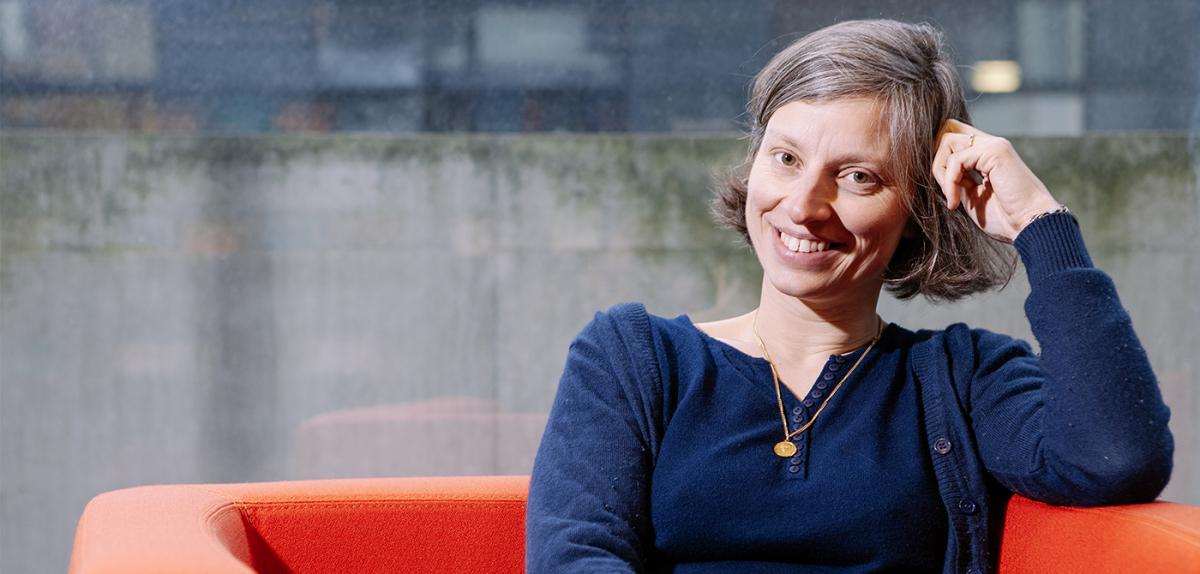

Elected to the Academy of Sciences in December 2013, this top-flight researcher will participate at the International Congress of Mathematicians in Seoul in August.

The blackboard that stretches across one of the walls of her office at the École normale supérieure (ENS) is whitened by clouds of intertwined mysterious symbols. These are equations, and they are unsurprising - Laure Saint-Raymond is a mathematician, a pearl in
her field of partial differential equations applied to problems of physics. A winner of the European Mathematical Society's Prize in 2008 and of the Joliot-Curie "Young Woman Scientist" award in 2011, she was elected to the Academy of Sciences when she was 38 years old, the youngest ever. And in August she will present a lecture in Seoul at the ICM, an unmissable event that attracts thousands of mathematicians every four years, during which the famous Fields medals are awarded.

Stratospheric Research

What does the daily life of a top mathematician look like? Wracking one's brains before a sheet of blank paper before scribbling equations on a blackboard? "Not exactly!" says this energetic researcher, smiling. "I spend a lot of time teaching, attending seminars, trawling the literature to help me keep abreast of what is happening, and communicating the results of my own research. But thinking in front of a blackboard is part of my work, and most of the time it's with my team. It's the creative phase, a mutual game during which we sometimes find nothing or sometimes not what we were looking for!"

What Laure Saint-Raymond seeks with her collaborators is to capture physical phenomena with mathematics. "My training in physics helps me to better understand the language of physicists and exchange ideas and develop an intuition for the phenomena we are trying to describe," she says. That was the year she graduated with a degree in applied mathematics from the University of Paris VI, the same year she obtained her degree in plasma physics.

All these strings to her bow have enabled her to tackle a tricky problem, first posed in 1900 and still unresolved: how does one effect a transition from a physical model to another, less complex and less precise? The scientist explains, "When we are in the presence of a rarefied gas, for example in the Earth's upper atmosphere, and we want to simulate the re-entry of a spacecraft, we use the so-called kinetic theory in which the state of the gas is characterised by a function of several variables, such as time as well as the positions of the atoms." Meanwhile, to describe the behaviour of gases around us, infinitely denser in atoms, it suffices to use a model wherein all the atoms are considered as a single continuous medium.

"What interests me is to understand how one moves from one to the other of these models: is there a smooth transition or, on the contrary, is there a discontinuity between the two descriptions which renders them both invalid in the intermediate regime?" says Laure Saint-Raymond.

Fundamental and stratospheric, this mathematics nevertheless has some physical applications: they allow us to understand better the entanglement phenomena at diferent scales of time and space, and to better account for the observed air flow around an aircraft, for example, or the formation of persistent whirlpools in the ocean.

From the Cello to the Sciences

Laure Saint-Raymond readily admits: as a child or a teenager, she had no particular attraction for mathematics. Her main thing was the cello. Then in high school, equations finally overcame the scales. "I had a facility with maths and physics, and my parents, both maths teachers, undoubtedly influenced my change in direction."

As a newly-minted bachelor in mathematics, she found the arms of the engineering industry extending towards her. However, she chose research, it being "intellectually more stimulating". In 1994, she joined the ENS where she began work on her thesis under the supervision of François Golse on the "kinetic theory of gases". To be clear: on mathematics applied to the movements of gases. Recruited by the CNRS in 2000, she spent two years as a Research Fellow before being appointed as a professor at the University of Paris VI. In 2007, she obtained a secondment at the ENS where she was made director of the department of Analysis. Currently, she is the deputy director of the Department of Mathematics and its Applications.

An exceptional journey

Her exceptional and rapid-as-lighting journey demands respect as it has happened in a largely male-dominated universe. "That is irrelevant," she counters. "My being a woman has never been a handicap, I have never been a victim of discrimination. And to do research today, it is no easier for a boy than for a girl, it's difficult for both: young people don't obtain a job till after several years of post-doctoral work, which, in some disciplines, means they have to wait till nearly 35 years of age before they are in a stable situation and able to start a family..."

Still, says Laure Saint-Raymond, her eyes shining and with enthusiasm in her voice, the game is worth the effort. "I will no doubt make a lot more money in the industry, but one's work cannot be reduced to a mere salary. Not one of my days as a teacher-researcher is like any other, and at the ENS, I have the immense freedom to conduct research that I want to do, and I enjoy myself thoroughly. This is priceless."

When she is not playing with partial differential equations, or not coaching one of her students, or not tutoring one of her six children (five boys and one girl, aged between 4 and 14 years!), Laure Saint-Raymond escapes to the mountains. Skiing in the winter or hiking in the summer, whichever, the key is to be outdoors all the time. "I really need to recharge my batteries, to disconnect completely from work, to return to the office with new ideas," she admits, and returns to whitening her blackboard again.


Dec 7, 2010

Korean Diplomacy

In 1470, the Korean king  Song-jong decided to restore the waning fortunes of Confucianism in his country, and invited Chinese dignitaries to his court. As described in Felipe Fernández-Armesto's excellent book 1492: The Year Our World Began, when the Chinese arrived, they were as much struck by the backwardness of Korea (despite the ancientness and wealth of the land and the well-established administrative system based on the mother country's) as by Korea's friendliness and hospitality:
five layers of honeyed bread, honey and flour cakes piled a foot high, rice soup, pickled relish, soy, rice wine superior in aroma and flavour to Chinese millet wine, beef, mutton, pork, walnuts, dates, mutton sausages, fish, and lotus roots to sweeten the breath.

Nov 26, 2010

Investor Guff

I am never disappointed when a bunch of investment types are thrown into a room with a 'senior' figure of philosophical bent. They strive to outdo each other in demonsrating just how deeply they have thought about matters of economic and historical import. They ask five-minute long questions. They look around the room after their questions, less interested in the answer than in the admiring reactions of their peers. Above all, they try to show the guru that they are no less knowledgeable than he is, and if he says, 'That is a good point!' they look smugger than a successful mugger.


Invariably, of course, the questions are the sort that one often finds discussed just that week in the Financial Times or the Economist. There are few original thoughts in the world, and those among investment managers are less original than most.


And so it turned out at George Magnus's lunchtime talk the other day. He himself spoke only for about a quarter of an hour, and then opened the floor to debate. After the usual hesitant silence, the alpha males started talking at once. One (with a heavy accent) said, "Everyone believes that in the next few decades, China will be bigger than the US. Historically, no handover from one superpower to another has happened peacefully, or without serious geopolitical risk. In lieu of war, how do you see the transition from US to China?"


Magnus, and some of the others who jumped in, thought he had said 'in view of war', so they spent the next few minutes debating possible escalations of violence between the two countries.


When the discussion faltered to a halt, the fellow said, "I said 'in lieu of war'." Were there any bashful faces? No.


Magnus brought up the Washington Consensus, and how there appears to be a less well-defined Beijing Consensus, and another worthy piped up. "Who'd want to live under a Beijing Consensus? The US has always been a benign superpower, so the Washington Consensus totally makes sense."


I've not heard the US being called 'benign' by too many people, but the fun didn't end there. Another fellow jumped up. "Two million Vietnamese killed. 'Benign'? Now China - there's a civilisation that's not bellicose."


Amazingly, Magnus seconded that view. Clearly nobody thinks the view of the countries around the South China Sea, or Vietnam or India, or Korea, or even Russia, or Tibet, is worth anything. The Chinese are no less 'benign' than the US, if by 'benign' you mean 'kick 'em in the teeth.'


Of course it's true that while the US hegemony is constantly chafed under, and people like to bash the Americans as often as they like to drink Coke, they also like to run to the Americans for security every time someone else flexes their muscles.


(But I can barely understand why an economic idea such as the Washington Consensus was suddenly interpreted as US hard power.)


Someone else popped up with: "But George, how can we convert your compelling ideas into trades?" Well, as it happens, George was speaking in the long run, ten to twenty years out. Which investment manager has that kind of horizon? They'd just like to make money in the next couple of years before their luck turns.


There was more such guff, but I tuned out shortly thereafter.

Nov 23, 2010

Not Corian

The recent contretemps between North and South Korea reminded me of my old colleague Jaekyeong. A few years ago we shared an office cubicle, and he would regale me with stories of life in his peninsular country. The southern one, I mean. I don't think there were any North Koreans in Illinois, leave alone in our office.

It used to be the done thing, he said, for graduating high school students to be taken to the 38th parallel to see for themselves the demilitarised zone, the no-man's land, the fortifications on the Southern side, and the stern North Koreans gazing at them from across the frontier.

At least that's what they were told - that the Northern soldiers were all marauding murderers who hardly cracked a smile. When they got to the border though, they were to be astonished.

The North Koreans knew we were coming, Jaekyeong marvelled. They put up big signs of welcome, and yelled greetings over massive megaphones. Welcome, welcome, senior students of Incheon School number 21! Have a pleasant day today! We wish you all success in your lives ahead!

They always knew! said Jaekyeong. They knew when my sisters' classes went. They even knew at any given time which school's students were approaching the walls, and who was leaving. Amazing intelligence! he said.

For a half-starved people, they sure put on quite a show.

Feb 12, 2008

South Gate Down

Here's a sad story. A fellow's residential area was redeveloped. He was dissatisfied with the compensation and appealed to a tribunal, which he felt did not treat his case with sufficient attention. So he planned his grand revenge over a period of several months. He climbed onto the Namdaemun gate using a ladder, poured paint thinner over it, and set the stone and wood structure aflame. Within moments, the 600-year old pride of Korea, a survivor of cataclysms and war, was burnt to a charred wreck. It feels like the heart of the nation was destroyed overnight, said one shocked citizen.

The Namdaemun (or Great Southern) gate was the oldest wooden structure in Seoul. Built in 1398, it served as the main entrance into the walled city, which had by then become the capital of the Korean kingdom. Also called Sungnyemun (or Gate of Exalted Ceremonies) had been restored several times over the intervening period; most recently, in the 1960s.

The locals blame easy access and lack of security for the destruction of their icon. The arsonist himself was no beginner at the game. He had attempted to set fire to the Changgyeong palace in 2006, for which he had been given a suspended sentence. What tortuous thoughts went through the fellow's mind? Clearly he had been embittered by what he perceived as an injustice. But to take it out on his own nation's cultural heart requires him to have a mind twisted entirely out of proportion. The world was aghast at the destruction of the Bamiyan Buddhas by that thuggish coterie of beards, who could (in their own minds) legitimately claim that they had no connection with the Buddhas, representations of a pagan religion. What claim could this man make?