JOST A MON

The idle ramblings of a Jack of some trades, Master of none

May 21, 2015

Hastings Trial

At the trial of Warren Hastings for corruption as Governor-General of Bengal in 1788, the following refreshments were on offer:
Sandwiches, of Veal and ham (for 1 shilling)
          , of Ham and Fowl (for 1 shilling)
          , of Tongue and Veal (for 1 shilling)
          , of Dutch Beef, with Butter (for 1 shilling)

Coffee and Chocolate,

Orange and Lemonade, with Queen's Cakes
different kinds of Bifcuits and Cakes

JELLIES,

And WINE and WATER

Feb 12, 2014

Oriya

What do I know of Orissa? Very little, as it turns out. Other than Konarak and Kalinga, I don't recall any coverage at all of this eastern state of India in all my years of education. History and geography, science and mathematics, all have ignored it. In my posts on various aspects of Indian history, too, I have paid it little attention. Time for a small remedy.

In the 1800s, the previously open-minded interactions between the British in India and the Indians were beginning to harden into disdain towards the latter's culture, art, traditions and behaviours. Indian religions were considered primitive, Indian learning was dismissed, and where there once were meetings of the mind, now there was British superciliousness and arrogance.

Shiva and Parvati. Oriyan temple sculpture. (13th century AD).
In such a clime, there were a few British men who would try to educate their countrymen about the wonders of the subcontinent. One of them was Charles Stuart, also known as Hindoo Stuart, an East India Company officer who amassed a large collection of Indian art, which is today found in the British Museum. In Stuart's house in Calcutta, he created a gallery which was one of the earliest systematic displays of Indian art aimed at the public. (To be sure, English public - I'm not sure if many Indians attended, despite Stuart's deep fondness for the natives.)

Five hundred years earlier, Orissa was ruled by a Hindu raja. Orissa was a Shaivite state - the God Shiva was supposed to be its lord, and the kingdom was dotted with grandly ornamented Shiva temples. One particularly magnificent sculpture - of Shiva and Parvati - likely stood at the entrance to one of the great temples. It found its way to Stuart and thence to the British Museum.


This was a life-size sculpture, and originally would have been brightly painted. Shiva would have been white, signifying the ash with which the ascetic God adorned himself, with a blue throat, from the poison he swallowed during the churning of the ocean for amrit. Observe the tenderness and devotion between him and his consort - this was no impersonal deity thundering abstinence and damnation upon his followers. Ganesha, their son, appears at the bottom, while figures representing the donor of the sculpture and his wife appear to the left and right of the Gods.
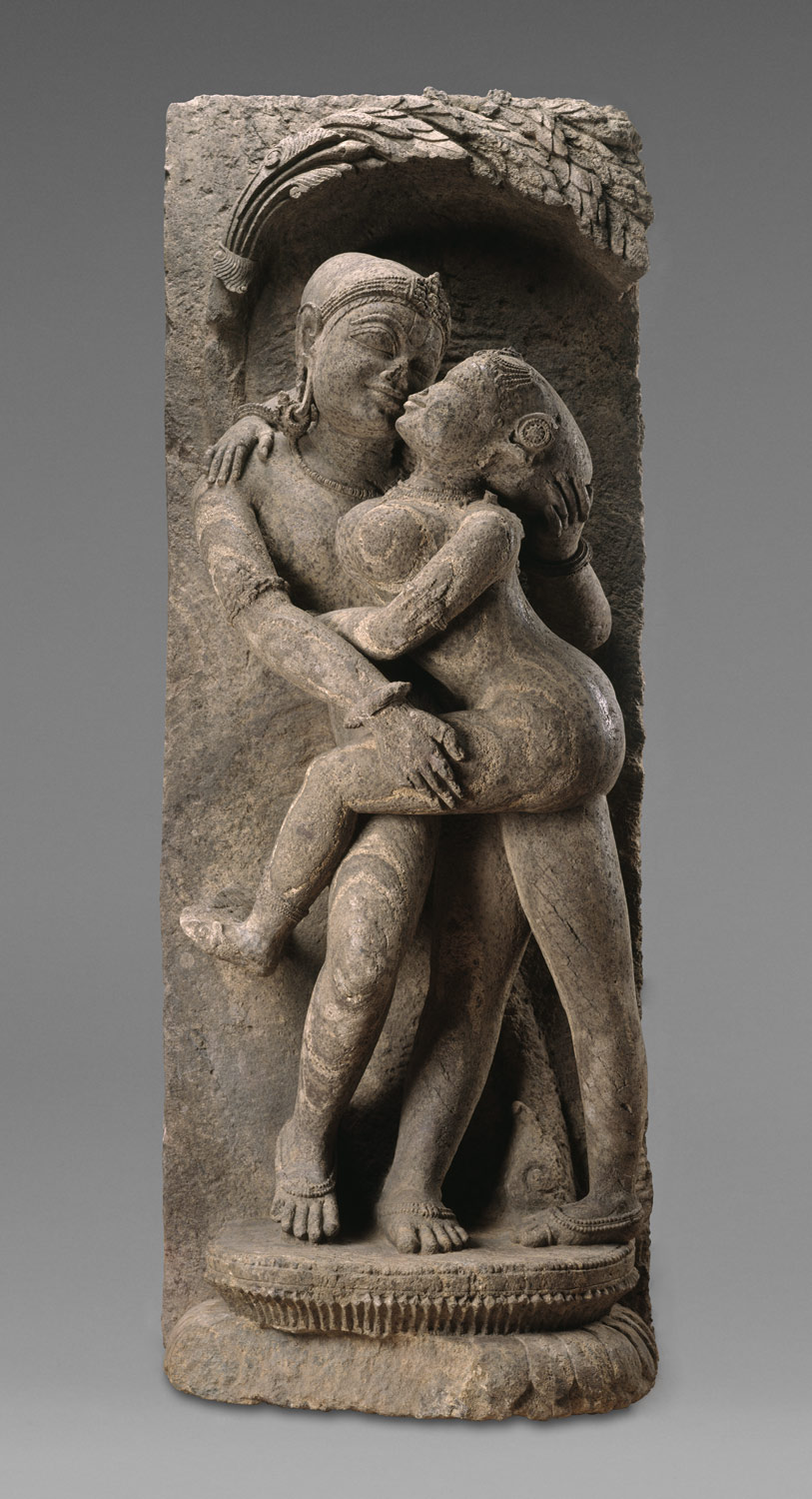
Mithuna, Eastern Ganga dynasty, Orissa. (13th century AD).
Another sculpture of love and devotion can be seen at the Metropolitan Museum of Art in New York. This too dates to the 13th century Orissa. It shows a loving couple (mithuna) and is also of stone, and was part of an Oriyan temple decoration. The kings of the time belonged to the Eastern Ganga dynasty, who had established the superb Sun temple at Konarak. They were allied by descent and marriage to the Cholas of the south and the Chalukyas of the west. By the time these sculptures were created, their kingdom was already in decline. Faced with aggression from the Muslim rulers of Bengal and Delhi, the Gangas slowly fragmented; a defeat by the Vijayanagar empire reduced their importance further. In 1425, a minister usurped power from the last 'mad' king, and the Eastern Gangas came to an end.

After Charles Darwin's publication of the theory of evolution, many scientists took up the mathematical study of racial differences in mankind. Given large datasets compiled by anthropologists of measurements made of a wide variety of peoples, the question was to determine if there were objective metrics by which people could be classified into races. Such investigations were not only intellectual, but also in many cases driven by notions of racial superiority and eugenics.

The measurements themselves were copious and exhaustive, incorporating - for the head alone, for example - such characteristics as cephalic index, head length, head breadth, nasal length, nasal breadth, and nasal index. Simple statistics such as the average and the standard deviation were clearly not sufficient to distinguish between one group and another, particularly when the measurement error alone resulted in overlapping values for two classes. In a brilliant series of papers published in a new journal called Biometrika, Karl Pearson and associates showed there were multidimensional measures whereby anthropological data could be analysed. More specifically, they could be used to 'assess similarity or dissimilarity between two populations' 1.


An example of a prevalent question at the time was whether Ancient Egyptians had any social affinity with Hindus. Some researchers had claimed that the physical resemblance between the two peoples implied a partial colonisation from one country to the other. Karl Pearson introduced the coefficient of racial likeness, or CRL, to analyse this issue, 'one of the first quantitative procedures to measure the admixture proportions, or the proportions which 'hybrid' populations derive from their various ancestors'2.


Given two populations of size n and n', with the mean of the ith measurement in the first population mi, and that in the second population m'i, and si2 the pooled variance in the ith measurements, the CRL C is given by:


Almost immediately, the CRL was used by M. L. Tildesley in her analysis of Burmese craniums in 19213. Shortly thereafter, critiques of the methodology began to appear in the literature - not only by anthropologists but also statisticians. A chief criticism was that the method assumed that the various metrics (e.g. head length, head weight, nose length) were independent of each other, a rather generous assumption. Another complaint was that the CRL was dependent on the sample size of observations, and that it provided only a degree of certainty that there was divergence between the groups, but could not quantify exactly how much divergence there was.


In 1925, an Indian statistician named P. C. Mahalanobis began an investigation into the question of racial differentiation in his native state of Bengal. He looked at the results of an anthropometric survey of Anglo-Indians (people of mixed European and Indian ancestry) conducted in 1891 to answer (in his words) the following questions:
How are these 200 Anglo-Indians in Calcutta related to the different caste-groups in Bengal? Are they more closely allied with the Hindus or the Mohammedans? Do they show a greater affinity with the higher castes of Bengal or with the lower castes? ... 4
In order not to be swayed by size differences in the various characteristics he used, Mahalanobis computed standardised values for them.
The characteristics differed by scale and variability. That is, Mahalanobis might have considered a half-inch difference in nasal length between two groups of skulls a significant difference whereas he considered the same difference in head length to be insignificant. Mahalanobis normalized differences in each characteristic by the characteristic’s standard deviation and then squared and summed the normalized differences, thus generating one composite distance measure that was invariant to the variability of each dimension. 5
This first Mahalanobis metric suffered from the same defect as Pearson's as it didn't consider the correlation between the various characteristics. In 1936, he introduced his famous concept of statistical differentiation that came to be known after him, the Mahalanobis distance.


If the human skull can be described by n characteristics that are measurable, an individual's skull can be represented as an n-dimensional vector. Now take a set of measurements belonging to one anthropological unit (say, Calcutta Brahmins), and compute its centre, or mean vector m, and its covariance matrix S. Then, if we want to classify a hitherto unclassified skull measurement y, what we do is compute its Mahalanobis distance D from the Calcutta Brahmin set's centre:


And we compute the distance against the centres of other classes, say, Calcutta Muslims or lower castes, and we decide that our unknown skull falls into that class from which it has the least distance D.


To simplify, assume that a skull can be characterised by two metrics, skull length and skull breadth. Then each skull can be represented by a point in two-dimensional space. If we plot our data of Calcutta Brahmin skulls and Calcutta Muslim skulls, we might find (if these are indeed two distinct anthropological classes) that our graph has two distinct clusters in it (Figure 1 from Kritzman and Li (reference below)):


In Kritzman and Li's words, then:
Suppose we compare a skull of unknown origin, represented by the square in Figure 1, with the two groups and categorize it. In terms of Euclidean distance, it lies closer to the center of Group 2 than to the center of Group 1. The Mahalanobis distance, however, would consider this skull more similar to Group 1 because its characteristics are less unusual in light of the more inclusive scatter plot of Group 1’s characteristics.
So what did Mahalanobis conclude from his investigation? First of all, he said, the Anglo-Indians in his sample derived (on the Indian side) from Biharis, Lepchas (of Sikkim), possibly from the Punjab, and none at all from the Northwest Frontier or the Chotanagpur tribals. He also noted that they seemed to derive from unions of higher-caste Indians and Europeans, adding that 'cultural status evidently played a large part in determining Indo-European Union.'


From a broader investigation into the anthropological classes of Bengal, Mahalanobis was able to arrive conclude: 
Summing up we find that intermixture within Bengal, i.e. intra-provincial intermixture has varied with the degree of cultural proximity, so that for Brahmins the amount of intermixture with other castes has been in proportion to the social standing of the caste concerned. Influence from outside Bengal, i.e., inter-provincial intermixture has followed two well-defined and clearly distinguished streams, one from the castes of Northern India (chiefly from Bihar and the Punjab) and the other from the aboriginal tribes of Chotanagpur. The influence of the Northern Indian castes decreases and that of the aboriginal tribes of Chotanagpur increases as we go down to the social scale... . None of the castes analysed here show much resemblence with any of the aboriginal tribes of the east... . Mohammedans (also) show a highly mixed character. They appear to be originally largely derived from Bihar but have intermixed extensively in Bengal; they do not show any resemblance with the Punjab Pathans. 6
As it happens, not all the anthropological conclusions of that 1925 paper are held valid today. Mahalanobis was correct in his assertion that Bengal Brahmins resemble other Bengal castes more than Brahmins elsewhere in India. However, later datasets have invalidated his claim that only the Brahmins among the people of Bengal have admixtures from the Punjab. 'Moreover, as far as the Anglo-Indian community is concerned, it is now believed that Mahalanobis had probably confined his study to a sample from the upper stratum of the community, and hence his conclusion of resemblance to upper caste Hindus is applicable to the upper class Anglo-Indians only'. 7


These days, Mahalanobis is venerated by many people not for his anthropological research or its conclusions; rather, it is the methodology he developed that is considered his greatest contributions to the sum of human knowledge. Even today, the Mahalanobis distance is part of the armoury of every scientist who needs to classify multidimensional data. As you can probably infer from the reference list, this includes not just statisticians, but also anthropologists, social scientists, and financial engineers. 


Quite a lot of good, in short, has come out of what once was eugenics research.


References


1. S. Dasgupta, "Evolution of the D2-Statistic of Mahalanobis", Sankhyā: The Indian Journal of Statistics, 1993, Special Volume 55, Series A, Pt 3, p 442.
2. M. Tapper, In the Blood: Sickle Cell Anemia and the Politics of Race, University of Pennsylvania Press, 1999.
3. M. L. Tildesley, "A First Study of the Burmese Skull", Biometrika, 13, 1921, 247-251
4. P. C. Mahalanobis, "Analysis of Race-mixture in Bengal", Journal of the Asiatic Society of Bengal, 23, 301-333.
5. M. Kritzman and Yuanzhen Li, "Skulls, Financial Turbulence, and Risk Management", Financial Analysts Journal, 66(5), 2010.
6. S. Dasgupta, as above, p 447.
7. J. K. Ghosh, "Mahalanobis and the Art and Science of Statistics: The Early Days", Indian Journal of History of Science, 29(1), 1994.

Apr 12, 2010

Burn 'Em All

I recall reading somewhere that the reason ancient documents of the lives and administrations of various kingdoms of India haven't survived the years is that, in keeping with the Hindu/Buddhist doctrine of life, death, and rebirth, archivists tended to destroy records when one ruler or dynasty was succeeded by another.

There are parallels elsewhere in the world, even if the destruction is due to different reasons. The first emperor of China, 秦始皇, Qin Shi Huang, is said to have feared that access to histories of his land would undermine his legitimacy, and ordered the wholesale purge of books predating his rule. And, of course, there are any number of examples of book-burning inspired by some ideology or the other, including religion. Egregious cases would include the burning of the Maya sacred books by evangelical Spaniards, the destruction of the library of Nalanda by Muslim invaders, sundry excesses by the Nazis, and the wholesale extirpation of Iraq's national library after the US invasion in 2003.

This is not to covertly imply that Hindus have been any more enlightened than the other zealots. From Manipur's history, we have a good example. [1] From about the 16th century onwards, Sanskrit scholars from Bengal began to settle in Manipur, and, having influenced the then monarch, Kiyamba, proselytised amongst the people in that land. The people had been worshippers of an animist faith of Sanamahi, and some of them converted to Hinduism. Kiyamba's successors allowed still more Sanksritists to preach, until in 1704, the king, Charai Rongba, was formally initiated into the faith.

The local language, Manipuri, already had a long and energetic literary tradition. It had its own script, called Meitei Mayek, and one of its great texts was the Cheitharon Kumpapa, the Court Chronicle of Manipur, tracing the genealogy of the monarchs from 33 to 1763 (more recently extended to 1955). [2]

After Charai Rongba, his son Gareeb Niwaz fell under the influence of the Chaitanya school of Vaishnavism. He decided to no longer support the Meitei Mayek script, and - fearing that the old texts would undermine his efforts to establish Hinduism among the Manipuris, and quite probably encouraged by his Brahmin adviser Shantidas Adhikari - ordered the burning of documents written in it. Large numbers of histories and texts of the old faith were publicly set aflame. In view of the supposed prestige of the languages of the incoming new faith, Manipuri began to be written in the Bengali script, which along with Sanskrit, assumed greater importance in ritual matters.

One consequence of this was the translation of sacred Sanskrit texts such as the Ramayana and the Mahabharata and their publication in Manipuri's new script. Furthermore, a large number of Indo-Aryan words were adopted in Manipuri, a Tibeto-Burman language.

Despite Gareeb Niwaz's efforts, Meitei Mayek didn't entirely die out, although it was largely displaced by the Bengali writing. It continued to be used in secular documents, being much more suited to its language. With the advent of printing, Manipuri texts were almost all published in the Bengali script. The trouble ever since has been that not all the Bengali letters are used, and there are several Manipuri sounds that do not correspond to any Bengali characters.

Recently, there has been an attempt to revive Meitei Mayek among school-children, and to promote it in public signs. Simultaneously, there have been woefully inevitable outrages. When linguistic chauvinists decide that one script is superior to another, inevitably there's burning of books. Linguistic terrorists of the MEELAL organisation (Meetei Erol Eyek Loinshillon Apunba Lup, or the United Forum for Safeguarding Manipuri Script and Language) in 2005 decided to 'reverse' Gareeb Nawaz's book-burning. Demanding the immediate restoration of the old script, they set the Manipur State Central Library on fire, with the ensuing destruction of more than 145,000 books. [3]

What goes around, evidently, doesn't fail to come around.


References

[1] Devi, Hajarimayum Subadani. 2004. Loanwords in Manipuri and their impact, Linguistics of the Tibeto-Burman Area, Volume 27, No. 1, pp. 29-60

[2] Parratt, Saroj Nalini. 2005. Court Chronicle of the Kings of Manipur: Cheitharon Kumpapa: 1 (Royal Asiatic Society Books). Routledge, London.

[3] Pradip Phanjoubam, An Incendiary Script, Outlook Magazine, Apr 26, 2005.

Oct 10, 2009

Dalrymple Again

It's been a year since I last saw William Dalrymple, our favourite Scotsman-in-India. He is in the middle of a grand promotional tour for his latest book, Nine Lives: In Search of the Sacred in Modern India, and I attended his talk a little while ago. It is gladdening to see that he is balder than last year, but hasn't lost any of his fidgety energy. He gambolled up onto the stage, plonked himself down on a chair, and for the ensuing forty-five minutes of his talk, continuously undid and redid his shoelaces, unwrapped and wrapped and re-arranged his scarf, and spoke animatedly about not wanting to produce yet another tome about the Westerner-in-India's-Spiritual-Market.

(Although it has to be said that critics such as Rohit Chopra say he continues to exemplify the Orientalist mentality.)

Dalrymple spoke movingly of the Bauls, troubadours of Bengal, and about the Devadasis of Karnataka, and about a cowherd in Rajasthan who had maintained a long oral tradition of a forty-thousand-line song that died with him when he succumbed, untreated, to cancer, because he was too poor to afford treatment.

A couple of Baul friends of Dalrymple's have accompanied him on his tour - they will travel with him to present their songs and music and dance in the UK and Australia and the USA, and possibly other countries as well. When he saw their passports in India, he said he had spoken a bit condescendingly about their impending trips abroad. But they had surprised him. It seems they had already travelled to England several years earlier. Dalrymple was amazed to learn, he said, that they had performed at a house-warming party - for Mick Jagger, no less.

When can a blog be truly said to have arrived? Why, when the Bong Blogosphere makes mention of it.

প্রায় একমাস আগে, জোস্ট আ মন ব্লগ এপ্রিল মাসে পড়া হয়েছে এমন ‘ভাষান্তরকৃত অপরাধ ও রোমাঞ্চ গল্পের‘ একটি রিভিউ পোস্ট করেন- যার মধ্যে বেশ কিছু বই ছিল মধ্য আর পূর্ব ইউরোপের লেখকদের

Eh? Eh?

And, of course, I only found out about it two months after.

Jul 28, 2007

Bongs galore

Why didn't the cyclotron at the Saha Institute in Calcutta work? And why is there no R & D in Bengal?

The Bengalis (or Bongs, as they are known by the rest of us desis) are a smart, fish-eating folk. In common with other communities in India, they have a distinctive lilt when they speak English, although they like to say their accent is the finest in the country. As they do not distinguish between the sounds 'r' and 'd' (the rolling 'd', as in 'sari', if you know what I mean), there is no R or D in Bengal.

As for the cyclotron, this is a more arcane joke. A charge q travelling with velocity V through a magnetic field B suffers a force F given by F = q (V x B), where x is the vector cross product. The Bongs pronounce V and B the same: 'bhi'. Now 'bhi' cross 'bhi' is zero, so there is no force on the electrons in the Saha cyclotron, and hence it doesn't work.

Okay, a nerdy joke, and losing somewhat in its telling. But now it's out in the ether, and it won't be long before furious Bongs assail me for devaluing their R & D.