JOST A MON

The idle ramblings of a Jack of some trades, Master of none

Yesterday at 7.00 heroic Theseus fought the red eyed Minotaur because every year 14 tributes were sent to Crete to be eaten by the Minotaur.

At 700 am heroic Theseus travelled to Crete to kill the fierce Minotaur because 14 tributes were sent to Crete because a old fierce king named king Minos was very sad of death of his son. It is well known that 14 tributes were sent to Crete because a terrifying King called King Minos was angry at the people of Crete. At Athens an Athenian went to King Ageus to declare that this year heroic Theseus should beat the half man-half bull creature.

It has been reported that one of the prisoners had seen Ariadne giving Theseus a ball of string. It has also been reported that as Theseus entered the cold dark labyrinth, he saw one horn sticking out behind a pillar.

"As I slowly crept along I saw the brutal Minotaur. I stabbed the cold bloodthirsty Minotaur. I have never been so nervous in my life," exclaimed Theseus.

The defeated King Minos said, "Theseus stole my daughter and the stupid Athenian prisoners and fled so fast."

It is reported that having fled the palace Theseus then cruelly left Ariadne on an island. "I can't believe that Theseus broke the agreement. I thought we had a deal," said Ariadne in anger.

(Newspaper report in the Athenian Metro, by the boy.)

Jun 1, 2013

Sakuntala

Sakuntala Tapestry, by Sándor Nagy.
Part of the rising nationalism in Europe comprised in the insistence on a glorious past, often identified with great historical civilisations. The Aryans, of course, were a prime candidate for any people seeking an illustrious antecedence. The Hungarians had several models, chief among them Attila the Hun; among the others were the ancient Hindus. And so we have the 1909 tapestry by Sándor Nagy titled Sakuntala, which symbolically combines the Magyar notion of the deer as a holy symbol with that of King Dushyant's chase of the animal that led him to Sakuntala. [1]
Hunting Gentry: Stained glass window - Veszprém Theatre. (1907).

Nagy was quite fixated on deer - he also depicted the beast in a frieze and on stained glass in the Veszprém Theatre, as well as a tapestry of the goddess Ildikó (1908).

Others have been fascinated with Kalidasa' tale of the unfortunate Sakuntala. Nikolai Karamzin, the great Russian historian, translated the tale into his language, claiming that it was a literature for the world. Here he was joining the likes of Goethe, Schelling, Herder, William Jones and de Chézy, in celebrating the great poem. Indeed, Abhijñānaśākuntalam was incredibly popular - nearly 10% of all works translated from Indian literature into Russian between 1792-1965 were of it! [2]

It's not just the Hungarians who were inspired by Sakuntala.  Camille Claudel sculpted the remarkable 'Çacountala' or 'L'Abandon ou Vertumne et Pomone' between 1886 and 1905. It received much attention, and was kept in storage for several years. Claudel, of course, was channelling her own passion for Auguste Rodin. From Çacountala, she made subsequent variations, one of which is this lovely Vertumnus and Pomona:

L'Abandon ou Vertumne et Pomone, by Camille Claudel.

Closer to India, a Nepali artist delicately painted scenes from the play onto a wooden manuscript cover. Below is a small scene from it. This appears to be the only surviving manuscript cover for a purely secular work, and although there were some reservations over the identification of this work with Kalidasa's Sakuntala, a discovery in the 1980s of a mate to this cover completed the identification. [3]

Ink and colour on wood, manuscript cover from Nepal.
In India, Raja Ravi Varma's Sakuntala cycle is well-known. Here is the lady with her friends:

Shakuntala looking back to glimpse Dushyanta, by Raja Ravi Varma.

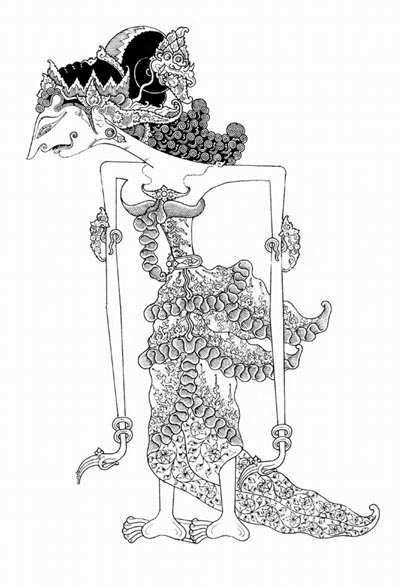
Meanwhile, music and dance saw their own manifestations of the gorgeous Sakuntala. Below is an example of Indonesian wayang (shadow-theatre) which is usually set to music. While there is evidence of indigenous story-telling predating the arrival of Hindu traders in the first century AD, much of the wayang oeuvre consists of tales from the great Hindu epics. Kisah Sakuntala, Ibu Kandung Bharata (or, The Tale of Sakuntala, the mother of Bharata) is one in the repertoire.
Sakuntala (Indonesian wayang)

One of Franz Schubert's operas is Sakontala (1820), an unfinished sketch with libretto by his friend J. P. Neumann. As late as 2000, one writer had written, "[Sakuntala] remains to this day the one and only Schubert stage work of which not one note has been performed for the public, anywhere, ever."[4] (This is not quite correct: a German television programme featuring Mallika Sarabhai's dance company had this music, and there have been some productions as well in the 1970s.)


Between 1913 and 1914, the sufi Hazrat Inayat Khan (1882-1927) visited Russia. He was received with much warmth in artistic circles, and he produced a ballet there titled 'Sakuntala'. The director Alexander Tairov had set up a new theatre; it was his hope to synthesise a multi genre spectacle. Inayat Khan's idea of a mystic balletic performance of Sakuntala appealed to Tairov. The music for the spectacle was arranged by Vladimir Pol. The New Theatre opened the production on 25 December 1914, with the title role played by Alisa Koonen. This wasn't a classical ballet but rather a dance interspersed with dramatic movements. Tairov wanted to present the production to the Czar, which sadly never happened. For a long time the music was thought to have been lost, but in 1991, it was found among various other documents at the Glinka Museum of Musical Culture. Three years later, a quartet of the Russian academy of music performed the piece. [5]


In 1889, Frederick Delius (1862-1935) set poetry by a Dane called Holger Henrik Herholdt Drachmann to music. A Dane! Who would have thunk it? Here's the first stanza of the poem:

Jeg kunde for Længsel ej sove,
En Blomstervind
Slog mig imod,
Strømmed herind ad mit Vindu
Som en vellugtaandende Flod;
Jeg hørte de høje Palmer
Suse svagt
Med sød Musik;
Det hvisked ihvor jeg stod og gik:
  Sakuntala, Sakuntala.

(I could not sleep for longing, a flower wind struck me ... )

It seems Drachmann had seen a staging of Kalidasa's play in Munich, and was struck by the parallels between his own ruined marriage and that of Sakuntala. [6]

Not to be left behind, the Italians got into the act as well. Here's Franco Alfano's 'La leggenda di Sakùntala', first act. He wrote it in 1921.


And that's it for now!

References

1. Jeremy Howard, Art Nouveau: International and National Styles in Europe, Manchester University Press, 1996.
2. Susmita Sundaram, 'Translating India, constructing self' in (ed.) Brian James, Contexts, Subtexts and Pretexts: Literary Translations in Eastern Europe and Russia, John Benjamins Publishing, 2011.
3. (ed.) Martin Lerner, The Flame and the Lotus: Indian and Southeast Asian Art from the Kronos Collections (p. 90), Metropolitan Museum of Art, 1984.
4. Uncle Dave Lewis, 'Franz Schubert: Sakontala', AllMusic.com
5. Cyclowiki, Shakuntala ballets (in Russian).
6. Hattie Anderson, 'Vilhelmine, the Muse of Sakuntala', The Delius Society Journal, Spring 2000, Number 127. (See here for PDF.)

Sep 16, 2011

Muhawbelly

It was Onam the other day. I only noticed because fellow Malayalis were busy congratulating each other. The wife was gallivanting around Budapest and the boy and I didn't feel like a sadhya. Not that the boy knew anything about sadhyas. He is a simple soul. Give him a chapati and dal followed by a gulab jamun and he is happier than Larry.

Still, I ought to do my part as a Malayali parent, I thought. I'm not much by way of religiousness, but a festival is a festival, innit? And there are legends. Everybody likes legends. I called the boy over.

"Today is Onam," I said.

"Okay," he said. "Can I go and play now?"

"Let me tell you about Onam," I said.

He sighed.

"It is the biggest festival in Kerala," I said.

He didn't say anything.

"There was a king many many years ago," I said. "He was a good king and everybody loved him."

"Were there dinosaurs?" said the boy.

"No," I said. "When dinosaurs roamed the earth, there were no people."

"Were the people all with Krishna?" said the boy.

"Yes, maybe," I said. "Now, the name of the king was Mahabali."

"Was I with Krishna when you and Amma got married?" said the boy.

"Yes, yes," I said. "Mahabali took care of his people. He was so good that the gods got worried."

"Why?" said the boy.

"Well," I said, "I guess the gods thought the people would forget them if they were so happy with their king."

He looked puzzled but kept mum.

"What was the king's name?" I said.

The boy mumbled something.

"Mahabali," I said.

"Muhawbelly," he said, deuced Englishman that he is.

"So Vishnu was born as a little man," I continued. "He came to Mahabali's court. Mahabali saw him and said, 'Ask me for a boon.'"

"Was he a carnivore?" said the boy.

"Eh?" I said, momentarily confused. "No, not 'bone'. 'Boon'. A boon is a wish."

"Okay," said the boy.

"Mahabali said, 'Do you want riches? Gold? Food? Whatever you want, it's yours.'" I continued. "But the little man said, 'I only want as much land as I can cover in three footsteps.'"

We thought about this for a while. The boy took three steps on the carpet.

"That's not a lot," he said. "Why didn't he ask for a toy or something like that?"

I shrugged.

"Mahabali agreed," I said. "And suddenly the little man grew enormous. E n o r m o u s. With one step, he covered the earth. With his next step, he covered the skies."

The boy's eyes first grew round and then narrow. Before he could speak, I continued, "'Where shall I place my foot for the third step?' asked the giant. Mahabali realised then that God Himself was before him. He bowed his head and asked Vishnu to place his foot on it. Vishnu did so and pushed him deep into the underground."

"Did he die?" said the boy.

"Nobody knows," I said. "But Vishnu was so pleased with Mahabali's generosity that he granted the king a boon as well. Every year he could come out of the underworld for a day, and his people would see him and be happy. And his land, Kerala, would be lovelier than heaven. And that day is Onam, and people every year await their king."

We sat and looked at each other. The boy didn't look very impressed.

"Is the story finished?" said the boy.

"Yes," I said.

"Is the king here?" said the boy.

"No," I said. "He is in Kerala."

"Did anyone see him?" said the boy.

"I'm sure someone said they did," I said.

"If the king was so good, why did Vishnu kill him?" said the boy.

I was afraid this would happen. Logic is not best served in legends.

"Er," I said. "Mahabali was a good king, but he was a demon, so the gods didn't like him much."

"But if he was good, how can he be a demon?" said the boy.

"I think you should ask Amma that when she comes back," I said.

[For anyone curious about Onam, Maddy's got a nice write-up.]

Jan 16, 2011

Wikicycle

It’s the tenth anniversary of Wikipedia (all hail) and the net is filled with celebratory topics and adulatory commentary. I’m somewhat inspired by a recent piece I saw on the BBC News website reporting on (pseudo)random browsing through the Wikipedia site, the writer starting with Aristotle, following links for an hour, and somehow finding his way back to Aristotle. Reminds me of James Burke’s Connections, which you will be pleased to know has a Wikipedia page all to itself as well.
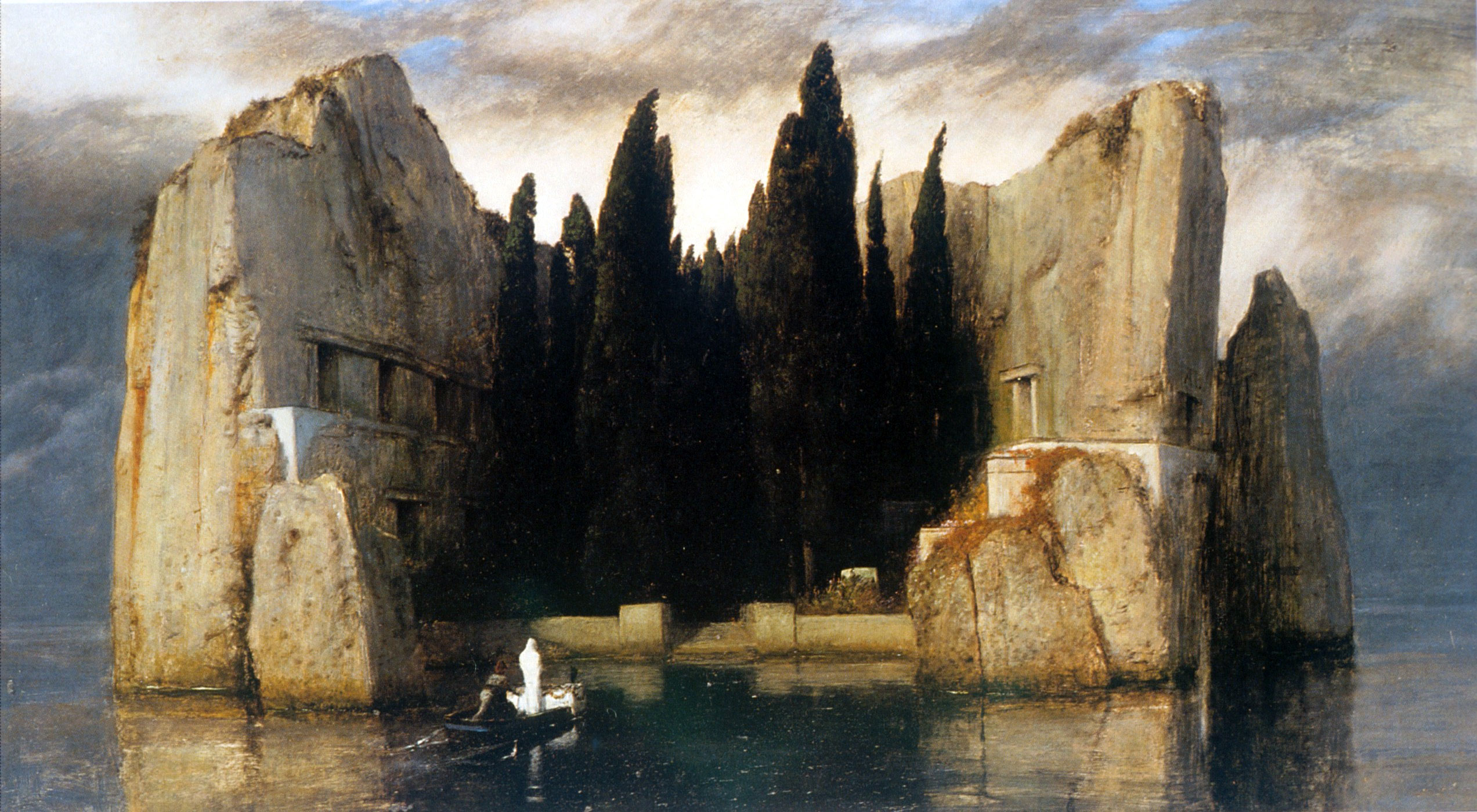
I’ll try to achieve a circular tour, but via the Russian Wikipedia, and see where that will get me. At the very top level, under the section ‘Did you know?’ appears the statement: A hundred years ago, it was a rare Berlin household that didn’t own a print of the ‘Islands of the Dead’. This was a series of paintings by the Swiss symbolist artist Arnold Böcklin, who created five variations on the theme between 1880 to 1886. In all of them, a boat approaches a small island that is riven with sharp cliffs; the boat is often assumed to be that of Charon, and the waters either of the Styx or the Acheron.

Now I can either head towards ‘Symbolism’, or ‘Charon’, or even ‘Acheron’, but instead I’ll look into the Styx – and I’ll find that it disambiguates to the legendary Greek river, a small river in Perm, a communication protocol implemented in the Inferno operating system, and also a rock band of the 1970-80s.

The rockers of the first incarnation of the Styx had four successive multiplatinum albums; I only recall with affection with one song ‘Mr Roboto’, from which – nearly 20 years ago - I learned that ‘Domo Arigato’ was Japanese for ‘Thank you’. Their song Krakatoa (1974) had a spread tone – a single note that attenuates and amplifies in loudness - that is supposed to have inspired George Lucas to create the audio logo (Deep Note) for his hi-fi cinema audio standard THX.
Krakatoa, of course, is the Indonesian supervolcano that erupted in 1883, but there’s no link to it from the Styx’s page, so I’ll go instead to George Lucas (1944- ), a famous film director who equally famously gave up any artistic integrity when he created the dismal prequels to his Star Wars trilogy. As a film technologist, however, he is incomparable: besides the audiovisual standards of the THX that I mentioned above, he is also responsible for Industrial Light and Magic, a preeminent special effects house, and Pixar, an animations studio. An interesting aside available on the Russian wiki (but not on the English version) is of Lucas’s visit to Moscow in the 1990s. He asked Russian officials to introduce him to Pavel Klushantsev, a film director. The officials, of course, had no idea who Klushantsev was. Lucas replied, ‘Klushantsev is the spiritual father of Star Wars.’ The two directors never did meet.
Pavel Vladimirovich Klushantsev (1910 – 1999) was a self-taught special effects engineer who created many techniques of special effects that proved influential in cinematography worldwide, and developed an oeuvre of documentaries that blended hard science with science fiction. For example, in 1934, his film Road to the Stars had cutting-edge special effects that accurately depicted weightlessness in space, a rotating space station, and even rocket travel to the moon.
Klushantsev also wrote books popularising science, and top Soviet illustrators did the drawings for them. One among them was E. V. Voishvillo who was a fairly well-known painter of marine scenes, many of which find pride of place in St Petersburg’s Museum of the World Ocean.
 
Here is Voishvillo’s depiction of St Nicholas, one of Peter the Great’s boats, considered the grandfather of the Russian navy; I learn that Voishvillo collaborated with A. L. Larionov in reconstructing a copy of Peter’s boat.
St Nicholas, it is often said, is also Santa Claus, but there’s no link out of Voishvillo to the bearded bearer of gifts, so all I can do is use Peter the Great as a conduit to further exploration. I find that he was a prodigious drunk, a lover of all things German, and his first official mistress, Anna Mons, was either Dutch or German herself. Sadly, there don’t appear to be any extant paintings of this famous beauty, so I’ll just put up one of Mary Hamilton, another of Peter’s lovers, whom he executed on the charge of infanticide, treason, and sundry other manifestations of his jealousy.

But back to our Anna-Margrethe von Monson! From her, we can head to things Germanic either filmographically to the German actress Ulrike Kunze (who played Anna’s role in “The Youth of Peter the Great”) or musically to Johann Sebastian Bach (who is said to have written the Brandenburg Concertos for Count Keyserling, who married Anna Mons late in his life).
As I hadn’t heard of the lovely Ulrike Kunze before, I might as well head her way. Born in Dresden in 1960, she trained in the dramatic arts, worked in Berlin and Magdeburg in various dramatic roles, and ended up in television, most recently, the series Love in Berlin.
Ulrike Kunze
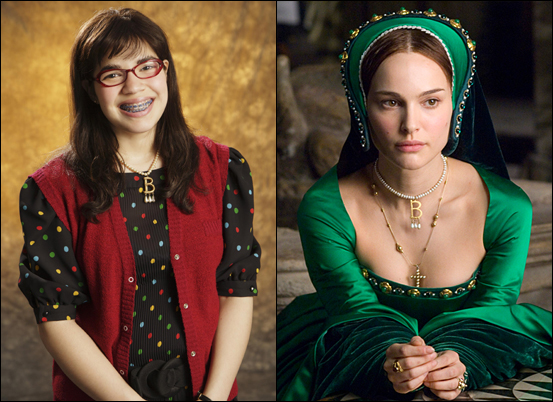
This telenovella is based on the Colombian hit series “Yo soy Betty, la fea”, which inspired, among other things, the US television series Ugly Betty. And just when you think that I’ve managed to telescope from the 18th century to the modern world (all that history was beginning to pall a bit), what do I find? The tacky ‘B’ necklace that Betty wears in the series is an exact replica of a necklace worn by Anne Boleyn.
 
(No post is complete without a picture of the lovely Natalie Portman: fortunately she has her own connection to Anne Boleyn, so this isn’t entirely gratuitous.)
Anyway, as someone said, you either have that bauble around the neck of a Queen, or of a girl from Queens.

Also from Queens is Steinway and Sons, makers of fortepianos and things since 1853. They were famous innovators in advertising and promotions, recruiting, for example, the great Russian pianist Anton Rubinstein (1829 – 1894), to play 215 concerts with their piano in 239 days in 1872. Thus began the Steinway Artists programme.

Anton Rubinstein was a friend of Alexander Glazunov (1865 – 1936), a composer in the Russian Romantic tradition, who composed the Symphony No. 4 and dedicated it to him.

I learn that the second movement of that symphony, the Scherzo, was inspired by Diana’s Chase, a painting, would you believe it, by Arnold Böcklin, with whom we started this Wikiramble.

Full circle, y’all!

Sep 8, 2010

Mahabharata

The literary works of Indian antiquity have long held fascination for readers of all ages, and indeed in all ages. The flurry of reinterpretations and revivals and retellings of the Mahabharata are a case in point. In the last few months alone, there have been new publications of this great tale.

Aficionados are no doubt aware that there are several single- and multi-volume editions of the Mahabharata published in India alone. At a pinch I can mention
Ramesh Menon's works, and Kamala Subramaniam's, and Bibek Debroy's. The abridgements by R. K. Narayan and C. Rajagopalachari are usually the first introductions to this tale. There are also the reimaginings by Pratibha Ray (Yajnaseni) and M. T. Vasudevan Nair (Randaamoozham) (further retold by Prem Panicker in Bhimsen), Shivaji Samant (Mrityunjay) and P. K. Balakrishnan (Ini Nyan Urangatte). This article in the Telegraph describes other efforts by Namita Gokhale, Amruta Patil and Devdutt Pattanaik. And the grand-daddy of them all is the otiose Victorian version by K. M. Ganguli.

Recently, there was
a review written by Wendy Doniger in the London Review of Books, mainly about the new Mahabharata by John Smith, but also providing some coverage of the world of Mahabharata translations. Incredibly enough, she didn't mention any of the Indian works (except Ganguly's) .

I wonder why this is. It could be that the Indian works are not widely available in the West. Possibly Doniger was unaware of them? I doubt that very much - she cites, for example, her review of Ramesh Menon's Ramayana in her list of publications. Or she didn't think it worthwhile to talk about them, assuming that that her readers would find it difficult to procure them. In this world of international shipping, the latter argument is specious.

And so I continue to wonder if this is yet another example of implicit dismissal in the Western academy of Indian intellectual achievement.

Apr 13, 2010

Maritime Jātaka

In the Bāveru-Jātaka1 is a tantalising story of trade between India and the land of Bāveru. Indian merchants took birds with them to Bāveru. Showing off a crow to the Bāveru natives, who had never seen a bird before and clamoured for it, they negotiated a price of a hundred pieces of money for it. On their next trip to Bāveru, the Indians showed off a peacock. The natives of Bāveru, staggered by its beauty, offered a thousand pieces for it. They then abandoned the crow, which went and settled on a dung-hill.

The Master used this story to illustrate some moral or the other, which I shall not bore you with. More interesting are three questions: 1) Where was this Bāveru, and 2) How did the Indians get there, and 3) Is there any supporting evidence to this sort of trade?

Various scholars have identified Bāveru as Babylon2 (although I find it hard to believe the Babylonians had never seen a bird before. Perhaps they hadn't seen a bird as shiny as a crow, or as graceful as a peacock?). There is some speculation that when the Indians called the crow 'useful', they may have meant they could use it for navigation: release it mid-sea, and if it returned, then there was no land nearby, and if it didn't, then there was land around (In fact, the Kevaddhasutta of the Digha-nikaya, a section of the Sutta-Pitaka dated to the 5th century BC, states exactly this navigational claim3.)

Now, of course, these birds could have been brought overland from India - across Sindh and Iran. Or, the merchants could have coast-hopped along the shores of the Arabian Sea. Another possibility is of blue-water journeys, and indeed there are stories in many Jātakas about long sea crossings, implying that such trips were not uncommon.

What evidence, if any, exists for such trades 2500 years ago? Well, it appears that the Tamil words for Indian commodities were used west of India as early as the 5th century BC: the Tamil togai (for 'peacock') became the Hebrew tukki, and the Tamil arisi (for 'rice') became the Greek ορυζα. Still, there appears to be little physical evidence for such maritime commerce in the period prior to Alexander.4


Notes

1. (tr.) H.T. Francis, R.A. Neil, 1897. Bāveru-Jātaka, The Jataka, Vol. III.

2. J. Kennedy, The Early Commerce of Babylon with India, JRAS (1898), pp 246-47.

3. (tr.) Thanissaro Bhikkhu, 'Conversations with the Gods', Kevatta Sutta: To Kevatta, Digha Nikaya.

4. M.A. Smith, 1995, The Development of Maritime Trade Between India and the West from c. 1000 to c. 120 B.C., Master of Arts Thesis, Texas A&M University.

Apr 9, 2010

Tauroid Tales

It has been a long, long time since I've seen the stars. I'm probably of the last generation of urban dwellers that recalls ever having seen the stars atwinkle in a clear night sky. And the only reason that I saw them at all was that in the late 1970s, what with load shedding in Delhi, entire swathes of the city went dark, and cloudless and unpolluted skies meant that the constellations appeared near enough to touch, and the Milky Way truly was Hera's breast milk streaking across the firmament.

Because Taurus is my zodiac, I've had a particular attachment to the stars in this constellation. The Bull squared off against Orion in an eternal battle. Mighty Aldebaran shone orange-red, fiery eye of the Bull, and the nymphly Pleiades clustered playfully. I used to wonder why all the star tales we were ever told were Greek myths. Didn't any other people ever look up at the night sky and see patterns and tell legends that mirrored their lives?

As it happens, they did, and we now have a treasure trove of stories from varied cultures around the world. Among the earliest depictions of Taurus is in the cave paintings at Lascaux, where the painted bull is
depicted with a markings that might represent the Seven Sisters or the Pleiads. For the Chinese, Taurus was not a bull but a white tiger, and Aldebaran then became the eye of that tiger.

Take a look at the name Aldebaran, though. This is an Arabic word, الدبران, meaning
the follower, as the star appears to follow the Pleiades. Many of the brightest stars in the sky have names that come from the Arabic - Achernar, Betelgeuse, Fomalhaut, Mizar, Algol ... - tribute to the great astronomers of the Islamic Middle-East. Aldebaran's Hindu incarnation is Rohini, the ochre-red wife of the Moon.

The Pleiades were called Kṛttikā by Indian astrologers, thought to be ruled by Agni, the Vedic fire god. Kartikeya, the warrior god, was born as six babies from the flaming seed of Shiva, and cared for by the six Kṛttikā, and merged into one infant with six faces by Parvati. For the Hindus, as for many other cultures, there were only six Pleiads; the Greeks claimed there were seven, daughters of Atlas, but one of them, Merope, was shamed into dullness for having married a mortal. They were chased by Orion and Zeus saved them by placing them in the night sky; when Orion himself was catasterised, he was set behind them, in tribute for that great chase.

There is another tale of a chase that resulted in the Pleiads: among the Kiowa of North America, it is said that seven girls went out to play, and were attacked by bears, and they ran up a rock and prayed to the spirit of the rock to save them, which it did by raising the rock to the heavens and placing the girls there as stars. The bears chased the girls onto the rock and left deep gouges on its sides as it became too steep for them to climb. That rock, they say, is the
Devil's Tower, in Wyoming.

For the
Mungulkabultu of Queensland, the Pleiads were the disastrous consequence of the loosening of the taboos of marrying within the clan. The king, Yunguipan, an emu man, continued to consort with Wakolo and her sister, both emu women, despite the advice and warnings of his priests. An insurrection against him resulted in various ills and chases and magics, and he and seven women found themselves entrapped in a log, and raised to the skies, where they became Aldebaran and the Pleiads. Wakolo, injured as she was in the tribulations on Earth, became the faintest of the seven stars.

Recently, I came across a Manipuri tale of the Pleiads in
Medieval Indian Literature: An Anthology, edited by K. Ayyappapanicker. A 14th century poem, Khongjomnubi Nongaron, tells of six girls who went to the lake to buy fish, and met six youths who begged them to stay the night, which they did unwillingly. The next day the girls were turned out of their homes by their parents for the shame they had brought to the families; upset because they couldn't find their lovers, they climbed a lofty mountain and prayed to the Sky God Soraren to save them. He turned them into the Pleiades, and the youths who had been in pursuit of the girls were turned into stars as well. The girls and the youths were allowed to descend to earth to consummate their relationships only once a year, and their children became cicadas.

If you know any other tales of Taurus, do shout.

Sep 21, 2009

London City Quiz

At the Barbican Library, there is a spectacular collection of documents from London's history all the way back to 1722. To celebrate this fact, there has been an exhibition of a thousand tomes available to borrow on the open shelves from June 2009. And, to encourage people to learn more about this greatest of cities, the library offered the following quiz, a lucky winner of which would win the Museum of London book London: The Illustrated History:
  1. In 1941, Noel Coward sang of 'London Pride', but what exactly is 'London Pride'?
  2. How many times was Dick Whittington elected Lord Mayor of London?
  3. Including the City of London (the 'Square Mile'), how many London boroughs are there?
  4. What type of mythical creature is depicted on the City of London crest?
  5. Which infamous building once stood on the site of the Old Bailey?
  6. The Olympics were twice previously hosted in London - which years?
  7. In which year was the last public execution carried out in London?
  8. Name two films, made famous by Ealing Studios in the late 1940s and early 1950s, with areas of London in their titles.
  9. In which year did trams disappear from the streets of London?
  10. Which is the odd one out in this selection of Cockney rhyming slang: Whistle and flute / Alice bands / Almond rocks / Round the houses / Dicky dirt / Tit for tat
  11. Whose address was once known as 'No. 1, London'?
  12. 'Going west', 'One for the road', and 'On the wagon' are all associated with the trip to which part of London, a trip that many were reluctant to take?
So there you go. Eminently do-able with judicious reference to the Internet. Have fun!

[Oh and yeah, the book's already been given away.]

[We continue the paraphrase of Allan Chapman’s Gods in the Sky, episode 2, from Channel 4]

So what was the point of the bizarre calendars we discussed in the first part of this post?

The primary function of the astronomical religions was to allow farmers to predict the seasons (as we have also seen from our exploration of Ancient Egyptian myth and faith). Indeed, it is the writer Hesiod who gives us the first documentary evidence of how the gods in the sky were used in farming:

But when Orion and Sirius are come into mid-heaven, and rosy-fingered Dawn sees Arcturus (30), then cut off all the grape-clusters, Perses, and bring them home. Show them to the sun ten days and ten nights: then cover them over for five, and on the sixth day draw off into vessels the gifts of joyful Dionysus. But when the Pleiades and Hyades and strong Orion begin to set (31), then remember to plough in season: and so the completed year (32) will fitly pass beneath the earth.

Like the peasants of Egypt and Babylon, Greek farmers used their myths to tell the time, but their myths were a lot more complicated than those of the other ancient peoples. And here lies a clue for why it was that the Greeks became by far the greatest astronomers of the ancient world.

In Greek legend, the Moon was held in special reverence, and worshipped as a beautiful and fertile goddess. She was a fertile goddess because her phases corresponded to the menstrual cycle of women, and she was so adored because she was so incredibly useful: her cycle lasted 28 days, dividing the month into 4 weeks. So, the adoration is understandable. But why did the Greeks have so many moon goddesses? Artemis was one, wielding her crescent bow; but so was Athena, who was known as ‘One who shines by night’; Hera, the wife of Zeus, was a moon goddess, as was the virgin Amalthea, and the orgiastic nymph, Io; and Nemesis, Andromeda, Danae, Selene, Helen, Persephone, Adrastea.

In Ancient Greece, you could hardly hurl a discus without hitting a moon goddess. The Sun was no slouch in multiplicity of godheads either. Take the Orion myth: Helios was the Sun. So was Apollo. And Zeus. And Hephaistos. Some Greeks worshipped the Cyclops as a one-eyed Sun god.

Why is Greek myth so complicated? Why all these multitudes of divinities? The answer lies in geography. Greece003 delphi comprises many small islands, and each island contained its own community often worshipping its own astronomical gods. As the Greeks were unified, all these various gods and myths became combined, making their legends very complicated, for they now consisted of multiple overlapping stories of astronomy and timekeeping. What’s more, the myths also began to reflect political relationships between the Greek states. The battles between the Greeks were recorded as squabbles between their various gods. And the fact that the Greeks lived in separate communities meant as well that there were differences in the ways they worshipped their pantheons.

This was to be crucial in the development of scientific astronomy. When the Greeks wished to talk to their gods, they would travel to the great temple at Delphi to meet the priests who would intermediate between them and the deities. At Delphi, they would ask questions of Apollo. But unlike the faithful of other peoples such as the Babylonians and the Chinese, the Greeks sought not instruction from their gods, but advice. And they could choose whether to accept or reject that advice. The Greeks, you see, were free.

Of all the peoples of the ancient world, only the Greeks enjoyed freedom, and this made a big difference to their view of the Universe. To see why, we can examine the despotic regimes of the ancient Orient. Unlike the Classical Greeks who lived in independent and democratic city-states, the Orientals lived under the heel of mighty monarchs, absolute kings, ruling by divine right in the names of their gods in the sky. 004 japan In Japan, it was said that the rule of the Mikado was by direct right from the Sun Goddess, and since he was the earthly representative of the divinity, he accompanied his court astrologers when they were taking astronomical readings of the shadow cast by the sun. Like the rulers of Ancient Egypt, the Orientals believed that the order they imposed on earth was a direct consequence and mirror of the order in the heavens. And just as the earthly emperor ruled on earth, so a Heavenly Emperor ruled in the skies. In China this was the Jade Emperor who lived in a cloud palace in a pearl star, and was so mighty he controlled the movements of the stars and the planets. To illustrate, we have the myth of the ox-herd.

The Jade Emperor’s daughter, we are told, is a beautiful princess called Chi Nu, the celestial goddess of weaving, associated with the star Vega, and who formed the constellation of Aquarius. Chi Nu was said to have made the clouds, and worn magical garments that changed colour with the seasons. One day she came down to Earth, and approached the bank of a silver river. She took off her magic coat and stepped into the flow in order to bathe. But while she was bathing, she was spotted and abducted by a common ox-herd (who was later to be associated with the star Altair, and whose ox was the constellation Capricorn). Much to the displeasure of the Jade Emperor, the two were happily married and had children. But one day, Chi Nu rediscovered her magic coat, and flew back into the heavens. To prevent the oxherd from following her, the Jade Emperor threw up the silver river into the heavens where it became the Milky Way.

Now this story which pertains to two stars belonging to what is now called the Summer Triangle is quite unlike the myths of the Greeks, for here we do not find a bunch of squabbling gods. Instead there was one supreme ruler, the Jade Empeoror, and it was in the name of this heavenly monarch that China’s rulers governed. So to challenge the earthly ruler would be to challenge the heavens themselves. You can see this in the myth of Monkey.

The story of Monkey is a satirical creation. Like other creation myths, it begins with an egg, which is fertilized by the wind. From the egg, there emerges a rebellious monkey who refuses to obey the laws of any human king, and declares himself a monkey king, and tries to become immortal like the heavenly ruler, to live forever among the people of the sky. This insolence angers the Jade Emperor and he summons the heavens themselves to attack Monkey. First, Monkey had to battle with the stars, and then with the planets, and if these weren’t enough, the Jade Emperor sends Time itself in the form of the twelve hours to attack the rebel.

Because the rulers of the ancient despotic lands claimed to govern as a divine right, the development of astronomy was seriously stymied, for anyone who speculated about the nature of the heavenly bodies was condemned as a blasphemer and a traitor. People were not free to question the official view of the heavens. What’s more, this way of linking the affairs of heaven with those of earth was deeply astrological, and a disturbance above would immediately suggest to a soothsayer something amiss down below. As a result, emperors were keen to keep astronomical data a closely guarded secret, terrified as they were of adverse astrological predictions, which they thought would reflect badly upon their rule. Astronomy, then, became a closed system. Although the Chinese collected a stupendous amount of astronomical data, they were unable to develop a truly scientific astronomy.

Today we might imagine that scientific astronomy began with Galileo and Copernicus. In truth, though, it was the Ancient Greeks who created the science of star-gazing. To understand how and why, we must look down from heaven and out to sea.

[To be continued.]

Sep 4, 2009

Like a Greek God

[From Allan Chapman’s series God in the Sky (Episode 2) on Channel 4]

In the beginning, according to the Ancient Greeks, there was no Heaven, no Earth, only Chaos. The only thing that existed in the midst of Chaos was a beautiful mighty goddess. She was black-winged Night. As black-winged Night danced, she set in motion Wind, which was something other than herself, with which she could begin the work of Creation. Night danced more and more wildly, arousing the sensual pleasure of the Wind, which coiled itself around her divine limbs and mated with her. And she became pregnant.

In the bosom of the infinite depths, black Night laid a silvery egg. We are told that after long revolutions over the ages, out of this egg, was born graceful Eros, the double-sexed goddess of sexual passion. And Eros brought out with her the Universe itself, the starry firmament set in motion. And to the stars, she added the Sun, the Earth, the Moon, and the planets.

According to the Greeks, the Universe was populated by a curious collection of gods and goddesses, whose adventures were recounted in the most bizarre stories. For example, we are told that after Eros set the cosmos in motion, mother Earth mated with Uranus, the sky god, and gave birth to the seven Titans, including the gigantic Atlas, whose job it was to guard the planets. But mother Earth became angry with her husband Uranus, and she persuaded her son Chronos to castrate his father. Chronos, whose name means time, stole into the royal bedchamber, and holding his sickle in one hand, crept up to Uranus; finding him asleep, he lifted Uranus’s tunic to reveal his father’s genitals, and he grabbed Uranus and castrated him. Chronos hurled the genitals into the sea, and from the foam they created, emerged the lovely Aphrodite, lovely and fatal.

Chronos then married his sister Rhea, who was also an Earth goddess. But it was prophesied that he would be overthrown by one of his own children, so every year that Rhea brought forth a child, Chronos would snatch it and swallow it. But Rhea grew tired of this and stole off one night to give birth in a place that Chronos could not reach. Thus Zeus was born, who in turn fathered two more planetary deities, warlike Ares and the swift Hermes, the speedy messenger of the gods.

001 What to make of all this? First of all, we should recognise that this creation myth shares a lot in common with creation myths of other peoples. These tales begin with primeval Chaos, out of which emerges the cosmic order of the gods in the sky, whose adventures often conceal important astronomical references. But the character of the Greek gods also reflects the nature of the planets. Saturn, the slowest and dimmest of the planets, was represented by the slow-witted Chronos, father of Time. Mercury, which whizzes around the Sun in only 88 days, was personified by Hermes. Jupiter, which is visible for most of the year, was represented by Zeus, King of the gods. Angry Mars, the red planet, was the warlike Ares. And Venus, which mysteriously appears and disappears, was the fickle Aphrodite, goddess of love.

But why did the Ancient Greeks worship the stars and the planets? Just like the Ancient Egyptians, the astronomical worship of gods in the sky had a practical application. The preoccupation here is with the understanding of Time, and this conundrum lies at the heart of many Greek myths. Take for example the story of Nemesis. She was a nymph goddess who always carried a wheel in one hand. We are told that Zeus fell in love with her and pursued her many months, eventually catching her and ravishing her. But we are also told that Nemesis pursued Zeus over many months, until she captured him and devoured him. This is a classic calendar myth, with the wheel of fortune representing the progress of the seasons, Zeus represents the Sun whose fortunes rise and fall as the year moves on. As the days lengthen and the fertile days of spring and summer dawn, so does Zeus enjoy good fortune. At the summer solstice, as the year moves to dreary autumn and bitter winter, Zeus is enfeebled and Nemesis devours him.

002 orion Different myths like this described the various phases of the solar year, and are found in a number of primitive societies. The Greek tales, however, went deeper, and a detailed examination of them reveals a close understanding of the movement of the planets and the stars. Take for example the myth of Orion. We are told that he fell in love with the lovely Merope, daughter of the King of Chios. Orion was the handsomest and cleverest hunter alive, but despite many attempts, he failed in his effort to marry Merope. When he was drunk in desperation, the cruel king of Chios crept up and put out his eyes. An oracle prophesied to Orion that he would regain his sight if he travelled to the east and showed his eye sockets to Helios. Although he couldn’t see, he was guided by the sound of hammering, which came from the workshop of the god Hephaistos, the smith of the pantheon, who made golden tables with the help of the one-eyed Cyclops. When Orion arrived in the east, it is said that the goddess of the dawn fell in love with him and persuaded her brother Helios to restore his eyesight. But then, we are told, Orion fell in love with the virgin Artemis, goddess of the silver bow. But her jealous brother Apollo sent a monstrous scorpion to pursue the hunter. Orion attacked the scorpion with arrows, but the scorpion’s armour protected it. Orion then attacked it with his sword, and failed again. He was forced to flee by diving into the sea. Apollo then persuaded Artemis that the figure bobbing up and down in the sea was some impudent mortal who had insulted her priestesses. And so Artemis was tricked into attacking and killing Orion. Upon realising her error, in her grief, Artemis set Orion and the scorpion into the heavens as constellations.

This myth is rife with astronomical references. Orion and Scorpio were names used by the Greeks to describe constellations as they are today. Helios was the Greek sun-god, whose chariot was built in the smithy of the crippled Hephaistos, who also built golden tables supported by three legs representing the three Greek seasons. Even the Cyclops was linked with the Sun, his single eye being an ancient solar symbol, as it had been for the Egyptians. Apollo, too, was associated with the Sun, while his sister Artemis, with her silver crescent bow, was the moon goddess.

The Orion myth contains important astronomical observations for time-keeping, in this case marking the beginning and end of summer. The Greeks noticed that the constellation Orion sank below the horizon for two months during spring, but rose up to mark the beginning of summer. His blindness represents his temporary absence from the heavens during spring, whilst the restoration of his sight by Helios, which 3000 years ago, would have coincided with the beginning of summer’s heat.

The Greeks also noted that at the end of summer, the sun rose in the constellation of Scorpio. In the myth, therefore, Orion gets chased off by the scorpion.

But was the point of these bizarre calendars? Well, (in KM’s honour) you’ll have to wait for part 2 of this post.

Aug 30, 2009

Astronomer Priests

Why, goes the question, would there have been astronomy in ancient times? Everyone then thought that the sky was Heaven, and that it was filled with mysterious creatures. Stories about these creatures and their doings formed our earliest myths. Was there any connection at all between this early mysticism and the beginnings of astronomy? Behind these tales of gods and monsters, was there a glimpse of divine reason?

When our ancestors gazed into the night sky, they saw more than stars. They saw heavenly creatures and terrible beasts whose moods could shape their lives and fortunes. These heavenly denizens were feared and worshipped by the ancients, who recorded their stories of love and war, jealousy and revenge. These stories are nowadays dismissed as fairy tales, but Dr Allan Chapman believes they are the earliest records of astronomical observation, and do much more than expected in explaining the beginnings of human civilization.
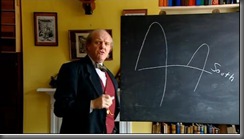
001 One of the oldest scientific instruments known to man is Stonehenge, a millennia-old collection of rocks assembled to mark the summer solstice – the longest day of the year. The builders of Stonehenge knew that the length of the day, as measured by the arc described by the sun on its path across the sky, was a function of the season. In winter, the sun would describe a short arc, not rising too high above the horizon (right-hand arc in figure); in summer, however, the arc was much larger, resulting in a longer trajectory, and hence the longer day (left-hand arc in figure). They therefore oriented their monument in the direction of the midsummer sunrise, and that would then act as a natural marker of time and season.

We know almost nothing about the people who built Stonehenge. We know nothing about why they built the monument; we know nothing of their beliefs. So the Druids who assemble each year at Stonehenge to indulge their rituals and mystical mumbo jumbo are enacting a modern fantasy. But we know far more about another ancient culture, and we might profit from an investigation into their astronomical achievements.

002 Ancient Egypt. The adulation and adoration for Stonehenge is nothing compared to the fascination New Age religionists have for the Pyramids. When in the 19th century, European archaeologists rediscovered the civilization of this ancient land, the imagination of the Victorians ran riot. Who could have built these vast monuments, and who could have designed them in this strange way? Fortunately, unlike the builders of Stonehenge, the builders of the Great Pyramids left written records. So we know that the people who designed these structures were priests, and we know that the gods they worshipped inhabited the skies. And we know that the most important of these Gods was Ra.

At the beginning of time there was boundless chaos and out of this chaos came Ra, not begotten of any father, not conceived of any mother. Of his own volition, he gave himself a body and entered into active existence. The demiurge, the supreme being, the quintessence of all the forces and elements of nature! Praise to thee, oh Ra, exalted power and lord of the hidden circles!
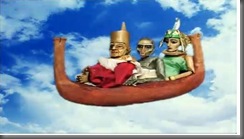
009 royal barge Remarkably, the doings of Ra perform the same function as those of the stones of Stonehenge, for like the stones, these myths refer to important astronomical events. To see how, we must decipher one of the most important of Egyptian myths, that of Ra and the beautiful goddess Nut. It is said that at the beginning of time, Ra took hold of his phallus in his hand and ejaculated the gods Tefnut and Shu, and from them came the star-spangled goddess Nut, whose beautiful naked body straddled the sky. We are told that at the dawn of each day, Nut gives birth to Ra from her blood red birth canal; across the day, Ra sails on his royal barge over Nut’s back, accompanied by Thoth and Ma’at, of whom more later. At night Nut, whom the Egyptians call ‘the sow that eats her own piglets’, swallows Ra, and the cycle of the day is complete.003 ra from nut
So what does this have to astronomy? Well, Ra is the Sun God, and his journey across Nut’s back is the path taken by the sun across the sky. The Sun represented light and dark, hot and cold, life and death, and defined the cardinal points of the compass – North, South, East, West. And when it came up in the morning, the deep dark was banished, and light was cast over the land of Egypt.

We should not be surprised that so many ancient peoples worshipped the Sun. Its appearance every morning represented the victory of day over night, life over death, good over evil. But why did the Ancient Egyptians believe that the Sun was swallowed by a giant woman who later gave birth to him? The story of Ra and Nut is not just a description of the daily journey of the Sun – it is also a clever way of representing the position of the Sun in the sky at different times of the year.

004 nut milky way For the Egyptians, Nut represented the Milky Way. Strangely enough, this hazy spread of stars does appear to bear the shape of a woman arching her back over the horizon (see picture, left). Next, the Egyptian astronomers realised that at the spring equinox the Sun rode to a point corresponding to Nut’s mouth, and moved over the next nine months through her body to be born, nine months after the equinox, at a point corresponding to her birth canal (see picture, right). For the Egyptians, this period of nine months was self-evidently the period of gestation of a human being; added to that fact was their belief that a woman conceives through her mouth, and suddenly the myth of Ra and Nut makes a lot more sense.005 sun thru milky way

The myth of Ra and Nut, then, helped the Egyptians mark two points in their year: the vernal equinox and the mid-winter solstice. But decoding the myth raises further questions: why did they want to mark these points of the year? And why did they worship the objects in the sky as Gods?

Historians are loath to accept any astronomical significance to ancient monuments (New Age nonsense, they scoff), but Allan Chapman believes that it is difficult to understand the purpose of such edifices as the Great Pyramids without recourse to astronomy. The steps leading to the tomb of Cheops in the greatest of the pyramids rises at a particular angle, and while it’s true that this angle has little significance today, we must remember (as historians often tend to forget) that the positions of the stars in the heavens are not fixed for all eternity. They have, in fact, moved in the 4500 years since the construction of the Pyramids. It is possible to calculate what the steps would have pointed towards at the time of the construction – they pointed at a very significant part of the night sky, which the astronomer priests of Egypt associated with Heaven.

They had observed that there was a small group of stars that did not rise, travel across the sky, and set as the other stars did. The Northern circumpolar stars were always visible. These are the stars we call the Great Bear. The Egyptians called them Ikhemusek – the Ones Not Knowing Destruction.

With the Ancient Egyptians we see for the first time the idea of a Heaven in the skies, and this heaven was populated by a bizarre collection of gods and goddesses that they associated with the stars and planets. When they looked at the planet Mercury, the Egyptians imagined the god Seth, the evil god of chaos and destruction. When they observed the planet Venus, they thought of Isis, the lovely goddess of fertility. And when they looked upon red Mars, they imagined they were charting the progress of angry Horus, the falcon-headed son of Isis. 

If we visit the tombs of the ancient Egyptians we see that they are covered with strange incantations to the great Gods, with symbols for the moon and stars and the planets. But why should the priests of the land have been so fixated with astronomical bodies? To understand, we need to acquaint ourselves with the daily rhythms of life in Egypt, lives that were so intimately connected to the mighty river Nile.

Egypt was one of the world’s first agricultural civilisations, and its fortunes, thus, were related to those of the immensely long river that flowed through it. Farming requires planning: you need to know when to sow, when to reap, and you need to know when the river will burst its banks and cover the plain with fertile mud. For all this, you need a concept of time.

To make use of the Nile’s life-giving properties in the dreary desert of Egypt, it was vital for the farmers to know when the river was about to flood. For them, an ability to measure time was literally a matter of life and death, and it was to the gods in the sky that they turned to for help. The use of astronomy in the all-important prediction of the annual inundation of the Nile can be seen in that myth of drunkenness and murder involving the seductive goddess Hathor. Hathor, also known as the star-spangled heavenly cow, was a seductive courtesan and dancer, and also, herself, a lover of the great Ra. We are told of a time when the divine Ra had grown old and dribbled at the mouth, and was mocked by mortal men and women. He summoned the other gods and goddesses to his great house, and spoke to them of the evil words used against him. It was decided that the Eye of Ra should go forth on Hathor and destroy all those who had spoken ill of him. Hathor rampaged throughout Egypt, putting the insolent mortals to the sword. The savage massacre continued until there were hardly any humans left. But Ra realised that Hathor had to be stopped in order to preserve humanity. So he made seven thousand pots of beer and poured them into the Nile. The river rose, flooding the land around, and Hathor noticed her lovely reflection in the rising waters and knelt before the Nile to drink. She drank and drank, until the river subsided, and by the time she had drunk all the seven thousand pots of beer, she was in no condition to kill any more.

The Ancient Egyptians connoted the Sun with Ra, who grows feeble as the summer comes to an end. Hathor they associated with what they called the Dog Star, or Sirius, the brightest star in the sky. Sometime in 3500 BC, it was observed that there was a time of the year when Sirius rose just before the Sun at dawn. This event, it was further noted, presaged the annual flooding of the Nile. By charting the progress of the divine gods, the Egyptians realised they could predict momentous events on Earth, such as the passing of the seasons and the floods of their life-giving river. The acts of the gods had direct consequences on their lives, and that is why it was necessary to worship these gods.

But Ra and Hathor only told the time two or three times a year. The Egyptians needed to tell time at greater frequency than this, and they turned to the wisest of the gods for assistance. Thoth, who accompanied Ra in his royal barge across the day, was the god of wisdom and time. He was depicted with an ibis-head crowned by the rising moon, and this is no accident. The moon, realised the priests of Egypt, was an uncannily regular timekeeper. Over its period of 28 days, it waxed and waned, and its phases had bearings on events on Earth – the tides, for example, or the menstrual cycle of women. And as far as we know, the Egyptians were the first people to divide the year into months, and this was such an important innovation that the moon-god, Thoth, became one of their most revered divinities. And although Ra the Sun was the creator, Thoth the Moon was the controller of the Universe.

But there is a problem. The sun governs the year, the moon controls the month, but there is no satisfyingly regular relation between the length of the month and that of the year. The Egyptians had other difficulties: they didn’t know exactly how long a year was, or when it began and ended. The most important myths of these people, therefore, dealt with their efforts to mark out astronomical time.

Initially, for instance, the astronomer priests believed that the solar year was 360 days long (which, indeed, is the origin of our 360-degree circle). But this  error meant that their seasons began to gradually slip out of line, forcing them to adjust their calendars every few years. Finally, they realised that they needed to increase their reckoning of the year by five days, and this realisation manifested itself in yet another myth of revenge and jealousy.

We are told that the beauteous goddess of the Milky Way, Nut, fell in love with her brother, the Earth god Geb, whom the Egyptians depicted as a bird. But when Nut began to make love to Geb, who should appear but her husband, the great god Ra? Trembling with jealous rage, Ra put a curse on his cheating wife: she would be unable to bear children on any day of the year. The clever Nut realised she could get around this curse by extending the number of days in the year, and to achieve this, she seduced Thoth. After having his wicked way with her, Thoth agreed to help, and oddly enough, began a game of draughts with the goddess Isis, wife of Osiris, whose death marked the shortest day of the year. To the Egyptians, draughts charted the movements of the stars and were much used in astrology; indeed, Thoth himself is said to have invented the board. Unsurprisingly, Thoth was able to defeat Isis and claimed the extra five days as his prize, which Nut then used to give birth to five children; and so it was that the ancient Egyptians became the first people to use a 365-day calendar.

Why did the Egyptians require precision to within a day? Farmers only need accuracy up to the seasons, but the civilisation they wrought had need for far finer details in time. The priests were not just astronomers and religious figures; they were also administrators who needed to organise the business of state. They needed to calculate taxes and pay workers; they needed to agree contracts and arrange building work. These people needed to know what day it was. Such was the sophistication of this culture that they needed to measure time in units smaller than a day! Again the Egyptians found the metronome for such time in the heavens, and again they depicted its discovery in their sagas.

Once again, we have a story of Ra and Nut. Every night when Ra was swallowed by Nut, he was transformed into Osiris, the ram-headed god of the dead. As Osiris, he was forced to sail down the Tuapt, the dangerous river that flows through Nut, passing through twelve gates where the powers of evil congregated to thwart him in his progress. Osiris had to defeat living mummies and the terrifying snake demon with twelve human heads on its back, until in the morning he re-emerged as Ra from the birth canal of Nut.
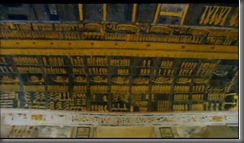
006 nut rameses VI The story of the twelve gates played an important part in Egyptian mythology, as can be seen, for example, in the superb burial chamber of Rameses VI in the Valley of the Kings. A fresco on the ceiling shows the entire legend in spectacular detail: the golden naked body of Nut in a double line across the sky, one side of her representing day, the other night. We see the evening sun entering her mouth and winding its way through her body. The twelve gates through which Osiris must pass are marked by twelve solar discs. At the end of the journey, we see him emerge again as Ra, triumphant in the dawn.

007 zodiac So what is the astronomical significance of these twelve gates? Well, each gate was a star, used by the priesthood to mark time. If they looked at the eastern sky at any period of time, they would see different stars rising and setting, each one following the other and making a great arc across the sky. At first, the Egyptians divided their sky into 18 divisions of the night, each one marked by a star, but they found that at dusk and dawn they lost several of these stars to the twilight. So they ended up using twelve bright stars, which divided the sky into twelve equal sections of darkness; by seein which star was rising, they could tell which gate Osiris was encountering at that point in time, and how many more he had to pass through before being reborn in the glory of the dawn sky. 

The priests didn’t stop measuring time at dawn; instead, they developed water clock to continue the division of the daytime into twelfths. Thus they became known as the Overseers of the Hours. And here we have the origin of our 24-hour day: twelve-hour night and twelve-hour day. For the Egyptians, the hours were a wondrous thing.

The conquest of time is one of the cornerstones of our civilization, for it allows us to reckon our seasons, grow our food, and order our lives. Astronomical timekeeping in Egypt, then, was not incidental to daily life. It was vital.

But we must remember that to the Egyptians the gods were not mere artefacts of astronomy. They were powerful beings that imposed morality and ethics, whose actions had direct consequences on their daily lives. One of the most bizarre of the myths recounts the battle between Order and Chaos, something that was of supreme relevance to the Egyptians’ existence and prosperity, and their fear that Chaos was an ever-present and lurking danger.

Chaos, the Egyptians knew, was a constant threat. There was natural chaos: disease, famine. There was social chaos: criminals, wars and invasions. Bad monarchs meant that there was no justice in the land. Chaos was personified by Seth, the god of destruction and disorder. We are told that Osiris was killed by Seth who hacked his body and scattered the pieces throughout Egypt. Isis, his wife, was distraught because his death meant that she would have no son to inherit Osiris’s kingdom, which would then fall to Seth. So she went in search of the pieces of her husband so that she might conceive from his reconstructed body. Unfortunately, Seth had thrown Osiris’s phallus into the Nile where it had been eaten by a fish. Nevertheless, Isis was able to construct another phallus from the parts of Osiris’s body she found, and with that was able to conceive a new Sun God, Horus. Horus tried to reconcile the warring gods and Seth invited him to his house. When Seth saw Horus, he became aroused and tried to violate the falcon-headed god. He failed in his attempt, but accidentally ejaculated into the hand of Horus. Horus ran to his mother to complain of his violation; outraged, Isis grabbed a sword and hacked off her son’s polluted hand and threw it into the Nile. She constructed a new hand for Horus and excited him sexually and collected his seed in a pot and secretly went to the house of Seth where she discovered some cabbages and poured the seed onto them. Ignorant Seth ate the cabbages and became pregnant with the child of Horus. Now Thoth, as governor of the living sky gods, entered the story. He summoned Seth and Horus to him to attempt to reconcile the two. He ordered that the child growing within Seth should come forth, and come forth he did, a new planetary disk, child of light and dark. Before Seth could claim suzerainty over the disc, Thoth wrestled it away from him, and triumphantly placed it on his own head.
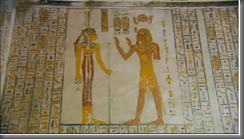
008This is a story of the battle between good and evil, and light and dark, and order and chaos, in which good only wins because of the intervention of Thoth, the moon god. Egyptians described the moon poetically as the child of light and dark, it dispels the dark night with light, and as the primary clock in the sky, imposes order on chaos. Thoth himself as governor of the gods imposed logical order upon stellar and planetary movements, and thus became the Egyptian god of logic and numbers and reckoning as well as language. He was held in special reverence, and they called him the Prince of Books and the Lord of Truth.

Astronomy was religion for the Egyptians because of the deep connection that they saw between events in the heavens and the consequences on Earth. They wished to bring the order and reason and truth they saw in the heavens down to earth and make it a living moral force in their own lives. Indeed, they had a goddess whose special task this was. She was the goddess Ma’at, the third traveller in Ra’s royal barge across the sky. Ma’at was a goddess of paramount importance to the Egyptians. When a king ruled in Ma’at’s name, there was peace and prosperity and order in the land. The Pharaohs had to earn the blessing of Ma’at by governing with the same logic and law on earth that they could see manifest in the heavens.

Today we have driven a wedge between religion and science. Religion is about good and evil, whereas Science is about cold facts and truths. But the astronomer priests of antiquity perhaps recognised better than us that the ability to understand the patterns of nature, and to use this knowledge for our own ends is what protects us from Chaos. This kind of knowledge is not neutral. It is a force for good. 

[From Allan Chapman’s series on Channel 4 – Gods in the Sky]

Every once in a while, mails such as the following erupt and circulate widely, spreading disinformation and canards throughout the world. Many people blindly forward it to their friends; some use it in pub quizzes and claim it's all true; very few are bothered to verify. I am as contrary as a trucker, and so here are my findings, debunking this lot of puerility. (But since my sources are on the Internet as well, you might well want to disbelieve me too.)

In the 1400's a law was set forth in England that a man was allowed to beat his wife with a stick no thicker than his thumb. Hence we have 'the rule of thumb'.
Tosh. There was no such law. It is likelier that the expression (which appears first in the 1700s) stems from the observation that the length of the top joint of a man's thumb is about an inch long. No scale? Use your thumb as a rule.

Many years ago in Scotland , a new game was invented. It was ruled 'Gentlemen Only...Ladies Forbidden'....and thus the word GOLF entered into the English language.
Arrant nonsense.


Every day more money is printed for Monopoly than the U.S. Treasury.
I'm not sure if this is true or not. There's an article by Martin Loughlin that makes this claim, but offers no evidence. So I shall hold fire at this moment.


Men can read smaller print than women can; women can hear better.
There are some sex-based differences among humans, it's true, but the variation is so large that you could almost always find a counter-example to claims such as these. The Language Log, as fine a source of solid information as one can hope to find, there's a good analysis of gender differences. Go and read it and the next time you hear that women use 20,000 words while men only grunt, kick whoever said it in the shins.


Coca-Cola was originally green.
Distilled crap, this. The colour of Coke has always been rich brown. It's been bottled in green bottles, but surely that's not a good reason to make this claim?


It is impossible to lick your elbow.
Take a look at this.


Intelligent people have more zinc and copper in their hair.
First of all, define 'intelligent'. Then explain what zinc or copper has to do with that definition of intelligence. Then show me the evidence.


The first novel ever written on a typewriter: Tom Sawyer.
It appears that Mark Twain made this claim in 1904. But it is difficult to prove. Read all about it here. It seems to be accepted that his typewritten submission was the first to be accepted. On the other hand, he confused his timeline, and there's some evidence that 'Life on the Mississippi' was the first typewritten composition. All on a Remington from 1874! I do have to point out, though, that 'Life on the Mississippi' is not a novel. It's a memoir. Dash it all.


The San Francisco Cable cars are the only mobile National Monuments.
In the United States. Only in the United States. What about the streetcars in New Orleans, eh? Eh?


Each king in a deck of playing cards represents a great king from history:
Spades - King David
Hearts - Charlemagne
Clubs - Alexander the Great
Diamonds - Julius Caesar

A subtle one! Not entirely untrue, but not the complete truth either. The naming of the cards is a French tradition dating back a few centuries. Or so says this site. Note, though, that playing cards themselves are not a French invention, so predating them, the kings might have had other names. Even during the French standardisation around 1780, these kings (and other suits) had been given other names, depending entirely on the whim of the engraver.


111,111,111 x 111,111,111 = 12,345,678,987,654,321
Yeah, and so what? Isn't it obvious? It would have been more remarkable (and as arbitrary, and more forgettable) had the factorization been written as 81 x 1369 x 111333666889.


If a statue in the park of a person on a horse has both front legs in the air, the person died in battle. If the horse has one front leg in the air the person died as a result of wounds received in battle. If the horse has all four legs on the ground, the person died of natural causes.
This used to be a favoured quiz question a few years ago, and I used it on an unsuspecting wife when we first met (she still hasn't forgiven me for it), but I have not found any evidence for this. Indeed, this site says this is possibly only coincidence, and that there has been no such overt tradition in Europe. Another urban legend?


Q. Most boat owners name their boats. What is the most popular boat name requested?
A. Obsession

More trash. Popular in which country? Which year? An informal survey by BoatUS over an 11 year period finds 'Serenity' the most popular in 1992, 1993, 1996, 1998, 2000. 'Obsession' was fifth in 2000. By 2008, 'Happy Ours' was the most popular in the US. Obsession was nowhere in the list. There were also names such as 'Anchor Management'. Two years earlier, the most popular was 'Aquaholic'. What a pointless question this is.


Q. If you were to spell out numbers, how far would you have to go until you would find the letter 'A'?
A. One thousand
On the other hand, if you spelled out the number 101 as 'one hundred and one', you wouldn't have to go as far out as that, eh? And you'd go even farther before you encountered the letter 'Q'. So? Pshaw, I say, pshaw.

Q. What do bulletproof vests, fire escapes, windshield wipers, and laser printers all have in common?
A. All were invented by women.

Some bosh and some truth. Bulletproof vests have been talked about since the 16th century at least; the Koreans came up with a soft vest in the 1860s. At the end of 1880s, Casimir Zeglen, man of Chicago, developed a vest of silk fabric that could stop a slow bullet. The likes of DuPont (of Kevlar fame) have been involved in this as well.

Meanwhile, it's true that the first patent for the fire escape was issued to a woman: Anna Connelly in 1887.

Another woman, Mary Anderson, is credited with the first patent for the windshield wiper swinging arm in the United States in 1903; contemporaneously, J. H. Apjohn "developed a method of moving two brushes up and down on a vertical plate glass windscreen", as Wikipedia deftly has it.

Finally, the laser printer was developed at Xerox by Gary Starkweather. This happened in 1969, and despite all that flower power and hash, he didn't become a woman.


Q. What is the only food that doesn't spoil?
A. Honey
Well, this is true. Ish. Honey has a large sugar content (which is hygroscopic, and sucks moisture out of any bacteria) and some hydrogen peroxide and antimicrobial properties, all of which lend it longevity. But if it is improperly stored, it can develop mould. Surely that's spoilage?


In Shakespeare's time, mattresses were secured on bed frames by ropes. When you pulled on the ropes the mattress tightened, making the bed firmer to sleep on. Hence the phrase 'goodnight, sleep tight.'
As far as I can tell, this is garbage. 'Tight' is generally used to mean 'soundly'. Shakespeare's time doesn't come into it at all. The earliest citation is from 1866, when Susan Bradford Eppes wrote 'Goodbye little Diary. "Sleep tight and wake bright," for I will need you when I return' in her diary Through Some Eventful Years.


It was the accepted practice in Babylon 4,000 years ago that for a month after the wedding, the bride's father would supply his son-in-law with all the mead he could drink. Mead is a honey beer and because their calendar was lunar based, this period was called the honey month, which we know today as the honeymoon.
Again, hogwash. According to the Online Etymology Dictionary, the earliest known use of this expression is in 1546, 'hony moone', possibly a reference to a new marriage's sweetness and how long it will last (given that the moon begins to wane as soon as it is full). For more detail, check this out.


In English pubs, ale is ordered by pints and quarts... So in old England , when customers got unruly, the bartender would yell at them 'Mind your pints and quarts, and settle down.' It's where we get the phrase 'mind your P's and Q's'
Well, this is as much an explanation as another that exhorted printers to watch out for their letters p and q as these were placed (reversed) on the typeset. Or if you want to be really geeky, you might imagine that if a student were not particularly careful and swapped p and q in a Poisson bracket, he might get momentum (p) and position (q) wrong. Yeah, a likely story, that.

Many years ago in England, pub frequenters had a whistle baked into the rim, or handle, of their ceramic cups. When they needed a refill, they used the whistle to get some service. 'Wet your whistle' is the phrase inspired by this practice.

More pish-posh. Since at least 1386 'whistle' has been used as a colloquialism for 'throat'. In 1612, Beaumont and Fletcher's Coxcomb had it thus: "Let’s have no pitty, for if you do, here’s that shall cut your whistle". The alliteration involved no doubt adds to the longevity. The Word Detective even says that in the 17th century, people would use the expression 'wet your weasand' to mean the same thing. Ah, those obsolete words and meanings.

So there you go. My two bits.