Yesterday at 7.00 heroic Theseus fought the red eyed Minotaur because every year 14 tributes were sent to Crete to be eaten by the Minotaur.
At 700 am heroic Theseus travelled to Crete to kill the fierce Minotaur because 14 tributes were sent to Crete because a old fierce king named king Minos was very sad of death of his son. It is well known that 14 tributes were sent to Crete because a terrifying King called King Minos was angry at the people of Crete. At Athens an Athenian went to King Ageus to declare that this year heroic Theseus should beat the half man-half bull creature.
It has been reported that one of the prisoners had seen Ariadne giving Theseus a ball of string. It has also been reported that as Theseus entered the cold dark labyrinth, he saw one horn sticking out behind a pillar.
"As I slowly crept along I saw the brutal Minotaur. I stabbed the cold bloodthirsty Minotaur. I have never been so nervous in my life," exclaimed Theseus.
The defeated King Minos said, "Theseus stole my daughter and the stupid Athenian prisoners and fled so fast."
It is reported that having fled the palace Theseus then cruelly left Ariadne on an island. "I can't believe that Theseus broke the agreement. I thought we had a deal," said Ariadne in anger.
(Newspaper report in the Athenian Metro, by the boy.)
Sofia Papalenou felt the changing seasons through her confectionery: in spring, there were the special Lenten biscuits and Easter breads to be baked; then came the summer wedding season and the demand for cakes and the deep fried pastry dipped in honey, kserotigano, that was handed out at nuptials. August was also the month when they made their own ice-creams in amazing flavours. Then came autumn which was specially busy for celebratory gateaux for saints' days, with Stavros, Elpida and Thomas being particularly popular names in this town. After that were the St Nicholas specialities at the beginning of December, the frantic Christmas period and finally the Vasilopita cakes for the New Year that reminded her that yet another twelve months had gone by and her daughter was still unattached.
From Victoria Hislop's "The Zacharoplasteion" in The Last Dance and Other Stories.
There's been a veritable spate of TV programmes on Ancient Rome lately. Just a week or so ago was Caligula by the lovely Mary Beard. This overlapped historically (and a little bit thematically) with Catharine Edwards' Mothers, Murderers and Mistresses: Empresses of Ancient Rome. Three months ago was Margaret Mountford's Pompeii: The Mystery of the People Frozen in Time, and that was an update on Mary Beard's programme on Pompeii (Life and Death in a Roman Town) from about two-and-a-half years earlier. Last year, we were treated to a series on the religions of Rome (pagan, Christian, Papish) by Simon Sebag Montefiore, as well as a search for its forgotten ruins (amphitheatres, canals, forts, lost cities) with Dan Snow. We've had a three-parter called Treasures of Ancient Rome hosted by Alastair Sooke, which shows us that the Romans may have been famed for murther and engineering, but that they were great artists as well. Mary Beard, too, has been extra busy, because her show on the lives of common Romans (Meet the Romans) was also shown last year.
There have been two programmes on Hadrian and his wall (in the Timewatch series of 2007, and by Dan Snow the following year). There have been several programmes on gladiators (Gladiator Graveyard), most recently in Timewatch again (2007), as well as one from 2003 titled The Colosseum: Rome's Arena of Death. Terry Jones explored the cultures of Rome's contemporaries - the people the Romans liked to call Barbarians (2006). More ambitious than all of these was a six-parter titled Ancient Rome: The Rise and Fall of an Empire also in 2006.
And these are just the BBC programmes. The other channels have not been negligent. Channel 5 has done its bit to promote the imperium (programmes on Julius Caesar and gladiators) as well as Channel 4 with its various Time Team digs uncovering Roman Britain.
You get the drift. Serious obsession with the Romans in these here British Isles. That's all right, it's all classical history and good fun.
So what do these programmes cover? Blood and sensation (peacetime and wartime) and some religion and art. Where are the stories of republican Rome? How did the Romans become a superpower? Where's Roman science? Engineering? Literary Rome? Mercantile Rome?
Classical history, of course, includes the Greeks. Here too we have rich amounts of programming (although nowhere in the league of the Romans). There's the usual stuff - Troy, Sparta, Athens, the battles against the Persians. Luckily there's also been some delightful programmes on Greek science (Aristotle, the Antikythera mechanism), as well as a recent cultural round-up by Michael Scott. But, again, it appears we are fated to see the same tired topics repeated over and over.
Can't we have some coverage of the post-Alexandrian Hellenic world? It extended to north-west India and lasted for centuries, brilliant blends of local cultures with that of the Greeks. What about Ptolemaic Egypt? And, again, mercantile Greece? Or its amazing scientific achievements? True, some of its mathematics was covered by Marcus du Sautoy, and some of its optics by Simon Schaffer. But there's a world of Greek thought just waiting to be shown on TV, surely.
There's more to Ancient Egypt than the Pyramids and King Tut, too. A nice recent programme was on the reconstruction of a boat supposedly sent by Queen Hatshepsut to Punt - although nobody really knows where Punt is. Another one was on the search for Rameses's lost city. (These searches for lost cities always seem to be high on a TV programmer's agenda.)
But there's far more to ancient history! The decipherment of ancient scripts? (You could do a nice programme of about an hour on the topic, using the epic of Gilgamesh as focus. Or an entire series, using a great text from each of the ancient civilisations. How about six parts - Sumer, Egypt, China, India, Maya, and the earliest alphabet (was it Phoenician?)) The hunt for the historical Hanging Garden of Babylon? Again, a stirring subject, with much controversy and any amount of to-ing and fro-ing amongst the historians. What about the spread of Hindu and Buddhist culture out of India? I don't think I've seen much about the Persians (although I recall there was some chatter when the British Museum organised its massive exhibition a few years ago). There could even be a kind of thematic coverage of great thinkers and philosophers - toss Confucius, Buddha, Mahavira, Zoroaster, and a couple of Greeks into the mix - and compare and contrast! I could go on and on.
I've been in this country for ten years, and I've found the quality of its public broadcasting superb, a true wonder. Now if only its coverage would widen.
I dip once every so often into Nicholas Ostler's Empires of the Word: A Language History of the World, a superb study of linguæ francæ (okay, I know that's incorrect and it should be lingua francas, but what's not to like about 'æ'?), and I find that I've forgotten what I've read the previous time. So it's a nice sort of infinite loop to be in. Or worrisome, if you want to think like that.
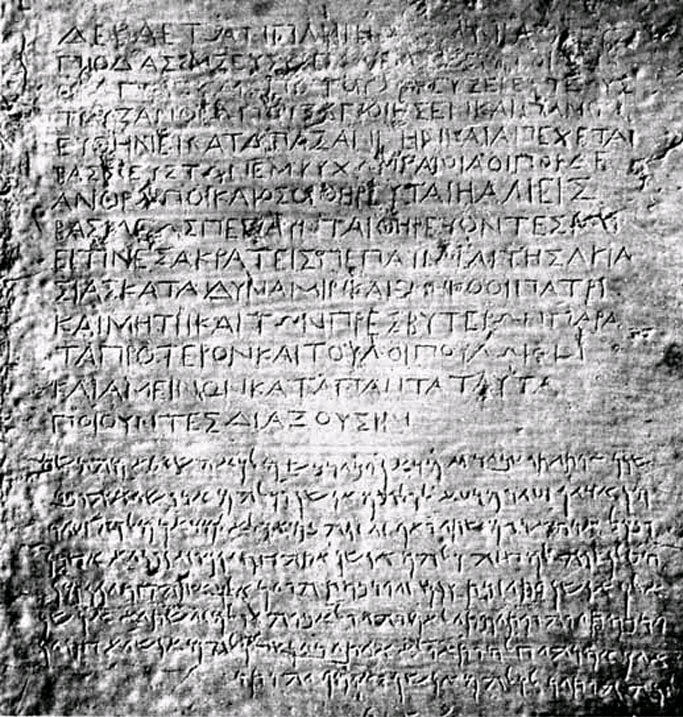
But anyway, that's neither here nor there. I remember reading elsewhere that Ashoka, once he was postbellumly saddened and enlightened, put up his edicts across his vast empire - from Afghanistan all the way south to the borders with Tamil country. In most places, the edicts were written in a script representing an Indian language, but out west, where the neighbours were Greek-speaking (Bactria and all), they were set down in Greek and - I learn from Ostler - in Aramaic.
Ashoka's Edict in Kandahar, Afghanistan
This is a Greek transliteration of his edict - found in the 1950s (?):
שנן 10 פתיתו עביד זי מראן פרידארש מלכא קשיטא מהקשט
מן אדין זעיר מרעא לכלהם אנשן וכלהם אדושיא הובד
ובכל ארקא ראם שתי ואף זי זנה כמאכלא למראן מלכא זעיר
קטלן זנה למחזה כלהם אנשן אתהחסינן אזי נוניא אחדן
אלך אנשן פתיזבת כנם זי פרבסת הוין אלך אתהחסינן מן
פרבסתי והופתיסתי לאמוהי ולאבוהי ולמזישתיא אנסן
איך אסרהי חלקותא ולא איתי דינא לכלהם אנשיא חסין
זנה הותיר לכלהם אנשן ואוסף יהותר.
And this is an English translation (of the Greek) by G. P. Carratelli:
Ten years (of reign) having been completed, King
Piodasses made known (the doctrine of)
Piety to men; and from this moment he has made
men more pious, and everything thrives throughout
the whole world. And the king abstains from (killing)
living beings, and other men and those who (are)
huntsmen and fishermen of the king have desisted
from hunting. And if some (were) intemperate, they
have ceased from their intemperance as was in their
power; and obedient to their father and mother and to
the elders, in opposition to the past also in the future,
by so acting on every occasion, they will live better
and more happily.
I've copied all these texts shamelessly from a Wikipedia page.
Why Aramaic? Well, that was the main language of communication across the Near East and the erstwhile Persian empire. (Recall it had fallen less than a century earlier.) Rather unchauvinistically, the Achaemenid rules of Iran didn't impose their own lingo on their subjects. The Greek bit is slightly more comprehensible - there were Greek-speaking peoples dotting the sundry Alexandrias set up by that maniac eponymous conqueror all the way from Greece to the Hindu Kush. According to Carratelli (the translator above) it appears that the Seleucid rulers of the area were in the process of establishing Greek as official bureaucratic language, but because it's unlikely that Ashoka was propagandising outside his empire, he must have been aiming his bilingual texts for Greeks living within it. (Why is it unlikely?)
Seleucus Nicator and Chandragupta Maurya (Ashoka's grandfather), as is well known, had signed a treaty establishing peace along their frontier. One of the terms was to allow intermarriage between Greeks and Indians, which would allow the former to skirt around the caste rules that dominated daily life under the Mauryas, establishing their position in society. (Prior to the discovery of the edict, it had been thought that Greeks achieved a status as fallen kshatriyas or not-impure sudras only later.) Clearly this socialisation of the Greeks had attained a natural level by the time of Ashoka, and his edict implies how widely understood this equilibrium was.
As for the Aramaic text, it contains Avestan religious words to denote Buddhist concepts, and is clearly addressed to the Iranian people living in the region. But they were not necessarily Zoroastrian (scholars are quite clear that they were non-Zoroastrian Mazdians, whatever that is, or some variant of Indo-Aryan religion). Carratelli suggests that Ashoka was aiming his message at the Scythians (Sakas) who had been living there for yonks.
Reference:
G. P. Carratelli, G. Garbini, 'A Bilingual Graeco-Aramaic Edict by Asoka', Serie Orientale Roma XXIX, 1964.
In Zone Defence, Petros Markaris deftly avoids the usual gastronomic trap that this blog is all about, and cunningly places a recipe for Inspector Haritos's favourite dish at the end of the book. That is not to say that food is not mentioned at all in this very funny crime caper. Indeed, there's a whole scene set in one of the fancier restaurants in Athens, where Haritos's essential country-bumpkin disconnect with haute cuisine is revealed.
Stuffed Vegetables (Constantinople Style)
Ingredients
1 kilo tomatoes
500 grams green peppers
1 kilo onions
250 grams white short-gran rice (not parboiled or basmati)
500 ml olive oil (not sunflower oil)
Some pine nuts and currants
Salt, pepper and spice
Instructions
Chop the onions, put them in a pan and leave to fry over moderate heat.
Slice the tops from tomatoes, remove pulp with a spoon and keep aside.
Do the same with the green peppers, removing the seeds.
When the onions are ready, add 250 ml of oil to the pan, together with salt, pepper and spice. Stir for a few minutes before adding the rice.
Stir the rice and onions before adding the pine nuts and currants.
Meanwhile, crush the tomato pulp with a potato masher. Add half of the pulp to the rice. Stir the mixture for a while, remove from heat and allow to cool for a short time.
Arrange the tomatoes and peppers in an ovenproof dish and, using a spoon, carefully fill them with the mixture. When finished, replace the tops and pour 250 ml of oil over them, together with the remaining tomato mixture diluted with a little water.
Cook in oven for 20 minutes at 250°C and then for another 40 to 50 minutes at 180°C.
Welcome, folks, to the seventy-third Carnivalesque, the Ancient/Modern edition of the popular History blog carnival. Thanks to all those who contributed and sent suggestions.
To start with, take a look at this timeline (timelines being some sort of minor addiction for me) of historical events that occurred in years ending in 73. Trite, eh? There’s considerable uncertainty about the older dates, of course, but if there’s at least one source that speculates an event occurred in such a year, well, I’ve bunged it in.
Events in the years before Christ (or Common Era, to be less religious) appear against negative numbers in this timeline. If you click on any of the titles, a little window should open up with some extra information.
This is the week after Easter, and so a light Christian history thread runs through this carnival. But fear not – there’s lots of other stuff to whet your secular appetites.
And so, to begin:
Africa
Kemsit, the Nubian queen of the Egyptian King Mentuhotep II (2061-2010 B.C.), and her servants; from a painting in her tomb chamber wall
Would you be willing to trek across the Egyptian desert all the way to Chad? Even today it’s a perilous journey, and yet there’s evidence that the Pharaoh Mentuhotep II (2061-2010 BC) organised an expedition to that western land. Read about it in Owen Jarus’ post in Unreported Heritage News.
*********
Europe
Around 3500 BC, the Neolithic inhabitants of the island of Jersey built a worship mound that came to be known as La Hougue Bie. Millennia later, a church was built atop it. The Neolithic mound was equinoctically aligned, and it turns out so is the church. Alun Salttells the story.
You may have seen some racy news recently - First Gay Caveman Found! - etc. Bunkum. The Corded Ware (2900-2500 BC) burial site near Prague was not of cavemen; rather it's of pre-Bronze Age farmers. Why do they think it was a gay caveman? John Hawksdoes a spot of debunking.
If you have wondered why Isocrates (436-338 BC) is not as well-known as, say, Plato, wonder no more. Michael Anderson has the scuttlebutt in his Ancient History Blog.
How likely is it that a list of survivors of the Battle of Marathon survived to this day? Or that such a list ever existed? Rogueclassicism has an overview of the affair of the Marathon tablet (403 BC ?) and its epigraphy.
What do Nerva, Trajan, Hadrian, Antoninus Pius, and Marcus Aurelius have in common? Adrian Murdoch’s series of podcasts on Gibbons’ “five good emperors” (AD 96-180) reveals all that you might want to know. Get them at his blogBread and Circuses.
Ivan Bilibin's Illustration to the Lay of Igor's Campaign (from Wikimedia Commons)
‘In AD 1185, as the Kievan Rus Empire was starting to deteriorate, a little known prince on the eastern Russian borders led his outnumbered men into battle against Mongolian invaders, the Polovtsians (Kumans). This battle and its aftermath would become the topic of the Russian literary epic, “The Lay of Igor’s Campaign.”’ Seesaw discusses the battle, the epic and its musical successors in Russia, Past and Present.
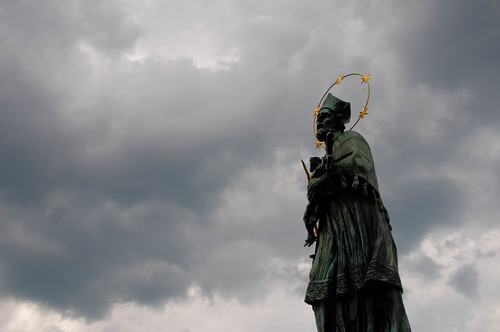
St. John of Nepomuk, Charles Bridge, Prague by dlnwelch, on Flickr
If you wander about the Upper Palatinate in Germany, you might find yourself wondering – as Patrick Shrier did – why there are statues of St John of Nepomuk (d. 1398) on nearly every bridge in sight. What’s a Czech saint doing in Germany? Shrier investigates and reports in Patrick’s Military History Blog.
A oft-repeated statement is that the famous vegetarian Leonardo da Vinci (1452 - 1519) was 'ahead of his time' in sundry disciplines. While this may be somewhat true of his art, it doesn't apply to his technical work, says Thony C. in the Renaissance Mathematicus.
There’s no end to weirdness in Europe, and Vlad the Impaler is about as weird as a historical character can get. Soon after taking up the throne of Wallachia (1457), he invited the nobility to an Easter feast and – well, Executed Today has the story.
'Tis the 550th anniversary of the Battle of Towton (1461) - one among many in the Wars of the Roses in sunny England - and there are no pictorial representations extant of that battle. So what was Sheila Corr to do when she had to provide a suitable illustration for an article in History Today? Find out here.
Speaking some more of seriously weird things: there was much faith in putting one’s fate in the hands of chance (or God) – even secular arguments were sought to be settled by means of trial by fire. One of the last such trials occurred in Florence in 1498, as Beachcombing’s Bizarre History Blog reports in Barbecuing Friars in Late Medieval Florence.
*********
Middle-East
While it’s widely believed that the Abrahamic faiths are monotheistic, there is considerable evidence that Judaism, the oldest of them, was initially polytheistic. JK at Varnamexplains the ins and outs of how god became God and acquired a wife, and other gods were consigned to oblivion (c. 8th century BC)
What’s up with physicists thinking they can contribute to historical analysis? Surely the age of the dilettante is past? Jona Lendering in New at LacusCurtius & Liviusexcoriates Colin Humphreys for his claim that Christ’s Last Supper took place on a Wednesday, and not – as historians agree – on Maundy Tuesday. “The trouble with the Jaubert-Humphreys Thesis is that it solves a problem that does not exist by using a method that is self-contradictory…Unfortunately, this is not an innocent, funny story about scientists who should not pretend they are historians.”
In the early days of Christianity, Easter was the chief religious festival. Birthdays were considered a pagan relic. So how did Christmas become the important festival it is today? Ranjith Kollanur explains in his blogA View From My Disjointed Laptop.
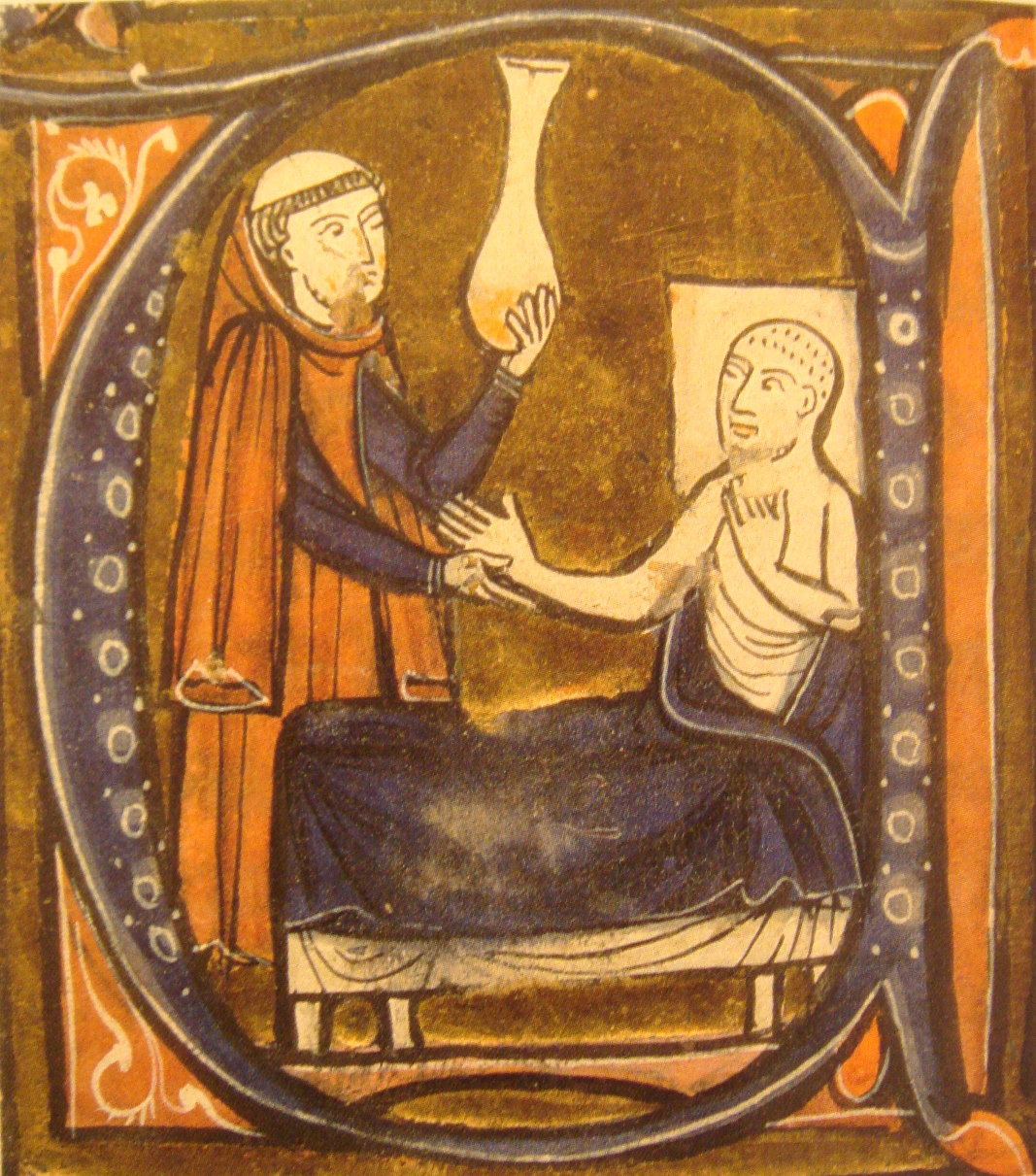
European depiction of the Persian doctor Al-Razi, in Gerardus Cremonensis "Recueil des traités de médecine", 1250-1260. (Wikimedia Commons)
When and where was the definitive recognition of smallpox made? In Persia around AD 900, a medic called al-Razi wrote a treatise named al-Judari wa al-Hasbah (On Smallpox and Measles). Lapham’s Quarterly blog has a small write-up.
*********
Asia
74,000 years ago, human beings were passing the Malay peninsula on their great migration across the planet. Archaeological digs in Perak revealed a sumptuous burial of a man, which showed that Malaysia was no civilisational backwater. Judith Weingarten has the story of the digs and the feisty woman who conducted the research in her blog Zenobia: Empress of the East.
According to the Vedas, a mighty river called the Saraswati flowed through the plains of north India. There have been efforts to identify this river - which no longer exists (in its original size, at least) - and there are controversies galore about its history. Researchers in geology, linguistics, archaeology, history, and climate science have contributed, and Michel Danino has a post discussing some of this interdisciplinary work.
Emperor Wu dispatching Zhang Qian to Central Asia (138 to 126 BCE), Mogao Caves mural, 618-712 CE (Wikimedia Commons)
Tired of horsemen attacking his villages, kidnapping the women and killing the men, and realising that they were untouchable until he obtained a powerful cavalry, in 103 BC the Chinese emperor Wu sent a taskforce to the land of the Wusun to bring back the heavenly horse. Heather Pringletells the story and its later ramifications.
Japanese samurai boarding Yuan ships in 1281 (Wikimedia Commons)
In AD 1281, Kublai Khan sent a fleet to invade Japan. 730 years later, the History Channel purported to explain it all to unsuspecting aficionados of popular history. Learn what really happened, and why you shouldn’t trust (ever!) the History Channel - in this piece by Tatsunoshi in Shogun-Ki.
*********
The Americas
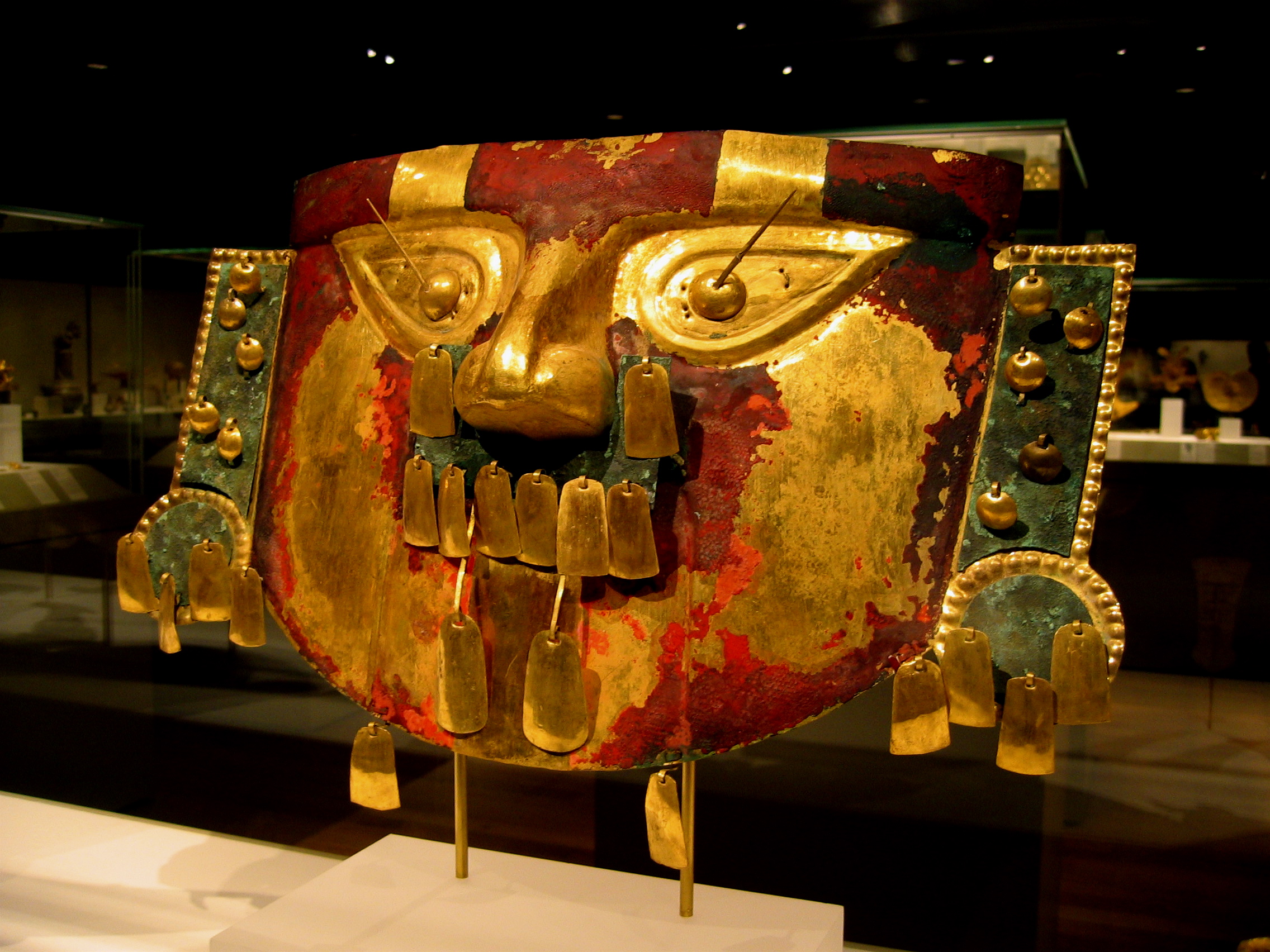
Funerary Mask, 9th-11th century Peru; (Lambayeque) Hammered gold with cinnabar and copper overlays, cinnabar; (Wikimedia Commons)
From the 8th century AD, the Lambayeque culture flourished in northern Peru. Like their more famous successors, the Incas, these were a people wont to fertility rituals and human sacrifices. How about combining the two by sacrificing women? Monty’s Worldhas the story.
Archaeologists long thought that the cultures of Central America and North America had little or no interaction. Now it appears that there may have been thriving trade between them, lasting as long as five centuries from AD 900. The Pueblos of southwest USA drank cacao, which they could only have got from Mesoamerica. As Gregory LeFever reports in his blog Ancient Tides, they would have paid for the cacao with turquoise.
The 400-breasted Mayahuel Aztec Goddess of the maguey or agave (Wikimedia Commons)
Why not ponder the fate of the Aztecs (13th – 16th centuries) and their rabbits? Even before the sanguinary and Easter-loving Spaniards turned up at their doorstep, they celebrated the bunny by naming a day in its honour. And they got as drunk as 400 rabbits. Say what? Judugrovee reveals the story in the blog The Complete Mesoamerica … and more.
*********
And, to round things off, interdisciplinaryment:
Art
When a snake escaped the Bronx Zoo a few days ago, a contest was announced in some papers to name her. Why not Wadjet? Here’s a post by Madeleine Cody in the Brooklyn Museum’s blog about the ancient Egyptian snake goddess, her history, her mythology and some of the art based on her.
Have you heard of the Codex Aureus? It’s a beautiful 10th century parchment manuscript featuring the four gospels. Peacay at the ever wonderful BibliOdysseyhas the scoop.
Allegoric figure of Fortitude from the Four Virtues by unknown artist (also attributed to Botticelli), c. 1490, fresco, Castle Chapel, Esztergom
Lovely Renaissance frescoes (1460s) were found in Esztergom, in Hungary. Zsombor Jékely in Medieval Hungary investigates - are they really by Botticelli?
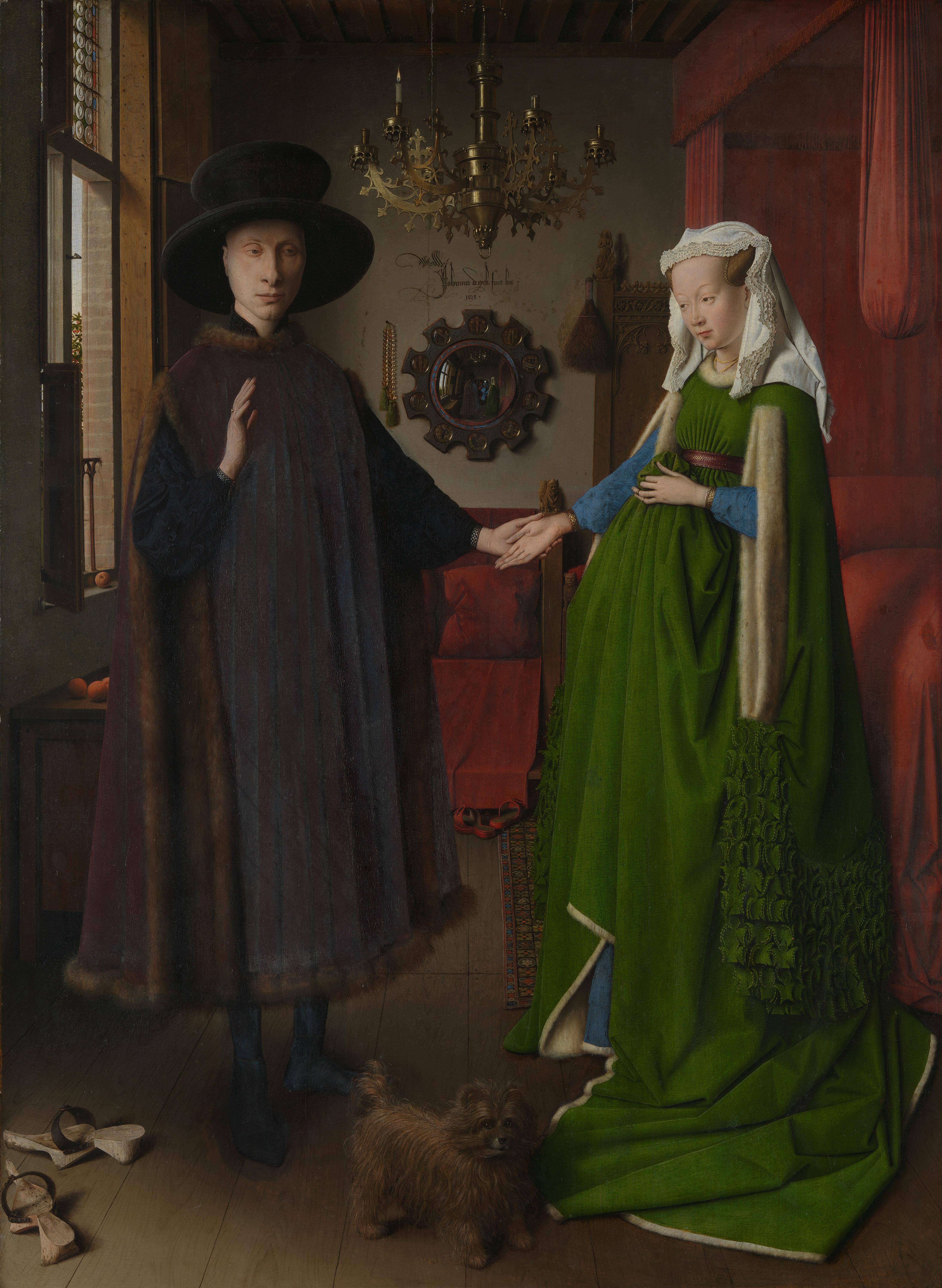
Untitled, by Jan van Eyck (or Portrait of Giovanni Arnolfini and his Wife) (Wikimedia Commons)
And we have another question: Is Van Eyck’s painting titled Arnolfini Portrait (1434) meant to portray Arnolfini’s wife? Considering there were five Arnolfinis in Bruges at the time, and we aren’t even sure which Arnolfini commissioned the painting, this might appear to be a fraught query. Alberti’s Windowhas a report.
*********
A Review or Two
Ever wondered about water and windmills? In Medieval History Geek, Curt Emanuel posts a review of Wind and Water in the Middle Ages: Fluid Technologies from Antiquity to the Renaissance. |The book is a scholarly compendium in ‘three general thematic sections with three papers having an archaeological focus, five concentrating on how mills "worked"; not physically but rather how they and their uses were integrated into society. The final three papers discuss how mills and milling were viewed by contemporaries through an examination of art and literature.’
While one Goth sacked Ancient Rome, a Vandal was its saviours. How’s that, you ask? That helpful Vandal was Stilicho. In Armarium Magnum, Tim O’Neill reviews at length a recent book by Ian Hughes titled Stilicho: The Vandal Who Saved Rome.
*********
That’s all for now, folks. Hope you enjoyed this round-up. The host of the next edition of this carnival will be announced shortly at the Carnivalesque website, and here’s a heads-up: it will cater to the Early Modern period, that is, AD 1500-1800.
In Hawala and Honour, I discussed various ways that medieval businessmen and private individuals and even the state (or royalty) obtained finance, and how they enforced contracts. In an about-turn to today's perceived view that the Protestant ethic is more conducive to financial innovation, in the medieval period, it was the Roman Church that enforced contracts in its jurisdictions. Bankers such as the Medici had a horror of lending money to the Germans because Catholic law didn't apply in German courts, and they often couldn't recover money from German debtors.
While the principles of money as a store of value and medium of transaction had long been established, coin or bullion was not always easily portable. Much of historical trade was on the basis of silver or gold in exchange for goods, of course, although this was never really secure. Long-distance trade didn't explode, therefore, until the development of the bill of exchange in the thirteenth century.
Here's how it worked [1]. An English exporter would send his goods to his Florentine counterparty. The importer would receive the goods and pay the agreed amount of florins to his bank, who would furnish him with a bill of exchange. He would then send the bill of exchange to his payee in England, while - in parallel, the bank would send a notification to its agent in London. When the exporter received the bill, he would approach the agent, hand over the bill and obtain his monies in sterling.
The exchange rates would, I surmise, have been as agreed between the exporter and importer. The importer would know how much his bank would charge to convert florins to sterling at some future delivery date; this rate would determine the amount of florins he would hand over to the bank upon receipt of the English goods. There were problems that could arise from the transit time between the shipment's departure and arrival, and the departure of the notification to the banker's agent, and his receipt of the bill of exchange from the English exporter. The determination of future rates was upon the assessment of the banker on the risks of the journey and the distance to be covered; the future payment date was often standardised, at usance: between Florence and London, this was set at 3 months.
This schematic is after Spufford [2].
International Trade and Credit Flow
The system of double-entry book-keeping that was invented at about the same time helped keep track of the various credits and debits in all these transactions. The exporter would write in his book's debit column an entry for goods sold. The importer would enter a credit to the payee upon receipt of the goods, and a debit to the banker for the delivered florins, thereby immediately balancing his book. The banker would enter a credit of florins from the importer. When the English exporter produced the bill of exchange at the banker's agent's, the agent would enter a debit for the bill to the banker, and the exporter himself would enter a credit for the payment received. The exporter's books would be balanced at that point. The bank and the agent would settle their books at their own convenience.
What did a typical bill of exchange look like? A treasure-trove of such information was revealed when, in 2000, the Borromeo-Arese family allowed academics from Queen Mary College to study two full ledgers from the medieval Borromei Bank of Bruges and London (estabished in 1434). Here is a description from the Queen Mary website [3]:
The acceptance or payment of a bill was usually set out in a complex sentence that indicated who had delivered the bill, who had taken it up, who had agreed to pay it and who was to be paid.[2] In the following example the Bardi of Bruges were takers of a bill of exchange for 800 scudi or flemish écus at an exchange rate of 7s 5d of the £ Barcelona per écu. The Deliverer sent the bill to the Payee in Barcelona; the Taker would write to the Payor in Barcelona with instructions to pay it to Payee at usance, that is 65 days from the writing of the letter. The Italian entry reads:
Ubertino de’ Bardi e compagni deon havere … sono per una lettera ne fecie a Barzalona di scudi 800 a s7 d5 per scudo per dì 65 fatta insino a dì 5 di questo in Antonio de Pazi e Francesco Tosinghi i quali rimettemo a Bernardo da Uzano e compagni per loro conto a loro, fo 168.
By the 15th century, bills of exchange were the commonest form of international monetisation in Europe. With the increasingly lucrative trade between the Ottomans and the Europeans, one would have expected this innovation to take hold in the East as well. This didn't always progress happily. There is an example of a letter of exchange drawn in Pera (Turkey) to be settled in Chios (Crete) that was rejected by the payer at Chios. Still, agents in Constantinople of European banks were quite happy to accept these letters. In 1437, a Cretan named Dimitri Argiti travelled to Gelibolu taking with him a letter for 1177 aspers. [4]
By 1460, credit in the form of letters of exchange was important even in Eastern commercial centres such as Bursa.
Check out:
1. Norman Biggs, 'Mathematics of Currency and Exchange: Arithmetic at the end of the 13th century', Gresham College, April 2008.
2. Peter Spufford, Handbook of the Medieval Exchange.
It’s the tenth anniversary of Wikipedia (all hail) and the net is filled with celebratory topics and adulatory commentary. I’m somewhat inspired by a recent piece I saw on the BBC News website reporting on (pseudo)random browsing through the Wikipedia site, the writer starting with Aristotle, following links for an hour, and somehow finding his way back to Aristotle. Reminds me of James Burke’s Connections, which you will be pleased to know has a Wikipedia page all to itself as well.
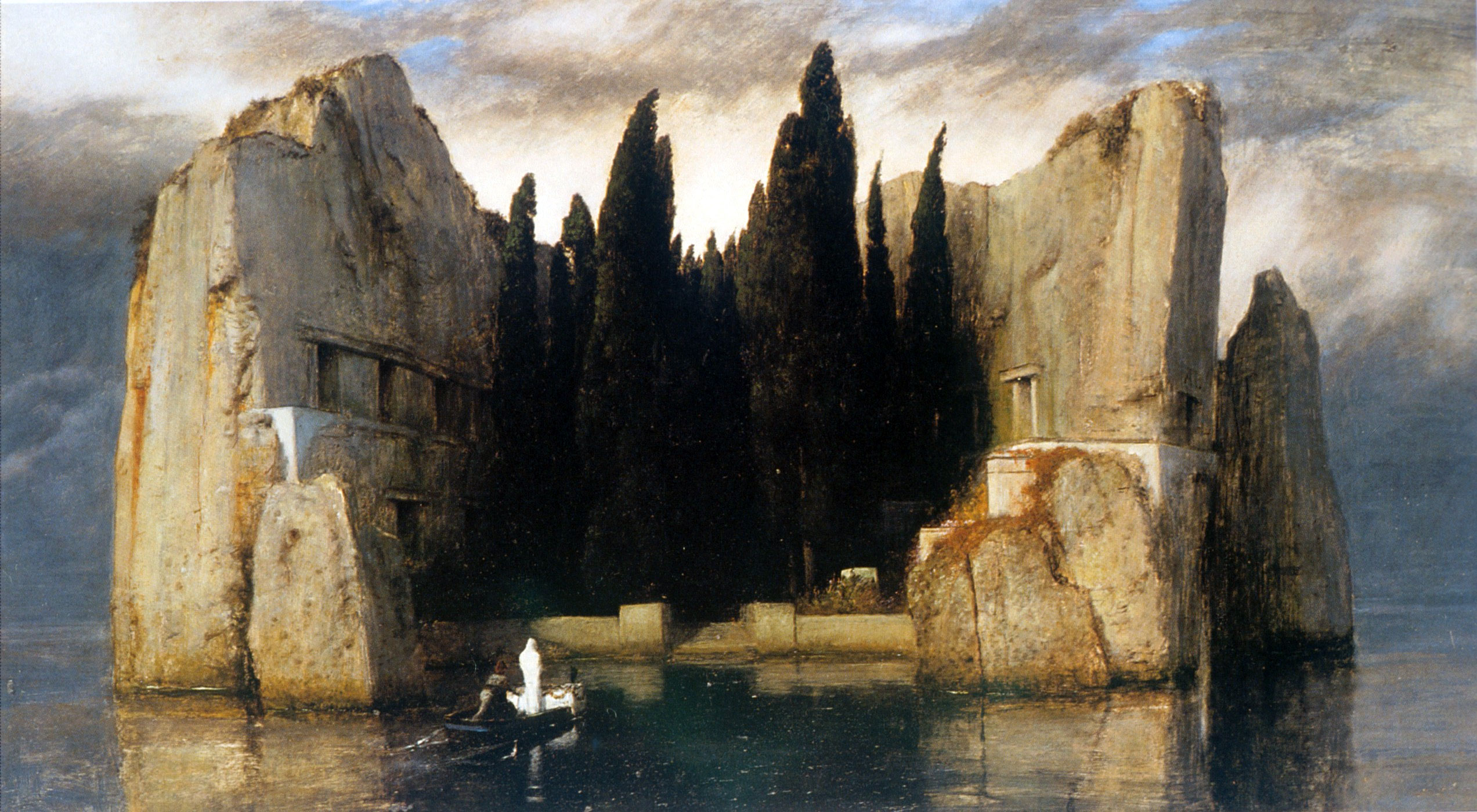
I’ll try to achieve a circular tour, but via the Russian Wikipedia, and see where that will get me. At the very top level, under the section ‘Did you know?’ appears the statement: A hundred years ago, it was a rare Berlin household that didn’t own a print of the ‘Islands of the Dead’. This was a series of paintings by the Swiss symbolist artist Arnold Böcklin, who created five variations on the theme between 1880 to 1886. In all of them, a boat approaches a small island that is riven with sharp cliffs; the boat is often assumed to be that of Charon, and the waters either of the Styx or the Acheron.
Now I can either head towards ‘Symbolism’, or ‘Charon’, or even ‘Acheron’, but instead I’ll look into the Styx – and I’ll find that it disambiguates to the legendary Greek river, a small river in Perm, a communication protocol implemented in the Inferno operating system, and also a rock band of the 1970-80s.
The rockers of the first incarnation of the Styx had four successive multiplatinum albums; I only recall with affection with one song ‘Mr Roboto’, from which – nearly 20 years ago - I learned that ‘Domo Arigato’ was Japanese for ‘Thank you’. Their song Krakatoa (1974) had a spread tone – a single note that attenuates and amplifies in loudness - that is supposed to have inspired George Lucas to create the audio logo (Deep Note) for his hi-fi cinema audio standard THX.
Krakatoa, of course, is the Indonesian supervolcano that erupted in 1883, but there’s no link to it from the Styx’s page, so I’ll go instead to George Lucas (1944- ), a famous film director who equally famously gave up any artistic integrity when he created the dismal prequels to his Star Wars trilogy. As a film technologist, however, he is incomparable: besides the audiovisual standards of the THX that I mentioned above, he is also responsible for Industrial Light and Magic, a preeminent special effects house, and Pixar, an animations studio. An interesting aside available on the Russian wiki (but not on the English version) is of Lucas’s visit to Moscow in the 1990s. He asked Russian officials to introduce him to Pavel Klushantsev, a film director. The officials, of course, had no idea who Klushantsev was. Lucas replied, ‘Klushantsev is the spiritual father of Star Wars.’ The two directors never did meet. Pavel Vladimirovich Klushantsev (1910 – 1999) was a self-taught special effects engineer who created many techniques of special effects that proved influential in cinematography worldwide, and developed an oeuvre of documentaries that blended hard science with science fiction. For example, in 1934, his film Road to the Stars had cutting-edge special effects that accurately depicted weightlessness in space, a rotating space station, and even rocket travel to the moon. Klushantsev also wrote books popularising science, and top Soviet illustrators did the drawings for them. One among them was E. V. Voishvillo who was a fairly well-known painter of marine scenes, many of which find pride of place in St Petersburg’s Museum of the World Ocean.
Here is Voishvillo’s depiction of St Nicholas, one of Peter the Great’s boats, considered the grandfather of the Russian navy; I learn that Voishvillo collaborated with A. L. Larionov in reconstructing a copy of Peter’s boat.
St Nicholas, it is often said, is also Santa Claus, but there’s no link out of Voishvillo to the bearded bearer of gifts, so all I can do is use Peter the Great as a conduit to further exploration. I find that he was a prodigious drunk, a lover of all things German, and his first official mistress, Anna Mons, was either Dutch or German herself. Sadly, there don’t appear to be any extant paintings of this famous beauty, so I’ll just put up one of Mary Hamilton, another of Peter’s lovers, whom he executed on the charge of infanticide, treason, and sundry other manifestations of his jealousy.
But back to our Anna-Margrethe von Monson! From her, we can head to things Germanic either filmographically to the German actress Ulrike Kunze (who played Anna’s role in “The Youth of Peter the Great”) or musically to Johann Sebastian Bach (who is said to have written the Brandenburg Concertos for Count Keyserling, who married Anna Mons late in his life).
As I hadn’t heard of the lovely Ulrike Kunze before, I might as well head her way. Born in Dresden in 1960, she trained in the dramatic arts, worked in Berlin and Magdeburg in various dramatic roles, and ended up in television, most recently, the series Love in Berlin.
This telenovella is based on the Colombian hit series “Yo soy Betty, la fea”, which inspired, among other things, the US television series Ugly Betty. And just when you think that I’ve managed to telescope from the 18th century to the modern world (all that history was beginning to pall a bit), what do I find? The tacky ‘B’ necklace that Betty wears in the series is an exact replica of a necklace worn by Anne Boleyn.
(No post is complete without a picture of the lovely Natalie Portman: fortunately she has her own connection to Anne Boleyn, so this isn’t entirely gratuitous.)
Anyway, as someone said, you either have that bauble around the neck of a Queen, or of a girl from Queens.
Also from Queens is Steinway and Sons, makers of fortepianos and things since 1853. They were famous innovators in advertising and promotions, recruiting, for example, the great Russian pianist Anton Rubinstein (1829 – 1894), to play 215 concerts with their piano in 239 days in 1872. Thus began the Steinway Artists programme.
Anton Rubinstein was a friend of Alexander Glazunov (1865 – 1936), a composer in the Russian Romantic tradition, who composed the Symphony No. 4 and dedicated it to him.
I learn that the second movement of that symphony, the Scherzo, was inspired by Diana’s Chase, a painting, would you believe it, by Arnold Böcklin, with whom we started this Wikiramble.
Full circle, y’all!
In Matilde Asensi's nonsensical novel (The Last Cato) of the search for the stolen remnants of the True Cross, the protagonists, a Swiss Guard, a Coptic archaeologist, and an uptight Sicilian nun stop for a bit of food en route to their latest test.
We were invited to a magnificent lunch in the hotel banquet room. I was like a kid when it came to the taramosalata and the mousaka, the souvlakia with tzatziki - small pieces of roasted pork seasoned with lemon, herbs, and olive oil, accompanied by the famous sauce made with yogurt, pepper, garlic, and mint - and the original kleftico. Especially delicious were the incomparable Greek breads made with raisins, spices, greens, olives, or cheeses. For dessert, a little freska frouta. Who could ask for anything more? Mediterranean cuisine is the best in the world. Farag proved that by eating enough for three or four people.
In Matilde Asensi's nonsensical novel (The Last Cato) of the search for the stolen remnants of the True Cross, the protagonists, a Swiss Guard, a Coptic archaeologist, and an uptight Sicilian nun stop for a bit of food en route to their latest test.
We were invited to a magnificent lunch in the hotel banquet room. I was like a kid when it came to the taramosalata and the mousaka, the souvlakia with tzatziki - small pieces of roasted pork seasoned with lemon, herbs, and olive oil, accompanied by the famous sauce made with yogurt, pepper, garlic, and mint - and the original kleftico. Especially delicious were the incomparable Greek breads made with raisins, spices, greens, olives, or cheeses. For dessert, a little freska frouta. Who could ask for anything more? Mediterranean cuisine is the best in the world. Farag proved that by eating enough for three or four people.
George Pelecanos is a tough writer of tough noir with an occasional nod to his Greek heritage. In A Firing Offense, his protagonist Nicky Stefanos wants to feed his lady some Mediterranean love (and food):
Most of the good fish had been picked over by that time of day. I bought some squid, at one forty-nine a pound, from a cross-eyed salt who was attempting to stare at Lee. We took it back to my apartment.
After removing the ink sacks and the center bone, I sliced the squid laterally into thin rings, and shook them in a bag with a mixture of bread crumbs, garlic, and oregano. Then I fried them in olive oil in a hot skillet.
We ate these with lemon and a couple of beers as we watched the first half of the Skins game. For the second half we napped together on the couch in roughly the same arrangement as the night before. We woke as the afternoon light was fading. I drove her back to her car at the store and kissed her good-bye.
Welcome to the twenty-fourth instalment of the Giant’s Shoulders, the monthly carnival of science and history-of-science blogging from around the planet. In this issue, there’s a bit of a preponderance of historical vignettes, which I trust you’ll find interesting.
Shall we start with a timeline of scientific discoveries, analyses and inventions? How about this – from years that end in 24 in every century? I’m missing several years, so if you’d like to fill those in, please be my guest.
I can’t think of any particular grouping in this carnival. You know, by subject and all that. It’s pretty motley. Chronological order is somewhat unsatisfying, like arranging books on your shelf in alphabetical order of title. Let us, therefore, be whimsical.
From New at LacusCurtius & Livius, we have Bill Thayer’s introduction and a link to a classic paper about how people developed effective ways to compute the heights of mountains. It’s a wide-ranging work, starting from the Ancient Greeks and working its way through Kepler and The paper is from 1929, so expect nothing on GPS in it!
Continuing with mensuration, Ethan Siegel at ScienceBlogs has a neat little piece about how to determine distances to the stars. In How Far to the Stars, he explains the principle of parallax, notes that Copernicus thought he could use it to tell distances, and then goes on to Christiaan Huygens’s idea of using luminosity to compute how far Sirius is from us.
So we are able to measure distances with excellent accuracy. But what of Heisenberg’s Uncertainty Principle? Surely it’s impossible to measure simultaneously (to arbitrary precision) both the position and the momentum of an object? This is certainly true on the scale of the truly small, but why is it not so evident on the scale of our senses? Why does quantum mechanics explain to remarkable accuracy the weird behaviour of the minute but loses that weirdness at the macroscopic? On homunculus, Philip Ball presents Big Quantum, where he talks about this explanatory lacuna in the transition between the very small and the large. It’s all due to decoherence!
For another example of the genre, we have Caroline Rance at The Quack Doctor with an interesting little piece about one type of alternative medicine – uroscopy. This is the use of urine’s colour, consistency, taste and smell as a diagnostic tool. By the 19th century, professional medics had discounted this as quackery, but common people continued to frequent piss-doctors. In Cameron the Piss-Prophet, we learn how one such worthy was hoist by his own petard.
From one aspect of quackery, we move on to another. In 1726, a woman named Mary Toft (or Tofts) was a sensation in England for having allegedly given birth to rabbits.
She had supporters and deriders in equal measure; scientists argued both in her favour (e.g. a medical doctor, John Maubray) and against (Sir Richard Manningham, a male midwife). William Hogarth’s Cunicularii at the Wellcome Library Item of the Month (besides analysing some lovely etchings by the great artist) raises a subtle question.
Leaving quackery, we ponder another form of obfuscation. Via Thony C. we have an article titled “Follies of the present day”: Scriptural Geology from 1817 to 1857 by J.M. Lynch at A Simple Prop. Who were scriptural geologists? These were scientists who tried somehow to unify vast geological time with their faith in the Bible’s six days of creation. Note that these people did not believe (pace Ussher) that the Universe was formed in 4004 BC.
Why did these Christian scientists not pay closer attention to James Hutton? In 1785, he had published an article Concerning the System of the Earth, Its Duration, and Stability in which he began the study of deep geological time. Via Thony C., we have John F. Ptak’s Raising Greatness: James Hutton’s Deep View of Time, 1795 posted at Ptak Science Books talking about Hutton’s remarkable intuition, as he saw the entirety of Earth’s history explained in the sloping red sandstone at Siccar Point.
While on the subject of deep time, a fossil of the Archaeopteryx was first discovered in 1861. Since then palaeontologists have argued whether this transitional creature (between dinosaurs and true birds) was capable of flight. Ed Yong presents First Birds Were Poor Fliers at the Discover Magazine Blog. There were some reasons to believe that the beast could fly but also good reasons why not.
Dorset Ancestors have a biography of Francis Glisson, a native of that English county, who went on to great success as a doctor in 17th century London. When he heard of a new debilitating disease among children of Dorset, he studied it carefully and concluded that this bone-deformative condition (which we know as ‘rickets’) was caused by malnutrition.
A sesquicentennial after Glisson plied his investigative mind, another Englishman began to consider the various causes of deafness in people. As a diagnostic tool, John Harrison Curtis invented the Cephaloscope, which is described in Jaipreet Virdi’s post The Cephaloscope on From the Hands of Quacks.
John Harrison Curtis also insisted that aurists – students of auditory illnesses – should also be attached to medical hospitals. Jaipreet Virdi’s related post The London Asylum for the Deaf and Dumb tells this story.
From illnesses of the body, we segue to a illness of the mind. The dreaded African disease, sleeping sickness, when in an advanced stage, often resulted in violent mania. Was this true insanity on the part of the natives, or just a manifestation of a fear of isolation in a camp? From Sleeping Sickness and Lunacy at the Colonial Psychiatry Hub, we learn that much documentation of the effects of sleeping sickness on the local population is available from the British staffers of the Colonial Office (Uganda).
This video is an overview of the life, times, and accomplishments of Antony van Leeuwenhoek (1632-1723), the Dutch scientist who used hand-made single-lens microscopes to become the first human to see protozoa, bacteria, sperm, and red blood cells, among many other things.
And although that video’s only 7 minutes long, it promises more riches to come. Can there be any more to van Leeuwenhoek, then? Indeed there can, and Thony C. presents Lego-nhoek? posted at Antoni van Leeuwenhoek Centraal.
van Leeuwenhoek, of course, was a contemporary, competitor and Royal Society colleague of that polymath Robert Hooke. I found several blogs on this brilliant Englishman, and planned to chuck them in here, but closer scrutiny revealed that at least one of those pieces was a copy of a Wikipedia article. I hope this is not a similar copy: Leland Velazquez discusses the Physics of Bungee Jumping. Hooke’s work on elasticity leading to his eponymous law is the underpinning of this extreme sport.
If Robert Hooke is around, Christopher Wren can’t be far behind. Another brilliantly multifaceted man, Wren involved himself in astronomy, mathematics, architecture, art, and – we learn from Christopher Wren and the Bees by Gene Kritsky at Wonders & Marvels – beekeeping. Why is this scientifically relevant? He also developed the transparent beehive that was suitable for the scientific observation of bee behaviour.
The bees were able to move between the various layers of the hive, and glass panels set into the structure allowed an observer to see the honey cascading down inside it. Although Wren’s construction had not been an immediate success (due to a failure to realise that bees worked downwards), it offered the prospect of an ever-increasing stock of bees and honey within the same hive. [from here]
Speaking of polymaths, there was Florence Fenwick Miller in the 19th century. She was a suffragette, a journalist, an educator, and a qualified medical doctor. From Peacay at the absolutely ravishing BibliOdyssey, we have An Atlas of Anatomy.
From Peacay at BibliOdyssey again, we have Fungis Danicis, a lovely set of illustrations of fungi studied by a Danish lawyer-turned-botanist named Theodor Holmskjold in the 18th century. This worthy actually identified over fifty new species during two years of observation in the countryside near Aarhus.
************************************************
Now for some controversy! When scientists without training in history try to develop works in the history of science, clearly feathers are ruffled. Via Thony C., we have Renaissance Art or Neuroanatomy? Part 1 and part 2, posted by Darin at PACHSmörgåsbord. It appears that there have been a series of papers over the past 20 years by various scientists trying to find hidden anatomically precise messages in Michelangelo’s art.
R. Donald Fields wrote up a guest blog at Scientific American recently that discusses the oeuvre; as it turns out, none of the scientists involved is a trained historian. As the rebuttal at PACHSmörgåsbord makes clear, this is dangerous practice:
Why does this matter? Because such articles attract the attention of editors and contributors at places like Scientific American. These contributors then post a redaction of the article on the website, where the post becomes one of the most popular. Such redactions misrepresent the history of science, suggest that anybody can write the history of science, and deny that historians of science have a discrete expertise. That’s why it matters.
But just to show that not all scientific speculation on art is ill-founded, check out this interesting bit of detective work by a bunch of astronomers at Texas State University. Via Thony C., we have a post by Roger Sinnott on Sky And Telescope titled Walt Whitman’s Meteor-Procession, we learn about the great poet’s imagery (“the strange huge meteor-procession" that went "shooting over our heads" with "its balls of unearthly light”) and an interesting astronomical phenomenon.
I’m not sure if this next piece fits within the purview of our Carnival (as it may be more aligned to sociology) but I think it relates to a seminal work of behavioural psychology, so perhaps I can present it? Christopher Greene’s Clarks’ Black-White Doll Experiment Replicated at Advances in the History of Psychology blog discusses an even more controversial subject than that in the preceding paragraph, and highlights its most recent replication under the aegis of CNN (full report here in PDF).
************************************************
On to more jolly subjects. Remember Light Amplification by the Stimulated Emission of Radiation? It is 50 years since the invention of the (optical) laser. Via Thony C., we have Happy Birthday! posted by Matt Springer at Built on Facts.
Another anniversary is that of Vannevar Bush’s visionary piece sixty-five years ago in the Atlantic Review about associative links in information, which one can easily see as an early precursor to hypertext and all that. Via gg, we have Simon Harper’s review ‘As We May Think’ at 65 from his blog Thinking Out Loud.
We end on a luminous, numinous note. What links a certain 1980s teen film, a song by John Parr, the Chinese sea-goddess Mazu, and – wait for it – ionised air? In St Elmo’s Fire, Captain Skellet of A Schooner of Science explains the whys and the hows of the gorgeous blue glow that appears on the tips of masts on sailing ships.
************************************************
[And there you have it. Thanks for stopping by. I hope this encourages you to write up your own pieces on science and its history and philosophy. Do consider submitting your blog article to the next edition of the giant's shoulders at The Dispersal of Darwin. You can use the carnival submission form. Past posts and future hosts can be found on the blog carnival index page.]
Keen-eyed readers may have observed that the ninth month of roundups of translated crime fiction never appeared in these pages. The same readers may have then shrugged and moved on with their lives. A recent holiday interfered with the sequence of posts, so I'm combining two months' worth here. Camomile Street library has come up trumps with several of my books on order, and we have a bit of variety this time around.
I may be going out on a limb when I say that the development of popular literature generally follows the same pattern around the world. As a society becomes literate, readers will prefer light material - novellas and pulp, generally involving thrills or spills and sex and romance. Penny dreadfuls take off, often competing for attention by means of lurid covers and suggestive blurbs - not just because it doesn't require intense concentration to appreciate, but also because it is invariably cheaper than middle-class literature. The occasional pulp author will then transcend the genre and establish himself or herself with critical acclaim and gradually move up-market. The readership often will follow this author and introduce itself to other, more literary works. Meanwhile newly literate people continue to fill the voids left behind by this upward mobility and eagerly embrace the canon of pulp.
How's that for a thesis? I mentioned penny dreadfuls, but I should probably also include other gems of the canon, such as those anthologised in the The Blaft Anthology of Tamil Pulp Fiction (selected and translated by Pritham Chakravarthy), and those lovingly referred to in Patricia Melo's In Praise of Lies. Both Brazil and India are roughly at the same level of economic development as far as the vast majority of people are concerned, and both countries have an enormous thirst for light reading and sensationalism. (One can see this in the wide reach of daytime soap operas on television in both countries.) The English translation of the original Tamil stories serves to include a more middle-class audience for what is essentially vernacular fiction; likewise Patricia Melo discusses the popularity of Brazilian noir among the socially downtrodden, and the cut-throat competition to serve it.
Now Melo does not address the consumers of the cheap literature; rather, she prefers to poke fun at the industry that supplies it. So we have Jose Gruber, a hack who copies the plots from greats of world literature and passes on the texts to a publisher who is unaware of Dickens and Dostoevsky; the readership doesn't know or care either. Jose falls in with a herpetologist, Melissa, who, unaware of his inspiration, believes that his is a fertile imagination. She then involves him in concocting clever plots of kill her husband, who she claims abuses her, and Jose is such a moral and physical coward that he ends up helping her. The stress results in his literary career stalling, with the publisher rejecting proposal after proposal (which lengthen in proportion to his desperation) as unworkable and uninteresting. The noirish aspects of the novel might have served to keep the plot ticking, but Melo is dissatisfied with satirising only the pulp industry and she switches her target to the self-help books that also attract a wide readership in Brazil. Between the crime committed and the unravelling of Melissa's and Jose's relationship, and his sudden success as a hack self-help author, there are suddenly too many threads in the novel, and it all gets increasingly inchoate. While the book started funny and clever, it appears as if Melo loses the plot herself as she goes along, and it ends up trying my patience.
The Blaft book is an uneven collection as well. There are two or three absolute sparklers, but the rest are somewhat pedestrian and obvious. I loved the brilliant wit and repartee of Pattukotai Prabakaran’s ‘Sweetheart, Please Die’ and the innuendo and bonhomie of Subha’s ‘Hurricane Vaij’, which were possibly the best stories in the book. Some of the stories are overtly preachy – offering a defence of a woman’s sexual rights, say, or urging honesty in a politician – and some involve mad scientists and that old favourite of Indian films, reincarnation and revenge. I guess this is not surprising: they must appeal to the lowest denominator, and so become obvious and forced. Still, it’s heartening to see that the remarkably prodigious authors of the stories (some of whom have written thousands of tales and novellas) are often capable of superb and sophisticated imagination, refusing to pander to the base, and, fortunately for us, Pritham Chakravarthy has located several gems of the genre, and published them here.
Being obvious is possibly the worst comment a reader can make on a crime novel, but what is obvious to one person may be opaque to another. In Tefcros Michaelides's Pythagorean Crimes, the twist at the end depends for its surprise entirely on whether the reader knows the history of mathematics or not. The plot is rather straightforward - a Greek mathematician is found murdered and his best friend (the narrator) looks back on his career, hoping to find clues to his death in his past. The description of this past is possibly the weakest part of the book: Michaelides evidently believes that describing the excitement and fervour of early 20th century mathematics is insufficient to drive the book forward, so he throws in a long section on the development of modern art in the back alleys of Paris, introducing Picasso and his coterie, and claiming that Picasso's art was much informed by his own fascination for the foundations of logic. The plot hinges on an important question on the underlying consistency of mathematics, but surely it defies logic that the resolution to this question should verily be a life-and-death matter?
It's not often one hears of crime fiction from Africa that is written in a non-native language, although now that Afrikaans has been spoken in South Africa for close to 300 years, perhaps it is as native a tongue as any other. Deon Meyer is a successful author of thrillers set in that country, and he uses the medium to explore several unsavoury aspects of South African history. The nexus between the apartheid regime and the vastly influential military-industrial complex is reasonably well-known; what is perhaps less known is its constant interference in the affairs of neighbouring countries, either on the pretext of containing Communism, or to co-opt corrupt Black leaders of those countries. The story in Blood Safari is, as far as thrillers go, fairly faithful to the genre: a rich young woman thinks she has seen her long-dead brother on TV, her house is firebombed, she buys the services of a top-notch bodyguard (named Lemmer) who helps her in her search for her brother. Of course, the enemies are many and vicious, and when both get injured in an attack, Lemmer decides to go on the offensive himself. He is a man with a short fuse and can be indescribably vicious himself, so when the villains meet their comeuppance, they don't go gently into the unknown. Meyer throws in social commentary on present-day South Africa as well. There is corruption at higher levels that thwarts honest policemen, there are social schisms between the Afrikaners and the English-speakers; there is suspicion at every level between the blacks and whites; and there are tensions between the various nations of blacks, too, as they scramble for economic advancement and funding from an impoverished state. Underlying this all is a passionate cry to save Africa's wildlife as well, not just the popular creatures of tourist imagination, but also birds such as vultures that are held in such distaste by everyone.
Véronique Ovaldé's Kick the Animal Out is a narrative from the viewpoint of a mentally-unbalanced girl desperate to locate her mother. This is an exploration of the lush mindscape of the fifteen year-old Rose who adores her mother and is baffled and upset by her father's seeming lack of anxiety when her mother vanishes. She seeks answers in her mother's past, uncovering details of old loves and past crimes. This is a slim book set in a sunny coast of France completely at odds with Rose's anguish, and it drags the reader into her world of 'immeasurable loss' more surely and heartbreakingly than weightier tomes by less assured writers. Well worth a read.
One of the great canards of medieval life that have been promoted to outraged titillation in the world of entertainment is the putative droit du seigneur, the right of a feudal lord to bed the wives of his serfs on their wedding night. There is almost no evidence that such a right ever existed in law, though it is undeniable that serfs were abused and their wives very likely forced into granting sexual favours. Still, this is a favourite trope among writers of historical fiction (equally, directors of films set in the Middle Ages), and Ildefonso Falcones in his Cathedral of the Sea proves no different. Perhaps, though, we should believe Falcones - he is, after all, a lawyer himself, and he quotes Catalan legal documents (the Usatges) that purport to grant such rights. The novel, a sweeping history of the construction of the magnificent Cathedral of Santa María del Mar by indigent labourers as an act of love and devotion, starts with the violation of a woman on the night of her wedding. The story then follows the fortunes of the woman's husband, and then their son, against the background of the rise of Barcelona's maritime power. It is a gripping tale, incorporating miracles, internecine feuds, pogroms against Jews, naval battles, detailed explanations of construction techniques, sex and strife between diabolically devious women and inhumanly good men, envy between brothers, religious schisms, class struggles, and, if all this were not enough, the Inquisition. I'm well pleased with this, especially because there was nary a mention of the Templars.
Friedrich Dürrenmatt's The Pledge is a tale of the fall of a brilliant Swiss detective. The denouement is somewhat pat, but the analysis of the detective's psyche is very good. A little girl is savagely murdered and the detective makes a promise to her mother that he will find the killer. When a suspect is arrested and he subsequently commits suicide, everybody is satisfied that the case is closed, even the victim's parents. But the detective is not convinced, and against all evidence and in the face of his superiors' disapproval, he lays an intricate trap to catch the killer. He is so obsessed with this plan that he doesn't mind sacrificing everything he has - his reputation, his relationships, even his 'adopted' family - to fulfil his pledge. The plan fails and he loses his mind, and when the explanation arrives (a bit contrived and convenient), it is far too late to save the detective. This is a small book, a quick but agonising read, and well worth for its insight into the extremes of human nature.
Gianluca Morozzi has written a neat claustrophobic thriller set in the elevator of a residential building. In Blackout, three individuals, strangers to each other, enter the lift. Shortly thereafter, the power goes out and the trio is trapped between floors. Their back-stories are filled in between chapters that describe the continuously rising paranoia and terror within the cramped quarters of the lift. I’m not giving anything away when I say that one of the three is vicious serial killer, and his is the only background that is really relevant to the story. The other two could have been pilots or scuba-divers for all their lives had any consequence up to the point they are trapped. So far, so good. True to the genre, the innocents have to escape. How though? And is that all to the story? This is where Morozzi cranks up the unlikeliness factor, and the story – to my mind – degenerates to droll fantasy. It is written in that arch, self-consciously-talking-to-the-reader fashion that might grate on some; the staccato sentences might alienate others, but it is a thin book, trying a bit to be too clever, and will serve as a decent page-turner on a short trip to work.
Arch and knowing books are, thankfully, not a dime a dozen, but Jef Geeraerts’s Public Prosecutor, The is another such. Geeraerts doesn’t have much time for organised religion, I gather from this fable, or for money-grubbing men or women, most of whom end up perishing in some gruesome fashion or the other. The protagonist of this parody of the paranoid thriller genre is the Public Prosecutor of Antwerp, a man who owes his position to his wife’s noble family. He leads the usual life of an alpha male – he has a beautiful young mistress; his wealth does not stop him from seeking more; and, of course, he detests his wife, and hardly has any time for his sons. The wife is a deeply religious Catholic who wants one of her sons to enter Opus Dei, the usual villain in books involving religious skullduggery, and to that end is willing to sacrifice everything, including her husband. There are other unsavoury Opus Dei operatives with connections at the highest reaches of power – both financial and administrative – and there are sundry criminals out for revenge. None of the characters has any redeeming qualities but the Prosecutor, harried and hassled, ends up being strangely sympathetic. This is so earnest a book I cannot imagine Geeraerts wasn’t grinning ironically all the while he was writing it; good fun.
And the humour continues in the latest caper from Latin America that I’ve read: the Uruguayan-Cuban author Daniel Chavarría’sAdios Muchachos is a rollicking dissection of Cuban life, where years of Communism have only served to drive the capitalist fervour of the masses to feverish pitch and materialism rules above all. Unlike the corruption and drug-addled misery limned in Leonardo Padura’s Havana series, Chavarría’s book is far too good-humoured. It is also a sexy romp with the pneumatic bottom of the wondrously bright and beautiful Alicia running riot, trying to ensnare rich foreigners who might then take her away to their own rich lands where she could lead a life of luxury. Her modus operandi is to ride her bike, wiggling her alluring bottom to attract a rich man in a fancy car, and then falling spectacularly before the sucker, prompting him to come to her rescue. Her mother aids and abets her schemes, providing fancy food and culture to the man, causing him to get more and more besotted by Alicia. Unfortunately, Alicia then falls in with a Canadian ex-con whom she mistakes for her latest wealthy conquest. He is leading a double-life himself, trying to persuade a multinational corporation to fund marine archaeology (to make money out of selling salvaged treasure) while also hiding his less than salubrious past from his employers. An accidental death sparks panic in Alicia and Victor, but also hands them possibility to make large amounts of money, and at this point, Chavarría’s grip over the plot begins to loosen, and confusion takes over. In the classic manoeuvre of the author who’s lost interest in the proceedings, there’s a final roundup of what happens in the subsequent lives of the various characters. I’ve often wondered what purpose such a roundup serves: it’s as though the story somehow were unable to close by itself, and so an artificial conclusion is forced on the reader. Dissatisfying, surely?
And, to round off this roundup, we have Jean-Christophe Grangé’s The Empire of the Wolves, as harrowingly graphic as any lesbian crime author’s work (as Ian Rankin once pointed out to much controversy). A secret right-wing Turkish sect is busy butchering its way through the textile-worker community in Paris (all trafficked women from Turkey). The wife of a senior bureaucrat is having violent flashbacks that lead her towards paranoia and breakdown. The policeman investigating the serial killings is forced to rope in a retired colleague, a man who has been well-known for his efficiency in keeping crime down in the Turkish quarter in the past (and notorious for his corruption and brutality). The two of them determine that political schisms in Turkey and the spread of transnational criminal gangs led as much by ideology as mere lucre are the cause of the murders in Paris. Naturally, the killers are in search of one particular person, and it’s not difficult to discern early on who this person might be. After all, there are only two supposedly disparate strands in this novel, and so they have to connect at some point. The denouement is, once again, in classic mode: in the end there are two people out to get each other, there’s some grandiose recrimination, and an obvious conclusion. This novel, I thought, was a bit over the top; for a much more satisfying experience, check out Dominique Manotti’s Rough Trade (Eurocrime Series), which is taut, gripping and eminently true to life.
I have modestly given myself the name of the greatest of the Eldar: Fëanor, the maker of the Silmarils and the creator of the Tengwar. He was a Master of many things. I am merely a Jack.












 (selected and translated by Pritham Chakravarthy), and those lovingly referred to in Patricia Melo's
  . Both Brazil and India are roughly at the same level of economic development as far as the vast majority of people are concerned, and both countries have an enormous thirst for light reading and sensationalism. (One can see this in the wide reach of daytime soap operas on television in both countries.) The English translation of the original Tamil stories serves to include a more middle-class audience for what is essentially vernacular fiction; likewise Patricia Melo discusses the popularity of Brazilian noir among the socially downtrodden, and the cut-throat competition to serve it.

 Being obvious is possibly the worst comment a reader can make on a crime novel, but what is obvious to one person may be opaque to another. In Tefcros Michaelides's
  , the twist at the end depends for its surprise entirely on whether the reader knows the history of mathematics or not. The plot is rather straightforward - a Greek mathematician is found murdered and his best friend (the narrator) looks back on his career, hoping to find clues to his death in his past. The description of this past is possibly the weakest part of the book: Michaelides evidently believes that describing the excitement and fervour of early 20th century mathematics is insufficient to drive the book forward, so he throws in a long section on the development of modern art in the back alleys of Paris, introducing Picasso and his coterie, and claiming that Picasso's art was much informed by his own fascination for the foundations of logic. The plot hinges on an important question on the underlying consistency of mathematics, but surely it defies logic that the resolution to this question should verily be a life-and-death matter?
 is, as far as thrillers go, fairly faithful to the genre: a rich young woman thinks she has seen her long-dead brother on TV, her house is firebombed, she buys the services of a top-notch bodyguard (named Lemmer) who helps her in her search for her brother. Of course, the enemies are many and vicious, and when both get injured in an attack, Lemmer decides to go on the offensive himself. He is a man with a short fuse and can be indescribably vicious himself, so when the villains meet their comeuppance, they don't go gently into the unknown. Meyer throws in social commentary on present-day South Africa as well.
 is a narrative from the viewpoint of a mentally-unbalanced girl desperate to locate her mother. This is an exploration of the lush mindscape of the fifteen year-old Rose who adores her mother and is baffled and upset by her father's seeming lack of anxiety when her mother vanishes. She seeks answers in her mother's past, uncovering details of old loves and past crimes. This is a slim book set in a sunny coast of France completely at odds with Rose's anguish, and it drags the reader into her world of 'immeasurable loss' more surely and heartbreakingly than weightier tomes by less assured writers. Well worth a read.
 proves no different. Perhaps, though, we should believe Falcones - he is, after all, a lawyer himself, and he quotes Catalan legal documents (the Usatges) that purport to grant such rights. The novel, a sweeping history of the construction of the magnificent Cathedral of Santa María del Mar by indigent labourers as an act of love and devotion, starts with the violation of a woman on the night of her wedding. The story then follows the fortunes of the woman's husband, and then their son, against the background of the rise of Barcelona's maritime power. It is a gripping tale, incorporating miracles, internecine feuds, pogroms against Jews, naval battles, detailed explanations of construction techniques, sex and strife between diabolically devious women and inhumanly good men, envy between brothers, religious schisms, class struggles, and, if all this were not enough, the Inquisition. I'm well pleased with this, especially because there was nary a mention of the Templars.
 is a tale of the fall of a brilliant Swiss detective. The denouement is somewhat pat, but the analysis of the detective's psyche is very good. A little girl is savagely murdered and the detective makes a promise to her mother that he will find the killer. When a suspect is arrested and he subsequently commits suicide, everybody is satisfied that the case is closed, even the victim's parents. But the detective is not convinced, and against all evidence and in the face of his superiors' disapproval, he lays an intricate trap to catch the killer. He is so obsessed with this plan that he doesn't mind sacrificing everything he has - his reputation, his relationships, even his 'adopted' family - to fulfil his pledge. The plan fails and he loses his mind, and when the explanation arrives (a bit contrived and convenient), it is far too late to save the detective. This is a small book, a quick but agonising read, and well worth for its insight into the extremes of human nature.
 , three individuals, strangers to each other, enter the lift. Shortly thereafter, the power goes out and the trio is trapped between floors. Their back-stories are filled in between chapters that describe the continuously rising paranoia and terror within the cramped quarters of the lift. I’m not giving anything away when I say that one of the three is vicious serial killer, and his is the only background that is really relevant to the story. The other two could have been pilots or scuba-divers for all their lives had any consequence up to the point they are trapped. So far, so good. True to the genre, the innocents have to escape. How though? And is that all to the story? This is where Morozzi cranks up the unlikeliness factor, and the story – to my mind – degenerates to droll fantasy. It is written in that arch, self-consciously-talking-to-the-reader fashion that might grate on some; the staccato sentences might alienate others, but it is a thin book, trying a bit to be too clever, and will serve as a decent page-turner on a short trip to work.
 is another such. Geeraerts doesn’t have much time for organised religion, I gather from this fable, or for money-grubbing men or women, most of whom end up perishing in some gruesome fashion or the other. The protagonist of this parody of the paranoid thriller genre is the Public Prosecutor of Antwerp, a man who owes his position to his wife’s noble family. He leads the usual life of an alpha male – he has a beautiful young mistress; his wealth does not stop him from seeking more; and, of course, he detests his wife, and hardly has any time for his sons. The wife is a deeply religious Catholic who wants one of her sons to enter Opus Dei, the usual villain in books involving religious skullduggery, and to that end is willing to sacrifice everything, including her husband. There are other unsavoury Opus Dei operatives with connections at the highest reaches of power – both financial and administrative – and there are sundry criminals out for revenge. None of the characters has any redeeming qualities but the Prosecutor, harried and hassled, ends up being strangely sympathetic. This is so earnest a book I cannot imagine Geeraerts wasn’t grinning ironically all the while he was writing it; good fun.
 is a rollicking dissection of Cuban life, where years of Communism have only served to drive the capitalist fervour of the masses to feverish pitch and materialism rules above all. Unlike the corruption and drug-addled misery limned in Leonardo Padura’s Havana series, Chavarría’s book is far too good-humoured. It is also a sexy romp with the pneumatic bottom of the wondrously bright and beautiful Alicia running riot, trying to ensnare rich foreigners who might then take her away to their own rich lands where she could lead a life of luxury. Her modus operandi is to ride her bike, wiggling her alluring bottom to attract a rich man in a fancy car, and then falling spectacularly before the sucker, prompting him to come to her rescue. Her mother aids and abets her schemes,
 , as harrowingly graphic as any lesbian crime author’s work (as
  , which is taut, gripping and eminently true to life.