JOST A MON

The idle ramblings of a Jack of some trades, Master of none

Nov 9, 2013

Bed Valance

I happened to be at Osterley House the other day, and there was an exhibition there about the East India Company but this post is not about that, exactly. Rather, it's about the Childs, enormously wealthy members of the Company and one-time masters of Osterley, and the amazing history of their imports from the Orient.

In particular, one import - Indian textile.

In the early 18th century, silk textiles were a major export from Surat. The Cambay embroidery was considered one of the finest varieties of cloth, and it was immensely popular in Europe. Between 1700 and 1730, cloth produced by the artisans of the Mochi (cobbler) caste of Gujarat arrived at the Childs' mansion, and was used to create the bed pelmet cover and canopy in Mr and Mrs Child's Bedchamber.

The valance for the bed has a plain cream background with brightly embroidered patterns of thin branches and leaves in a dark green colour, with red and yellow flowers. I would show it to you except my camera's battery had died. (You can see an exemplar here.)

The Mochi folk had at one time developed their delicate skills of chain-stitch hooking and needlework on leather, and then adapted the technique to cloth. They had been patronised by the Mughals, but - seeing the particular tastes of the Europeans - they began to adapt their designs for the East India Company trade. From the great English factories in Surat started the huge export chain.

By the 1730s, the East India Company's monopoly was dwindling, but the factory in Surat was maintained.

Meanwhile the Childs had other fine products from India. One was a dressing table by their Yellow Taffeta bedchamber, described in a 1782 inventory: a deal toilet table with quilted stuff coat with gold worked muslin cover of Silk Veil covered with ditto. A japanned Glass and dressing boxes.

The table was made in India of real gold strips in pattern; the muslin textile, also gold-worked, was originally from India as well.

Oct 20, 2013

The Commercial Road

I had a lunch meeting in the City and a bit of time to spare before another meeting in Canary Wharf, so I decided to walk. The straightest route, from Aldgate to Cabot Square, is more or less on the Commercial Road, as busy a street as you can want, and filled with rather shabby shops and rundown godowns and so on. It is a rather old thoroughfare, though, and an observant perambulator can see a thing or two worth looking at.

So this was my route:

View Larger Map


First, you must know that the Commercial Road was cut through the East End in the early 19th century by the East India Company.

Almost the first thing of importance on the way is the Proof House of the Worshipful Company of Gunmakers. The Company was established in 1637; unlike other livery companies of the City, this was always situated outside the City walls, probably because of the noise of its 'proof' procedures. (Proofing was the testing of the safety of gun barrels.) The company acquired the property in a 'physic' garden in Whitechapel in 1675, which is now 46-50 Commercial Road. The original Proof House was damaged by explosions and rebuilt after 1757.1


Gunmakers' Company Proof House

Further along is the Synagogue of the Congregation, incorporating several Jewish strands - the Bikur Cholim and the Yevra Isroyel. The congregation was founded in 1904, comprising Lithuanian and Polish Jewish immigrants. Today, much of the congregation consists of local Jews as well as Jews from India and Germany. The synagogue was consecrated in 1921 after an internal redecoration by Lewis Solomon and Son, but was for a long time unused. After extensive renovations in 2004, it appears to be thriving again. I didn't see the interior, but it's supposed to be rather pretty.2


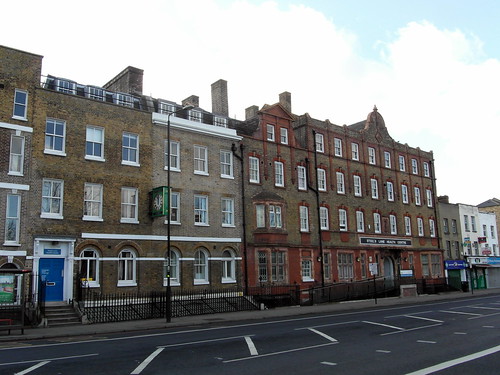
Continuing along my merry way, I saw the Steel's Lane Health Centre. This used to be the East End Maternity Hospital (1889-1968), which began as a Mother's Home at Number 394, and then gradually took over the rest of the block. 
Steel's Lane Health Centre
Steel's Lane Health Centre, by Tom Bastin, on Flickr.

It is architecturally notable for its windows with terracotta mullions and canted bays at either end. A chapel with trefoil-headed windows survives at the rear.3, 4 Above the main entrance to the clinic is a plasterwork figure with a cross. There is also a bright green clock with Roman face and gilt-edged, on which appears the legend 'East End Maternity Hospital'.


Victor McLaglen and Cary Grant in Gunga Din.

Next! I saw a blue plaque celebrating Victor Andrew de Bier McLaglen (1886-1959), a UK-born boxer and Hollywood actor. I hadn't heard of him, but it appears that he won an Academy Award in 1935 for the film The Informer (directed by John Ford). Here he is with Cary Grant in Gunga Din.


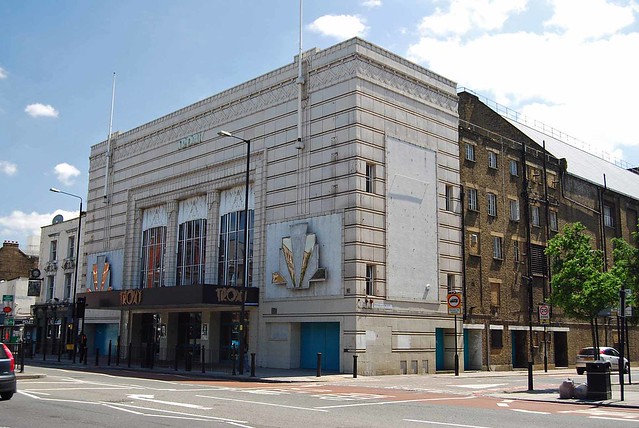
Troxy Art Deco Cinema, by Maggie Jones, on Flickr.

At 490 Commercial Road is a large Art Deco edifice called Troxy. It was designed by George Coles and opened as a cinema in 1933, seating 3520 people. It was built on the site of an old brewery; it was fashionable and luxurious and showed the best films. It even had an organ in the orchestral pit that would play the latest tunes during the interval. The cinema operated from its first film (King Kong) to its last (The Siege of Sydney Street) for 27 years. Later on, it served as a rehearsal space for the Royal Opera House and as a bingo centre. Today it's been restored to its Art Deco glory and serves as a multipurpose venue.

As I approached Limehouse Station, I noticed a set of row houses on White Horse Road. This street is quite old: it was till modern times the only northerly route from the Thames through the East End. The area, historically, used to be the hamlet of Ratcliff. Until the 19th century, it appears that there were several large houses with spacious gardens, in which lived captains and others related to the shipping industry.5 The current terraces are not in any way distinctive, and the street has little else to recommend itself (other than a little graveyard at the corner with Salmon Lane - which I didn't walk up to), so I shall linger here no longer.

A problem with Commercial road is that it is, in fact, very commercial, and not pretty at all. There are many properties derelict, businesses shuttered, squats. It might have been more interesting to walk around the squares and residential parts of the East End and Limehouse. I was in a hurry, however, and continued to propagate rectilinearly.


The next notable building is The Passmore Edwards Limehouse District Public Library. It is closed and derelict. It was founded in 1900 by Passmore Edwards, a newspaperman and philanthropist,6 who also created several other buildings to succour the East End. The library closed in 2003, was sold to a restaurant company,7, 8 and has still not been put to any use.


Limehouse Town Hall in 1937
A little further along is the Limehouse Town Hall, which doesn't look in great shape either. It was built in 1879. 9 I learned that when several parishes were amalgamated into the London Borough of Tower Hamlets, this building (along with the Poplar and St George's town halls) became surplus to requirements. It has housed various organisations over the years; these days it's being renovated as a cultural space, and was, in fact, opened to the public during this year's Open House Weekend.


St Anne's Limehouse, painted by Noel Gibson (via Spitalfields Life).
The lovely St Anne's Church is the next building on this potted tour. Designed by Nicholas Hawksmoor, it was consecrated in 1730, ruined by fire in 1850, restored shortly thereafter, and underwent a complete refurbishment between 1999-2009. It has deep connections with the Royal Navy: its clock was designed to guide shipping on the Thames, chiming every fifteen minutes.10 These days it chimes hourly, and no, I didn't hear it.
The clock in the tower is still the highest church clock in London, had the first illuminated clock face in the country, and its elevation enabled it to be seen by the thousands of ships which moored every day in the surrounding docks.11
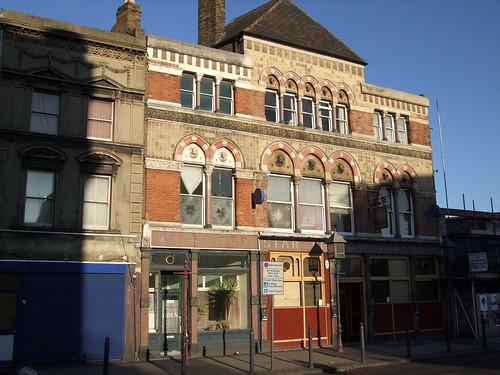
The Star of the East pub is the penultimate building on my walk: it has a a couple of gas street lamps in front of it. I don't know if these are still lit or not. The pub was run by the Baxter family for years.12
Star of the East, Limehouse, E14
The Star of the East pub, by Ewan Munro, on Flickr.
It appears that the first Baxter (Henry William) was hairdresser next door to the pub (founded in 1845), and he took over in 1871. There were still Baxters ruling the pub in 1915.13 The Star of the East, Commercial Road, unusually has a fancy polychromed Gothic frontage, no doubt intended to attract drinkers from the nearby docks.14 The pub was closed in 2008 and was a restaurant for a while, and now there's chatter that it's a pub again, but I saw no evidence of activity as I nipped by.

Across the pub is the British and Foreign Sailors' Hostel - yet another charitable construction by that worthy Passmore Edwards - which opened in 1901.15 This was recognised for the quality of the accommodations provided to sailors from across the British Empire. It is an Edwardian building, Art Nouveau in spirit, a welcoming gateway in form, and fluently carved with maritime symbols,16 including Britannia as a ship's figurehead. There are also various inscriptions, some faded more than others. You can see a bunch of pictures of the building and its features on Maggie Jones' Flickr set.17 Over the years, the building has had many popular names: Sailors' Palace, Jack's Palace, Mariners' Hotel...

At this point, I had to leave Commercial Road and get onto the West India Dock Road, and as I had already dawdled a bit and was running late for my meeting, I jumped onto a bus.


*****

Other interesting sights that I missed:

The George Tavern.
The Original Chinatown: most of it was demolished following rioting and anti-Chinese agitation in the 1930s. To be fair, much of it was spread across Limehouse, and few traces remain on the Commercial road itself.

References

  1. Street Directory of the Commercial Road, south side, 1921.
  2. Congregation of Jacob Synagogue, by David Brandes.
  3. Bridget Cherry, Charles O'Brien and Nikolaus Pevsner (2005). London 5: East. p. 526.
  4. East End Maternity Hospital, on the Lost Hospitals of London website.
  5. Sidney Maddocks (June 1935), 'White Horse Street', in The Copartnership Herald, vol V, no. 52.
  6. Dean Evans (February 2013), 'Passmore Edwards in the East End', Spitalfields Life. 
  7. Poplar Conservatives, 'Mayor Rahman Sells Off Limehouse Library - What Next?', July 2012.
  8. Passmore Edwards Centennial: Libraries.
  9. Kieran (Sep 2011), 'Limehouse Town Hall', Secret London.
  10. St Anne's Limehouse: History.
  11. Hugo Marchant (2012), 'St Anne's Church Limehouse', in his website I'm visiting London.
  12. Eric Pemberton's Postcards - Limehouse, on the Isle of Dogs Life blog.
  13. Star of the East pub, Limehouse, listing in Pubshistory.com
  14. Bridget Cherry, Charles O'Brien and Nikolaus Pevsner (2005). London 5: East. p. 79.
  15. Sailors' Place, on Exploring East London's website.
  16. Bridget Cherry, Charles O'Brien and Nikolaus Pevsner (2005). London 5: East. p. 77.
  17. Maggie Jones, Edwardian Buildings in London 1902-1910.

In Al-Hind: the Making of the Indo-Islamic World, André Wink makes the claim that the Rashtrakuta kingdom's rise in the Western Deccan and the Gujarat area was a direct consequence of a sharp rise in trade with the Persian Gulf, following the establishment of the great Arab caliphate of Baghdad and the Arab conquest of Sindh. He adds that the demise of the Rashtrakutas (AD 743-974) coincides with the fall of that trade in the late 10th century, when the Fatimid caliphate gained ascendancy in Egypt.

During the early period of consideration, trade between the Middle-East and India was predominantly between the Persian Gulf and Gujarat, with the great ports of Cambay, Somnath, Asawal and Broach all documented by Arab geographers and merchants. al-Biruni, for instance, writes: 'the reason why in particular Somnath has become so famous is that it was a harbour for seafaring people, and a station for those who went to and fro between Sofala in the country of the Zanj and China.' There was a Jewish trading outpost at Broach, and Parsis thrived along the west coast. The Arabs imported large quantities of teakwood, important for shipbuilding, as well as perfumes, bamboo, ginger, indigo, and cotton cloth of every colour. Much of the trade was conducted by foreigners; the Gujarati Hindus and Muslims were not, at this point, dominant.

Towards the late 10th century, however, the great ports of Gujarat began to decline. According to Wink, the proximate cause was the steady erosion of the Persian Gulf trade as the Red Sea and Egypt became more important. These countries dealt more with Malabar and Coromandel. The resultant decline in wealth and power of the Rashtrakutas was matched by the growing clout of the Cholas in the south of India, with the predictable result.

Still, during the reign of the Rashtrakuta kings, their domain with its capital at Mankir (present-day Malkhed) was considered to be the greatest in al-Hind (as the Arabs called India). 'The kings of al-Hind are not subject to a single king: each of them alone possesses authority in his own country; but the Ballahara is the king of kings (malik al-muluk) of al-Hind.' What is this Ballahara? Well, it's the Arabicised form of the Sanskrit title Vallabharaja, 'beloved lord and husband king'. Both Sanskrit and Arabic sources assert that the Rashtrakuta kings were paramount overlords over India for nearly 200 years. Indeed, the temple of Krishneswara at Rameswaram proclaims the Rashtrakuta advance into the deep south of India; Kanauj was a major conquest in the north. The great art works of Elephanta and Ellora exemplify the high culture and wealth of the Rashtrakutas.

The Arab chronicler Masudi says of this kingdom:
The most powerful king in al-Hind of our time is the Ballahara, king of the city of Mankir ... the greatest centre (of the country). ... This was the name of the first sovereign (of this kingdom), but it has become the dynastic title of his successors on the throne of Mankir and so it remained until the present ... Most of the kings of al-Hind turn their faces towards him whiel they are praying and prostrate (salla) themselves before his ambassadors when they arrive at his court ... He owns horses, numerous elephants and great riches ... He has a large kingdom, and his country has vast stretches of cultivated lands, abundant commerce and plentiful resources. He receives large amounts of revenues and his wealth is enormous ... The Ballahara lives in the city of Mankir. This city is forty parasangs in length, is made of teak, bamboo, and other sorts of wood. It is said that there are a million elephtants to transport the goods of the people. In the king's own stable there are sixty thousand elephants, and one hundred and twenty thousand elephants belong to the cloth-bleachers there. In the idolhouse, there are about twenty thousand idols made of a variety of materials such as gold, silver, iron, copper, brass, and ivory, as also of crushed stones adorned with precoius jewels ... In it there is also an idol made of gold, which is twelve cubits in height. It is on a throne of gold, under the centre of a golden dome, adorned with jewels, pearls and precious stones.
Interestingly, no Rashtrakuta coinage has been found! Indeed, there are no coins from their predecessors in Gujarat, the Chalukyas, either. That's not to say there were no coins at all in Gujarat - there's considerable evidence of large quantities of unminted bullion in the land, much of which served to decorate temples or become idols. Furthermore, the main coinage of the medieval world was the gold dinar and the silver dirham, and the lands of the Indian Ocean were fully integrated in that economy. Wink suggests that the Rashtrakutas were part of this Arab monetary network of dinars and dirhams. While there were also silver pieces circulating in the Rashtrakuta kingdom that were remarked upon by Arab chroniclers: '... the monetary means are constituted by the tatariya dirhams which each weigh 1½ dirham and are minted as the coin of the king', the dominance of the Arab coinage suffices to resolve the paradox of a wealthy kingdom that did not issue its own coin.

Jun 2, 2011

Nutmeg

This is nutmeg.
Nutmeg (from BBC)

Not very prepossessing, is it? And yet men killed and warred and competed all over the world for it.

Medieval mendicants and medics insisted that nutmeg was a cure for all ills. They claimed it could protect against the 'blody flux' and the 'sweating syckness' in the time of the plague. They recommended it against the cough ('mulled wine with nutmeg'), and trapped gas, and ills of the 'mouthe of the stomacke and the spleen'.

Andrew Borde wrote in the Dyetary of Helth (a treatise that made him more popular than his previous one on beards): 'Nutmeges be good for them which have cold in their head and doth comforte the syght and the brain.' He said that nutmeg dampened the libido, but by his own admission, 'it is hard to get out of the flesh what is bred in the bone' and he, a celibate former monk, died in disgrace.

Others claimed nutmeg was a powerful aphrodisiac. Charles Sackville said that even a tidbit of nutmeg before bedtime resulted in troubled slumber:
Dreaming last night on Mrs Farley,
My prick was up this morning early,
And I was fain without my gown
To rise in th'cold to get him down
Hard shift, alas, but yet a sure,
Although it be no pleasing cure.
And then, said Samuel Pepys, Sackville was gaoled 'after running up and down all night almost naked through the street.'

In Chaucer's time, nutmeg was a rarity available only to the rich. In the Canterbury Tales, Sir Thopas craved it.
Ther spryngen herbes, grete and smale,
The lycorys and cetewale,
       And many a clowe-gylofre,
And notemuge to putte in ale,
Wheither it be moyste or stale,
       Or for to leye in cofre.
Even Shakespeare wrote about it in The Winter's Tale:
I must have saffron to colour the warden
pies; mace; dates?--none, that's out of my note;
nutmegs, seven; a race or two of ginger, but that I
may beg; four pound of prunes, and as many of
raisins o' the sun.
A Dutch traveller named Jan Huyghen van Linschoten weighed in with his five volume Itinerario, an encyclopedia of the East Indies: 'nutmegs fortify the brain and sharpen the memory. They warm the stomach and expel winds. They give clean breath, force the urine, stop diarrhoea, and cure upset stomachs.'

And this is what led to all that mayhem and blood, and the rise of colonialism and the fall of empires.

Check out: Giles Milton, Nathaniel's Nutmeg: How One Man's Courage Changed the Course of History.

Nov 14, 2010

Equindia

You may recall that Afanasii Nikitin came to India in the 15th century trying to make his fortune after a concatenation of circumstances resulted in him losing all his worldly goods. He heard that there was a big demand for horses in India, and thought to bring along a colt to sell. 

Of course, he was absolutely right. Horses from Arabia or Persia were most highly coveted among the kingdoms of the subcontinent. There were Indian varieties available, termed kuhi (from the Northeast of the country), but the tatari (Central Asian) and the bahri ('from across the Seas' - or Arab/Persian) were better rated. 

It is interesting that when Benjamin of Tudela toured these lands in the 12th century, he made no mention of the equine trade. Scarcely a century later, Marco Polo was complaining of the way Indians treated their steeds,  pointing out that they had hardly any skilled horse-keepers. The Gulf tradesmen was smart - they were happy enough to export horses, but not the breeders or trainers that might create a competitive breeding business in India.

It was not just the lack of horsekeepers in the subcontinent that caused such a toll in the livestock. The climate was barely conducive to the health of the Gulf horse. And so over time, the import demand for horses continued to rise, much to the glee of the Gulf traders.

The volume of trade was staggering. Chinese manuscripts and Ilkhanid chronicles, besides Marco Polo's texts, especially are illuminating in this regard. One recounted story (by the Ilkhanid historian Rashid ad-Din Fazlallah) is about the trade with the Pandyan kingdom (Ma'bar, as he called it):
...the brother of Shaykh Jamal ad-Din, ruler of Kish, Malik Taqi Allah, who was an important official in Ma'bar decided to acquire 1,400 horses from his brother’s stud farms annually and send them to Ma'bar. Additionally, 10,000 horses should be bought from other places in the Gulf as Qatif, Lahsa, Bahrayn, Hormuz, Kalahat and others. The price for one horse should be 220 dinars and the merchants should be compensated for any loss or death of the horses. The annual price for these 10,000 horses was thus 2,200,000 dinars. In the historiography of Vassaf almost the same text can be found. At first glance this transaction seems to be a deal between the two brothers at the expense of the treasury of the kingdom of Ma'bar, whose rulers, however, had to consent. According to the above mentioned numbers, if we make the generous calculation that 100 horses could have been loaded onto one ship, we could conclude that at least 100 “horse-ships” annually took to the sea from the Persian Gulf to Ma'bar! 1
The price of the horse multiplied crazily once it arrived in India. Ibn Battuta talks some numbers: the best bahri horse was valued at up to 4000 tanka, as compared to the middling tatari, which cost only about 100 tanka. The top-class bahris were not for war - most were kept as luxury items coveted by the rich; only the tataris were destined to be warhorses.

References
1. Ralph Kauz, "Horse Exports from the Persian Gulf until the Arrival of the Portuguese", in The Indian Ocean, Southeast Asia, and the Maritime World, 2009.

Being somewhat at loose end, and to limber up my understanding of somewhat idiomatic and idiosyncratic French, I translated Denys Lombard's 1994 review of a Haraprasad Ray monograph on Sino-Indian trade and diplomacy. Check it out if you like.

Denys Lombard uses such expressions as "Les commentaires de M. Haraprasad Ray, qui est lui-même d'origine bengalie, ne laissent pas d'être précieux." This baffles not merely me, but also two automatic translators and several native French speakers, before, finally, succumbing to one colleague who explains that this is a literary expression rarely used in common speech. It means, as you might guess, something like "The observations of Mr Haraprasad Ray, himself of Bengali origin, are surely invaluable."

I'll try this out on some unsuspecting Frenchman one day. "Vos commentaires," I'll say, "ne laissent pas d'être précieux."

I'll be sure to report the results of said pronouncement.