JOST A MON

The idle ramblings of a Jack of some trades, Master of none

The dish of the day was a splendid roast guinea fowl cooked in sea-salt, with a chickpea purée. Lola ordered it without thinking twice. Ingrid had gone for a seared steak tartare with French fries.

Dominique Sylvain, The Dark Angel.

Jun 3, 2016

Bedford in Bordeaux

We look, we inhale, we draw in our mouthful: we chew, we think. It is a slow process… utterly absorbing and near an ordeal — the raw tannin puckers the inside of the cheeks, rasps the throat like claws, while at the kernel one finds a notion of… what? Texture, structure, multiplicities of scents…
Sybille Bedford, Pleasures and Landscapes.

In Habib Selmi's The Scents of Marie-Claire, the Tunisian narrator dreams that his dead mother and he are visiting his girlfriend's mother's house. The latter urges his mother to try various cheeses.
"I want you to try this piece of Roquefort, Madame Turki," said Marie-Claire's mother as she leaned over a big plate full of various cheeses. "All these cheeses are from our country." My mother devoured a piece of cheese and presented her plate immediately to Marie-Claire's mother, who was happy to see my mother's unexpected appetite for her cheeses. 
"And now, how about a small piece of Pont-l'Évêque?" 
"Delicious," said my mother as she passed her plate back again. 
"Have a piece of this Chaussée Aux Moix; and this piece of Camembert; and this piece of Brie de Meaux; and this and this .... "

Lourdes also proceeded to demonstrate, to my amazement, that (at least in this region of the stratosphere) there was no apparent relation between the amount of food its inhabitants put away and the ligne of their figures. To put it bluntly, she gorged as though she had skipped lunch, but came out of it looking like the Sugar Plum Fairy, albeit one with truly wonderful breasts. She wanted some caviar en blini. She insisted that I try some of her duck liver, not forgetting one or two of its abundant nuggets of black truffle. If Laurent had had ortolans en caissette, those tiny and rare buntings served whole in fluted paper cases, I am sure her relentless and champing jaws would have disposed of half a dozen before proceeding to the civet de lièvre avec pommes soufflées, and thence to the tart of Anjou pears with a little rhyming pear sorbet on the side, and finally, like some marathon runner breaking the tape, to the immense trolley of cheeses. She ate her way through all this without the slightest appearance of strain. It was I who sweated and inwardly groaned, for my menu had prices on it whereas, in the chauvinistic manner of French restaurants then, hers did not.
From "The Spectacle of Skill", by Robert Hughes. 

There's a book recently published in Russia, titled Литературный авангард русского Парижа. 1920—1926. История. Хроника. Антология. Документы. Written by Leonid Livak and Andrei Ustinov, it is 992 pages of history, chronicles, anthologies and documents pertaining to the great Russian diaspora in Paris between 1920-1926. By all accounts (including this review, by Vasily Molodyakov, from which I've shamelessly and poorly translated this article), it is a tour-de-force, a seminal work, a book that shreds the usual templates of study of emigre Russian literature.

What sort of avant-garde? the Soviets would say. Sure, a bunch of Russians legged it after the Revolution - some to Berlin initially, and then to Paris - and they may have written a thing or two.  Bunin, Kuprin, Shmelev, Zaitsev, Aldanov... The Soviets claimed that the real literature remained in Russia. The emigres were undeserving pretenders filled with nostalgia for their homeland; talented painters bemoaned their exile or returned with tails between their legs; the youth there was effete. The Soviets would bring up Marina Tsvetaeva, that most avant-garde of poets: what did emigration do for her?

Viktor Bart, Sergei Romov, Konstantin Tereshkovich. Founders of the group "Через" (1923).
The emigres would counter that the Soviets had defiled the avant-garde. The diaspora carried with it the forces of Russian tradition and the legacy of its great classical literature. The youth may quest for modernity, but the majority of them prefer to follow the great preceptors. Those who behave are published in "Modern Notes", while those who don't appear in "Numbers". This version of the argument is canonised by Adamovich and Gleb Struve after the second world war. The other version, that emigre literature is weak and ineffectual, and that the real literature is in Russia, is canonised in the English-language "Modern Russian Literature" by Marc Slonim.
"Merry Dynamite", manuscript by Dovid Knut. 1923.

So why do we have a thousand-page exposition from Livak and Ustinov? Well, for one thing, it illuminates little-known aspects of the Russian emigre experience, not just artistic but also literary. It overturns the myth of the absence of the avant-garde abroad, or of its marginalisation or insignificance. The Russian avant-garde was active, visible, powerful: "Gataparak", "The Palace of Poets", the Union of Russian Artists in France. But until 1924, the literary life of the Russian youth in Paris had three characteristic features: 1) an absence of anti-Soviet sentiment among the organisers and participants in the artistic groups; 2) a markedly pronounced popularity of the Soviet avant-garde in literature (Futurism) and art (Constructivism); and 3) close ties with the French Dadaist movement." (page 16).
Portrait of Mikhail Larionov by Man Ray. (1922-23).

The book also disposes of the myth that Russian Paris was somehow lesser than the Russian Berlin in 1921-23. The two capitals were not in opposition to each other; rather they were in consonance. And how could they not be, given that the same personages drove the avant-garde in both places?

Who were these people? You can learn nearly everything you might ever want about them, because nearly 3/4 of the book is comprised of the texts of the heroes of the avant-garde, the poetry and experimental prose of ten authors: Valentin Parnakh, Sergei Sharshun, Mark Talov, Georgi Evangulov, Alexander Ginger, Dovid Knut, Boris Bozhnev, Boris Poplavsky, Ilya Zdanevich and Vladimir Sveshnikov. Some of the text has appeared in print before, but gathered in one place, they offer a wonderful view. Another 250 pages deal with manifestoes, essays, letters as well as a reprint of all four volumes of the rare journal "Udar" ("Impact") by Sergei Romov. This sort of a Russian diaspora we haven't known. And such a Russian avant-garde we haven't known.

Dec 6, 2014

A Parisian Put-Down

Enrique Vila-Matas wrote a fictionalised biography of his younger (somewhat exaggerated) self in Paris, Never Any End to Paris, in which he tried hard to emulate his hero Ernest Hemingway, to be poor and happy, to learn to write, to see the world in the light of his master. Instead, he was poor, desperately unhappy, and the paucity of his achievement was laid bare when he met Javier Grandes at a bar, who merrily said he was slow off the mark becoming a writer.
What I mean is you're slow compared to Boris Vian. At your age, he was already nearly dead, but he'd written about five hundred songs, three hundred poems, I don't know how many novels, fifty stage plays, eight operas, one and a half thousand music reviews. And that's not all, he used and abused the trumpet. And he was a great nighthawk, who used to flit from the Bar Vert to La Rhumerie Martiniquaise, from Tabou to Petit Saint-Benoit, from Trois Canettes to Vieux Colombier daily. Two marriages, I don't know how many kids, an engineering degree, thousands of conversations with the waiters at the Balzar, a thousand transgressions, he wore out the needles on the record players at the local rich kids' bashes, and well, anyway, I don't need to tell you.
Who could handle such frankness? Enrique was crushed, "practically destroyed, as if I'd lost a thousand games of pinball."

****


Cave Tabou, Paris
The Cave Tabou that Grandes mentioned was jazz club frequented by Boris Vian's circle as well a bunch of journalists and existentialists in St Germain-des-Prés. As Vian said, "Very quickly, the Tabou has become a center of organized madness. Let's be frank, none of the clubs that followed could recreate that incredible atmosphere, and Tabou itself, alas! could not retain it for very long... it was impossible." It was here that a reporter overheard Juliette Greco say, "We are all existentialists" and the expressive coinage was born. Juliette Greco was a brunette, but the poet Anne-Marie Cazalis was a redhead, and the two of them were frequently in the club, listening to Vian's jazz.


Greco and Cazalis

****


La Rhumerie Martiniquaise was another existentialist and jazz haunt in St Germain-des-Prés. Besides Vian, the likes of Georges Bataille, Henri Salvador, Antonin Artaud, Marcel Aymé, Man Ray, Aimé Césaire were to be found here. If high intellectualism was not your thing, you could splurge on the finest Antillean rums here.


La Rhumerie Martiniquaise in 1955.

Aug 9, 2014

nazi crime fiction

Crime fiction, paradoxically, flourished under the nazis. A recent anthology (in French) by Vincent Platini allows us to rediscover these novels today. Le Figaro interviewed him recently, and this is a rather loose translation.

Vincent Platini is a researcher and lecturer at the Freie Universität de Berlin,. He analyzes the reasons that led the detective genre to flourish in the Third Reich. To be sure, the regime was not an undifferentiated bloc: while it maintained a totalitarian grip on cultural life evoking George Orwell's 1984, it also supported a mass culture based on frivolous and stupefying entertainment, reminiscent of Aldous Huxley's Brave New World. Platini says that only a few works would have been overt propaganda. Though the nazis were hostile to kitsch culture, the likes of Goebbels realised that forcing political issues onto the public would quickly jade them. They would proceed gradually. However, this supposedly apolitical culture colluded in maintaining nazi power as it held out the promise of a better life. When the war began, mass culture was used for its soothing effect: a novel such as Annex 27, published in 1944, described a prosperous Germany distant from the impending catastrophe. It reflected nazi ideology by denying the death throes of the regime.

Platini uncovers the development of consumerism and Americanism in nazi Germany, and recalls the notable advertisements for Coca-Cola and the craze for jazz. How could the censor tolerate gangster novels and films such as were set in Chicago? Platini points out that the Reich was not viscerally anti-American; indeed, the regime had a fascination for America and the public had a taste for foreign products. Hollywood set the example for German cinema, and crime fiction took on the English style. Admittedly, this leniency only lasted for a period. As censorship became more severe, the regime tried to promote 'good' German crime fiction. This was not an overt success. England and the US remained the trendsetters and German crime writers placed their novels in American settings but with a German footprint. This displacement became liberating: it was easy to pretend that major crimes no longer existed within the Third Reich; it also permitted a veiled criticism of the regime. Here, crime fiction became escapism in the true sense.

There is a curious absence of racial obsession and anti-semitic fury in the anthology. Platini explains that this is only a relative absence. Publications connected with the nazi party had their own share of caricatures and stereotypes. For instance, in the film Münchhausen, these were implicitly Jews. However, despite the importance of racist discourse of the time, there were very few Jews in crime fiction. Anti-semitism was not a theme particularly appreciated by the public, which - amidst the persecution - preferred to turn a blind eye to it. This split consciousness was reflected in the mass culture. On the other hand, and this was more chilling, a population was annihilated through its pretend exclusion. It would have been difficult to constantly stage scenes of Jewish denigration. Hiding the repression from the public eye allowed it to be exercised without restraint. On the other hand, some Jewish authors managed to re-emerge in the imagination: Zwick, for example, wrote a novel whose narrator, exiled in the US, returns to Germany to kill the one who caused the loss of his family. What a beautiful literary revenge!

Platini mentions 'treasures buried beneath the corpse'. Was there any artistic merit to contraband literature produced in nazi Germany? Indeed, he avers, there was more merit to this than the 'legitimate' culture, if art, among other things, is a challenge to the established discourse. This scorned literature acquired value precisely it was overlooked by the censors. The art that was recognised by the nazis did not perform its critical function. But an author such as Kuckhoff - of the highest intellectual training - deliberately turned towards the detective genre because it gave him a subversive opportunity that was subtle enough to be printed in the largest magazine of the time. Even a work of resistance such as The Open Letter reveals itself a gem of rhetoric, overturning the vocabulary of propaganda. But it remains the reader's responsibility to have a critical sensibility.

Krimi, une anthologie du récit policier sous le Troisième reich», selected, edited and translated by Vincent Platini, Anacharsis, 444 p., 23 €

Jun 11, 2014

Shrimp Provencale

In Frei Betto's Hotel Brasil, Mônica wants to make a camarões à la provençal for Cândido.
While Mônica cleaned up the shrimp and marinated them in salt and orange juice, Cândido chopped up the garlic so fine it was as if he was trying to split atoms. She put the rice on to boil, adding nothing by way of seasoning, but lining the bottom of the pan with extra virgin olive oil. As she did so, a satisfying feeling came over her. […] 
He added a few splashes of molho de pimento to the camarões, while she drizzled olive oil over the side salad.
As the rice cooked on the hob and the prawns baked in the oven, Mônica and Cândido sat on footstools, glasses of vinho in their hands. […] 
When the food was ready, they tipped the pan of rice over the shrimp, added a little parsley and gave everything a good stir. They took the dish into the lounge, where the table lay beautifully set and candlelit.

In August this year, Seoul will host the latest International Congress of Mathematicians. It's that quadrennial time when gossips begin to natter about Fields Medallists. A lot of people are talking up Manjul Bhargava. It is his last chance to win - by the time the next ICM comes around he will be older than 40. I'm hoping at least one woman will be awarded the prize this time.

In the run-up to the last ICM (in Hyderabad), I'd blogged about potential candidates for that year. None of them won. I hope to profile a few new names ahead of this year's ICM.

One that has popped up (new to me, at least) is Laure Saint-Raymond. Here is a loose translation of an interview that appeared a few days ago in Le Journal: "Laure Saint-Raymond, la boss des maths", by Louise Mussat (April 28, 2014).


Elected to the Academy of Sciences in December 2013, this top-flight researcher will participate at the International Congress of Mathematicians in Seoul in August.

The blackboard that stretches across one of the walls of her office at the École normale supérieure (ENS) is whitened by clouds of intertwined mysterious symbols. These are equations, and they are unsurprising - Laure Saint-Raymond is a mathematician, a pearl in
her field of partial differential equations applied to problems of physics. A winner of the European Mathematical Society's Prize in 2008 and of the Joliot-Curie "Young Woman Scientist" award in 2011, she was elected to the Academy of Sciences when she was 38 years old, the youngest ever. And in August she will present a lecture in Seoul at the ICM, an unmissable event that attracts thousands of mathematicians every four years, during which the famous Fields medals are awarded.

Stratospheric Research

What does the daily life of a top mathematician look like? Wracking one's brains before a sheet of blank paper before scribbling equations on a blackboard? "Not exactly!" says this energetic researcher, smiling. "I spend a lot of time teaching, attending seminars, trawling the literature to help me keep abreast of what is happening, and communicating the results of my own research. But thinking in front of a blackboard is part of my work, and most of the time it's with my team. It's the creative phase, a mutual game during which we sometimes find nothing or sometimes not what we were looking for!"

What Laure Saint-Raymond seeks with her collaborators is to capture physical phenomena with mathematics. "My training in physics helps me to better understand the language of physicists and exchange ideas and develop an intuition for the phenomena we are trying to describe," she says. That was the year she graduated with a degree in applied mathematics from the University of Paris VI, the same year she obtained her degree in plasma physics.

All these strings to her bow have enabled her to tackle a tricky problem, first posed in 1900 and still unresolved: how does one effect a transition from a physical model to another, less complex and less precise? The scientist explains, "When we are in the presence of a rarefied gas, for example in the Earth's upper atmosphere, and we want to simulate the re-entry of a spacecraft, we use the so-called kinetic theory in which the state of the gas is characterised by a function of several variables, such as time as well as the positions of the atoms." Meanwhile, to describe the behaviour of gases around us, infinitely denser in atoms, it suffices to use a model wherein all the atoms are considered as a single continuous medium.

"What interests me is to understand how one moves from one to the other of these models: is there a smooth transition or, on the contrary, is there a discontinuity between the two descriptions which renders them both invalid in the intermediate regime?" says Laure Saint-Raymond.

Fundamental and stratospheric, this mathematics nevertheless has some physical applications: they allow us to understand better the entanglement phenomena at diferent scales of time and space, and to better account for the observed air flow around an aircraft, for example, or the formation of persistent whirlpools in the ocean.

From the Cello to the Sciences

Laure Saint-Raymond readily admits: as a child or a teenager, she had no particular attraction for mathematics. Her main thing was the cello. Then in high school, equations finally overcame the scales. "I had a facility with maths and physics, and my parents, both maths teachers, undoubtedly influenced my change in direction."

As a newly-minted bachelor in mathematics, she found the arms of the engineering industry extending towards her. However, she chose research, it being "intellectually more stimulating". In 1994, she joined the ENS where she began work on her thesis under the supervision of François Golse on the "kinetic theory of gases". To be clear: on mathematics applied to the movements of gases. Recruited by the CNRS in 2000, she spent two years as a Research Fellow before being appointed as a professor at the University of Paris VI. In 2007, she obtained a secondment at the ENS where she was made director of the department of Analysis. Currently, she is the deputy director of the Department of Mathematics and its Applications.

An exceptional journey

Her exceptional and rapid-as-lighting journey demands respect as it has happened in a largely male-dominated universe. "That is irrelevant," she counters. "My being a woman has never been a handicap, I have never been a victim of discrimination. And to do research today, it is no easier for a boy than for a girl, it's difficult for both: young people don't obtain a job till after several years of post-doctoral work, which, in some disciplines, means they have to wait till nearly 35 years of age before they are in a stable situation and able to start a family..."

Still, says Laure Saint-Raymond, her eyes shining and with enthusiasm in her voice, the game is worth the effort. "I will no doubt make a lot more money in the industry, but one's work cannot be reduced to a mere salary. Not one of my days as a teacher-researcher is like any other, and at the ENS, I have the immense freedom to conduct research that I want to do, and I enjoy myself thoroughly. This is priceless."

When she is not playing with partial differential equations, or not coaching one of her students, or not tutoring one of her six children (five boys and one girl, aged between 4 and 14 years!), Laure Saint-Raymond escapes to the mountains. Skiing in the winter or hiking in the summer, whichever, the key is to be outdoors all the time. "I really need to recharge my batteries, to disconnect completely from work, to return to the office with new ideas," she admits, and returns to whitening her blackboard again.

The French feminist collective La Barbe laid into the French literary world a couple of weeks ago. In the 110 year history of the Prix Goncourt, they said, hardly any woman has won it. They said that this omission pointed to the invisibility of women writers: a hundred out of 110 Goncourt winners, and 75 out of 87 Renaudot winners were men.

So - are the literary juries misogynists and the women truly invisible? Or is this just a persistent cliche? Anne Brigaudeau did an analysis in an article published on a France TV blog a couple of days ago, when the awards season began with the Grand Prix du roman de l'Académie française, followed by the Goncourt, the Renaudot, the Femina, the Décembre, the de Flore, the Médicis, the Goncourt des Lycéens, the Renaudot des Lycéens and will end with the Interallié.

Participation in juries

It is as clear as ABC: a committee of men will naturally reward male talent, writes Anne Brigaudeau. And when the juries are chosen by appointment, it is not unexpected that men will nominate other men. This is a phenomenon that is no less rare in the 21st century than in the previous centuries. Take a look at the current composition of the juries:

The Goncourt jury is more or less fixed - 10 members, out of whom three are women (Edmonde Charlex-Roux joined in 1983; Françoise Chandernagor, since 1995; Paule Constant from this year).

The Renaudot jury also has ten members, of which only one (Dominique Bona since 1999) is a woman. The Flore has twelve jurors of which two are women. The Décembre is slightly better (five out of twelve are women) while the Médicis almost achieves parity (four of nine jurors are women).


The exception that proves the rule is the Femina, which was explicitly established as an anti-Goncourt and has an entirely female jury. But this is neatly counterbalanced by the Interallié which comprises nine men. Clearly, the men overwhelm the women in numbers, including in the Academy française, which has only six women among thirty-seven members.

Participation in shortlists

In the literary season of 2013, according to the publication list of Livres Hebdo, 36% of novels were written by women. 


How many of these novels were shortlisted for the majors? The Goncourt - one in four. The Renaudot - none out of six. The Décembre - none out of three. The Médicis - three out of eight. The Femina - two out of five. The Grand Prize - one in three. The surprises came from de Flore (four out of five) and the Interallié (three out of four). The two remaining prizes revert to the norm (Goncourt des Lycéens - one out of five, and Renaudot des Lycéens - one out of seven).


Participation among the winners

So what is the result of the 2013 awards season? Out of nine prizes awarded thus far (the Interallié comes out on the 19th), three were won by women (the Femina to Leonora Miano for La saison de l'ombre, the Médicis to Marie Darrieussecq for Il faut beaucoup aimer les hommes, and the de Flore to Monica Sabolo for Tout cela n'a rien à voir aver moi). In other words, a rule of thirds applies - a third of novels published are by women, a third of the novels short-listed novels are by women, and a third of the winners are women.


Does that sound fair enough - at least as far as the 2013 season is concerned?


Oct 24, 2013

The Muslim Detective

A passing comment by Zoë Ferraris got me thinking about the lack of Muslim detectives in crime fiction. Casting my mind back on the books I've read, I couldn't recall a single one (other than Ferraris' own Nayir ash-Sharqi and Katya Hijazi). But then my facility with names is particularly fraught, so I had to depend on the web to locate some names.

It turns out that I've read crime fiction featuring Muslim detectives in at least two books - one (The Bethlehem Murders) by Matt Rees and the other (Kismet) by Jakob Arjouni. There may be more, but I'm not in a position to say so.

Of course, as soon as I saw Arjouni's name, I recalled Kayankaya, as brilliant a creation as you can ask for. Wise-cracking, to boot! Indeed, a few years ago when I was ploughing my way through foreign crime fiction, I had noted this wonderful detective.

To be honest, 'Muslim' is far too broad a brush. There's much that differentiates a Turkish-German detective from, say, a poor Palestinian teacher-turned-investigator or a Saudi desert guide-turned-detective; and even more that differentiates any of those mentioned above - all men - from a Saudi forensic pathologist-turned-detective as well, a superbly etched Katya Hijazi. And though they are all Muslims, they run the gamut from secular to deeply devout, from people for whom religion has almost no impact on their daily lives to those whose every waking moment is governed by the Shariah. 

So I'd say that merely giving a detective a Muslim name doesn't make him one. Just as pointed out by those who deprecate underwritten and token minorities in speculative fiction, creating a run-of-the-mill character and tossing him or her a particular name does not make a difference. Chris Culver, a self-published author who recently found much success in the genre with The Abbey said he hadn't encountered many Muslim detectives in his reading, and, tired by the popular depictions of Muslims as terrorists, he had decided to feature a recovering alcoholic, Ash Rashid, an Indianapolis detective. How much Culver knows about Islam and whether Rashid is even a tiny bit coloured by Islam is something I can't answer, not having read the book. I'd be glad to hear from anyone who has.

And then there's the Canadian ad-man-turned-writer Scott Thornley whose Erasing Memory has a Muslim woman, Fiza Aziz, as a member of the detective team. I hope I'm not giving anything away when I say she supposedly suffers a bit of a burn-out in the first novel, but then comes back a-rearin' in the second The Ambitious City.

Zoë Ferraris, though, is absolutely top-notch. My knowledge of that most stifling of countries, Saudi Arabia, comes from the reading of two or three books (non-fiction, mainly) and the experiences of my wife in the neighbouring Kuwait. Ferraris is brilliant and insightful. Her characters (the very conservative Nayir and the struggling-against-the-patriarchy Katya) are deeply sympathetic; her understanding of the family dynamic in a traditional culture is nuanced; her depiction of the claustrophobia and the suffocation felt not just by women but also men in Saudi is eye-opening. I've only read the first of her trilogy featuring these detectives, The Night Of The Mi'raj, but I haven't been so moved by such an astute insight into character and motivations since I read Katie Kitamura's The Longshot.

The web search also revealed other detectives in the Islamic lands. It turns out that there was an entire Turkish golden age of crime fiction between 1928-50, and it was Turkey-centric, there were papers written on the depiction of foreigners in these books. What were these books? Are there any translations into English? All good questions.

The Moroccan-French writer Driss Chraïbi's Inspector Ali series features a Muslim detective. To be honest, Chraïbi was a social critic more than a genre writer, and how these books stand up as crime fiction, I can't say, not having read any of them.

I wouldn't be surprised if among the teeming volumes of pulp fiction published in Hindi, Urdu and other Indian languages, there weren't a few in which Muslim investigators do go after the villain. (I should take a look once again at my copy of The Blaft Anthology of Tamil Pulp Fiction.) Many writers of these works are socially activist and often point an accusing finger at the hypocrisies and tragedies of life in South Asia. Some works may very well be steeped in the Muslim milieu as well, offering yet another perspective on a demonised community. On the other hand, if action and plot trump characterisation, the 'Muslim' detectives may just turn out to be tokens.

Serendipitiously, I came across this review of four detective books by the Urdu writer Ibne Safi (published, hurrah hurrah, by Blaft), in which the perfect and cold Colonel Faridi, accompanied by the witty and dashing Captain Hameed, are counterespionage agents who do a bit of detection on the side. The reviewer goes on to say: But fun as they are to read, they are not particularly satisfying as detective stories: plot developments can be arbitrarily motivated; there are long stretches of inane dialogue; there are convenient coincidences, hasty endings. As a quick read in discardable pulp format, this probably acquit themselves admirably; they will not rival Zoe Ferraris's works for mastery, perhaps.

Who are the others? Am I missing any obvious ones?


Sep 18, 2013

Watercolour

Watercolour is a remarkably unforgiving medium of art. If you make a mistake, you cannot easily rectify it. With oils, you can paint over, or possibly even erase. Still, in the 19th century, oils were considered the higher art form. Neither the academy nor the cognoscenti gave watercolour the standing it deserved.

Luckily, this lack of encouragement did not hold the masters back. Entire hordes of British artists got into the habit of using watercolours. When war and time permitted, they would traipse off to lovely parts of Europe to paint. In the early 19th century, a bevy of them headed to Paris. Much of their work can be seen at the Wallace Collection's The Discovery of Paris - Watercolours by Early 19th Century British Artists - an exhibition that runs till September 15, 2013.

I was there the other day. The artworks were displayed in two not-too-large rooms. Many were by painters I hadn't heard of. I am glad indeed to be introduced to them.

The British didn't quite take to Paris. For them, when they weren't mooning over London, Venice was still the cynosure of cityscape. In France, the British appeared even to prefer Rouen to Paris. Although they appreciated the light and the architecture of Paris, and they admired it as a city of pleasure, they disdained its filth and open gutters. For most British painters of Paris, the city was the source of only a small fraction of their outputs.

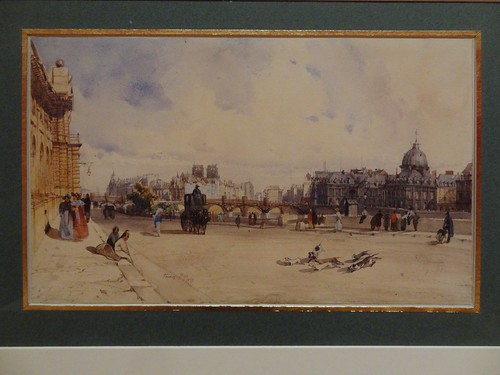
For Thomas Shotter Boys (1803-74), Paris was of signal importance. He was great friends with Richard Parkes Bonington (1802-28), and they often painted vistas from similar viewpoints. His painting of the Pont des Arts shown below is, in fact, closely akin to Bonington's own earlier composition.

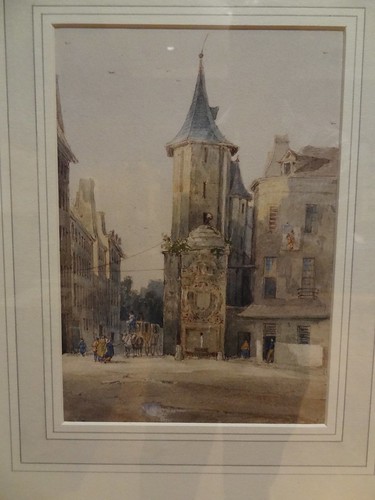
Louis Francia (1722-1839) was native to Calais, but spent years in England as a master and watercolorist. When he returned to Calais, he taught the likes of Bonington ('[Paris is] this city of mud and dirtiness') and William Wyld. 

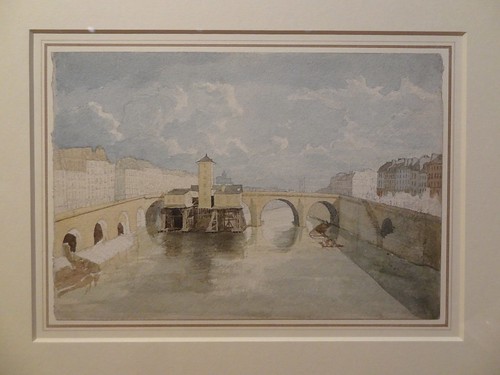
Another artist was John Gendall (1789-1865). He was sent by a publisher (Rudolf Ackermann) to prepare watercolours for a book, Picturesque Tour of the Seine, from Paris to the Sea (1821). The work below by Gendall was based on a sketch by Auguste Pugin.

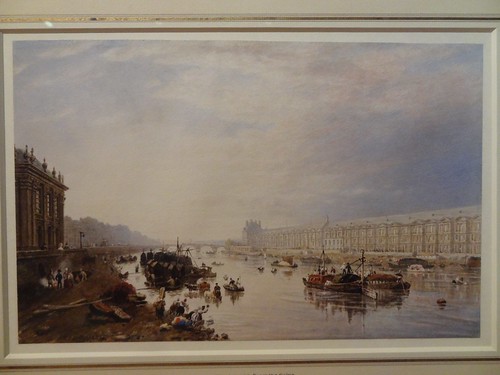
Frederick Nash (1782-1856) was a specialist of architectural views, and he liked to add some verisimilitude by including washerwomen and charcoal burners in some of his paintings. His view of the Seine looking towards the Louvre below was part of a series of illustrations executed for a major book Picturesque Views of the City of Paris and its Environs.

The pieces on display are varied - from the sharply executed precision of some to the diffuse impressions of others. I took some pictures. Take a look!

Untitled
The Pont des Arts from the Quai du Louvre, by Thomas Shotter Boys. (1833).
Untitled
Pont Notre-Dame from the Pont au Change, by John Gendall. (1820-21).
Untitled
The Seine, looking towards the Louvre and the Pont Royal, by Frederick Nash. (1820s).
Untitled
The Fontaine Saint-Victor, by Louis Francia. (1825).
Some of the pictures below were at the exhibition as well, but the images are not mine.
Pont des Arts, by Richard Bonington. (1826).

Saint Severin, by James Holland. (1831). The irregular wall on the right is from his imagination!


Sep 10, 2013

Bordeaux or Burgundy?


In particular:

Le Duc de Bordeaux ne boit qu' du Bourgogne,
Mais l' Duc de Bourgogne, lui, ne boit que de l'eau;
Ils ont aussitôt échangé sans vergogne
Un verr' de Bourgogne contr' le port de Bordeaux.

A song of good cheer (chanter le vin) from Burgundy. Drink wine and be merry.

The Duke of Bordeaux drinks only Bourgogne
But the Duke of Bourgogne he drinks water alone
so neither felt shame when they sought to exchange
a glass of Bourgogne for the port of Bordeaux.

(From Norman Davies, Vanished Kingdoms: The History of Half-Forgotten Europe, page 108.)

Sep 6, 2013

Troubador

Canczon audi q'es bella'n tresca
que fo de razo Espanesca;
non fo de paraulla Grezesca
ne de lengua Serrazinesca.
Dolz'e suaus es plus que bresca,
e plus qe nulz pimentz q'om mesca;
qui ben la diz a lei Francesca
cuig me qe sos granz pros l'en cresca
e q'en est segle l'en paresca.

Tota Basconn' et Aragons
e l'encontrada delz Gascons
sabon quals es aqist canczons
e ss'es ben vera 'sta razons.
Eu l'audi legir a clerczons
et a gramadis, a molt bons,
si qon o monstral passions
en que om lig estas leiczons.
e si vos plaz est nostre sons,
aisi conl guidal primers tons,
eu la vos cantarei en dons.

Cançó de Santa Fe or Chanson de Sainte Foi d'Agen, first half of 11th century. Troubador chanson in Old Occitan, collected in Vers e regles de trobar, by Jofre de Foixa (died 1300).

I heard a song which is good to dance to, and its content was Spanish; it was not in Greek nor in the Saracen tongue. It is sweet and succulent, more than a honeycomb, and more than a spiced drink poured out ready. He who utters it well in the French manner, I think that he will get great profit from it, and that the profit will be evident in this world. All the Basque country and Aragon and the land of Gascony know what a song it is and if what it has to say is true. And I heard it read by clerks and scholars of note exactly as the 'passion' shows it - the 'passion' in which those 'lessons' are read. And if our melody pleases you, then I will freely sing it to you in teh style set by the first melody.

Translation from John Stevens, Words and Music in the Middle Ages: Song, Narrative, Dance and Drama, 1050-1350, page 234.

Jean-François Parot in his The Phantom of Rue Royale falls precisely into the cliché of the modern crime writer: the work has no atmosphere unless it segues into food, preferably with the entire recipe, accompanied often by pornographic descriptions of the ensuing meal. Here, he launches into an entirely unnecessary description of a calf's breast pie as prepared in a cheap restaurant in 18th century Paris. I go into the merits of the novel elsewhere, but here is the gastronomic excerpt:

'Only because it's you, Commissioner. Otherwise, I wouldn't say a word, even under torture. Here goes. You cut a decent piece of calf's breast - choose it well: it has to be plump and pearly. Then you cut it up into slices, which you lard with one or two pieces of fat. Make a crusty pastry out of lard and lower it into the pie dish. Put in the slices of veal, after seasoning them with bacon, salt, pepper, cloves, nutmeg, herbs, bay, mushrooms and artichoke ends, and cover the whole thing with pastry. Two good hours in the oven. You take it out, and just before serving, you cut a little hole in the top and carefully pour in a white sauce made with lemon juice and egg yolks.' 
'That seems to me perfectly adapted to the emptiness of our bellies,' said Bourdeau with a gleam in his eye and his lips all aquiver with anticipation. 
'And to whet your appetites, I'll serve cherries, the first of the year, cooked in cinnamon wine.' 
'Ideal for a little eleven o'clock meal,' said Nicolas ingratiatingly.

Jun 20, 2013

Natal Food

In the Hotel Atlantic, a spy is having Christmas dinner with a mathematician. It's the time of the love of their lives.
Between them, over the course of the evening, they ate servings of duck foie gras with a peach wine jelly, Scottish scallops, ham, deboned saddle of lamb from the Auvergne, white beans with truffles, sea bream, poached apricots, bay leaf panacotta, cheeses and chocolates. They drank champagne, a house white wine, Rothschild Bordeaux, Chateau Villefranche dessert wine; he an espresso and she a cup of rooibos tea. There were also almonds and Christmas pudding with brandy sauce from the Ritz in London.
J. M. Ledgard, Submergence. 

Feb 20, 2013

Leftovers

In Pascal Garnier's brutal The A26, Yolande is cooking for her brother.
Yolande's soup consisted of some leftover cabbage, a tine of ravioli in tomato sauce, two potatoes, a chicken carcass, a handful of lentils, a vanilla pod and two or three other ingredients she couldn't quite recall. While emptying the cupboards into the large cooking-pot she had said to herself that her recipe would be called 'Everything must go'.

Jan 21, 2013

Forty-fifth Degree

I was reading Peter Pesic's Abel's Proof: An Essay on the Sources and Meaning of Mathematical Unsolvability when I came across the story of Adriaan van Roomen and Francois Viète. The former, a Dutch mathematician, had in 1593 put out a challenge problem to the mathematicians of all the world:


The Dutch ambassador to the court of Henri IV ironically suggested to the French king that there was no mathematician in his kingdom who could solve this equation. Henri summoned Viète. Viète was already a well-known cryptographer and mathematician, he had recently published a book on trigonometric formulae, and - fortunately for la gloire de France - recognised the equation as an expansion of some powers of trigonometric functions. In a few minutes he was able to determine the twenty-three positive solutions of van Roomen's problem, and the following day he provided the remaining 22 negative solutions as well (although he disdained them).

Van Roomen was extremely impressed, travelled to Paris, met Viète, and they remained buddies for the rest of their lives. Aww, you might say. Geek man-crush and all that. 

Looking at this equation, I have no idea where to begin solving it. Descartes' rule of signs tells me that there are twenty-three sign changes in the equation, indicating the existence 23 positive roots (not all necessarily distinct, of course). By the fundamental theorem of algebra, we know that an algebraic equation in the 45th power will have forty-five roots. So we can deduce that there will be 22 negative roots. But what the devil are they?

Recourse to the programming environment R's polynom package is easily done, but as that's a numerical solver, the nested square roots in the constant part of the above equation can create instabilities rendering the final answer somewhat unlikely. Indeed, I find that I get a bunch of complex roots, whereas Viète determined real-valued solutions.

I thought I might use Wolfram Alpha to solve the equation symbolically. Unfortunately, the polynomial definition is too long for the input box on that site.

Another problem is that there appear to be different versions written down of the equation: some of the coefficients are different (e.g. I've seen 740,259x35 and 740,459x35; there are other discrepancies as well.)

Perhaps I should use the clue that Viète used a trigonometric identity to solve the equation. By the sixteenth century, several of these were already known in Europe. For example,


If we let , we can get a cubic equation , where  . Were a solver to recognise the left-hand-side as an expansion for a trigonometric function, he or she would be able to use the identity to solve the algebraic equation. Similarly, Viète realised that using the above substitution for x, that large 45th degree equation reduced to , which he could then solve using a table of sines.1

Check out Philippe Henry's paper (in French)2 - it's got as comprehensive a treatment of the problem and Viète's approaches to solving it as you might want. I gotta tell you - it has less to do with algebra than geometry. And indeed, the reason Viète rejected the negative solutions is that they did not make sense in 'real life'. Or, that is to say, geometry.

References

1. Jeff Suzuki, Mathematics in Historical Context, page 189.
2. Philippe P. A. Henry, La solution de François Viète au problème d’Adriaan van Roomen, 2008.

A few years ago, Olivia Judson burst onto the scene with Dr Tatiana's Sex Advice To All Creation. Various animals wrote to this biological agony-aunt asking for tips for better sex and procreation, and she gave them very pertinent advice. How to avoid being eaten by your mate after sex was one important topic, especially when you are a few hundred times smaller than her. A successful television show followed.

A bit later, Isabella Rossellini got into the act with her online series of videos titled 'Green Porno', which explored the sex lives of various fauna. These were gross yet funny; I watched one or two.

It turns out that the very clever Alessandro Boffa beat both women to it with his exploration of love, obsession and beastly antics, You're an Animal, Viskovitz. The hapless Viskovitz is desperately in love with the seductive Ljuba, but no matter what his incarnation - a mantis, a shark, a sponge, a scorpion - he is constantly thwarted, either by his bad timing, or biology, or the pressures from his friends or competitors (and it's always the same trio: Lopez, Zucotic, Petrovic). The wondrous Ljuba makes eyes at him, yet invariably he has to settle for the homely Jana. Animal behaviour to illustrate the human condition can be dry and academic, but Boffa, a biologist by training, has a facility with expression and superb humour, and this is lovely, whimsical stuff.

Animal sex can be smutty, which allows us to segue into Alan Bennett's twofer, titled Smut: Two Unseemly Stories. Bennett has an unjudgmental touch with much sympathy for his characters, and he wields it lightly here. In one story, a widow joins a local teaching hospital as a diagnostic aid; the professor is attracted to her; the students think her 'cool' because she has allowed her bedsit tenants to perform sex acts in her presence in lieu of rent. Bennett explores sexual awakening in middle age: the widow is impressed by the versatility and energy of the young tenants and recalls that she had never been quite as enthusiastic with her husband. Although she doesn't appear to be much aroused by what she sees, she veers between heightened interest and indifference, and her main concern remains 'what will other people think if they knew?' In the other story, a gay man with an overbearing mother and a distant father marries a woman he considers silly. The dynamics in the family are in constant flux, and everyone's imperative to maintain their   secrets and superficial relationships provides the humour and pathos in the tale.

On the one hand, there are families that successfully hide their loves from each other, and on the other, there are entire societies that keep an aggressive, claustrophobic eye on everyone. The resulting atmosphere of suspicion and poison, parochiality and patriarchy, love and desire, is sparely described in Wajdi Ahdal's  A Land without Jasmine. Set in Yemen, a lovely girl is an object of barely suppressed lust by nearly all the men she encounters. Her neighbours, local shopkeepers, her professors, all assume that she wants to seduce them. Polite smiles are taken as invitations. No matter how demurely she conducts herself, she stirs loins. The girl disappears one day, the police get involved, and the story lurches from one self-serving point of view to another. This is a furious, explicit polemic against the systematic brutalisation of women in traditional Arab society; small wonder that books like these forced Ahdal to leave the country to save his life. He is back in Yemen now, but who knows whether his much-needed voice has the audience it deserves?

And finally we have the frankly peculiar Story of the Eye, by Georges Bataille. Reading it reminded me of Guillaume Apollinaire's nutty, frenetic and surreal Les Onze Mille Verges: Or, the Amorous Adventures of Prince Mony Vibescu, a bonkfest that is too funny to be erotic. (Oh, and it could have been in my sub-200-page read list, except I've read it already.) But where Apollinaire was light-hearted, Bataille is obsessive. Geometrically unfeasible contortions abound in this debut novel, which has far too many multiple orgasms to have any resemblance to reality. (Or, perhaps, I've just led a very sheltered existence.) Roland Barthes' textual analysis led to hidden meaning and much philosophising - so why is the book promoted as erotica? Besides the obvious intersection between sex, murder, madness and religion, what does it offer? It might have been avant-garde when it first appeared in 1928, but today it feels forced and pedestrian. I'm baffled, baffled, I tell you.

(For some utterly bizarre reason I can't fathom, several of the books I've got from the library as part of my exploration of the sub-200-page range deal with sex. And I'm only up to the letter B! As you see above, we have an Ahdal, a Bataille, a Bennett, and a Boffa. Were it not for the Ahdal, I'd have given this blog the title of Birds and Bs.)

Dec 4, 2012

Under 200

There are more than four hundred books on my To-Read list. It is a daunting number made especially so by attention deficit and a niggling feeling of restlessness. I have decided to put them aside for now. Maybe when I have that study I have been promised where I can reign like a potentate and reach out to grab a likely book from one of several floor-to-ceiling shelves - then, I'll get onto buying these books and reading them. Until then, to keep my mind ticking along its unexamined and un-introspected path, I have resolved to introduce an element of randomness to my reading.

Those four hundred books on my list range quite widely across genres of fiction and tropes of non-fiction. Most of them are on the list, however, because I read of them on some review or the other. As I do not browse bookstores anymore, there is no serendipity in my reading. So what better way to reintroduce an element of chance than by random grabs from the library's fiction shelves?

I don't want to spend hours on thick tomes that might prove enervatingly boring half-way through. I don't want to linger for hours on one paragraph and try to glean every manner of jewel from it. As I said - attention deficit. So here's what I am going to do: I'll go through the fiction shelves of my local library in alphabetical order and I'll pick up every book under 201 pages long. I will ignore the blurbs and I will get stuck into every book. I'll likely discover authors I had never heard of, never read, and - given any other trajectory in my life - would never attempt. 

The choice of 200 pages as the upper limit on size is quite arbitrary. After all, a book of 150 pages with small font is as chunky, word-wise, as another with 200 in big type. Still, it's an important psychological barrier. I can finish a two-hundred page book in a day (or at a sitting were it not for constant interruptions from sundry little imps and my own nervous energy). I needn't worry about wasting hours should the prose be impenetrable. And carrying the books from and to the library will not ruin my back. Good stuff.

So here I'll make (and keep updating) the list I'm ploughing over. I might blog about them. Or I might not.
  1. Wajdi Ahdal, A Land without Jasmine. [Yemen]
  2. Woody Allen (*), Mere Anarchy. [USA]
  3. Niccolò Ammaniti (*), Me And You. [Italy]
  4. Steven K. Amsterdam, Things We Didn't See Coming. [USA]
  5. Lin Anderson, Blood Red Roses. [Scotland]
  6. Margaret Atwood, The Tent. [Canada]
  7. Paul Auster, Timbuktu. [USA]
  8. Muriel Barbery, The Gourmet. [France]
  9. Lukas Bärfuss, One Hundred Days. [Switzerland]
  10. Djuna Barnes, Nightwood. [USA]
  11. Nicola Barker, Love Your Enemies. [England]
  12. H. E. Bates, The Darling Buds of May. [England]
  13. Georges Bataille, Story of the Eye. [France]
  14. M. C. Beaton, Deborah Goes to Dover. [Scotland]
  15. Alan Bennett (*), Smut: Two Unseemly Stories. [England]
  16. Louis de Bernières, Red Dog. [England]
  17. Alessandro Boffa, You're an Animal, Viskovitz. [Italy]
  18. Roberto Bolaño, Monsieur Pain. [Chile]
  19. Anne-Sophie Brasme, Breathe. [France]
  20. Theresa Breslin, Prisoner in Alcatraz. [Scotland]
  21. George Mackay Brown, Beside the Ocean of Time. [Scotland]
  22. Willa Cather, The Bohemian Girl. [USA]
  23. Truman Capote, Summer Crossing. [USA]
  24. Angela Carter, The Passion Of New Eve. [England]
  25. Robert Carter, The Gun-runners.
  26. Maxime Chattam (*), Carnage. [France]
  27. Janet Davey, First Aid. [England]
  28. Patricia Duncker, Hallucinating Foucault. [England]
  29. Marguerite Duras, Moderato Cantabile. [France]
  30. Ann Dee Ellis, This Is What I Did. [USA]
  31. Bret Easton Ellis, Less Than Zero. [USA]
  32. Jenny Erpenbeck, Visitation. [Germany]
  33. Janet Frame, The Lagoon: A Collection of Short Stories. [New Zealand]
  34. Alan Ford, Thin Ice. [England]
  35. Günther Freitag, Brendel's Fantasy: A Novel. [Austria]
  36. Jostein Gaardner, Through A Glass, Darkly [Norway]
  37. Damon Galgut, In a Strange Room. [South Africa]
  38. Jane Gardam, The Pangs Of Love. [England]
  39. Alan Garner, Thursbitch. [England]
  40. Pascal Garnier, The A26. [France]
  41. Hella Haasse, The Black Lake. [Netherlands]
  42. Hugo Hamilton, The Last Shot. [Ireland]
  43. Shirley Hazzard, Cliffs Of Fall. [Australia]
  44. Zoë Heller, Everything You Know, [England]
  45. Victoria Hislop, The Last Dance, and Other Stories. [England]
  46. Peter Hobbs, In the Orchard, the Swallows. [England]
  47. Alois Hotschnig, Maybe This Time. [Austria]
  48. Geoffrey Household, Face to the Sun. [England]
  49. Ted Hughes, Difficulties of a Bridegroom. [England]
  50. Helen Humphreys, The Lost Garden. [Canada]
  51. Rod Humphries, The Last Coal Trip to Tenby. [Wales]
  52. Samantha Hunt, The Seas. [USA]
  53. Jorge Ibargüengoitia, The Dead Girls. [Mexico]
  54. Yasushi Inoue, The Hunting Gun, [Japan]
  55. Robin Jenkins, A Very Scotch Affair. [Scotland]
  56. Ma Jian, Stick Out Your Tongue. [China]
  57. Andrew Kaufman, The Tiny Wife. [Canada]
  58. Michael Kimball, How Much of Us There Was. [USA]
  59. Katie Kitamura, The Longshot. [USA]
  60. Milan Kundera (*), Slowness. [France]
  61. Rodrigo de Souza Leão, All Dogs are Blue. [Brazil]
  62. J.M. Ledgard, Submergence. [Scotland]
  63. Stephen McGeagh, Habit. [England]
  64. Norman Maclean, Contracts. [Scotland]
  65. Tessa McWatt, Vital Signs. [Canada]
  66. Ernesto Mallo, Needle in a Haystack. [Argentina]
  67. Sándor Márai, Esther's Inheritance, [Hungary]
  68. Cornelius Medvei, Caroline: A Mystery. [England]
  69. David Miller, Today. [England]
  70. Alison Moore, The Lighthouse. [England]
  71. Alistair Morgan, Sleeper's Wake. [South Africa]
  72. Herta Müller, The Passport. [Romania/Germany]
  73. Irène Némirovsky, David Golder. [Russia/France]
  74. William Newton, The Two Pound Tram. [England]
  75. Raul Nuñez, The Lonely Hearts Club. [Argentina]
  76. Simon Okotie, Whatever Happened to Harold Absalon? [England]
  77. Anna Maria Ortese, The Iguana. [Italy]
  78. Julie Otsuka, The Buddha in the Attic. [USA]
  79. Chuck Palahniuk, Tell-All. [USA]
  80. Franck Pavloff, Brown. [France]
  81. Mervyn Peake, Letters from a Lost Uncle. [England]
  82. Per Petterson, It's Fine By Me. [Norway]
  83. Padgett Powell, Edisto. [USA]
  84. Annie Proulx, Brokeback Mountain. [USA]
  85. Atiq Rahimi, Earth and Ashes. [Afghanistan]
  86. Joan Riley, Waiting in the Twilight. [Jamaica/England]
  87. Mary Robison, Why Did I Ever. [USA]
  88. Knud Romer, Nothing But Fear. [Denmark]
  89. Meg Rosoff, How I Live Now. [USA]
  90. Leo Rosten (*), The Education of H*y*m*a*n K*a*p*l*a*n. [USA]
  91. Ambalavaner Sivanandan, Where the Dance is. [Sri Lanka/England]
  92. Elke Schmitter, Mrs Sartoris. [Germany]
  93. Alan Sillitoe, The Loneliness of the Long Distance Runner. [England]
  94. Ali Smith, Girl Meets Boy. [Scotland]
  95. Alexander Solzhenitsyn, One Day in the Life of Ivan Denisovich. [Russia]
  96. Simona Sparaco, About Time. [Italy]
  97. Muriel Spark (*), The Finishing School. [Scotland]
  98. Graham Swift, Learning to Swim and Other Stories. [England]
  99. Véronique Tadjo, As the Crow Flies. [Côte d'Ivoire]
  100. Mary M. Talbot, Dotter of Her Father's Eyes. [England]
  101. Pier Vittorio Tondelli, Separate Rooms. [Italy]
  102. Jáchym Topol, The Devil's Workshop. [Czech]
  103. Justin Torres, We the Animals. [USA]
  104. Kurt Tucholsky, Castle Gripsholm. [Germany]
  105. Fred Uhlman, Reunion. [Germany/England]
  106. Dimitri Verhulst, The Misfortunates. [Belgium]
  107. Sarah Webb, Behind Closed Doors. [Ireland][
  108. Nathanael West, The Day of the Locust. [USA]
  109. Rebecca West, The Return of the Soldier. [England]
  110. Jeanette Winterson, Weight: The Myth of Atlas and Heracles. [England]
  111. Taichi Yamada, Strangers. [Japan]
Okay, I felt compelled to add some genre stuff too. It's a rare crime or sci-fi book that comes in at less than 300 pages, but if you look closely enough, there are some sub-200 ones. Rare, but they're there.
  1. Ted Allbeury, Dangerous Arrivals. [England]
  2. Benjamin Black, The Lemur. [Ireland]
  3. Lilian Jackson Braun, The Cat Who Went Bananas. [USA]
  4. Max Brooks, Closure, Limited and other Zombie Tales. [USA]
  5. Tori Carrington, Queens Ransom. [USA]
  6. Judith Cutler, Silver Guilt. [England]
  7. Philip Daniels, The Inconvenient Corpse. [England]
  8. Francis Durbridge, Curzon Case. [England]
  9. Wolf Haas, The Bone Man. [Austria]
  10. Gerald Hammond, With My Little Eye. [Scotland]
  11. Alanna Knight, Deadly Beloved. [Scotland]
  12. Bill Knox, To Kill a Witch. [Scotland]
  13. Fritz Leiber (*), Swords and Ice Magic. [USA]
  14. Elmore Leonard (*), The Switch. [USA]
  15. Roy Lewis, An Assumption of Death. [Wales]
  16. Roger Ormerod, More Dead Than Alive. [England]
  17. Anne Perry, A Christmas Visitor. [England]
  18. Alexei Sayle, Mister Roberts. [England]
  19. Leopold Ritter von Sacher-Masoch, Venus in Furs. [Austria]
  20. Georges Simenon (*), Maigret Sets a Trap. [Belgium]
  21. Peter Turnbull, False Knight. [Scotland]
  22. Barry Unsworth, Morality Play. [England]
  23. Minette Walters, The Tinder Box. [England]
  24. David Wilson, The King's Park Irregulars. [Scotland]

The authors with stars against them are those I've read before. Onward!

Update: December 10: I'm beginning to think that with twenty-five books into this quixotic randomness, I've still not passed the first three letters of the alphabet. Too slow a progress! So, from the letter D, I'll only pick up books by authors I haven't read before - unless I really want to read that book.

Update: January 21: Incredible. There are books in this list that I cannot bear to continue reading. Sub-200? Pshaw. The books that defeat me are crossed out in the list above.

Update: January 31: I figured I might as well add the country of origin of each writer, so that I can keep track of the translated works.

Update: February 10: Letter 'I' and Inoue's doing my head in.

Update: February 18: Up to the letter 'K' with a slight detour towards Verhulst.

Update: February 28: Now nipping my way to 'O'.

Update: March 12: Decided to scan the crime/sci-fi/fantasy/horror shelves alphabetically as well.

Update: April 6: In the 'R' lot, with a couple of 'S' lying around too.

Update: April 16: Added the first graphic novel/memoir into the mix (Talbot's 'Dotter of Her Father's Eyes').

Update: May 8: Man, I'm really suffering now. I'm at the W's and it's a real drag to continue with this. Second wind, second wind...

Update: June 4: Haven't really made much progress with the W's, but rather liked Taichi Yamada's Strangers...