JOST A MON

The idle ramblings of a Jack of some trades, Master of none

Aug 21, 2014

Hrabal Pub Crawl

The Circle Line Pub Crawl is one of the most famous antics in the binge-drinking business. You have a pint of beer, choose a station on London Underground's Circle Line, choose a direction in which to take the train, get off at the next station, find a pub, have a pint, get back on the Circle Line, repeat - till all 27 stations are complete and 28 pints have been downed. 

The Circle Line, of course, is a misnomer these days. A little while ago, instead of the circular loop it had been running on for decades, it became a yo-yo. Still, the pub crawl remains an important rite of passage for Antipodeans with more bravado than sense. I'm looking at you, Andy.

Now, were you to find yourself in Prague - another great city for beer - you can try to repeat  Haňťa's drinking escapade. Bohumil Hrabal's hero from Too Loud A Solitude starts the Grand Slalom, a course he and his friend had attempted many times before but successfully only once.
It was so long ago I had forgotten most of the course, so my friend, whose name I had also forgotten, launched into an impassioned description of it to win me over: we'd start off at the Vlachovska and move on to the Little Horn, then down to Paradise Lost and then to Myler's and the Coat of Arms, and at each place we'd order only a large beer, because we had to have time to make it to Jarolímek and Ládá's and round the bend to the Charles IV and, after a detour down to the World Cafeteria, we'd go over to Hausmann's and the Brewery, and then across the tracks to the Good King Wenceslas and on to Pudil's or Krofta's, and finally Douda's or the Mercury before coming into the home stretch at the Palmovka or Scholler's Cafeteria, and if it wasn't too late, we'd cross the finish line at either Horký's or the Town of Rokycany. Running through the course, he clung to me drunkenly, but I finally shook him off and left Čížek's, crossing the luxuriant periwinkle patches of Charles Square, where the sun worshipers had moved from benches that were now in the shade to benches that were now in the setting sun. On my way back to the Black Brewery I had a glass of rum and then a beer and then another rum. Not until we are totally crushed do we show what we are made of.
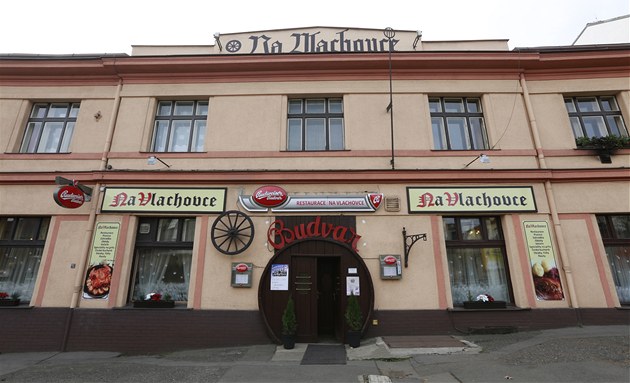
Vlachovka restaurant, pub, winery

Dec 28, 2011

Another Random Tootle

And again, instead of going to the gym, I go on a random walk around my part of London. I walk briskly, honest. I cover about 3 miles in 45 minutes, burn 320 calories, and see some sights and witness some events and overhear some chats. And read some petitions and speak some French.

The initial and fastest leg is from Bank over Southwark Bridge to Borough High Street. I nip past Borough Market, observing the long queues at Neal’s Yard Dairy (a fine British cheesemonger). Desperate Christmas shoppers throng the place. Some of my colleagues have recently received boxes of Neal’s Yard cheeses from their brokers and I am delighted to see that such specialties as Appleby’s Cheshire and Sparkenhoe Red Leicester have pride of place on Neal’s Yard’s shelves. I haven’t had either cheese but I intend to as soon as I have this cholesterol thing beat, and shall report at length. 2012, here I come.

There are even longer queues at local pubs. What’s with people drinking at 3pm, I ask you?
At 67 Borough High Street, I see a lovely red building on which appears the following legend: W H & H Le May Hop Factors. Surely that’s worth a brief investigation? Yes, it is.
W H & H Le May Hop Factors
I find that the Le Mays were a famous supplier of hops to brewers and the like. (The Le Mays were a well-to-do family. One of them, Lt Algernon Le May, aged 34, perished in the Great War – his name appears on a nearby war memorial.) The hop trade was a major part of Southwark till nearly the 1970s. For centuries, Borough High Street and Old London Bridge were the only means of ingress into London from the south. The area, therefore, was dotted with inns and taverns. Recall Harry Bailey who led the pilgrims in Chaucer’s tale? He was a proprietor of a local tavern, and very rich to boot. Hop factors were warehousers and intermediaries between the growers and the breweries.


Southwark is rich in listed properties, many pre-dating the 19th century. This building though is rather modest inside. 19th century developers liked to apply a bit of embellishment to the exterior to aggrandise their creations.


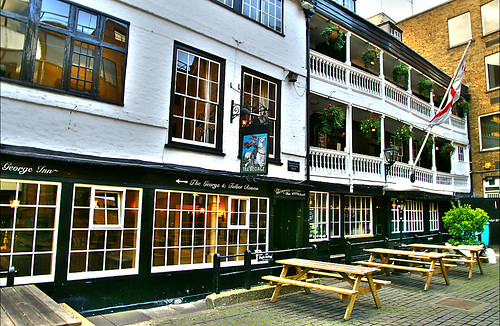
Not fifty metres away at 77 Borough High Street is George Inn, one of the last extant hostelries in Southwark. This was built in the 17th century. These inns catered to horse-drawn traffic, and were situated on long plots with a narrow frontage onto the main street. These survive mainly in name only. I don’t go inside George Inn Yard to inspect the inn itself. I’ll leave that for another time I shirk off gym. It’s a National Trust property, which helps as I am a member. But here’s a picture of its lovely galleried front.
The George Inn - Southwark - London
 [The George Inn by Nick Garrod, on Flickr]
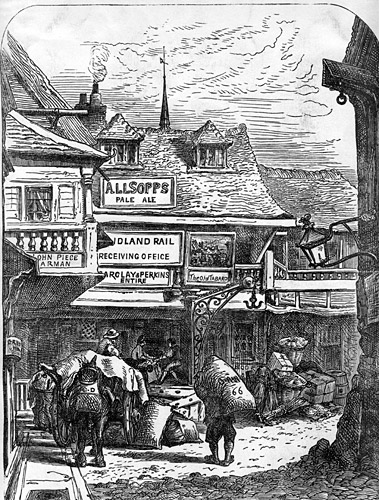
A little further along and a quick left onto Talbot Yard reveals a non-descript office building on which appears a plaque. Here stood Chaucer’s Tabard Inn, from where the pilgrims set off on their grand trip to Canterbury. Just like the George, it had burned down in the 17th century and was reconstructed; unlike the George, it didn’t survive the Industrial revolution, and exists only in literary memory. Luckily, we have engravings of it from the 180o’s when it looked a bit like this:
[The Tabard Inn, c. 1850. Wikimedia Commons]
I retrace my steps to Borough High Street and shift left on Newcomen Street. I hope there might be a plaque or some memorial or the other to the only Newcomen I’ve heard of, who invented the steam-powered pump and inspired James Watt’s steam engine. But he was a Devon man, and I am not sure if he had much to do in London.

Like many of the side-streets in Southwark, this street too used to be coaching inn yard (once called Axe Yard). In the 17th century, it came to be owned by two charities. One building bears the name of one of the charities – John Marshall’s. The street, however, is named after the other – Mrs Newcomen’s. She owned three messuages – ha! I learn a new word – one of which was in Axe Yard, and she bequeathed them upon her death in 1675 for "the clothing of poor boys and girls with a suit of linen and woollen once a year, whereof two-thirds . . . [were to] be out of the Borough side, and the other third . . . out of the Clink Liberty . . . and for . . . teaching them to read and write and cast accounts, and for . . . putting forth boys apprentice at 5l a piece, at their age of 14 years." (Quote from here.)

As I continue along Newcomen street – not the prettiest street in Southwark, admittedly – I note signs everywhere of King’s College and Guy’s Hospital. Every time I look up, I see the immense Shard. It looms over the entire borough. Guy’s Hospital is so much more to human scale. There is a courtyard with an arch. It is another memorial to the fallen soldiers of the Great War.
 Keats at Guy's Hospital
[John Keats at Guy’s Hospital, by Mike Paterson]

Beyond is a colonnade separating two inner courtyards. In one of them stands Lord Nuffield, a benefactor of the hospital, and in the other is a seated John Keats, a bronze-work by Stuart Williamson inaugurated in 2007. The great poet had trained as a surgeon in the hospital, and quit, undone by the gruesomeness. As far as I can tell, the only bit of medicine that ever appeared in his poetry are these lines from Ode to Fanny:

Physician Nature! Let my spirit blood! 
O ease my heart of verse and let me rest; 
Throw me upon thy Tripod, till the flood 
Of stifling numbers ebbs from my full breast.

Across St Thomas’s street is the Old Operating Theatre and Herb Garret. It is closed, unfortunately, till the New Year. As I head away from it, a lovely girl steps out in front of me, followed by a young man who tells her, 'I have an entire archipelago of mistresses.'

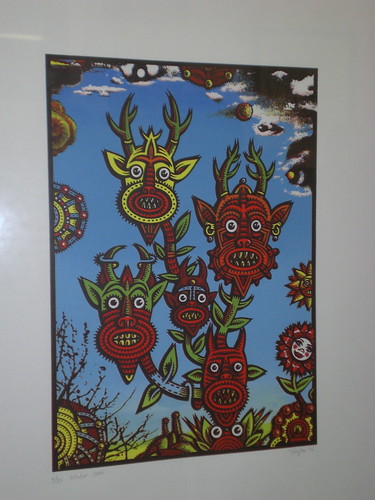
Say what? Before I can react, they disappear into a side street. Scratching my head, I continue along St Thomas’s Street till I get to Crucifix Lane. I see a sign for the Fashion and Textile Museum. There’s no time to take a gander at that; I turn towards the Shard. Construction all around has wrecked views and entrances and my neck hurts from craning. I see BVAG petitioning against the demolition of Southwark’s heritage (London Bridge is the first city-centre railway terminus, it thunders, it should not be treated so shoddily; prevent the demolition of prime Victorian-age train sheds), and I see an interesting art gallery. It is called the Underdog Art Company, exhibits graphic art and has live music shows, and I’m afraid I have no time for that either.


Underdogart Exhibition


[Silk Screen Print by Tony Lee at Underground Art Co. Image by Shuby, on Flickr.]


I am accosted by a couple of young women. ‘Excuse me, sir,’ says one. ‘The Underground?’ She has a strong French accent, and waggles her fingers down. West African, I surmise, so in my best French I respond, ‘Suivez la rue 300 mètres et tournez à droite.’ They grin at me happily. ‘D’accord!’ says the other woman, and giggling at my accent (I hope) they head away.

The rest of my walk is even brisker than ever – onto Barnham Street to Tooley Street, left onto Tower Bridge Road and over that fruitcake bridge back to the City. I don’t stop anywhere, just burn my soles on Tower Hill and Tower Street and Eastcheap and King William Street, all the way back to Bank.


Dec 19, 2010

Fried Singh

In Shamini Flint's Inspector Singh Investigates: Bali Conspiracy Most Foul: A Bali Conspiracy Most Foul, the corpulent eponymous hero is on secondment to the hunt for the Bali bombers, and finds a moment to stuff himself silly with some Indonesian food.
Singh took a deep breath. He smelt the spicy warm scent of ikan bakar, fish wrapped in banana leaf, on the hotel barbecue. His nostril hairs quivered appreciatively. Wherever he was, the smell of cooking food was always enticing... The policeman shrugged and ordered a cold Bintang beer and a nasi goreng. 
[...] 
His nasi goreng arrived, a neat hemisphere of fried rice topped with a fried egg, its soft yellow yolk trickling down the sides like lava from a newly awakened volcano. A chicken drumstick, six sticks of satay, achar or pickled vegetables and a couple of cucumber slices, were neatly arranged around the circumference of the plate. He ate every last bit with gusto, including the small bowl of sliced green chilli padi floating in light soya sauce. 
Singh tried to avoid thinking of the oily food coalescing around his arteries.

Dec 3, 2010

Trix and Topsy

A. P. Herbert's ditzy-but-wise heroine Topsy writes long, stream of consciousness missives to her faithful friend Trix. In the months of rationing and food shortage after the Second World War, she and her politician husband are on their way back to England from Denmark on a ship laden with food for the starving British masses. Here's an excerpt from the very droll Topsy Turvy:
...my dear Haddock has just been in and he says the wind is only Force 4 South Easterly but freshening, the drab thing will be if I miss the mid-day meal, I think there's a dim hope still because my delicious Danes do everything at the wrongest time, my dear we lunch at 11.30 and have dinner at half-past-five which gives one rather a protracted evening, but my dear what meals, the entire crew is only 21, but you couldn't comb Soho for more salubrious cooking and the most paternal steward, the overture to lunch is like all the stories, my dear yesterday I counted fifteen things on the table and all enchanting, there were two kinds of smoked herring and one smoked sole, with onions, imagine darling, two categories of bacon no three I think because one was hot, some fascinating sliced ham, some sort of hot fish, two types of egg-food, liver pate, home made and high marks for succulence, cold pork, and pressed beef, sausages in two styles, oh yes and mayonnaise of salmon and some sort of inscrutable stuff I cannot classify, all this my dear accompanied by schnapps, with chasers of refreshing lager, not to mention a mountain of butter, and of course just when you think the meal is over, not that you tackle all the things of course, it's just the spectacle, well in comes some hot pork or beef or somewhat magically but simply cooked, actually my dear they do not consume excessively but there is no doubt they understand the art of living, however perhaps one had better discontinue this discussion because it's putting ideas into the little tummy and now it's too manifest that steamers of 1000 tons ought not to go about the oceans excepting in the flattest calm, my dear Haddock who's indecently well keeps surging in and saying What a good sea-boat which I've told him not to say again, however to go back to the buildings which may be safer, there's one fantastic pale-green spire made of the tails of four dragons twisted together, I'll send you a postcard...

I'd like to say that my subtle palate discerns thyme, oak, honey and the whisper of ants on a meadow when I quaff a tankard of ale. But I would be lying. My palate has all the sensitivity of a chainsaw. Honestly, I can barely tell the difference between a chardonnay and a riesling, and I drink way more wine than beer. In fact, I barely touch the stuff. Still, I have to try the tipple when I am in Germany, haven't I? After all, it is the Holy Land for hop-lovers, and the Nord Rhine region is home to subtle local traditions that imbue its beers with flavours not found elsewhere.

I explored some of this variety at Cologne and Dortmund. The local beers of the former, known collectively (and as a protected name along the lines of Champagne) as Kölsch, are served in small glasses called Kölsch-Stanges that are quite distinctive from the enormous steins of Bavaria. They look a bit like Pils, light yellow in colour, but are much less bitter. Some are even a bit sweet.

In Cologne, brusque blue-apron-clad beer waiters called Köbes serve the local tipple. I didn't realise that a tip was to be given directly to them, rather than leaving it on the table, but the Köbe I spoke to was cheerful nonetheless. He told me in somewhat broken English that only about twenty-odd Kölsches remained in Cologne, and many of their breweries had been acquired by bigger concerns. The migration of a beer from one brewery to another inevitably results in a loss of flavour and character, and, for all I know, these twenty beers possibly are not as distinctive as they once were.

At one time, the beer was brewed in the cellars of the brew-houses (which still stand), but these days are produced a few kilometres outside the city. Good thing, that. Don't want a malty explosion in the basement, do we? Especially when thirsty hordes are hanging about with their tongues hanging out?

The Köbes added that they couldn't export Kölsch because they didn't add chemicals in it, which - according to him - was a prerequisite in the US and Asia. Perhaps I missed something in the translation.

I took notes of my Kölsch binge. As each glass contained only about 200 ml and I left quite a bit on the table at each little beer-house I visited, the quantities absorbed into my bloodstream were well within my tolerance. Still, as you can see, I was notably verbose with my commentary:

Mühlenkölsch - malty
Früh Kölsch - malty(ish), sweet(ish).
Dom Kölsch - not bitter.

Nope, I couldn't really tell them apart. The locals, however, swear by them. It's the drink of choice in Cologne, and anyone drinking any other beer is probably a visitor. Both the young and the old love Kölsch. (I didn't ask the middle-aged.) It epitomises their hometown for them.

Dortmund is another brewery heaven, although its original canvas of about 94 varieties has collapsed to a rather more manageable six. The Dortmund Actien Brauerei (DAB for short) has one nice little lager-style beer, which I tried ('not bitter' I distinctly remember saying to myself). The Dortmund beers are exported, of course, and therefore probably better known outside the region than the Colonial ones. I managed to try out a Hövels Hausbrauerei bitterbier, which I hasten to add wasn't very bitter either. On the other hand, I did discern a smoky texture, and the beer itself, dark honey-red, looked and smelled delightful.

When you think of the antiquity of Belgian beers (Stella Artois, they insist, is several centuries old), the Rhinish offerings are mere striplings. DAB dated from about 1900. The Hövels was only seven years older.

Beer snobs (such as this fellow) try to sing its praises in much the same vein as wine snobs. I'm nowhere near that level of sophistication, but even if I were, I don't think I'd ever be able to say things like this with a straight face
Swooning from the intense flavors even more than the alcohol, I tried to catalog the tastes: caramel, acacia and notes of smoked meats ranging from ham to Alaskan salmon and sweet unagi, Japanese eel. It was liquid bacon, sure, but it was also as peaty as a fine single malt - Ardbeg came to mind.
What a pompous boob.

Sigh. It no doubt explains why Evan Rail writes for the New York Times, and I remain a Jost-a-mon.

* PS: Please don't jeer. It is good beer.
* PPS: Why did I say 'jeer'? I'm now saying 'cheer.'