JOST A MON

The idle ramblings of a Jack of some trades, Master of none

Mar 10, 2017

Osmium

It appears that J P Vaswani is still going strong, nearly a century after he was born. While he is known for his spiritual teachings, at one time his c.v. also included a line to the effect that he was the nephew of T L Vaswani, a boon companion of Mohandas Gandhi himself, and a founder of a mission. I was never clear on what that mission's mission was.

Back in Jakarta in the 80s he would visit our school frequently. As a Shukracharya for the kids, he would hold forth on a variety of topics for our moral instruction. We'd sit in the assembly hall, wilting with boredom, and listen to him go on about matters of the soul and supreme powers and the like. Once in a while he'd come out with an illustrative story or two. We rarely paid much attention.

One day he was talking about the immensity of God.

'Do you know osmium?' he said. 'It is the heaviest metal in the world.'

We stirred.

'It is so heavy,' he said, 'that you could not lift a spoonful of it.'

At this point half the class turned to look at me. I was no less than JP at throwing out random assertions.

I shook my head in teenage outrage.

'He is wrong,' I said through clenched teeth.

After the lesson, my classmates laughed at me.

'Come on, guys,' I said. 'Work it out.'

A spoon is about 15 millilitres. The density of osmium is 22.6 grammes / ml. So you have 339 grammes of osmium in a spoon.

I'm yet to find a person who can't lift 339 grammes.

Nov 3, 2015

Auschwitz Violinist

In Maria Àngels Anglada's The Auschwitz Violin, the young luthier Daniel remembers Passover feasts.
He would imagine the two holiday meals at Passover with all the relatives, uncles and cousins. The basket with the haroseth, the bitter herbs that would have tasted so good now, the hard-boiled eggs, the white silk cloth with blue stripes that covered them … What he would have given for a hard-boiled egg today! Or better still, a piece of lamb. He remembered the taste of the matzo - the unleavened bread - and the fun of searching for the hidden piece, the prize for the child who found it. He didn't want to think about the songs or the three toasts. If he could just have a few spoonfuls of cholent - the terrine of rice, eggs, dried beans and goose that had to be cooked all night in the community oven. As a young boy, he'd been sent more than once to fetch it.

Feb 8, 2015

Pancake Week

It's the Russian week of pancakes from tomorrow - Maslenitsa - and here's a bit of Chekhov (On Human Frailty):
Counselor Semyon Petrovich Podtykin sat down at the table…and at risk of burning his fingers, grabbed the two hottest bliny from the top of the pile and plopped them onto his plate with an appetizing smack. They were golden brown, light, and plump like the shoulder of a merchant’s daughter…


Jan 15, 2015

Technical Moksha

The boy likes to cuddle with his amma before bed and discuss philosophical matters. The other day, she read him some passages from the Bhagavad Gita about moksha and material desires preventing the soul from breaking out of the cycle of suffering and rebirth. 

"I hope your soul achieves moksha, amma," said the boy.

"Thank you, sweetie," said the wife. "But what about you?"

"It will be very difficult for me," said the boy.

"Why is that?" said the wife.

"Because I really, really want that 50-inch curved screen LED TV, amma," he said.


Mar 3, 2014

Sweetly Greek

Sofia Papalenou felt the changing seasons through her confectionery: in spring, there were the special Lenten biscuits and Easter breads to be baked; then came the summer wedding season and the demand for cakes and the deep fried pastry dipped in honey, kserotigano, that was handed out at nuptials. August was also the month when they made their own ice-creams in amazing flavours. Then came autumn which was specially busy for celebratory gateaux for saints' days, with Stavros, Elpida and Thomas being particularly popular names in this town. After that were the St Nicholas specialities at the beginning of December, the frantic Christmas period and finally the Vasilopita cakes for the New Year that reminded her that yet another twelve months had gone by and her daughter was still unattached.

From Victoria Hislop's "The Zacharoplasteion" in The Last Dance and Other Stories.

Feb 3, 2014

Church Food

In Evelio Rosero's venomously anti-Church novel Good Offices, the three Lilias, old and worn-out and attached to the Church have prepared a meal of eyewatering ambition and mouthwatering delicacy when the priest, Father Almida, has a local benefactor over for repast.
On one occasion, Don Justiniano had agreed to have lunch with the Father in the presbytery dining room; they had dined alone, behind closed doors. The three Lilias had outdone themselves: spicy potato stew, avocados, passion-fruit pudding, flank steak, fruit cocktail, chicken with dried fruit and almonds, saffron rice with parsley, triple dairy flan, melon, soursop sorbet, stewed curuba fruit and a creamy cheese with honey that the Lilias called manna. But it had all been in vain, because in the end, lunch had been delivered from the kitchens of the Hilton Hotel: American-style fried chicken breasts, pork loin in sherry, eggs à la king, ravioli in sauce, curried rice and a Normandy pear tart.
Almida did apologise to them, so don't worry. 

[Continued from Part II, and loosely translated from A Russian Missionary in India: Archimandrite Andronicus.]

After his departure from the Bethany ashram, Andronicus settled in Pattanapuram at the English school of St Stephen. He was then able to travel as a pastor around Travancore; occasionally, he was invited by Russians living in other parts of India to perform rites in Calcutta, Bangalore and Bombay. He also visited the Portuguese colony of Goa.

In 1939, he was established an Orthodox chapel in the village of Patali, a few miles from Pattanapuram, and began offering services. Next door was a Hindu temple of Bhadrakali. The locals were not pleased that the church was being set up, and complained to the government, which ignored them and permitted the church to continue.

Andronicus, as ecumenical as ever, established cordial relations with the chief priest of the Bhadrakali temple, as well as the local Muslim clergy. (Subsequently, he even attended a series of lectures on Hinduism in Madras, offered in 1948 by Somasundaram Iyer.) In Patali, there were Jacobites as well, whose church Andronicus often visited, and who also came to him during the Holy Week for confession. He was tireless in his works - preached, performed the liturgy at the St Thomas Church, constantly visited the sick. His superiors considered him a prime example of the apostolic man, hard-working and self-sacrificing, courageously undergoing all sorts of hardships and dangers both physical and spiritual, and continuing for years without confession.

Andronicus's superior, the Parisian metropolitan Eulogius, did all he could to publicise among the faithful in the Church. He wrote to the Russian Orthodox flock living in India about Andronicus, praising his steadfastness and urging the Russians to go to him for all their spiritual needs. 'His work is great and difficult,' wrote Eulogius. 'He brought from the Mother Church and lit up in distant India the lamp of the holy Orthodox faith that will not only illuminate the Russian peoples scattered there, but also, possibly, attract the native non-Christian folk and kindle in them a feeling for the Saviour, so that they may exclaim in an incandescence of faith as did St Thomas: My Lord and my God!'

Eulogius concluded his epistle with an exhortation to the Russians to assist father Andronicus in his lonely task. Let not the light of Orthodoxy be extinguished, he wrote, let it shine its saving grace on everything - be it ours or their's, be it near or far.

In 1934, for the first time Andronicus was able to hold a service for a distinctly Russian audience - nearly sixty peasants who had come to India in the previous two years, but who were now getting ready to leave for Brazil. For the first time in three and a half years in India, wrote Andronicus to Eulogius, I was able to serve as in Russia, and offer confession and communion.

In 1937, Andronicus was promoted to the rank of Archimandrite; his investment was performed at the Catholicos' residence, and conducted by the Serbian metropolitan Dosifej who was in India attending an international conference of the YMCA at Mysore.

Andronicus's travels around India continued. In 1944, he served the nearly 80 Russians in Calcutta, and performed office for the local Armenians as well at their cemetery church. There were fewer Russians in Bombay but there was still a need for pastoral care. During a visit to Delhi, Andronicus got acquainted with Nicholas Roerich's assistant, Shibayev, from whom he came learn of the various activities and interests of the great Russian artist, writer and Orientalist, who lived in the Himalayas at the time.

In 1947, Andronicus was invited to teach Russian at the University of Delhi. He had learned over his travels in India that Indians were interested in Russia and the Orthodox faith, although to varying degrees: they were interested in Russian politics and economics, and vaguely so in the faith; indeed, most educated Indians tended to assert that all religions were equal and good. So Andronicus was happy to use the opportunity in Delhi to teach Indian students not only the language, but also (hoping that they would develop deeper interests in) Russian culture and religion.

Following Indian independence and the establishment of diplomatic relations with the Soviet Union, the Russian department at the University expanded considerably. Many students hoped to obtain employment at the Soviet embassy. 

Andronicus stayed in Delhi for over a year, during which he introduced the basics of Orthodoxy to his students. In one of the two rooms he occupied during his stay, he established a little chapel where he offered worship regularly. He then returned to the south, hoping to establish a monastery in the Nilgiris and to continue his monastic life. This did not quite work out, as in 1948, he was invited by bishop John (Shakhovsky) to travel to the United States to continue his pastoral work in the Americas. And so his eighteen-year stay in India came to an end.

He spent two months awaiting his passport and visa in Madras, where he often visited the site of the martyrdom of St Thomas the Apostle. The holy location was situated within a small Catholic nunnery. The Thomas church on the hill held an ancient revered stone cross and an icon of the Mother of God. There was a grand cathedral in Mylapore that Andronicus often went to, built over the tomb of St Thomas. 'These places, of course, remain shrines for all true Christians,' he wrote, 'and the Orthodox faithful from the western coast visit them in awe.'

In 1949, Andronicus travelled by sea to New York. There began a new period in his pastoral work. He also started to write his memoir of his Indian life. To the end of his life, he held India in especial esteem. No matter where I might be, he wrote, I cannot remove India from my heart and from my thoughts. The unification of the churches remained his lifelong occupation and concern.

Andronicus died in 1958. His book Eighteen Years in India was published in the Russian language in Argentina the next year. A review appeared in the Bulletin of the Russian Student Christian Movement, praising his selflessness, elevating him as an outstanding evangelist, talked about the lonely heroism of his mission, and celebrated his memoir a special example in the literature of exile. Others familiar with his work in India pointed out that his mission was essentially a failure, as he had been unable to convert the heathens to the faith, and did not establish his own church community either. The reason, of course, was that the Orthodox church of South India, while not in communion with the Russian Orthodox, was close enough to the latter in faith and spirit. And so after much deliberation, Andronicus concluded he should help the Syrian Orthodox church and not establish a separate congregation. Where Andronicus had established a small church in Patali, a lone Indian monk remained, continuing his work. The surrounding communities remembered the unusual Russian priest with gratitude and hoped he'd return, but it was not to happen.

[Part II of Russian Religious Missions to India, loosely translated excerpts from the original Russian.]

A special place in the history of Russian religious missions to India belongs to the archimandrite Andronicus, who spent eighteen years in India and established close ties with Indian Christians of various denominations. He was born in 1894 to a professor of church history, the seventh of twelve children, and he followed his brothers into the theological seminary of Olonets. Shortly after his graduation from the seminary in 1916, it occurred to him to travel to India. Having read in Eugraph Smirnov's history of the church that there were Christians in South India with rituals related to the Orthodox, he asked himself - why not travel there if they want to join us?

Andronicus took part in the Great War, during which he heard the happy news that he had been admitted to the St Petersburg Theological Academy. Of course, the Revolution intervened, and his studies were disrupted, with the result that he spent a few years in Finland and Germany, before moving to Paris in 1923. Two years later, at the St Sergius Church in Paris, he was tonsured as a monk, and ordained to the priesthood. He was then sent to the Belfort, close to the German frontier, to take over a parish.

He was a somewhat austere soul, reluctant to take money for religious services from his congregation: instead, he rented a house with a large garden where he grew his own food; he also worked at a local Peugeot factory. 

Again he brought up his desire to sojourn in India, a request that was granted by the Metropolitan Eulogius. With the money saved up from his Peugeot job, he travelled on the steamer General Messenger to Ceylon.

En route, he befriended a couple of Indians: one a Brahmin who had graduated from university in England, the other a Muslim Bengali merchant.

From Colombo, Andronicus travelled to India, and settled in Bangalore where he worked in an agricultural factory that employed an old Russian acquaintance of his. S. F. Kirichenko had bought a small estate in South India and taken up farming; unable to concentrate on his new projects, Kirichenko had asked for another worker to replace him, and Andronicus offered to take his place. 

Andronicus worked in Coimbatore as well. In one of the rooms of the factory, he established a little chapel. In those years, there were only around 300 Russian Orthodox Christians in the country, and it was his duty to provide pastoral care to them all. Prior to his arrival, Russian believers had to visit non-Orthodox clergy in times of trouble. One example was that of the Princess Urusova, who wanted to partake of Holy Communion on her deathbed in Bombay, and had to beseech the Anglican bishop who  initially refused, but finally relented. 'You may pretend that you are taking communion from the hands of an Orthodox priest,' he said to the princess, 'I shall get in touch with your bishop and ask him to approve the holy eucharist.' It was clear that there was an urgent need for an Orthodox priest in the country.

In October 1931, Andronicus visited Travancore for three weeks, during which he met Syrian Orthodox Christians. Their denomination had split 22 years earlier from the Syro-Jacobite patriarchate of Syria, and was interested in making peace with the patriarchate, but the latter's demand for complete submission prevented any harmony. After the death of Metropolitan Dionysius VI in 1934, the first Catholicos of the church, a constitution was drawn up at the conference of all the churches in Kottayam that established the independence of the Syrian Orthodox denomination under the leadership of a Catholicos, although it was still spoken of as a subsidiary of the Syrian church. (The issue was resolved only in 1962 with the recognition of the Malabar Syrian church by the Antiochian patriarch Ignatius-Jacob III.)

In Travancore, Andronicus visited the Catholicos Basil-Gregorius and had a conversation with him. He also visited the local seminary, sharing meals with the priests, teachers and students, followed by theological discussions. Subsequently, in Kottayam, Andronicus stayed with the Catholicos, and was thereafter always assured of the most welcoming hospitality. He established close links with the clergy and bishops of the Syrian Church of South India. In their conversations, Andronicus was quick to indicate the prominent drawback of the isolation of the Syrian church from the universal church, but was comforted by the desire for unification with the universal church through their links with the Russian Orthodox church.

In Kottayam, Andronicus was also able to meet the Jacobite patriarch Ilia, whose visit from Syria was an all too rare event for the local Christians. Ilia recalled the deep faith of the Russian Christians in Jerusalem and sang their praises. Andronicus then visited the Syro-Jacobite Metropolitan Athanasios in Alwaye; staying at his residence, he had the opportunity to speak with the clergy and seminarians.

Andronicus met the bishops of the Mar Thoma denomination, which was at the time headed by the Metropolitan Titus, and comprised a hundred thousand worshippers and a hundred churches. This church was allied with the Protestants, he discovered: among other things, it did not recognise saints. Rounding off his visits with the metropolitan Dionysius in Kunnamkullam, he was happy to inform his superiors back in Paris that he had met the heads of all the denominations of the Syrian church in South India that were of interest to the Russian Orthodox.

In 1932, Andronicus joined the monastery of Bethany ashram (near Vadasserikara) to study the religious life of Christians in India. He paid great attention to the missionary activities of St Thomas the Apostle in South India, the Nestorian movement and so on.

In particular, he was interested in the propagation of the Roman Catholic faith in India. He learned of St Francis Xavier, who had begun his mission in Goa, converting the locals, then moving on to Travancore, and Madras. Returning from Japan in 1562 to Goa, this energetic missionary then headed to China where he perished of malaria. He is interred in a magnificent tomb in Goa, and is considered the patron saint of India, reported Andronicus.

Andronicus noted that the Catholics had been very active in the previous decades in all parts of India, establishing great churches in Madras, Bangalore, Calcutta, Delhi, in the Nilgiris, all over Malabar, and in Goa; everywhere, there were crowds of pilgrims; one would hear of their bishops, their monasteries and nunneries. Their resources were tremendous, he said, they acquired land and buildings; in a pagan country, their presence was a cultural boost.

His greatest interest remained towards the Syrian Orthodox. He wrote of its doctrines, governance, peculiarities of ritual, the sacraments, the tradition of iconography, the church hierarchy and so on.

At the Bethany ashram, he was permitted to perform the orthodox liturgy, and even after his sojourn ended, he often visited the monks, whom he considered close friends. In his missives to Paris, he wrote detailed accounts of the monastery. He said that the Jacobite monastic charter was quite distinct from the Russian Orthodox: not as austere, no long services, no vows at tonsure, and no use of the Jesus Prayer; prayer and obedience were not the essence of monastic life; common prayers were frequent but brief; on the other hand, institutionalised hours among the Jacobites for meditation and silence were better defined.

[To be continued…]

Oct 24, 2013

The Muslim Detective

A passing comment by Zoë Ferraris got me thinking about the lack of Muslim detectives in crime fiction. Casting my mind back on the books I've read, I couldn't recall a single one (other than Ferraris' own Nayir ash-Sharqi and Katya Hijazi). But then my facility with names is particularly fraught, so I had to depend on the web to locate some names.

It turns out that I've read crime fiction featuring Muslim detectives in at least two books - one (The Bethlehem Murders) by Matt Rees and the other (Kismet) by Jakob Arjouni. There may be more, but I'm not in a position to say so.

Of course, as soon as I saw Arjouni's name, I recalled Kayankaya, as brilliant a creation as you can ask for. Wise-cracking, to boot! Indeed, a few years ago when I was ploughing my way through foreign crime fiction, I had noted this wonderful detective.

To be honest, 'Muslim' is far too broad a brush. There's much that differentiates a Turkish-German detective from, say, a poor Palestinian teacher-turned-investigator or a Saudi desert guide-turned-detective; and even more that differentiates any of those mentioned above - all men - from a Saudi forensic pathologist-turned-detective as well, a superbly etched Katya Hijazi. And though they are all Muslims, they run the gamut from secular to deeply devout, from people for whom religion has almost no impact on their daily lives to those whose every waking moment is governed by the Shariah. 

So I'd say that merely giving a detective a Muslim name doesn't make him one. Just as pointed out by those who deprecate underwritten and token minorities in speculative fiction, creating a run-of-the-mill character and tossing him or her a particular name does not make a difference. Chris Culver, a self-published author who recently found much success in the genre with The Abbey said he hadn't encountered many Muslim detectives in his reading, and, tired by the popular depictions of Muslims as terrorists, he had decided to feature a recovering alcoholic, Ash Rashid, an Indianapolis detective. How much Culver knows about Islam and whether Rashid is even a tiny bit coloured by Islam is something I can't answer, not having read the book. I'd be glad to hear from anyone who has.

And then there's the Canadian ad-man-turned-writer Scott Thornley whose Erasing Memory has a Muslim woman, Fiza Aziz, as a member of the detective team. I hope I'm not giving anything away when I say she supposedly suffers a bit of a burn-out in the first novel, but then comes back a-rearin' in the second The Ambitious City.

Zoë Ferraris, though, is absolutely top-notch. My knowledge of that most stifling of countries, Saudi Arabia, comes from the reading of two or three books (non-fiction, mainly) and the experiences of my wife in the neighbouring Kuwait. Ferraris is brilliant and insightful. Her characters (the very conservative Nayir and the struggling-against-the-patriarchy Katya) are deeply sympathetic; her understanding of the family dynamic in a traditional culture is nuanced; her depiction of the claustrophobia and the suffocation felt not just by women but also men in Saudi is eye-opening. I've only read the first of her trilogy featuring these detectives, The Night Of The Mi'raj, but I haven't been so moved by such an astute insight into character and motivations since I read Katie Kitamura's The Longshot.

The web search also revealed other detectives in the Islamic lands. It turns out that there was an entire Turkish golden age of crime fiction between 1928-50, and it was Turkey-centric, there were papers written on the depiction of foreigners in these books. What were these books? Are there any translations into English? All good questions.

The Moroccan-French writer Driss Chraïbi's Inspector Ali series features a Muslim detective. To be honest, Chraïbi was a social critic more than a genre writer, and how these books stand up as crime fiction, I can't say, not having read any of them.

I wouldn't be surprised if among the teeming volumes of pulp fiction published in Hindi, Urdu and other Indian languages, there weren't a few in which Muslim investigators do go after the villain. (I should take a look once again at my copy of The Blaft Anthology of Tamil Pulp Fiction.) Many writers of these works are socially activist and often point an accusing finger at the hypocrisies and tragedies of life in South Asia. Some works may very well be steeped in the Muslim milieu as well, offering yet another perspective on a demonised community. On the other hand, if action and plot trump characterisation, the 'Muslim' detectives may just turn out to be tokens.

Serendipitiously, I came across this review of four detective books by the Urdu writer Ibne Safi (published, hurrah hurrah, by Blaft), in which the perfect and cold Colonel Faridi, accompanied by the witty and dashing Captain Hameed, are counterespionage agents who do a bit of detection on the side. The reviewer goes on to say: But fun as they are to read, they are not particularly satisfying as detective stories: plot developments can be arbitrarily motivated; there are long stretches of inane dialogue; there are convenient coincidences, hasty endings. As a quick read in discardable pulp format, this probably acquit themselves admirably; they will not rival Zoe Ferraris's works for mastery, perhaps.

Who are the others? Am I missing any obvious ones?


[Loosely translated from the original Russian. 1]

In 1721, in the newly established imperial capital of St Petersburg, a school of Slavonic studies was set up in the Monastery of Alexander Nevsky. This, the precursor of the Theological Academy of St. Petersburg, had twenty-six students, several of whom were foreigners and one an 'Indian'. 2

It is unlikely that this novice arrived at the banks of the Neva directly from India. Rather, the student  most probably came from Astrakhan, which at the time was a trading entrepôt in which dwelt Russians, Tatars, Indians, Armenians, Persians and Kalmyks.  From the 18th century onwards there were factories organised in this city, where caravan, river and marine merchant routes met, run by various nationalities who maintained their residences in the centre of the White City. To this day there survives an Indian courtyard in Astrakhan, which was built in the early 19th century over what previously used to be stone guest-houses that had been in an Asiatic style reminiscent of the Spassky monastery dating from 1625. 3

In the 19th century, representatives of the Russian Orthodox church began the revival of ties with the old eastern churches of the Near East: the Armenian, Coptic and Ethiopian. This prompted ambassadors from the Syrian Orthodox church of South India to meet their Russian counterpart in Constantinople in 1851. But the Crimean war (1853-56) interrupted the discussions for closer ties with the Orthodoxy.

Still, the Indian Christians did not lose their interest in the Orthodox faith. In 1898, in the Turkestan Gazette  № 88, appeared a letter from A. I. Vygornitsky, a Russian traveller who had visited one of the major cities of South India. He described how during one of his stays he was approached by several local residents who said that the Archbishop of the whole of South India would like to meet him as he could be of assistance, given that he had ties to St. Petersburg.4

'I never had connections to St. Petersburg,' the traveller went on to write, 'but I at once took a rickshaw to go to the Archbishop's house.' The Archbishop was expecting Vygornitsky, and was accompanied by his assistant, a doctor at law. After exchanging pleasantries, the Archbishop made his request in the following words: 'In India, especially in the south, there are many Christians of the Antiochian church, founded by St. Thomas. The followers of this church do not recognise the supremacy of the Pope. They have their own Archbishop appointed by the Antiochian Church, but over time it is becoming harder and harder to appoint the Archbishop, because the Antiochian Church does not have enough people who could occupy the post in India. It may be that the Indians will be left without a pastor, and our church is in danger of falling into Catholicism, especially as even now the Catholics are attempting to swallow her up.' 5

Then the Archbishop added that, bearing in mind these circumstances, he and his flock of fifteen thousand souls had decided to become Orthodox, which they had familiarised themselves with from conversations with priests of the visiting merchant marine. 6

The trader, of course, knew that the British rulers of India would not tolerate any interference in the religious practices of their subjects, but he promised to convey the Archbishop's request to the relevant authorities in St. Petersburg. 'With joy, I gathered all the papers from my friends, and three days later, voyaged to Russia, having finished my travels in India to my satisfaction.' 7

From a theological point of view, there were no obstacles to the accession of the Indian Christians to Orthodoxy. After all, in the same year of 1898, on the feast of Annunciation (March 25) in the Holy Trinity Cathedral of the Alexander Nevsky Monastery in St. Petersburg took place the ceremonial union of the Syro-Persian (Assyrian) Church of Mar Jonah (representing several hundred Assyrian families that lived in northern Turkey and Iran, lands bordering Russia) with the Orthodox Church. Russian missionaries were despatched to the Assyrians to educate them in Orthodoxy; the missions continued successfully until the first World War, and even for some time after the beginning of hostilities.

As for the Indian request, there wasn't much coverage in the popular press of the time. Even the Orthodox journal that reprinted the Turkestan gazette's article merely stated in an editorial comment 'It would be interesting to have information on the further progress of the case.' 8 The answer might be found in the archives of the Holy Synod, but it can be assumed that the Russian government did not want to worsen relations with Great Britain, and for political reasons did not set in motion the request of the Indian Christians.

Following the First World War and the social upheaval in Russia, the Indians broke off their negotiations with the Russian Orthodox Church. These ties were resumed in the early 1930s thanks to the efforts of Russian Christians who found themselves exiled from their homeland.


References
  1. Архимандрит Августин (Никитин), Русский миссионер в Индии, Россия в красках.
  2. Ilarion Chistovich (1857), St. Petersburg Theological Academy. St.Petersburg. p. 11.
  3. Klyucharev Chronicle, Astrakhan, 1887. (Quoted in A. I. Yukht, 'An Indian Colony in Astrakhan', Questions of History, Number 3. 1857.)
  4. A. I. Vygornitsky (1898), 'The desire of Indian Christians to unite with the Russian Church', Orthodox Evangelist, № 24. p. 361.
  5. ibid. p. 362.
  6. ibid. p. 362.
  7. ibid. p. 363.
  8. ibid. p. 363.

Jul 23, 2013

Jewish Malayalam

In the middle of all the Malayalam dialects, both extant and extinct, was that spoken by the thousand-year old community of Jews. Jewish Malayalam is an admixture of Hebrew and Malayalam, written in the Malayalam script, spoken extensively until the middle of the 1950s when Keralite Jews began their big emigration to Israel. These days few Jews remain in Kerala, and the language is on the verge of extinction even in Israel.

As with Mappila Malayalam (that spoken by Malayali Muslims), this Jewish dialect was a popular tongue, generally used in the secular sphere. For religious purposes, the Jews continued to use Hebrew. But they wrote songs for weddings in Malayalam, the oldest of which appear to be from the 15th century and are close in style to contemporary Hindu compositions (such as the Payyannūrpāṭṭə, which actually mentions Jews as members of merchant guilds). The Arabs who settled and intermarried in Kerala created their own equivalent dialect, but they wrote it in  the Arabic script, and it is suspected that they did so because they felt part of an Arabian ocean that stretched from East Africa through Arabia to South Asia.  But the Jews were a minority cut off from the rest of their coreligionists, and so felt no need to distinguish themselves in Hebrew script.

For a roundup of the Jewish presence in India you should read Maddy's various essays [2, 3], or Edna Fernandes' excellent book [4].

Jewish Malayalam literature consists mainly of compendia of wedding songs, as mentioned above, and written in 'castolects' different from the standardized version of Malayalam. These songs are called nāṭaṉpāṭṭə, or regional songs. After emigration to Israel, in order to transmit these songs to younger generations unfamiliar with Malayalam script, these were transcribed into Hebrew. Some of these books were curious admixtures - Hebrew songs written in Malayalam, Malayalam songs written in Hebrew - to cater to illiteracy in one or the other tongue.

There were two types of songs in the Jewish Malayalam liturgy, a male variety descending from the Arabic tafsir (translation of the Bible into Arabic) which incorporated archaic modes in Malayalam, and a female variety called arttham, descending from Sanskrit performance art, which remained closer to the spoken Malayalam. Both included Hebrew components including excerpts from the Torah.

Interestingly, in Jewish Malayalam, kinship words were more akin to the Muslims (e.g. umma for mother, kaakka for elder brother) while social terms were shared with the Hindu (e.g. taṟavaːɖə ‘ancestral home’; kaːrɳɳoːrə ‘the eldest male in the clan’). Other words are also shared in usage and origin with the Muslims, such as moːlyaːrǝ, ‘rabbi’ (which comes from muðaliyār, ‘leader’) with moylyārə, ‘religious guide.’

Jewish Malayalam has undergone more changes since the migration to Israel. Meanings have drifted a bit: guɳam, ‘good quality,’ and doːȿam, ‘fault, bad quality,’ now denote ‘luck’ and ‘character’. Hebrew words have entered the vocabulary, even if they have undergone semantic shifts. An elderly aunt would tease one woman with suːṟaː ellaːm poːyi (Your beauty is gone), where suːṟaː means 'form' in Hebrew, but is used to mean 'beauty' in Jewish Malayalam.

Nicknames applying to individuals (oːmaṉa-ppeːr) and families have a strange and compelling beauty. A rabbi who preferred veɭɭappam (rice flat bread) over tuition fees was called veɭɭappamoːlyaːrǝ 'rice-bread rabbi.' A very tall man called Ephraim was called kaːlan efraːyim, ‘legged Ephraim.’ A Jewish family excommunicated in the mid-19th century are still referred to as 'paːmbǝ' (snake in Malayalam). The nickname comes from the Hebrew initials of the words describing the most severe excommunication: niduy (banishment), ħerem (excommunication) and ʃamataɂ (curse), that is n-ħ-ʃ (נח“ש), which reads ‘snake’ in Hebrew!

The general greeting in Malayalam is sugam taṉṉe alle? (all's well, isn't it?) but a jocose version exists in Jewish Malayalam, poking fun at the ostensibly miserly Cochin Jews, which goes: tiṉṉ’ oːɳɖ’ all-eː vann-e? (you've eaten and come, right?) so that the visitor needn't be fed.

There are some proverbs unique to the Jews that other Malayalis do not recognise. One such, kaːlaṉ.ḏe peːṟe poːy-aːlumjuːðaṉ.ḏe peːṟe poːv-alleː, translates as 'better follow a demon than a Jew', and is used when a Jew has deceived or cheated someone. 

More good stuff: Jewish Malayalam jokes, stories, nursery rhymes and riddles. Check out the Gamliel paper [1] and references therein.

Also, Bala Menon's blog post from 2011 is pretty neat: The 'Song of Evarayi' & Other Cochin Jewish Songs.


References


  1. O. Gamliel (2013). 'Voices Yet to be Heard: On Listening to the Last Speakers of Jewish Malayalam', Journal of Jewish Languages, (1), pp 135-137. Brill.
  2. Maddy's Ramblings: Abraham, Asha and the Geniza.
  3. Maddy's Ramblings: Sara's Story.
  4. Edna Fernandes (2008). The Last Jews of Kerala: The Two Thousand Year History of India's Forgotten Jewish Community. Skyhorse.


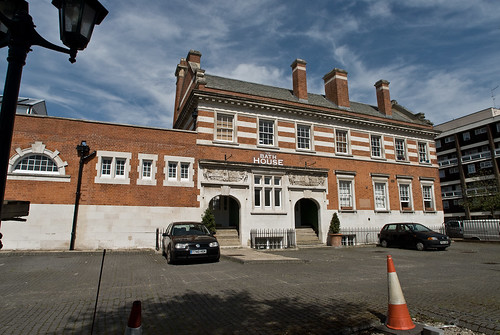
When the BBC World Book Club polled its listeners for whom they'd most like to have at their monthly programme, Neil Gaiman was by some miles ahead of the runner-up. Today he was interviewed at BBC House in London, and I was there amidst the clamouring throng. 

The format is fairly standard. Gaiman is introduced briefly. He reads an excerpt from his novel American Gods. He takes a few questions. He reads a bit more. He takes a few more questions. He reads another excerpt. He is witty and urbane. He is kind and attentive. It is all excellent fun.

A brief intro to the book: a convict called Shadow is released from jail and finds his wife is dead. Not knowing what to do with himself, he is roped in as a flunky and bodyguard to a mysterious one-eyed gent called Wednesday, who, it turns out, is the Norse god Odin in a seriously diminished form. Odin wants to rouse the other old gods who were brought to America by their believers and then left high, dry, unworshipped and powerless as those believers died and they were forgotten. Arrayed against the old god are the new ones - all shiny, sparkling, the gods of media and technology and transport.

There are questions from the studio audience. There are questions posted on the programme's Facebook page. There are questions called in from Australia and Norway and California. There are questions from Twitter.

When was he inspired to write the book? Well, he says, it is something he can date very accurately because he was in Iceland one summer years ago, and he thought he would write till it turned dark, but the hours went by and at 3am he found it had merely dimmed outside ('yeah, you're ahead of me here') so he went for a walk and there was nobody around and everything was closed, except a tourist office which he entered to find a diorama of the explorations of Leif Ericsson, and the thought struck him - what if Leif and the Vikings took their gods with them to the new world, and over the years forgot them?

A fan-girl from London (via Mumbai) asks why he chose Kali as one of the dispossessed gods in his book. He loves Kali, replies Gaiman. She is fun. She is a goddess of destruction, but also of the wheel of life. How can you not love a goddess with a necklace of skulls? 

Did Gaiman not realise that Mamaji, as she is addressed in the novel, means 'uncle'? Yes, he says. He originally had her down as Mataji, but an Indian friend of his told him that he had read an American book in which Kali was addressed (wrongly, but so unabashedly Americanly) as Mamaji, and so Gaiman decides to use that epithet.

One of the things that interested him when he wrote the book, says Gaiman, is the exploration of gods who may be venerated in other countries but have been devalued or forgotten and replaced by other gods in America. Kali is one such, he says, and he can imagine how a manifestation of hers outside India can be reduced in power and glory.

There is a god in the book, says someone, who is forgotten by the hero as soon as he is seen. Could this be Agni? Gaiman declines to answer. It is a secret to be revealed in the next book of the sequence, he says.

Is Gaiman a believer? He is a 'possibilist', he says, quoting someone or the other. Although raised a Jew, he is not really a theist. He finds that he believes intensely in something only when he is writing about it. At this point he continues to be fascinated by the Norse gods, he says, and finds himself returning over and over again to the subject. They are the only pantheon he knows of whose destruction is written in the legends. These are tragic gods because they know they will die and yet have to continue to go about their mighty lives as though they are immortal. 

Anansi appears in American Gods, says someone. Is this the same Anansi as in the West African god of Anansi Boys? It is the same character, but the latter book is otherwise completely disjunct from the former, says Gaiman.

Speaking of gods, someone said, why were the main ones so conspicuous missing? Jehovah and Allah (and Buddha, adds Gaiman). He offers an analogy. If you are writing about the low-life and dregs of society, would you involve the President? 

HBO recently announced a forthcoming production of American Gods. Without getting into casting details, does Gaiman see any particular actor in any particular role? Gaiman is happy to reveal that the character of Odin was very much driven by the actor Rip Torn whom he met once. Rip, he says, had a wide smile that didn't quite appear genuine and an aggressively forthright manner, just the sort of frightening face a once proud and now diminished god on a crusade would have. Rip Torn was in Beastmaster, of course (not that I have seen either the man or the film), and it seems fitting that such a manifestly scary individual should inspire Gaiman.

Of course, the main character, Shadow, is the one everyone's interested in. Some people feel that he is really not a scary individual despite being depicted as a hulk with a commanding presence. Gaiman thinks Shadow is very closed and keeps a tight lid on his emotion because were he to lose control, the damage around him would be grave. Shadow is inspired by yet another pal of Gaiman's, a fellow who was tiny when young and often bullied, and then became massive in his teens, and the former bullies now could do nothing to him. He would stay quiet and observant, and people would think him stupid but as he was huge, nobody could actually say anything. Shadow, says Gaiman, is the same.

Gaiman has many friends. Tori Amos is one. He travelled with her to her farmstead where he saw an enormous tree, the biggest walnut tree ever, and he thought to himself that it would serve admirably as the equivalent of Yggdrasil. Shadow is tied up to one such tree for nine days and nights in one of the more harrowing portions of American Gods.

Speaking of Tori Amos, Gaiman was once pressured by his French publisher into attending a book signing in Alsace. When he arrived, nobody turned up to get their copies signed. The publisher shrugged Gallically and said something about Tori Amos. Everyone laughs. I should have listened more carefully.

What gods would he introduce in a sequel? He thinks he would do well to look into the gods of social networking, says Gaiman. They are gods for whom sacrifices are continuously being made. You could say the same about a god of television, he adds. After all what you sacrifice to that god is time.

Gaiman says that American Gods in many ways is a book of its era, which is 1999. There are references in it to things that no longer exist. Imagine the terror of the new gods, he says. They are powerful now and in the flower of their puissance, but their presence on the stage of worship is ephemeral. Fads that fuel them come and go. How jealous of the older dying gods would they be?  They had lasted so much longer.

I have not read the book. I might, one day. I would have liked to ask a question, though. But as I do not think of a single question while the programme records, I find I am keen to ask two when I'm on the train home.

Gaiman's book for him is more a road trip across America than an exploration of theological issues. But if he wants to explore the soul of such a deeply religious country surely the idea of gods diminishing is a contradiction?

And from my own experience of life in the US, it occurs to me that there is not one manifestation of any god. There is a free market in gods. For every interpretation of Jesus you can imagine, there's a church you can join. Did Gaiman think there was an equally interesting exploration of America to be had through the multiple avatars of the same god fighting it out for survival?

Unlike the Indian fan-girl who was rushing to yet another appearance of Neil Gaiman immediately after the BBC recording, I doubt I'll run into the author again. I daresay these questions will remain unanswered.

Apr 29, 2013

Shoreditch Walk

Going to the dentist is a famously hesitant and curiously unfulfilling venture (unless you have cavities, heh), so I figured I might as well take a nice walk around the East End once I was done. I meandered a roundabout course that finished up at Nicholas Hawksmoor's lovely Christchurch Spitalfields where I was waylaid by a buzzing crowd of young 'uns from a local primary school. I had been taking pictures all along but when I got home, I forgot to upload them onto my computer, and days later I formatted the flash card, and whoosh, they all disappeared. Tragic, I call it.

The walk began at Cheshire St., once a hub of the industrial East End, sadly reduced in the 1970s, and then rising phoenix-like to provide accommodations to a burgeoning service industry. Among the bigwigs of the older incarnation of the street was Lipton Tea.

Tea Building, Cheshire Street, 1973. (From here.)

One of the most famous landmarks of the East End and pride of Cheshire Street is the Repton Boxing Club, training ground for many indigent boys in the pugilistic arts. Repton is a public school in Derbyshire which started this club in 1884 to support the poorer members of society. [Since then it has become probably the top boxing club in the country, although when I walked by, there was not a boxer to be seen. The whole place, to wit, was empty of life.] The club only moved to these premises about forty years ago.

Tony Burns, a boxing coach at Repton Boxing Club, said of his youth:
When I was a kid you either kicked a ball or you hit someone. So, when I was twelve, I became a boxer. My mum died when I was a kid and if you lived in a place like this years ago, you was very fortunate to have a loving family. We all lived in Bacon St and Charlie Burns was the eldest, and they was a pain in the arse that family, but when I boxed all the family and friends would come, so I used to have quite a following. [1]
Right next to the club - in fact, they're all in the same building - is the Bethnal Green Bath House. This was built in 1899 as a public bath and laundry. At the time, hardly any of the local houses had baths, so this was in the public interest. The building was part of a complex that included the Ramsay Street School. [2] Currently it's a block of apartments. I wonder if there are still smells from the chlorinated and sulphurated days of yore.

Bethnal Green Bath House
Cheshire Street Bath House
Walking a bit on, I came across a set of warehouses below railway tracks. One of them, Coppermill Ltd., has a Royal Warrant and deals with industrial cleaning cloths. It has been around for about a century. Victorian warehouses have a strange charm about them, especially those beneath tracks. Many of them in other parts of the city have been converted to art studios and cafes and restaurants, but this one retains its original function.
The best thing about this scruffy building is the Royal Warrant sign.
Coppermill Ltd., Shoreditch.

Cheshire Street was also the site of an installation art exhibition by Martin Creed (the chap who turned a light off and on and won a Turner Prize [3]) a few years ago. The Hauser & Wirth Coppermill was the venue; to be honest, I don't think I noticed the building as I walked by.

A little further on, on St Matthew's Row, is a pub: Carpenter's Arms. It is said that it was bought by the notorious gangsters, the Kray brothers, for their mother. Ostensibly the bar surface was a coffin lid - but who knows for sure?

Carpenter's Arms, Shoreditch.
Truman's Pubs owned this and several other pubs all around the East End. Some of the others have been demolished. [4]

The wonders of Cheshire street don't stop here - I came across the wonderfully monickered Duke of Uke. What do you think this is? A ukulele store, no less. Bertram Wooster would be so pleased. Till recently, this emporium used to be on Hanbury Street, a few blocks away; this latest venue should bring in the punters all agog with excitement.

Next, I saw a rather clever sign: The Devil Wears Prada but the People Wear £5 Plimsolls. There were boots and boots galore. This was the Blackman's store.

The Devil Wears Prada, But the People Wear Plimsoles

Then there's a fashion store by Dragana Perisic. I went in thinking I might grab a little something for the wife, and then I walked right out.

Dragana Perisic's fashion store on Cheshire St.
No, this woman was not there at the time.

A few minutes' walk away is Brick Lane, as grotty and edgy a street as you might want. It has some of the most disgusting curries in the world and fine beigels, but also a fascinating multicultural history going back centuries. Huguenots, Jews, cockneys, Bengalis, weavers, streetwalkers, murderers, noncorformists, anarchists, racists - there has been a constant turnover in the social mix here going back to the 1500s.
Brick Lane 1932 © Tower Hamlets Local History Library and Archives

Just off Brick Lane is Pedley Street, on which I saw a graffito of the Queen reading. Drat, I can't find an image of this - it is a circular picture on the side of a building.

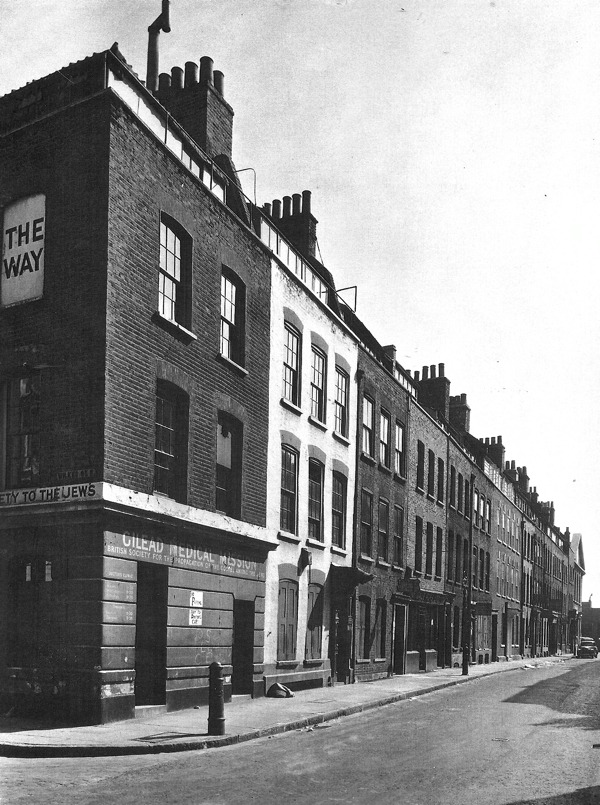
15 & 17 Fournier Street: Mission of Christianity to the Jews (1878-1947)


Next was Fournier Street, on which once Jack the Ripper romped. Today it is the site of the studio of the remarkable artists Gilbert and George, and the renovated 18th century building that once housed a joiner and then became a mission to convert Jews to Christianity at the end of the 19th century. [5] The most famous building here, of course, is the wonderful Hawksmoor Christ Church, which occupies the western end of the street.
Christ Church Spitalfields
Christ Church, Spitalfields, by Mr_Zephyr on Flickr.


References:
  1. "Tony Burns, Boxing Coach", in Spitalfields Life.
  2. Stephen Levrant, "Proposed internal alterations and change of use - Bath House Cheshire Street", Tower Hamlets council.
  3. Hazel, "Martin Creed at Hauser & Wirth Coppermill", Londonist, May 9, 2007.
  4. Duncan Richards, "Truman's East End Pub Archive", Design Department Store, Sep 5, 2011.
  5. "All Change at 15 & 17 Fournier St", in Spitalfields Life.

Oct 23, 2012

Lingua Franca Ashoka

I dip once every so often into Nicholas Ostler's Empires of the Word: A Language History of the World, a superb study of linguæ francæ (okay, I know that's incorrect and it should be lingua francas, but what's not to like about 'æ'?), and I find that I've forgotten what I've read the previous time. So it's a nice sort of infinite loop to be in. Or worrisome, if you want to think like that.

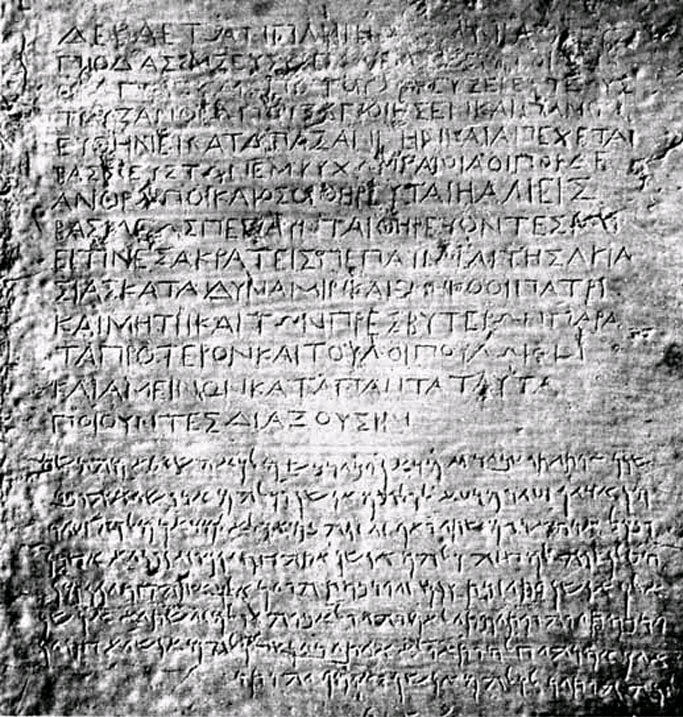
But anyway, that's neither here nor there. I remember reading elsewhere that Ashoka, once he was postbellumly saddened and enlightened, put up his edicts across his vast empire - from Afghanistan all the way south to the borders with Tamil country. In most places, the edicts were written in a script representing an Indian language, but out west, where the neighbours were Greek-speaking (Bactria and all),  they were set down in Greek and - I learn from Ostler - in Aramaic.

Ashoka's Edict in Kandahar, Afghanistan

This is a Greek transliteration of his edict - found in the 1950s (?):

δέκα ἐτῶν πληρη[....]ων βασι[λ]εὺς
Πιοδασσης εὐσέβεια[ν ἔδ]ε[ι]ξεν τοῖς ἀν-
θρώποις, καὶ ἀπὸ τούτου εὐσεβεστέρους
τοὺς ἀνθρώπους ἐποίησεν καὶ πάντα
εὐθηνεῖ κατὰ πᾶσαν γῆν• καὶ ἀπέχεται
βασιλεὺς τῶν ἐμψύχων καὶ οἱ λοιποὶ δὲ
εἲ τινες ἀκρατεῖς πέπαυνται τῆς ἀκρα-
σίας κατὰ δύναμιν, καὶ ἐνήκοοι πατρὶ
καὶ μητρὶ καὶ τῶν πρεσβυτέρων παρὰ
τὰ πρότερον καὶ τοῦ λοιποῦ λῶιον
καὶ ἄμεινον κατὰ πάντα ταῦτα
ποιοῦντες διάξουσιν.

And this is the Aramaic as written in Hebrew.

שנן 10 פתיתו עביד זי מראן פרידארש מלכא קשיטא מהקשט
מן אדין זעיר מרעא לכלהם אנשן וכלהם אדושיא הובד
ובכל ארקא ראם שתי ואף זי זנה כמאכלא למראן מלכא זעיר
קטלן זנה למחזה כלהם אנשן אתהחסינן אזי נוניא אחדן
אלך אנשן פתיזבת כנם זי פרבסת הוין אלך אתהחסינן מן
פרבסתי והופתיסתי לאמוהי ולאבוהי ולמזישתיא אנסן
איך אסרהי חלקותא ולא איתי דינא לכלהם אנשיא חסין
זנה הותיר לכלהם אנשן ואוסף יהותר.

And this is an English translation (of the Greek) by G. P. Carratelli:

Ten years (of reign) having been completed, King
Piodasses made known (the doctrine of)
Piety to men; and from this moment he has made
men more pious, and everything thrives throughout
the whole world. And the king abstains from (killing)
living beings, and other men and those who (are)
huntsmen and fishermen of the king have desisted
from hunting. And if some (were) intemperate, they
have ceased from their intemperance as was in their
power; and obedient to their father and mother and to
the elders, in opposition to the past also in the future,
by so acting on every occasion, they will live better
and more happily.

I've copied all these texts shamelessly from a Wikipedia page.

Why Aramaic? Well, that was the main language of communication across the Near East and the erstwhile Persian empire. (Recall it had fallen less than a century earlier.) Rather unchauvinistically, the Achaemenid rules of Iran didn't impose their own lingo on their subjects. The Greek bit is slightly more comprehensible - there were Greek-speaking peoples dotting the sundry Alexandrias set up by that maniac eponymous conqueror all the way from Greece to the Hindu Kush. According to Carratelli (the translator above) it appears that the Seleucid rulers of the area were in the process of establishing Greek as official bureaucratic language, but because it's unlikely that Ashoka was propagandising outside his empire, he must have been aiming his bilingual texts for Greeks living within it. (Why is it unlikely?)

Seleucus Nicator and Chandragupta Maurya (Ashoka's grandfather), as is well known, had signed a treaty establishing peace along their frontier. One of the terms was to allow intermarriage between Greeks and Indians, which would allow the former to skirt around the caste rules that dominated daily life under the Mauryas, establishing their position in society. (Prior to the discovery of the edict, it had been thought that Greeks achieved a status as fallen kshatriyas or not-impure sudras only later.) Clearly this socialisation of the Greeks had attained a natural level by the time of Ashoka, and his edict implies how widely understood this equilibrium was.

As for the Aramaic text, it contains Avestan religious words to denote Buddhist concepts, and is clearly addressed to the Iranian people living in the region. But they were not necessarily Zoroastrian (scholars are quite clear that they were non-Zoroastrian Mazdians, whatever that is, or some variant of Indo-Aryan religion). Carratelli suggests that Ashoka was aiming his message at the Scythians (Sakas) who had been living there for yonks.


Reference:
G. P. Carratelli, G. Garbini, 'A Bilingual Graeco-Aramaic Edict by Asoka', Serie Orientale Roma XXIX, 1964.


Sep 18, 2012

18 September

A fairly nondescript day, you might think, 18 September. A vacant yet short-tempered fellow called Joseph of Cupertino, Italy, levitated seventy times in the seventeenth century and was first Inquisitioned and then raised to sainthood. This is his day. 
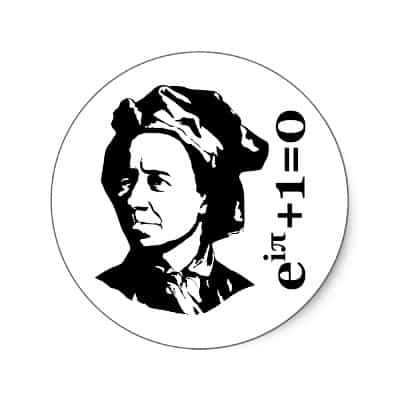
Leonhard Euler's fine turban and formula

It is also the day Leonhard Euler died in 1783. 

This was discussed, but not by that Foucault.
Jean-Baptiste-Leon Foucault the physicist was born the same day in 1819. 

Joseph Locke by mslrman, on Flickr.

Then it was Joseph Locke's turn to pass on (1860) - he was a civil engineer. 

Greta Garbo by Carmen Luna

Greta Garbo arrived in 1905. 

John Cockcroft by Rodrigo Moynihan.

Nobel-winning physicist John Cockcroft died on 18 September 1967. 

Jimi Hendrix by missperple

Then Jimi Hendrix departed this earthly vale of tears three years later.

So now you know.


Aug 6, 2012

1729

A taxicab
You've probably heard this story before. The English mathematician G.H. Hardy once visited the Indian mathematician S. Ramanujan in hospital. Hoping to the cheer up the patient, Hardy said he'd arrived in a taxi numbered 1729, which struck him as a rather boring number.

Ramanujan demurred. It is an interesting number, he said, because it's the smallest number that can be expressed a sum of two cubes in two different ways.

That is to say, 1729 = 93 + 103 = 13 + 123

And there's a galaxy (in Orion) with the catalogue number NGC 1729. (A supernova was detected there on February 20, 2012. Check it out here.) We could conceivably name it after Ramanujan, I daresay?

But 1729 is interesting in several other ways too. Sure, these are mere numerical coincidences. Numerologists base their entire lives on the like. I am inclined to point out some of these below because it's a slow day and it's raining and Usain Bolt has done his thing and I'm bored.

1,729 steps to the top of the Mandalay Hill
1729 steps to Mandalay Hill
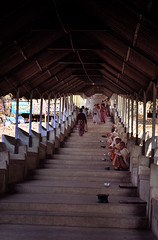
If you go to Mandalay, your eye will oftentimes be drawn to the enormous Mandalay Hill. Pagodas and shrines surround the long path that leads up to it. How many steps on that path? 1729.

There's a baroque musical group called Ensemble 1729. I think they're a bunch of Canadians. They are inspired by Ramanujan and by the fact that the year 1729 has several historical coincidences - you can see what they were on the group's website.

Gideon Rubin: Louis XV
If you fancy a bit of champagne, you'll be pleased to hear that its first house was also established in the year 1729. This was the house of Ruinart, which received the heraldic crest in 1817 that it has used ever since. Ruinart likes to promote contemporary art. In Basel last year they came up with an exhibition of works by Gideon Rubin who based his paintings on photographs and drawings from the Ruinart archives.

Speaking of champagne, Baltimore, Maryland, was founded in 1729 and scarcely seventeen years later, its first manufacturing industry was beer.

I'm forced to admit that this litany of 1729-hood is rapidly devolving into a list of dates, which is not interesting at all. Hence a rapid exit is indicated.


Oct 19, 2011

A Gibb In India

Matthew Gibb (1849-1920)

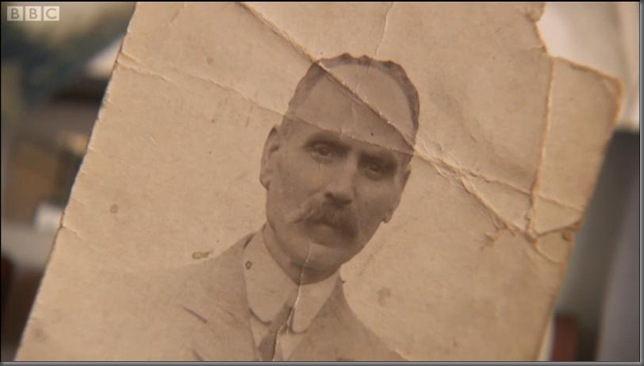
Matthew Gibb (1849-1920), great-grandfather of the Bee Gees, was a military man. According the Scottish records office, he was 5’ 5¾” tall at enlistment at the age of 18 in the 60th Rifles (which later became known as Scottish Rifles, The Cameronians). He was a shoemaker in the parish of Abbey, Paisley, Scotland when he joined up. His eyes were hazel, and his hair was brown. He served in India (1867-1878, 1880-81), Afghanistan (1878-1880), South Africa (1881-1882) and back home in 1882. He was discharged in 1905 with a rank of Quartermaster, after having served nearly four decades with the Forces. His conduct was reported as ‘Exemplary’ and was awarded the Good Conduct medal and the Long Service medal, and another one for combat in Afghanistan.

Gibb's Medals

“In spite of the above mentioned good conduct and decorations, it appears that in 1874 while serving in India, he was arrested for drunkenness, tried, and reduced in rank from Corporal back to Private.”

To his descendants today, this seems entirely out of character, for all his sons were teetotallers, and he himself appears as unbending and stern in his photographs. And yet how could something as trivial as drunkenness result in so harsh a punishment?

The Regimental Headquarters of the 60th Rifles is in Winchester, and the details of Gibb’s service are available in greater detail there.

Indian Army Indian Army  

He was one among the many BOR – British Other Ranks – soldiers from these isles who served in India, along with the much larger native forces. They bivouacked in Cantonments waiting to be called out on campaign. When he joined, India was the largest and most important  of British colonies. The Army acted as a vast Imperial police force, maintaining law and order and British interests in the region. Gibb was one of sixty thousand white soldiers living and working along with Indian army men in garrison towns across the subcontinent.

Royal Indian Army Garrison

It was for the most part a fairly uneventful routine. Gibb’s battalion was moved around from station to station: Benares, Bara Gali, Rawalpindi, Changla Gali, Fatehgarh: carrying out peacekeeping duties and training exercises, ready to be called upon when trouble broke out. He was promoted fairly quickly to Lance Corporal soon after his arrival in India.

Cantonment A Lance Corporal is not a rank but an appointment. Gibb’s performance was evaluated whilst he remained in this probationary state. Clearly he did well, and was soon made Corporal with attendant privileges, more pay, better pension.

At the time, there were no serious engagements for the Army. There were occasional skirmishes, but in the main, his existence consisted of waking up, parading, facing the odd inspection, guard duties, a never-ending dullness that prompted the bored infractions of military life. For many soldiers there was little to do during the day except go to the wet canteen and drink. And drink they did, hard drinks like rum and arrack. And they gambled, and they lost their money, and they drank more and gambled more in a bottomless spiral.

  Army Drinking This drunkenness was a serious problem at the time, and in many pubs were signs ‘No Red Coats or Dogs’ because the soldiers would drink to excess. But alcohol had long been a part of army life. It was long believed that it would help the troops withstand the heat, and was certainly healthier to drink than water in India. By the 1860s, however, there was growing concern about the effects of alcohol on discipline and well-being. Soldiers were encouraged to join Army Temperance Groups. Severe punishments were meted out to anyone found drunk on duty. Army Temperance Group
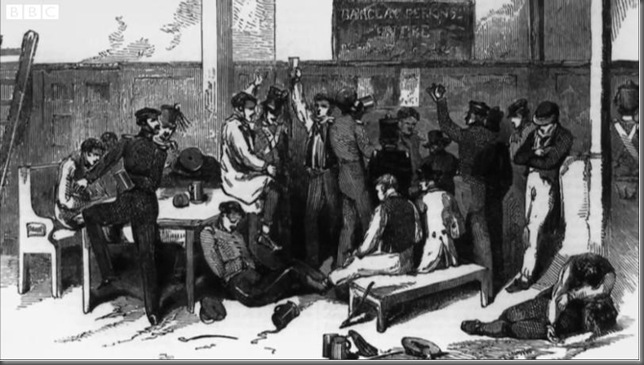
In Gibb’s case, he was found so drunk that he was hauled up before his commanding officer, sentenced to two weeks’ solitary confinement and reduced in rank. That was the end of his hitherto stellar rise through the ranks, a serious blow to his hopes of bettering his life.

Matthew Gibb was not completely crushed, however, for by the end of that year, he had obtained an Army Certificate of Education, Second Class. This was in recognition of his effort to become literate, having gone to school to educate himself. And then it took him another eight years to regain his rank of Corporal, in 1882. Eventually he ended up being a Staff Sergeant.

This was a man of determination, who had managed to pull himself by his bootstrings to a dignified station in life.

[Matthew Gibb’s early life had been a stark contrast. He was one of several children listed as living in the William Gibb household in the 1851 Census. William was a handloom weaver, a craftsman of that cloth mimicking cashmere that came to be known after the Scottish town of Paisley. But in the 1861 census, Matthew was no longer living with his parents: aged 12, he was in the East Lane Ragged School.
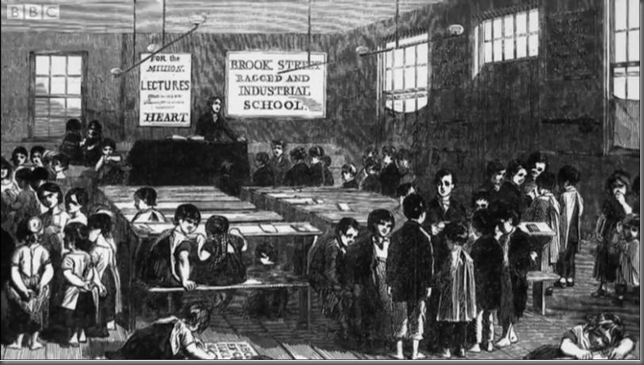
Ragged SchoolA Ragged School, or Industrial School for Destitute Children, was for orphans or indigent children to receive a good education and vocational training and three square meals a day. Boys received training in shoemaking, tailoring, to inculcate in them a work ethic and discipline. This was one of several institutions set up in the Victorian period out of a deep sense of philanthropy and Christian imperative to do good. The Paisley Ragged School was part of that national movement, much of which was driven not by the wealthy but by common folk such as the Portsmouth cobbler who trained up children in his trade from 1818. By the middle of the 19th century, there were nearly 700 Ragged schools throughout Britain providing a home, a basic education and a trade for society’s poorest children.
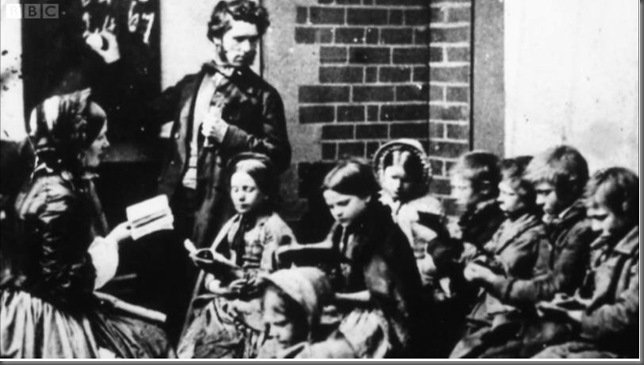
Teaching the PoorVictorian Poor In Paisley, only children from the margins of society were selected to the Ragged School. In particular, those begging on the street or in danger of falling into crime were given priority. In the 1850s, during the so-called Golden age of the Paisley looms, Matthew’s father had been earning well, despite frequent fluctuations in labour demand. The Paisley shawl was in favour during that time, with even Queen Victoria promoting it. But as the decade wore on, the condition of the weavers gradually worsened.  Mechanised looms began to replace craftsmen as the Industrial revolution trundled remorselessly. The craftsmen tried to compete by producing larger amounts of the cloth, but only ended up flooding the market and driving down prices. Although the power loom could never weave a pattern as complex as a Paisley, its cheaply produced shawls began to undercut the prices of the real thing as well. The result for Matthew’s father and his cohorts was disaster.
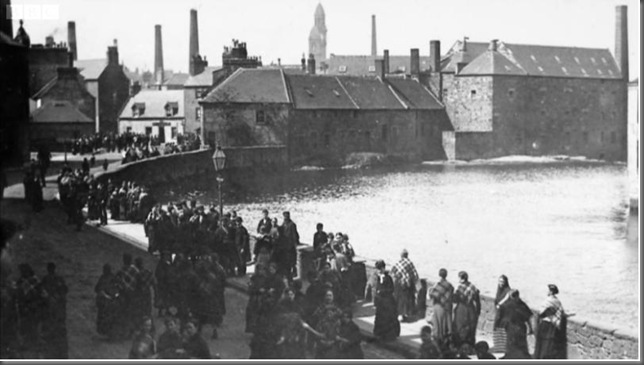
Out of Work

In 1854, Matthew’s mother died; shortly thereafter, William left his children destitute as he went in search of work elsewhere in Scotland. He was away for two years, leaving his children to be cared for by the parish, effectively abandoned. In 1857, Matthew was in the Ragged School; in 1863, his father was institutionalised, driven insane by depression. By the 1870s, the Paisley shawl works were for all purposes extinct, and William Gibb died in a poor-house in 1874.

From BBC’s Who Do You Think You Are? – Robin Gibb.]