JOST A MON

The idle ramblings of a Jack of some trades, Master of none

Apr 25, 2013

Maneaters

In my hunt for the art of the erstwhile Russian imperium, I came across the Georgian artist Merab Abramishvili. A painter well-versed and steeped in Oriental mysticism, paganism and medieval Christianity, he created a wide range of works seeking to synthesise their varied wisdoms. One of his very best works is the 2005 canvas called the Maneater of Kumaon. Here it is:

Maneater of Kumaon, by Merab Abramishvili. (2005).
Maneater of Kumaon is an important example of Abramishvili’s preoccupation with mystical beasts. A tiger is set against a meticulous and elaborate exotic garden. Lace-like foliage is painstakingly painted in tempera, yet smudged over with a layer of almost transparent paint, in places creating the effect of a soiled antique mural. The tiger itself appears elongated and delicate like a sublime beast that might have stepped out of an Oriental miniature. Abramishvili’s thin, meticulous brushstrokes carefully outlining the figures turn into smudges and dribbles of paint to produce the overall impression of a mirage. Gazing out into the distance the heroic tiger is so other worldly that the victim at his feet can easily pass unnoticed. Covered with streaks of red, (s)he lies lifeless and forgotten. The subdued violence of this work exemplifies the concealed qualities of the artist’s utopian visions. [1]
The Maneaters of Kumaon, of course, is a well-known book by the big-game hunter turned conservationist Jim Corbett. In a career spanning thirty years he shot several great cats that had taken a taste to human flesh in the foothills of the Himalayas. This was not the only book out of India with 'Maneater' in its title - R. K. Narayanan wrote The Man-Eater of Malgudi in 1961.

This book, though, has little to do with cats; instead, it is a humorous tale of a printer's woes on account of his acquaintance with a veritable demon of a taxidermist. Demonic man-eaters are a dime a dozen in art, too, especially in the art of gaming fantasy, as for example here:
Who is this by?
A certain A. Hitler was depicted as a demonic maneater in wartime propaganda, as in this English poster (inspired by contemporary Soviet works).

MANEATER

The good thing about propaganda is that it can cut both ways. Here is a Japanese anti-Russian poster by  Hitokui Rokoku (1904), in which the Czar personifies the Russian man-eater with peoples of various nationalities swallowed and struggling in his stomach.

Russia: The Man-Eater, by Hitokui Rokoku. (1904).

At the time it was put down by Japan, Russia, like a devilish man-eater, abused severely people of all countries it had swallowed: [the devil] eats some tendon and starts sneezing, he bites some meat, but starts coughing, he pinches something and becomes itchy, he thrusts somewhere and farts. But in the end he throws up everything he has eaten. [2]

And, speaking again of Japan, Hall and Oates visited in 1982, where they performed their famous song, titled - you guessed it - 'Maneater'. Here they are:


References

  1. 'At the Crossroads: Contemporary Art from the Caucasus & Central Asia', Sotheby's exhibition catalogue notes, March 2013.
  2. Yulia Mikhailova, 'Japan and Russia: Mutual Images, 1904-39'.

Feb 17, 2013

Under 200, Part 6

For some reason I cannot fathom, the local library has an occasional memoir among its fiction books.  Perhaps the librarians have a crafty cynicism? Some of these books are less than 200 pages long and I pick them up as part of my rampage through the shelves. To be honest, I pick one up - Rod Humphries' The Last Coal Trip to Tenby. I am not happy. It reads like a transcript of oral recollections. It is punctuated badly and the grammar is often awful. It is an interesting story of vanishing life in Wales just before the Second World War. It has rugby and eccentric characters. It has bibliophiles and religious nuts. It has avid drinkers and outdoors toilets. It has sporadic references to Welsh food. It would have done much better as a period comedy on TV.

In fact, my latest stash of borrowings have been singularly under par. Even vaunted writers such as Yasushi Inoue and Janet Frame and Shirley Hazzard have underwhelmed. The last of these wrote Cliffs of Fall, and Other Stories, which explores the emotional relationships between women and men in a series of short stories set in various parts of the world. Every one of her characters appears to have the same emotional maturity; they speak in similar voices; their introspection is identical irrespective of age. Every story deals with some sort of breakup, usually prompted by the (emotionally unavailable) men, sometimes by death. It's as though Hazzard feels that she can only extract nuances of human behaviour from unhappy people. Clearly she has taken Tolstoy to heart.

****

Yasushi Inoue's The Hunting Gun is one of the masterpieces of Japanese literature. I don't get it.

****

I exaggerate a tad. Pleasure was had from Zoë Heller's first novel Everything You Know, which has one of the most acerbic misanthropes I've encountered in the past year or so. His hatred of London and New York is so intense and so exquisitely described that any reader who hasn't been to these cities would probably never want to visit. He has a troubled relationship with his daughters (one of whom kills herself) and in his youth had served time for the murder of his wife (acquitted on appeal). Despite his dislike for people in general, and contempt for the women in his life, he occasionally does feel pangs of sympathy for them, and he tries to do the right thing. Of course, his good work is invariably thrown back in his face. No wonder he staggers through life despising everyone. Heller does like an optimistic ending, though. I'd have preferred the man to die filled with his bitterly dark humour.

****

Oh, and Günther Freitag's Brendel's Fantasy is another exploration of a man's mortality. Like Heller's protagonist, Freitag's - Höller - is dying as well, and he is determined to go with a bang. He feels that every musical masterpiece has an ideal location suited to it, where it must be played to extract every ounce of its beauty. He is convinced that the great pianist Alfred Brendel is the man to play Franz Schubert’s Wanderer Fantasy, his favourite piece. Retiring to a little town in Tuscany, he senses that here's where he'll stage Brendel's performance of the piece. The novel follows Höller's efforts to establish a venue deserving of the Fantasy. Naturally he faces incomprehension, dismay and unsavoury characters as he tries to bring his life's desire to fruit.

****

I'm past the letter 'I' and heading 'K'-wards... Katie Kitamura! Happy days.

Oct 14, 2012

Rice

In the 80s, every so often Punjabi farmers would arrive in Delhi's residential colonies, phut-phutting away on their tractors and bearing large sacks of grain. They would knock on the doors and ask housewives if they'd like to buy wheat or basmati rice. They would offer these grains cheaper than at local stores, and they would expect the housewives to buy large quantities. Many families kept huge barrels to store the grain, and would not be averse to fifty or hundred kilogrammes. We had less storage space than most, but we too would buy the rice.

And what rice it was - fragrant and delicious! Quite different from the usual parmal that we ate, this was a grain fit for festivals and lordly occasions. Pulaos were more delicious with basmati, as were biryanis, and even plain rice with simple curries was tastier than usual. It would, therefore, be brought out only for special events. But eventually the Indian climate would begin to wear it down, weevils would appear in the dry grain, and we'd have to cook up the remainder in an orgy of fragrance and anticipation.

We would take trips to Kerala every so often, and there we would encounter the rich, red Kerala rice, unpolished and fat. Steaming ladlefuls on our plates accompanied by fish curry and every manner of coconut preparation tasted like heaven. 'This is the real rice,' the paterfamilias would say contentedly.

But he could only have it during those short few days of holidays - any more, and he'd complain of it sitting heavy in the stomach, difficult to digest. So we'd never bring any back to Delhi, and we'd go back to parmal and the infrequent basmati.

When I studied in Bangalore, the hostel messes were scenes of enormous piles of rice being cooked day and night. It is a staple in South India, after all, and it was consumed by the ton. I didn't stop to wonder what breed of rice it was, generic and flat and flavoured only because of the curries that we liberally mixed with it. Better yet was the stream of hot chapatis that the mess attendants would bring to the tables, and I began to lose my interest in rice.

Meanwhile, my family was in Japan, on my dad's final posting before retirement. They were staggered by the cost of the Japanese rice. The Japanese growers were a cartel that enforced high prices, which for whatever reason, the locals were willing to pay. This was a fine rice, sticky and chewy, but completely unsuitable for an Indian cuisine.

One year, the harvest of Japanese rice was worse than usual, and the prices shot up to levels that even the locals blanched at. In desperation, the government cast about for a replacement, and they settled on aromatic Thai rice. But the Japanese, conservative to the bitter end, refused to buy much of it, and the authorities had to offload it at throwaway prices. This was manna to the underpaid Third World types, and when I visited my folks, I was treated on a daily basis to the new grain.

It was superb, long grained and fragrant, intrinsically so flavourful it could be eaten without accompaniment. Mere dollops of coconut or jasmine would accentuate the taste. Unfortunately, this flavour would be completely subsumed by the spices of Indian cooking, and the rice would then take on the characteristics of parmal. Still, it was better than using Japanese rice for Indian cooking, and we managed rather well.

When I went to the US, I was amazed to find basmati everywhere. We had heard that the best basmatis were being exported from India - here I found not only Indian but Pakistani basmati as well. I couldn't tell the difference between the two, and consumed such quantities that before long the thrill was gone, and it became as pedestrian as any other.

I investigated other varieties - Mexican, for example, and short and long grained Californian. They were fine grains but with little novelty. Much better was the risotto, short and fat and creamy, while Spanish paella rice was remarkably thirsty, yet retaining its distinct grains when cooked.

Now I'm conducting a bit of an experiment. In the last few months, we've been trying different rices. First, our idea was to go back to that Kerala rice that the wife and I remembered so fondly. It has been a bit of a hit-and-miss experience. The red raw rice we first tried is spectacular in colour, but it doesn't quite match our memory of Kerala. I've also tried a parboiled red rice, which turns out to be a closer approximation. This is quite difficult to cook, though, requiring a pressure cooker and lots of water, and my green credentials are taking a bit of a beating.

Unfortunately, my experimentation has been without record-keeping, so I've forgotten all the varieties of rice I've recently tried. I do have vague recollections of Sri Lankan names and ponni and matta. These will have to do for the time being, until I discover the next great rice.


Jun 15, 2012

Saké?

Michel Tournier went to Japan. In his book Lieux Dits, he describes his experience of drinking saké.
That evening, some friends were waiting for me at a bar. What else is there to drink but Saké? I'm drinking Japanese alcohol for the first time. "Watch out," I am warned, "It is very strong." I take a sip, and at once feel myself shaken violently. "You were right, it is very strong!" I say. "No, no!" say my friends. "That is because there was a temblor exactly when you swallowed!"

Aug 23, 2011

The Food Demon

Kanoko Okamoto's A Riot of Goldfish comprises two novellas, one the eponymous one and the other eponymous to this blog's title. Eponymity, don't you know. At any rate, in The Food Demon, there's an intense young man called Besshiro who bullies his wife and wants to be known as Sensei. Unfortunately, in the Japan of his time, there's little respect accorded to a chef, even to one as skilled as he. 

His best friend brought out the best in him:
The sorts of things he usually ate, such as soupe a l'oigninon served baked in a small bowl covered in cheese, rice with stewed ox tongue, or salad with haricots verts and vinaigrette, were easy enough for Besshiro to prepare. But dishes like duck simmered in duck blood or eel medallions with vinegared aspic were new to Besshiro and more challenging to make even with the detailed instructions his friend would rattle off from his bed. Simmering the duck blood on an alcohol burner made a rich and sticky broth, like a good red-bean soup, in which the slices of duck were cooked along with salt and pepper. He tasted the meat after cooking it very lightly and was surprised to find that it did not taste badly. His friend explained that it was the specialty of a famous duck restaurant in Paris and was considered quite an elaborate and extravagant dish.
Another time, Besshiro, insulted by what he considered the superficiality of an art lover's criticism, invites her and her husband to dine with him. He is convinced that she will reveal the shallow nature of her understanding of art, and is determined to outdo himself in his culinary attempt just to show her up:
But Besshiro proceeded on the assumption that the woman was a connoisseur and busied himself ordering foods that could stand up to a connoisseur's scrutiny, like moroko fish straight from the Moroko River in Sakamoto, and pepper tree bark from Kurama.

The woman looked impressed and thanked him as she began to eat. 'This catfish roe is gorgeous!' 'And the stewed ebi imo potatoes are exquisite!' As her lips took on a coat of oil from the kara-age, she said simply 'Delicious!' 'Delicious!' and ate on single-mindedly.

Apr 26, 2011

Carnivalesque 73

Welcome, folks, to the seventy-third Carnivalesque, the Ancient/Modern edition of the popular History blog carnival. Thanks to all those who contributed and sent suggestions.

To start with, take a look at this timeline (timelines being some sort of minor addiction for me) of historical events that occurred in years ending in 73. Trite, eh? There’s considerable uncertainty about the older dates, of course, but if there’s at least one source that speculates an event occurred in such a year, well, I’ve bunged it in.

Events in the years before Christ (or Common Era, to be less religious) appear against negative numbers in this timeline. If you click on any of the titles, a little window should open up with some extra information.


This is the week after Easter, and so a light Christian history thread runs through this carnival. But fear not – there’s lots of other stuff to whet your secular appetites.

And so, to begin:

Africa


Kemsit, the Nubian queen of the Egyptian King Mentuhotep II (2061-2010 B.C.), and her servants; from a painting in her tomb chamber wall; Metropolitan Museum of Art, New York; from Naville, The XI Dynasty Temples at Deir el-Bahri III (London: Egypt Exploration Fund, 1913), pl 3.
Kemsit, the Nubian queen of the Egyptian King Mentuhotep II (2061-2010 B.C.), and her servants; from a painting in her tomb chamber wall
Would you be willing to trek across the Egyptian desert all the way to Chad? Even today it’s a perilous journey, and yet there’s evidence that the Pharaoh Mentuhotep II (2061-2010 BC) organised an expedition to that western land. Read about it in Owen Jarus’ post in Unreported Heritage News.


*********


Europe


Around 3500 BC, the Neolithic inhabitants of the island of Jersey built a worship mound that came to be known as La Hougue Bie. Millennia later, a church was built atop it. The Neolithic mound was equinoctically aligned, and it turns out so is the church. Alun Salt tells the story.

You may have seen some racy news recently - First Gay Caveman Found! - etc. Bunkum. The Corded Ware (2900-2500 BC) burial site near Prague was not of cavemen; rather it's of pre-Bronze Age farmers.  Why do they think it was a gay caveman? John Hawks does a spot of debunking.


If you have wondered why Isocrates (436-338 BC) is not as well-known as, say, Plato, wonder no more. Michael Anderson has the scuttlebutt in his Ancient History Blog.

How likely is it that a list of survivors of the Battle of Marathon survived to this day? Or that such a list ever existed? Rogueclassicism has an overview of the affair of the Marathon tablet (403 BC ?) and its epigraphy.

What do Nerva, Trajan, Hadrian, Antoninus Pius, and Marcus Aurelius have in common? Adrian Murdoch’s series of podcasts on Gibbons’ “five good emperors” (AD 96-180) reveals all that you  might want to know. Get them at his blog Bread and Circuses.

Ivan Bilibin's Illustration to the Lay of Igor's Campaign (from Wikimedia Commons)
‘In AD 1185, as the Kievan Rus Empire was starting to deteriorate, a little known prince on the eastern Russian borders led his outnumbered men into battle against Mongolian invaders, the Polovtsians (Kumans). This battle and its aftermath would become the topic of the Russian literary epic, “The Lay of Igor’s Campaign.”’ Seesaw discusses the battle, the epic and its musical successors in Russia, Past and Present.


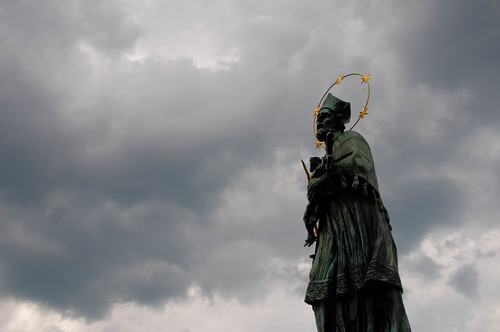
St. John of Nepomuk, Charles Bridge, Prague
St. John of Nepomuk, Charles Bridge, Prague by dlnwelch, on Flickr

If you wander about the Upper Palatinate in Germany, you might find yourself wondering – as Patrick Shrier did – why there are statues of St John of Nepomuk (d. 1398) on nearly every bridge in sight. What’s a Czech saint doing in Germany? Shrier investigates and reports in Patrick’s Military History Blog.


A oft-repeated statement is that the famous vegetarian Leonardo da Vinci (1452 - 1519) was 'ahead of his time' in sundry disciplines. While this may be somewhat true of his art, it doesn't apply to his technical work, says Thony C. in the Renaissance Mathematicus.

There’s no end to weirdness in Europe, and Vlad the Impaler is about as weird as a historical character can get. Soon after taking up the throne of Wallachia (1457), he invited the nobility to an Easter feast and – well, Executed Today has the story.

'Tis the 550th anniversary of the Battle of Towton (1461) - one among many in the Wars of the Roses in sunny England - and there are no pictorial representations extant of that battle. So what was Sheila Corr to do when she had to provide a suitable illustration for an article in History Today? Find out here.


Speaking some more of seriously weird things: there was much faith in putting one’s fate in the hands of chance (or God) – even secular arguments were sought to be settled by means of trial by fire. One of the last such trials occurred in Florence in 1498, as Beachcombing’s Bizarre History Blog reports in Barbecuing Friars in Late Medieval Florence.


*********

Middle-East


While it’s widely believed that the Abrahamic faiths are monotheistic, there is considerable evidence that Judaism, the oldest of them, was initially polytheistic. JK at Varnam explains the ins and outs of how god became God and acquired a wife, and other gods were consigned to oblivion (c. 8th century BC)

What’s up with physicists thinking they can contribute to historical analysis? Surely the age of the dilettante is past? Jona Lendering in New at LacusCurtius & Livius excoriates Colin Humphreys for his claim that Christ’s Last Supper took place on a Wednesday, and not – as historians agree – on Maundy Tuesday. “The trouble with the Jaubert-Humphreys Thesis is that it solves a problem that does not exist by using a method that is self-contradictory…Unfortunately, this is not an innocent, funny story about scientists who should not pretend they are historians.”

In the early days of Christianity, Easter was the chief religious festival. Birthdays were considered a pagan relic. So how did Christmas become the important festival it is today? Ranjith Kollanur explains in his blog A View From My Disjointed Laptop.

European depiction of the Persian (Iranian) doctor Al-Razi, in Gerardus Cremonensis "Recueil des traités de médecine" 1250-1260. (Wikimedia Commons)
European depiction of the Persian doctor Al-Razi, in Gerardus Cremonensis "Recueil des traités de médecine", 1250-1260. (Wikimedia Commons)
When and where was the definitive recognition of smallpox made? In Persia around AD 900, a medic called al-Razi wrote a treatise named al-Judari wa al-Hasbah (On Smallpox and Measles). Lapham’s Quarterly blog has a small write-up.

*********

Asia

74,000 years ago, human beings were passing the Malay peninsula on their great migration across the planet. Archaeological digs in Perak revealed a sumptuous burial of a man, which showed that Malaysia was no civilisational backwater. Judith Weingarten has the story of the digs and the feisty woman who conducted the research in her blog Zenobia: Empress of the East.


According to the Vedas, a mighty river called the Saraswati flowed through the plains of north India. There have been efforts to identify this river - which no longer exists (in its original size, at least) - and there are controversies galore about its history. Researchers in geology, linguistics, archaeology, history, and climate science have contributed, and Michel Danino has a post discussing some of this interdisciplinary work.

Emperor Wu dispatching Zhang Qian to Central Asia from 138 to 126 BCE, Mogao Caves mural, 618-712 CE (Wikimedia Commons)
Emperor Wu dispatching Zhang Qian to Central Asia (138 to 126 BCE), Mogao Caves mural, 618-712 CE (Wikimedia Commons)
Tired of horsemen attacking his villages, kidnapping the women and killing the men, and realising that they were untouchable until he obtained a powerful cavalry, in 103 BC the Chinese emperor Wu sent a taskforce to the land of the Wusun to bring back the heavenly horse. Heather Pringle tells the story and its later ramifications.

Japanese samurai boarding Yuan ships in 1281 (Wikimedia Commons)
In AD 1281, Kublai Khan sent a fleet to invade Japan. 730 years later, the History Channel purported to explain it all to unsuspecting aficionados of popular history.  Learn what really happened, and why you shouldn’t trust (ever!) the History Channel - in this piece by Tatsunoshi in Shogun-Ki.


*********

The Americas

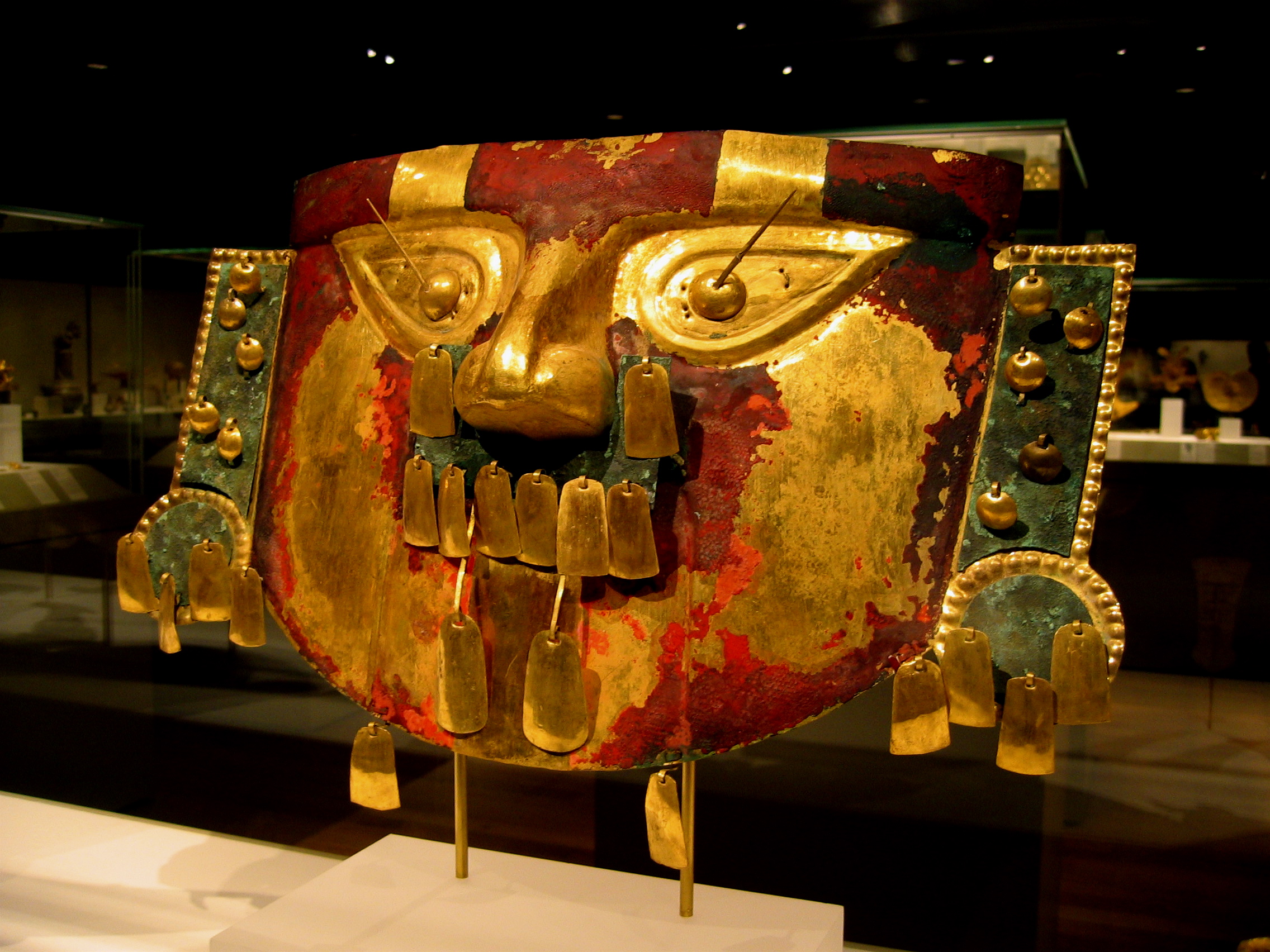
Funerary Mask, 9th-11th century Peru; (Lambayeque) Hammered gold with cinnabar and copper overlays, cinnabar; H. 11 1/2 in. (29.2 cm) Gift and Bequest of Alice K. Bache, 1974, 1977 (1974.271.35) (Wikimedia Commons)
Funerary Mask, 9th-11th century Peru; (Lambayeque) Hammered gold with cinnabar and copper overlays, cinnabar;  (Wikimedia Commons)
From the 8th century AD, the Lambayeque culture flourished in northern Peru. Like their more famous successors, the Incas, these were a people wont to fertility rituals and human sacrifices. How about combining the two by sacrificing women? Monty’s World has the story.

Archaeologists long thought that the cultures of Central America and North America had little or no interaction. Now it appears that there may have been thriving trade between them, lasting as long as five centuries from AD 900. The Pueblos of southwest USA drank cacao, which they could only have got from Mesoamerica. As Gregory LeFever reports in his blog Ancient Tides, they would have paid for the cacao with turquoise.

The 400-breasted Mayahuel Aztec Goddess of the maguey or agave (Wikimedia Commons)
Why not ponder the fate of the Aztecs (13th – 16th centuries) and their rabbits? Even before the sanguinary and Easter-loving Spaniards turned up at their doorstep, they celebrated the bunny by naming a day in its honour. And they got as drunk as 400 rabbits. Say what? Judugrovee reveals the story in the blog The Complete Mesoamerica … and more.

*********

And, to round things off, interdisciplinaryment:

Art

When a snake escaped the Bronx Zoo a few days ago, a contest was announced in some papers to name her. Why not Wadjet? Here’s a post by Madeleine Cody in the Brooklyn Museum’s blog about the ancient Egyptian snake goddess, her history, her mythology and some of the art based on her.

Have you heard of the Codex Aureus? It’s a beautiful 10th century parchment manuscript featuring the four gospels. Peacay at the ever wonderful BibliOdyssey has the scoop.

Allegoric figure of Fortitude from the Four Virtues by unknown artist (also attributed to Botticelli), c. 1490, fresco, Castle Chapel, Esztergom
Lovely Renaissance frescoes (1460s) were found in Esztergom, in Hungary. Zsombor Jékely in Medieval Hungary investigates - are they really by Botticelli?

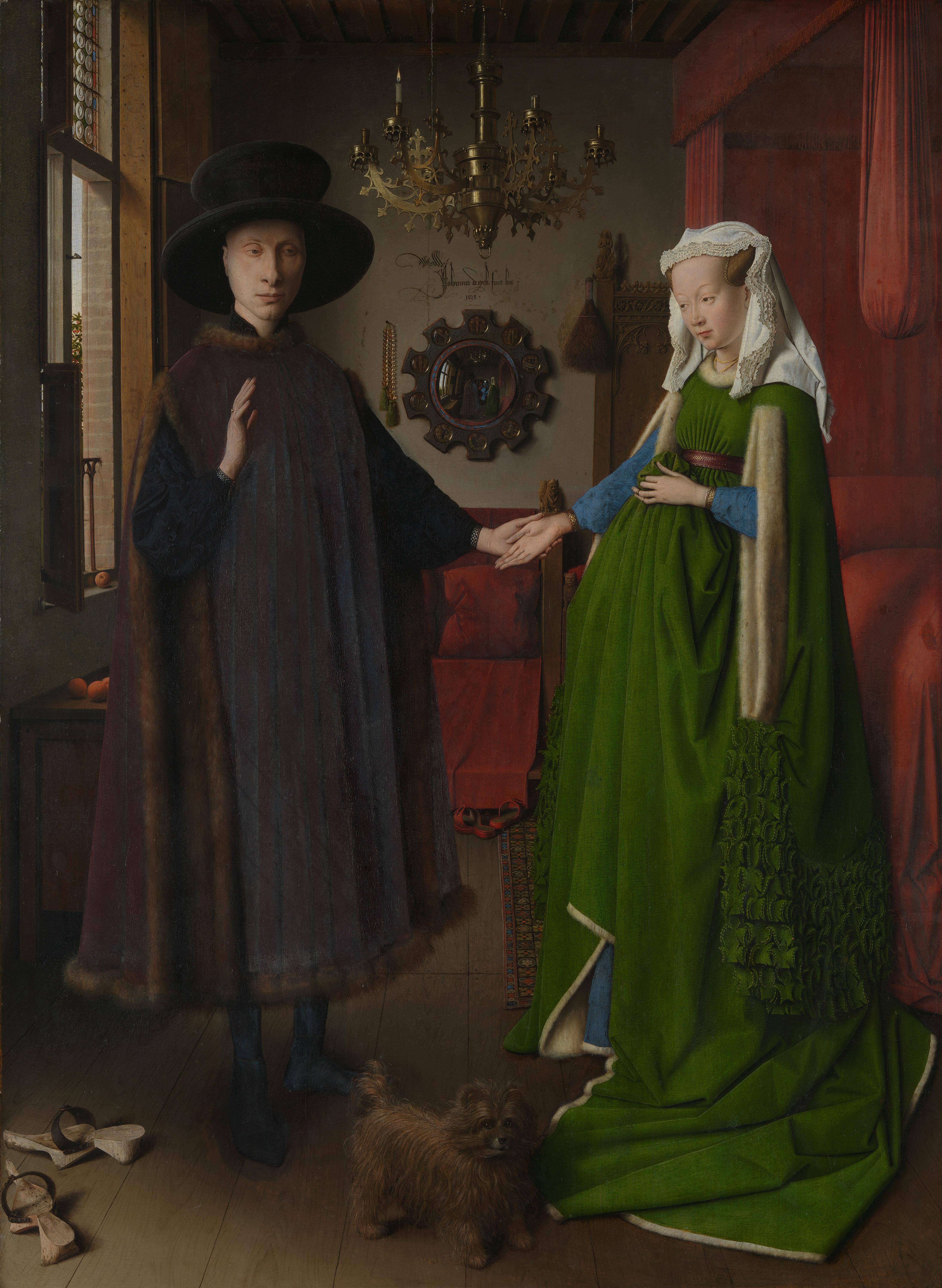
Untitled, by Jan van Eyck (or Portrait of Giovanni Arnolfini and his Wife) (Wikimedia Commons)
And we have another question: Is Van Eyck’s painting titled Arnolfini Portrait (1434) meant to portray Arnolfini’s wife? Considering there were five Arnolfinis in Bruges at the time, and we aren’t even sure which Arnolfini commissioned the painting, this might appear to be a fraught query. Alberti’s Window has a report.

*********

A Review or Two

Ever wondered about water and windmills? In Medieval History Geek, Curt Emanuel posts a review of Wind and Water in the Middle Ages: Fluid Technologies from Antiquity to the Renaissance. |The book is a scholarly compendium in ‘three general thematic sections with three papers having an archaeological focus, five concentrating on how mills "worked"; not physically but rather how they and their uses were integrated into society. The final three papers discuss how mills and milling were viewed by contemporaries through an examination of art and literature.’

While one Goth sacked Ancient Rome, a Vandal was its saviours. How’s that, you ask? That helpful Vandal was Stilicho. In Armarium Magnum, Tim O’Neill reviews at length a recent book by Ian Hughes titled Stilicho: The Vandal Who Saved Rome.

*********

That’s all for now, folks. Hope you enjoyed this round-up. The host of the next edition of this carnival will be announced shortly at the Carnivalesque website, and here’s a heads-up: it will cater to the Early Modern period, that is, AD 1500-1800.

Dec 1, 2010

Sumo Despondent

Met recently with a noticeably despondent Japanese economist. And boy, did he have something to be despondent about. Moribund politicos, he moaned. Far too populist! No new ideas on how to rebalance the Japanese economy. Massive corporate tax evasion. The yen will enter a long fall like a sumo wrestler. There will be a massive transfer of wealth from the younger generation to the soon-to-retire babyboomers. Their pensions are underfunded. There are no growth prospects. The corporate landscape is filled with zombies. Japanese equities are not going to improve in this lifetime. And who will want Japanese bonds at less than 1% yield? Damnation, death and despair is all that awaits us.

Then he looked at me hopefully and said, 'Maybe India will show the way.'

Right, India. This is your chance. I have spoken.

Sep 22, 2010

A War of Cultures

During the Second World War, it was well-known among Allied soldiers that the Japanese treated prisoners-of-war with horrific brutality. This knowledge served both to terrify the Allies as well as to harden their hearts against the caricatured little yellow men. For their part, the Japanese, impressed with their own daring conquests of South East Asia, held British and Indian soldiers with utter contempt.

There was a massive clash of cultural mores here. As the British noted, you could mow down 95 out of a hundred Japanese troops, and the remaining five would fight bitterly till four were dead, whereupon the last one would kill himself. The Japanese considered it dishonourable to surrender; to die for their Emperor was a worthy cause. Indeed, they found it unfathomable that anyone could surrender, which is why they treated Allied prisoners of war as less than animals.

On the other hand, when they encountered what they considered honourable behaviour on the side of the British, they were moved. After one ambush in which they wiped out a company of Indian and British soliders, they saw the British officer stand up and blow his brains out. They treated his body with deep respect. Another man who commanded a platoon they defeated they treated like a Samurai - they shaved his head, a mark of deep honour.

The Japanese fought with fanatic bravery. Their juggernaut was halted first by British and Indian troops in the North-East of India, at the infamous siege of Kohima in Nagaland. By that time, the Japanese lines were overstretched, undersupplied, and the British had air superiority, and far better armament. Still, the Japanese assault continued. They were indomitable.

Yet in their own camps, the bravery often sagged. One Japanese officer, seeing his men hungry and careworn,  rounded them up. As they stood facing him, he put his hand in his trousers. He ordered them to grab hold of their penises. If it is hanging loose, he said, it meant the soldier was brave and in control. He could scarcely find his own, shrivelled as it was in his terror. As his men looked on curiously, he kept a poker face, and they obeyed him. One of the youngest in the platoon suddenly yelped that he couldn't find his penis. Where is it? he said anxiously, and all the men burst out laughing. It was a rare moment of humour in a war that was savage and quickly getting out of their hands.

For the Japanese, obedience and adherence to the rigid hierarchy of society and army was a paramount dogma. And so it was that the General - Sato - in charge of the invasion of India found himself reviled for disobeying orders and abandoning Kohima and the road to Dimapur after a bitter battle lasting weeks. He realised that his higher-ups had neither the will nor the ability to keep him supplied. Meanwhile, his men were starving to death. 

For years after the war, he made it his penance to go to the families of every one of his soldiers who died under his command, and to beg forgiveness and light a flame in their honour. Rare among the military elite of Japan, he showed moral courage and true honour.

Feb 24, 2010

Georgians Galore

The little country of Georgia has been in the news for a variety of reasons. Most recently, their luge champion tragically died in a practice run at Vancouver's Whistler Sliding Centre. Prior to this tragedy, of course, was the brief but bitter war it fought against Russia. Meanwhile, Stalin appears to be a common object of veneration among the warring parties - both Russia and Georgia (where he was born) are in the midst of a massive rehabilitation of that mass-murderer. Like the Mongols who have reclaimed Genghis Khan, the Georgians want to believe that Stalin, possibly the most famous Georgian ever, is their one claim to greatness. A few months ago, a BBC reporter named John Sweeney (previously famous for losing his temper and yelling at Scientologists) produced a film about the adulation and celebration of Stalin in these countries. Scary stuff.

In a bid to expand its international clout, Georgia has also come up with a couple of other plans. An American teenager is competing in the ice dancing at the Winter Olympics this year for Georgia. (She is half-Japanese, which explains why her elder siblings are also in the field, competing for Japan.) Her dance partner is Georgian, and the Georgians rushed her citizenship through last month so she could compete in Vancouver. (Can't point the finger at Georgia alone, though. I guess their action is not so different from Qatar and Bahrain issuing citizenships to African athletes just so they can have a presence (and possibly a medal or two) at the Summer games.)

What has to take the cake, though, is the recent appointment of a scion of the Habsburgs as Georgia's ambassador to Germany. The ambassador, Gabriela Maria Charlotte Felicitas Elisabeth Antonia von Habsburg-Lothringen, princess Imperial and Archduchess of Austria, Princess Royal of Hungary and Bohemia, used to be an avant-garde sculptor, and having lived in Georgia since 2001, has become its citizen. A name like that, says Georgia's president, should open doors (according to the Economist).

Now tell me: Does Saakashvili have a deliciously deprecating sense of humour or not?

[We continue the paraphrase of Allan Chapman’s Gods in the Sky, episode 2, from Channel 4]

So what was the point of the bizarre calendars we discussed in the first part of this post?

The primary function of the astronomical religions was to allow farmers to predict the seasons (as we have also seen from our exploration of Ancient Egyptian myth and faith). Indeed, it is the writer Hesiod who gives us the first documentary evidence of how the gods in the sky were used in farming:

But when Orion and Sirius are come into mid-heaven, and rosy-fingered Dawn sees Arcturus (30), then cut off all the grape-clusters, Perses, and bring them home. Show them to the sun ten days and ten nights: then cover them over for five, and on the sixth day draw off into vessels the gifts of joyful Dionysus. But when the Pleiades and Hyades and strong Orion begin to set (31), then remember to plough in season: and so the completed year (32) will fitly pass beneath the earth.

Like the peasants of Egypt and Babylon, Greek farmers used their myths to tell the time, but their myths were a lot more complicated than those of the other ancient peoples. And here lies a clue for why it was that the Greeks became by far the greatest astronomers of the ancient world.

In Greek legend, the Moon was held in special reverence, and worshipped as a beautiful and fertile goddess. She was a fertile goddess because her phases corresponded to the menstrual cycle of women, and she was so adored because she was so incredibly useful: her cycle lasted 28 days, dividing the month into 4 weeks. So, the adoration is understandable. But why did the Greeks have so many moon goddesses? Artemis was one, wielding her crescent bow; but so was Athena, who was known as ‘One who shines by night’; Hera, the wife of Zeus, was a moon goddess, as was the virgin Amalthea, and the orgiastic nymph, Io; and Nemesis, Andromeda, Danae, Selene, Helen, Persephone, Adrastea.

In Ancient Greece, you could hardly hurl a discus without hitting a moon goddess. The Sun was no slouch in multiplicity of godheads either. Take the Orion myth: Helios was the Sun. So was Apollo. And Zeus. And Hephaistos. Some Greeks worshipped the Cyclops as a one-eyed Sun god.

Why is Greek myth so complicated? Why all these multitudes of divinities? The answer lies in geography. Greece003 delphi comprises many small islands, and each island contained its own community often worshipping its own astronomical gods. As the Greeks were unified, all these various gods and myths became combined, making their legends very complicated, for they now consisted of multiple overlapping stories of astronomy and timekeeping. What’s more, the myths also began to reflect political relationships between the Greek states. The battles between the Greeks were recorded as squabbles between their various gods. And the fact that the Greeks lived in separate communities meant as well that there were differences in the ways they worshipped their pantheons.

This was to be crucial in the development of scientific astronomy. When the Greeks wished to talk to their gods, they would travel to the great temple at Delphi to meet the priests who would intermediate between them and the deities. At Delphi, they would ask questions of Apollo. But unlike the faithful of other peoples such as the Babylonians and the Chinese, the Greeks sought not instruction from their gods, but advice. And they could choose whether to accept or reject that advice. The Greeks, you see, were free.

Of all the peoples of the ancient world, only the Greeks enjoyed freedom, and this made a big difference to their view of the Universe. To see why, we can examine the despotic regimes of the ancient Orient. Unlike the Classical Greeks who lived in independent and democratic city-states, the Orientals lived under the heel of mighty monarchs, absolute kings, ruling by divine right in the names of their gods in the sky. 004 japan In Japan, it was said that the rule of the Mikado was by direct right from the Sun Goddess, and since he was the earthly representative of the divinity, he accompanied his court astrologers when they were taking astronomical readings of the shadow cast by the sun. Like the rulers of Ancient Egypt, the Orientals believed that the order they imposed on earth was a direct consequence and mirror of the order in the heavens. And just as the earthly emperor ruled on earth, so a Heavenly Emperor ruled in the skies. In China this was the Jade Emperor who lived in a cloud palace in a pearl star, and was so mighty he controlled the movements of the stars and the planets. To illustrate, we have the myth of the ox-herd.

The Jade Emperor’s daughter, we are told, is a beautiful princess called Chi Nu, the celestial goddess of weaving, associated with the star Vega, and who formed the constellation of Aquarius. Chi Nu was said to have made the clouds, and worn magical garments that changed colour with the seasons. One day she came down to Earth, and approached the bank of a silver river. She took off her magic coat and stepped into the flow in order to bathe. But while she was bathing, she was spotted and abducted by a common ox-herd (who was later to be associated with the star Altair, and whose ox was the constellation Capricorn). Much to the displeasure of the Jade Emperor, the two were happily married and had children. But one day, Chi Nu rediscovered her magic coat, and flew back into the heavens. To prevent the oxherd from following her, the Jade Emperor threw up the silver river into the heavens where it became the Milky Way.

Now this story which pertains to two stars belonging to what is now called the Summer Triangle is quite unlike the myths of the Greeks, for here we do not find a bunch of squabbling gods. Instead there was one supreme ruler, the Jade Empeoror, and it was in the name of this heavenly monarch that China’s rulers governed. So to challenge the earthly ruler would be to challenge the heavens themselves. You can see this in the myth of Monkey.

The story of Monkey is a satirical creation. Like other creation myths, it begins with an egg, which is fertilized by the wind. From the egg, there emerges a rebellious monkey who refuses to obey the laws of any human king, and declares himself a monkey king, and tries to become immortal like the heavenly ruler, to live forever among the people of the sky. This insolence angers the Jade Emperor and he summons the heavens themselves to attack Monkey. First, Monkey had to battle with the stars, and then with the planets, and if these weren’t enough, the Jade Emperor sends Time itself in the form of the twelve hours to attack the rebel.

Because the rulers of the ancient despotic lands claimed to govern as a divine right, the development of astronomy was seriously stymied, for anyone who speculated about the nature of the heavenly bodies was condemned as a blasphemer and a traitor. People were not free to question the official view of the heavens. What’s more, this way of linking the affairs of heaven with those of earth was deeply astrological, and a disturbance above would immediately suggest to a soothsayer something amiss down below. As a result, emperors were keen to keep astronomical data a closely guarded secret, terrified as they were of adverse astrological predictions, which they thought would reflect badly upon their rule. Astronomy, then, became a closed system. Although the Chinese collected a stupendous amount of astronomical data, they were unable to develop a truly scientific astronomy.

Today we might imagine that scientific astronomy began with Galileo and Copernicus. In truth, though, it was the Ancient Greeks who created the science of star-gazing. To understand how and why, we must look down from heaven and out to sea.

[To be continued.]

Jul 20, 2009

Crime - Sixth Month

For the princely sum of £5, I requested several books via inter-library transfer, and I am somewhat taken aback to note that one of those requests has already failed. 'The book is not available in a format suitable for library use' said the helpful response from Camomile Street Library. Somewhat puzzled, I quizzed the librarian about it. It turns out that she could only get the book in electronic (hence unsuitable) format. 'The British Library, I would have thought, would stock a print copy,' she said, in a perplexed tone.

Well, whatever. As I await the rest of the crime novels, I am able to boast of this month's reading. It has been rather good. We can begin with Koji Suzuki's short stories, titled Dark Water. Widely considered to be Japan's equivalent of Stephen King, Suzuki is better known as the author of the Ring - cult-book-turned-cult-movie. In this book, he bases his tales of horror around the Tokyo-Yokohama bay. I should hasten to add that I wasn't horrified by any of the stories, although one or two had a couple of moments of causing me anxiety. The stories are supposedly recounted by a grandmother to a young girl, but little other than the omnipresence of water links them. And of course all the protagonists are somehow flawed, troubled people - if not abusive, then paranoid, or passive-aggressive. The story I liked the best is called 'Dream Cruise', in which an aggressive salesman and his irritating wife take his classmate, a somewhat laid-back and self-satisfied fellow, on a cruise, with a view to recruiting him to their pyramidal sales scheme. Those of you who read my experiences with Amway will note that I have little patience with these evangelists. So the horrors that await the salesman and his wife when they encounter a child's shoe in the sea and their boat snags on something are music to my ears... Suzuki's interested in the people's back-stories, and he expends pages elucidating this or that aspect of their characters. The plots then begin to thin a bit, and it appears as if - story after story - he loses patience, and attempts to wrap it all up. His attempts at a twist at the end are not entirely fortuitous. I can't tell if the prose is leaden because of the translation, or if it is a particular trait of the Japanese short story. At any rate, this is not a book to savour; on the other hand, reading the stories in rapid succession results in a melded confusion. If you have better luck with it, please do tell.

Arturo Perez-Reverte is back with the latest of his Captain Alatriste swashbucklers to be translated into English, The Man In The Yellow Doublet. This is superb stuff, twirling moustaches, withering scorn, flashing swords, love across social classes, all set in the declining Spain of the 17th century. This is not literature of nuance, but it is exciting, punctuated by sparkling line and verse by the greats of the time: Quevedo, de Vega, Cervantes. The young narrator of the series, Iñigo Balboa, is growing up, as besotted as ever with the beautiful and treacherous Angelica de Alquezar, who has no qualms about loving him at the same time as plotting his and his foster-father Alatriste's demise. Alatriste is the lover of the famed actress Maria de Castro, but the King has his eye on her as well. When the monarch is felled during one tryst with the beauty, Alatriste is fingered as the jealous killer; it later turns out that it was actually the King's double who was murdered. Alatriste then has to investigate the conspiracy that has led him so close to the gallows, and this escapade involves swords and daggers, whispers in the night, and the deaths of old friends. The Spain of Philip IV is a cauldron of competing interests, and mercenaries like Alatriste are mere pawns in a greater game, but true to the genre, the pawns end up saving the day.

Håkan Nesser is this month's obligatory Scandinavian, and I am pleased to say that in his acerbic and sardonic detective Van Veeteren, we have a wonderful winner. As police procedurals go, The Mind's Eye is representative of the genre; what raises this above the usual is the meta-text provided by the author - knowing asides and darkly humorous commentary that enliven the pages. Often, the chapters start with pronouns, requiring some amount of concentration from the reader to decide exactly who is being talked about; unlike other reviewers who found this confusing, I thought it refreshing, serving to keep the story going as well as keeping me alert. Van Veeteren is the classic noir footpad with a troubled marriage and a jailbird son, and has the usual likes (jazz and classical music) one expects from such a detective. He investigates the case of a husband wakes up one day to find his memory gone and his beautiful wife slaughtered. A sparkling set piece in a court enumerates the facts of the case. The husband is consigned to a mental institution where his memory returns, and for no reason I can discern, he sends a message to the killer. Shortly thereafter he is killed as well. The police procedural then takes over and the investigation proceeds meticulously. It is fairly obvious who the murderer is, even if it's not clear for a while what triggered the murderous spree; it is also disappointing that Nesser needs that old trope of Scandinavian fiction, namely abusive parents, to give credence to the tale. Still, this is one of the better crime novels I've read, and I heartily recommend it.

Talking about Scandinavian fiction, and why a supposedly idyllic and peaceful land has been gutted by bloodthirsty explorations of its underbelly, this article from Salon tries to figure it all out.

A few years ago, I read the mathematics-tinged The Oxford Murders by the Argentinian writer Guillermo Martinez, and found that somewhat irritating in its insistence of mysticism around logic and set theory. The writer now comes up with an even more fantastic tale in The Book of Murder, in which, it appears, characters are killed by a mad author and nobody is able to establish that fact. The narrator is approached by a distraught Luciana, a secretary who had briefly worked with him a decade earlier, who accuses the far more famous novelist Kloster of systematically killing off her family in revenge for her own actions that (in Kloster's mind) resulted in his abandonment by his wife and in the death of his daughter. Luciana used to be a beauty but now she is deformed by her paranoia and anguish, and the narrator - a somewhat less successful author himself - finds it difficult to believe her. Still, some vestiges of loyalty to her lead him to accost Kloster who dismisses him brusquely. Inflamed, the narrator decides to put down Luciana's story in the form a novel and threatens Kloster with its publication unless he agrees to reveal his involvement. At this point, Martinez appears to lose the plot and introduces a peculiar agent who is supposed to have committed gross crimes in the town. Suddenly, the book we are reading and the book the narrator is writing become aspects of a single unifying theme; exactly what that theme is I am unable to determine, and just like so many books with interesting premises, this one also meanders into opaqueness and stultification. Read it if you must.

In the past six months of translated criminal roundups, the dominant writers have been Nordics or Italians or French. There are one or two Spaniards, too, in the mix, and Javier Cercas can be added to the lot. His The Speed of Light is not really a crime novel; instead, it is a rumination on the effects of war and war-crimes on a thoughtful intellectual. Its foundation is a horrific assault on women and children in a Vietnamese village by American special forces during the US campaign in Indo-China. The narrator is a Spaniard visiting as a research fellow at Urbana-Champaign, a young man who still has supreme confidence of his own literary ability, which is simultaneously undermined and energised by his encounter and subsequent friendship with a veteran of that same massacre (as he later finds out). Much of the book deals with literary criticism and the shadow of experience on writing; it also details in tawdry detail the fall from grace that inevitably follows success; the nature of friendship is examined in subtle detail. This is a densely written book with much superfluous detail and cascading clauses, and it careens from philosophy to conspiracy theory and back in staccato bursts. But the denouement once again disappoints - it is stereotyped and weak - involving deaths of loved ones as metaphor, and the ensuing search for redemption.

Emil is the much-loved hero of Erich Kästner's series of books for children set in the 1920 and 1930s, and in Emil and the Detectives (Red Fox Classics) we encounter the little fellow going to Berlin to meet his grandmother and cousin. En route, he falls asleep and awakes to find that one of his companions in the train has stolen his money. Naturally, he won't have any of this, but recognising that it was unlikely that any policeman would take his word against that of an adult (and recalling with embarrassment and fear that the police might indeed arrest him for painting a moustache on the statue of a famous man in his village), he decides to follow the thief himself. He then encounters an entire cohort of kids who offer to help him out, and with true Prussian sang-froid, run the thief down. Everything ends well. As far as sophistication goes, I dare say a five-year old might find this entertaining - there's far too much of the smug and upright here to interest any hot-blooded child older than that. Contrasted with the naughtiness and scrapes of William, Emil is a pale imitation. He insists that he will fight anyone who thinks he is a mummy's boy just because he is protective of his mother and far too responsible for his age, but this is too mild a protest to convince anyone. There are a couple of other jaunty boys who are superficially more appealing, and might have made far better heroes. Oh well. When I checked out the book, the librarian sighed 'I loved this one', and frankly I'm baffled why. If this is the sort of book that has been thrust upon generations of British boys by a feminised teaching community, I'm not surprised that they have been permanently turned off reading.

In desperation, I'm forced to return to authors I've read before, and few are better than Fred Vargas, archaeologist-historian-turned-crime-novelist-of-class. Several of her later books featuring the ethereal detective Jean-Baptiste Adamsberg have been translated into English, and recently, the very first one in the series was rendered into English as well. (There was a cri-de-coeur recently about this phenomenon of out-of-order release of translations, and I find it quite irritating that I am unable to follow the development of a character from start to finish just because publishers can't be bothered to publish chronologically. This is especially egregious when the full series is already available in the original language, and still they are translated at random.) The Chalk Circle Man introduces the provincial detective-turned-Parisian-commissioner who can sense evil in people and prefers to doodle instead of following up on clues and interrogating suspects. His evident success (summed up by one of his rivals as ''You sit around daydreaming, staring at the wall, or doodling on a bit of paper as if you had all the time and knowledge in the world, and then one day you swan in, cool as a cucumber, and say "Arrest the priest. He strangled the child to stop him talking."') has attracted various curious individuals, each more peculiar than the other, and all of them in some circumstantial way involved in the latest puzzle that is attracting his attention. All of Paris is agog by a street artist who goes about drawing perfect chalk circles on pavements in various arrondissements, enclosing some object or the other within them - a hat, a mouse, a lighter. Is this the latest break-out art? Adamsberg senses cruelty, however, and keeps alert to any developments, and is proved right when a murdered woman is found one day within one such circle. The investigation then splits into competing hypotheses - is the chalk-circle man responsible for the death? Or is someone following him around to piggy-back off those circles and implicate him? This is a detective novel with a surreal premise: unlike Poirot who uses strict logic, or Van Veeteren, who is a meticulous footpad, Adamsberg arrives at his conclusions mystically, and expects his deputy Danglard to fill in the gaps. Good fun, though.

Finally, if we have one Scandinavian, then we should have another, and Helene Tursten fills the gap with her Glass Devil, The (Inspector Irene Huss Investigation), as poor an example of the genre as we can imagine. This is a very poor effort, I'm saddened to say, especially because in Inspector Irene Huss is an interesting protagonist - a loving wife and mother and workaholic. A teacher is found brutally slain, and when the police go over to his parents' place to break the news, they find that the couple have been murdered as well. There are signs of Satanism (inverted pentagrams and all), and evidence of computer geekery - the hard-drives of the machines have been found completely wiped. It turns out that the surviving member of the family is a daughter (a computer geek) based in London, who has been so stunned by the deaths of her kin that she suffers a mental collapse. Huss is forced to travel to London to interrogate the woman, and there's an entirely pointless addition of a travelogue about the places she has time to visit and H&M shopping she is able to accomplish while she awaits the woman's pleasure. Even more egregious is the several pages describing a gruesome attack on Huss by drug-addled rapists that she is able to repel owing to her Olympic-level jiu-jitsu. What was the point of this? What are the chances that a chance visitor in London will suffer such an attack? Negligible, I'd have thought. The attack does nothing to advance the plot, adds little to Huss's character development, and serves no earthly purpose I could discern. But what really got my goat were the footnotes that dotted the book at various places. The publisher evidently is targeting an American audience, for whenever the text used metric measurements, a footnote would translate into imperial measures. Now consider - how many readers of translated fiction would be unaware of the metric system? It's just a puerile insult to one's intelligence. And, I'm sad to say, the book is no better, falling back on that old standby of Scandinavian child abuse. Evidently there are no other social problems worth addressing in that idyllic land.


Jul 17, 2009

Moon Year

Wondering what to do during the quadridecennial year of the Moon landings? Assuming you are not planning a lunar trip yourself, you might as well read a book or five about it. Or watch a likely DVD? Le Figaro offers some suggestions, which I have helpfully (and rather loosely) translated. Stuff for all ages and levels of seriousness. There's film and Lucian and short stories and documentaries and Norman Mailer. Enjoy.

Feb 20, 2009

Best Translated Poetry

The University of Rochester has declared the winners of the 2009 Best Translated Book of the Year award (sponsored by Melville House and Open Letter Books). Needless to say, none of the crime fiction I'm reading at the mo has even figured in the longlist. Oh well.

The winner in the poetry section is Hiraide Takashi (ably translated by Sawako Nawakasu), for The Fighting Spirit of the Walnut. I'm as clueless as the next person when it comes to poetry, and Hiraide's work requires as much concentration as aqua regia. Here's one example:
Continuous thoughts of packaging ice. No matter what I write it melts, even the
address. If and when it arrives, that person will be gone.
Hiraide's poems are not long; they are epigrammatic and terse. According to some reviewers, he is not so much about emotion as about wordplay and linguistic wallops. Not entirely impenetrable, then. Here's another:
Summoning up my last bit of energy, I shall give a gift to your pale doorway. So that it might become your first bit of food before heading over to the other eye. Whirling tides that are sealed in. And the sun with new bandages. Drupes with wisdom.
Hmm. I expect I'll sample his mots at infrequent intervals, but if anyone gets a hold of this little book, please do post a full review and critique.

Jan 4, 2008

Old Business

When was the last time I used a pencil? I can't remember. I use a (ball-point) pen almost daily, but only to scribble a small note or telephone number. Writing longhand has died a quiet death. In fact, the last time I tried it, my writing came out all wonky and my muscles ached with the unaccustomed strain. Far easier to type out a missive and print it and sign it and send it. Who writes anymore these days?

Therefore it comes as a surprise to me that the great pencil makers of the world - the likes of Faber-Castell and Schwan-Stabilo and Staedtler - are moving higher up in the value chain by manufacturing luxury pens. These houses, established in 1761, 1855, and 1835 respectively, find themselves outgunned by cheap Chinese manufacturers of pencils, so they come up with innovative designs and fancy inks and designer biros and fountain pens.

My fascination for these companies is occasioned mainly by their longevity. To survive in their essential business for two or three centuries implies several things: they produced high-quality products in niche markets that others found it difficult (or uneconomical) to break into; they innovated constantly and adapted to changing demands for their products; they had managers with foresight. And, in the case of family-run enterprises like Faber-Castell, they had clear lines of inheritance established in favour of capable successors, so that the companies were not broken up on the death of their heads.

In this, a long-lived company is not that different from an imperial dynasty. Inevitably, the most dynamic royal family ends up producing pusillanimous incompetents or debauched wastrels who exhaust their realms. Unless kings of quality ruthlessly establish their heirs by culling the deadwoods, and unless there are successors of ability to take over the enterprise, it is doomed to failure.

Consider, therefore, the famed glass-making company of Barovier and Toso that has been in Murano for seven hundred years. Nineteen generations of the family have run it and it has prospered despite severe competition from (and cheap counterfeiting by) less illustrious glaziers. Will it survive into the next generation? The prospects are not bright. The current head, Jacopo Barovier, joined the family concern reluctantly several decades ago. Now he finds that his siblings and children are not keen on running the show. He is philosophical about this. They have had a good run.

The oldest extant family-run concern in the world is Japanese. This is an example of an extremely niche market in which the company has a monopoly. Founded in the year 578, Kongo Gumi are contractors and builders and restorers of temples. The current head is the fortieth of the dynasty to run it. Interestingly, the Kongo family was brought to Japan from Korea to build the Shitennoji Temple in Osaka. A far cry, I guess, from the rampant discrimination Koreans have faced in the last century or so from the Nipponese.

The next oldest family concern is also Japanese. It is an inn, Hoshi Ryokan, in Komatsu, run by the Houshi family since AD 718. The first European outfit that enters the list is a French vineyard that dates back to AD 1000. Château de Goulaine in Brittany also runs a museum and offers its chateau for formal events.

For a comprehensive list, check out the site1 in the Reference section.

I'd like to mention Ede & Ravenscroft, tailors set up in 1689 and surviving to this day in the City of London. This is not truly a family concern - from its history, it appears to have changed hands several times, although each time to an associate or apprentice of the owning family. It was founded by the tailoring Shudalls and appears to have been taken over by an Ede, who then married into the Ravenscroft wig-making family. Hence the double-barrelled name! They have been involved in dressing up the Royal family for twelve successive coronations, starting with that of William and Mary in 1689. If the Royals can wear their outfits, I don't see why I can't. In fact, I did! I have a (very small) soft spot for this traditional concern because they were the purveyors of the elaborate gown I had to don for my graduation from Cass Business School. Buggers socked me a pretty penny, but it was worth it in the end.

Reference

1. The Oldest Family Companies in the World.

Dec 12, 2007

Eelectricity?

The Japanese never cease to surprise. As reported by Reuters, Kazuhiko Minawa, an inventor, designed an aquarium with aluminium panels inside from which cables were laid to a nearby Christmas tree. He placed an electric eel in the tank. Every time it struck the sides of the tank, six hundred volts of electricity would surge through the electrodes and power the lights on the tree. It took him a month to design the system, he said.

"If we could gather all electric eels from around the world, we would be able to light up an unimaginably giant Christmas tree," he added.

Environmentally friendly power! goes the cry in Japan.

Visit the Aqua Toto Gifu aquarium in Hokkaido to check it out yourself.

And if you want a comprehensive explanation on how an electric eel generates its power (to stun or kill its prey, not to light up Christmas trees), you will find no better source than this.