"I am working on the opening of an exhibition of Persian manuscripts at the Ashmolean. No, at the Bodleian."
"I was at the opening of the Arabian nights exhibition in Paris. I was in Paris earlier this year and got so tired that I started working on a novel. It's set in the Wars of the Roses."
"I've been working with a private collector on exhibiting his Orientalist works at the Dorchester hotel. Should open in the next few weeks."
"I prefer the souk in Damascus. I bought an astrolabe there."
"Hmm, not the usual RAS crowd here today. On the other hand, I will travel far for a free drink."
"I've become a grandfather for the nth time. We're flying to New York soon - assuming there will still be a New York. But we're coming back on the Queen Mary. We can avoid the jet-lag that way."
You've probably heard this story before. The English mathematician G.H. Hardy once visited the Indian mathematician S. Ramanujan in hospital. Hoping to the cheer up the patient, Hardy said he'd arrived in a taxi numbered 1729, which struck him as a rather boring number.
Ramanujan demurred. It is an interesting number, he said, because it's the smallest number that can be expressed a sum of two cubes in two different ways.
That is to say, 1729 = 93 + 103 = 13 + 123
And there's a galaxy (in Orion) with the catalogue number NGC 1729. (A supernova was detected there on February 20, 2012. Check it out here.) We could conceivably name it after Ramanujan, I daresay?
But 1729 is interesting in several other ways too. Sure, these are mere numerical coincidences. Numerologists base their entire lives on the like. I am inclined to point out some of these below because it's a slow day and it's raining and Usain Bolt has done his thing and I'm bored.
1729 steps to Mandalay Hill
If you go to Mandalay, your eye will oftentimes be drawn to the enormous Mandalay Hill. Pagodas and shrines surround the long path that leads up to it. How many steps on that path? 1729.
There's a baroque musical group called Ensemble 1729. I think they're a bunch of Canadians. They are inspired by Ramanujan and by the fact that the year 1729 has several historical coincidences - you can see what they were on the group's website.
Gideon Rubin: Louis XV
If you fancy a bit of champagne, you'll be pleased to hear that its first house was also established in the year 1729. This was the house of Ruinart, which received the heraldic crest in 1817 that it has used ever since. Ruinart likes to promote contemporary art. In Basel last year they came up with an exhibition of works by Gideon Rubin who based his paintings on photographs and drawings from the Ruinart archives.
I'm forced to admit that this litany of 1729-hood is rapidly devolving into a list of dates, which is not interesting at all. Hence a rapid exit is indicated.
What do you know, it’s that time of the month anew when birds chirp and the minds of bloggers turn to things festive and carnival-like. And so here we have the 35th instalment of the popular carnival of science. It promises to be a beaut. (Is it a beaut or is it a beaut? I’d say it is a beaut.)
History of Science
The first documented automaton is a flying dove from Greece in the 5th century BC. That knowledge transmitted itself subsequently to the Arab world. Medievalists.nethave a short explanation.
If you were setting out to write a book about science and how it began, how and where would you begin? The question exercised Patricia Fara, who discusses it at Soapbox Science in Science: A Four Thousand Year History.
Down House (photo by Mario Modesto)
Have you been to Down House, where Charles Darwin and his family dwelt from 1842? If not, do so vicariously via John Graham-Cumming’s Geek Weekend: Charles Darwin’s Home.
Continuing the vicarious pleasures of armchair travel, check out Urban Ramblings, a post by Rupert Baker on the Royal Society’s connections with London at the History of Science Centre’s blog.
The teaching of evolution in the USA has long been a cauldron of political and religious trouble. In Political Descent, Piers Hale talks about the Scopes trial and other legal ramifications of what, essentially, should be a scientific issue.
Continuing on the theme of evolution, Asa Gray was Darwin’s supporter in America just as Thomas Huxley was in England. In Wired Science, David Dobbs recounts the story of Gray’s debates with Louis Agassiz that led to the respectability of evolutionary theory in the US. And – as a bonus – you can even read Gray’s review of the Origin of Species in the Atlantic Magazine.
After Newton and Leibniz, a new rational philosophy took over the world of science, and people began to deride their predecessors (such as Athanasius Kircher) as scientific incompetents. BOOKTRYST has an articleabout a 1715 book that poked fun at Kircher and his fellows.
In the 1870s, the Dutch government decided to blow a ton of money on improving their scientific infrastructure, and assigned a million and a half guilders to Leiden University for, among other things, a new natural history museum. Where is that museum now? Collect and Connect explores.
Earth Sciences
In the Great War, the Austro-Hungarians created a special force called Kriegsgeologen, tasked with the use of geology for war. History of Geology describes them in War Geology.
The Osborne Company produced the first laptop computer way back in 1981. Have you ever heard of it? How to be a Retronaut tells you all about it.
Ravi Kannan recently won the 2011 Knuth prize for outstanding contributions to the foundations of computer science. Dick Lipton celebrates the achievement and discusses some of Kannan’s work at Gödel’s Lost Letter and P=NP
Physics
James Maxwell is the genius extraordinaire responsible for the first great unifying theory of physics. 150 years ago, he published the first of four papers that comprised his tour de force. The Economist’s Babbage blogtells the story.
If you are interested in the early scientific history of fission, you can do no better than to read the review by Louis Turner; Ptak Science Booksdiscusses it.
Whipple Libraryhas an article about the Nernst lamp, an innovative light source brighter than filament lamps and not requiring the use of vacuum.
Pyro Optical Pyrometer
And, in the vein of lamps, can you use re-radiated heat to measure temperature? A Pyro Optical Pyrometer can come to your rescue, as Sebastian Assenza reveals at the University of Toronto's Scientific Instruments Collection.
There was a young lady named Fisk
Whose fencing was exceedingly brisk
    So fast was her action
    That the FitzGerald contraction
Reduced her rapier to a disk.
In 1572, an English member of Parliament speculated - for the first time - on why (if the universe were infinite) the night sky was not fully lit up with stars in every line of sight. Jost A Mon (in other words, me) tells the story.
The Earth and Moon as seen from Mercury (for some cosmononplusation; credit NASA)
Einstein’s general theory of relativity predicts that light is bent as it passes near a gravitating object. What cosmological discoveries have been made by using this property of space? 365 Days of Astronomyhas a nifty little podcast.
Chemistry
Abiotic genesis of life’s building blocks, anyone? The famous Miller and Urey experiments of the 1950s resulted in amino acids when a gloop of simple chemicals were subjected to electricity. Recent analysis of the vials left by Miller reveals that hydrogen sulphide in that primordial soup would have been even more efficacious. Life, Unboundedhas the story.
If you have a pain in your spleen (and how would you know it was your spleen aching?), you can do no better than to follow Nicholas Culpepper’s advice from the 17th century, as Barbara blogs in 17th Century American Woman.
The lovely Res Obscura blog has excerpts and illustrations from a 1690 pharmacopoeia published in London. Check out The Treasury of Drugs Unlock’d.
In medieval Europe, alchemy combined with medicine to produce a potent drug called Precipitato to restore the human body to its pristine natural state. It was so toxic that it required the most delicate handling. Read about it at William Eamon, Professor of Secrets.
Shortly after Dr Hahnemann published a paper in the British Medical Journal in 1859 on his new ‘discipline’ of homoeopathy, a Glasgow doctor named William Gairdner issued an exacting and trenchant critique. Memoirs of a Defective Brainhas the story.
And, in the vein of anesthesia, Providentia provides the details on The Chloroform Man.
Life Sciences
In the 16th century, people believed that there were fundamentally no differences in male and female genitalia, one being a mirror image of the other. Mirabile Visu talks about this gender inversion.
In 1733, two Swedish workmen reported finding a dull but live frog inside a boulder they had just cut open. Over the centuries, there have been other reports of immured yet live creatures found. Hoax or not? The History of Geologyinvestigates in Toad in a Hole.
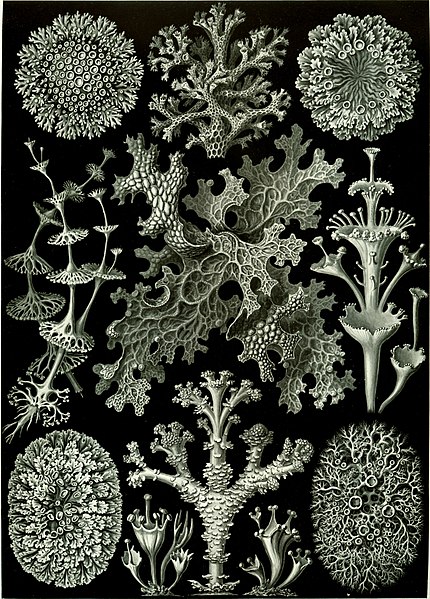
Lichens from Haeckel's Kunstformen der Natur (1904)
Ptak Science Bookshas a piece on Ernst Haeckel's Kunstformen der Natur (1904), a compendium of staggeringly lovely lifeforms found in nature.
Speaking of staggeringly lovely, have you seen BibliOdyssey's article on the Flora Sinensis, the first Western book (1656) to document the sub-tropical flora of China?
Why do people still insist that apes are not monkeys? It’s all down to an old taxonomy that is today quite obsolete, says PaoloV at Zygoma.
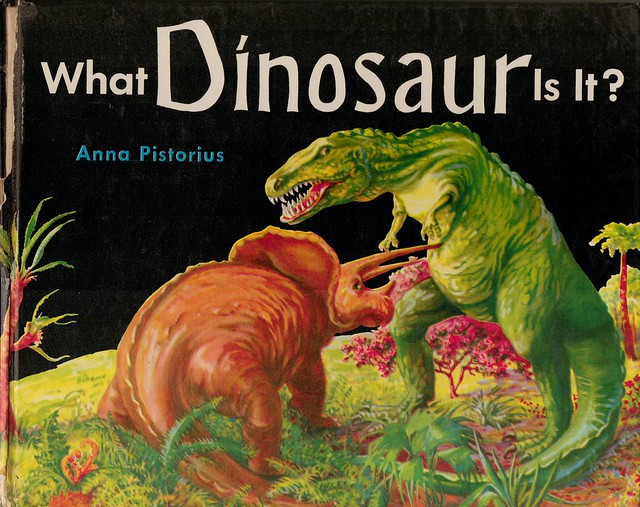
In the 1950s, Anna Pistorius created an illustrated book of dinosaurs for kids. Love in the Time of Chasmosaurs has some lovely scans and explanations from it.
[And that’s it for May 2011, folks! Thanks to all those who submitted articles (and especially to Thony C., indefatigable as ever, for finding fascinating tidbits in the scientific blogosphere). I hope this encourages you to write up your own pieces on science and its history and philosophy. Do consider submitting your blog article to the next edition of the giant's shoulders. You can use the carnival submission form. Past posts and future hosts can be found on the blog carnival index page.]
In 1572, a massive supernova lit up the sky, outshone Venus, and stayed visible during the day. Tycho Brahe recorded it in his Stella Nova, a compendium of new stars. Contemporary astronomers (the European ones, at least) were stunned by the event as it contradicted their long-held theories of the immutability of the stellar sphere.
Although Copernicus' treatise on the heliocentric universe had already appeared thirty years earlier, he too had thought that the stars were equidistant from the Sun, fixed with respect to each other, and moving at a constant speed in an enormous solar orbit. It took a Member of Parliament from Wallingford, England, named Thomas Digges, to postulate an idea of differing stellar distances 1.
"In 1573 Digges published Alae seu scalae mathematicae, a work on the position of the new star which is often called Tycho Brahe's supernova of 1572 since Brahe also observed the star and determined its position accurately. Digges' work includes observations of the position of the 'new star' and trigonometric theorems which could be used to determine the parallax of the star. The observations are particularly impressive making Digges one of the ablest observers of his time." 2
The appearance of a new star, while disturbing enough, was less worrisome than its gradual disappearance. Why did it begin to dim? Digges' foster-father, a natural philosopher called John Dee, suggested that the star had brightened as it approached the Earth, and dimmed as it retreated. This thesis alone put a spoke through the idea of an equidistant and unchanging shell of stars.
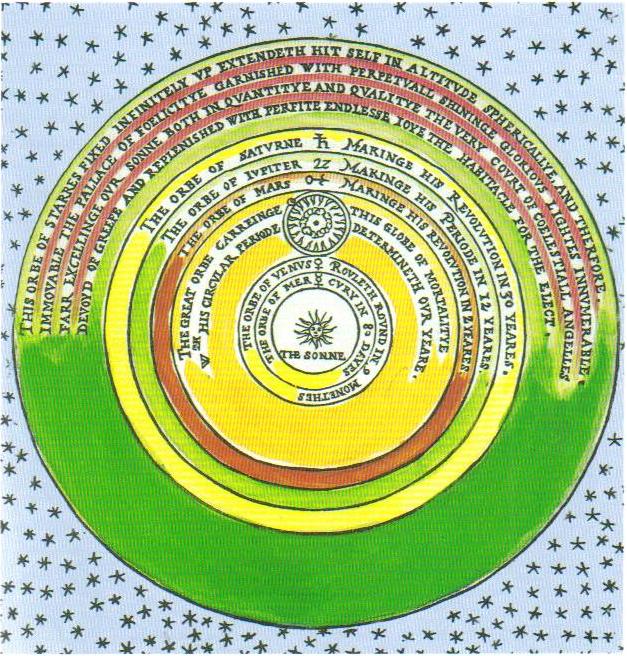
An illustration of the Copernican universe from Thomas Digges' book (Wikimedia Commons)
Digges published an English version of Copernicus' treatise in 1576 (Perfit Description of the Celestiall Orbes) with some additions and elucidations of his own. His own contribution was the startling one of an infinite universe (crystallised into this one diagram), and possibly the first statement of what later came to be known as Olbers Paradox:
Clearly, if the universe was infinite and had an infinite numbers of stars, and had lasted for an infinity, every line of sight from Earth would end up in a star, and so the night sky should be completely lit up. Equally clearly, it isn't. Why?
Digges was unable to propose an entirely satisfying resolution to the problem. No shame falls to him, however, as it took nearly 350 years for the answer to emerge. With the discoveries of Edwin Hubble of the expanding universe, it became clear that the universe was not, in fact, infinite, and it hadn't existed forever, and that there were stars far out in the deep field whose light still hadn't had time to reach us.
It is only fairly recently in human history that people realised that our Sun is a star. For this discovery, we have to thank Father Angelo Secchi, the Vatican’s Chief Astronomer, and his work in stellar spectroscopy.
Spectroscopy involves passing light from a source through a prism to break it up into its constituent colours. If the light is absolutely ‘pure’, the spectrum observed will be continuous, with no breaks. But if the light has passed through any transparent medium (other than vacuum, of course), the medium will take out some portions of the spectrum in a very characteristic way: dark lines appear where the light was absorbed. Every element in the Universe has its own characteristic spectrum, and by studying the dark lines, we can identify the materials that the light went through.
In the 19th century, Father Secchi used an observatory above his church in Rome to gather light from the Sun. He split the light into its components, and then magnified each portion to study it more clearly. He discovered – at the edge of the Sun – a revelation.
Galileo, centuries earlier, had determined that the Sun was not an unblemished disc: it has spots that move, from which he inferred that the Sun rotates around its axis. But that was as far as the Sun’s imperfection went. Nobody had suspected that there were emanations from the Sun’s outer layers, prominences and flares. True, during eclipses, scientists had observed the solar corona before Secchi, but the brightness of the sunlight prevented closer study. Secchi found patterns and movement in the corona that nobody had seen before.
With Secchi’s technique, astronomers could study not only the edges but also the body of the Sun. Galileo’s sunspots were revealed as Earth-sized tears in its surface. The surface itself bubbled before their eyes. Soon they were able to identify the chemicals that made up the Sun. Dark bands in the spectrum revealed the presence of hydrogen, calcium and iron, and also an element that had previously been unknown on Earth. It was named after the Greek Sun god Helios – helium.
In 1862, Father Secchi turned his spectroscope to the night sky to see what the stars were made of. He recognised the pattern of chemicals immediately. They were all but identical to the Sun’s.
And thus, one of the great mysteries of the heavens was resolved. Our Sun is a star.
(From Episode 5: Star of the BBC's superb 1999 series The Planets)
It’s the tenth anniversary of Wikipedia (all hail) and the net is filled with celebratory topics and adulatory commentary. I’m somewhat inspired by a recent piece I saw on the BBC News website reporting on (pseudo)random browsing through the Wikipedia site, the writer starting with Aristotle, following links for an hour, and somehow finding his way back to Aristotle. Reminds me of James Burke’s Connections, which you will be pleased to know has a Wikipedia page all to itself as well.
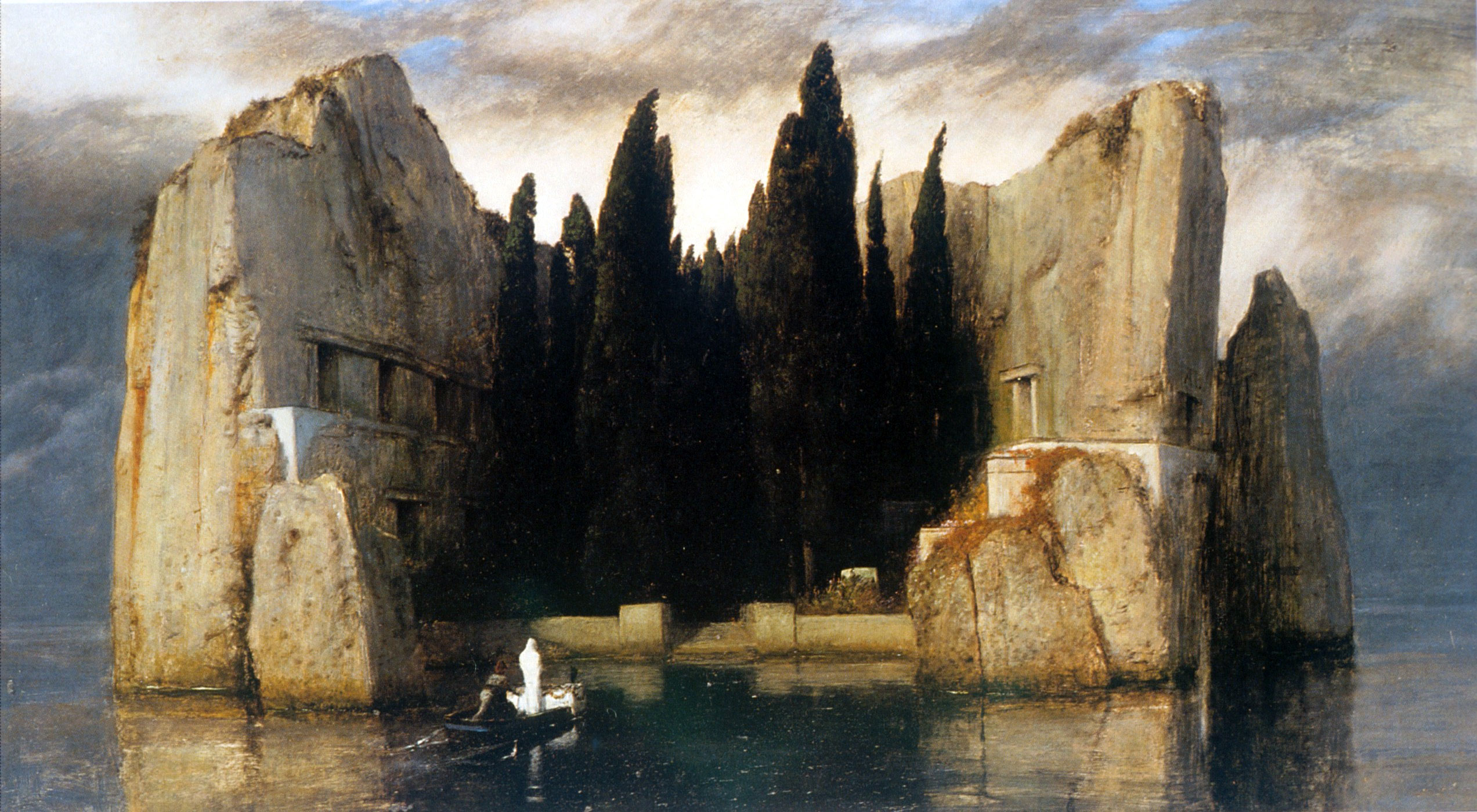
I’ll try to achieve a circular tour, but via the Russian Wikipedia, and see where that will get me. At the very top level, under the section ‘Did you know?’ appears the statement: A hundred years ago, it was a rare Berlin household that didn’t own a print of the ‘Islands of the Dead’. This was a series of paintings by the Swiss symbolist artist Arnold Böcklin, who created five variations on the theme between 1880 to 1886. In all of them, a boat approaches a small island that is riven with sharp cliffs; the boat is often assumed to be that of Charon, and the waters either of the Styx or the Acheron.
Now I can either head towards ‘Symbolism’, or ‘Charon’, or even ‘Acheron’, but instead I’ll look into the Styx – and I’ll find that it disambiguates to the legendary Greek river, a small river in Perm, a communication protocol implemented in the Inferno operating system, and also a rock band of the 1970-80s.
The rockers of the first incarnation of the Styx had four successive multiplatinum albums; I only recall with affection with one song ‘Mr Roboto’, from which – nearly 20 years ago - I learned that ‘Domo Arigato’ was Japanese for ‘Thank you’. Their song Krakatoa (1974) had a spread tone – a single note that attenuates and amplifies in loudness - that is supposed to have inspired George Lucas to create the audio logo (Deep Note) for his hi-fi cinema audio standard THX.
Krakatoa, of course, is the Indonesian supervolcano that erupted in 1883, but there’s no link to it from the Styx’s page, so I’ll go instead to George Lucas (1944- ), a famous film director who equally famously gave up any artistic integrity when he created the dismal prequels to his Star Wars trilogy. As a film technologist, however, he is incomparable: besides the audiovisual standards of the THX that I mentioned above, he is also responsible for Industrial Light and Magic, a preeminent special effects house, and Pixar, an animations studio. An interesting aside available on the Russian wiki (but not on the English version) is of Lucas’s visit to Moscow in the 1990s. He asked Russian officials to introduce him to Pavel Klushantsev, a film director. The officials, of course, had no idea who Klushantsev was. Lucas replied, ‘Klushantsev is the spiritual father of Star Wars.’ The two directors never did meet. Pavel Vladimirovich Klushantsev (1910 – 1999) was a self-taught special effects engineer who created many techniques of special effects that proved influential in cinematography worldwide, and developed an oeuvre of documentaries that blended hard science with science fiction. For example, in 1934, his film Road to the Stars had cutting-edge special effects that accurately depicted weightlessness in space, a rotating space station, and even rocket travel to the moon. Klushantsev also wrote books popularising science, and top Soviet illustrators did the drawings for them. One among them was E. V. Voishvillo who was a fairly well-known painter of marine scenes, many of which find pride of place in St Petersburg’s Museum of the World Ocean.
Here is Voishvillo’s depiction of St Nicholas, one of Peter the Great’s boats, considered the grandfather of the Russian navy; I learn that Voishvillo collaborated with A. L. Larionov in reconstructing a copy of Peter’s boat.
St Nicholas, it is often said, is also Santa Claus, but there’s no link out of Voishvillo to the bearded bearer of gifts, so all I can do is use Peter the Great as a conduit to further exploration. I find that he was a prodigious drunk, a lover of all things German, and his first official mistress, Anna Mons, was either Dutch or German herself. Sadly, there don’t appear to be any extant paintings of this famous beauty, so I’ll just put up one of Mary Hamilton, another of Peter’s lovers, whom he executed on the charge of infanticide, treason, and sundry other manifestations of his jealousy.
But back to our Anna-Margrethe von Monson! From her, we can head to things Germanic either filmographically to the German actress Ulrike Kunze (who played Anna’s role in “The Youth of Peter the Great”) or musically to Johann Sebastian Bach (who is said to have written the Brandenburg Concertos for Count Keyserling, who married Anna Mons late in his life).
As I hadn’t heard of the lovely Ulrike Kunze before, I might as well head her way. Born in Dresden in 1960, she trained in the dramatic arts, worked in Berlin and Magdeburg in various dramatic roles, and ended up in television, most recently, the series Love in Berlin.
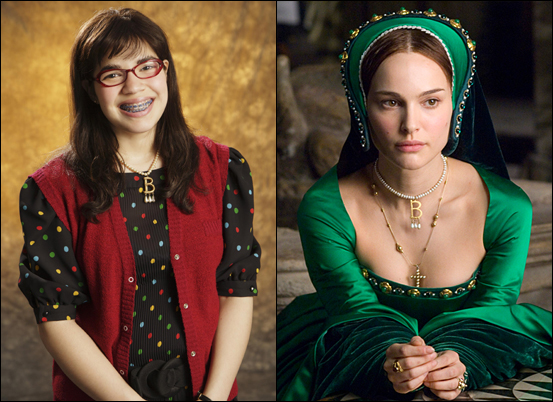
This telenovella is based on the Colombian hit series “Yo soy Betty, la fea”, which inspired, among other things, the US television series Ugly Betty. And just when you think that I’ve managed to telescope from the 18th century to the modern world (all that history was beginning to pall a bit), what do I find? The tacky ‘B’ necklace that Betty wears in the series is an exact replica of a necklace worn by Anne Boleyn.
(No post is complete without a picture of the lovely Natalie Portman: fortunately she has her own connection to Anne Boleyn, so this isn’t entirely gratuitous.)
Anyway, as someone said, you either have that bauble around the neck of a Queen, or of a girl from Queens.
Also from Queens is Steinway and Sons, makers of fortepianos and things since 1853. They were famous innovators in advertising and promotions, recruiting, for example, the great Russian pianist Anton Rubinstein (1829 – 1894), to play 215 concerts with their piano in 239 days in 1872. Thus began the Steinway Artists programme.
Anton Rubinstein was a friend of Alexander Glazunov (1865 – 1936), a composer in the Russian Romantic tradition, who composed the Symphony No. 4 and dedicated it to him.
I learn that the second movement of that symphony, the Scherzo, was inspired by Diana’s Chase, a painting, would you believe it, by Arnold Böcklin, with whom we started this Wikiramble.
Full circle, y’all!
Welcome to the twenty-fourth instalment of the Giant’s Shoulders, the monthly carnival of science and history-of-science blogging from around the planet. In this issue, there’s a bit of a preponderance of historical vignettes, which I trust you’ll find interesting.
Shall we start with a timeline of scientific discoveries, analyses and inventions? How about this – from years that end in 24 in every century? I’m missing several years, so if you’d like to fill those in, please be my guest.
I can’t think of any particular grouping in this carnival. You know, by subject and all that. It’s pretty motley. Chronological order is somewhat unsatisfying, like arranging books on your shelf in alphabetical order of title. Let us, therefore, be whimsical.
From New at LacusCurtius & Livius, we have Bill Thayer’s introduction and a link to a classic paper about how people developed effective ways to compute the heights of mountains. It’s a wide-ranging work, starting from the Ancient Greeks and working its way through Kepler and The paper is from 1929, so expect nothing on GPS in it!
Continuing with mensuration, Ethan Siegel at ScienceBlogs has a neat little piece about how to determine distances to the stars. In How Far to the Stars, he explains the principle of parallax, notes that Copernicus thought he could use it to tell distances, and then goes on to Christiaan Huygens’s idea of using luminosity to compute how far Sirius is from us.
So we are able to measure distances with excellent accuracy. But what of Heisenberg’s Uncertainty Principle? Surely it’s impossible to measure simultaneously (to arbitrary precision) both the position and the momentum of an object? This is certainly true on the scale of the truly small, but why is it not so evident on the scale of our senses? Why does quantum mechanics explain to remarkable accuracy the weird behaviour of the minute but loses that weirdness at the macroscopic? On homunculus, Philip Ball presents Big Quantum, where he talks about this explanatory lacuna in the transition between the very small and the large. It’s all due to decoherence!
For another example of the genre, we have Caroline Rance at The Quack Doctor with an interesting little piece about one type of alternative medicine – uroscopy. This is the use of urine’s colour, consistency, taste and smell as a diagnostic tool. By the 19th century, professional medics had discounted this as quackery, but common people continued to frequent piss-doctors. In Cameron the Piss-Prophet, we learn how one such worthy was hoist by his own petard.
From one aspect of quackery, we move on to another. In 1726, a woman named Mary Toft (or Tofts) was a sensation in England for having allegedly given birth to rabbits.
She had supporters and deriders in equal measure; scientists argued both in her favour (e.g. a medical doctor, John Maubray) and against (Sir Richard Manningham, a male midwife). William Hogarth’s Cunicularii at the Wellcome Library Item of the Month (besides analysing some lovely etchings by the great artist) raises a subtle question.
Leaving quackery, we ponder another form of obfuscation. Via Thony C. we have an article titled “Follies of the present day”: Scriptural Geology from 1817 to 1857 by J.M. Lynch at A Simple Prop. Who were scriptural geologists? These were scientists who tried somehow to unify vast geological time with their faith in the Bible’s six days of creation. Note that these people did not believe (pace Ussher) that the Universe was formed in 4004 BC.
Why did these Christian scientists not pay closer attention to James Hutton? In 1785, he had published an article Concerning the System of the Earth, Its Duration, and Stability in which he began the study of deep geological time. Via Thony C., we have John F. Ptak’s Raising Greatness: James Hutton’s Deep View of Time, 1795 posted at Ptak Science Books talking about Hutton’s remarkable intuition, as he saw the entirety of Earth’s history explained in the sloping red sandstone at Siccar Point.
While on the subject of deep time, a fossil of the Archaeopteryx was first discovered in 1861. Since then palaeontologists have argued whether this transitional creature (between dinosaurs and true birds) was capable of flight. Ed Yong presents First Birds Were Poor Fliers at the Discover Magazine Blog. There were some reasons to believe that the beast could fly but also good reasons why not.
Dorset Ancestors have a biography of Francis Glisson, a native of that English county, who went on to great success as a doctor in 17th century London. When he heard of a new debilitating disease among children of Dorset, he studied it carefully and concluded that this bone-deformative condition (which we know as ‘rickets’) was caused by malnutrition.
A sesquicentennial after Glisson plied his investigative mind, another Englishman began to consider the various causes of deafness in people. As a diagnostic tool, John Harrison Curtis invented the Cephaloscope, which is described in Jaipreet Virdi’s post The Cephaloscope on From the Hands of Quacks.
John Harrison Curtis also insisted that aurists – students of auditory illnesses – should also be attached to medical hospitals. Jaipreet Virdi’s related post The London Asylum for the Deaf and Dumb tells this story.
From illnesses of the body, we segue to a illness of the mind. The dreaded African disease, sleeping sickness, when in an advanced stage, often resulted in violent mania. Was this true insanity on the part of the natives, or just a manifestation of a fear of isolation in a camp? From Sleeping Sickness and Lunacy at the Colonial Psychiatry Hub, we learn that much documentation of the effects of sleeping sickness on the local population is available from the British staffers of the Colonial Office (Uganda).
This video is an overview of the life, times, and accomplishments of Antony van Leeuwenhoek (1632-1723), the Dutch scientist who used hand-made single-lens microscopes to become the first human to see protozoa, bacteria, sperm, and red blood cells, among many other things.
And although that video’s only 7 minutes long, it promises more riches to come. Can there be any more to van Leeuwenhoek, then? Indeed there can, and Thony C. presents Lego-nhoek? posted at Antoni van Leeuwenhoek Centraal.
van Leeuwenhoek, of course, was a contemporary, competitor and Royal Society colleague of that polymath Robert Hooke. I found several blogs on this brilliant Englishman, and planned to chuck them in here, but closer scrutiny revealed that at least one of those pieces was a copy of a Wikipedia article. I hope this is not a similar copy: Leland Velazquez discusses the Physics of Bungee Jumping. Hooke’s work on elasticity leading to his eponymous law is the underpinning of this extreme sport.
If Robert Hooke is around, Christopher Wren can’t be far behind. Another brilliantly multifaceted man, Wren involved himself in astronomy, mathematics, architecture, art, and – we learn from Christopher Wren and the Bees by Gene Kritsky at Wonders & Marvels – beekeeping. Why is this scientifically relevant? He also developed the transparent beehive that was suitable for the scientific observation of bee behaviour.
The bees were able to move between the various layers of the hive, and glass panels set into the structure allowed an observer to see the honey cascading down inside it. Although Wren’s construction had not been an immediate success (due to a failure to realise that bees worked downwards), it offered the prospect of an ever-increasing stock of bees and honey within the same hive. [from here]
Speaking of polymaths, there was Florence Fenwick Miller in the 19th century. She was a suffragette, a journalist, an educator, and a qualified medical doctor. From Peacay at the absolutely ravishing BibliOdyssey, we have An Atlas of Anatomy.
From Peacay at BibliOdyssey again, we have Fungis Danicis, a lovely set of illustrations of fungi studied by a Danish lawyer-turned-botanist named Theodor Holmskjold in the 18th century. This worthy actually identified over fifty new species during two years of observation in the countryside near Aarhus.
************************************************
Now for some controversy! When scientists without training in history try to develop works in the history of science, clearly feathers are ruffled. Via Thony C., we have Renaissance Art or Neuroanatomy? Part 1 and part 2, posted by Darin at PACHSmörgåsbord. It appears that there have been a series of papers over the past 20 years by various scientists trying to find hidden anatomically precise messages in Michelangelo’s art.
R. Donald Fields wrote up a guest blog at Scientific American recently that discusses the oeuvre; as it turns out, none of the scientists involved is a trained historian. As the rebuttal at PACHSmörgåsbord makes clear, this is dangerous practice:
Why does this matter? Because such articles attract the attention of editors and contributors at places like Scientific American. These contributors then post a redaction of the article on the website, where the post becomes one of the most popular. Such redactions misrepresent the history of science, suggest that anybody can write the history of science, and deny that historians of science have a discrete expertise. That’s why it matters.
But just to show that not all scientific speculation on art is ill-founded, check out this interesting bit of detective work by a bunch of astronomers at Texas State University. Via Thony C., we have a post by Roger Sinnott on Sky And Telescope titled Walt Whitman’s Meteor-Procession, we learn about the great poet’s imagery (“the strange huge meteor-procession" that went "shooting over our heads" with "its balls of unearthly light”) and an interesting astronomical phenomenon.
I’m not sure if this next piece fits within the purview of our Carnival (as it may be more aligned to sociology) but I think it relates to a seminal work of behavioural psychology, so perhaps I can present it? Christopher Greene’s Clarks’ Black-White Doll Experiment Replicated at Advances in the History of Psychology blog discusses an even more controversial subject than that in the preceding paragraph, and highlights its most recent replication under the aegis of CNN (full report here in PDF).
************************************************
On to more jolly subjects. Remember Light Amplification by the Stimulated Emission of Radiation? It is 50 years since the invention of the (optical) laser. Via Thony C., we have Happy Birthday! posted by Matt Springer at Built on Facts.
Another anniversary is that of Vannevar Bush’s visionary piece sixty-five years ago in the Atlantic Review about associative links in information, which one can easily see as an early precursor to hypertext and all that. Via gg, we have Simon Harper’s review ‘As We May Think’ at 65 from his blog Thinking Out Loud.
We end on a luminous, numinous note. What links a certain 1980s teen film, a song by John Parr, the Chinese sea-goddess Mazu, and – wait for it – ionised air? In St Elmo’s Fire, Captain Skellet of A Schooner of Science explains the whys and the hows of the gorgeous blue glow that appears on the tips of masts on sailing ships.
************************************************
[And there you have it. Thanks for stopping by. I hope this encourages you to write up your own pieces on science and its history and philosophy. Do consider submitting your blog article to the next edition of the giant's shoulders at The Dispersal of Darwin. You can use the carnival submission form. Past posts and future hosts can be found on the blog carnival index page.]
It has been a long, long time since I've seen the stars. I'm probably of the last generation of urban dwellers that recalls ever having seen the stars atwinkle in a clear night sky. And the only reason that I saw them at all was that in the late 1970s, what with load shedding in Delhi, entire swathes of the city went dark, and cloudless and unpolluted skies meant that the constellations appeared near enough to touch, and the Milky Way truly was Hera's breast milk streaking across the firmament.
Because Taurus is my zodiac, I've had a particular attachment to the stars in this constellation. The Bull squared off against Orion in an eternal battle. Mighty Aldebaran shone orange-red, fiery eye of the Bull, and the nymphly Pleiades clustered playfully. I used to wonder why all the star tales we were ever told were Greek myths. Didn't any other people ever look up at the night sky and see patterns and tell legends that mirrored their lives?
As it happens, they did, and we now have a treasure trove of stories from varied cultures around the world. Among the earliest depictions of Taurus is in the cave paintings at Lascaux, where the painted bull is depicted with a markings that might represent the Seven Sisters or the Pleiads. For the Chinese, Taurus was not a bull but a white tiger, and Aldebaran then became the eye of that tiger.
Take a look at the name Aldebaran, though. This is an Arabic word, الدبران, meaning the follower, as the star appears to follow the Pleiades. Many of the brightest stars in the sky have names that come from the Arabic - Achernar, Betelgeuse, Fomalhaut, Mizar, Algol ... - tribute to the great astronomers of the Islamic Middle-East. Aldebaran's Hindu incarnation is Rohini, the ochre-red wife of the Moon.
The Pleiades were called Kṛttikā by Indian astrologers, thought to be ruled by Agni, the Vedic fire god. Kartikeya, the warrior god, was born as six babies from the flaming seed of Shiva, and cared for by the six Kṛttikā, and merged into one infant with six faces by Parvati. For the Hindus, as for many other cultures, there were only six Pleiads; the Greeks claimed there were seven, daughters of Atlas, but one of them, Merope, was shamed into dullness for having married a mortal. They were chased by Orion and Zeus saved them by placing them in the night sky; when Orion himself was catasterised, he was set behind them, in tribute for that great chase.
There is another tale of a chase that resulted in the Pleiads: among the Kiowa of North America, it is said that seven girls went out to play, and were attacked by bears, and they ran up a rock and prayed to the spirit of the rock to save them, which it did by raising the rock to the heavens and placing the girls there as stars. The bears chased the girls onto the rock and left deep gouges on its sides as it became too steep for them to climb. That rock, they say, is the Devil's Tower, in Wyoming.
For the Mungulkabultu of Queensland, the Pleiads were the disastrous consequence of the loosening of the taboos of marrying within the clan. The king, Yunguipan, an emu man, continued to consort with Wakolo and her sister, both emu women, despite the advice and warnings of his priests. An insurrection against him resulted in various ills and chases and magics, and he and seven women found themselves entrapped in a log, and raised to the skies, where they became Aldebaran and the Pleiads. Wakolo, injured as she was in the tribulations on Earth, became the faintest of the seven stars.
Recently, I came across a Manipuri tale of the Pleiads in Medieval Indian Literature: An Anthology, edited by K. Ayyappapanicker. A 14th century poem, Khongjomnubi Nongaron, tells of six girls who went to the lake to buy fish, and met six youths who begged them to stay the night, which they did unwillingly. The next day the girls were turned out of their homes by their parents for the shame they had brought to the families; upset because they couldn't find their lovers, they climbed a lofty mountain and prayed to the Sky God Soraren to save them. He turned them into the Pleiades, and the youths who had been in pursuit of the girls were turned into stars as well. The girls and the youths were allowed to descend to earth to consummate their relationships only once a year, and their children became cicadas.
In the first few days following the announcement of this edition of the Giant's Shoulders carnival, I received a few articles that appeared to strike off completely from the subject matter of the previous edition. To wit, I hoped that I might be able to do for geophysics what The Primate Diaries had done so ably for Charles Darwin. Over the ensuing days, though, I realised that there would not be such a concentration in one topic as before, and that this carnival would end up being as motley as its readers like to see. And so we have not only geophysics, but also (as we expect) evolutionary theory, palaeontology, quantum physics, astronomy, epidemiology, and a remarkable treasure-trove of resources for the science of food.
Before Darwin could come up with On The Origin of Species, someone had to rigorously define what a 'species' is. Indeed, before Linnaeus, someone had to come up with a coherent system of biological classification. The man to do both these things was John Ray. The Renaissance Mathematicus discusses Ray's contributions in A Boy From Essex Who Made Good, pointing out that the first definition of 'species' in a strictly biological context was made by Ray, who published a magisterial study of the flora of Cambridgeshire with his student Francis Willughby. Whilst in many an account of the scientific explosion in the 17th and 18th centuries the hat is tipped towards astronomy and physics, The Renaissance Mathematicus insists that this is unfair towards the other sciences, which also advanced greatly during the period. And, he adds, in a fair world in which the history of scientific development were not defined as the history of physics [.] Ray would be acknowledged as standing on a level with Galileo or Newton, and not be regarded as some obscure biologist. [via gg]
Before he got busy usurping credit for the idea of vaccination, Edward Jenner was a keen ornithologist who took it upon himself to answer a question that had puzzled natural historians since antiquity. The Common Cuckoo had been known to be a nest parasite, that is, it would lay an egg in the nests of birds of other species; when the egg hatched, the chick would be raised by the unwitting hosts. It would be the sole survivor in that nest - all other fledglings and eggs would vanish. Who was responsible for their disappearance? That was the puzzle, and Edward Jenner was responsible for its resolution in a seminal paper published in 1788, as revealed by John in his A Historic Paper on Cuckoo Behavior posted at A DC Birding Blog. John adds that this paper was written long before Origin of Species, and the lack of a concept of natural selection is evident in several passages ... Instead, Jenner refers several times to nature's design, a concept that he does not have much elaboration.
Brian Switek has been notably prolific this past month, and so we have three paleontological contributions from him [all via gg]. First, in The Species that Domesticated Itself, he discusses Louis Leakey's attempt to identify the earliest hominid ancestor and the various blind alleys and tight spots he put himself in when he made hurried claims that this fossil or the other was exactly that ancestor. When in 1959 his wife Mary reconstructed a skull that appeared at once familiar (like an australopithecine) and alien, Leakey insisted that this was a new ancestral species that he dubbed Zinjanthropus. But dating techniques cast doubt on this conclusion. Brian adds: It seems that in Louis' view he and his team discovered our ancestors while everyone else was puttering about with evolutionary dead-ends. Once he had in mind that something was an ancestor, such as Zinj, he forcefully made the case that it was so, even if he had to abandon the very notion he had just popularized.
When a field of study is pursued in completely different ways by two camps of scientists, it shouldn't surprise us that major differences of opinion should arise between them, not only with respect to methodology but also in the conclusions and in the resulting establishment of a foundational theory. In the second of his posts featuring in this carnival, Riding the Bicycle posted at Laelaps, Brian Switek draws our attention to one such schism: geneticists in their laboratories were observing a slow-and-steady pace of evolutionary change, while palaeontologists were demonstrating that evolutionary change occurred in bursts followed by periods of stasis. Brian describes an attempt in 1980 to reconcile these two strands of science that has now come to be known as a palaeobiological synthesis, but laments that in many popular portrayals of evolution the contributions of palaeontology still take a backseat to genetics: thanks for the fossils, but don't worry so much about the theory next time. Authors seem grateful that there are fossils with transitional features to demonstrate the fact of evolution, yet evolution is still often presented as being a uniformitarian march from simple to complex.
The third piece from Brian is The Witness of the Deluge, in which he reveals how the discovery in 1725 of a supposedly humanoid skeleton was taken as definitive proof for the Biblical flood, and hence as validation by devout Christians of their faith. To the Swiss naturalist Jacob Johann Scheuchzer, the skeleton appeared to have, as Brian writes, a distinctively human appearance. The remains primarily consisted of a backbone and a semicircular skull with two eyes in it, and the fact that the remains of an antediluvian human had been discovered was so astounding that Scheuchzer described it the following year and again in his 1731 work Physica Sacra. He called it Homo diluvii testis, commonly translated as "Man, a witness of the Deluge." But, of course, it was no such thing. We'd like to say that the story proves yet again that it pays to keep one's dogmas out of one's science. But in the 18th century, naturalists were generally in agreement that terrestrial geology had been shaped by Noah's Flood. So why pillory poor Scheuchzer?
We take this opportunity to segue from palaeontology to geophysics, and what better way to do so than to learn how the California Thrasher led a biologist Joseph Grinnell to his understanding of climate change. In a three-part post at Ecographica, Johnny says that the first post introduces the idea of the 'ecological niche' and then discusses [Grinnell's] papers introducing the concept. The second post (linked at bottom of the first) details his life's work and then transitions to the third and final post in which Grinnell's research is used in modern studies.
What effect do the eccentricities of the Earth's orbit around the Sun have on its climate? I use 'eccentricity' not only in its mathematical meaning, although the elliptical orbit, as is well known, does contribute to seasonal climatic change. But this elliptical orbit rotates such that its axes shift over time; simultaneously, the Earth itself precesses; and, finally, the tilt of its axis away from the perpendicular changes in a long cycle. Together, these effects cause periodic ice-ages over 100,000 years, and these are called Milanković Cycles. The Russian science site Elementy explains the Cycles, and I took the liberty of translating the article into English at Sundry Translations and Other Tangentialia.
Next up, TonyB has a guest-post at Watts Up With That? a discussion of Little Ice Age Thermometers - History and Reliability. He reports on studies that examine the reliability of historic datasets [between 1660 and 1850] as a means for climate researchers to gaze into our past to see if there are any lessons for the present.
Moving onto Fundamental Physics now; we first present Eric Cavalcanti, in Quantum Communications, who tells us all that we need to know about the Einstein-Podolsky-Rosen paradox, non-locality and Bell's Theorem, all pillars of the foundations of quantum mechanics, in his article Can Quantum Mechanical Description of Physical Reality Be Considered Complete? He concludes The answer is still debatable, if what the question is asking is whether or not hidden variables underlying quantum phenomena really exist. But in search of an answer, EPR, Bohm and Bell have unearthed the astounding fact that our classically intuitive descriptions of a reality in which things exist independently of each other, interacting only locally to create the multiplicity of phenomena we experience, is demonstrably untenable.
Speaking of ghostly interactions and ephemerae, Jeremy's Edumacation 101 delves into the wondrous world of the neutrino in What Are Neutrinos And How Are They Detected? He points out that since the particles are electrically neutral and are not affected by strong force, the neutrinos pass through the Earth relatively unaffected. It can be said that during the daytime, solar neutrinos shine down on humanity, but during the night, these neutrinos shine up from underneath! More than fifty trillion solar neutrinos pass through the human body every second. So why are we all not totally fried? Read and find out.
While this is not really a blog-post, I'm inclined to be broadminded this festive season, and so I include a contribution from Surbhi Bhatia that explains the workings of Quantum Computers. She offers A 'Quantum' Leap posted at The Viewspaper.
Next, we have Jennifer Ouellette's Chamber of Secrets posted at Cocktail Party Physics. She points out some lovely art inspired by cloud chambers, delves into the history of these original subatomic particle detectors, and talks of the multifaceted talent of Donald Glaser. This Nobelist not only developed the bubble chamber, but, bored by the increasing automation involved in particle physics, went on to achieve great things in molecular biology and oncology; he later founded one of the earliest biotech companies,correctly foreseeing the explosion in applying the fruits of molecular biology research to industry, particularly medicine and agriculture. And when even that lost its novelty, Glaser moved into neurobiology, specifically studying the human visual system and its perception of motion and depth. Glaser also used photo-analyzing equipment he'd originally developed for his bubble chamber to identify species of bacteria via computer scanning, so he brought a bit of automation to his new field as well.
Let There Be Light! exclaims Brian Koberlein, and presents Fiat Lux posted at Upon Reflection. While the story of Isaac Newton splitting light into its constituent colours is famous, surely not everyone is au courant with all the details. For instance, Newton wasn't the first to split light with a prism. And why did the prism produce the rainbow? Brian points out that in Newton's time it was already well known that light passing through a prism would produce a spectrum of colors. It was generally thought that the color must somehow be contained within the prism glass, and when light passed through a prism it would be tinted various colors. Newton was able to clearly show this was not the case.
From Physics to Astronomy is not a massive leap, and so we can move right on to Becky Jungbauer's Truth Universally Acknowledged, which features a nice three-part write-up on Galileo, The Medici, and the Age of Astronomy. She begins Galileo Galilei wasn't just an Italian physicist, mathematician, astronomer, philosopher and heresy suspect (not to mention father of modern observational astronomy, modern physics, science, and modern science, that last one he was named by both Hawking and Einstein). He was also a friend of the Medici, the political Italian dynasty whose patronage of scientists and artists led to the Renaissance, and goes on to discuss some of the instruments that Galileo designed and developed, and sets his scientific achievements in the context of European culture in the 16th and 17th centuries.
What does a scientist do when he finds out that one of his best ideas has been independently obtained (and promoted) by another, far more famous, scientist? Dejection and frustration might prompt him to abandon his work. Or he could do as Ewan Cameron did when he found out that Linus Pauling also had the idea that Vitamin C could be help ameliorate the ravages of cancer. In spcoll's Pauling Blog we read the story of this fine researcher, who in later years recalled: Just as the idea evolved, I learned that Professor Linus Pauling had stated that vitamin C might be helpful for cancer patients. My first reaction was one of dismay, even defeat, but such a feeling did not last very long. I wrote immediately to Dr. Pauling and we have been close collaborators ever since.
Continuing to speak of disease: PalMD presents Captain of the Men of Death posted at White Coat Underground. This is a brief roundup of the history of the pneumococcus bacterium, which was known to live harmlessly in the nose and throat and only sometimes causes disease. Pneumoccocal disease was and is still a leading cause of disease and death, killing perhaps a million children per year. It causes ear and sinus infections, but also meningitis, and is the most common cause of pneumonia. In the past it was referred to as "the captain of the men of death" for its ability to claim so many.
Next up, folks, we have Greg Laden offering a comparative study on the dissonance in our minds when we encounter not-so-perfect copies of ourselves in Perfect Strangers at SEED Magazine.
And lastly, if you've ever wondered why it's better to whisk eggs in copper bowls and why milk is the best drink to kill spice, Gracie Turner is your portal to all the answers you seek in food chemistry. She presents 100 Great Videos to Learn About Food Science posted at Online Courses.org.
To conclude, I must point out that - for a limited time only! - the Royal Society (as you have all heard, I'm sure) has made freely available sixty classic papers from its Philosophical Transactions. This is part of the celebrations to commemorate its 350 years at the pinnacle of scientific endeavour. Check out the Trailblazing site, and note that at least one of the blogs in this carnival has been directly inspired by a 'classic' paper. A hat tip to the first person to identify the blog.
I have modestly given myself the name of the greatest of the Eldar: Fëanor, the maker of the Silmarils and the creator of the Tengwar. He was a Master of many things. I am merely a Jack.