JOST A MON

The idle ramblings of a Jack of some trades, Master of none

Apr 25, 2013

Maneaters

In my hunt for the art of the erstwhile Russian imperium, I came across the Georgian artist Merab Abramishvili. A painter well-versed and steeped in Oriental mysticism, paganism and medieval Christianity, he created a wide range of works seeking to synthesise their varied wisdoms. One of his very best works is the 2005 canvas called the Maneater of Kumaon. Here it is:

Maneater of Kumaon, by Merab Abramishvili. (2005).
Maneater of Kumaon is an important example of Abramishvili’s preoccupation with mystical beasts. A tiger is set against a meticulous and elaborate exotic garden. Lace-like foliage is painstakingly painted in tempera, yet smudged over with a layer of almost transparent paint, in places creating the effect of a soiled antique mural. The tiger itself appears elongated and delicate like a sublime beast that might have stepped out of an Oriental miniature. Abramishvili’s thin, meticulous brushstrokes carefully outlining the figures turn into smudges and dribbles of paint to produce the overall impression of a mirage. Gazing out into the distance the heroic tiger is so other worldly that the victim at his feet can easily pass unnoticed. Covered with streaks of red, (s)he lies lifeless and forgotten. The subdued violence of this work exemplifies the concealed qualities of the artist’s utopian visions. [1]
The Maneaters of Kumaon, of course, is a well-known book by the big-game hunter turned conservationist Jim Corbett. In a career spanning thirty years he shot several great cats that had taken a taste to human flesh in the foothills of the Himalayas. This was not the only book out of India with 'Maneater' in its title - R. K. Narayanan wrote The Man-Eater of Malgudi in 1961.

This book, though, has little to do with cats; instead, it is a humorous tale of a printer's woes on account of his acquaintance with a veritable demon of a taxidermist. Demonic man-eaters are a dime a dozen in art, too, especially in the art of gaming fantasy, as for example here:
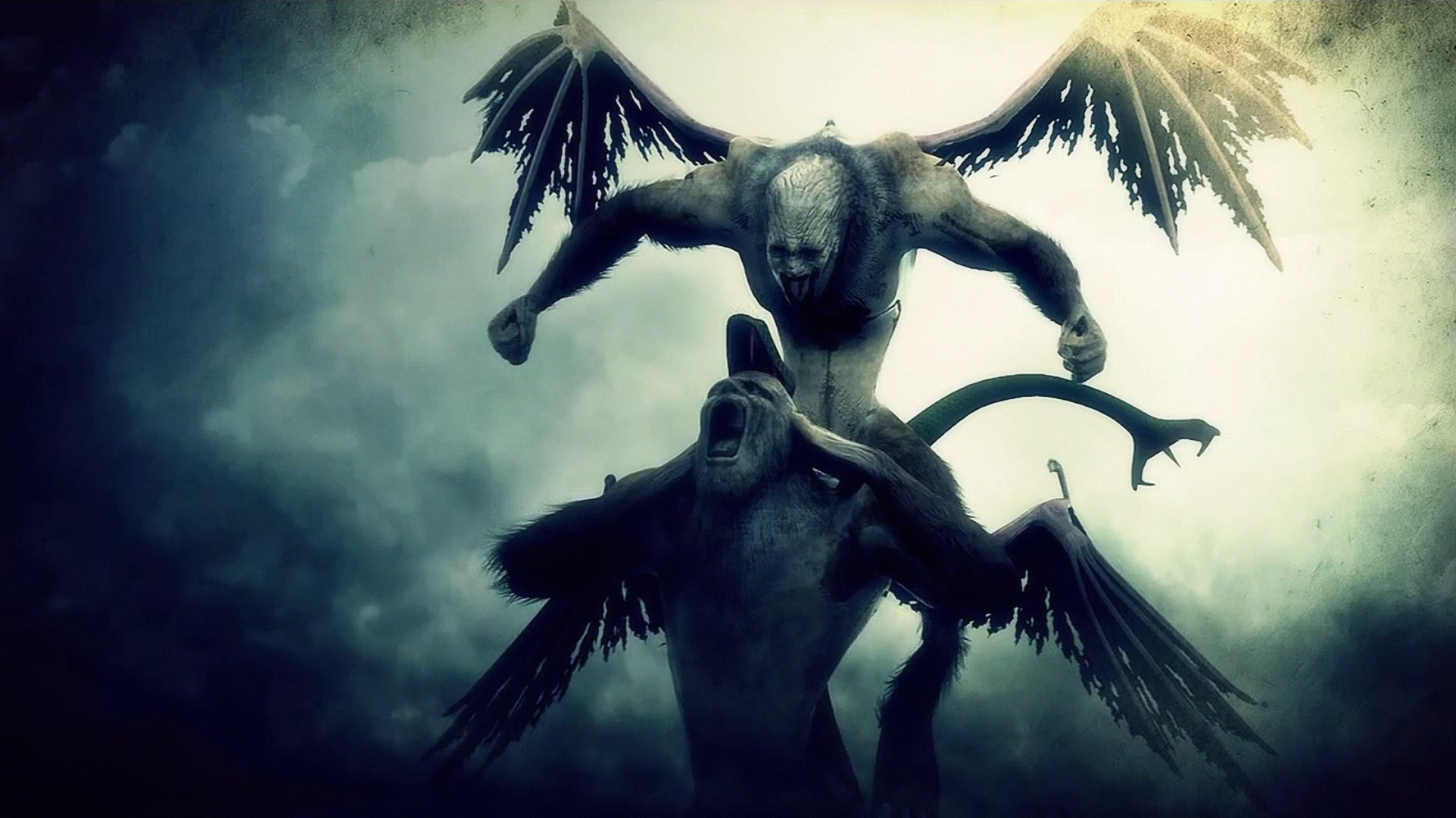
Who is this by?
A certain A. Hitler was depicted as a demonic maneater in wartime propaganda, as in this English poster (inspired by contemporary Soviet works).

MANEATER

The good thing about propaganda is that it can cut both ways. Here is a Japanese anti-Russian poster by  Hitokui Rokoku (1904), in which the Czar personifies the Russian man-eater with peoples of various nationalities swallowed and struggling in his stomach.

Russia: The Man-Eater, by Hitokui Rokoku. (1904).

At the time it was put down by Japan, Russia, like a devilish man-eater, abused severely people of all countries it had swallowed: [the devil] eats some tendon and starts sneezing, he bites some meat, but starts coughing, he pinches something and becomes itchy, he thrusts somewhere and farts. But in the end he throws up everything he has eaten. [2]

And, speaking again of Japan, Hall and Oates visited in 1982, where they performed their famous song, titled - you guessed it - 'Maneater'. Here they are:


References

  1. 'At the Crossroads: Contemporary Art from the Caucasus & Central Asia', Sotheby's exhibition catalogue notes, March 2013.
  2. Yulia Mikhailova, 'Japan and Russia: Mutual Images, 1904-39'.

Nov 26, 2012

Auctioneers

It's that time of year again when the wealth of the world pours into art in London. The auction houses, great and small, organise their biggest shows. Russian art is as big as it gets, and this week has both Sotheby's and Christie's arranging 'Important Russian Art' auctions. It's a good opportunity for those of us without the eyewatering bank balances required to purchase this art to take a look at what's on offer. 

I went to Sotheby's first. There weren't too many people around. An elderly elegant duchess accompanied by a somewhat energetic young man paced her way past the Fechins and Larionovs and Goncharovas and Sudeikins that were displayed handily on sundry walls. I followed them around as they cast their eyes over the price estimates ('half million, this one' and 'one point five, that one'). I'm happy to report that I recognised not just the names of many of the artists but also individual works. In fact, two of Zinaida Serebriakova's portraits were on sale - and I had blogged about them. 

Suddenly Lado Gudiashvili appears to be all the rage. There was a large canvas of his, all multicoloured landscape of sinuous trees and river and a damsel. One of the prize exhibits, I understand.

****

A cartoon by Annenkov was hung upside down at Sotheby's. A punter pointed it out to an attendant. Her first response was, "No, it's fine." Her next was, "Why do you say so?"

He said, "Look at the signature."

She didn't see it immediately. Then she called for someone else to take the piece down, and the two of them carried it off in considerable style.

****

I attended the Alexander Volkov exhibition at Christie's a few months ago. Wonderful stuff. Its curator, Meruyert Kaliyeva, was kind enough to invite me to their Russian Winter event. 

I thought I might see her there. The place, however, was seething with wealth, only some of which appeared interested in the art hanging on the walls. Tough-looking men, paunchy men, young jabbering men, and impossibly lanky models, nearly all Russian, milled about. Years after tall women invaded the City of London, there they were - every one of them over six feet tall and ravishingly beautiful.

The models formed an impassable barrier at the dessert table. Through occasional gaps I caught sight of macaroons and chocolate tartlets and sundry pastries. I am proud to say that I managed to snag a macaroon through a gap when one of the models inhaled.

****

Christie's lots were not different from Sotheby's - that is to say, the artists represented were pretty much the same. Fechin, Sudeikin, Goncharova, Larionov. Did I see any Vereshchagins? Maybe those were at Sotheby's. There were coy references to 'important private collection in France' and 'Kapitsa collection, Moscow'. There were lists of owners and exhibitions to establish provenance. There was also a large numbers of paintings and sketches by a Maria Iakunchikova, whom I'd never heard about. Her family was selling off her works. Given that she died aged 32 more than a century ago, she probably is not complaining too much.

****

I was waylaid by a desi dude while I peered at a Maliavin sketch. We rapidly went through the usual litany - 'Are you from?' 'Do you know?' 'Where did you study?' - and established, oddly enough, that we had no mutual acquaintances whatsoever.

He was a corporate lawyer, he said. He had no interest in Russian art, he said. He grew up in an artistic family, he added. His mother is an acknowledged expert on batik, he explained. He dismissed South-east Asian batik as plagiarism of the Indian variety. He pointed out that Manmohan Singh was recently sighted wearing a bright orange batik shirt at an ASEAN conference. Everybody's wondering what happened to our sober Prime Minister, he marvelled.


It appears that the Georgians are as argumentative as any desi. At the Royal Asiatic Society the other day, Robert Parsons, a journalist, was explaining his take on Mikhail Saakashvili's electoral loss. He said that there were several achievements to Saakashvili's credit, among which was the massive infrastructural developments in the Armenian and Azeri minority areas of Georgia.

One Georgian fellow in the audience piped up, "I'm sorry but why do you call them Armenian and Azeri? They are all Georgian citizens."

Parsons said, "Could you wait till I finish, please? You can ask me all the questions you want at that time."

The fellow said, "I am sorry, but I cannot hold back. This is not nice at all to say Armenian and Azeri."

A Georgian woman sitting next to me jumped up, and exclaimed, "Yeah, and it's not nice to interrupt when someone is speaking." 

A little while later, a red-faced dude began to rant about the appalling penal system in Georgia that incarcerated people for eight to ten years just because they had a sprig of marijuana on them or they collected fallen twigs in a forest for firewood. 

The woman jumped up and said, "This is not true. You get a penalty for possessing marijuana. Two times you get a penalty. It is as I say. I have friends who have had penalties."

The red-faced fellow said, "And I can name eight or nine friends who have been put away for years!"

Dec 18, 2010

In Russia

Laurens van der Post, Afrikaner traveller extraordinaire, tootled about Russia, and reminisced in his book Journey into Russia that all Russians seemed to eat bread as if the very eating of it gives them a kind of reassurance.
Meanwhile more and more food appeared on the table, deep bowls of mutton and potato soup, fried chicken, delicious young cucumbers cut unpeeled in slices covered with sour cream, and the fiery Georgian dish, shashlyk, wood-spiced grilled cubes of mutton, which, with that young wine fresh and innocent as the spring air outside, tasted succulent. Yet good as it all was, I noticed that my Russian companion enjoyed nothing so much as the bread, ... 
[...] 
They all ate far more bread than was necessary, and produced also a greater variety of breads than any other people I have ever known. I saw shops in the great cities where to cope with this craving they sold more than a hundred kinds of bread of every texture, from white to brown and midnight black, from snowy puffs of twist bread to poppyseed rolls and grey Minsk pistolets. But nothing ever equalled the black bread that was meal and reassurance in itself.

Feb 24, 2010

Georgians Galore

The little country of Georgia has been in the news for a variety of reasons. Most recently, their luge champion tragically died in a practice run at Vancouver's Whistler Sliding Centre. Prior to this tragedy, of course, was the brief but bitter war it fought against Russia. Meanwhile, Stalin appears to be a common object of veneration among the warring parties - both Russia and Georgia (where he was born) are in the midst of a massive rehabilitation of that mass-murderer. Like the Mongols who have reclaimed Genghis Khan, the Georgians want to believe that Stalin, possibly the most famous Georgian ever, is their one claim to greatness. A few months ago, a BBC reporter named John Sweeney (previously famous for losing his temper and yelling at Scientologists) produced a film about the adulation and celebration of Stalin in these countries. Scary stuff.

In a bid to expand its international clout, Georgia has also come up with a couple of other plans. An American teenager is competing in the ice dancing at the Winter Olympics this year for Georgia. (She is half-Japanese, which explains why her elder siblings are also in the field, competing for Japan.) Her dance partner is Georgian, and the Georgians rushed her citizenship through last month so she could compete in Vancouver. (Can't point the finger at Georgia alone, though. I guess their action is not so different from Qatar and Bahrain issuing citizenships to African athletes just so they can have a presence (and possibly a medal or two) at the Summer games.)

What has to take the cake, though, is the recent appointment of a scion of the Habsburgs as Georgia's ambassador to Germany. The ambassador, Gabriela Maria Charlotte Felicitas Elisabeth Antonia von Habsburg-Lothringen, princess Imperial and Archduchess of Austria, Princess Royal of Hungary and Bohemia, used to be an avant-garde sculptor, and having lived in Georgia since 2001, has become its citizen. A name like that, says Georgia's president, should open doors (according to the Economist).

Now tell me: Does Saakashvili have a deliciously deprecating sense of humour or not?

The Caucasus, exemplified by its mountains and the hardy folk that dwell in them, is intrinsically a schizophrenic condition. Assertions and contradictions abound in it. Famously it is supposed to divide Europe from Asia, but nobody is quite sure where it itself belongs. Its people are riven by religion, language, tribal mores, and yet they subscribe to the same sacred creed of hospitality to all guests. Blood feuds extend across countries and time. Ancient hatreds consume the present. And casting a dark shadow over it all is the humiliation and loss, and the piecemeal degradation of its character caused by the long arm of Russia.

You see some of this schizophrenia reflected in its literature. One of the most famous works to come out of the region is Ali And Nino: A Love Story by Gurban Said. It is a beautiful novel set in a romantic early 20th century Baku, and tells the ultimately tragic tale of the love of Ali Khan Shirvanshir, an Azerbaijani Muslim, and Nino, a beautiful Georgian Christian. Many commentators have called this book a wonderful evocation of the pre-revolutionary cosmopolitan Caucasus, and extolled the accuracy of the writer's observations of the customs and culture of the period. This review, written by an Azerbaijani, calls it a glimpse into the soul of his homeland. And yet, nobody knows who Gurban Said was. There's some evidence that he might have been Lev Nussimbaum, a scion of a prominent Jewish family from Baku. Others claim that Nussimbaum was a fraudster copying stories from better writers, and that the book was really penned by Yousif Chamanzaminli, a famous Azeri writer.

Fascinatingly, this tale asserts a series of stereotypes common in the region. From an Azeri perspective, Ali Khan is a hero of staggering manliness and grace. He wins the heart of the lovely princess Nino and marries her despite opposition from all sides. Nino loves Ali, but she is not blind to the problems facing an inter-faith marriage. She can see the evident hypocrisy that promises death for Ali's sister who wants to marry out of the faith. Still, she marries Ali and is then slowly sapped of vitality by the restrictions placed on her by his family. Perhaps in succumbing to the muscular Ali, Nino represents Georgia in Azeri eyes - beautiful, yes, but ultimately a push-over.

Mediating between the two is Ali's Armenian friend, Nachararyan. Initially he claims that only intermarriage between the Muslims and the Christians could sow peace between them; later, stricken by the slaughter of his compatriots by the Turks, he decides that there is no hope, and acts in a manner most perfidious towards his old friend. The calumny here is obvious - the Armenians are to the Caucasus as the Jews are to Europe: the butt of cruelty, envy and hatred. Furthermore, Armenians and Azeris are ancient enemies, and clearly the latter see the former as treacherous, no matter how many protestations of friendship they might make.

Now this may be pointing out a superficiality in the novel. After all, the warring tribes in the Caucasus had been forced into mutual accommodation by a brutal overlord, which could have led to occasional bursts of friendship and possibly even love. Still, one can't escape the feeling that they basically hate each others guts. Gurban Said may have only meant the stereotypes ironically; possibly, overall, his narrative is accurate and representative of the times. As Wendell Steavenson, a former reporter for Time, who spent two years immersing herself in Georgia, points out in her wonderful Stories I Stole, most of the details are right, but the incidents and characters are all taken from local legend, almost as if it were a guidebook in disguise. Everything is at its most obvious, almost Caucasian cliches.

For instance, Steavenson points out that Ali's name Shirvanshir arises from the Khanate of Shirvan that ruled in Baku at the time. Nino's name is the traditional Georgian one, after St. Nino. The stories recounted by Ali are all available in 19th century travel guides, especially the ones about Imam Shamil. On the other hand, there are startling errors - Nino declares herself a Greek Orthodox Christian, which coming from a Georgian is peculiar, to say the least; Ali is said to speak Tartar, whereas his language would have been Azeri, a dialect of Turkish.


None of this, of course, takes away from the lovely tale. A perfect little gem.


From Georgia and Azerbaijan, it is but a small step to Armenia, that ancient land of poetry, milk and honey. Philip Marsden's lyrical book The Crossing Place: Journey Among the Armenians describes the lives, trials, defeats and triumphs of these people, who are still scarred from their genocide in 1915, and the loss of the centre of their spirituality and faith - Mt Ararat - to the perpetrators of that slaughter, the Turks. The Armenians, like the Jews, are an ancient race. They have been scattered across the world, and like the Jews, have established for themselves an influence entirely disproportionate to their population in almost every region they inhabit. Marsden has followed their fortunes across twenty countries with a becoming empathy and grace. However, he has let his prejudice colour his descriptions of the few Turks he meet: they appear in his eyes shifty, xenophobic, disdainful. This reminds me of the old story about a traveller arriving at a new town and asking a resident what the townfolk were like. The resident wants to know how the traveller found the people in the previous town. "Oh, they were wonderful", gushes the traveller. "Welcoming and friendly, honest and open." The resident tells him he would find this town pretty much the same. A while later, another traveller appears and asks the same resident what the townspeople are like.


"What were the people like in the last town you were in?" asks the resident.


"Oh, they were a bunch of crooks, inhospitable and cruel", says the traveller.


"Well", says the resident. "You'll find the people in this town are more or less the same."


To correct this perspective of the Turks, the mightiest among the Caucasians, read the superb Sons of the Conquerors: The Rise of the Turkic World, by Hugh Pope. Whereas only the north-eastern part of Turkey is properly in the Caucasus, the Turks and their linguistic cousins extend in a swathe across the region all the way to China. This lends them a vast influence both in geographical as well as historical terms. After all, some of the most glorious names in history are of the Turks.


After centuries of subjugating their neighbours, the Turks fell into a long weakness that lasted well into recent times. These days, however, they are resurgent again and exporting their influence far and wide, from Kazakhstan to Xinjiang. Part of this resurgence means that weaker nations are put down again. Notable among them are those who have no friends other than the mountains - the Kurds.


After Such Knowledge, What Forgiveness?: My Encounters With Kurdistan by Jonathan C. Randal is a moving study of the Kurdish question. The litany of betrayals and hurts faced by these redoubtable people is heart-breaking. Somehow they have struggled on and survived, and to this day, have a large share of the populations of Turkey, Iran, Syria, and Iraq. Expectedly, they are mistrusted and resented, and any attempt at autonomy is immediately quashed. The one high point in their history seems to have been Saladin, peerless in chivalry, conqueror of Jerusalem. But even he abandoned his Kurdishness as he settled into his sultanate. Since then, they have been assailed and scattered by greater powers, their identity denied and their culture whitewashed from history. Sadly, as with many other subjugated nations, when outsiders are not messing with them, there's internecine violence and factional strife to keep up the body count. (This book, published in 1993, is not current, meaning that the small uplift in fortunes of the Kurds (at least of those in Iraq) after the fall of Saddam Hussein has not been mentioned.)


Finally, Yo'av Karny's Highlanders: A Journey to the Caucasus in Quest of Memory concentrates on the Chechens, Ingush, Dagestanis, Abkhaz, and other peoples racked by centuries of occupation, discord and pride, and fierce feuds, and also contains a perceptive commentary on the bigger nations, all of whom demonstrate an astounding perseverance, a dogged sense of pride, irrational pursuits of liberty. As in the Balkans, imagined or real slights centuries past continue to polarise the people in the Caucasus today. As economic units, the smaller tribes are unviable, but that doesn't prevent their constant struggle for independence (or, more usually, domination of their neighbours); tragically, during any short period of autonomy, they squander it in factional strife and corruption. Long memories of blood feuds persist, but nobody remembers those wasted opportunities. This remains the tragedy of the Caucasus today.