‘Turtle, Fish, Venison of the best quality’ washed down with ‘Champagne, Hock, Burgundy, and Claret’ as well as ‘Vin de France and Hermitage drunk in copious libations.’
We look, we inhale, we draw in our mouthful: we chew, we think. It is a slow process… utterly absorbing and near an ordeal — the raw tannin puckers the inside of the cheeks, rasps the throat like claws, while at the kernel one finds a notion of… what? Texture, structure, multiplicities of scents…
And what wine it was! The first drop was like blistering viscid resin. Sweet and thick lava flowed down my throat, its stream ran further, washing off all my insides. It was as if I saw myself from inside, felt my every cell - just like I did in the morning and ... I lost feeling in my legs. It was as if a butterfly-swallowtail was trying to open its glued wings inside my chest. The thick liquid had the taste of time - the bitterness of twenty-year-old dust ingrained into the glass of the bottle, the roughness of the wild berries that died long ago, and the sweetness of yellow sugar (of the kind that no longer can be found!). And also - a particular aroma of some kind of unknown potion. My lips nestled eagerly on the mug, and I tore myself away only when they had turned black and when whiteness glimmered on the bottom.
In particular:
Le Duc de Bordeaux ne boit qu' du Bourgogne, Mais l' Duc de Bourgogne, lui, ne boit que de l'eau; Ils ont aussitôt échangé sans vergogne Un verr' de Bourgogne contr' le port de Bordeaux.
A song of good cheer (chanter le vin) from Burgundy. Drink wine and be merry.
The Duke of Bordeaux drinks only Bourgogne But the Duke of Bourgogne he drinks water alone so neither felt shame when they sought to exchange a glass of Bourgogne for the port of Bordeaux.
(From Norman Davies, Vanished Kingdoms: The History of Half-Forgotten Europe, page 108.)
Between them, over the course of the evening, they ate servings of duck foie gras with a peach wine jelly, Scottish scallops, ham, deboned saddle of lamb from the Auvergne, white beans with truffles, sea bream, poached apricots, bay leaf panacotta, cheeses and chocolates. They drank champagne, a house white wine, Rothschild Bordeaux, Chateau Villefranche dessert wine; he an espresso and she a cup of rooibos tea. There were also almonds and Christmas pudding with brandy sauce from the Ritz in London.
You're still suffering from Marisa's death. Pain has the virtue of making people deeper beings. Suffering makes the good guys more compassionate, more noble; it makes the bad guys worse, more perverse, more wicked. So what can I do about it? Just stay calm. Trying to resist will only make it worse. In time it will pass. Right now I've got a lovely bottle of red waiting to be drunk and a pork loin stuffed with pineapple cooking in the oven, which it would be plain stupid to eat on my own. You fancy tackling it with me? Did you wash your hands after work? Are you crazy? That's where the extra flavour comes from.
... He sliced the little sardine bodies lengthwise with his pocket-knife, speared a half, spread it over a scrap of bread, and shoved the bite into his mouth. As he chewed, the tender, oil-drenched fish flesh blended with the insipid pitta bread into a delicious lump. It lacked perhaps a few drops of lemon, he thought - but this came very close to frivolous gourmandising, for after each bite, as he took a small swallow of red wine from the bottle, let it run across his tongue and shifted it between his teeth, the steely aftertaste of the fish blended with the lively, acidic bouquet of the wine in such a convincing fashion that Jonathan was certain he had never dined better in all his life than at that very moment. The can held four sardines - that made eight bites, chewed deliberately with the bread, and eight swallows of the wine to go with them. He ate very slowly. He had once read in a magazine that eating hurriedly, especially when you were very hungry, was not healthy and could lead to digestive problems, even to nausea and vomiting. He also ate slowly because he believed this meal to be his last.
They'd chosen house specials: salmon with a bouquet of enoki mushrooms for her, lobster in beurre blanc for him, after sharing a cold foie gras with a garnish of beluga caviar. A Muscadet accompanied the meal, inexpensive and unambitious. Mac Smith had had enough of complexity and ambition for one day.
Now, with coffee in front of them, they sat back in their heavy armchairs and looked at each other.
"I am disappointed, you know," she said.
Here's an oenological excerpt from his masterpiece of travel-writing, Barbarian in the Garden. He is in Orvieto:
On the menu I find a wine named after the town. The padrone praises it more loudly than the cathedral... It is more difficult to describe the wine than the cathedral. It is the color of straw and has a strong, elusive aroma. The first sip is rather unimpressive. The effect starts after a moment. The well-like chill flows down, freezing the intestines and heart while the head begins to blaze... The sensation is enchanting.From Ewa Hryniewicz-Yarbrough's review of the book, here.
I've been invited to Kloster Eberbach, the location for The Name of the Rose and the largest wine estate in Germany. It's a monastery whose wine-making tradition dates back to the 17th century. Even Bismarck bought wine here. Bond and Bismarck, there can't be many places that can make claim to those visitors.
...
So tell me about this building - this is an extraordinary space.
We're here in the hospital of the Kloster Eberbach, it's the oldest Gothic building in Germany, it was built in the year 1220. So it's really a true old building.
How long has wine been stored here?
Well, after the Thirty Years' War, in 1635, the monks started making wine here, in this cellar, because wine has become very important for the monastery.
...
So let's start with the dry Riesling from the year 2008, from the Baiken vineyard.
Mmm...That's delicious.
It's fruity, it's dry, crisp, it's elegant.
Yeah. Mmm. It's very, um, quaffable, I think that's the word. Yeah, very nice, yeah. Mmm. Oh, I could do this all day... Well, you do!
Well, someone's got to do it, someone's got to do it.
The next wine, perhaps, is a Pinot Noir, from our single vineyard, the Hollenberg vineyard, which is our most precious single vineyard for Pinot Noir.
Now I have drunk more than my fair share of Pinor Noir, but never a German one, so, umm... I'm not supposed to really guzzle it.
It's a good sign.
It's a good sign. Um, going back in time...
Last, but not least, the year 1959, a very special year, a very very special vintage...
[This was the 800 euro bottle I was waiting for.]
The colour's incredible.
Yeah, that's very typical. So, 51 years old.
Yes, I could drink that all day long.
Well, if you can afford. It's very pricey.
Bloken was in tears when D-Section left White City without him...Bloken blamed his amulets for failing him. He now realised the charms had let him down because when he acquired them in Gboko, his home town in Tivland, he had gone to the snake-oil pedlar instead of going to the Great Priest whose charms cost a whopping sixpence more. It wasn't because Bloken was a miser; on the day he bought the charms he'd been drunk on sweet palm wine, and on a potent home-brewed gin which was called Push-Me-I-Push-You because a man drunk on it entered a dizzying state in which he thought he was walking forward and backward and upward and downward and to the left and to the right all at the same time when in fact he was simply swaying in one spot.
He'd had several gallons of Burukutu, a vinegary malt beer made from fermented millet.
Then he'd moved on to Pito, a glorious chaser which was no chaser at all. Pito, like the wonderful Burukutu, was a hallucinogenic cider made from maize and millet but fermented for only half the time.
He'd topped up by smoking wee-wee, a fragrant medicinal herb derived from the dried flowers of top-grade, non-industrial Gboko hemp.
It was a mind-bending cocktail which always had the curious effect of making Bloken break bottles on his bald head just to show how tough he was.
It was almost eight o'clock and her hunger was sharp. In her imagination, she could already see the scrumptious dishes Krister was preparing. Since they had been together when he had bought the ingredients, she knew what was on the menu. The appetizer was going to be baked goat cheese encrusted in honey, served on a bed of basil on a slice of bread. The main course was grilled cod, vegetables in wine sauce stir-fried in a wok, and home-fried potatoes. The dessert was Irene's favourite: chocolate mousse. Not exactly food for weight-watchers, but incredibly good. The wine was from South Africa and was called, oddly enough, Something Else. Intriguing, because they hadn't had it before.
[...]
"Sweetheart," Krister said, "this wine is far too light and dry. Shall I go to the wine cellar and get a Drosty-Hof instead?"
Irene thought the wine they had had was good, but Krister was the expert; if he said they should drink the other wine, then it would be probably be better.
Krister went to the laundry room and opened the top cabinet of the closet next to the drying cabinet. An almost-empty bottle of Famous Grouse was there, along with two bottles of Drosty-Hof white wine and a small Bristol cream purchased on their last short vacation to Skagen because the blue bottle looked so nice.
Mabile was not displeased with herself. Agnès de Souarcy had expressed her wish to thank the good chaplain and the servant had prepared a proper feast - a six-course meal, no less. Following an hors d'oeuvre of fresh fruit, whose acidity was supposed to act as an aid to digestion, there was a broth made of almond milk. For th third course the servant had plumped for roasted quail spiced with a black pepper sauce. That insufferable Agnès de Souarcy was such a sickler for table manners that the baby fowl should keep her busy for a while...
...She must hurry. The quail would not keep them busy forever. She should be back in the kitchen helping Adeline serve the desserts: a traditional goat's milk blancmange followed by black nougat made from boiling honey and adding last year's walnuts and spices. To round off the meal she had prepared some hippocras, a mixture of red and white wine sweetened with honey and spiced with cinnamon and ginger.
The windows of the bácari offer you halved boiled eggs, rolled anchovies, crabs' claws, olives all'Ascolana, rice arancini, polpettini, stewed saltimbocca, nervetti (pork or beef tendon), fried sardines, masanete (small crabs), folpi (small octopus), creamed cod, onions, coppa di toro (bull salami), wild boar ham, squares of mortadella, cubes of dressed mozzarella, parallelepipeds of gorgonzola. These are all, of course, washed down with an ombra, a glass of wine that was once tapped straight from the barrel behind the bar.
It isn't clear where the 'technical term' ombra (shadow) comes from: and that's as it should be, even its etymology should remain in darkness. At the most banal level, ombra might designate the misty translucency of the wine. But it's more likely that it refers to the open-air wine stalls in the summer, in the shade of the campanili, where people sheltered from the heat by drinking a glass of chilled wine. 'Andiamo a prendere un'ombra - Let's go and take the shade,' was a kind of wink, implying: 'Let's go where the drinking's done.'
Meanwhile more and more food appeared on the table, deep bowls of mutton and potato soup, fried chicken, delicious young cucumbers cut unpeeled in slices covered with sour cream, and the fiery Georgian dish, shashlyk, wood-spiced grilled cubes of mutton, which, with that young wine fresh and innocent as the spring air outside, tasted succulent. Yet good as it all was, I noticed that my Russian companion enjoyed nothing so much as the bread, ...
[...]
They all ate far more bread than was necessary, and produced also a greater variety of breads than any other people I have ever known. I saw shops in the great cities where to cope with this craving they sold more than a hundred kinds of bread of every texture, from white to brown and midnight black, from snowy puffs of twist bread to poppyseed rolls and grey Minsk pistolets. But nothing ever equalled the black bread that was meal and reassurance in itself.
For one such bacchanalian expedition, the cellarer at Monplaisir brought out 11 flasks of 'Her Majesty's sweet wine' (Hungarian Tokay), 21 bottles of her favourite English beer, 12 bottles of fortified wine, 1 bottle of the 'new sweet wine', 17 bottles of Burgundy, 16 bottles of champagne, 53 bottles of Rhine wine, 6 flasks of Gdansk vodka, 2 flasks of aniseed-flavour vodka, half a flask of lemon vodka and 2 phials of mustard.
A French-speaking cousin of mine, who has pronounced herself a wine connoisseur, always starts by asking for a large wine glass with a stem. She pours wine into it, commenting on the colour in the process, then swirls the glass slowly in her hand, puts her redesigned nose into it, moistens her gums, keeps the wine in her mouth for a moment with half-closed eyes, and eventually - watched in fascination by everyone else - delivers her peremptory and definitive opinion. Every time she goes to Paris she makes a point of learning by heart the vintage and price of a few famous wines so she can bewitch her entourage (and these are people who serve wine in Coke bottles) by quoting endless lists of enchanting mythical names such as Romanée-Conti 1929 or Mouton-Rothschild 1982, oh, if you only knew...
five layers of honeyed bread, honey and flour cakes piled a foot high, rice soup, pickled relish, soy, rice wine superior in aroma and flavour to Chinese millet wine, beef, mutton, pork, walnuts, dates, mutton sausages, fish, and lotus roots to sweeten the breath.
In the BBC series The Trip (directed by Michael Winterbottom – how about that?), Steve Coogan and Rob Brydon potter about the North of England, taking in the scenery, discussing life, and eating at some of the finest restaurants of the region. In Cartmel, they partake of the tasting menu at L’Enclume, where a French waiter describes to them each dish they have:
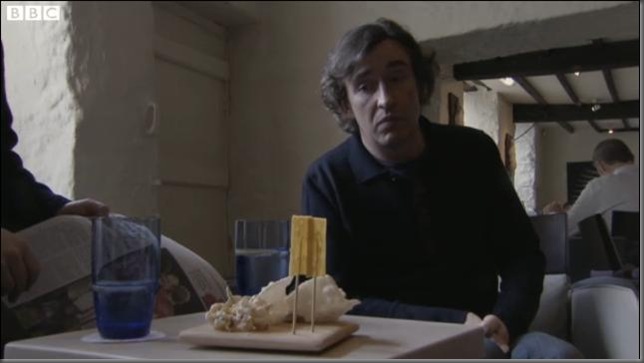
There we have some little canapés to begin with. A little duet of tapioca-based crackers, spiced popcorns and the lollipops are made out of duck fat with peanuts.
There we are gentlemens. To begin with we have a nice little appetiser. We have liquor made out of mallow leaves, topped with a fizz which is made out of ginger beer, whiskey, as well as chilli.
It’s a Cote du Rhone Guigal winemaker 2006, will be a blend of Viognier, Roussane and Marsanne, a fresh, floral and rounded, and you will find a nice crisp finish as well.
There we are, gentlemens, at the bottom of those little sacks we got some diced smoked kale as well as shredded radishes, covered with very smooth duck foie gras mousse.
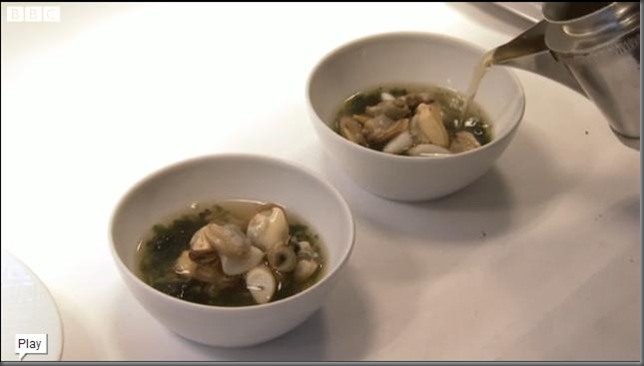
There we are gentlemens. Your next course is what we call the Humphries Pool. It’s a shellfish broth made out of mussels, clams, cockles which are cooked in their own juices, before to be garnished with a shred of local seaweed.
So what we have at the base of the dish, we got a goat cheese mousse and globe artichoke puree, and is garnished with deep-fried globe artichoke leaves, as well as baby Jerusalem artichoke.
It’s a cold dish this one, you’ve got some Manx queenies, which are baby queen scallops. They are resting on griddled baby gem and parsley coulis as well as a light creamy horseradish sauce.
To follow with that, a red, which is from France, Loire Valley which is in the northwest of France, Cabernet from grape, 100%, light fruity easy to follow.
Here is your next dish, gentlemen, which is a cut of the skate, pan-seared, served with a little langoustine, which are resting on a base of cauliflower puree and some baby celery stems.
I have a Pippin apple sorbet, served with a apple cake and butterscotch powder, and a roasted quince.
Links
About Me
Categories-
- advertising (10)
- afghanistan (2)
- africa (9)
- algeria (2)
- alphabet (1)
- andorra (1)
- anglo-indians (3)
- apple (2)
- arabs (9)
- archaeology (7)
- architecture (23)
- argentina (6)
- armenia (3)
- art (94)
- astronomy (14)
- australia (6)
- austria (5)
- automobile (3)
- beer (5)
- behaviour (12)
- belgium (9)
- bengal (7)
- berlin (1)
- biography (45)
- birthdays (7)
- blogs (42)
- bolivia (1)
- book (1)
- books (398)
- bosnia (1)
- botswana (2)
- brazil (7)
- bridges (14)
- burma (4)
- business (45)
- cambodia (1)
- campanology (2)
- canada (8)
- caucasus (5)
- chechnya (3)
- cheese (4)
- chemistry (6)
- child abuse (3)
- chile (2)
- china (26)
- chocolate (2)
- climate (8)
- cocktail (5)
- coffee (5)
- colombia (3)
- computing (10)
- conference (5)
- congo (2)
- côte d'ivoire (2)
- credit (1)
- cricket (2)
- crime (1)
- cuba (4)
- culture (21)
- cyprus (1)
- czech (4)
- delhi (3)
- denmark (5)
- economics (16)
- edinburgh (3)
- education (15)
- egypt (13)
- england (143)
- environment (4)
- epidemiology (5)
- eritrea (1)
- espionage (2)
- estonia (3)
- etymology (5)
- evolution (8)
- exhibitions (7)
- family (77)
- fashion (8)
- film (39)
- finance (33)
- finland (2)
- folk tales (2)
- fonts (5)
- food (234)
- france (99)
- fraud (7)
- friends (12)
- fruit (3)
- gaming (10)
- genetics (2)
- geodesy (2)
- georgia (6)
- germany (54)
- ghana (3)
- greece (25)
- guatemala (1)
- health (9)
- hindi (4)
- history (219)
- holland (4)
- humour (63)
- hungary (8)
- iceland (2)
- ICM (10)
- IISc (13)
- IKEA (1)
- india (139)
- indonesia (5)
- inquisition (1)
- internet (18)
- iPod (2)
- iran (10)
- ireland (4)
- israel (8)
- italy (74)
- jamaica (1)
- japan (16)
- jordan (1)
- kazakhstan (1)
- kenya (1)
- kerala (6)
- kidnapping (1)
- korea (5)
- kurds (4)
- language (78)
- lebanon (2)
- life (127)
- london (98)
- low-cost airlines (2)
- malaysia (2)
- mali (2)
- manipur (2)
- maps (3)
- mathematics (70)
- mauritius (1)
- medicine (13)
- memory (1)
- mexico (15)
- mobile phone (2)
- mongolia (2)
- morocco (7)
- moscow (5)
- music (61)
- myth (16)
- names (4)
- nepal (1)
- netherlands (9)
- networking (3)
- neuroscience (1)
- new zealand (2)
- newspapers (15)
- nigeria (2)
- norway (7)
- oranges (2)
- pakistan (4)
- palestine (1)
- paris (6)
- parsis (4)
- persia (10)
- peru (2)
- philippines (1)
- photography (33)
- physics (18)
- poetry (66)
- poland (9)
- politics (28)
- polynesia (1)
- portugal (4)
- psychology (7)
- pubs (3)
- quiz (8)
- race (7)
- religion (73)
- risk (4)
- roaring twenties (5)
- robotics (1)
- romania (4)
- rome (9)
- russia (77)
- samsung (1)
- saudi arabia (2)
- science (68)
- scotland (26)
- search (1)
- serbia (2)
- sex (25)
- singapore (4)
- society (73)
- south africa (4)
- spain (42)
- sports (17)
- sri lanka (1)
- St. Stephen's (9)
- suicide (1)
- surreal (2)
- sweden (12)
- switzerland (8)
- syria (3)
- tahiti (1)
- taiwan (1)
- tajikistan (2)
- tamil (2)
- tata (3)
- tea (3)
- technology (16)
- television (16)
- thailand (6)
- thames (9)
- theatre (4)
- tibet (1)
- tolkien (2)
- trade (6)
- translation (23)
- travel (135)
- tunisia (1)
- turkey (22)
- typesetting (6)
- uganda (1)
- ukraine (4)
- uruguay (1)
- USA (87)
- uzbekistan (3)
- venezuela (2)
- vietnam (3)
- visa (1)
- vodka (4)
- wales (5)
- walks (20)
- war (23)
- web (2)
- west indies (3)
- whisky (3)
- wine (23)
- wodehouse (6)
- work (24)
- yemen (2)
- york (1)
- zambia (1)
- zimbabwe (1)
- zoroastrianism (4)