JOST A MON

The idle ramblings of a Jack of some trades, Master of none

May 19, 2017

Muhi al-Din Lari

I came across a reference to Muhi al-Din Lari in Ziauddin Sardar's magisterial Mecca: The Sacred City. Lari was supposed to be a hugely influential miniaturist, famous for his 16th century pilgrimage guide to the holy cities of Mecca and Medina, the Kitab Futuh al-Haramayn. The book, written in mystical and ecstatic Persian prose and illustrated by Lari, was produced in various editions - in Mecca, Turkey, Persia and India. Its depiction of the Sacred Mosque became the de facto standard for imagery of the Kaaba for centuries thereafter.

Sardar called Lari an Indian painter. He also said that very little is known about the man's life. He is supposed to have died around 1526, but I've also seen 1521 as a possible year of death. A brief bit of rummaging about the internet located a book that said Lari was Persian, though his chief work, the pilgrim's guide (written about 1505 or so), had been dedicated to the sultan of Gujarat. I suppose this is possible - Lari might refer to a person from the Iranian town of Lan, not far from Shiraz. Indeed, another book said he was a student of a famous Persian scholar who did indeed travel to Lar. On the other hand, there is a Lar in Uttar Pradesh too.

In the early 1500s, a famous artist would have had a selection of patrons to choose from - the Lodis in Delhi, the Bengal sultanate, even the Bahmanis in the Deccan, besides the rulers of Gujarat. What would prompt a painter from North India to seek the favour of a Gujarati sultan? It's still possible, of course, that Lari was, indeed, Iranian. His teacher wanted to move to India in search of cultural patronage, and it's possible that he either accompanied his teacher, or that he was inspired by the idea to seek the patronage of a Western Indian king.

I'd be interested to learn how Sardar determined that Lari was Indian. Where was he born? Where did he live? When did he go on his pilgrimage? What are the other works he created? How is it known when he died? Perhaps there are still myriads of Persian manuscripts that haven't been translated which might tell us more about this early polymath.

(At any rate, I have drafted an article with as much information as I could find and put it on Wikipedia's sandbox. If I can find a couple more citations and add a bit more to the piece, I might be happy enough to post it as an article.)

Continuing the round-up of 2016: three more non-fiction titles that were well worth my time.

Elizabeth Pisani is a multitalented woman - journalist, health-worker, linguist. If you look past the arrogance of her wanting to 'introduce' Indonesia to the world (a phrase she has repeated in her preface and several interviews) and the irritating comparison of the country to an old flame, her Indonesia etc.: Exploring the Improbable Nation is a comprehensive account of the lives and times of the fourth most populous country in the world. While the general tourist will likely visit a city or two in Java and Bali, Pisani travels across the archipelago, living with subsistence farmers, fishermen, smugglers, the nouveau riche, the up and coming politicos, the religious fanatics, and the indigent. Many times, the story is ostensibly repetitious - she arrives at an island, discovers a quirk of the local society, meets the bottom and the top of local society - and after a while, every island seems to blend into every other. But the people are affectionately described, and combining sociology with a thorough exposition of modern Indonesian history and political economy, this becomes overall a fine book.

Helena Attlee runs horticultural tours in Italy, and when she's not popping in and out of some of the finest gardens in the country, she studies the citrus fruit, and she writes absolutely riveting books, such as The Land Where Lemons Grow: The Story of Italy and its Citrus Fruit. Weaving history and botany, architecture and landscape design and scrumptious foods, the book ranges across the peninsula and explores oranges, lemons and every citrus in between. (The blood orange is my own particular favourite, and her account of the groves beneath Etna made me want to hurry over and retire there immediately.)

Finally, we have Margalit Fox's Riddle of the Labyrinth: The Quest to Crack an Ancient Code and the Uncovering of a Lost Civilisation, an excellent guide to the people behind the decipherment of Linear B, the ancient Minoan script. She is as good at the technical details of the decipherment as at the personages involved. In particular, she puts to the forefront the lesser-known Alice Kober who provided most of the impetus for the cracking of the code, though it was the ultimately tragic Michael Ventris, a self-taught decipherer, who managed the breakthrough. The tablets he read weren't stirring tales of kings but rather palace accounts; still, the thrill of the chase and the frustration of the dead-ends are well worth the time spent on the book.

Jan 3, 2017

Hussar Blowout

Before the Hussars even got to Waterloo, one of their chiefs, the 2nd Earl of Uxbridge, put down riots in London by hungry people protesting the Corn Laws. In their spare time between engagements, what did the Hussars do? They consumed:
‘Turtle, Fish, Venison of the best quality’ washed down with ‘Champagne, Hock, Burgundy, and Claret’ as well as ‘Vin de France and Hermitage drunk in copious libations.’

Nov 15, 2016

Liddles

My good friend Guru mentioned Swapna Liddle and I sat up.

Do you know she organises heritage walks in Delhi? he said.

She was our senior at College, he added.

I've heard the name, I said, but only because I read Madhulika Liddle's blog.

Sister? he said.

Quite possibly, I said.

Small world, he said.

****

When we were at Khan Market, we stopped to look at books at Faqirchand and Sons. A genial proprietor sat behind the desk at the entrance.

Do you have Madhulika Liddle's The Englishman's Cameo? I said.

Madhulika Liddle, Madhulika Liddle, he muttered and scratched his chin.

Book came out a few years ago, no? he said.

I nodded.

Oye, Suresh, he called. (Or Chotu. Or possibly Desai.) An assistant looked up.

Do you remember Madhulika Liddle? he said.

Suresh shook his head.

Sure you do, urged the proprietor. She gave a talk here. Just a few years ago.

Chotu shook his head again.

Yaar, history type book, prompted the proprietor.

Desai went back to his shelving.

Romance, no? the proprietor said to me.

Historical crime fiction, I said.

Yes, I remember, he said.

He looked into the distance.

So, do you have the book? I said.

No, he said.

So, 2015 is over. This was the year my blogging ground to a halt, my habits became even more sedentary, my achievements negligible, and my travels were to Orlando, for heaven's sake. Another year like that and I might as well throw in a nearby towel and take up life on some bend in a river, pondering the existence of fish.

To be honest, this year is not off on the thumpingest of starts. My washing machine conked out and the delivery guys of a new one couldn't install it. My patience with incompetence is also thinning. I've been lugging heaps of apparel to a laundrette and obtaining a renewed appreciation for subcontinental people who breaks stones with clothes. At the same time, various neighbours and municipal councillors have been casting beady eyes on a bit of renovation we're planning. I have half a mind to invite some illegals to occupy the jungly garden at the back and encourage them to throw nightly parties just to keep the neighbours bright and interested.

******

The reading was down on the previous three years. I managed 118 books. In this I'm way behind that powerhouse, M. Orthofer, doyen of the Complete Review, who polishes off probably three hundred books a year and manages to review ⅔ of them.

Some books were brilliant and others were absolute dogs. This is no news.

But here are some stats to start off:

Fiction - 80%
Women authors - 30%
Translations - 43%
Countries (non-English) - 14
Languages other than English - 25

My first Basque translation, I think, and my first book by an Eritrean author. And my first Dogri and Rajasthani translations.

LanguageCount
French6
German4
Italian4
Russian4
Spanish4
Arabic3
Portuguese3
Finnish2
Hebrew2
Polish2
Swedish2
Assamese1
Basque1
Catalan1
Czech1
Dogri1
Dutch1
Gujarati1
Korean1
Oriya1
Rajasthani1
Slovenian1
Turkish1
Urdu1
*******

For a quick roundup of recommended titles, I start with non-fiction.

Catherine Merridale, Red Fortress: The Secret Heart of Russia's History: a riveting account of the Moscow Kremlin, from its earliest to latest incarnations, and the worrisomely brutal types that lived in it, destroyed it, refashioned it, and bent it to their own interpretations of history.

Caleb Scharf, The Copernicus Complex: The Quest for Our Cosmic (In)Significance: what an incredible repositioning of the human experience bang into the centre of the Universe! One of the biggest advances of science has been the demotion of humanity and the Earth from their egocentric position in the cosmos and the realisation that in almost every respect and at every scale of the Universe, we are negligible and not special. But Scharf reveals the latest thinking in cosmology and quantum physics that shows this 'Copernican' principle needs to be modified in the light of all sorts of special events that should have taken place for the Universe to be as it is, for the solar system to have developed, and for our remarkable appearance at a particular juncture in time when we can actually learn something of the Universe. Superb.

Mariusz Szczygieł, Gottland : Mostly True Stories from Half of Czechoslovakia: Indians would no doubt fondly recall Bata, that ever-present purveyor of shoes. The story of his ruthless rise to power is well told in this Polish author's superb collection of essays (translated by Antonia Lloyd-Jones) on lesser-known aspects of Czechoslovakia's Communist and capitalist avatars. As a fellow Iron Curtain survivor, his insights into the paranoia and delusions of the Czechs are sympathetic, accurate and mordant.

Jan Zalasiewicz and Mark Williams, Ocean Worlds: The story of seas on Earth and other planets: a wonderful, detailed and erudite study of what water means for a planet, how it gets there, what happens to it, how it escapes it, and - the atmosphere! plate tectonics! evolution! life! extraterrestrial worlds! It's all mind-blowing and absolutely superb.

I should mention Peter Frankopan's The Silk Roads: A New History of the World, which was a best-seller in India, if less covered in the mainstream press in the UK: although it purports to be a non-Eurocentric perspective of world history, to me it did seem more like a study of the effects of the rest of the world on Europe than a proper history of that rest of the world. I'm not putting it very well, but ultimately it disappointed me for its lack of coverage of enormous swathes of the planet - Africa and Latin America were almost completely ignored, and Oceania and China were given rather short shrift. There was much talk of trade links but very little of scientific and cultural cross-pollination. I suspect a properly non-Eurocentric world history can be fashioned from this one, using its superb bibliography, which by itself is worth the price of the book.

*******

Now a bit of fiction.

When I read bildungsromans like Stefanie de Velasco's Tiger Milk, it occurs to me I completely missed out during my teen years. No sneaking out of the house at odd hours, no wild parties, no unprotected sex with people with mid-life crises, no adulterated liquors, no drugs, no creativity. Damn. I was a nerd, so that might explain much of the relative joylessness, but the young girls in this German novel (translated by Tim Mohr) are bright and sensitive and yet get into such heaps of self-inflicted tribulations, I'm glad (in retrospect) I grew up completely boring.

Alena Graedon has fashioned a very scary near future in The Word Exchange where people's addictions to their smart devices and information retrieval via instant Google searches can be co-opted for profit by private enterprises. Already there's research showing people think they're smarter than they are because they can look up facts on the internet, and simultaneously there's a devaluation of people and cultures that are not present on the web (note the widespread consequences of gender and cultural biases in Wikipedia). Graedon's dystopia is only slightly incredible but it's frightening - grab it for some sleepless nights of worry.

The Sudanese writer Amir Tag Elsir's Arabic novel African Titanics (translated by Charis Bredin and Emily Danby) is the story of desperate emigrants trying every way to get to Europe. Topical, of course, but adumbrated by the stories they tell each other, this book lends another perspective to the horrors of their crossing.

(I'm in awe of Charis Bredin, who I think is still a student and yet she has a couple of translations published already. In awe and deeply envious.)

I was so taken up by Esmahan Aykol's Baksheesh, (translated by Ruth Whitehouse), one of her series of crime novels featuring Kati Hirschel, a feisty Istanbullu detective-book-shop owner, that I went and created a Wikipedia article for the author.

What is the use of those obscene Emiratis and Saudis and Qataris who do nothing of any artistic or scientific consequence with their immense wealth, in comparison to the indigent Egyptians and Maghrebis and Syrians? Take the writer Ali Al-Muqri's Hurma (translated T. M. Aplin) - what an insight into the lives of Yemeni women and their desperate attempts to take ownership of themselves in a claustrophobically patriarchal and hypocritical society.

I should also mention Jacob and Dulce, a bitingly satirical dissection of Indo-Portuguese life in Goa in those pre-Independence days by Gip (nom-de-plume of Francisco João da Costa; translated by Alvaro Noronha da Costa), one of the very few really readable translations from the Sahitya Akademi.

And finally the sharply observed short stories of Ahmed Essop, South-African writer of Indian origin, Hajji Musa and the Hindu Fire-walker are well worth the read.

*******

Have a superb 2016, folks.

Around two years ago I learned that Sidin Vadukut, Dominus Maximus himself, was in London on assignment for the Mint newspaper. Having been a fan of his writings I thought it might not be a scaly plan to meet up with the man. Cunning investigative work revealed his email address and I wrote off to him asking if he'd like to catch up over a coffee. He replied promptly that he was spending much of his time at the British Library, and while he got tremendously freaked out by new people, he saw no reason why we shouldn't meet.

To cut a long story short, we didn't.

Then his book The Sceptical Patriot: Exploring the Truths Behind the Zero and Other Indian Glories came out in early 2014, and the reason for his British Librarying became clear.

You must have seen emails popping up every now and then that listed all the ways India is excellent and unique. Most of the assertions are quite patently rubbish while others might have some kernel of truth in them. As a journalist, Vadukut decided to probe some of the claims. To see what he found, you would do well to read the book.

Vadukut's a humorist, as readers of his blog and fiction would know, and in this book he brings some of his humour to bear. But it is essentially an investigative work, interspersed with stories of growing up in the Gulf and his years of engineering school. He has fun with - among other things - 'zero' (turns out that the earliest representation of the number zero appears not in India but in Cambodia) and with ancient Indian plastic surgery, the supposed lack of Indian invasions of foreign countries, and the invention of radio. But above all, it is a timely reminder to be sceptical.

Jun 9, 2015

An Armenian in India

In the 18th century, the Russians smashed their way across the Caucasus and forced the Ottomans to cede large chunks of territory to them. In the midst of the landgrab, Armenians began to think about a possible autonomous polity. They had not been independent for nearly a millennium, but with Russian support, perhaps they could re-establish themselves.

There were two proposals for an Armenian state. One, by an archbishop Hovsep Arghutian, was to have a kingdom with a capital at Vagharshapat. The king would chosen by the Russian czar, could be either Russian or Armenian, would mint his own currency and allow the Russians access to the Caspian sea. The other proposal, by Shahamir Shahamirian, was for an Armenian republic, one governed by a prime minister with a parliament, cleaving to Russia with a military and free-trade treaty.

Clearly, Arghutian's conservative approach was favoured by the traditionalists, the feudal and religious powers in Armenia. Shahamirian's proposal was modernist, hoping to curb the power of the aristocracy and give more voice to the bourgeoisie.

(In the end, neither approach bore any fruit. Political competition between the Russians, Persians and the Ottomans meant that Armenian hopes were put aside for generations.)

Who was this modernist Shahamir Shahamirian? It turns out he was an intellectual and a merchant - and based in Madras!

I had previously heard that the first Armenian printing press was established not in its homeland, but in India - in Madras, in fact, which was under British rule at the time. In 1771-72, Shahamirian had founded that press.

Encouraged by British parliamentary democracy (such as it was), Shahamirian hoped that a new Armenia would similarly be guided by the popular power of the middle class, thereby checking the illiberal nobility and the church. In his treatise of political philosophy, Shahamirian articulated a view of equality and opportunity that held true to the values of the Enlightenment. Indeed, it was quite likely the first blueprint for a constitutional democracy ever to appear in the world! In 1773, in the Vorogayt Parats (The Snare of Glory), he wrote:
Every human being, whether Armenian or of some other race, whether man or woman, born in Armenia or brought there from another country, shall live in equality and shall be free in all their occupations.

Check out:
  1. Agop Jack Hacikyan, Gabriel Basmajian, Edward S. Franchuk, The Heritage of Armenian Literature: From the eighteenth century to modern times, pp. 160-161.
  2. Simon Payaslian, The History of Armenia, pp. 109-110.

Jun 3, 2015

Yalta

In case you wondered what it was that Stalin and Churchill and Roosevelt were munching on during the Yalta conference, here's the menu for the last banquet (from the London Review of Books blog):

Caviar Pies 
White and Red Salmon 
Salted Herring 
Sturgeon in Aspic 

Swiss Cheese 
Game 
Sausage 
Suckling Pig with Horseradish Sauce 

Vol-au-Vent of Game 

Game Bouillon 
Cream of Chicken 

White Fish, Champagne Sauce 
Baked Kefal 

Shashlik of Mutton 
Wild Goat from the Steppes 
Pilau of Mutton 

Roast Turkey 
Roast Quails 
Roast Partridge 
Green Peas 

Ice Cream 
Fruit 
Petits Fours 
Roasted Almonds 

Coffee

May 21, 2015

Hastings Trial

At the trial of Warren Hastings for corruption as Governor-General of Bengal in 1788, the following refreshments were on offer:
Sandwiches, of Veal and ham (for 1 shilling)
          , of Ham and Fowl (for 1 shilling)
          , of Tongue and Veal (for 1 shilling)
          , of Dutch Beef, with Butter (for 1 shilling)

Coffee and Chocolate,

Orange and Lemonade, with Queen's Cakes
different kinds of Bifcuits and Cakes

JELLIES,

And WINE and WATER

Apr 18, 2015

Crossed Wires

Given the speed of our communications, the problem of unintentional ‘crossed wires’ in the ancient world must have been severe. A lot could happen while a message from A was taking a month to reach B. A famous story—possibly invented by that imaginative fellow Ben Trovato—illustrates the point. In AD 40, Caligula wanted a statue of himself as Jupiter erected in the temple at Jerusalem. The local governor Petronius wrote suggesting this was really not a very good idea. At the same time, Herod Agrippa, a local tetrarch of the region, was in Rome, heard of Caligula’s plans and dissuaded him. So Caligula wrote to Petronius cancelling the project—and only then received Petronius’ letter. Seeing it as insubordination, he wrote back, ordering Petronius to top himself. The letter was delayed by storms, eventually arriving 27 days after news had already reached Petronius that Caligula had been assassinated. Phew! So there is something to be said for delays in the mail after all.

There's a book recently published in Russia, titled Литературный авангард русского Парижа. 1920—1926. История. Хроника. Антология. Документы. Written by Leonid Livak and Andrei Ustinov, it is 992 pages of history, chronicles, anthologies and documents pertaining to the great Russian diaspora in Paris between 1920-1926. By all accounts (including this review, by Vasily Molodyakov, from which I've shamelessly and poorly translated this article), it is a tour-de-force, a seminal work, a book that shreds the usual templates of study of emigre Russian literature.

What sort of avant-garde? the Soviets would say. Sure, a bunch of Russians legged it after the Revolution - some to Berlin initially, and then to Paris - and they may have written a thing or two.  Bunin, Kuprin, Shmelev, Zaitsev, Aldanov... The Soviets claimed that the real literature remained in Russia. The emigres were undeserving pretenders filled with nostalgia for their homeland; talented painters bemoaned their exile or returned with tails between their legs; the youth there was effete. The Soviets would bring up Marina Tsvetaeva, that most avant-garde of poets: what did emigration do for her?

Viktor Bart, Sergei Romov, Konstantin Tereshkovich. Founders of the group "Через" (1923).
The emigres would counter that the Soviets had defiled the avant-garde. The diaspora carried with it the forces of Russian tradition and the legacy of its great classical literature. The youth may quest for modernity, but the majority of them prefer to follow the great preceptors. Those who behave are published in "Modern Notes", while those who don't appear in "Numbers". This version of the argument is canonised by Adamovich and Gleb Struve after the second world war. The other version, that emigre literature is weak and ineffectual, and that the real literature is in Russia, is canonised in the English-language "Modern Russian Literature" by Marc Slonim.
"Merry Dynamite", manuscript by Dovid Knut. 1923.

So why do we have a thousand-page exposition from Livak and Ustinov? Well, for one thing, it illuminates little-known aspects of the Russian emigre experience, not just artistic but also literary. It overturns the myth of the absence of the avant-garde abroad, or of its marginalisation or insignificance. The Russian avant-garde was active, visible, powerful: "Gataparak", "The Palace of Poets", the Union of Russian Artists in France. But until 1924, the literary life of the Russian youth in Paris had three characteristic features: 1) an absence of anti-Soviet sentiment among the organisers and participants in the artistic groups; 2) a markedly pronounced popularity of the Soviet avant-garde in literature (Futurism) and art (Constructivism); and 3) close ties with the French Dadaist movement." (page 16).
Portrait of Mikhail Larionov by Man Ray. (1922-23).

The book also disposes of the myth that Russian Paris was somehow lesser than the Russian Berlin in 1921-23. The two capitals were not in opposition to each other; rather they were in consonance. And how could they not be, given that the same personages drove the avant-garde in both places?

Who were these people? You can learn nearly everything you might ever want about them, because nearly 3/4 of the book is comprised of the texts of the heroes of the avant-garde, the poetry and experimental prose of ten authors: Valentin Parnakh, Sergei Sharshun, Mark Talov, Georgi Evangulov, Alexander Ginger, Dovid Knut, Boris Bozhnev, Boris Poplavsky, Ilya Zdanevich and Vladimir Sveshnikov. Some of the text has appeared in print before, but gathered in one place, they offer a wonderful view. Another 250 pages deal with manifestoes, essays, letters as well as a reprint of all four volumes of the rare journal "Udar" ("Impact") by Sergei Romov. This sort of a Russian diaspora we haven't known. And such a Russian avant-garde we haven't known.

Robin Gibb found out that one of his ancestors had been a soldier in India, who, after winning several good conduct commendations, had ended up demoted and cashiered for drunkenness and disorderliness.  The reason for the moral fall appears to have been boredom. Other than daily drills, there were few opportunities for British military types in India to expend their masculine energies. The ennui and monotony drove many of them to drink and gambling, and many more to prostitutes.

A similar trajectory can be found in one of Billy Connolly's ancestors. A gunner with the Royal Horse Artillery, based in south India during and after the revolt of 1857, Daniel Doyle had started with commendations and good conduct. In the 1860s however he was censured sixteen times and later hospitalised - for alcoholism, dysentery, diarrhoea, and syphilis.

Again, the descent into indiscipline stemmed from lack of constructive activity. In particular, the southern garrisons Doyle was based with didn't see any action at all during 1857, no doubt to the utter frustration of the men.

It turned out that the British Army in India understood that the soldiers would need some release, and while its morality didn't exactly encourage licentiousness, it was happy enough to provide prostitutes for its men. Invariably it would be local indigent women who would service the men, and a typical garrison of a thousand men would be served by about 20 women. Indeed, these women were for the exclusive use of the garrison.

Naturally sexually transmitted disease was rampant - there were some estimates that one in three British soldiers caught the infection. Daniel Doyle had primary syphilis, which presents itself with genital sores. Connolly read out an extract from a contemporary British Medical Journal (given to him by historian Mridula Raman) describing how the military surgeons had to inspect the men.
The health inspection is differently performed in different regiments, according to the custom in the corps, or the views or convenience of the surgeon. In some regiments the men are marched in a body to the hospital, and passed into or through a room, one by one, for individual examination. This is the surest and least offensive mode of performing it; but it necessarily occupies a great deal of time, is wearisome to all parties, and often inconvenient in keeping the men long from their other duties. The more usual plan is to inspect them in their several barrack rooms, the men being drawn up in line, and called to 'attention' as the medical officer enters the room. In some cases, they stand in their ordinary fatigue dress, each man unbuttoning the front of his trousers, and parading his genitals for the inspecting surgeon; this operation generally giving rise to suppressed manifestations of mirth, shame, or indignation, according to the character and temper of individuals; but at all times, to say the least of it, humiliating and disgusting to the surgeon. Sometimes the soldiers are partially or even entirely undressed, or with the shirt on only, the front tail of which is lifted up as the surgeon passes down the line. [1]
The situation for the women was worse, because inevitably they were considered to be the cause of the infection. The Army, keen to contain its spread, would put any of the women found to carry the disease in 'lock hospitals' for examination and quarantine. The women would be locked up for up to three months, and if they were then found to be clean, they'd be brought back to the military brothels to continue their trade.


Lock Hospitals in India were created following the Contagious Diseases Acts of 1864 and 1868. There is little information on the actual treatment of venereal disease; at most, the hospitals aimed to provide hygiene and cleanliness. The soldiers were absolved of any responsibility in spreading the disease. Instead, the women continued to be blamed, and fined or imprisoned if they didn't present themselves for examination or, driven by starvation or poverty, if they plied their trade without registering with the authorities. [2]

References

[1] Inspector-General Dartnell, British Medical Journal, April 28, 1860.
[2] Medical History of British India, National Library of Scotland.
[3] William Acton, Prostitution Considered, Routledge, 2012.
[4] Who Do You Think You Are? Billy Connolly, BBC, Series 11, Episode 9.

Oct 3, 2014

Pem Nem

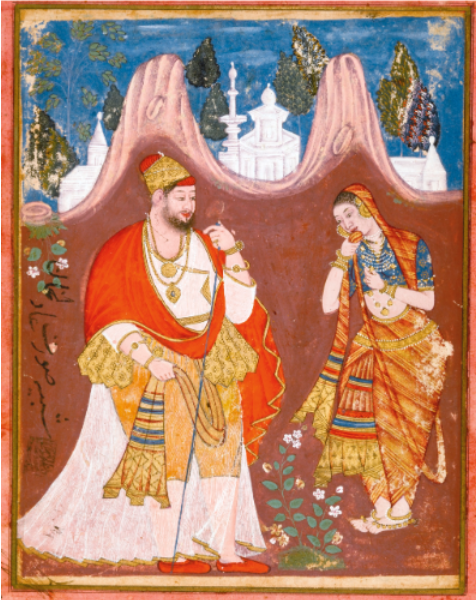
This is a painting of the Bijapuri sultan Adil Shah dated to between 1590-1605, complete with inscription by Jahangir, the Mughal emperor, that attests to the likeness: shabihi surat Adilkhan. The painter himself is nameless, but he is considered among the finest artists from the Deccan, and it has been established that he was responsible for nearly half the illustrations in the Pem Nem manuscript, one of the loveliest (and surely the only complete) books of Sufi couplets extant from the medieval period.

Adil Shah had been forced to marry off his daughter to a son of Akbar, following the Mughal conquest of the neighbouring sultanate of Ahmadnagar, and along with the marriage train went hundreds of manuscripts, the Pem Nem among them. Expectedly, you won't find the Pem Nem in India - rather, it's in the British Library.

There are thirty-four illustrations in the Pem Nem, mostly of ink and watercolour and gold and silver, made by three different artists. These paintings had been done on pieces of paper that were then pasted onto the sheets of the manuscript. It's not entirely clear if these artworks were made at the same time as the manuscript was written.

The author of the book was Hasan Manju Khalji. Interestingly, no other books by him are known. The calligraphy is lovely and clear, but as he wrote masnavi couplets in a Deccani Urdu that contains admixtures from Marathi and local dialect, it is difficult to understand today. The text is a narrative poem in rhyme, describing the Sufi's love of and quest for God.

There is frequent wordplay - shah jal bal bal pal tal mal - monosyllabic words that don't make sense. While these interjections remain obscure, the story is well-understood. A prince named Shah Ji seeks a beloved named Mah Ji; the two had fallen in love with each other when a tortoise shows each of them the other's portrait. It then appears that Mah Ji takes on a yogini's guise to seek her lover, while Shah Ji travels around looking for her. He ends up across the oceans on an island called Sangaldip, which, coincidentally, is ruled by his uncle. He finds Mah Ji as well, but rejects her because for him the real Mah Ji is the image in the portrait, while she is only a reflection. He then takes off to seek the truth. So Mah Ji goes through a period of enduring the agony of love (here the masnavi is combined with the Indian baramasa, songs describing a year of love and pain).

Neither the mysterious tortoise nor the trip across the ocean is illustrated, but Shah Ji's arrival and Mah Ji's baramasa are. There are symbols too - Mah Ji's image appears on Shah Ji's chest, and Mah Ji herself is shown burning up in her love despite an attendant dousing the fires of her passion with water. According to [1], such visual metaphors of longing are exceptional and do not often occur in Indian art.

Eventually Shah Ji returns, the couple get married, and the most lavish illustrations in the book depict the nuptial celebrations.

The overwhelming number of female figures in the illustrations seem to imply that the audience for the book was mainly female as well. The use of the dialect and Deccani Urdu may reinforce this viewpoint as that may have been the vernacular in the Sultan's harem. On the other hand, there was a general emphasis of the feminine in Deccani culture at the time. It is therefore not entirely clear for whom the book was meant.

References

1. Deborah Hutton, "The Pem Nem: A Sixteenth Century Illustrated Romance from Bijapur" in Sultans of the South: Arts of India's Deccan Courts, 1323-1687, (ed.) Navina Najat Haidar, Marika Sardar.

Sep 27, 2014

A Bit of Hindi

When I was in school, Hindi was my Achilles heel - I could barely make head or tail of it, and the insistence on the Sanskritised variety confused me even further. We covered quite a bit of poetry those days, poetry that was occasionally melodic, occasionally ancient, and occasionally a bit moral. Here's one that suddenly came back to me recently, and the only reason it came back to me (because, to be sure, I've put all matters of Hindi education to a dark and undusted corner of my mind) is that Dusted Off mentioned it during her coverage of little-known ruins in Delhi.

बुरा जो देखन मैं चला
बुरा ना मिलिया कोय
जो दिल खोजा आपना
मुझसा बुरा ना कोय

By Abdur Rahim Khan-e-Khanan (1556-1626), general and poet, a Navratan of Akbar.

"When I set out to look for evil, I found no-one wicked. When I searched my own heart, I found there was none as evil as I."

Aug 9, 2014

nazi crime fiction

Crime fiction, paradoxically, flourished under the nazis. A recent anthology (in French) by Vincent Platini allows us to rediscover these novels today. Le Figaro interviewed him recently, and this is a rather loose translation.

Vincent Platini is a researcher and lecturer at the Freie Universität de Berlin,. He analyzes the reasons that led the detective genre to flourish in the Third Reich. To be sure, the regime was not an undifferentiated bloc: while it maintained a totalitarian grip on cultural life evoking George Orwell's 1984, it also supported a mass culture based on frivolous and stupefying entertainment, reminiscent of Aldous Huxley's Brave New World. Platini says that only a few works would have been overt propaganda. Though the nazis were hostile to kitsch culture, the likes of Goebbels realised that forcing political issues onto the public would quickly jade them. They would proceed gradually. However, this supposedly apolitical culture colluded in maintaining nazi power as it held out the promise of a better life. When the war began, mass culture was used for its soothing effect: a novel such as Annex 27, published in 1944, described a prosperous Germany distant from the impending catastrophe. It reflected nazi ideology by denying the death throes of the regime.

Platini uncovers the development of consumerism and Americanism in nazi Germany, and recalls the notable advertisements for Coca-Cola and the craze for jazz. How could the censor tolerate gangster novels and films such as were set in Chicago? Platini points out that the Reich was not viscerally anti-American; indeed, the regime had a fascination for America and the public had a taste for foreign products. Hollywood set the example for German cinema, and crime fiction took on the English style. Admittedly, this leniency only lasted for a period. As censorship became more severe, the regime tried to promote 'good' German crime fiction. This was not an overt success. England and the US remained the trendsetters and German crime writers placed their novels in American settings but with a German footprint. This displacement became liberating: it was easy to pretend that major crimes no longer existed within the Third Reich; it also permitted a veiled criticism of the regime. Here, crime fiction became escapism in the true sense.

There is a curious absence of racial obsession and anti-semitic fury in the anthology. Platini explains that this is only a relative absence. Publications connected with the nazi party had their own share of caricatures and stereotypes. For instance, in the film Münchhausen, these were implicitly Jews. However, despite the importance of racist discourse of the time, there were very few Jews in crime fiction. Anti-semitism was not a theme particularly appreciated by the public, which - amidst the persecution - preferred to turn a blind eye to it. This split consciousness was reflected in the mass culture. On the other hand, and this was more chilling, a population was annihilated through its pretend exclusion. It would have been difficult to constantly stage scenes of Jewish denigration. Hiding the repression from the public eye allowed it to be exercised without restraint. On the other hand, some Jewish authors managed to re-emerge in the imagination: Zwick, for example, wrote a novel whose narrator, exiled in the US, returns to Germany to kill the one who caused the loss of his family. What a beautiful literary revenge!

Platini mentions 'treasures buried beneath the corpse'. Was there any artistic merit to contraband literature produced in nazi Germany? Indeed, he avers, there was more merit to this than the 'legitimate' culture, if art, among other things, is a challenge to the established discourse. This scorned literature acquired value precisely it was overlooked by the censors. The art that was recognised by the nazis did not perform its critical function. But an author such as Kuckhoff - of the highest intellectual training - deliberately turned towards the detective genre because it gave him a subversive opportunity that was subtle enough to be printed in the largest magazine of the time. Even a work of resistance such as The Open Letter reveals itself a gem of rhetoric, overturning the vocabulary of propaganda. But it remains the reader's responsibility to have a critical sensibility.

Krimi, une anthologie du récit policier sous le Troisième reich», selected, edited and translated by Vincent Platini, Anacharsis, 444 p., 23 €

Jul 25, 2014

Apák könyve

The Guardian thought it was full of silly ideas, a veritable gamut of Bible-like begats. The New York Times thought it was graceful and alluring. The Guardian thought its women characters were only there as incubators and to bring disaster upon the men. The New York Times thought it was a virtuoso portrayal of idiosyncratic characters. When I read Miklós Vámos' The Book Of Fathers, I thought it was alternately moving and humorous, steadily descending into the morass of Hungarian history of the past three hundred years.

Each chapter had a pastoral overture, which baffled me. How did it pertain to the story that ensued? Vámos revealed in an afterword that he intended the overture to illustrate the zodiac under which the chapter's main character was born. Indeed (and I didn't notice this), each of the twelve characters in the book was born under a different star sign. 

These twelve characters are linear descendants, father-to-son, and they, Forrest Gump-like, pop up inadvertently or advertently, at major events in Magyar history. So far, so ordinary. Vámos then pointed out that the Hungarian language was an overwhelmingly rural, unsophisticated tongue until a big cultural explosion in the late 18th century led to huge innovations in its vocabulary and its establishment as a literary vehicle to rival German and French in the Austro-Hungarian empire. 

Vámos therefore wrote the earlier chapters, which dealt with his characters in 17th and 18th centuries, in an archaic form, using only the extant vocabulary of the time, and gradually modernised his text as it moved to the 1990s. He admitted that it would be difficult to render this evolution in an Indo-European language, but that he hoped the reader would notice the language steadily change.

Well, this reader didn't notice it. Damn, I wish I could read Magyar, if only for this one linguistic treat.

Mar 14, 2014

A Spot of Reading

When I first learned to read, my dad would insist that I do so loudly. In turn, when the boy started to read, I would ask him to do it out loud.

In both cases, we (that is, the boy and I) quickly realised that we read much slower when articulating the words than when reading in our minds.

When I grew up a bit, I also learned that some people who read in their minds were sub-vocalising. In other words, they were mentally pronouncing each word. This meant, of course, that they were reading slowly.

Did it really make a difference, whether one read loudly or quietly? Was subvocalised reading less efficient than speed-reading? Was it important to be an efficient reader?

When my boy read loudly, he sometimes slurred the words. I had to ask him to slow down. I wanted to make sure he pronounced each word correctly - after all, while his vocabulary was growing, he needed to know what the words sounded like. 

*****

I noticed that when I was paying attention to the act of reading, I tended to understand less of what I read. That is to say, observing myself reading affected my reading - and comprehension.

One day, when I was about thirteen years old, I decided I would read an entire James Bond book. I was in the library and there were about two hours to closing. I finished it just in time. When I got home, I had forgotten the entire plot of the book - and yet, as I was reading it, I was enjoying it! (The sexy bits, at least.)

*****

When I was little, every time I came across a new word, I'd ask my dad what it meant. He'd direct me to the dictionary, and as it was too much of a hassle to stop reading, pick up the dictionary and look up the word, I stopped asking for meanings. My boy asks me for meanings, as I once did. I don't direct him to the dictionary; I tell him the meanings; but I find that he doesn't always remember what I said. The asking appears to be more important than the hearing.

*****

Historically, reading was a communal affair - at least here in England. Sister-familias would read loudly to the family, mater-familias would knit, pater familias would smoke a pipe, frater-familias would get a kick every time he fidgeted. The family spent some time as a unit, welcomed new worlds into its midst, enjoyed the sonority of the words.

How did reading become a solitary affair? Here is St Augustine, writing about his mentor, St Ambrose:
When he was reading, he drew his eyes along over the leaves, and his heart searched into its sense, but his voice and tongue were silent. Oft-times when we were present... we still saw him reading to himself, and never otherwise... . But with what intent soever he did it, that man certainly had a good meaning to it.
Was Augustine surprised at the silent reading? Did this mean that silent reading at the time (4th century AD) was considered an oddity? Or was he more perturbed by the fact that Ambrose was reading to himself whilst in company? Was reading expected to be a shared experience?

These days, privacy is all and individualism is paramount. The occasions for shared reading are few and circumscribed. An author reads excerpts on a publicity tour. A parent reads to a child. A pastor reads to the congregation. The magic of the written word is now a purely personal thing.

Feb 12, 2014

Oriya

What do I know of Orissa? Very little, as it turns out. Other than Konarak and Kalinga, I don't recall any coverage at all of this eastern state of India in all my years of education. History and geography, science and mathematics, all have ignored it. In my posts on various aspects of Indian history, too, I have paid it little attention. Time for a small remedy.

In the 1800s, the previously open-minded interactions between the British in India and the Indians were beginning to harden into disdain towards the latter's culture, art, traditions and behaviours. Indian religions were considered primitive, Indian learning was dismissed, and where there once were meetings of the mind, now there was British superciliousness and arrogance.

Shiva and Parvati. Oriyan temple sculpture. (13th century AD).
In such a clime, there were a few British men who would try to educate their countrymen about the wonders of the subcontinent. One of them was Charles Stuart, also known as Hindoo Stuart, an East India Company officer who amassed a large collection of Indian art, which is today found in the British Museum. In Stuart's house in Calcutta, he created a gallery which was one of the earliest systematic displays of Indian art aimed at the public. (To be sure, English public - I'm not sure if many Indians attended, despite Stuart's deep fondness for the natives.)

Five hundred years earlier, Orissa was ruled by a Hindu raja. Orissa was a Shaivite state - the God Shiva was supposed to be its lord, and the kingdom was dotted with grandly ornamented Shiva temples. One particularly magnificent sculpture - of Shiva and Parvati - likely stood at the entrance to one of the great temples. It found its way to Stuart and thence to the British Museum.


This was a life-size sculpture, and originally would have been brightly painted. Shiva would have been white, signifying the ash with which the ascetic God adorned himself, with a blue throat, from the poison he swallowed during the churning of the ocean for amrit. Observe the tenderness and devotion between him and his consort - this was no impersonal deity thundering abstinence and damnation upon his followers. Ganesha, their son, appears at the bottom, while figures representing the donor of the sculpture and his wife appear to the left and right of the Gods.
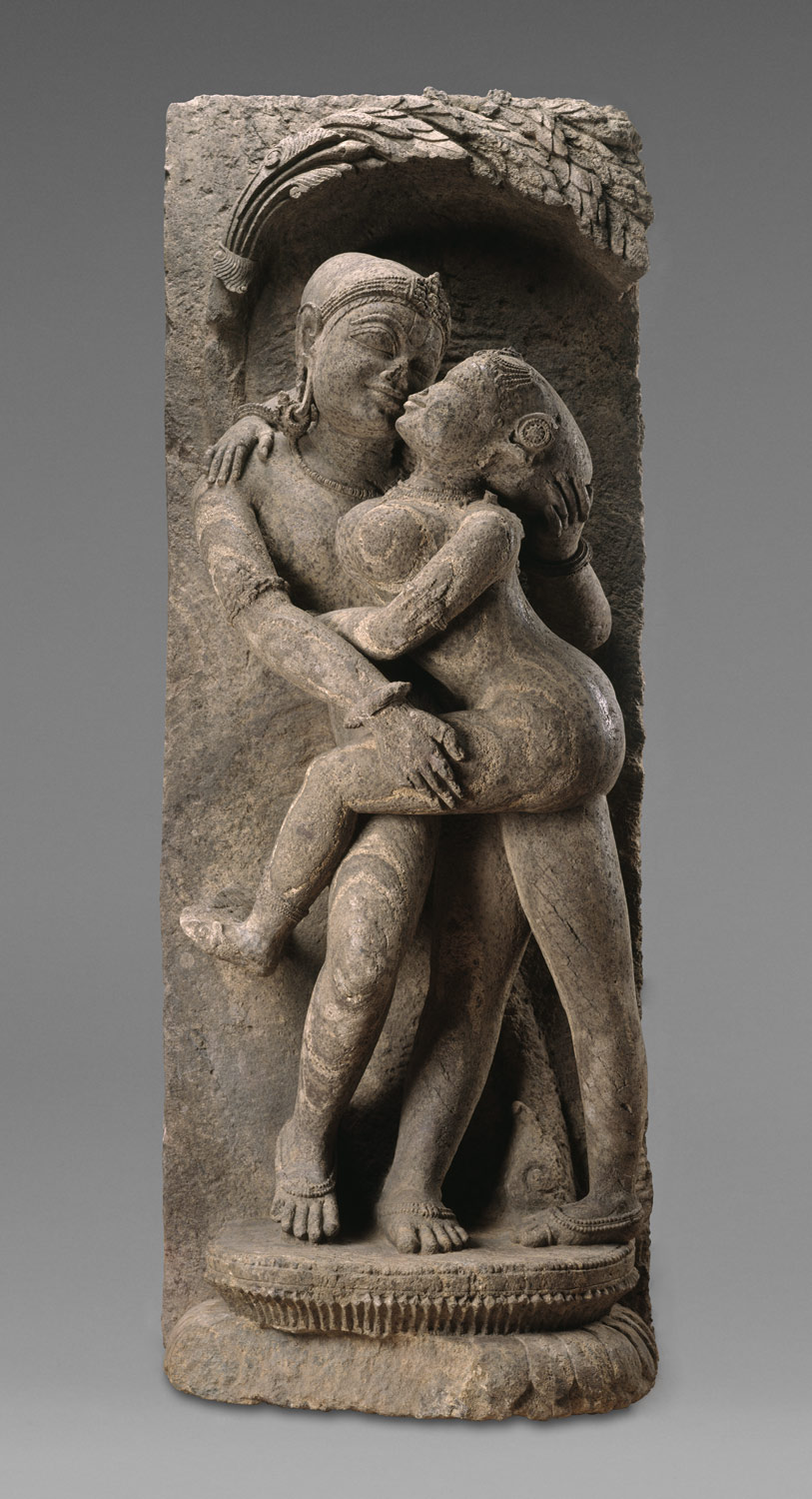
Mithuna, Eastern Ganga dynasty, Orissa. (13th century AD).
Another sculpture of love and devotion can be seen at the Metropolitan Museum of Art in New York. This too dates to the 13th century Orissa. It shows a loving couple (mithuna) and is also of stone, and was part of an Oriyan temple decoration. The kings of the time belonged to the Eastern Ganga dynasty, who had established the superb Sun temple at Konarak. They were allied by descent and marriage to the Cholas of the south and the Chalukyas of the west. By the time these sculptures were created, their kingdom was already in decline. Faced with aggression from the Muslim rulers of Bengal and Delhi, the Gangas slowly fragmented; a defeat by the Vijayanagar empire reduced their importance further. In 1425, a minister usurped power from the last 'mad' king, and the Eastern Gangas came to an end.

[Continued from Part II, and loosely translated from A Russian Missionary in India: Archimandrite Andronicus.]

After his departure from the Bethany ashram, Andronicus settled in Pattanapuram at the English school of St Stephen. He was then able to travel as a pastor around Travancore; occasionally, he was invited by Russians living in other parts of India to perform rites in Calcutta, Bangalore and Bombay. He also visited the Portuguese colony of Goa.

In 1939, he was established an Orthodox chapel in the village of Patali, a few miles from Pattanapuram, and began offering services. Next door was a Hindu temple of Bhadrakali. The locals were not pleased that the church was being set up, and complained to the government, which ignored them and permitted the church to continue.

Andronicus, as ecumenical as ever, established cordial relations with the chief priest of the Bhadrakali temple, as well as the local Muslim clergy. (Subsequently, he even attended a series of lectures on Hinduism in Madras, offered in 1948 by Somasundaram Iyer.) In Patali, there were Jacobites as well, whose church Andronicus often visited, and who also came to him during the Holy Week for confession. He was tireless in his works - preached, performed the liturgy at the St Thomas Church, constantly visited the sick. His superiors considered him a prime example of the apostolic man, hard-working and self-sacrificing, courageously undergoing all sorts of hardships and dangers both physical and spiritual, and continuing for years without confession.

Andronicus's superior, the Parisian metropolitan Eulogius, did all he could to publicise among the faithful in the Church. He wrote to the Russian Orthodox flock living in India about Andronicus, praising his steadfastness and urging the Russians to go to him for all their spiritual needs. 'His work is great and difficult,' wrote Eulogius. 'He brought from the Mother Church and lit up in distant India the lamp of the holy Orthodox faith that will not only illuminate the Russian peoples scattered there, but also, possibly, attract the native non-Christian folk and kindle in them a feeling for the Saviour, so that they may exclaim in an incandescence of faith as did St Thomas: My Lord and my God!'

Eulogius concluded his epistle with an exhortation to the Russians to assist father Andronicus in his lonely task. Let not the light of Orthodoxy be extinguished, he wrote, let it shine its saving grace on everything - be it ours or their's, be it near or far.

In 1934, for the first time Andronicus was able to hold a service for a distinctly Russian audience - nearly sixty peasants who had come to India in the previous two years, but who were now getting ready to leave for Brazil. For the first time in three and a half years in India, wrote Andronicus to Eulogius, I was able to serve as in Russia, and offer confession and communion.

In 1937, Andronicus was promoted to the rank of Archimandrite; his investment was performed at the Catholicos' residence, and conducted by the Serbian metropolitan Dosifej who was in India attending an international conference of the YMCA at Mysore.

Andronicus's travels around India continued. In 1944, he served the nearly 80 Russians in Calcutta, and performed office for the local Armenians as well at their cemetery church. There were fewer Russians in Bombay but there was still a need for pastoral care. During a visit to Delhi, Andronicus got acquainted with Nicholas Roerich's assistant, Shibayev, from whom he came learn of the various activities and interests of the great Russian artist, writer and Orientalist, who lived in the Himalayas at the time.

In 1947, Andronicus was invited to teach Russian at the University of Delhi. He had learned over his travels in India that Indians were interested in Russia and the Orthodox faith, although to varying degrees: they were interested in Russian politics and economics, and vaguely so in the faith; indeed, most educated Indians tended to assert that all religions were equal and good. So Andronicus was happy to use the opportunity in Delhi to teach Indian students not only the language, but also (hoping that they would develop deeper interests in) Russian culture and religion.

Following Indian independence and the establishment of diplomatic relations with the Soviet Union, the Russian department at the University expanded considerably. Many students hoped to obtain employment at the Soviet embassy. 

Andronicus stayed in Delhi for over a year, during which he introduced the basics of Orthodoxy to his students. In one of the two rooms he occupied during his stay, he established a little chapel where he offered worship regularly. He then returned to the south, hoping to establish a monastery in the Nilgiris and to continue his monastic life. This did not quite work out, as in 1948, he was invited by bishop John (Shakhovsky) to travel to the United States to continue his pastoral work in the Americas. And so his eighteen-year stay in India came to an end.

He spent two months awaiting his passport and visa in Madras, where he often visited the site of the martyrdom of St Thomas the Apostle. The holy location was situated within a small Catholic nunnery. The Thomas church on the hill held an ancient revered stone cross and an icon of the Mother of God. There was a grand cathedral in Mylapore that Andronicus often went to, built over the tomb of St Thomas. 'These places, of course, remain shrines for all true Christians,' he wrote, 'and the Orthodox faithful from the western coast visit them in awe.'

In 1949, Andronicus travelled by sea to New York. There began a new period in his pastoral work. He also started to write his memoir of his Indian life. To the end of his life, he held India in especial esteem. No matter where I might be, he wrote, I cannot remove India from my heart and from my thoughts. The unification of the churches remained his lifelong occupation and concern.

Andronicus died in 1958. His book Eighteen Years in India was published in the Russian language in Argentina the next year. A review appeared in the Bulletin of the Russian Student Christian Movement, praising his selflessness, elevating him as an outstanding evangelist, talked about the lonely heroism of his mission, and celebrated his memoir a special example in the literature of exile. Others familiar with his work in India pointed out that his mission was essentially a failure, as he had been unable to convert the heathens to the faith, and did not establish his own church community either. The reason, of course, was that the Orthodox church of South India, while not in communion with the Russian Orthodox, was close enough to the latter in faith and spirit. And so after much deliberation, Andronicus concluded he should help the Syrian Orthodox church and not establish a separate congregation. Where Andronicus had established a small church in Patali, a lone Indian monk remained, continuing his work. The surrounding communities remembered the unusual Russian priest with gratitude and hoped he'd return, but it was not to happen.

[Part II of Russian Religious Missions to India, loosely translated excerpts from the original Russian.]

A special place in the history of Russian religious missions to India belongs to the archimandrite Andronicus, who spent eighteen years in India and established close ties with Indian Christians of various denominations. He was born in 1894 to a professor of church history, the seventh of twelve children, and he followed his brothers into the theological seminary of Olonets. Shortly after his graduation from the seminary in 1916, it occurred to him to travel to India. Having read in Eugraph Smirnov's history of the church that there were Christians in South India with rituals related to the Orthodox, he asked himself - why not travel there if they want to join us?

Andronicus took part in the Great War, during which he heard the happy news that he had been admitted to the St Petersburg Theological Academy. Of course, the Revolution intervened, and his studies were disrupted, with the result that he spent a few years in Finland and Germany, before moving to Paris in 1923. Two years later, at the St Sergius Church in Paris, he was tonsured as a monk, and ordained to the priesthood. He was then sent to the Belfort, close to the German frontier, to take over a parish.

He was a somewhat austere soul, reluctant to take money for religious services from his congregation: instead, he rented a house with a large garden where he grew his own food; he also worked at a local Peugeot factory. 

Again he brought up his desire to sojourn in India, a request that was granted by the Metropolitan Eulogius. With the money saved up from his Peugeot job, he travelled on the steamer General Messenger to Ceylon.

En route, he befriended a couple of Indians: one a Brahmin who had graduated from university in England, the other a Muslim Bengali merchant.

From Colombo, Andronicus travelled to India, and settled in Bangalore where he worked in an agricultural factory that employed an old Russian acquaintance of his. S. F. Kirichenko had bought a small estate in South India and taken up farming; unable to concentrate on his new projects, Kirichenko had asked for another worker to replace him, and Andronicus offered to take his place. 

Andronicus worked in Coimbatore as well. In one of the rooms of the factory, he established a little chapel. In those years, there were only around 300 Russian Orthodox Christians in the country, and it was his duty to provide pastoral care to them all. Prior to his arrival, Russian believers had to visit non-Orthodox clergy in times of trouble. One example was that of the Princess Urusova, who wanted to partake of Holy Communion on her deathbed in Bombay, and had to beseech the Anglican bishop who  initially refused, but finally relented. 'You may pretend that you are taking communion from the hands of an Orthodox priest,' he said to the princess, 'I shall get in touch with your bishop and ask him to approve the holy eucharist.' It was clear that there was an urgent need for an Orthodox priest in the country.

In October 1931, Andronicus visited Travancore for three weeks, during which he met Syrian Orthodox Christians. Their denomination had split 22 years earlier from the Syro-Jacobite patriarchate of Syria, and was interested in making peace with the patriarchate, but the latter's demand for complete submission prevented any harmony. After the death of Metropolitan Dionysius VI in 1934, the first Catholicos of the church, a constitution was drawn up at the conference of all the churches in Kottayam that established the independence of the Syrian Orthodox denomination under the leadership of a Catholicos, although it was still spoken of as a subsidiary of the Syrian church. (The issue was resolved only in 1962 with the recognition of the Malabar Syrian church by the Antiochian patriarch Ignatius-Jacob III.)

In Travancore, Andronicus visited the Catholicos Basil-Gregorius and had a conversation with him. He also visited the local seminary, sharing meals with the priests, teachers and students, followed by theological discussions. Subsequently, in Kottayam, Andronicus stayed with the Catholicos, and was thereafter always assured of the most welcoming hospitality. He established close links with the clergy and bishops of the Syrian Church of South India. In their conversations, Andronicus was quick to indicate the prominent drawback of the isolation of the Syrian church from the universal church, but was comforted by the desire for unification with the universal church through their links with the Russian Orthodox church.

In Kottayam, Andronicus was also able to meet the Jacobite patriarch Ilia, whose visit from Syria was an all too rare event for the local Christians. Ilia recalled the deep faith of the Russian Christians in Jerusalem and sang their praises. Andronicus then visited the Syro-Jacobite Metropolitan Athanasios in Alwaye; staying at his residence, he had the opportunity to speak with the clergy and seminarians.

Andronicus met the bishops of the Mar Thoma denomination, which was at the time headed by the Metropolitan Titus, and comprised a hundred thousand worshippers and a hundred churches. This church was allied with the Protestants, he discovered: among other things, it did not recognise saints. Rounding off his visits with the metropolitan Dionysius in Kunnamkullam, he was happy to inform his superiors back in Paris that he had met the heads of all the denominations of the Syrian church in South India that were of interest to the Russian Orthodox.

In 1932, Andronicus joined the monastery of Bethany ashram (near Vadasserikara) to study the religious life of Christians in India. He paid great attention to the missionary activities of St Thomas the Apostle in South India, the Nestorian movement and so on.

In particular, he was interested in the propagation of the Roman Catholic faith in India. He learned of St Francis Xavier, who had begun his mission in Goa, converting the locals, then moving on to Travancore, and Madras. Returning from Japan in 1562 to Goa, this energetic missionary then headed to China where he perished of malaria. He is interred in a magnificent tomb in Goa, and is considered the patron saint of India, reported Andronicus.

Andronicus noted that the Catholics had been very active in the previous decades in all parts of India, establishing great churches in Madras, Bangalore, Calcutta, Delhi, in the Nilgiris, all over Malabar, and in Goa; everywhere, there were crowds of pilgrims; one would hear of their bishops, their monasteries and nunneries. Their resources were tremendous, he said, they acquired land and buildings; in a pagan country, their presence was a cultural boost.

His greatest interest remained towards the Syrian Orthodox. He wrote of its doctrines, governance, peculiarities of ritual, the sacraments, the tradition of iconography, the church hierarchy and so on.

At the Bethany ashram, he was permitted to perform the orthodox liturgy, and even after his sojourn ended, he often visited the monks, whom he considered close friends. In his missives to Paris, he wrote detailed accounts of the monastery. He said that the Jacobite monastic charter was quite distinct from the Russian Orthodox: not as austere, no long services, no vows at tonsure, and no use of the Jesus Prayer; prayer and obedience were not the essence of monastic life; common prayers were frequent but brief; on the other hand, institutionalised hours among the Jacobites for meditation and silence were better defined.

[To be continued…]