You know what they say about Americans abroad: if the locals don't understand what they say, they speak louder and louder... In English. But check this:
We took our leave of Sóstófürdő with a modest lunch. In the square where the pub was, a wilds how advertising Sprite. Gangsta rap over loudspeakers while Hungarian kids on skateboards slalomed in and out of giant green bottles imagining themselves black brothers. At a table nearby, the father of the family called to the waiter in Polish,"Kotlet scshabowy z fryktami! Veal cutlet with fries! Veal cutlet, dummy!" No matter how much the man raised his voice, however, the Hungarian dummy didn't understand a word.
From Andrzej Stasiuk, The Road to Babadag: Travels in the Other Europe.
The Guardian thought it was full of silly ideas, a veritable gamut of Bible-like begats. The New York Times thought it was graceful and alluring. The Guardian thought its women characters were only there as incubators and to bring disaster upon the men. The New York Times thought it was a virtuoso portrayal of idiosyncratic characters. When I read Miklós Vámos' The Book Of Fathers, I thought it was alternately moving and humorous, steadily descending into the morass of Hungarian history of the past three hundred years.
Each chapter had a pastoral overture, which baffled me. How did it pertain to the story that ensued? Vámos revealed in an afterword that he intended the overture to illustrate the zodiac under which the chapter's main character was born. Indeed (and I didn't notice this), each of the twelve characters in the book was born under a different star sign.
These twelve characters are linear descendants, father-to-son, and they, Forrest Gump-like, pop up inadvertently or advertently, at major events in Magyar history. So far, so ordinary. Vámos then pointed out that the Hungarian language was an overwhelmingly rural, unsophisticated tongue until a big cultural explosion in the late 18th century led to huge innovations in its vocabulary and its establishment as a literary vehicle to rival German and French in the Austro-Hungarian empire.
Vámos therefore wrote the earlier chapters, which dealt with his characters in 17th and 18th centuries, in an archaic form, using only the extant vocabulary of the time, and gradually modernised his text as it moved to the 1990s. He admitted that it would be difficult to render this evolution in an Indo-European language, but that he hoped the reader would notice the language steadily change.
Well, this reader didn't notice it. Damn, I wish I could read Magyar, if only for this one linguistic treat.
Part of the rising nationalism in Europe comprised in the insistence on a glorious past, often identified with great historical civilisations. The Aryans, of course, were a prime candidate for any people seeking an illustrious antecedence. The Hungarians had several models, chief among them Attila the Hun; among the others were the ancient Hindus. And so we have the 1909 tapestry by Sándor Nagy titled Sakuntala, which symbolically combines the Magyar notion of the deer as a holy symbol with that of King Dushyant's chase of the animal that led him to Sakuntala. [1]
Nagy was quite fixated on deer - he also depicted the beast in a frieze and on stained glass in the Veszprém Theatre, as well as a tapestry of the goddess Ildikó (1908).
Others have been fascinated with Kalidasa' tale of the unfortunate Sakuntala. Nikolai Karamzin, the great Russian historian, translated the tale into his language, claiming that it was a literature for the world. Here he was joining the likes of Goethe, Schelling, Herder, William Jones and de Chézy, in celebrating the great poem. Indeed, Abhijñānaśākuntalam was incredibly popular - nearly 10% of all works translated from Indian literature into Russian between 1792-1965 were of it! [2]
It's not just the Hungarians who were inspired by Sakuntala. Camille Claudel sculpted the remarkable 'Çacountala' or 'L'Abandon ou Vertumne et Pomone' between 1886 and 1905. It received much attention, and was kept in storage for several years. Claudel, of course, was channelling her own passion for Auguste Rodin. From Çacountala, she made subsequent variations, one of which is this lovely Vertumnus and Pomona:
L'Abandon ou Vertumne et Pomone, by Camille Claudel.
Closer to India, a Nepali artist delicately painted scenes from the play onto a wooden manuscript cover. Below is a small scene from it. This appears to be the only surviving manuscript cover for a purely secular work, and although there were some reservations over the identification of this work with Kalidasa's Sakuntala, a discovery in the 1980s of a mate to this cover completed the identification. [3]
Ink and colour on wood, manuscript cover from Nepal.
In India, Raja Ravi Varma's Sakuntala cycle is well-known. Here is the lady with her friends:
Shakuntala looking back to glimpse Dushyanta, by Raja Ravi Varma.
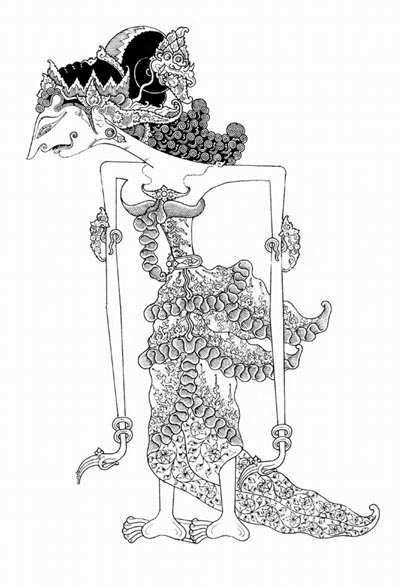
Meanwhile, music and dance saw their own manifestations of the gorgeous Sakuntala. Below is an example of Indonesian wayang (shadow-theatre) which is usually set to music. While there is evidence of indigenous story-telling predating the arrival of Hindu traders in the first century AD, much of the wayang oeuvre consists of tales from the great Hindu epics. Kisah Sakuntala, Ibu Kandung Bharata (or, The Tale of Sakuntala, the mother of Bharata) is one in the repertoire.
Sakuntala (Indonesian wayang)
One of Franz Schubert's operas is Sakontala (1820), an unfinished sketch with libretto by his friend J. P. Neumann. As late as 2000, one writer had written, "[Sakuntala] remains to this day the one and only Schubert stage work of which not one note has been performed for the public, anywhere, ever."[4] (This is not quite correct: a German television programme featuring Mallika Sarabhai's dance company had this music, and there have been some productions as well in the 1970s.)
Between 1913 and 1914, the sufi Hazrat Inayat Khan (1882-1927) visited Russia. He was received with much warmth in artistic circles, and he produced a ballet there titled 'Sakuntala'. The director Alexander Tairov had set up a new theatre; it was his hope to synthesise a multi genre spectacle. Inayat Khan's idea of a mystic balletic performance of Sakuntala appealed to Tairov. The music for the spectacle was arranged by Vladimir Pol. The New Theatre opened the production on 25 December 1914, with the title role played by Alisa Koonen. This wasn't a classical ballet but rather a dance interspersed with dramatic movements. Tairov wanted to present the production to the Czar, which sadly never happened. For a long time the music was thought to have been lost, but in 1991, it was found among various other documents at the Glinka Museum of Musical Culture. Three years later, a quartet of the Russian academy of music performed the piece. [5]
In 1889, Frederick Delius (1862-1935) set poetry by a Dane called Holger Henrik Herholdt Drachmann to music. A Dane! Who would have thunk it? Here's the first stanza of the poem:
Jeg kunde for Længsel ej sove,
En Blomstervind
Slog mig imod,
Strømmed herind ad mit Vindu
Som en vellugtaandende Flod;
Jeg hørte de høje Palmer
Suse svagt
Med sød Musik;
Det hvisked ihvor jeg stod og gik:
  Sakuntala, Sakuntala.
(I could not sleep for longing, a flower wind struck me ... )
It seems Drachmann had seen a staging of Kalidasa's play in Munich, and was struck by the parallels between his own ruined marriage and that of Sakuntala. [6]
Not to be left behind, the Italians got into the act as well. Here's Franco Alfano's 'La leggenda di Sakùntala', first act. He wrote it in 1921.
And that's it for now!
References
1. Jeremy Howard, Art Nouveau: International and National Styles in Europe, Manchester University Press, 1996.
2. Susmita Sundaram, 'Translating India, constructing self' in (ed.) Brian James, Contexts, Subtexts and Pretexts: Literary Translations in Eastern Europe and Russia, John Benjamins Publishing, 2011.
3. (ed.) Martin Lerner, The Flame and the Lotus: Indian and Southeast Asian Art from the Kronos Collections (p. 90), Metropolitan Museum of Art, 1984.
4. Uncle Dave Lewis, 'Franz Schubert: Sakontala', AllMusic.com
5. Cyclowiki, Shakuntala ballets (in Russian).
6. Hattie Anderson, 'Vilhelmine, the Muse of Sakuntala', The Delius Society Journal, Spring 2000, Number 127. (See here for PDF.)
Disappointments continue apace. Francis Durbridge's Curzon Case stars his long-time detective Paul Temple and his lovely wife Steve who - despite the police's best efforts - investigate some missing boys in Steve's hometown. Once again we have a pompous protagonist (how that Steve tolerates Paul I cannot comprehend), class warfare, a motley plot involving smugglers, fine art, drugs, and the restaurant scene. Or am I thinking of the meals consumed in various picnics and parties? Durbridge's style is canonically Golden Age, although somewhat racier and in a possibly more modern setting. In classic style, the detective brings everyone into a room for his final revelation. I'm not convinced, however, that he is even in the class just below that of Christie or Allingham.
*****
In the non-genre fiction category, I read Sándor Márai's Esther's Inheritance. The return of her lifelong love Lajos after decades has Esther aquiver with anticipation and flushed with foreboding. Lajos had dumped her for her sister and absconded shortly after his wife's death, leaving his children in Esther's temporary care. Lajos - as seen through Esther's eyes - is a charmer, a chameleon, an inconstant fellow whom everyone loves, a slippery and subconscious con-man. To me at this point he appeared monochromatic, a cipher, a nonentity. Esther knows that Lajos is returning only to break her heart again, but still she is unable to deny him. As the moment of his arrival draws near, her excitement is febrile. He comes in bearing gifts (but she knows they're worthless); his children accompany him (and they recognise their father's all-consuming weaknesses, but they hold Esther responsible); there is a malevolent woman in tow too (what is her role in the story?). Lajos' defence of himself is the first time I saw intelligence and agency in the man. For all that, he remains deeply flawed and destructive to those in his midst.
All the action of the book is concentrated among a handful of characters, all of whom have known Lajos in their youth and have experienced his charm and his betrayals. Esther, therefore, is not alone. She has all the support she could have wanted and a searching introspective mind. And yet she manages to chuck it all away, in a resolution of the standoff that I found ultimately unconvincing.
*****
Atiq Rahimi's Earth and Ashes was published in Dari, then in French - to wide acclaim - and then in English. Since then he's switched to writing in French (I blogged about him and other non-native French writers here) and has won the Goncourt. This was his first book and it treats with poetic voice the tragedy of Afghanistan. Years of history are compressed into a few days experienced by an old man and his grandson as they wait at a quarry to break ill tidings to the boy's father. The book, narrated by the old man in second person, alludes to ancient myth and epic poetry. Those of us who know these myths will feel their resonance; to those that don't, Rahimi's language will appear obfuscatory. The story, however, is timeless and without borders - in times of war, depredations and horrors are common, and the people that live through it are sorely damaged; family ties are often impotent before social strictures; and there is little healing to be had from death and heartbreak.
In the late 1980s, Stephen Brook hung out in Budapest and noted that there was no other part of Eastern Europe where the food was as plentiful and of as good quality. In his excellent (simply excellent!) account of his time in three capitals along the Danube, The Double Eagle: Vienna, Budapest, Prague, he writes:
The shops are well-stocked, and good quality meat and fish are readily available. A visit to the huge covered market at Dimitrov tér is a revelation to those who assume that all Eastern Europe is a land of unmoving queues and perpetual shortages... The most attractive stalls were those selling peppers. Masses of cherry-red and yellow paprika pods, strung into wreaths and other elaborations, were hanging form the beams and walls framing the stalls, while on trays below were scattered hundreds of shiny pale green sweet peppers. Beans and nuts and herbs were abundantly available, and in a far corner of the market a few stalls specialized in whole goose livers. Not cheap, of course, at 900 forints, but probably a tenth of the price you would have to pay in a Périgord town square. The market is spacious enough to accommodate bakeries, clothes shops, sausage and lángos stands, peasants behind trestle tables selling locally produced honeys and jams and orchids boxed in transparent plastic. I bought some lángos, a lump of pale dough that is slung into hot fat, where it writhes until golden and dimpled; in the mouth it is soft, juicy and delicious, a kind of extrem doughnut that regrettably leaves a nasty oily taste in the mouth, no doubt an honest reflection of nasty oil in which it attained its succulence.
To be invited to speak at the International Congress of Mathematicians is a great honour, and to be forty years of age or younger is doubly impressive, for it means that you might be very well in with a chance to win the Fields Medal. I thought I might scan through the list of speakers at the ICM 2010 site and see who the young guns are. In particular, I thought I'd focus on the women.
Now, at the absolute top rank of mathematics, there have been historically very few women. Think about this: between the first ICM and the first address by a woman, almost 30 years passed. Then another 60-odd years went by until Karen Uhlenbeck spoke at ICM 1990.
Fortunately, though, this is all changing. And so it is heartening indeed to see women's names pop up in this list. Even more wondrously, these young scientists are not restricted to the traditional powerhouses of mathematics - Russia, France, USA. You'll find Iranians and Spaniards and Taiwanese as well.
So here goes.
Maryam Mirzakhani: this mathematician from Iran, now based in the USA, is doubly honoured - she addresses a session in Topology as well as Dynamical Systems. Like several previous winners of the Fields Medal, she was very successful in her youth at the International Mathematics Olympiad. More recently, she was awarded the Blumenthal Award (2009), which is awarded quadrennially, and is for the best PhD thesis published in preceding four years. Her work - among others - is in the geometric structures and their deformations in all sorts of spaces, and she brings in an interdisciplinary approach to solving problems in the field, by using insights from combinatorics and mathematical physics.
Irit Dinur: is a theoretical computer scientist from Israel, where she has been working on problems in proof theory - how to establish formally that a proof is correct? In particular, by making random inspections of a formally written-out proof, is it possible to verify it? This is a deep problem in theoretical computer science, with a fundamental result (that it is, indeed, possible) established in 1992. She was able to establish a much simpler and radically new proof of this theorem in 2005, which has resulted in fresh pastures for investigation. As we know, it's not enough to solve a problem - what's better is to do so in such a way that a whole new domain of research opens up, with exciting new possibilities. Dinur has done this with aplomb. And so there's some gossip that she might win the Rolf Nevanlinna Prize (which is also awarded quadrennially at an ICM) for the applications of mathematics in the information sciences.
Sophie Morel: is from France, and her PhD thesis was an important development in the Langlands Program, solving a problem that had remained open for over twenty years. (You may recall that Laurent Lafforgue won the Fields Medal in 2002 for his contributions in this area.) This is cutting-edge work at the intersection of number theory and algebraic geometry. She was made a full professor of mathematics at Harvard last year, a notably rare and distinguished achievement made especially so when you realise that she's the first woman to be tenured in mathematics at that university! To boot, she is a skilled polyglot, conversant in French, English, Russian, German, Spanish, and now learning Korean.
Chiu-Chu Liu: is a mathematical physicist from Taiwan. She, again, is a multidisciplinarian, combining techniques from topology, differential geometry, and algebraic geometry to answer open problems in theoretical physics. In particular, her work in establishing the Marino-Vafa conjecture has been well-recognised. This has deep ramifications in string theory.
Anna Erschler: is a Russian mathematician based in France. Along with Mirzakhani, she too has two addresses at the ICM (Probability and Geometry). Her work is at the conjunction of probability and group theory.
Isabel Fernández: is a Spanish professor of mathematics at the University of Seville, and has received much attention in her native country for being the first ever Spanish woman to be invited to an ICM. Her work has been termed, loosely, soap-bubble geometry, because she investigates the geometric properties of curved objects. It is at once a classical field in mathematics, but equally cutting-edge, combining results from differential equations, complex analysis and variational calculus. Interestingly, her work has found immediate practical application in architecture, notably at the Olympic stadium in Munich, where surfaces she studied have been found to be light-weight, use little by way of materials, and are notably resilient. And, having solved one of the open major problems in the field - minimal surfaces in homogeneous spaces - the invitation to the ICM celebrates her achievement (to be sure, with her colleague Paul Mira).
Catharina Stroppel: is a German mathematician, winner of the 2007 Whitehead prize for her work in representation theory and its applications to low-dimensional topology.
Marianna Csörnyei: is Hungarian, another Whitehead prizewinner (2002), and works in geometric measure theory. "Central to her work is the analysis of viable definitions of ‘negligible’ in the context of infinite-dimensional situations, with a view to applications in non-linear geometric functional analysis. Technically difficult, the judges described her work as characterised by the ‘startling nature of many of her results’. A particularly ‘spectacular achievement’ highlighted was her proof that the three main notions of ‘negligibility’ coincide, and her revelation of delicate phenomena in the theory of Lipschitz quotients even in the finite dimensional case." (from here)
Nalini Anantharaman: is French; her work is in mathematical physics, and she attempts to answer questions about the phenomenon of dispersion: "A wave propagates in a closed cavity. It will bounce off the walls. I'm trying to understand how it will dissolve: will it remain compartmentalized, contained in a portion of the cavity or will it be dispersed throughout the cavity?" (from here) One of her major contributions is in quantum chaos, where she established some results supporting the Quantum Unique Ergodicity Conjecture.
Katrin Wendland: is German; her work is in mathematical physics, particularly in the nature of particles. Notably, she "constructed a large class of examples of mirror symmetry using orbifold methods and Kummer K3 surfaces" (from here) Her research also unfolds deep connections between non-commutative geometry and algebraic geometry, and she has many contributions in topological quantum field theories.
Dorit Aharonov: is an Israeli computer scientist. In 2005, she was profiled in Nature. One of her major achievements was to show that even in the presence of interfering noise, a quantum computer could still achieve reliable results. Because quantum computers require considerable isolation from their surroundings (the 'quantum processors' should not interact with their surroundings, or the resultant errors will rapidly degrade the computation), it was thought that these would remain theoretical curiosities. Her work in quantum error correction went a long way in establishing the domain as technologically viable. In addition, she has worked in the quantum scale problem - why do quantum effects manifest only at subatomic levels but appear to vanish at human scales? "Aharonov showed that for many noisy quantum systems, there is a level of noise above which a transition to classical behaviour is inevitable. Such transitions are much sharper than expected from other theories that predict a gradual shift away from quantum behaviour."
This month I'm a tad late with the round-up of non-English crime fiction consumed and I blame the weather for this. It's been remarkably good. But all good things must end, and today we have a tremendous downpour, I'm off to Luxembourg, and I'm shooting off this post.
So, where were we? Ah, yes. War crimes in Pavel Hak's Sniper was the last book in last month's survey, and we segue into governmental oppression with Imre Kertész's Detective Story. Imre Kertész is, of course, a Nobelist. He is also an emigre Hungarian author (having been based in Berlin for decades), which is why this book strikes me as a bit of a cop-out. To explain: he sets the novel in an unnamed Latin American police state where the internal security apparatus wields its power of arrest and terror with impunity. To my mind, he is excoriating the arbitrariness of dictatorial power, and his book would make as much sense in Mexico as in Hungary - so why did he not just base it on his homeland? For some reason, he preferred to report on the action at a remove, through the confession of Martens, a man who was once an enforcer (and police spy) for the previous regime. Now that that regime has been overthrown, and its apparatchiks are in prison, Martens awaits the kind of tortured death that he indirectly laid upon innocents in his youth. In any country, especially in one that is as insecure as Martens, there will always be scapegoats for perceived or imagined political threats. Surveillance and arbitrary arrest and torture is a logical concomitant. The torture can be physical as well as psychological; Martens explains how his organisation systematically destroyed an innocent father and a son. After all, even the most innocuous cannot be ignored, for the slightest threat is a danger to an absolutist regime, and every operative can hide behind the excuse of merely following orders. Detective Story is spare prose at its best, a small book concentrated in its chilling horror.
Entirely accidentally, I also picked up another Nobel Prizewinner's book. An Austrian, Elfriede Jelinek's Greed is supposedly her most accessible work. At least, it says on the blurb. If this is accessible, I don't know what her other novels are like. It completely defeated me. Jelinek's prose is dense, long (paragraphs extending for pages), frequently unpunctuated; it roars in places, quivers with ferocious disdain for its characters (many of whom are unnamed). Nominally, this is about a country policeman who wants to amass property and so seduces every middle-aged landowning woman in his village; there is much furious and seedy coupling and complete lack of understanding between men and women; there is a murdered girl and her mother who is often terrified by her absence and at other times relieved. I could make neither head nor tail of this novel. Perhaps it is one to be grappled with, treated as an adversary? A reviewer in the Guardian, who has no patience with people demanding easy reads, called it daredevil, risk-taking prose (What is killing the novel is people's growing dependence on feel-good fiction, fantasy and non-fiction. With this comes an inability or unwillingness to tolerate any irregularities of form, a prissy quibbling over capital letters, punctiliousness about punctuation. They act like we're still at school! Real writing is not about rules. It's about electrifying prose, it's about play.) But I made no headway. If any of you read it and understand it, please be sure to explain it all to me.
To lighten up (both emotionally and muscularly), I zipped through the very delightful The Fairy Gunmother. Set in Belleville, a district of Paris where drug-runners and muggers and deliciously human characters all dwell, it is the second of a quartet of ironic and merry novels by Daniel Pennac. Ably translated by Ian Monk, this one deals with old women who go around murdering policemen and other old women, and has a voluptuous investigative journalist who is the beloved of a literary scapegoat (a chap who is hired to stand around looking depressed and thus deflect the fury of disgruntled authors who come to their publisher to vent and complain) with a fecund mother and many siblings, and a strangely empathetic policeman who manages to extract confessions from even the most hardened criminals, and a hearty Yugoslav who drives old ladies around historically important parts of the country, and drug-addled grandfathers who are taken in and cared for by the scapegoat's family. What a novel! It hums along at frantic pace, filled with lovely wordplay and clever mots and a joie-de-vivre. Several thumbs way, way up.
We continue to be light-hearted with Mehmet Murat Somer's tale of a transvestite detective in The Prophet Murders. The idea of a murderer using some literary or religious concatenation to commit serial crimes is, of course, very old. It has been variously attempted in the 'Christian' world by the likes of Matthew Pearl (The Dante Club) and Arnaud Delalande (The Dante Trap), and in the 'Hindu' world by Ramesh Menon (The Hunt for K). It is now the turn of the Islamic world, and how unlikely a source for it? In any Muslim country other Turkey (or possibly Indonesia), Mehmet Murat Somer himself would not have survived long - a flamboyantly gay transvestite is not exactly the most welcome of people even in his native land. His detective appears to be very like him, a likeable no-nonsense martial-arts expert who runs a transvestite club and is a foodie and expert oenophile. The other 'girls' look up to him for support and protection, even as one by one they are killed off by some crazed maniac. The club owner, whose name escapes me now, decides to go on the hunt, and of course ends up - in true slasher stereotype - in the maws of the villain, but not before conducting a stellar tour of the gay underbelly of Istanbul and introducing us to its very witty and frothy and dark and troubled denizens.
Massimo Carlotto went on the run when falsely implicated in a crime in his native Italy, but he returned eventually to serve out his term. The miscarriage of justice that he faced colours his perception of the ruling classes in his country, and his The Master of Knots is filled with revulsion for the entire legal and investigative establishment. Carlotto is a left-wing activist, which informs the novel considerably: the juxtaposition of a crime procedural with Communist politics might appear a bit contrived, but the main characters in this novel manage to straddle both worlds with equal facility. At any rate, this is an exploration of yet another underbelly: the extreme S&M scene, very disturbingly graphic at times. Women willing to be dominated are a rare and prized commmodity in those circles, so it is somewhat puzzling to find that one of them has been murdered; shortly thereafter, her husband and another woman he dominated also go missing. Carlotto describes the extreme precautions members of the S&M tribe take to avoid trouble with the law and suspicion with their 'normal' families; he goes into considerable detail about 'snuff' porn; he throws in an anti-globalisation demonstration in which the police viciously club protesters to pulp; amidst all this, the three protagonists stalk their prey in the shadowy underground. An uneven read, and often troubling.
Unwilling investigators are not very common in crime fiction, as far as I can tell, but Carlotto offers one example of the type. Another is Bernard Schlink, whose Self's Deception is the story of one man's principled search for a missing girl, although he suspects (and is soon proven right) that his generous patron has reasons other than familial concerns to locate her. Gerhard Self is a one-time Nazi prosecutor; now he is a middle-aged man struggling to decide whether or not to marry his younger girlfriend. He is an introspective man of principle, very thoughtful, mordant in his analysis. Such a man spends much of his time examining his own motives (and piling on the calories with rich food wherever he goes), and when he acts, by his own estimation, irrationally, it only serves to add richness to his own complexity. Meanwhile, there's a convoluted plot involving eco-terrorists and an American military base and frequent appearances of extraneous characters that do nothing to aid the plot, but do add to an overall atmosphere. This is a slow-paced story underneath a frenetic superstructure - short chapters, lots of information - good stuff.
The Financial Times is always filled with delicious gems. Consider this one from today's Lex Column.
"Hátravan még a feketeleves" was a phrase muttered around Hungary yesterday as details of a massive $25 billion lifeline emerged. Literally, this means "the black soup is yet to come" - a way of saying that, after a pleasant interlude, bad times lie ahead. It dates from the 150 year Ottoman occupation when, after a meal with their new rulers, out would come coffee, a previously unknown beverage in Hungary, and the unpleasant business of tributes and taxes would be broached.
Lovely bit of history, and an even finer tribute to Magyar acerbity.
I have modestly given myself the name of the greatest of the Eldar: Fëanor, the maker of the Silmarils and the creator of the Tengwar. He was a Master of many things. I am merely a Jack.