JOST A MON

The idle ramblings of a Jack of some trades, Master of none

There's a book recently published in Russia, titled Литературный авангард русского Парижа. 1920—1926. История. Хроника. Антология. Документы. Written by Leonid Livak and Andrei Ustinov, it is 992 pages of history, chronicles, anthologies and documents pertaining to the great Russian diaspora in Paris between 1920-1926. By all accounts (including this review, by Vasily Molodyakov, from which I've shamelessly and poorly translated this article), it is a tour-de-force, a seminal work, a book that shreds the usual templates of study of emigre Russian literature.

What sort of avant-garde? the Soviets would say. Sure, a bunch of Russians legged it after the Revolution - some to Berlin initially, and then to Paris - and they may have written a thing or two.  Bunin, Kuprin, Shmelev, Zaitsev, Aldanov... The Soviets claimed that the real literature remained in Russia. The emigres were undeserving pretenders filled with nostalgia for their homeland; talented painters bemoaned their exile or returned with tails between their legs; the youth there was effete. The Soviets would bring up Marina Tsvetaeva, that most avant-garde of poets: what did emigration do for her?

Viktor Bart, Sergei Romov, Konstantin Tereshkovich. Founders of the group "Через" (1923).
The emigres would counter that the Soviets had defiled the avant-garde. The diaspora carried with it the forces of Russian tradition and the legacy of its great classical literature. The youth may quest for modernity, but the majority of them prefer to follow the great preceptors. Those who behave are published in "Modern Notes", while those who don't appear in "Numbers". This version of the argument is canonised by Adamovich and Gleb Struve after the second world war. The other version, that emigre literature is weak and ineffectual, and that the real literature is in Russia, is canonised in the English-language "Modern Russian Literature" by Marc Slonim.
"Merry Dynamite", manuscript by Dovid Knut. 1923.

So why do we have a thousand-page exposition from Livak and Ustinov? Well, for one thing, it illuminates little-known aspects of the Russian emigre experience, not just artistic but also literary. It overturns the myth of the absence of the avant-garde abroad, or of its marginalisation or insignificance. The Russian avant-garde was active, visible, powerful: "Gataparak", "The Palace of Poets", the Union of Russian Artists in France. But until 1924, the literary life of the Russian youth in Paris had three characteristic features: 1) an absence of anti-Soviet sentiment among the organisers and participants in the artistic groups; 2) a markedly pronounced popularity of the Soviet avant-garde in literature (Futurism) and art (Constructivism); and 3) close ties with the French Dadaist movement." (page 16).
Portrait of Mikhail Larionov by Man Ray. (1922-23).

The book also disposes of the myth that Russian Paris was somehow lesser than the Russian Berlin in 1921-23. The two capitals were not in opposition to each other; rather they were in consonance. And how could they not be, given that the same personages drove the avant-garde in both places?

Who were these people? You can learn nearly everything you might ever want about them, because nearly 3/4 of the book is comprised of the texts of the heroes of the avant-garde, the poetry and experimental prose of ten authors: Valentin Parnakh, Sergei Sharshun, Mark Talov, Georgi Evangulov, Alexander Ginger, Dovid Knut, Boris Bozhnev, Boris Poplavsky, Ilya Zdanevich and Vladimir Sveshnikov. Some of the text has appeared in print before, but gathered in one place, they offer a wonderful view. Another 250 pages deal with manifestoes, essays, letters as well as a reprint of all four volumes of the rare journal "Udar" ("Impact") by Sergei Romov. This sort of a Russian diaspora we haven't known. And such a Russian avant-garde we haven't known.

Dec 6, 2014

A Parisian Put-Down

Enrique Vila-Matas wrote a fictionalised biography of his younger (somewhat exaggerated) self in Paris, Never Any End to Paris, in which he tried hard to emulate his hero Ernest Hemingway, to be poor and happy, to learn to write, to see the world in the light of his master. Instead, he was poor, desperately unhappy, and the paucity of his achievement was laid bare when he met Javier Grandes at a bar, who merrily said he was slow off the mark becoming a writer.
What I mean is you're slow compared to Boris Vian. At your age, he was already nearly dead, but he'd written about five hundred songs, three hundred poems, I don't know how many novels, fifty stage plays, eight operas, one and a half thousand music reviews. And that's not all, he used and abused the trumpet. And he was a great nighthawk, who used to flit from the Bar Vert to La Rhumerie Martiniquaise, from Tabou to Petit Saint-Benoit, from Trois Canettes to Vieux Colombier daily. Two marriages, I don't know how many kids, an engineering degree, thousands of conversations with the waiters at the Balzar, a thousand transgressions, he wore out the needles on the record players at the local rich kids' bashes, and well, anyway, I don't need to tell you.
Who could handle such frankness? Enrique was crushed, "practically destroyed, as if I'd lost a thousand games of pinball."

****


Cave Tabou, Paris
The Cave Tabou that Grandes mentioned was jazz club frequented by Boris Vian's circle as well a bunch of journalists and existentialists in St Germain-des-Prés. As Vian said, "Very quickly, the Tabou has become a center of organized madness. Let's be frank, none of the clubs that followed could recreate that incredible atmosphere, and Tabou itself, alas! could not retain it for very long... it was impossible." It was here that a reporter overheard Juliette Greco say, "We are all existentialists" and the expressive coinage was born. Juliette Greco was a brunette, but the poet Anne-Marie Cazalis was a redhead, and the two of them were frequently in the club, listening to Vian's jazz.


Greco and Cazalis

****


La Rhumerie Martiniquaise was another existentialist and jazz haunt in St Germain-des-Prés. Besides Vian, the likes of Georges Bataille, Henri Salvador, Antonin Artaud, Marcel Aymé, Man Ray, Aimé Césaire were to be found here. If high intellectualism was not your thing, you could splurge on the finest Antillean rums here.


La Rhumerie Martiniquaise in 1955.

Sep 18, 2013

Watercolour

Watercolour is a remarkably unforgiving medium of art. If you make a mistake, you cannot easily rectify it. With oils, you can paint over, or possibly even erase. Still, in the 19th century, oils were considered the higher art form. Neither the academy nor the cognoscenti gave watercolour the standing it deserved.

Luckily, this lack of encouragement did not hold the masters back. Entire hordes of British artists got into the habit of using watercolours. When war and time permitted, they would traipse off to lovely parts of Europe to paint. In the early 19th century, a bevy of them headed to Paris. Much of their work can be seen at the Wallace Collection's The Discovery of Paris - Watercolours by Early 19th Century British Artists - an exhibition that runs till September 15, 2013.

I was there the other day. The artworks were displayed in two not-too-large rooms. Many were by painters I hadn't heard of. I am glad indeed to be introduced to them.

The British didn't quite take to Paris. For them, when they weren't mooning over London, Venice was still the cynosure of cityscape. In France, the British appeared even to prefer Rouen to Paris. Although they appreciated the light and the architecture of Paris, and they admired it as a city of pleasure, they disdained its filth and open gutters. For most British painters of Paris, the city was the source of only a small fraction of their outputs.

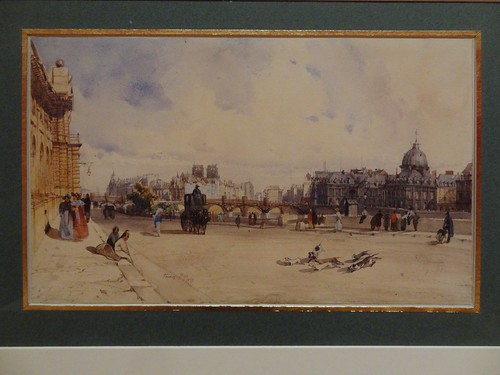
For Thomas Shotter Boys (1803-74), Paris was of signal importance. He was great friends with Richard Parkes Bonington (1802-28), and they often painted vistas from similar viewpoints. His painting of the Pont des Arts shown below is, in fact, closely akin to Bonington's own earlier composition.

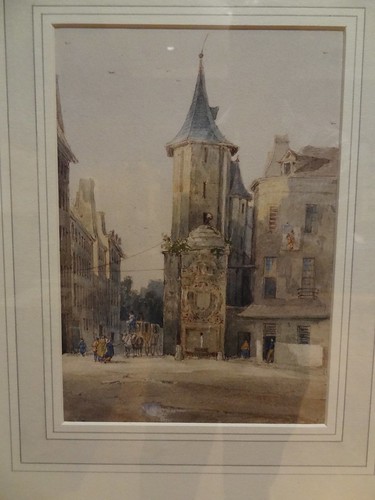
Louis Francia (1722-1839) was native to Calais, but spent years in England as a master and watercolorist. When he returned to Calais, he taught the likes of Bonington ('[Paris is] this city of mud and dirtiness') and William Wyld. 

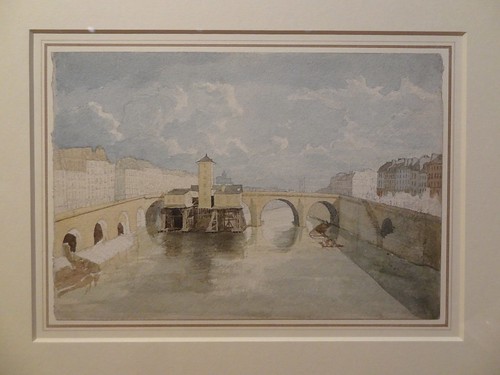
Another artist was John Gendall (1789-1865). He was sent by a publisher (Rudolf Ackermann) to prepare watercolours for a book, Picturesque Tour of the Seine, from Paris to the Sea (1821). The work below by Gendall was based on a sketch by Auguste Pugin.

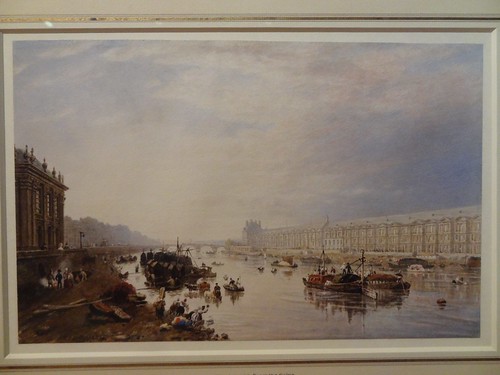
Frederick Nash (1782-1856) was a specialist of architectural views, and he liked to add some verisimilitude by including washerwomen and charcoal burners in some of his paintings. His view of the Seine looking towards the Louvre below was part of a series of illustrations executed for a major book Picturesque Views of the City of Paris and its Environs.

The pieces on display are varied - from the sharply executed precision of some to the diffuse impressions of others. I took some pictures. Take a look!

Untitled
The Pont des Arts from the Quai du Louvre, by Thomas Shotter Boys. (1833).
Untitled
Pont Notre-Dame from the Pont au Change, by John Gendall. (1820-21).
Untitled
The Seine, looking towards the Louvre and the Pont Royal, by Frederick Nash. (1820s).
Untitled
The Fontaine Saint-Victor, by Louis Francia. (1825).
Some of the pictures below were at the exhibition as well, but the images are not mine.
Pont des Arts, by Richard Bonington. (1826).

Saint Severin, by James Holland. (1831). The irregular wall on the right is from his imagination!


Oct 10, 2012

Moveable Feast

In the 1920s, Ernest Hemingway and his wife Hadley went to Paris, to move among the 'Lost Generation' (a name coined by Gertrude Stein, matriarch of expatriate artists, that Papa resented very much), attempt to become a great writer, and pretend to be starving while the cheques poured in for his various works. He had brought letters of introduction to this exalted circle from America, but really, there was no need - all the expats were very welcoming and went to the same eateries. He was quickly caught up in the whirl of intellectual hedonism and the excitement of Paris, and to his dying day, claimed
If you are lucky enough to have lived in Paris as a young man, then wherever you go for the rest of your life, it stays with you, for Paris is a moveable feast.
One day he was hungry and received six hundred francs from some German publisher, and he went to Brasserie Lipp, purveyor of authentic and fine Alsatian cuisine. In his posthumously published A Moveable Feast, considered by mavens to be one of his finest works, he described the meal in his characteristically terse and trenchant style
The beer was very cold and wonderful to drink. The potatoes in oil were firm and marinated and the olive oil was delicious. I ground black pepper over the potatoes and moistened the bread in the oil. After the first heavy draught of beer I drank and ate very slowly, and when the potatoes were gone I ordered another serving and a cervalas, a sausage-like heavy, wide frankfurter split in two and covered with mustard sauce. I mopped up all of the oil and all of the sauce with bread and drank the beer slowly until it began to lose its coldness and then I finished it and ordered another.
Hemingway was a creature of habit and always went to the same restaurants to order his favourite dishes; only if someone else were paying would he choose something new to try. He considered himself a down-to-earth sort, and preferred hearty rustic cooking to French haute cuisine. He liked, he said
the kinds of food that stick to your ribs and give you the feeling that you really have something that you can dig into with gusto and not worry too much about good manners.
That search for the simple and the hardy, it is clear, informed not only his gastronomic quests, but also his literary oeuvre. Wonderful stuff.

Also check out:

Harold Stephens, Hemingway and Food

Aug 22, 2012

Chagall in Paris

When Marc Chagall first arrived in Paris, he was shocked at the prices of food. A franc at the time was worth half a rouble, and he was getting a rather comfortable monthly stipend from one of his well-wishers back home. Yet, he said, it's impossible to eat as well as in Russia. He wrote in one of his letters home:
Meat, for example, is very expensive, and in restaurants they give you small portions; it's the same with eggs and milk. Our black bread doesn't exist at all, and the quality of their white bread and so-called black bread - it makes me feel sick when I see it. When you go into a restaurant for dinner, they immediately give you wine - red or white - but I am going to refuse this for the rest of my life because my stomach can't stand it. But even in this case you have to pay a tip - just to refuse it!
(From Jackie Wullschlager, Chagall: Love and Exile, Penguin, 2010.) 

Feb 9, 2012

Arty

I have been singularly remiss in posting and the reason's plain to see
I am obsessing about the Russian avant-garde and it has taken over me 
I'd like to point you all to another blog of mine 
Because clearly when I can't manage one 
Two will work out fine.

Three, if you include Tumblr. Hot damn.

Long years ago - well, maybe four - there was a TV programme by Marcel Theroux that addressed the phenomenon of Russian oligarchs buying up every piece of their country's art that they could lay their hands on. This was no different from rich Chinese and Indians piling on to artistic treasures of their own countries, but given that Chinese and Indian art is not quite mainstream in the West, and only what happens in the West is worth documenting, much fanfare was made of the Oligarts, as Theroux put it. At the time, I did watch the programme. It was a fascinating insight into a period of Russian creativity before it got stomped on by Communism. There were names - like Zinaida Serebriakova - who were coming back into vogue, decades after their oeuvre had been forgotten. I watched avidly and then as with many other ephemeral interests, I forgot all about it.

Until recently, when suddenly the bug bit me again. I'm not sure exactly what it was that caused the infection, but it came on creepingly and it came on strong. So the past few weeks have found me busily scouring the web for images and translating text from Russian and French, educating myself a bit about the art of the Russian  (and Soviet) imperium. So far I have covered Zinaida Serebriakova, Vera Rockline and started on Pavel Shmarov, all of whom were contemporaries, exiles in Paris from the 1920s onwards. The Russian avant-garde included such famous folks as Kandinski and Chagall, but so much is known of them, and much less about Kustodiev and Vassilief and all those others. Nor do I want to restrict myself to ethnic Russians - the avant-garde was much more inclusive, and there were other nationalities from the Russian empire that participated. And there's no reason to stick to the avant-garde either. So I'll go over them all slowly - one hopes. As with all my interests, this too can fade at a blink.

Meanwhile, it's not that I have been ignoring life in general. There was an expedition to Asia House for a display of art by George Chinnery. There was copious consumption of all things Scottish at Burns night. There were several episodes of Lost Kingdoms of Africa, too. I'm reading, too, far less than I once used to. There are several books to note. And there's always the boy's escapades in the world of mathematics. Much to talk about and so little time. Soon!