I stood marvelling for a long time in front of a blackboard on which all the delicious fare one could order was listed in chalk. I was bewildered by the abundance of food and drink bearing names with literary associations. Printer's Ink Wine and Blood and Thunder Coffee; Sweetpaper Sandwiches (they could not only be eaten but also written on); Muse's Kiss Cocoa and Liquid Inspiration (the latter a brutally high-proof spirit); Horror Candies (to be eaten while reading thrillers, many of them with surprise fillings of vinegar, cod liver oil or desiccated ants); and seventeen types of pastries named after various classical poets, for example, Bethelzia B. Binngrow Buns and Ardelf Nennytos Cookies. Those in need of more substantial fare could gorge themselves on dishes named after popular novelists or their heroes, for instance Prince Sangfroid Pie or Risotto a la Avisko Dosti, but there was also a light Syllabic Salad incorporating alphabet spaghetti and trombophone mushrooms. It was enough to make your head spin.
Having pulled myself together at last, I ordered a big jug of Midnight Oil Espresso and a pastry known as a Poet's Ringlet.
Crime fiction, paradoxically, flourished under the nazis. A recent anthology (in French) by Vincent Platini allows us to rediscover these novels today. Le Figaro interviewed him recently, and this is a rather loose translation.
Vincent Platini is a researcher and lecturer at the Freie Universität de Berlin,. He analyzes the reasons that led the detective genre to flourish in the Third Reich. To be sure, the regime was not an undifferentiated bloc: while it maintained a totalitarian grip on cultural life evoking George Orwell's 1984, it also supported a mass culture based on frivolous and stupefying entertainment, reminiscent of Aldous Huxley's Brave New World. Platini says that only a few works would have been overt propaganda. Though the nazis were hostile to kitsch culture, the likes of Goebbels realised that forcing political issues onto the public would quickly jade them. They would proceed gradually. However, this supposedly apolitical culture colluded in maintaining nazi power as it held out the promise of a better life. When the war began, mass culture was used for its soothing effect: a novel such as Annex 27, published in 1944, described a prosperous Germany distant from the impending catastrophe. It reflected nazi ideology by denying the death throes of the regime.
Platini uncovers the development of consumerism and Americanism in nazi Germany, and recalls the notable advertisements for Coca-Cola and the craze for jazz. How could the censor tolerate gangster novels and films such as were set in Chicago? Platini points out that the Reich was not viscerally anti-American; indeed, the regime had a fascination for America and the public had a taste for foreign products. Hollywood set the example for German cinema, and crime fiction took on the English style. Admittedly, this leniency only lasted for a period. As censorship became more severe, the regime tried to promote 'good' German crime fiction. This was not an overt success. England and the US remained the trendsetters and German crime writers placed their novels in American settings but with a German footprint. This displacement became liberating: it was easy to pretend that major crimes no longer existed within the Third Reich; it also permitted a veiled criticism of the regime. Here, crime fiction became escapism in the true sense.
There is a curious absence of racial obsession and anti-semitic fury in the anthology. Platini explains that this is only a relative absence. Publications connected with the nazi party had their own share of caricatures and stereotypes. For instance, in the film Münchhausen, these were implicitly Jews. However, despite the importance of racist discourse of the time, there were very few Jews in crime fiction. Anti-semitism was not a theme particularly appreciated by the public, which - amidst the persecution - preferred to turn a blind eye to it. This split consciousness was reflected in the mass culture. On the other hand, and this was more chilling, a population was annihilated through its pretend exclusion. It would have been difficult to constantly stage scenes of Jewish denigration. Hiding the repression from the public eye allowed it to be exercised without restraint. On the other hand, some Jewish authors managed to re-emerge in the imagination: Zwick, for example, wrote a novel whose narrator, exiled in the US, returns to Germany to kill the one who caused the loss of his family. What a beautiful literary revenge!
Platini mentions 'treasures buried beneath the corpse'. Was there any artistic merit to contraband literature produced in nazi Germany? Indeed, he avers, there was more merit to this than the 'legitimate' culture, if art, among other things, is a challenge to the established discourse. This scorned literature acquired value precisely it was overlooked by the censors. The art that was recognised by the nazis did not perform its critical function. But an author such as Kuckhoff - of the highest intellectual training - deliberately turned towards the detective genre because it gave him a subversive opportunity that was subtle enough to be printed in the largest magazine of the time. Even a work of resistance such as The Open Letter reveals itself a gem of rhetoric, overturning the vocabulary of propaganda. But it remains the reader's responsibility to have a critical sensibility.
Krimi, une anthologie du récit policier sous le Troisième reich», selected, edited and translated by Vincent Platini, Anacharsis, 444 p., 23 €
Detlef Bernd Blettenberg (October 13, 1949, Wirges - ) is a German writer and reporter.
Blettenberg was born an only child in a working class family, growing up in Elgendorf, a small village community. In 1966, he moved to Leverkusen where he undertook an apprenticeship as a draughtsman in mechanical engineering. He then did his military service, and after attending the Naval Signal School at Flensburg- Mürwig he went to sea as a radio operator.
In 1972, he joined an international development agency where he would spend the next two decades. He was a development worker in Ecuador between 1972-76 where he helped coordinate vocational training at the Ministry of Education in Quito. Ecuador was the setting of his novels Weint nicht um mich in Quito and Agaven sterben einsam.
Between 1982-86, Blettenberg was a commissioner in the German Development Service in Thailand; 1992-94 in Nicaragua; 2003-2004 in Ghana. His novels Siamesische Hunde and Farang were set in Thailand, while Blauer Rum and Null Uhr Managua were set in Nicaragua, and Murnaus Vermächtnis in Ghana.
Between these missions abroad, he worked as a consultant for vocational training and trade promotion in Bonn and later in Berlin. These roles led him regularly to Africa, Latin America, Asia and Arabia. In addition, he has published technical papers for professional training, for business promotion and technology transfer. Berlin is the stage for several of his novels, especially in Barbachs Bilder and Berlin Fidschitown. Impressions from his numerous foreign trips are reflected in the novels Harte Schnitte and Land der guten Hoffnung.
Blettenberg is married to the actress Andrea Heuer.
****
Blettenberg is a four-time winner of the Deutscher Krimi Preis: Farang (1989), Blauer Rum (1995), Berlin Fidschitown (2004), and Murnaus Vermächtnis (2011).
[Continuing my series of little biographical sketches of winners of the Deutscher Krimi Preis. This one is a quick and dirty translation of Peter Mohr's note "A Late Bloomer" in celebration of Hans Werner Kettenbach's 80th birthday, published on May 14, 2008, at literaturkritik.de.]
For a highly successful writer, Hans Werner Kettenbach may have found his way to literature unusually late in life, but actually he has always been a late bloomer. He started his first job at age 28, he married at thirty, he graduated at the age of 36, and he only published his first novel just before his 50th birthday. In between he had been a construction worker, a stenographer and an Assistant Editor of the sports magazine "Kicker". When he was planning to emigrate to Caracas, the Kölner Stadt-Anzeiger offered a job. Clearly this was anything than a model curriculum vitae for a writer.
A happy coincidence paved the way for Hans Werner Kettenbach, who was born on April 20, 1928 in Bendorf near Koblenz, to enter the world of literature. In 1977, he participated in a crime competition offered by a prestigious publishing house. With his manuscript Grand mit Vieren, which he had written after careful design in fourteen days, he won the first prize.
It was followed by the novels Glatteis (Black Ice), Sterbetage (filmed under the title Im Jahr der Schildkröte), and Schmatz oder Die Sackgasse which netted the Deutscher Krimi Preis for him in 1988. Nevertheless, the successful author remained a part-time writer. His main profession continued at the "Kölner Stadt-Anzeiger" - until his retirement in 1992 as Deputy Editor-in-Chief.
Kettenbach's two hats - journalism and literature - were extremely fruitful. Journalism informed the timeliness of his novels, and literature meant a respite from the politics of the day, while the many contacts he had made as a political journalist proved of great benefit for his literary work.
The novel Die Konkurrentin (2002), in which a successful local politician becomes entangled in a finely spun web of intrigue, takes place in a major Rhineland city. Here, one presumes, Kettenbach drew equally from his journalistic experience as he did in Kleinstadtaffäre (2004), in which the aging, successful writer Carl Wallot comes to a reading in a small town and is drawn into a power struggle with the dodgy manufacturer Kepler, who pulls all the strings in the province. Meanwhile, Zu Gast bei Dr. Buzzard (2006) goes into the mysterious events and emotional rollercoaster rides of two couples who befriend each other while travelling in the United States.
In addition, the passionate cigar smoker has been equally successful as a screenwriter: he wrote some episodes for the series Peter Strohmat the end of 1980s, the script "Ausgespielt" (with Manfred Krug), and was also involved in the film adaptation of his novel Davids Rache (David's Revenge) (1995).
He is inspired "not only by Patricia Highsmith, but also by Georges Simenon", says Hans Werner Kettenbach. For him, it's not just the psychologizing, but also the exciting stories of sympathetic ordinary figures standing in the background. In the near future he would like to fulfil his younger daughter's wish and "finally write a cheerful book".
****
Kettenbach's Schmatz oder Die Sackgasse won the Deutscher Krimi Preis in 1988.
****
I'm pleased to say that not only has Hans Werner Kettenbach been translated into English but I've also read one of his books. Glatteis (Black Ice) was decent, although for some reason I don't appear to have mentioned it during my various slogs through translated crime fiction. Perhaps I misremember how good it was? This book, The Stronger Sex and David's Revenge are all available from that fine publisher Bitter Lemon Press.
[Continuing my series of little biographies of winners of the Deutscher Krimi Preis. This one comprises translated excerpts from the German Wikipedia.]
Heiner Michael Molsner (April 23, 1939, Stuttgart - ) is a German journalist, scriptwriter and author of crime fiction and children's books.
The son of a writer and a journalist, Molsner grew up in Olsztyn, Aalen and Munich. After graduating high school in 1959, he studied German and English literature at the University of Heidelberg. Following an editorial internship, he first held a court reporter role in Munich, then journalism appointments in Hamburg and Hanover. Since 1968, he has been a freelance writer. He is one of the founders of the "Verband deutscher Schriftsteller" (Association of German Writers), a body representing the interests of professional writers, and "Autorengruppe deutschsprachige Kriminalliteratur – Das Syndikat" (The Syndicate, an association of German crime fiction authors).
Since 2000, Molsner has lived in the Ruhr area - first in Dortmund and now in Duisburg.
Acclaim in the press has been widespread: "This man knows how to entertain an audience." (Buchreport, May 2000); "Unusually smart ... his novels have Anglo-Saxon qualities" (Frankfurter Allgemeine Zeitung, August 16, 1985); "...has narrative verve and a sophisticated understanding of the social milieu" (Frankfurter Rundschau, 1996); "The best kind of challenging and addictive word play that I can think of" (Eugen Drewermann reviewing Molsner's Schwarzen Faktor). Der Spiegel wrote: "...Molsner, a trained journalist, has proven to have the greatest narrative range and multifaceted understanding of the social conditions and consequences of crime. These are exemplified in his thriller Rote Messe, published in 1973: a sociological study of a small town fearful of student agitations leading to the deaths of two migrant workers. Molsner has been compared to Leonard Sciascia and Sjöwall and Wahlöö, and lauded for his "educative entertainments and entertaining educations".
*****
Michael Molsner has won the Deutscher Krimi Preis thrice: Die Euro-Ermittler: Der ermordete Engel (1987), Unternehmen Counterforce (1988), and Die Ehre einer Offiziersfrau and Euro-Ermittler: Urians Spur (1989). In 1998, he was awarded a special prize by The Syndicate for his services to the German crime fiction fraternity.
The Euro-Ermittler (Investigator) series dealt with issues of economic and state crime. Another of his series Global-Agenten examined political topics across Europe, the Balkans, and the Middle-East.
*****
When asked why he wrote crime fiction, he replied: "I was a child in Olsztyn, East Prussia - northeast of Auschwitz and southwest of the Wolf's Lair. Murder there was an everyday office business. The quotidian life is the subject of literature. But literature must also be fun. And so we have the sellable form: crime fiction."
[Continuing my series of little biographies of winners of the Deutscher Krimi Preis. This one is a vague translation of a profile of Frank Göhre titled 'The Exception', by Ilke Kreutzträger (November 12, 2010), on Taz.de.]
Gruff, shameless, profound. That's the kind of books Frank Göhre writes. He gradually developed a reputation as a pornographer of the crime genre. Many photographs show him in a hat, with moustache and long coat, always looking a little grim. Just as a crime writer should.
On his webpage, he has written an 'Obituary within a lifetime' for himself. ...his sexual fantasies became so extensive that his manuscripts were no longer accepted. His writing career ended abruptly. The once-popular writer spent his last years in a hotel suite on Miami Beach, where he died in the arms of a Cuban transvestite last Friday.
And waiting at the appointed spot on the overpass by the jetty is this older gentleman. He wears a baseball cap for his stroll along the harbour. He has a warm handshake, a soft voice, kind eyes.
Frank Göhre was born in 1943 in Děčín (in the Sudetenland), and grew up in Bochum. At the age of 15, he quit school because, as he says, he was so bad at Latin. It did not look like he'd become the writer who would later in life be feted as an innovator in the German noir. He worked at a wholesale merchant's and then trained to be a bookseller. At the end of the 1960s, he joined the protests against the miserable training conditions faced by apprentices, and began at this time to write his first short stories.
He won a prize for a radio drama, and then began to receive commissions from the German public radio stations (NDR and WDR). Before he decided to become a freelance writer in 1973, he continued as a bookseller.
It seems he learned his meticulous work habits from that time. He is no mere storyteller; he is a researcher. He does not merely invent characters and let them do fictional things, but rather he investigates their personalities and saves everything he learns in case he might need it for a later story. He writes in his diary how the weather was, keeps newspaper clippings, notes down current events, scribbles on a possible story that might be interesting to a reader, perhaps even evoked memories of the time.
Göhre came to Hamburg in 1981 where he lives today with his wife in Winterhude, close to the city park. He teaches at the writers' school in Hamburg, or the screenplay camp in Freiburg, or at Ludwigsburg's Film Academy.
He doesn't like the fixed nature of a screenplay where from the outset, everything should hold together rigidly. While writing a novel, he feels much freer. He might know more or less the kind of solution he might propose for a story, but if his wife asked him on an evening which direction he might take, he would be unable to offer any information.
Göhre's daily routine is much more predictable. He is a morning person. By eight, he is usually seated at his desk in his four metres square study which is full of bookshelves. In fact, only the balcony is free from books. He writes in the mornings, and in the afternoons, he works on proofs or answers emails. The hard tasks. His wife has noticed a certain rhythm in his work, he says. He might write fast and loose a day or two, do nothing for the next two or three days, and then throw much away. Previously there were days when entire passages of text were consigned to the trashcan, and he thought he was lost for days. But nowadays he is not worried.
In his novel, Eloi - Der Auserwählte (Eloi - The Chosen One) it took Göhre five attempts to find the right beginning. Five times he wrote the text, cut out individual paragraphs, shifted the snippets back and forth, trying different combinations until they fit.
Göhre preserved all the intermediate steps of his work. He cleared out his attic, installed shelves and set up his archive. All his works are saved, even the double editions. When he is finished with a book, he said, he packed everything into an IKEA box and took it to the attic. He has finalised his will, he said. He doesn't think of death, but he knows there are family disputes in the estates of many authors. He speaks of his new book in the same satisfied tones he spoke of his estate. Nobody in the German-speaking world writes as he does, he says, no one interleaves their plots as him. People have praised his flashbacks and changes of perspective. This is not difficult for him because he thinks not in dialogue but in images. He is an exception, he says. And there is no immodesty or boastfulness in this claim. His years as a bookseller have given him a long view into the genre. It is something missing in his younger colleagues. Many have never heard of Chandler, he says, his face looking grim for the first time. Writing detective fiction is not as easy as many retired teachers seem to think, he says. It does not merely involve an assembly of characters, red herrings and then revealing the most unexpected person as the perpetrator. In the summer, Göhre and his wife want to stay a month in Amsterdam. He will collect stories, do some research. Next week he will go there to find a small apartment with a garden, overlooking the canal. He has always wanted to do this, he says, and now he finally has the time.
*****
Frank Göhre won the Deutscher Krimi Preis in 1987 for Der Schrei des Schmetterlings, and in 2011 for Der Auserwählte.
[Continuing my series of little biographical posts of the Deutschen Krimi Preis winners, translated from the German Wikipedia.]
Horst Bieber (January 12, 1942, Essen - ) is a German journalist and writer of crime fiction.
Bieber studied history, philosophy and German literature at university, obtaining a doctoral degree. He began his journalism career at the Essener Tageszeitung. He is a political editor has also been a member of the editorial board of Die Zeit.
His writing career began with historical non-fiction: a book on Paul Rohrbach - a conservative journalist and critic of the Weimar Republic (1972), and a work on Portugal (1975). In 1982, he published his first thriller Sackgasse (Dead end).
In his novels, Bieber addresses topical issues of society and politics: data protection, the intrusiveness of intelligence agencies, problematic police investigations. His strengths are the precision of his observation and strong storytelling talent.
Bieber has also written several crime dramas for radio, broadcast on the Westdeutscher Rundfunk, German public radio.
Bieber's journalistic career is well-respected: his work on environmental issues and the Green party, in particular, has been recognised.
In 1987, Bieber received the Deutscher Krimi Preis for Sein letzter Fehler (His Last Error).
*****
And, again, no sign of English versions of his books. Found a Polish one, though...
[Continuing my series of little biographical posts of the Deutscher Krimi Preis winners. This one is badly translated from the German Wikipedia articles on Norbert Klugmann and Peter Mathews] Norbert Klugmann (August 27, 1951, Uelzen - ) is a German journalist and novelist. He has written crime fiction, thrillers, satire and children's books.
Klugmann was the youngest of three children born to Hildegard, a housewife, and Willi Klugmann, a canteen worker at the town railway station. The family had come from Eastern Pomerania, fleeing to the West post-World War II. After high school, Klugmann first studied German and sociology at Hamburg University, with the aim of becoming a teacher; he also took some classes in general studies including medicine, but did not finish at the University.
In 1979, Klugmann met the actress Karin Roscher-Hoffknecht; they married two years later. They had a daughter in 1996, and divorced in 2005. Since 1998, Klugmann has lived in Wellingsbüttel, near Hamburg.
Klugmann's journalistic career began in 1979: he freelanced for the music magazine Sounds,and also took up a role in the press office of the Norddeutscher Rundfunks. In the 1980s, he worked for Zeit magazine. Backed by his earnings, he was then able to concentrate on his literary career.
Between the 1970s and 2012, Klugmann had written over 70 novels, of which ten were in collaboration with Peter Mathews.
****
Peter Mathews (October 22, 1951, Bremerhaven - ) is a German author of crime fiction, a ghostwriter and copywriter.
Mathews took up an apprenticeship as an industrial clerk at the Hamburg school of Economics and Politics, and graduated with a degree in Economics. Until 1980, he worked at various publishers, while between 1980 and 2000, he was an advertising manager, editor and publisher at Rowohlt publishing house. From 2004-2008, he was a literary agent and publisher, and since 2008, he has worked as a freelance journalist in Berlin.
Between 1984 and 1999, he collaborated with Norbert Klugmann on a series of crime novels and stories, and also published a thriller magazine.
****
Norbert Klugmann and Peter Mathews won the Deutscher Krimi Preis in 1986 for their novels Flieg, Adler Kühn and Ein Kommissar für alle Fälle.
[Continuing my series of little biographical posts of the Deutscher Krimi Preis winners. This one is badly translated from the French Wikipedia.]
Peter Schmidt (August 11, 1944 - ) is a German psychologist, cognitive scientist, and author of crime and science fiction. He is also known under his nom-de-plumes of Peter Cahn and Mike Jaeger.
Schmidt was born in Gescher, Germany. He studied literature and philosophy at the University of Bochum, with a specialisation in psychology.
During the Cold War, German critics considered Schmidt the one serious writer in espionage fiction (Stern magazine). His novel Schafspelz (Sheepskin) was recognised as the first breach in the Anglo-Saxon monopoly of thrillers (Capital magazine). In his novels, Schmidt anticipated many developments in contemporary society: the collaboration of the German ministry of national security with the Red Army Faction (Die Regeln der Gewalt (Rules of Violence)), or corrupt monetary dealings by East Germany's Finance Minister Schalk-Golodkowski (Ein Fall von großer Redlichkeit (A Case of Great Honesty)), which led to his being persecuted by the Stasi during his travels in the Eastern bloc.
In his ambiguous and enigmatic detective comedies (Linders Liste (1988), Roulette (1992), Schwarzer Freitag (1993)) Schmidt also represents a unique genre of literary crime novel, which is dominated by irony, philosophical reflection and satirical approach to human weaknesses. Meanwhile, the starting point of Einsteins Gehirn (2012) is a historical crime: after Einstein's death the pathologist Thomas Harvey stole the brain of the creator of the theory of relativity. When, after years of travelling around the United States in the back of Harvey's truck, it was returned to the Princeton hospital, a Swiss admirer of the genius commissioned a small-time crook Edwin Klein to nick the precious relic and bring it to Europe. It is a curious confusion. Half a century later the 14-year old Albert researches the circumstances of his birth, as he encounters a mysterious bottle of nitrogen in his father's basement. During his own odyssey around the globe, Albert, hailed as a wunderkind because of his superior intellectual abilities, is invited to talk shows on CNN; he appears on the cover of Time magazine, discusses happiness with the Dalai Lama, argues with President George W. Bush about the failure of his foreign policy, and during an audience with Pope Benedict, finally the mystery of his true origin is resolved.
Schmidt's science fiction includes Gen Crash (1994), an epidemiology thriller involving scientists researching a cure for influenza; 2999 - Das dritte Millennium (1999) depicts a high-tech ecological dictatorship in a Europe that remains green while the other continents continue to pollute (this book, amazingly, has been translated into Czech. Czech!); Endzeit (2004) has a mad researcher who creates prehistoric pterosaurs that terrorise his city.
In his philosophical novel Montag oder Die Reise nach innen (Monday, or the Inward Journey) (1989), Schmidt describes the progression of a meditative consciousness towards greater emotional intelligence in the style of a Bildungsroman, telling the story of a gifted young protagonist, Marc Herzbaum. The ideas in the novel germinated from his own scientific researches into emotional intelligence: Schmidt developed a cognitive technique called EQ-Training, which enabled people to overcome stress, allowing them to better control their fears and other negative feelings.
Schmidt is a three-time winner of the Deutscher Krimi Preis: Erfindergeist (1986); Die Stunde des Geschichtenerzählers (1987); Das Veteranentreffen (1991). He has also won the Ruhr Literary Prize in 1994 for his lifetime of work.
And - as far as I can make out - none of his novels has been translated into English.
[Continuing my series of little posts on winners of the Deutscher Krimi Preis. Peter Zeindler already has an English Wikipedia page, so I have (rather badly) translated a recent news article on him.]
At the center of Peter Zeindler's latest detective story, Die weisse Madonna is once again the retired Secret Service Agent Konrad Sembritzki. Whoever is aware of other novels by Peter Zeindler also knows Sembritzki - he has already been the protagonist of several other spy novels by Zeindler.
Peter Zeindler was born in Zurich in 1934. He studied German, and worked as a journalist, presenter and author of radio and television plays. As a crime writer, he established himself in the 1980s: he wrote of KGB agents in Cold War settings even before genre of crime fiction in Switzerland became a vogue.
The latest case begins on a dull February evening: Konrad Sembritzki gets a mysterious phone call. The caller calls Sembritzki to a secret meeting in Einsiedeln; except that this meeting never happens: the caller is found murdered.
This is where Sembritzki's investigation begins. They lead him to the monastery church in Einsiedeln, a psychiatric clinic at Lake Constance, and from the island of Reichenau to Berlin, and then into far-right circles. This is not a high voltage thriller; rather, it is steeped in an eerie atmosphere. And yet, the reader will want to know how this story will end.
Swiss colour and international flair
Peter Zeindler is one of the most successful crime writers from Switzerland. Central to his success is that, from early on, he wrote spy novels with a Swiss flavour. His novels had from the beginning not only a Swiss atmosphere, but also a lot of international flair. His secret agents were Swiss and much of the action was set behind the Iron Curtain. Zeindler's books appealed as well to a wider readership in German-speaking countries.
(Indeed, Zeindler is the most successful Deutscher Krimi Preis winner, having obtained it four times for Der Zirkel (1986), Widerspiel (1988), Der Schattenagent (1990), and Feuerprobe (1992).)
An anti-hero, not a James Bond
One of the ingredients of Zeindler's success is his deft characterisation. Konrad Sembritzki offers the reader a high degree of identification: unlike, say, James Bond, for whom everything is easy, Sembritzki a very grounded character: a melancholic man, plagued by self-doubt, he suffers in the world, and the women with whom he'd like to succeed want no relationship with him.
For decades, Peter Zeindler has been publishing his masterly books, and they have never diminished in quality. Zeindler has remained Zeindler, an established brand with its own undying fan base.
[Continuing my series of little biographical posts of the Deutschen Krimi Preis winners, translated from the German Wikipedia.]
Frieder Faist (June 19, 1948 - August 6, 2008) was a German author of crime fiction and a screenwriter.
Faist was born in Augsburg. He served an apprenticeship as an industrial clerk and worked as an administrative officer. Until 1980, he ran a pub in his hometown, where he had lived since his birth.
He was part of a poetic group called Pitz Kinzer, which aimed to rehabilitate drug addicts by means of literature.
Faist wrote a series of crime novels set in Augsburg. He also wrote several radio plays. In 1982 and 1987, he received the Art Prize of Augsburg. In 1985, he won the Deutscher Krimi Preis for his novel Schattenspiele (1984).
****
And, no surprises here, his books are not available in English translation.
****
According to a reviewer of one of Faist's novels (Nebenrollen (1986)), Faist wrote in Chandleresque style, brimming with black humour. On the other hand, the reviewer Karl-Heinz Götze said, the humour was not as funny or as entertaining as the author wanted it to be. (Die Zeit, April 10, 1987.)
[Continuing my series of little biographical posts of the Deutscher Krimi Preis winners.]
Werner Waldhoff (1943 - 1997) was a German author and translator. He wrote crime fiction under the pen-name Claude Ericsson.
Waldhoff was born in Breslau. After his high school, he spent a short time in the army, following which he joined the merchant navy and travelled to Africa, America and Southeast Asia. He then started and abandoned higher studies in physics, economics and computer science. In between his studies, he worked as a waiter and a truck driver.
Waldhoff was arrested for criminal activities, including car jacking, and imprisoned for four years. He tried several times to escape from gaol. At the end of his sentence, he began to write short crime stories for popular magazines. He also began his translation work at around the same time.
Waldhoff's works include crime novels, books for children, poetry, screenplays for television dramas. Among his translations (into German) are works by authors such as Paul Theroux, Margaret Atwood, Fay Weldon, and Jack Kerouac.
In an interview he was asked what he'd like as an epitaph. "I want to speak to my lawyer," he said.
He won the Deutscher Krimi Preis in 1985 for his novels Des einen oder des anderen Glück (1983) and Ausbruch (1984).
I created a Wikipedia page for the Deutscher Krimi Preis a while ago. Then I began to wonder - being on my usual hobby-horse these days - if these outstanding German crime novelists were ever published in English. The lack of English Wikipedia pages for the majority of the writers was a partial counter to my hope that I might find their works in translation. So I decided to translate the German Wikipedia pages for the various prize-winning authors. I'm too lazy to create new Wiki pages; instead, I'll put them up here.
*****
Helga Riedel (August 24, 1942 - ) is a German writer, best known for her crime fiction.
She was born in Luckenwalde, Brandenburg. Her father perished at Stalingrad during the Second World War. To come of age, she got married in 1962. Four years later, she moved to Gelsenkirchen, where she began her writing career. Her first works were short stories published in local newspapers. She also wrote some poetry and plays. She was active in the Gelsenkirchen literary workshop (Literarischen Werkstatt Gelsenkirchen), where the crime writer Frank Göhre and Max von der Grün also participated.
In 1969, Riedel moved to Wyk auf Föhr (in the Friesian islands) with her children to be a teacher, having separated from her husband. One time, while hospitalised, she wrote her first crime novel, Einer muß tot, which is the story of a German teacher who marries a Turkish illegal immigrant. The book was published eventually only 14 years later.
Riedel's next novel was Wiedergänger (Revenants) which appeared in 1984. Just like its predecessor, this book was also set in northern Schleswig-Holstein.
Riedel's third novel Ausgesetzt was published in 1985. Set in the Adenauer era, between the years 1959 and 1962, it was written purporting to be a compendium of documents including a report on a teenager whose father loses his life.
That same year, Helga Riedel began her fourth novel Der kleine Tod. She suffered a serious car accident and was in a coma for a long time, which abruptly ended her literary career. There were other tragedies in her life as well - her mother believed that one of the characters in her books was based on her, and broke off contact. Her books disappeared from the shelves for several years; they were republished only in the 2000s.
Riedel was awarded the Deutscher Krimipreis for her first two books in 1985.
In Knud Romer's fictionalised memoir of growing up in 1960s Denmark, Nothing But Fear, he recollects his grandmother's Gullasch.
I loved Grandmother's cooking. She made Wienerschnitzel and Kalbsfleischgeschnetzeltes mit Rösti, but best of all was her Gullasch. She would stand in the kitchen busily cooking among her old pots and her butcher's knives while the pork and the onions spat and sizzled in the pan. The air was full of spices - paprika and cinnamon and pepper - that made you sneeze, and the steam billowed up from the saucepans, filling the house with fragrances that nothing could match. It was hard not to stick a finger in to taste, and, when the moment finally arrived and the Gullasch was served, my world exploded on my palate into tastes that reached deeper and deeper and never had an end. It felt as though you had been far away on a distant journey, as though many years had passed, when you found yourself back in the sitting-room, your face glowing, and took yet another mouthful.
A passing comment by Zoë Ferraris got me thinking about the lack of Muslim detectives in crime fiction. Casting my mind back on the books I've read, I couldn't recall a single one (other than Ferraris' own Nayir ash-Sharqi and Katya Hijazi). But then my facility with names is particularly fraught, so I had to depend on the web to locate some names.
It turns out that I've read crime fiction featuring Muslim detectives in at least two books - one (The Bethlehem Murders) by Matt Rees and the other (Kismet) by Jakob Arjouni. There may be more, but I'm not in a position to say so.
Of course, as soon as I saw Arjouni's name, I recalled Kayankaya, as brilliant a creation as you can ask for. Wise-cracking, to boot! Indeed, a few years ago when I was ploughing my way through foreign crime fiction, I had noted this wonderful detective.
To be honest, 'Muslim' is far too broad a brush. There's much that differentiates a Turkish-German detective from, say, a poor Palestinian teacher-turned-investigator or a Saudi desert guide-turned-detective; and even more that differentiates any of those mentioned above - all men - from a Saudi forensic pathologist-turned-detective as well, a superbly etched Katya Hijazi. And though they are all Muslims, they run the gamut from secular to deeply devout, from people for whom religion has almost no impact on their daily lives to those whose every waking moment is governed by the Shariah.
So I'd say that merely giving a detective a Muslim name doesn't make him one. Just as pointed out by those who deprecate underwritten and token minorities in speculative fiction, creating a run-of-the-mill character and tossing him or her a particular name does not make a difference. Chris Culver, a self-published author who recently found much success in the genre with The Abbey said he hadn't encountered many Muslim detectives in his reading, and, tired by the popular depictions of Muslims as terrorists, he had decided to feature a recovering alcoholic, Ash Rashid, an Indianapolis detective. How much Culver knows about Islam and whether Rashid is even a tiny bit coloured by Islam is something I can't answer, not having read the book. I'd be glad to hear from anyone who has.
And then there's the Canadian ad-man-turned-writer Scott Thornley whose Erasing Memory has a Muslim woman, Fiza Aziz, as a member of the detective team. I hope I'm not giving anything away when I say she supposedly suffers a bit of a burn-out in the first novel, but then comes back a-rearin' in the second The Ambitious City.
Zoë Ferraris, though, is absolutely top-notch. My knowledge of that most stifling of countries, Saudi Arabia, comes from the reading of two or three books (non-fiction, mainly) and the experiences of my wife in the neighbouring Kuwait. Ferraris is brilliant and insightful. Her characters (the very conservative Nayir and the struggling-against-the-patriarchy Katya) are deeply sympathetic; her understanding of the family dynamic in a traditional culture is nuanced; her depiction of the claustrophobia and the suffocation felt not just by women but also men in Saudi is eye-opening. I've only read the first of her trilogy featuring these detectives, The Night Of The Mi'raj, but I haven't been so moved by such an astute insight into character and motivations since I read Katie Kitamura'sThe Longshot.
The web search also revealed other detectives in the Islamic lands. It turns out that there was an entire Turkish golden age of crime fiction between 1928-50, and it was Turkey-centric, there were papers written on the depiction of foreigners in these books. What were these books? Are there any translations into English? All good questions.
The Moroccan-French writer Driss Chraïbi's Inspector Ali series features a Muslim detective. To be honest, Chraïbi was a social critic more than a genre writer, and how these books stand up as crime fiction, I can't say, not having read any of them.
I wouldn't be surprised if among the teeming volumes of pulp fiction published in Hindi, Urdu and other Indian languages, there weren't a few in which Muslim investigators do go after the villain. (I should take a look once again at my copy of The Blaft Anthology of Tamil Pulp Fiction.) Many writers of these works are socially activist and often point an accusing finger at the hypocrisies and tragedies of life in South Asia. Some works may very well be steeped in the Muslim milieu as well, offering yet another perspective on a demonised community. On the other hand, if action and plot trump characterisation, the 'Muslim' detectives may just turn out to be tokens.
Serendipitiously, I came across this review of four detective books by the Urdu writer Ibne Safi (published, hurrah hurrah, by Blaft), in which the perfect and cold Colonel Faridi, accompanied by the witty and dashing Captain Hameed, are counterespionage agents who do a bit of detection on the side. The reviewer goes on to say: But fun as they are to read, they are not particularly satisfying as detective stories: plot developments can be arbitrarily motivated; there are long stretches of inane dialogue; there are convenient coincidences, hasty endings. As a quick read in discardable pulp format, this probably acquit themselves admirably; they will not rival Zoe Ferraris's works for mastery, perhaps.
Who are the others? Am I missing any obvious ones?
Poor joke, that there title. I wandered about the Tate Modern gallery a bit ago and saw some stuff that can never be unseen. When I recovered my wits, I staggered into adjoining rooms where surrealism and Russian revolutionary posters clashed against constructivism and post-Impressionism and several other -isms that did little to restore my tissues. But there were two (or possibly three) pieces that were quite impressive and had somehow slipped my attention the last time I visited.
First was geometry dissed by tumbleweed as visualised by the German artist Gego (Gertrud Goldschmidt, 1912-1994).
Untitled, by Gego. (1977).
Gego had a serious problem with idealism, especially that portrayed geometrically. Hence these modular shapes cast about the floor.
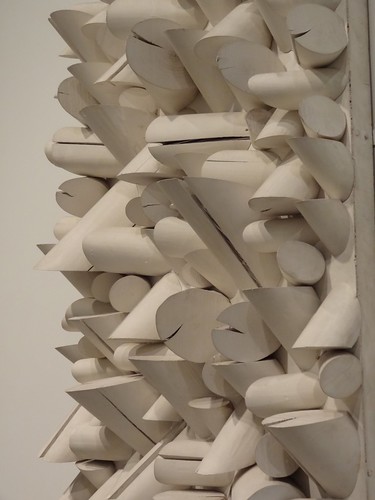
Then I saw this frenzied relief by Sergio Camargo (1930-1990). This Franco-Brazilian sculptor envisaged a synthesis of material roughness and artistic craft by using wood in a relief suggestive of crystal growth. More geometric obsession but with the added dimension of light-and-shadow play. I can tell you little more.
Large Split Relief No. 34/4/74, by Sergio Camargo. (1964-65).
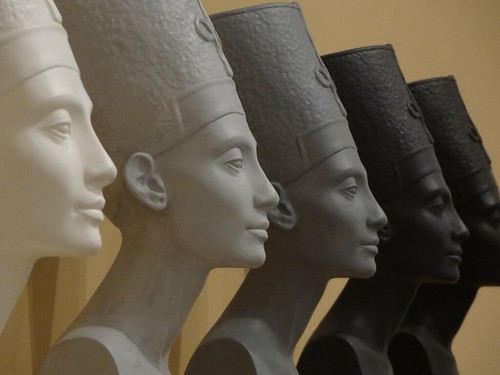
And, lastly, I saw Fred Wilson's exploration of racial identity, appropriation and myth, titled Grey Area (Black Version) (1993). Among African Americans there seems to be a perception that Nefertiti was a Black African queen, although, of course, historians are not as sure. Fred Wilson wanted to point out these obscurities and he did so by reproducing multiple copies of an ancient Egyptian bust of Nefertiti.
Grey Area (Black Version), by Fred Wilson. (1993).
As I was heading down one of the long escalators in the museum, I was struck by a translucent shield that partially reflected the escalators and allowed the people behind it to be seen. When I say 'struck', I don't mean 'struck', but 'struck', don't you know. I call this wonderful piece of dynamic photography Verisimilitude. Observe the interplay between the perpendicular and the transverse, the clean lines of the escalator and the intangibility of the reflection, the acceleration of the women straining to exit the premises and the concentrated communication of the other women. Note as well the juxtaposition of the mythical against the charitable, with the pudding melting off the sightless woman's head onto the donation cabinet beneath. Feel free to be awed and to acclaim.
... royal genealogists can achieve wonderful results through imaginative misrepresentation; vulgar forgery is unnecessary. By the skilful use of Englished forms, by an emphasis on titles as opposed to surnames, and above all by the selective filtration of unwanted bloodlines, dedicated family-tree-surgeons have transformed the dominant flavour of their product. No doubt with the best patriotic motives in mind, they have persuaded the unsuspecting public that British royalty's closes ancestral ties are with the English and Scottish monarchs all the way back to William the Conqueror and beyond. In the process, they have sidelined the royal family's far closer ties with the Hanovers, the Tecks, the Brandenburg-Ansbachs, the Brunswick-Wolfenbüttels, the Württembergers and the Schleswig-Holstein-Sonderburg-Glücksburgs. If the only the truth were known, the degree of consanguinity between the 'Mountbatten-Windsors' and the Normans, Plantagenets, Tudors and Stuarts is almost astronomically remote.
He goes on to point out that under Victoria and Albert, the British were prominently pro-German almost throughout the 19th century; after the world wars, the majority of the 20th century was Germanophobic. So it was that Diana Spencer regretted having married into a German family while Prince Albert never had any such regrets.
Es war ein Land, - wir liebten dies Land, -
Aber Grauen sank drüber wie Dünensand.
Verweht wie im Bruch des Elches Spur
Ist die Fährte von Mensch und Kreatur, -
Sie erstarrten im Schnee, sie verglühten im Brand,
Sie verdarben im Elend in Feindesland,
Sie liegen tief auf der Ostsee Grund,
Flut wäscht ihr Gebein in Bucht und Sund,
Sie schlafen in Jütlands sandigem Schoß, -
Und wir letzten treiben heimatlos,
Tang nach dem Sturm, Herbstlaub im Wind, -
Vater, Du weißt, wie einsam wir sind!
Nie zu klagen war unsre Art,
Du gabst und Du nahmst, - doch Dein Joch drückt hart!
Vergib, wenn das Herz, das sich Dir ergibt,
Nicht vergißt, was zu sehr es geliebt.
Agnes Miegel (1876-1964), Prussian poet, expelled from Königsberg, wrote refugee poems collected in a book called You are Still Part of Me.
Once there was a land - how dearly did we love it -
Yet waves of horror rolled over it, as dunes of sand.
Vanished as the elk's trail in marsh and meadow
Is every trace of man and beast.
Frozen in the snow, consumed in the flames,
Miserably they wasted in enemy hands.
How deep they lie under the Baltic's waves,
Their bones awash in bays and straits.
They sleep upon Jutland's sandy bosom, -
And we, the last of our kind, wander homeless,
Strewn about like seaweed afrer the storm,
Driven aimlessly like the autumn leaves, -
Heavenly Father, You alone know our desolation!
Part of the rising nationalism in Europe comprised in the insistence on a glorious past, often identified with great historical civilisations. The Aryans, of course, were a prime candidate for any people seeking an illustrious antecedence. The Hungarians had several models, chief among them Attila the Hun; among the others were the ancient Hindus. And so we have the 1909 tapestry by Sándor Nagy titled Sakuntala, which symbolically combines the Magyar notion of the deer as a holy symbol with that of King Dushyant's chase of the animal that led him to Sakuntala. [1]
Nagy was quite fixated on deer - he also depicted the beast in a frieze and on stained glass in the Veszprém Theatre, as well as a tapestry of the goddess Ildikó (1908).
Others have been fascinated with Kalidasa' tale of the unfortunate Sakuntala. Nikolai Karamzin, the great Russian historian, translated the tale into his language, claiming that it was a literature for the world. Here he was joining the likes of Goethe, Schelling, Herder, William Jones and de Chézy, in celebrating the great poem. Indeed, Abhijñānaśākuntalam was incredibly popular - nearly 10% of all works translated from Indian literature into Russian between 1792-1965 were of it! [2]
It's not just the Hungarians who were inspired by Sakuntala. Camille Claudel sculpted the remarkable 'Çacountala' or 'L'Abandon ou Vertumne et Pomone' between 1886 and 1905. It received much attention, and was kept in storage for several years. Claudel, of course, was channelling her own passion for Auguste Rodin. From Çacountala, she made subsequent variations, one of which is this lovely Vertumnus and Pomona:
L'Abandon ou Vertumne et Pomone, by Camille Claudel.
Closer to India, a Nepali artist delicately painted scenes from the play onto a wooden manuscript cover. Below is a small scene from it. This appears to be the only surviving manuscript cover for a purely secular work, and although there were some reservations over the identification of this work with Kalidasa's Sakuntala, a discovery in the 1980s of a mate to this cover completed the identification. [3]
Ink and colour on wood, manuscript cover from Nepal.
In India, Raja Ravi Varma's Sakuntala cycle is well-known. Here is the lady with her friends:
Shakuntala looking back to glimpse Dushyanta, by Raja Ravi Varma.
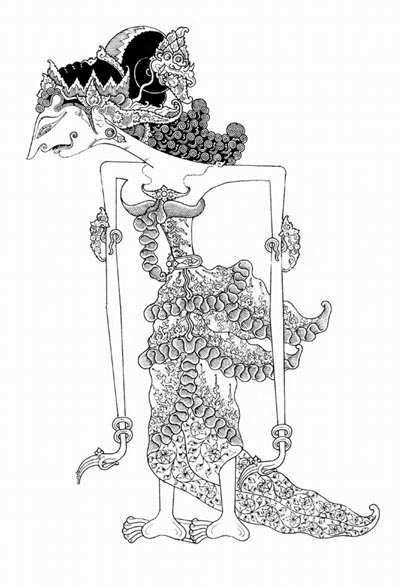
Meanwhile, music and dance saw their own manifestations of the gorgeous Sakuntala. Below is an example of Indonesian wayang (shadow-theatre) which is usually set to music. While there is evidence of indigenous story-telling predating the arrival of Hindu traders in the first century AD, much of the wayang oeuvre consists of tales from the great Hindu epics. Kisah Sakuntala, Ibu Kandung Bharata (or, The Tale of Sakuntala, the mother of Bharata) is one in the repertoire.
Sakuntala (Indonesian wayang)
One of Franz Schubert's operas is Sakontala (1820), an unfinished sketch with libretto by his friend J. P. Neumann. As late as 2000, one writer had written, "[Sakuntala] remains to this day the one and only Schubert stage work of which not one note has been performed for the public, anywhere, ever."[4] (This is not quite correct: a German television programme featuring Mallika Sarabhai's dance company had this music, and there have been some productions as well in the 1970s.)
Between 1913 and 1914, the sufi Hazrat Inayat Khan (1882-1927) visited Russia. He was received with much warmth in artistic circles, and he produced a ballet there titled 'Sakuntala'. The director Alexander Tairov had set up a new theatre; it was his hope to synthesise a multi genre spectacle. Inayat Khan's idea of a mystic balletic performance of Sakuntala appealed to Tairov. The music for the spectacle was arranged by Vladimir Pol. The New Theatre opened the production on 25 December 1914, with the title role played by Alisa Koonen. This wasn't a classical ballet but rather a dance interspersed with dramatic movements. Tairov wanted to present the production to the Czar, which sadly never happened. For a long time the music was thought to have been lost, but in 1991, it was found among various other documents at the Glinka Museum of Musical Culture. Three years later, a quartet of the Russian academy of music performed the piece. [5]
In 1889, Frederick Delius (1862-1935) set poetry by a Dane called Holger Henrik Herholdt Drachmann to music. A Dane! Who would have thunk it? Here's the first stanza of the poem:
Jeg kunde for Længsel ej sove,
En Blomstervind
Slog mig imod,
Strømmed herind ad mit Vindu
Som en vellugtaandende Flod;
Jeg hørte de høje Palmer
Suse svagt
Med sød Musik;
Det hvisked ihvor jeg stod og gik:
  Sakuntala, Sakuntala.
(I could not sleep for longing, a flower wind struck me ... )
It seems Drachmann had seen a staging of Kalidasa's play in Munich, and was struck by the parallels between his own ruined marriage and that of Sakuntala. [6]
Not to be left behind, the Italians got into the act as well. Here's Franco Alfano's 'La leggenda di Sakùntala', first act. He wrote it in 1921.
And that's it for now!
References
1. Jeremy Howard, Art Nouveau: International and National Styles in Europe, Manchester University Press, 1996.
2. Susmita Sundaram, 'Translating India, constructing self' in (ed.) Brian James, Contexts, Subtexts and Pretexts: Literary Translations in Eastern Europe and Russia, John Benjamins Publishing, 2011.
3. (ed.) Martin Lerner, The Flame and the Lotus: Indian and Southeast Asian Art from the Kronos Collections (p. 90), Metropolitan Museum of Art, 1984.
4. Uncle Dave Lewis, 'Franz Schubert: Sakontala', AllMusic.com
5. Cyclowiki, Shakuntala ballets (in Russian).
6. Hattie Anderson, 'Vilhelmine, the Muse of Sakuntala', The Delius Society Journal, Spring 2000, Number 127. (See here for PDF.)
Themes appear in clumps in my alphabetical assault on thin books. Among the 'M's is mortality, sudden and shocking in some cases, gradual and insidious in others. I have in mind David Miller's Today, where a family gathering to celebrate the younger son's 18th birthday is cast into disarray by the death of the father. I also have in mind Tessa McWatt's Vital Signs, where a cerebral aneurysm causes confabulation in a mother, and her confusing speech lays bare the tensions among the rest of the family, who deal with her degradation with varying levels of defiance, guilt and pain.
Miller's debut novel is set in 1924 when Joseph Conrad died. His wife is an invalid who faces a life of increasing discomfort and loneliness. His elder son has returned damaged from the Great War and is enraged with his father for being distant, jealous of his younger brother for receiving Conrad's attention, worried about making ends meet for his own young family. The younger boy recalls his father's kindness and cannot imagine a life ahead without the shelter of that love. Conrad's secretary is in the book as well: her mind is not as sharp as it once was, and she has her own memories of the author; but did their intimate work relationship also become an affair? Conrad's great friend Curle, a journalist, is most moved by the passing, and tries to keep the family coherent. The book is strong on details of activity that ensue after the death, activity that wants to take the place of emotion. But emotion is above all in this book, in the fraternal rivalry, in the distance Conrad's wife feels from her own siblings, and in the desolation that Conrad's secretary faces.
Aleksandar Maćašev's illustrations for Vital Signs
Tessa McWatt's little book is filled with illustrations by the remarkable Aleksandar Maćašev, illustrations that the husband uses as the only possible way to communicate with his sick wife. Long years of intimacy and sexual satisfaction have not prevented him from straying. He blames his wife's strength and the downward spiral of his own once successful career for his infidelity. Yet he is hardly supportive of his lover despite their years-long affair. It is clear he is quite an unreliable man, and even in his introspection there is falsity. When his wife retreats into false memories of her life following her aneurysm, however, he is desperate to bring her back. As he examines their lives together, he learns of his disappointment with her and his own selfishness. While Vital Signs is about his attempts to reconnect with his wife, for me the true tragedy is the fate of the children who have been cast into the world with little empathy from him, and who respond in their own ways - shamed, conciliatory, passive, enraged. It is a traumatic doubt that many a parent faces - what if their children become strangers to them?
****
I should also mention Simon Okotie's clever 'Whatever Happened to Harold Absalon', a tale of a seedy, horny, intensely self-analytical, obsessive detective named Marguerite, who is following the wife of the disappeared Harold Absalon. Okotie wrote this book while commuting by bus, and the action, such as it is, is predominantly on a bus, except that the book is less about plot (the entire narrative covers about half an hour of action) than about the dendritic manner of thought, where every thought has sub thoughts and digressions. The time it takes Marguerite to board a bus and then get off it requires tens of chapters because at every juncture, Marguerite - or a person who is looking into his head and questioning his motives - feels it necessary to explain himself as thoroughly as possible, as though he were in court, facing a deeply inquisitive judge. The nesting of thoughts is long and rambling, and runs into paragraphs of dense prose. There is humour in this obsession, but it is rapidly wearying, and though the book is exactly 200 pages long, the conceit loses its charm in about 50. Still, I wouldn't dismiss it entirely, as despite Marguerite's desperation for accuracy, it's clear that there may be another, more troubling, parallel narrative. If you read it, let me know what you think.
****
Then there's Herta Mueller's The Passport, which is as grim an account of social ostracism and despair as I have ever read. Mueller is of the Swabian (German-speaking) minority in Romania, and this little book is about the desperation of a miller to emigrate from Ceausescu's pitiful country to Germany. The book seethes with corruption, paranoia and disaffection: the priest demands sexual favours to provide baptismal certificates; the militiaman demands sexual favours to forward the papers to the relevant authority; you are not even convinced that life in Germany is any better, what with its own lax social mores and filth on television; the Romanians despise you and can barely wait to get rid of you so they can take over your property. Life under totalitarianism is so invidious in its effects that humanity itself is lost. Everything that can bring joy in freedom is twisted out of shape here. Can you even trust your own family?
I have modestly given myself the name of the greatest of the Eldar: Fëanor, the maker of the Silmarils and the creator of the Tengwar. He was a Master of many things. I am merely a Jack.