JOST A MON

The idle ramblings of a Jack of some trades, Master of none

Sep 10, 2012

The City in Art

The other day I went into the Guildhall Art Gallery where I found an entire series of artworks depicting the heart of London over the centuries. Here are a few that I liked.

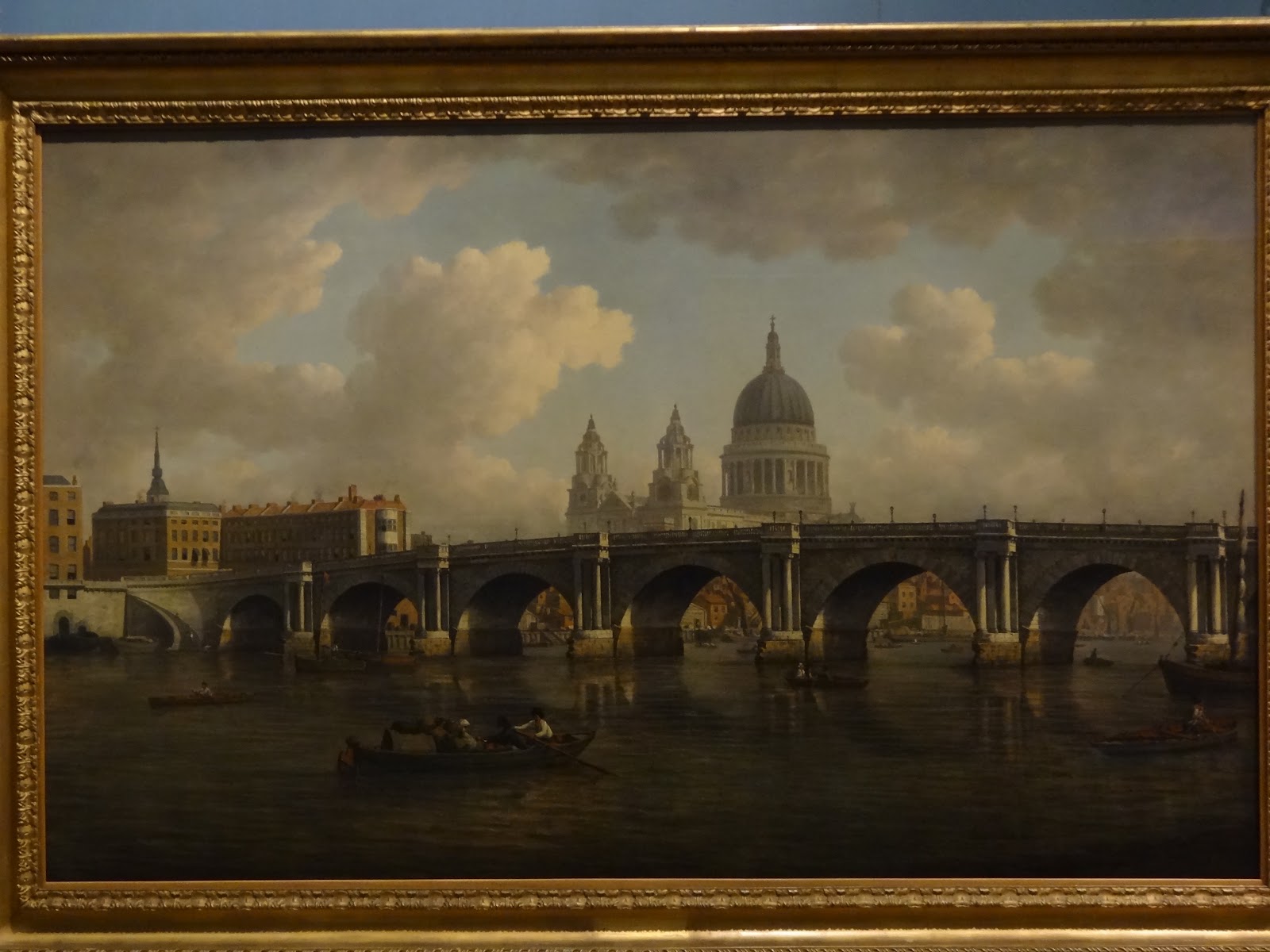
First off, Blackfriars Bridge and St Paul's, a view painted many times by William Marlow (1740-1813). The City wharves are visible through the bridge's Portland stone arches. The design of the bridge was by a 25-year-old man called Robert Mylne who had been influenced by Piranesi during his sojourn in Italy.

Blackfriars Bridge and St Paul's Cathedral, by William Marlow
Next, we have a depiction of a frozen Thames, which happened fairly frequently in the years before the demolition of Old London Bridge, the river's flow having been impeded considerably by that structure. Frost Fairs used to be held atop the ice. This view is from Whitehall looking north and east from Westminster Bridge on the right, which was under construction at the time.

The Thames during the Great Frost of 1739-40, by Jan Griffier
And finally we have a Canaletto-like sharply limned and well-lit view of the entrance to that foulest of London sewers, the Fleet river. This is an idealised view of the Fleet Ditch with the Bridewell Footbridge making London appear a bit like Venice. St Bride's Church's spire, the Bridewell belfry and St Martin Ludgate's spire are seen atop the roofline.

Entrance to the Fleet River, by a follower of Samuel Scott

Dec 28, 2011

Another Random Tootle

And again, instead of going to the gym, I go on a random walk around my part of London. I walk briskly, honest. I cover about 3 miles in 45 minutes, burn 320 calories, and see some sights and witness some events and overhear some chats. And read some petitions and speak some French.

The initial and fastest leg is from Bank over Southwark Bridge to Borough High Street. I nip past Borough Market, observing the long queues at Neal’s Yard Dairy (a fine British cheesemonger). Desperate Christmas shoppers throng the place. Some of my colleagues have recently received boxes of Neal’s Yard cheeses from their brokers and I am delighted to see that such specialties as Appleby’s Cheshire and Sparkenhoe Red Leicester have pride of place on Neal’s Yard’s shelves. I haven’t had either cheese but I intend to as soon as I have this cholesterol thing beat, and shall report at length. 2012, here I come.

There are even longer queues at local pubs. What’s with people drinking at 3pm, I ask you?
At 67 Borough High Street, I see a lovely red building on which appears the following legend: W H & H Le May Hop Factors. Surely that’s worth a brief investigation? Yes, it is.
W H & H Le May Hop Factors
I find that the Le Mays were a famous supplier of hops to brewers and the like. (The Le Mays were a well-to-do family. One of them, Lt Algernon Le May, aged 34, perished in the Great War – his name appears on a nearby war memorial.) The hop trade was a major part of Southwark till nearly the 1970s. For centuries, Borough High Street and Old London Bridge were the only means of ingress into London from the south. The area, therefore, was dotted with inns and taverns. Recall Harry Bailey who led the pilgrims in Chaucer’s tale? He was a proprietor of a local tavern, and very rich to boot. Hop factors were warehousers and intermediaries between the growers and the breweries.


Southwark is rich in listed properties, many pre-dating the 19th century. This building though is rather modest inside. 19th century developers liked to apply a bit of embellishment to the exterior to aggrandise their creations.


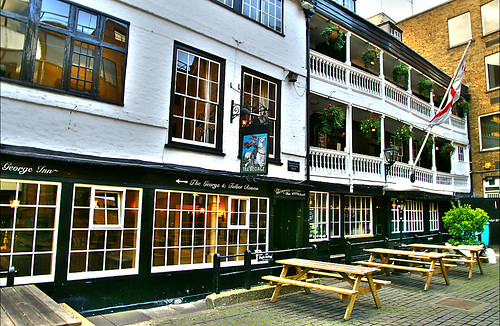
Not fifty metres away at 77 Borough High Street is George Inn, one of the last extant hostelries in Southwark. This was built in the 17th century. These inns catered to horse-drawn traffic, and were situated on long plots with a narrow frontage onto the main street. These survive mainly in name only. I don’t go inside George Inn Yard to inspect the inn itself. I’ll leave that for another time I shirk off gym. It’s a National Trust property, which helps as I am a member. But here’s a picture of its lovely galleried front.
The George Inn - Southwark - London
 [The George Inn by Nick Garrod, on Flickr]
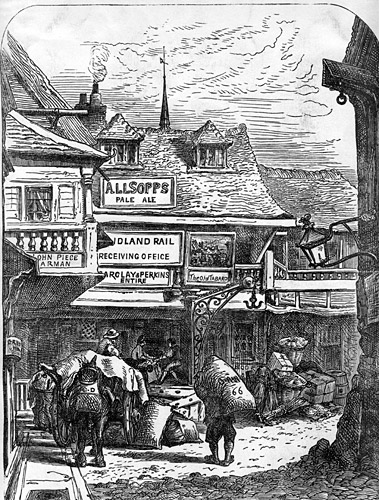
A little further along and a quick left onto Talbot Yard reveals a non-descript office building on which appears a plaque. Here stood Chaucer’s Tabard Inn, from where the pilgrims set off on their grand trip to Canterbury. Just like the George, it had burned down in the 17th century and was reconstructed; unlike the George, it didn’t survive the Industrial revolution, and exists only in literary memory. Luckily, we have engravings of it from the 180o’s when it looked a bit like this:
[The Tabard Inn, c. 1850. Wikimedia Commons]
I retrace my steps to Borough High Street and shift left on Newcomen Street. I hope there might be a plaque or some memorial or the other to the only Newcomen I’ve heard of, who invented the steam-powered pump and inspired James Watt’s steam engine. But he was a Devon man, and I am not sure if he had much to do in London.

Like many of the side-streets in Southwark, this street too used to be coaching inn yard (once called Axe Yard). In the 17th century, it came to be owned by two charities. One building bears the name of one of the charities – John Marshall’s. The street, however, is named after the other – Mrs Newcomen’s. She owned three messuages – ha! I learn a new word – one of which was in Axe Yard, and she bequeathed them upon her death in 1675 for "the clothing of poor boys and girls with a suit of linen and woollen once a year, whereof two-thirds . . . [were to] be out of the Borough side, and the other third . . . out of the Clink Liberty . . . and for . . . teaching them to read and write and cast accounts, and for . . . putting forth boys apprentice at 5l a piece, at their age of 14 years." (Quote from here.)

As I continue along Newcomen street – not the prettiest street in Southwark, admittedly – I note signs everywhere of King’s College and Guy’s Hospital. Every time I look up, I see the immense Shard. It looms over the entire borough. Guy’s Hospital is so much more to human scale. There is a courtyard with an arch. It is another memorial to the fallen soldiers of the Great War.
 Keats at Guy's Hospital
[John Keats at Guy’s Hospital, by Mike Paterson]

Beyond is a colonnade separating two inner courtyards. In one of them stands Lord Nuffield, a benefactor of the hospital, and in the other is a seated John Keats, a bronze-work by Stuart Williamson inaugurated in 2007. The great poet had trained as a surgeon in the hospital, and quit, undone by the gruesomeness. As far as I can tell, the only bit of medicine that ever appeared in his poetry are these lines from Ode to Fanny:

Physician Nature! Let my spirit blood! 
O ease my heart of verse and let me rest; 
Throw me upon thy Tripod, till the flood 
Of stifling numbers ebbs from my full breast.

Across St Thomas’s street is the Old Operating Theatre and Herb Garret. It is closed, unfortunately, till the New Year. As I head away from it, a lovely girl steps out in front of me, followed by a young man who tells her, 'I have an entire archipelago of mistresses.'

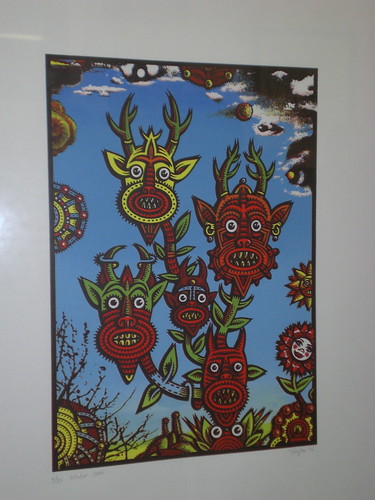
Say what? Before I can react, they disappear into a side street. Scratching my head, I continue along St Thomas’s Street till I get to Crucifix Lane. I see a sign for the Fashion and Textile Museum. There’s no time to take a gander at that; I turn towards the Shard. Construction all around has wrecked views and entrances and my neck hurts from craning. I see BVAG petitioning against the demolition of Southwark’s heritage (London Bridge is the first city-centre railway terminus, it thunders, it should not be treated so shoddily; prevent the demolition of prime Victorian-age train sheds), and I see an interesting art gallery. It is called the Underdog Art Company, exhibits graphic art and has live music shows, and I’m afraid I have no time for that either.


Underdogart Exhibition


[Silk Screen Print by Tony Lee at Underground Art Co. Image by Shuby, on Flickr.]


I am accosted by a couple of young women. ‘Excuse me, sir,’ says one. ‘The Underground?’ She has a strong French accent, and waggles her fingers down. West African, I surmise, so in my best French I respond, ‘Suivez la rue 300 mètres et tournez à droite.’ They grin at me happily. ‘D’accord!’ says the other woman, and giggling at my accent (I hope) they head away.

The rest of my walk is even brisker than ever – onto Barnham Street to Tooley Street, left onto Tower Bridge Road and over that fruitcake bridge back to the City. I don’t stop anywhere, just burn my soles on Tower Hill and Tower Street and Eastcheap and King William Street, all the way back to Bank.


[There once used to be a neat little website for the North London Walkers describing some interesting walks in this great city. It no longer exists. Luckily the time machine that is archive.org has snapshots of it from before it went kaput. I’m reposting the (slightly) re-edited versions here, with added pics.]

This 11 kilometre long route starts at the Tower of London and, after crossing over Tower Bridge, follows the River Thames upstream offering panoramic views of the City and Westminster.  The South Bank of the Thames at this point is in the London Borough of Southwark and it is here that you will find a full size replica of Sir Francis Drakes Golden Hind and Shakespeare's Globe Theatre.

As you continue along the riverbank you enter the London Borough of Lambeth where you will find the London home of the Archbishop of Canterbury, Lambeth Palace, and the new headquarters of MI5 the British Secret Service.

At this point you recross the river over Vauxhall Bridge and then walk back downstream to the Houses of Parliament, passing on the way the Tate Gallery. Next to the Houses of Parliament you will find Westminster Abbey, where the coronation of England's Monarchs takes place and where many of them were later buried.

The route then continues along the riverbank, past Cleopatra's Needle, to the Temple Tube Station.

Start :- Tower Hill Tube Station (Circle & District Lines)

Upon exiting the station go down steps under road towards The Tower of London. Turn left at the Tower Moat and follow it round to Tower Bridge Approach.

Q1 - On the North Tower of Tower Bridge there is a plaque. Who opened the Bridge?

Cross over Tower Bridge (River Thames) and go down steps in middle of the footpath on the South side. At the bottom of the steps turn Right and travel along the embankment towards HMS Belfast. Proceed past HMS Belfast to Hays Galleria, turn left into the shopping arcade which emerges in Tooley Street. Turn right along Tooley Street, just past the London Dungeons turn right (the road is still Tooley Street). Continue along passing under London Bridge and emerging in Montague Close behind Southwark Cathedral.

Q2 - On the right 10 yards beyond the bridge is a Hall used by three City Livery Companies.  What is the name of the hall?

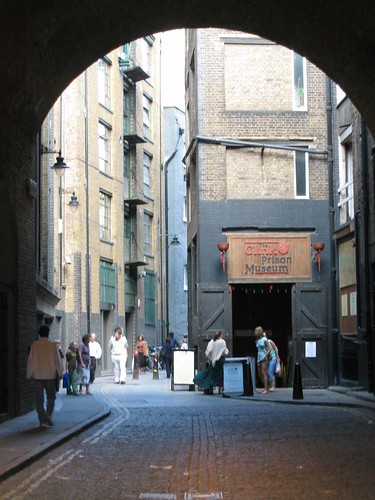
St Mary Overy Docks and the Clink Prison Museum

At the end of Montague Close turn right to Pickfords Wharf. Go past St. Mary Overy Dock and the remains of Winchester Palace and into Clink Street. Travel along Clink Street, past the Clink Prison Museum, and turn right after passing through the railway arch. This will bring you back out onto the South Embankment. Turn left and continue following the riverside path, going under Southwark bridge and past the Globe Theatre and the former Power Station and on to Blackfriars Bridge.

Q3 - At Blackfriars Bridge there is the remains of the old railway bridge. Which Railway Company's crest is displayed here?

Gabriel's Wharf, South Bank

Pass under the bridge and then past Sea Containers Wharf, Gabriels Wharf and the London Weekend Television Centre. You will then come across a complex comprising The Royal National Theatre, The National Film Theatre, The Queen Elizabeth Hall, Royal Festival Hall, The Hayward Gallery and the Museum of the Moving Image.

Q4 - Along the route at various points there are silver plaques on the ground. What do these plaques commemorate?

Continue along the River bank past the above complex and under Waterloo Bridge and Hungerford Railway bridge and past Jubilee Gardens and the Old County Hall. Go under Westminster Bridge and continue along the Riverside path (Albert embankment) past St. Thomas's Hospital and Lambeth Palace to Lambeth Bridge.

Front Gate of Lambeth Palace

Q5 - What museum is situated near the entrance to Lambeth Palace?

Go under Lambeth Bridge and continue along the Albert Embankment past the Headquarters of the London Fire Brigade and the new headquarters of MI5 (Vauxhall Cross) to Vauxhall Bridge. Cross over the River at this point, turn right on the far side and walk along Millbank back towards Lambeth Bridge, passing the Tate Gallery on the way.

Q6 - In the gardens to the right of the main entrance to the Tate Gallery there is a statue. Who is it of?

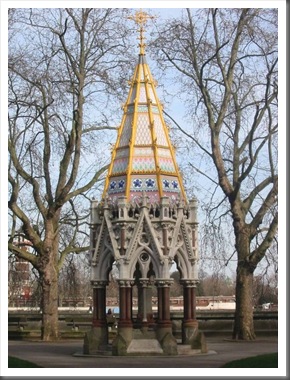
Buxton Memorial Fountain in the Victoria Tower Gardens (© Derek Harper) At Lambeth Bridge cross over the road and go down the steps into Victoria Tower Gardens. Travel through the gardens towards Palace of Westminster/Houses of Parliament. Walk around the perimeter of the Houses of Parliament to the Clock Tower (Big Ben), passing on the way Westminster Abbey and Parliament Square. Once at the Clock Tower cross over Bridge Street and continue along Victoria Embankment.

Q7 - On the corner of Westminster Bridge opposite the Houses of Parliament there is a statue. Who is it of?

Somerset House

Walk along the North Bank past Scotland Yard, Ministry of Defence and the old paddle steamers SS Tatershall Castle and the Hispaniola. Then pass under Charing Cross Railway Bridge past Cleopatra's Needle and then under Waterloo Bridge. You then pass Somerset House and Kings College and about 30 yards further along come to the finish.

Q8 - Almost opposite Temple Tube Station there is the first of three ships moored. What is its name?

Finish:- Temple Underground Station (Circle & District Lines)


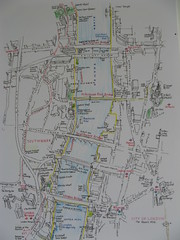
City Map of London's Thames
Originally uploaded by Feanor
I took this photo of a display map of the London Mayor's Thames Festival displayed near London Bridge. The boy and I were on a small expedition along the river to Waterloo.

Aug 10, 2009

Cherrapunji

I never thought Cherrapunji (once the wettest place on Earth) had another, even more remarkable, claim to fame.

Root Bridges!

Trees whose secondary roots can extend many metres across streams and are strong enough to support up to fifty people at a time!

Amazing stuff.

In Britain, our poets have always had a very intense relationship with the places that matter to them. In this post, taken almost verbatim from Owen Sheers’ excellent television series on BBC, we look at a poem by one of the greats that has come out of this ongoing conversation between Britain’s landscape and her poets. The most famous such conversation was that between William Wordsworth and the Lake District. When we think of Wordsworth, the images that probably come to mind are lakes, wandering clouds and daffodils. And yet, in 1802, when he wrote, in what would become one of his best known poems, “Earth hath not anything to show more fair”, the beautiful view he was writing about wasn’t a mountain or some flowers he had stumbled upon. He was writing instead of this place - London.

Composed Upon Westminster Bridge (William Wordsworth) 
Earth has not anything to show more fair:
Dull would he be of soul who could pass by
A sight so touching in its majesty:
This City now doth, like a garment, wear
The beauty of the morning; silent, bare,
Ships, towers, domes, theatres, and temples lie
Open unto the fields, and to the sky;
All bright and glittering in the smokeless air.
Never did sun more beautifully steep
In his first splendour, valley, rock, or hill;
Ne'er saw I, never felt, a calm so deep!
The river glideth at his own sweet will:
Dear God! the very houses seem asleep;
And all that mighty heart is lying still!
This poem is a fourteen-line sonnet about London at dawn, one of the great love songs to the city.

London It is a fabulous piece of writing that does all the things that a good poem should: in the incredibly short space of a page, it takes us somewhere, it manages to change the weather in our heads. It is also a poem very much of its time, and yet manages to travel remarkably well, in that were we to walk across Westminster Bridge today, we would still have the same basic experience. There would still be Wordsworth’s moment of stillness betwixt all that activity on the banks. We only need to talk to the people who cross it every day in the morning on their way to work to get a sense of this. The best thing for me about seeing the river in the morning is it’s a very small world shared with very few people. So very early in the morning when just the sun’s coming up, it feels like a little town. This is a beautifully simple poem about the city at dawn. So how come it was written by a poet from the Lake District? What was Wordsworth doing on Westminster Bridge that morning? Where was he going? What was on his mind?

The story behind the poem is the surprising tale of Wordsworth’s love life, the complex tale of his love for three different women.
Lake District Lakeland poet William Wordsworth was, of course, one of the towering figures of English Romanticism, alongside Keats, Byron, Shelley, and Wordsworth’s close friend Coleridge. When he started writing at the end of the 18th century, he was an idealistic radical. By the end of his life, in the middle of the 19th, he’d become the revered and grand old man of English verse. The Lakes was where he was born and bred, spent most of his life, and where his poetry seems indelibly inked on the landscape. For Wordsworth as a writer, the landscape of the Lake District was so much more than just his poetic canvas. It was his teacher, his muse, or as he said himself, “The anchor of my purest thoughts, the nurse, the guide, the guardian of my heart, and soul, of all my moral being.” Although he was raised in the lakes, at 17 he moved away, first to university in Cambridge, then becoming something of a nomad, spending much of his time hiking across England and Wales, and further afield on trips to Switzerland, Germany, Austria and revolutionary France. During those years, he searched restlessly for a purpose for his life, aiming to define his ideas about nature and religion and politics. In 1800, at the age of 29, he found himself once again without a permanent residence and with a growing certainty that he was ready to go back home.
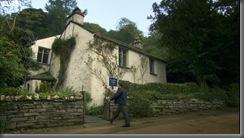
Dove Cottage In the autumn of that year he returned on a walking tour with Coleridge. It was on that tour that he discovered the cottage that became his home. Dove Cottage immediately seemed the ideal place in which to begin a new chapter in his life.

At this point in his life, it is fair to say that in the eyes of the world, he had achieved relatively little. But once ensconced in this place, all of that began to change. When he moved in here, the house was cold; apparently one of the chimneys smoked very badly; but Wordsworth didn’t mind: he was ecstatic finally to have a home. The publication of the radical collection of his and Coleridge’s verse, Lyrical Ballads, had started to make his name. But with the new-found security of this place, over the next three years, Wordsworth would go on to write some of the best poetry of his life.

But Wordsworth didn’t come to Dove Cottage on his own. He moved in with his sister Dorothy. William and Dorothy were brought up separately, after the death of first their mother and then their father. However, they retained a strong emotional bond, and in their mid-20s, out of friendship and convenience, they began living together. By the time they moved to Grasmere five years later, they were clearly devoted companions.

The fascinatingly intimate journal that Dorothy kept about their time together here is the main source of information about their daily routine. It’s also clear from the pages of this journal that brother and sister shared and discussed many of the experiences that would go on to become Wordsworth’s poems. There is still a strong echo at Dove Cottage of that intense literary and personal relationship between brother and sister, although neither these rooms, Dorothy’s journal, nor Wordsworth’s poems, answer the many outstanding questions about their artistic and emotional interaction.

Adam O’Riordan is the writer-in-residence at the Wordsworth Trust in Grasmere. What is it like for him to live with William and Dorothy?

There is this sense of the things that Dorothy and William and Coleridge and everyone else was pushing towards do still live on here in a way. I guess the role of the poet-in-residence is to embody that, and to be that, if that doesn’t sound too grand, which it’s not. You’re keeping that going, you’re writing the poems. There is something so winning and drawing about re-imagining the intimacies that existed between the Wordsworths, between Dorothy and Mary and William, and what went on in that house. It is a great starting point for poems. I know other poets have successfully written about them, but they are great places to go to fire your imagination.
A Double Wash Stand (Adam O’Riordan)

Before the age condemned such joint ablutions
You dip your hands in the tepid water
as geese come in low across the lake
landing on their shadows,
their shadows becoming their wake
breaking apart the imago
they seem to chase.
So you break this tension
shattering your own reflections.
There’s a complicity
in getting clean together
who knows what distances
you travelled in your sleep
back towards one another,
and the secrets
that those distances will keep
each movement fluid
and practised in the winter air
You revel in this intimate act,
not quite each other’s double.
Your easy mime of mannerisms
from other lives
like brother and sister.
No, I mean man and wife.

There will always be speculation about William and Dorothy’s relationship at Dove Cottage. But she certainly wasn’t the only woman in Wordsworth’s life. One of his closest friends at the time was a Lakeland girl, Mary Hutchinson. Wordsworth had actually been in the same school as Mary, so he’d known her almost all of his life. In the summer of 1787, she joined William and Dorothy on their rambles through the woods and hills of Penrith. Since their arrival at Dove Cottage, she’d been a regular visitor. At some point, possibly around the end of 1801, William decided to ask her to marry him. His marriage to Mary and her settling in at Dove Cottage would be the final keystone in the architecture of this newly settled life that Wordsworth was building for himself at Grasmere.
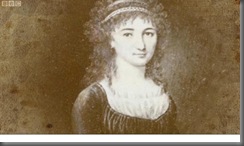
Annette In early 1802, William and Mary were more than ready to get married. But there was a problem. Several hundred miles from Grasmere there was another woman who had been calling herself Mrs Wordsworth for the last ten years. Annette Vallon, the third woman in this story, had met Wordsworth when as a hot-blooded young graduate he travelled to France to take a look at the Revolution in action. He met Annette in Orleans. One thing led to another and a couple of months after they met she was pregnant. Wordsworth left France before the baby was born, and although he may have planned to return, a few weeks after he came back, France declared war on England. Return to Annette and his newly-born daughter Caroline became impossible, and gradually, his thoughts of France began to fade.

In the spring of 1802, Wordsworth realised that he just couldn’t get married to Mary without first going to France to speak with Annette face to face. Thanks to a recent peace treaty with the French, this was, for the first time in a decade, actually possible. On the 9th of July, William left Grasmere for London on his way to Calais. As ever, he wasn’t travelling on his own. His companion was his sister, Dorothy.
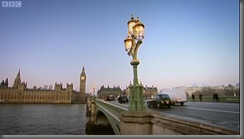
Westminster Bridge Wordsworth had both enjoyed and suffered the maelstrom of London on a number of occasions before 1802, and his poetic responses sum up the sensory overload that the capital made on his Lakelander sensibility: “…the quick dance / Of colours, lights and forms; the Babel din; / The endless stream of men, and moving things, … / The comers and the goers face to face, Face after face …” This was the city in which William and Dorothy found themselves, when early on the morning of July 31st, 1802, they arrived at Charing Cross to catch a stagecoach for Dover. The Wordsworths had taken their seats on the top of the carriage, quite possibly because they were cheaper, and this meant that they were able to see over the bridge’s parapet, which at the time was much higher than it is today. As they crossed over Westminster Bridge, they were both enraptured by the view, which more than likely remained their topic of conversation as the coach carried on towards Dover. When Dorothy wrote about their trip to France some months later, her journal seems to pause for a moment to pay special attention to the view from the bridge.

“It was a beautiful morning. The city, St Paul’s, with the river and a multitude of little boats, made a most beautiful sight as we crossed Westminster Bridge. The houses were not overhung by their cloud of smoke and they were spread out endlessly, yet the sun shone so brightly with such a pure light that there was even something like the purity of nature’s own grand spectacles.”

This entry from Dorothy’s journal clearly shares William’s images and words, and we can only imagine that it was their conversation on the bridge that morning which brought the poem to life.

View of Thames painting The basic experience that Wordsworth is describing and is making us relive in this poem is one of course that all of us experience all the time in cities. When you’re on one side of the river, and you’re in those very close horizons of the streets, and you’ve got buildings all around you, you’ve got a lot of noise and activity; and then you step out onto the bridge, and you walk across the bridge, and then suddenly there’s this space in the air, you haven’t got buildings in front of your eyes. You’ve got the river there.

The movement of the poem is very simple, from that opening line of astonished statement through to that sense of a very deep calmness. But across that movement the poem is charged crucially by a sense of brevity, a brevity that explains the bridge itself; then there is the brevity of the form, the sonnet, which gives the poem its potency, its power. Even in the very first line: “EARTH has not anything to show more fair” the weight on that first syllable is total; imagine how much weaker it would have been had he said “the world” and we didn’t have that weight until the second syllable. That continues onto the second line when he says, “Dull would he be off soul who could pass by.” Who would want to be thought of as dull of soul? None of us, so we stay with the poet and we linger. And then again, the close of the poem is broken up with this quite surprising apostrophe - “Dear God!” – before it falls down to a sense of beautiful calm - “the very houses seem asleep; / And all that mighty heart is lying still!”

It’s a sublime vision of London, in which the city becomes a sleeping, breathing, organic creature. Simon Armitage, a poet who shares Owen Sheer’s fascination for this poem, says that that dramatic first sentence, , might lead one to believe the poem was about a mountain or a lake or some such artefact of splendid nature. Instead, one is startled to find that the poem is about London; surely an antithesis of Wordsworth? But further readings reveal that there can be no beauty or sense of miracle in London (or in any city, for that matter) without the presence of nature. The city is transfigured by the morning sun. Not only that, the city is framed as well. There’s a phrase about being open to the fields and the sunlight … every part of the city has a border of nature: the sky, the sun, the fields, the river.

The evening of the day the Wordsworths crossed Westminster Bridge, they took a boat over to Calais. They arrived early next morning. William went ashore and met Annette almost immediately. In 1802, Calais was no more glamorous a town than it is today, but it must have been fascinating to visit after a decade of strife between France and England. Dorothy’s journal is quite detailed about some of their time here. She complains about the bad smells in her lodging, she waxes lyrical about the phosphorescence in the sea. She is frustratingly quiet on the things we really want to know about: what was it like for William and Annette to see one another again? was there still any spark? how was it for William to meet his nine-year-old daughter for the first time in his life? His already imperfect French would have been fairly rusty, so how did they even manage to talk to each other?

What we do know is that they spent a lot of time together on the beach. “We walked by the sea shore almost every evening with Annette and Caroline, or William and I alone. I had a bad cold and could not bathe at once, but William did.” This beach holiday lasted a whole month, and while there’s no surviving record, William and Annette obviously reached some kind of agreement which allowed him to marry with a clear conscience.
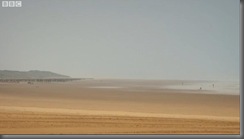
Calais Beach That month also afforded William plenty of time for writing poetry. He loved to form his poems while he was walking, ideally on uninterrupted ground so that his rhythms and thoughts were not disturbed. So the impressive expanse of the Calais beach would have been the perfect place for him to compose, especially because the dozen or so poems he wrote over that month were all sonnets, 14 lines, tightly packed, and easy to hold in the mind as he strode along the sands.

Once again, Dorothy had a crucial hand in this. She had been reading the sonnets of the great John Milton to her brother. It was these that prompted him to experiment with the sonnet himself. In one fantastic poem, a counterpoint to his sonnet about the dawn in London, he tenderly addresses his daughter Caroline.
It Is A Beauteous Evening, Calm and Free (William Wordsworth)
It is a beauteous evening, calm and free,
The holy time is quiet as a Nun
Breathless with adoration; the broad sun
Is sinking down in its tranquillity;
The gentleness of heaven broods o'er the Sea:
Listen! the mighty Being is awake,
And doth with his eternal motion make
A sound like thunder--everlastingly.
Dear Child! dear Girl! that walkest with me here,
If thou appear untouched by solemn thought,
Thy nature is not therefore less divine:
Thou liest in Abraham's bosom all the year;
And worship'st at the Temple's inner shrine,
God being with thee when we know it not.

It’s curious that this unique and brief reference to the poet’s daughter, although fond, seems strangely detached, especially when compared to the passion that Wordsworth expresses about London. That summer of 1802, he appears to have focussed his energy on refining his skills as a sonneteer. The sonnets he wrote all are impressive, and they provide an important context for the sonnet on Westminster Bridge. What is really fascinating about the story around the writing of this poem is how it touches on so many exciting elements of Wordsworth. Nowadays his reputation is quite often drawn from the later part of his life, from his Establishment phase, but it should be remembered that he was, in his youth, quite the rebel. He was a father outside of wedlock, he was widely travelled, he was a sympathiser of the French Revolution, and he chose to lead a literary life outside of London. His poem therefore moves between these two places that really formed Wordsworth – the Lake District and the radical revolutionary France that he had known as a young man.

And right in the middle, halfway between those two places, is London. Seen in this context, it is not surprising that the poem, in its own way, is quite radical. As Simon Armitage says, it has been usual in traditional literature to see cities as places of evil intent, filthy, inhuman, murderous places. Wordsworth, though, takes the opposite view, a watershed moment in poetry. Although the poem is sentimental and romantic, it is still a brave poem, especially for Wordsworth (whose sympathies do lie elsewhere) to stand up and say at this moment that this is beauty.

The Vision (Simon Armitage)

The future was a beautiful place, once.
Remember the full-blown balsa-wood town
on public display in the Civic Hall.

The ring-bound sketches, artists’ impressions,
blueprints of smoked glass and tubular steel,
board-game suburbs, modes of transportation
like fairground rides or executive toys.
Cities like dreams, cantilevered by light.
And people like us at the bottle-bank
next to the cycle-path, or dog-walking
over tended strips of fuzzy-felt grass,
or motoring home in electric cars,
model drivers. Or after the late show -
strolling the boulevard. They were the plans,
all underwritten in the neat left-hand
of architects - a true, legible script.
I pulled that future out of the north wind
at the landfill site, stamped with today’s date,
riding the air with other such futures,
all unlived in and now fully extinct.

From London, the Wordsworths headed back north, where William finally got to marry Mary. He brought his new bride back to Grasmere where they lived for the rest of their lives, eventually ending up at the grand Victorian villa in Rydal Mount, barely twenty minutes’ walk away from Dove Cottage. Dorothy lived with his brother and sister-in-law for the rest of her life, in what was a fairly unusual but remarkably successful domestic arrangement. And the third woman from that summer of 1802, Annette, and her daughter Caroline, as far as we know, only met Wordsworth one more time, while he was on a holiday in Paris with his family twenty years later, by which point, he and Mary had three teenage children of their own.

In the end, we have no idea how Wordsworth responded to the complex situation he found himself in that fateful summer, meeting his mistress and a daughter for the first time on the eve of his marriage to Mary. But what we do know is that as a result of that journey, Wordsworth, our great poet of nature, wrote one of the most euphoric poems about a city in the English language. The resonance of the poem has strengthened over time. As London becomes more built up, as we find ourselves more and more surrounded and dwarfed by the buildings around us, the experience that the poem describes of the great sense of relief that washes over us as we cross the Thames has over the years become not less but more powerful.

Written and Narrated by Owen Sheers: A Poet’s Guide to Britain, BBC Four.
Britain is a country that owes a great deal to its rail empire. For a century, the railways dominated the development of this country. This was a network that supported a global superpower. But today, the British Isles are home to ten thousand miles of disused lines, a silent grid of embankments, stations, and viaducts. For many, they have become the perfect platform for exploring the country on foot.

The Speyside Way

Along the banks of the river Spey, Scotland’s second longest river and one of its most famous, people come from far and wide to fish for salmon in its pure waters. And where the Fiddich meets the Spey is the heartland of one of the great drinks of the world. Walking along the Speyside railway line is therefore doubly special. Not only is it a beauteous trail, but it’s also a walk through the core of Scottish industry. We can find out here how the railway helped a small local product become an global icon.

By the mid-1800s, the river Spey already featured a number of distilleries along its course. As railway mania took hold in north-east Scotland, there was an obvious candidate for expansion. The cities of Aberdeen, Inverness and Perth were becoming slowly better connected. For the whisky industry, it was the arrival of the Strathspey railway in 1863 that really made the difference. New distilleries opened up along the tracks, which now offered great access to Edinburgh and Glasgow. This is where single malts could be blended and distributed across the UK and beyond.

The walk starts from the remains of the Craigellachie station, sticking firmly to this section of the Strathspey line. Even early in the day, there’s the prospect of trying out the local tipple. At the Craigellachie hotel, morning coffees, bar lunches, afternoon teas, fine dinners are offered, and, of course, over 550 single malts are available. But with 12 miles still to go, it’s probably best not to get distracted.

The route from Craigellachie to Ballindalloch is as follows: head south as straight as possible, while the river meanders its way through the valley, to the sizeable town of Aberlour, a name well-known to whisky aficionados; upriver, the tracks cross the river at the oldest distillery at Daluaine; pass the town of Carron, once a bustling community, now a quiet retreat in the shadow of the boarded up buildings of the old Imperial Distillery. Whisky hasn’t gone away from these parts: Knockando and Tamdhu are both alive and well, despite the ghostly nature of their stations. The Spey and the railway both turn south for a long straight run into Ballindalloch station, which gets the walker into the estates of the Macpherson-Grant family, who have been involved in the history of the whisky lands since the railway first opened. There is a final crossing of the river just before the station, and this is where the local populace would gather to drink long into the night as part of the Granary Ball.

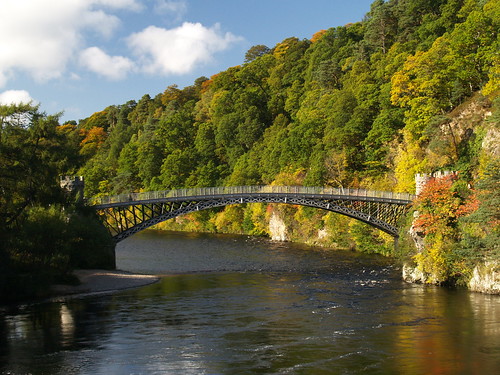
Telford's Craigellachie Bridge No visit to Craigellachie is complete without inspecting the lovely iron bridge across the Spey built long before the railways by one Thomas Telford. When this bridge was built, Napoleon was still tearing up Europe, and Beethoven was still composing. Looking down it from above is like a view into the transport history of this country. Materials for the cast-iron bridge were brought by barge on the river, the great arterial ways of the age. Since 1812, Telford’s bridge, the railway, and the more recent road bridge, have all enjoyed their periods of dominance. And since the arrival of the railway, there has been no escaping the influence of whisky in Craigellachie. Surrounded by the Spey and the Fiddich, the town has two distilleries, and is the site of Scotland’s largest cooperage. 100,000 oak barrels are processed here every year, most of them acquired second-hand from the American bourbon industry. You can see them stacked up in pyramids, dozens of these neat structures on a flat field, with the glorious greenery stretching miles into the hills.

Approaching the first great bend of the Spey, the walk takes you through an old, rare tunnel, one of only four in the entire Great North of Scotland network. You are right by the main road, but you can’t hear the traffic at all. On the other hand, the quiet murmur of the river is audible, calming and joyful. The railway was squeezed here, and the engineers had to cut through the stone and build a wall, which now acts as support for the road as well. The old railway then enters one of the familiar, long straight sections, with a vista of trees on either side that appears to go on and on. The undergrowth is dense, and little remains of the track. There’s only an occasional reminder of it to keep you company as you march along: mileposts that tell you how far you are from the local hub of Aberdeen.

Aberlour Station and Church The walk brings you to the outskirts of Aberlour, a town that balances its whisky credentials with another, quite different product – shortbread. Walkers are the producers of pure butter shortbread, founded on Aberlour’s main street by Joseph Walker; for over a hundred years, they have been expanding, and now are managed by the fourth generation of Walkers. One tradition has remained constant: it’s the local residents who get to test (and taste) any new biscuits.

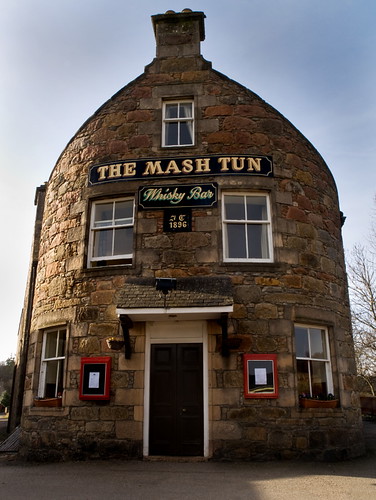
What was once Aberlour station is now a visitor centre for the Speyside railway, and a tea-room. What is more interesting, though, is the Mash Tun, a pub that once was known as the Station Bar, and there’s a chance – just a little chance – that it may one day be called the Station Bar once more. The Mash Tun is named after a vessel used in the whisky-making process, quite apt, therefore, for a whisky bar in whisky country. It is run by Mark and Karen Braidwood, and they say that when the next train pulls into the platform nearby, they will be quick to rename it Station Bar.

Mash Tun Aberlour, home to 550 single malts The Aberlour whisky is possibly the first whisky to attempt on this walk: done in sherry casks, very sweet, typical of the Speyside dram. It is smooth and strong, and you first try it neat to get its full flavour. It is a drink to sip and enjoy.

All whiskies are made in more or less the same way, but the little things such as the size and nature of the cask, the length of the aging, give each single-malt its distinction. Some people like to use the oaken cask, while others prefer used Chardonnay casks. The whisky needs to be in the cask for three years in Scotland for it to gain the appellation Scotch.

The Mash Tun is one of two comprehensive whisky bars in the world (the other is Bar Nemo in Tokyo), and this one boasts as well of the longest consecutive stock of whiskies, Glenfarclas, released from 1952 to 1994. The oldest, from 1952, would set you back £224 a dram.

An elegant footbridge enables you to cross the Spey as you walk out of Aberlour. Officially known as Victoria Bridge, the locals call it the Penny Brig, which was the toll you paid to use it. Alternatively, you can use the rather rickety suspension bridge across the Burn of Aberlour (the chief source of pure water for the local distilleries) that is dedicated to walkers. At one time it was a solid railway crossing, but now it rocks and moves underfoot, as you march purposefully on.

And once again you continue along a shaded path, greenery profuse, large tanks to your right, where the residues from the whisky-making are dealt with. Were they to dump the detritus into the Spey, its oxygen levels would drop, which wouldn’t be good news for the little trout and salmon that abound in it.

This treatment plant is for the Daluaine distillery, which has been in continuous operation since 1851. The railway arrived a dozen years later, and it became quickly obvious that the two industries could be of great use to each other. Daluaine received its own station years later.

Ian Peaty is an expert on the delicious and delicate interplay between iron and Scotch. He’s been writing a book on the subject, and visits the area often as part of his research. As he reveals, Daluaine Halt was built in 1933 for the whisky owners and their families. The large barrels and casks and industrial matter was brought up the quite steep hill in the distillery’s own puggy little railway. On the other side of the hill from the station, you can see a small distillery hidden in the glen.

Glen Grant Locomotive on the Morayshire Railway The Scots gave an affectionate name ‘puggy’ to the most hardworking little locomotives that ran up and down the region. These were saddle-tank locomotives, meaning that the water tank sat on top. Until the best efforts of Dr Beeching in the 1960s, the puggy used to run all the way into the heart of the distillery. Today the work is done by a succession of lorries and tankers.
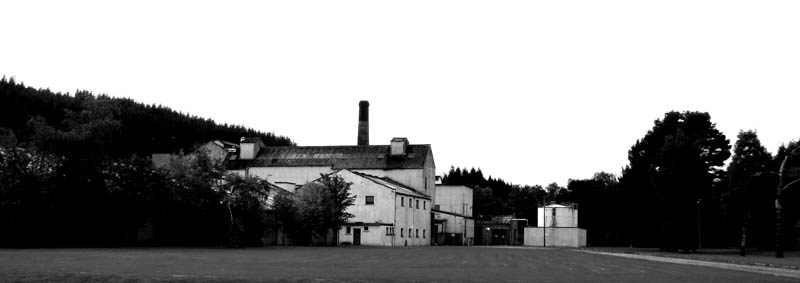
A painting for Ian’s book reveals the third puggy, built about 1936, owned by the distillery owners, who bedecked it in their own livery. There used to be a shed where the locomotive would be serviced and kept overnight. An evocative picture it is, to be sure.

The idea for a puggy line was first mooted by the distillery owner William Mackenzie in the 1880s, but it took well over a decade for the line to be built. The final motivation for the line was provided by another distillery that was built by Mackenzie’s son: the line could now provide for both factories, the only complication being that they were on either side of the river. And so the puggy joined the mainline, with both sets of trains sharing the rather elegant Carron Bridge across the Spey (which was also a rare example of road and rail sharing the same infrastructure).

The river flows all the way down to the Morayshire coast, where a lot of the barley used in the whisky is grown.

Carron Bridge is a few hundred yards from the village of the same name, once a major stop on the Strathspey railway, and home to the Mackenzies’ second distillery. It is a much more substantial halt than the little one at Daluaine, but it is terribly run down. You notice that even the clock there has stopped ticking.

Imperial Distillery With the railway and the distillery at its heart, Carron village once bustled with life. The distillery was opened with considerable pomp in 1897, during Queen Victoria’s diamond jubilee year, and was duly named Imperial. It had a high production level, which could only have been supported by the existence of the branch line that led right up to it. Today only the buildings remain. It’s become a silent distillery, and that’s how the people in the trade describe it. Carron itself has become an altogether different community. There’s something sad but beautiful about the silent distillery and its surroundings. The only lively part of the village now is the cottages, built by the distillery owner for his workers. Here and at other places along the railway, the locals could make a request halt of the trains. Quite literally, you could thumb a lift.

Strolling along a Beeching railway, you are suffused with thoughts of the past. Local stories, local people, a lost age still fondly recalled.

You mustn’t forget, though, that the Spey is still the centre of a global product. The nearby distilleries of Knockando and Tamdhu are an integral part of this global network. The former, beautifully housed, is owned by the same people as own Daluaine. A handful of multinationals dominate the industry, owning such labels as Johnny Walker, J & B, Grant’s and Bell’s. Few remain in private hands.

Despite the multinational presence, the Speyside is very quiet. You might expect the hubbub of articulated lorries and corporate throng, but look around – it is remarkably peaceful, well-managed, blending into the surrounding scape.

Tamdhu Station There is still a reverence for the past at these modern factories. The station at Tamdhu is beautifully preserved, and Knockando has a well-maintained Customs and Excise post, home to a figure who was very important to the industry, who logged the produce at each distillery, and ensure that not too much illegally disappeared when nobody was looking.

Three things shape your journey across the Speyside: the whisky industry, which depended so intimately on the river, and the railway, which followed the course of the Spey from the Scottish hills and valleys. Through it all, the Spey has maintained a totally unaffected character. This is Scotland’s fastest flowing river, winding a hundred miles, past the Cairngorms to its mouth at the Moray Firth. The railway, meanwhile, had to negotiate its major tributaries. There’s a viewing platform on one causeway across one such tributary, and it is quite a view, high, high above the tinkling stream.

The castle of Ballindalloch, built in the 16th century, is not visible from your trail, hidden as it is behind the dense canopy of trees. It is, however, the private residence of the Macpherson-Grants, one of clans of Scotland, and has been continuously occupied by that family since 1546. With five hundred years of history and 23000 acres of estates,they have clearly wielded considerable influence in the adjoining area. George Macpherson-Grant was one such luminary, forward-thinking to a fault, who established the nearby Cragganmore distillery. But the family was a prime mover in another domain as well. On their fields, cattle from Aberdeen were brought together with cattle from Angus. The beasts were well-fed with the discarded grain from the distillery, and a 150 years later, the herd is still intact, the original Aberdeen-Angus family.

Back on the other side of the river, there’s just a short walk to reach Ballindalloch village, and that’s where you tackle a final piece in this railway jigsaw. While the whisky trade made the railway unique, it was also vital to the local community, scattered across the sparsely populated area. One more river crossing brings you to your final destination, and this is a steel girder viaduct, 140 years old, and stern-looking, that leads to Ballindalloch station where you stop to learn about the arcane art of stealing whisky from its casks.

The Annual Granary Ball was the highpoint of life here in the days past. Up to a thousand fancy-dressed individuals from as far as Aberdeen would descend upon Ballindalloch on the specially laid on trains. In the 1920s and 30s, this was the place to be seen. Accounts suggest, however, that very little tipple was actually purchased at these balls. Instead, the locals would store their own supplies of liquor in the long grass outside the venue. They would have acquired these stores by means not entirely ethical. The staves of the casks that stored the whisky had rings on them, which the sneaky pilferer would remove, drill a little hole with a pocket gimlet, fill his pail with the gloried liquid, stick a wooden spike in the hole, cut off the excess, put back the ring, and neither the Excise man nor the owners would know that the barrel had ever been breached. Alternatively, they would carry long cylinders that they could dip into the barrels when nobody was looking, and cork the contents and slip the cylinder into their pockets – all the distillery boys would carry these containers, without any markings on them that might have inadvertently identified them.

The station closed in 1968, to the everlasting sadness of the Speyside villagers. The railways had brought their beloved industry to a global level, and whisky continues to be a vibrant produce with a great future. But the little things are missed the most – the school journeys on little trains, the puggies hauling material up and down the hills, a time of slow grace that is now gone.

[Based on Julia Bradbury’s eponymous Railway Walks, BBC Two.]

Aug 19, 2007

Moving Bridges

Fanatics of the Mummy series of movies will no doubt recollect (with a thrill) the scene where Brendan Fraser runs onto Tower Bridge desperately trying to catch up with his son's kidnappers.

As he speeds towards the car carrying his son, the drawbridge starts to rise. He slows with the effort of running upwards - there is a shot of him barely moving - but then he jumps across what looks like twenty metres of air, and grabs hold of the other blade of the drawbridge, gasping for breath, face strained with despair.

Tower Bridge, that fruity complement to the Tower of London, was pilloried in intellectual circles when originally erected in 1894 as an architectural gimrack, a monstrous and preposterous architectural sham, and a discredit to the generation that created it. The main design goal was to blend it with the ancient Tower, and the fact that many visitors assume the bridge has been longer than just over a century is further proof of the success of the design, as Chris Roberts points out in his excellent Cross River Traffic. The public loved it from the start, however, and it has proven to be an icon of London much more recognised than any other.

Many films, including the Mummy referred to above, have used London's bridges and the areas around them for backdrops. St. Katherine's Dock, just to the north of Tower Bridge, is a fancy part of town, mixing posh with public housing. The Long Good Friday, a famous British crime film, is based here, with Bob Hoskins playing a villain sensing opportunity in the redevelopment, but also a victim of his own narrow parochialism.

Basil Dearden's Pool of London is another crime film set near the Tower Bridge. This, in fact, shows the docks fully operational - as they were in the 1950s. Besides the Tower Bridge, the most heavily filmed bridge in London is that of Westminster. Meanwhile, Albert Bridge appears in Absolute Beginners, Maybe Baby, and Gwyneth Paltrow's Sliding Doors, but not to overly great effect, for which Chris Roberts refuses to blame this doxy of a bridge.

Suzy Kendal leaves the bright lights of the Swinging Sixties in Chelsea for Battersea crossing over Chelsea Bridge to see for herself how the working classes lived, in Up the Junction, while the paranoid thriller Defence of the Realm makes use of Hungerford Bridge (in whose darkly lit walkways two young men were beaten senseless in 1999, and thrown over the railings into the river by a gang of six hoodlums). And Southwark Bridge adds its two mites to the crime flick, starting with the first of the Ealing comedies, Hue and Cry.


Waterloo Bridge plays a role in the song Waterloo Sunset by the Kinks: Terence Stamp and Julie Christie, lovers at the time, cross the river symbolising the wonder at Swinging London, the beautiful city being reborn in the Sixties. Surely, though, the finest tribute to it should be the eponymous film starring Vivien Leigh as a young ballerina who falls for Robert Taylor, a Scots officer. She is fired from the ballet, no doubt for immorality, for spending a last evening with him before he heads for the war, and is driven to prostitution around the bridge where she had met her love for the first time. It's all very tragic and ends with her leap into the Thames off the bridge. The film starts and finishes on the bridge, but most of it was filmed on a backlot in California, and Chris Roberts, moved by it all, says it has everything: love, life, opportunity, despair and hope, which pretty much sums up the bridge .

Lastly, Westminster Bridge, London's oldest river crossing still in use, is put to stark effect in the eerie 28 Days Later; other disaster movies in which it appears are The Day of the Triffids and Reign of Fire (the latter I watched only because it starred dragons, and one, you agree, cannot have too many dragons in one's life).

Beaduric controlled the area around the present day Battersea, whose name derives from Batrices Ege, or island. Marshes at one time, then market gardens, murders, and Benedict Arnold (buried in the parish church) are what made the place famous. But in this posting, I consider the various artists who flocked to the old Battersea bridge and painted it and the river in their various moods. As usual, I refer to Chris Roberts' lovely book .


James Whistler celebrated the beauty contained in the urban landscape. His Nocturne series had a remarkable influence on later artists. As Lee Parsons said, "These simple pieces offer an affecting synthesis of romance and melancholy that is remarkable for its time and must have thrown open doors to a new world of expression in painting." And yet, he only received the derisory sum of a farthing when he sued the famous critic John Ruskin for libel, after the latter accused him of demanding "two hundred guineas for flinging a pot of paint in the public's face". The court clearly thought that despite his witticisms, his work was hardly deserving of the title 'Art', despite his witty repartee when asked if his work was a "correct representation" of Battersea Bridge:
It was not my intent simply to make a copy of Battersea Bridge. The pier in the centre of the picture may not be like the piers of Battersea Bridge. I did not intend to paint a portrait of Battersea Bridge, but only a painting of a moonlight scene. As to what the picture represents, that depends upon who looks at it.

Joseph Turner found the bridge and the Battersea Reach a favoured subject for his work. He painted in the romantic style, with an Italianate sensibility quite at odds with the polluted, swirling and murky Thames. His boatman was the father of Whistler's boatman, Walter Graves, a rather less well-known British painter. I am sad to say here, though, that I am unable to find any of Graves's (or indeed Turner's Thames) paintings readily on the web. This one, on the right, is by Turner, titled Sun Rising Through Vapour: Fishermen cleaning and selling. But are they on the Thames? Who knows?

You have to hand it to Dr. Johnson. Rapier wit, eh? He was referring to the commission of the construction of Blackfriars Bridge to a young upstart Scots architect named Robert Mylne, who was preferred over his friend John Gywnn... With that, I continue with my summary of London's bridges, with frequent reference to the superb Cross River Traffic, by Chris Roberts.


The first Blackfriars Bridge was finished by 1769, its main purpose being to gentrify the north side. At the time, Bridewell Prison stood there, surrounded by dismal slums. The notorious Fleet Prison was on the other side of the road, another hellhole famous for its debauchery and thuggish wardens.

The prisons were close to where the lawyers worked, in the Inns of Court at Newgate, but also because the district was a crime-ridden ghetto. Under ecclesiastial law (finally abolished in 1697), asylum could be granted in Church grounds to criminals fleeing from the police. The Alsatia sanctuary at Whitefriars was notorious: thugs would repair their in the evenings to spend the night after a bountiful day mugging and pillaging. More interestingly, the area was famous for unlicensed, often bigamous, marriages performed by bankrupt priests locked up in one of the prisons. These Fleet Marriages were outlawed only shortly before work on the bridge started.

Originally, the bridge was intended to be named after William Pitt, but by 1769, his star was fading, so instead it was christened after the Dominican monastery that used to stand at the north bank. It didn't last quite as long as the monastery, however, owing to the polluted Thames and the contaminated Fleet eating away at its foundations, eroding the Portland stone. A replacement was constructed only in the late 1880s and was accompanied by a railway bridge which the London, Chatham and Dover railway wanted. The sculptor, J.B.Philip decorated the columns with freshwater creatures and land birds on the upstream side, and marine life and seagulls downstream, reflecting Blackfriar's former position as the tidal turning point. A Venetian-Gothic flair is imparted by the cast-iron balustrade; indeed, contemporaries complained that the bridge was far too ornate.

Queen Victoria opened the new bridge, but she didn't linger long, as a rowdy crowd jeered her throughout the opening ceremony. The London mob went so far as to chuck missiles at her, no doubt seized with a momentary republican impulse.

Chris Roberts recommends the Blackfriars pub at the north-side of the bridge. Supposedly, it is the only Art Nouveau pub in London. Check out its gilt interiors, gorgeous mirrors, ornate fittings and pictures of fat monks drinking ale.

James Boswell, in a particularly horny mood, stopped at Westminster Bridge and candidly recorded his experiences.
I picked up a strong jolly young damsel and taking her under the arm I conducted her to Westminster Bridge, and there in amour complete did I engage up in this noble edifice. The whim of doing it there with the Thames rolling below us amused me much.
As Chris Roberts describes in his superb Cross River Traffic, it is not known whether Boswell's exertions contributed to the structural problems with the bridge's foundations. Boswell did his thing before night-watchmen had been hired to protect passersby at night, but already by his time, muggers and prostitutes lurked in the dark at the side of the bridge; these sheltered spots were dry and ideally suited to their purposes.

Hauntings are common near this bridge. Every year, at midnight on 31 December, a leaping shadow jumps in to ring in the New Year. Supposedly, this is the shade of Jack the Ripper; the background is that Ripper suspect Montague Druitt did commit suicide in the Thames. Another spectre is that of three people on a boat going under the bridge, never to appear at the other side.
Canaletto rendered the first bridge at Westminster (which opened in 1750 and lasted a century) twenty times in a decade from 1746. Many people thought the bridge one of the most elegant and complete structures of its kind in the world. Balustrades of stone with half-octagonal turrets provided protection for the pedestrian. Designed by Charles Labelye, a Swiss engineer, it was supported by his innovative pre-built caissons, boxes constructed on land, floated into position and driven into the riverbed by pile drivers; water was pumped out and the caissons filled with stone, the weight of the piers constructed above fixing them in place. The requirement for temporary piers was thus obviated; furthermore, Labelye's design was the least obstructive of the river flow.
Where the likes of William Wordsworth took poetic licence when claiming to have seen the rising sun glittering in the smokeless air, the view over the river has generally been gloomy. With the Industrial Revolution, dark and dank smog settled over the city; the pea-soupers sinking London into respiratorial despair didn't get cleared up till the late 1950s. Monet and cohorts loved the lack of light, and flocked to London to paint it.
The current bridge dates from 1862, architected by Sir Charles Barry to harmonise with his new Westminster Palace (housing the Parliament). To match the colour of the benches in the House of Commons, the bridge is painted olive green; the ironwork of the bridge has, among other insignia, the cross of St. George, a thistle, a shield and a rose. This is the oldest London crossing still in use and is pretty much in the same state as Thomas Page, its builder, left it. The northern bank is adumbrated by Thomas Thornycroft's statue to Boadicea (with her two, for some unknown reason, bare-breasted daughters at her feet); the south bank has a statue of a Lion.