JOST A MON

The idle ramblings of a Jack of some trades, Master of none

In Rosa Liksom's excellent Compartment No 6, a nameless girl dines on the Trans-Mongolian railway with a brutish fellow.
'There isn't any vodka,' the waiter said gruffly. 'Is that so hard to understand, comrade?' 
'Bring me a bottle of cognac, then. Cognac will do nicely.' 
When he'd got his plate of vobla and his cognac he took a long swig, grinned, and bit off some of the dry fish. 
'Now we can order some food,' he said. 
The waiter looked at him wearily. 
'A bowl of selyanka to start with. For the main dish fifteen blinis, shashlik, some boiled tea sausage, salad, and a bottle of cognac.' 
Instead of shashlik they got some dry chicken legs and instead of salad some potatoes fried in margarine.

Nov 18, 2016

Wettlin

Growing up in Moscow in the 70s, I'd devour Russian books, as many as I could get my hands on. The Soviet publishing machine was prolific, especially where children's books were concerned, but their availability was always a matter of chance. As Mark Grigorian pointed out to me, in the USSR, one could never be sure which book would suddenly be banned. So books were a scarce commodity; they would always be treasured, passed from hand to hand, read till they fell apart from use.

My dad, meanwhile, stalked the bookstores for translations into English. He wasn't always successful. In any case, although the books were relatively cheap, his salary didn't quite extend to large-scale purchases. Still, he managed to amass a small collection of fiction by the great Russians.

When we came back to India, I discovered English translations of the books I'd loved. Exported from the USSR as part of cultural propaganda - no wonder hardly any were available in Moscow. At the time, I wasn't fussed about the quality of the translation - if it conveyed the story with fidelity, I was content. Nor did I particularly bother about the translators. Some of my favourite books were translated by a Margaret Wettlin. But other than wondering if her last name should have been spelled Wetlina, in the feminine Russian ending, I didn't think too much about it.

Recently, I found out that Wettlin was an American woman who had sailed off to Russian in 1932 to join what she thought was a great social experiment - the establishment of a new economic model for the world. Disappointed by the fraying of the American social fabric during the Great Depression, she fancied an adventure in an unknown land. She taught English for a bit in Russia, fell in love with a theatre director, had children. Then Stalin announced that foreigners would either have to take up Soviet citizenship, or leave. Unwilling to abandon her family, she naturalised. She would end up staying in the USSR for nearly fifty years.

Her house was a hotbed of artistic fervour. Her husband was a friend of Stanislavsky; there were actors and playwrights in and out of their lives. The family travelled extensively across the country, even to Mongolia, setting up regional theatres. It was a heady time. It was also a nervous time for her, personally, as the KGB recruited her to spy on her neighbours.

Then the war happened and they were caught in Moscow. The suffering of the Russians during that bitter conflict has been covered extensively. The famines in the Soviet Union caused by misguided Communist policies are also well-known. Her own voice was added with the eventual publication of Fifty Russian Winters: An American Woman's Life in the Soviet Union.

After the war, Wettlin began to translate Russian fiction into English for publication by the Soviet press. Her translations of Gorky, Pasternak, and Tolstoy were well received. As I found out, she also translated Nikolai Nosov, whose books I still recall with undimmed affection.

She continued to live in Moscow till about 1980, when the Soviets finally granted permission for her, her daughter and grandson to leave the country. The US State Department determined that she had become a Soviet citizen under duress and restored her US citizenship. She returned to Philadelphia. Her son couldn't join her for another seven years.

Wettlin died in 2003.

Jun 9, 2015

An Armenian in India

In the 18th century, the Russians smashed their way across the Caucasus and forced the Ottomans to cede large chunks of territory to them. In the midst of the landgrab, Armenians began to think about a possible autonomous polity. They had not been independent for nearly a millennium, but with Russian support, perhaps they could re-establish themselves.

There were two proposals for an Armenian state. One, by an archbishop Hovsep Arghutian, was to have a kingdom with a capital at Vagharshapat. The king would chosen by the Russian czar, could be either Russian or Armenian, would mint his own currency and allow the Russians access to the Caspian sea. The other proposal, by Shahamir Shahamirian, was for an Armenian republic, one governed by a prime minister with a parliament, cleaving to Russia with a military and free-trade treaty.

Clearly, Arghutian's conservative approach was favoured by the traditionalists, the feudal and religious powers in Armenia. Shahamirian's proposal was modernist, hoping to curb the power of the aristocracy and give more voice to the bourgeoisie.

(In the end, neither approach bore any fruit. Political competition between the Russians, Persians and the Ottomans meant that Armenian hopes were put aside for generations.)

Who was this modernist Shahamir Shahamirian? It turns out he was an intellectual and a merchant - and based in Madras!

I had previously heard that the first Armenian printing press was established not in its homeland, but in India - in Madras, in fact, which was under British rule at the time. In 1771-72, Shahamirian had founded that press.

Encouraged by British parliamentary democracy (such as it was), Shahamirian hoped that a new Armenia would similarly be guided by the popular power of the middle class, thereby checking the illiberal nobility and the church. In his treatise of political philosophy, Shahamirian articulated a view of equality and opportunity that held true to the values of the Enlightenment. Indeed, it was quite likely the first blueprint for a constitutional democracy ever to appear in the world! In 1773, in the Vorogayt Parats (The Snare of Glory), he wrote:
Every human being, whether Armenian or of some other race, whether man or woman, born in Armenia or brought there from another country, shall live in equality and shall be free in all their occupations.

Check out:
  1. Agop Jack Hacikyan, Gabriel Basmajian, Edward S. Franchuk, The Heritage of Armenian Literature: From the eighteenth century to modern times, pp. 160-161.
  2. Simon Payaslian, The History of Armenia, pp. 109-110.

Jun 3, 2015

Yalta

In case you wondered what it was that Stalin and Churchill and Roosevelt were munching on during the Yalta conference, here's the menu for the last banquet (from the London Review of Books blog):

Caviar Pies 
White and Red Salmon 
Salted Herring 
Sturgeon in Aspic 

Swiss Cheese 
Game 
Sausage 
Suckling Pig with Horseradish Sauce 

Vol-au-Vent of Game 

Game Bouillon 
Cream of Chicken 

White Fish, Champagne Sauce 
Baked Kefal 

Shashlik of Mutton 
Wild Goat from the Steppes 
Pilau of Mutton 

Roast Turkey 
Roast Quails 
Roast Partridge 
Green Peas 

Ice Cream 
Fruit 
Petits Fours 
Roasted Almonds 

Coffee

Apr 26, 2015

Feast for Tereshkova

A reception for the first woman in space, Valentina Tereshkova, was held in the Kremlin. A guest recalled:
There were dishes of cold roast fillet of beef so tender and moist that the meat dissolved like snowflakes on the tongue; sturgeon from the Volga, smoked and fresh; Pacific salmon; Kamchatka crabs; silver cups the size of a giant's thimble containing a mixture of mushrooms and sour cream or a fricassee of wild birds; and in bowls pressed into crushed ice pungent red salmon roe and caviar from the Caspian, the fat grains glittering in colours from almost yellow to darkest grey.

Mark Frankland, Child of My Time: An Englishman's Journey in a Divided World.

Apr 6, 2015

Stalin's Grub

Comrade Stalin was not stingy when it came to food. There was salmon roe and herring and salted cucumbers and meat salad and grilled vegetables and borsht and pelmeni and blini and lamb cutlets and pierogi with ice cream. There was wine of various colours and of course there was vodka. And even more vodka.
From Jonas Jonasson's very silly caper, The Hundred-Year-Old Man Who Climbed Out of the Window and Disappeared.

Mar 13, 2015

An Abundance of Riches

In the early 90s, shortly after the implosion of the USSR, the world was suddenly awash with brilliant Soviet scientists and engineers who found themselves unemployed and impoverished. Many of them wanted nothing more than to continue their work, while others seized the opportunity to move to greener pastures abroad. A small number were coopted by countries and terrorists seeking nuclear and biochemical weapons know-how. In order to keep the rest from succumbing to such temptation, US institutions organised monthly stipends for them, while George Soros created the International Science Foundation to support the sciences in the former Soviet Union. Meanwhile, a large-scale emigration of Jewish scientists began to Israel, which found itself swamped by these riches.

I was at TIFR in the summer one of those years, and the notice-boards in the cafe were festooned with newspaper clippings describing efforts by various countries to attract the scientists. Some pooh-poohed the miserly stipends the US were paying out - $500 a year or so. Some marvelled at the Chinese willingness to pay top dollar for expertise. And many bemoaned Indian bureaucratic intransigence and hierarchical pig-headedness that prevented us from paying higher salaries to attract Soviet scientists than our own professors were earning. And thus a superb opportunity to revamp our scientific and technical base, and to improve the calibre of our research and our universities was forever lost.

For the Israelis, though, the incoming rush was a mixed blessing. Haaretz recently had a beautiful piece on the diaspora from the Soviet Union. The Jews of the USSR did much to change the political landscape in Israel, especially towards a conservative direction. They also added considerable fillip to cultural diversity. But many of them found it hard to adjust to their new lives. Israel did not have the capacity to accommodate every brilliant Jewish scientist who arrived. After two or three top-notch algebraic theorists arrived, for example, where would the fourth be placed? And so many a scientist, who anywhere else in the world would have been a superstar, found themselves sidelined and frustrated.

It is a heartbreaking thing when pearls are so abundant that their shine is lessened.

There's a book recently published in Russia, titled Литературный авангард русского Парижа. 1920—1926. История. Хроника. Антология. Документы. Written by Leonid Livak and Andrei Ustinov, it is 992 pages of history, chronicles, anthologies and documents pertaining to the great Russian diaspora in Paris between 1920-1926. By all accounts (including this review, by Vasily Molodyakov, from which I've shamelessly and poorly translated this article), it is a tour-de-force, a seminal work, a book that shreds the usual templates of study of emigre Russian literature.

What sort of avant-garde? the Soviets would say. Sure, a bunch of Russians legged it after the Revolution - some to Berlin initially, and then to Paris - and they may have written a thing or two.  Bunin, Kuprin, Shmelev, Zaitsev, Aldanov... The Soviets claimed that the real literature remained in Russia. The emigres were undeserving pretenders filled with nostalgia for their homeland; talented painters bemoaned their exile or returned with tails between their legs; the youth there was effete. The Soviets would bring up Marina Tsvetaeva, that most avant-garde of poets: what did emigration do for her?

Viktor Bart, Sergei Romov, Konstantin Tereshkovich. Founders of the group "Через" (1923).
The emigres would counter that the Soviets had defiled the avant-garde. The diaspora carried with it the forces of Russian tradition and the legacy of its great classical literature. The youth may quest for modernity, but the majority of them prefer to follow the great preceptors. Those who behave are published in "Modern Notes", while those who don't appear in "Numbers". This version of the argument is canonised by Adamovich and Gleb Struve after the second world war. The other version, that emigre literature is weak and ineffectual, and that the real literature is in Russia, is canonised in the English-language "Modern Russian Literature" by Marc Slonim.
"Merry Dynamite", manuscript by Dovid Knut. 1923.

So why do we have a thousand-page exposition from Livak and Ustinov? Well, for one thing, it illuminates little-known aspects of the Russian emigre experience, not just artistic but also literary. It overturns the myth of the absence of the avant-garde abroad, or of its marginalisation or insignificance. The Russian avant-garde was active, visible, powerful: "Gataparak", "The Palace of Poets", the Union of Russian Artists in France. But until 1924, the literary life of the Russian youth in Paris had three characteristic features: 1) an absence of anti-Soviet sentiment among the organisers and participants in the artistic groups; 2) a markedly pronounced popularity of the Soviet avant-garde in literature (Futurism) and art (Constructivism); and 3) close ties with the French Dadaist movement." (page 16).
Portrait of Mikhail Larionov by Man Ray. (1922-23).

The book also disposes of the myth that Russian Paris was somehow lesser than the Russian Berlin in 1921-23. The two capitals were not in opposition to each other; rather they were in consonance. And how could they not be, given that the same personages drove the avant-garde in both places?

Who were these people? You can learn nearly everything you might ever want about them, because nearly 3/4 of the book is comprised of the texts of the heroes of the avant-garde, the poetry and experimental prose of ten authors: Valentin Parnakh, Sergei Sharshun, Mark Talov, Georgi Evangulov, Alexander Ginger, Dovid Knut, Boris Bozhnev, Boris Poplavsky, Ilya Zdanevich and Vladimir Sveshnikov. Some of the text has appeared in print before, but gathered in one place, they offer a wonderful view. Another 250 pages deal with manifestoes, essays, letters as well as a reprint of all four volumes of the rare journal "Udar" ("Impact") by Sergei Romov. This sort of a Russian diaspora we haven't known. And such a Russian avant-garde we haven't known.

Feb 8, 2015

Pancake Week

It's the Russian week of pancakes from tomorrow - Maslenitsa - and here's a bit of Chekhov (On Human Frailty):
Counselor Semyon Petrovich Podtykin sat down at the table…and at risk of burning his fingers, grabbed the two hottest bliny from the top of the pile and plopped them onto his plate with an appetizing smack. They were golden brown, light, and plump like the shoulder of a merchant’s daughter…


Jan 21, 2015

Big Red Train Food

In 1926, the European correspondent for the Chicago Daily News, Junius Wood, travelled on the Trans-Siberian railway. He had this to say about the cuisine on board:
At 3.30 p.m. a plate of soup appeared - greasy hot water poured over cold pieces of fish that had been cooked earlier in bulk. The next course was pre-cooked cauliflower warmed with a sauce of unknown texture. Roast veal, cooked weeks earlier and now dry and hard, smothered in warm brown gravy, without vegetables, was the main course.
(It was not that much different on some of the trains when Christian Wolmar, author of To the Edge of the World: The Story of the Trans-Siberian Express, the World's Greatest Railroad (from where I got the above quote) travelled on the line in 2012.)

I've been somewhat obsessed with Russian art for a bit.  A few months ago, the obsession combined with avarice when I heard about the publication of the Encyclopedia of the Russian Avant-Garde, a three-volume masterpiece edited by D. Sarabyanov and V. Rakitin, featuring contributions from 170 specialists. It contains biographies of artists great and small, movements major and minor, groups, collectives and manifestos, and illustrations of fine calibre for every aspect of this great period of art. The editors had laboured over it for more than 10 years, and the final product looked like a beaut - superb production values and, dash it, a limited print run. The few copies that remained after the bulk had been sent to museums and archives were priced at tens of thousands of rubles. 

Eru Ilúvatar,
I've been good this year. Can I please have the Encyclopedia of the Russian Avant-Garde? I promise to be good next year as well.
Fëanor

I found one online store selling the book. The price, as I said, was eye-watering, even when converting to pounds sterling. Recently the ruble collapsed to less than half its original value and I took a look at the website again. The book was no longer available! Drat and damn! Those pesky Russians, obviously trying to safeguard their money, had gone on a buying spree. They bought large-screen TVs, property in London, and this encyclopedia. Morgoth alone knows when copies will emerge for sale again.

There was talk about electronic versions and French translations, but where are they, I ask. Where?

Ilúvatar, what are you going to do about this?

So after weeks of abstention, I dropped by Dark Sugars, a mighty fine chocolatier on Brick Lane. The genial man behind the counter made me a quick hot chocolate and topped it off with a palmful of slivers of dark and brown chocolate. While I stood there salivating, a woman walked in and said she wanted to get a selection of salty caramel chocs.

'Which box shall I put them in?' she said.

'Whichever you like, dear,' said the genial man.'You spend your life trying to convince men they needn't tell you what to do. So don't let me tell you what to do.'

Giggles all around.

*****

I grabbed a salmon beigel and a salami beigel from the Beigel shop. £2.40 for a fine meal.


*****

The reason I went to Brick Lane was not to go to Brick Lane - because, really, Brick Lane is a bit of a sham show, especially its southern end - but rather because I was at the Calvert 22, a gallery of Russian and Eastern European works. This is in Shoreditch, and on my way back to the office, I sauntered down Brick Lane. Calvert 22 were hosting an exhibition of photographs (titled Close and Far) by Prokudin-Gorsky along with works by a bunch of modern photographers. I took a cursory look at the modern works, but spent more time admiring Prokudin-Gorsky.

What a chap. He spent years on the Czar's commission, travelling back and forth and up and down the mighty empire, snapping away at people and buildings and landscapes. Many of these areas haven't been photographed since, and many of the monuments were destroyed in subsequent wars and Communist depredations. He used a colour methodology of his own making, and produced vibrant polychrome pictures that look like they might have been taken yesterday.

The exhibition ends today, August 17, so I dare say most of you will miss it.

Jun 5, 2014

Another Old Photo

Boris Akunin likes to trawl through old family photo-albums and gaze at the portraits and try to imagine what fates befell their subjects. Often he looks for a long time at a photograph and concocts an entire biography, and then he looks at the back of it and more often than not realises that his romantic imaginations do not match the facts.

This is a picture he posted on his blog.


A lovely little girl. Surely, thought Akunin, this is a girl who had a wonderful destiny, beautiful loves, a life full of drama and unexpected twists (after all, she would have lived in twentieth century Russia). And the girl would surely become someone, because not only was she beautiful but there were makings of an extraordinary personality.

Then he turned the photo over to the other side and learned that little Lyuba Lokshina was born March 9, 1917, and died April 12, 1929. As far as I can make out, she died when a balcony collapsed. 


As Akunin says, this is not just tragic but absurd. One can somehow get used to tragedy. But absurdity? 

May 30, 2014

Gun

when I hear 
the word 
culture,
I reach 
for a gun 

the gun plays 
a major role in
contemporary 
art 

with a gun 
artists 
paint pictures 

with a gun 
poets 
draw poems 

musicians 
gather consonances 
with the gun 

filmmakers 
with a gun 
shoot 
eminent 
movies 

maybe 
even I 
can 
with the aid of a gun 
extract 
something
from myself.

An extract from the poem by the Ryazanian poet Alexei Kolchev who died in 2013. (Via Colta.ru.)

Apr 28, 2014

Márquez in the USSR

[Several days after the death of Gabriel José de la Concordia García Márquez, the literary world has been offering up its memoirs of the great author. Here are Tatyana Pigareva's recollections of Márquez's visits to the USSR, loosely translated from the article on Colta.ru. Cross-posted from Tangentialia, my translations blog.]

Our university days - at the beginning of the 80s - coincided with the Latin American boom, and among our classmates in philology there was a joke: 'Whom do you love more - Borges or Cortázar?' which was answered with 'Márquez!' The names of the 'Holy Trinity' were interchangeable, but the author of One Hundred Years of Solitude occurred more often not in the question, but in the answer. His fascinating and dramatic novel, appearing in Russia in the magnificent translation by Valery Stolbov and Nina Butyrina, read like a poem in one breath. It became not just a bestseller but a byword for an entire generation, which, having lived an entire age with Macondo, was not much surprised when the Soviet imperium would be 'swept off the face of the earth by a hurricane' but not 'erased from people's memories.'

In 1990, in Moscow's Pushkin Square, a McDonald's opened, and above it shone the country's first advertisement for Coca-Cola. Festively honouring the end of an era evoked in the politically incorrect memoirs of Márquez - 'The USSR: 22,400,000 square kilometres without a single Coca-Cola advertisement' - we gathered in a company of Márquezomaniacs, and went to the Friendship Park by the Rechny railway station. There in 1957, the thirty-year old Colombian, deputed to the International Festival of Youth and Students, had planted a tree. Our idea of spontaneous performance concluded in laying a bouquet of yellow flowers (Márquez's favourite bloom) at that same tree. The flowers could equally have been a tribute to Cervantes - in those years, the only monument in Moscow to a foreign writer was in the same park - but, of course, One Hundred Years of Solitude had long been dubbed the 'Don Quixote' of the twentieth century. We made merry, tossing quotations at each other; someone claimed that this wide linden was just like the chestnut of Jose Arcadio Buendía; but at that moment from the neighbouring treetop flew out a flutter of brimstone butterflies. Yellow butterflies - a clear sign from the wise Gabo - we unanimously decided to name this that same tree. On the way to the metro, someone cried out, 'Look at the puddles - a goldfish is sure to emerge!' The text of the 'One Hundred Years of Solitude' was firmly rooted in our lives: the golden fish would first evoke Aureliano Buendía and, only much later, Pushkin's fairy tale.

The appearance of One Hundred Years of Solitude coincided with a major shift in Russian consciousness. The final days of the USSR were upon us: mirages of history were sprinkled with 'fallen leaves', life was stuck in an ill groove, and nobody wrote letters to anyone, not merely the Colonel. Everything appeared all too familiar: the non-existent trains with corpses; the sleeping sickness that destroyed memory; the commands to paint all housesin blue; generals and patriarchs. But gradually the storied parallels fell by the wayside, like a 'transparent or ghostly' town, and the mythic reality became paramount: an idealised model of reality where any 'big village' from Moscow to the suburbs could be equated with the universal village of Macondo, and any history found itself mirrored in the alembic of Melquíades.

In the middle of the 1980s, I was a guest at the translator Ella Braginskaya's. Behind the glass door of a bookcase was a photograph: Ella and Márquez in an affectionate argument. Such surrealism! 'Yes, this was at Vera Kuteishikova and Lev Ospovat's, in 1979 - he was exhausted from our discussions about his artistic plans and asked how we cooked potatoes. So we began to argue about national cuisines. His eyes just lit up...' Then Márquez explained to Ella that his entire family used to live on potatoes while he was writing One Hundred Years of Solitude, and when he wanted to send the manuscript to the publisher, he need 160 pesos, while he only had 80, and so he had to pawn a dryer and a mixer. His long-suffering wife Mercedes sighed: 'All we needed was for the novel to sink...' Amazing shots from this first literary visit of Márquez to the USSR survived with Yuri Greiding, an adviser on Latin American literature to the Writers' Union. He had accompanied Márquez and family, and fortunately didn't abandon his camera: there were pictures of the meeting at the airport, of Yevtushenko, of signings, of the Pushkin Museum, of dinners with Hispanists, of meetings at the journal 'Latin America'. In this journal appeared the only non-pirated Soviet edition of Márquez - the writer had personally allowed Lyudmila Sinyanskaya to publish the translation of Chronicle of a Death Foretold.

The third - and final - visit of Márquez to the USSR in 1987 was to the Moscow Film Festival. He refused to travel in an entourage, but he was happy with a promised meeting with Gorbachev. Following their interview, Márquez's verdict was: 'You have never had a ruler of such intelligence, of such measure.' Gorbachev's calibre left a special trace in my own Márquezian history. At the Film Festival, I worked with the Spanish delegation; we were dining at the Rossiya hotel, and examining the slogan that proclaimed that Communism was Soviet power plus the electrification of the entire country, and adorned the thermal power station across. The producer, Enrique Gonzalez Macho, now the president of the Spanish Film Academy, waved his hand, and we were joined by his friend of a somewha t gloomy mien. I continued my story about the slogan's mathematical operations, and of my dream of living under 'electrification': Communism minus Soviet rule, nothing could be better. The grim Spaniard laughed with everyone else, his eyes brightened, and he announced that he hadn't seen a crazier hotel in his life, and if private enterprise were allowed in the USSR, he would establish a taxi service to transport guests through its corridors. He apologised, said he was tired and that he had an unbearably officious press-conference to attend, and said goodbye. The Spaniards began to talk about unfortunate films based on Márquez's works, and that's when I understood that it had been him. That was the chronicle of an appearance unforetold. I remembered Ella Braginskaya, and that potato.

2012 was a triple jubilee for Márquez: 85 years since his birth, 45 years since the publication of One Hundred Years of Solitude, and 30 years since the Nobel Prize. In the Cervantes Institute, we decided to hold an exhibition of modern Russian artists on the themes of the novel One Hundred Years of Solitude. Honoured artists responded immediately, but the reaction of the younger ones, who had taken up the novel following our invitation, was surprising: 'What a strange book... we couldn't grasp it... tedious, exhausting.' Was this a generational problem? The answer turned out to be simple and unhappy. Firstly, the classic translation of the novel was by Valery Stolbov and Nina Butyrina. They had worked for years on the complex text; all the items in their house had been named after the heroes of the novel: the armchair was Ursula, the massive sideboard was Aureliano Buendía; they had engaged with the characters and discussed them constantly, honing the rhythms and styles. That text sounded natural and poetic in Russian, and became the 'real Márquez' for several generations. In its early editions, there had been elisions of several sex scenes, but these were later reinstated. And then in 1997 the Rusiko publishing house printed a new translation by Margarita Bylinskaya with the surprising subtitle 'A complete translation from the Spanish'.

The translator accompanied her publication with a series of articles in the press on the imperfections and sins of the previous translation, and also informed Márquez's literary agent that the novel had been published earlier in an abridged Soviet translation, and that only now were its mistakes corrected. As a result, when the AST publishing house acquires the legal rights for the One Hundred Years of Solitude, the only version printed is that of Margarita Bylinskaya's translation.

This is not the place for a detailed analysis of blunders and mistakes - these could happen to anyone. The tragedy mainly lies in the intonation and stylistic register. Recall the scene of the passing of Remedios the Beauty, who had inspired the love and caused the death of her beloved. Butyrina and Stolbov rendered it: The foreigners, who heard the noise in the dining room and hurried over to take away the corpse, noticed that his skin exuded the stunning aroma of Remedios the Beauty. Margarita Bylinskaya: The remaining uninvited guests, hearing the terrible noise, rushed out of the dining room, lifted the corpse and immediately realised how strongly it reeked of the breath of Remedios the Beauty. In the same translation, instead of 'ants crawling on the body' (original text), there appeared 'flesh that bristled and burned'. In Márquez's prose there is a poetic, musical nature; in it rings the voice of the narrator, archaic and fearless. And so the erotic texts, a particular standout in the 'full translation' of Bylinskaya had appeared in the original translation of Butyrina and Stolbov as a stylistic revelation for Russian literature. García Márquez himself had noted that he had always wanted the book to have a poetic rather than a narrative value. The Mozart of the Caribbean captivates the reader, and if this doesn't happen, if the tonality of the speech is lost, then even One Hundred Years of Solitude can seem 'tedious and exhausting' reading. And so the novel should be sought not in bookstores, but only in libraries, in the old translation. Even though the AST publishing house has confirmed that the preprint of the 'new old translation' is ready and has shortly gone on sale.

A few years ago in Guatemala I stumbled across a lump of ice at a beach bar. It lay on the hot sand, shimmering in a cloud of vapour. There they were, 'ants crawling on the skin'. 'Many years later, as he faced the firing squad, Colonel Aureliano Buendía was to remember that distant afternoon when his father took him to discover ice.' There is no greater wonder. To the question posed in 1979 in the journal 'Latin America' - 'What do you believe in: magic realism or the magic of literature?', García Márquez had replied: 'I believe in the magic of real life.' May there be with everyone that inspired solitude, with the cockerels of Ursula, the goldfish of Aureliano, the aromas of Remedios and the parchments of Melquiades.

[Also see Yan Shenkman (April 21, 2014), 'Márquez was inspired by the Soviet Union', Russia & India Report.]

[Continued from Part II, and loosely translated from A Russian Missionary in India: Archimandrite Andronicus.]

After his departure from the Bethany ashram, Andronicus settled in Pattanapuram at the English school of St Stephen. He was then able to travel as a pastor around Travancore; occasionally, he was invited by Russians living in other parts of India to perform rites in Calcutta, Bangalore and Bombay. He also visited the Portuguese colony of Goa.

In 1939, he was established an Orthodox chapel in the village of Patali, a few miles from Pattanapuram, and began offering services. Next door was a Hindu temple of Bhadrakali. The locals were not pleased that the church was being set up, and complained to the government, which ignored them and permitted the church to continue.

Andronicus, as ecumenical as ever, established cordial relations with the chief priest of the Bhadrakali temple, as well as the local Muslim clergy. (Subsequently, he even attended a series of lectures on Hinduism in Madras, offered in 1948 by Somasundaram Iyer.) In Patali, there were Jacobites as well, whose church Andronicus often visited, and who also came to him during the Holy Week for confession. He was tireless in his works - preached, performed the liturgy at the St Thomas Church, constantly visited the sick. His superiors considered him a prime example of the apostolic man, hard-working and self-sacrificing, courageously undergoing all sorts of hardships and dangers both physical and spiritual, and continuing for years without confession.

Andronicus's superior, the Parisian metropolitan Eulogius, did all he could to publicise among the faithful in the Church. He wrote to the Russian Orthodox flock living in India about Andronicus, praising his steadfastness and urging the Russians to go to him for all their spiritual needs. 'His work is great and difficult,' wrote Eulogius. 'He brought from the Mother Church and lit up in distant India the lamp of the holy Orthodox faith that will not only illuminate the Russian peoples scattered there, but also, possibly, attract the native non-Christian folk and kindle in them a feeling for the Saviour, so that they may exclaim in an incandescence of faith as did St Thomas: My Lord and my God!'

Eulogius concluded his epistle with an exhortation to the Russians to assist father Andronicus in his lonely task. Let not the light of Orthodoxy be extinguished, he wrote, let it shine its saving grace on everything - be it ours or their's, be it near or far.

In 1934, for the first time Andronicus was able to hold a service for a distinctly Russian audience - nearly sixty peasants who had come to India in the previous two years, but who were now getting ready to leave for Brazil. For the first time in three and a half years in India, wrote Andronicus to Eulogius, I was able to serve as in Russia, and offer confession and communion.

In 1937, Andronicus was promoted to the rank of Archimandrite; his investment was performed at the Catholicos' residence, and conducted by the Serbian metropolitan Dosifej who was in India attending an international conference of the YMCA at Mysore.

Andronicus's travels around India continued. In 1944, he served the nearly 80 Russians in Calcutta, and performed office for the local Armenians as well at their cemetery church. There were fewer Russians in Bombay but there was still a need for pastoral care. During a visit to Delhi, Andronicus got acquainted with Nicholas Roerich's assistant, Shibayev, from whom he came learn of the various activities and interests of the great Russian artist, writer and Orientalist, who lived in the Himalayas at the time.

In 1947, Andronicus was invited to teach Russian at the University of Delhi. He had learned over his travels in India that Indians were interested in Russia and the Orthodox faith, although to varying degrees: they were interested in Russian politics and economics, and vaguely so in the faith; indeed, most educated Indians tended to assert that all religions were equal and good. So Andronicus was happy to use the opportunity in Delhi to teach Indian students not only the language, but also (hoping that they would develop deeper interests in) Russian culture and religion.

Following Indian independence and the establishment of diplomatic relations with the Soviet Union, the Russian department at the University expanded considerably. Many students hoped to obtain employment at the Soviet embassy. 

Andronicus stayed in Delhi for over a year, during which he introduced the basics of Orthodoxy to his students. In one of the two rooms he occupied during his stay, he established a little chapel where he offered worship regularly. He then returned to the south, hoping to establish a monastery in the Nilgiris and to continue his monastic life. This did not quite work out, as in 1948, he was invited by bishop John (Shakhovsky) to travel to the United States to continue his pastoral work in the Americas. And so his eighteen-year stay in India came to an end.

He spent two months awaiting his passport and visa in Madras, where he often visited the site of the martyrdom of St Thomas the Apostle. The holy location was situated within a small Catholic nunnery. The Thomas church on the hill held an ancient revered stone cross and an icon of the Mother of God. There was a grand cathedral in Mylapore that Andronicus often went to, built over the tomb of St Thomas. 'These places, of course, remain shrines for all true Christians,' he wrote, 'and the Orthodox faithful from the western coast visit them in awe.'

In 1949, Andronicus travelled by sea to New York. There began a new period in his pastoral work. He also started to write his memoir of his Indian life. To the end of his life, he held India in especial esteem. No matter where I might be, he wrote, I cannot remove India from my heart and from my thoughts. The unification of the churches remained his lifelong occupation and concern.

Andronicus died in 1958. His book Eighteen Years in India was published in the Russian language in Argentina the next year. A review appeared in the Bulletin of the Russian Student Christian Movement, praising his selflessness, elevating him as an outstanding evangelist, talked about the lonely heroism of his mission, and celebrated his memoir a special example in the literature of exile. Others familiar with his work in India pointed out that his mission was essentially a failure, as he had been unable to convert the heathens to the faith, and did not establish his own church community either. The reason, of course, was that the Orthodox church of South India, while not in communion with the Russian Orthodox, was close enough to the latter in faith and spirit. And so after much deliberation, Andronicus concluded he should help the Syrian Orthodox church and not establish a separate congregation. Where Andronicus had established a small church in Patali, a lone Indian monk remained, continuing his work. The surrounding communities remembered the unusual Russian priest with gratitude and hoped he'd return, but it was not to happen.

[Part II of Russian Religious Missions to India, loosely translated excerpts from the original Russian.]

A special place in the history of Russian religious missions to India belongs to the archimandrite Andronicus, who spent eighteen years in India and established close ties with Indian Christians of various denominations. He was born in 1894 to a professor of church history, the seventh of twelve children, and he followed his brothers into the theological seminary of Olonets. Shortly after his graduation from the seminary in 1916, it occurred to him to travel to India. Having read in Eugraph Smirnov's history of the church that there were Christians in South India with rituals related to the Orthodox, he asked himself - why not travel there if they want to join us?

Andronicus took part in the Great War, during which he heard the happy news that he had been admitted to the St Petersburg Theological Academy. Of course, the Revolution intervened, and his studies were disrupted, with the result that he spent a few years in Finland and Germany, before moving to Paris in 1923. Two years later, at the St Sergius Church in Paris, he was tonsured as a monk, and ordained to the priesthood. He was then sent to the Belfort, close to the German frontier, to take over a parish.

He was a somewhat austere soul, reluctant to take money for religious services from his congregation: instead, he rented a house with a large garden where he grew his own food; he also worked at a local Peugeot factory. 

Again he brought up his desire to sojourn in India, a request that was granted by the Metropolitan Eulogius. With the money saved up from his Peugeot job, he travelled on the steamer General Messenger to Ceylon.

En route, he befriended a couple of Indians: one a Brahmin who had graduated from university in England, the other a Muslim Bengali merchant.

From Colombo, Andronicus travelled to India, and settled in Bangalore where he worked in an agricultural factory that employed an old Russian acquaintance of his. S. F. Kirichenko had bought a small estate in South India and taken up farming; unable to concentrate on his new projects, Kirichenko had asked for another worker to replace him, and Andronicus offered to take his place. 

Andronicus worked in Coimbatore as well. In one of the rooms of the factory, he established a little chapel. In those years, there were only around 300 Russian Orthodox Christians in the country, and it was his duty to provide pastoral care to them all. Prior to his arrival, Russian believers had to visit non-Orthodox clergy in times of trouble. One example was that of the Princess Urusova, who wanted to partake of Holy Communion on her deathbed in Bombay, and had to beseech the Anglican bishop who  initially refused, but finally relented. 'You may pretend that you are taking communion from the hands of an Orthodox priest,' he said to the princess, 'I shall get in touch with your bishop and ask him to approve the holy eucharist.' It was clear that there was an urgent need for an Orthodox priest in the country.

In October 1931, Andronicus visited Travancore for three weeks, during which he met Syrian Orthodox Christians. Their denomination had split 22 years earlier from the Syro-Jacobite patriarchate of Syria, and was interested in making peace with the patriarchate, but the latter's demand for complete submission prevented any harmony. After the death of Metropolitan Dionysius VI in 1934, the first Catholicos of the church, a constitution was drawn up at the conference of all the churches in Kottayam that established the independence of the Syrian Orthodox denomination under the leadership of a Catholicos, although it was still spoken of as a subsidiary of the Syrian church. (The issue was resolved only in 1962 with the recognition of the Malabar Syrian church by the Antiochian patriarch Ignatius-Jacob III.)

In Travancore, Andronicus visited the Catholicos Basil-Gregorius and had a conversation with him. He also visited the local seminary, sharing meals with the priests, teachers and students, followed by theological discussions. Subsequently, in Kottayam, Andronicus stayed with the Catholicos, and was thereafter always assured of the most welcoming hospitality. He established close links with the clergy and bishops of the Syrian Church of South India. In their conversations, Andronicus was quick to indicate the prominent drawback of the isolation of the Syrian church from the universal church, but was comforted by the desire for unification with the universal church through their links with the Russian Orthodox church.

In Kottayam, Andronicus was also able to meet the Jacobite patriarch Ilia, whose visit from Syria was an all too rare event for the local Christians. Ilia recalled the deep faith of the Russian Christians in Jerusalem and sang their praises. Andronicus then visited the Syro-Jacobite Metropolitan Athanasios in Alwaye; staying at his residence, he had the opportunity to speak with the clergy and seminarians.

Andronicus met the bishops of the Mar Thoma denomination, which was at the time headed by the Metropolitan Titus, and comprised a hundred thousand worshippers and a hundred churches. This church was allied with the Protestants, he discovered: among other things, it did not recognise saints. Rounding off his visits with the metropolitan Dionysius in Kunnamkullam, he was happy to inform his superiors back in Paris that he had met the heads of all the denominations of the Syrian church in South India that were of interest to the Russian Orthodox.

In 1932, Andronicus joined the monastery of Bethany ashram (near Vadasserikara) to study the religious life of Christians in India. He paid great attention to the missionary activities of St Thomas the Apostle in South India, the Nestorian movement and so on.

In particular, he was interested in the propagation of the Roman Catholic faith in India. He learned of St Francis Xavier, who had begun his mission in Goa, converting the locals, then moving on to Travancore, and Madras. Returning from Japan in 1562 to Goa, this energetic missionary then headed to China where he perished of malaria. He is interred in a magnificent tomb in Goa, and is considered the patron saint of India, reported Andronicus.

Andronicus noted that the Catholics had been very active in the previous decades in all parts of India, establishing great churches in Madras, Bangalore, Calcutta, Delhi, in the Nilgiris, all over Malabar, and in Goa; everywhere, there were crowds of pilgrims; one would hear of their bishops, their monasteries and nunneries. Their resources were tremendous, he said, they acquired land and buildings; in a pagan country, their presence was a cultural boost.

His greatest interest remained towards the Syrian Orthodox. He wrote of its doctrines, governance, peculiarities of ritual, the sacraments, the tradition of iconography, the church hierarchy and so on.

At the Bethany ashram, he was permitted to perform the orthodox liturgy, and even after his sojourn ended, he often visited the monks, whom he considered close friends. In his missives to Paris, he wrote detailed accounts of the monastery. He said that the Jacobite monastic charter was quite distinct from the Russian Orthodox: not as austere, no long services, no vows at tonsure, and no use of the Jesus Prayer; prayer and obedience were not the essence of monastic life; common prayers were frequent but brief; on the other hand, institutionalised hours among the Jacobites for meditation and silence were better defined.

[To be continued…]

[Loosely translated from the original Russian. 1]

In 1721, in the newly established imperial capital of St Petersburg, a school of Slavonic studies was set up in the Monastery of Alexander Nevsky. This, the precursor of the Theological Academy of St. Petersburg, had twenty-six students, several of whom were foreigners and one an 'Indian'. 2

It is unlikely that this novice arrived at the banks of the Neva directly from India. Rather, the student  most probably came from Astrakhan, which at the time was a trading entrepôt in which dwelt Russians, Tatars, Indians, Armenians, Persians and Kalmyks.  From the 18th century onwards there were factories organised in this city, where caravan, river and marine merchant routes met, run by various nationalities who maintained their residences in the centre of the White City. To this day there survives an Indian courtyard in Astrakhan, which was built in the early 19th century over what previously used to be stone guest-houses that had been in an Asiatic style reminiscent of the Spassky monastery dating from 1625. 3

In the 19th century, representatives of the Russian Orthodox church began the revival of ties with the old eastern churches of the Near East: the Armenian, Coptic and Ethiopian. This prompted ambassadors from the Syrian Orthodox church of South India to meet their Russian counterpart in Constantinople in 1851. But the Crimean war (1853-56) interrupted the discussions for closer ties with the Orthodoxy.

Still, the Indian Christians did not lose their interest in the Orthodox faith. In 1898, in the Turkestan Gazette  № 88, appeared a letter from A. I. Vygornitsky, a Russian traveller who had visited one of the major cities of South India. He described how during one of his stays he was approached by several local residents who said that the Archbishop of the whole of South India would like to meet him as he could be of assistance, given that he had ties to St. Petersburg.4

'I never had connections to St. Petersburg,' the traveller went on to write, 'but I at once took a rickshaw to go to the Archbishop's house.' The Archbishop was expecting Vygornitsky, and was accompanied by his assistant, a doctor at law. After exchanging pleasantries, the Archbishop made his request in the following words: 'In India, especially in the south, there are many Christians of the Antiochian church, founded by St. Thomas. The followers of this church do not recognise the supremacy of the Pope. They have their own Archbishop appointed by the Antiochian Church, but over time it is becoming harder and harder to appoint the Archbishop, because the Antiochian Church does not have enough people who could occupy the post in India. It may be that the Indians will be left without a pastor, and our church is in danger of falling into Catholicism, especially as even now the Catholics are attempting to swallow her up.' 5

Then the Archbishop added that, bearing in mind these circumstances, he and his flock of fifteen thousand souls had decided to become Orthodox, which they had familiarised themselves with from conversations with priests of the visiting merchant marine. 6

The trader, of course, knew that the British rulers of India would not tolerate any interference in the religious practices of their subjects, but he promised to convey the Archbishop's request to the relevant authorities in St. Petersburg. 'With joy, I gathered all the papers from my friends, and three days later, voyaged to Russia, having finished my travels in India to my satisfaction.' 7

From a theological point of view, there were no obstacles to the accession of the Indian Christians to Orthodoxy. After all, in the same year of 1898, on the feast of Annunciation (March 25) in the Holy Trinity Cathedral of the Alexander Nevsky Monastery in St. Petersburg took place the ceremonial union of the Syro-Persian (Assyrian) Church of Mar Jonah (representing several hundred Assyrian families that lived in northern Turkey and Iran, lands bordering Russia) with the Orthodox Church. Russian missionaries were despatched to the Assyrians to educate them in Orthodoxy; the missions continued successfully until the first World War, and even for some time after the beginning of hostilities.

As for the Indian request, there wasn't much coverage in the popular press of the time. Even the Orthodox journal that reprinted the Turkestan gazette's article merely stated in an editorial comment 'It would be interesting to have information on the further progress of the case.' 8 The answer might be found in the archives of the Holy Synod, but it can be assumed that the Russian government did not want to worsen relations with Great Britain, and for political reasons did not set in motion the request of the Indian Christians.

Following the First World War and the social upheaval in Russia, the Indians broke off their negotiations with the Russian Orthodox Church. These ties were resumed in the early 1930s thanks to the efforts of Russian Christians who found themselves exiled from their homeland.


References
  1. Архимандрит Августин (Никитин), Русский миссионер в Индии, Россия в красках.
  2. Ilarion Chistovich (1857), St. Petersburg Theological Academy. St.Petersburg. p. 11.
  3. Klyucharev Chronicle, Astrakhan, 1887. (Quoted in A. I. Yukht, 'An Indian Colony in Astrakhan', Questions of History, Number 3. 1857.)
  4. A. I. Vygornitsky (1898), 'The desire of Indian Christians to unite with the Russian Church', Orthodox Evangelist, № 24. p. 361.
  5. ibid. p. 362.
  6. ibid. p. 362.
  7. ibid. p. 363.
  8. ibid. p. 363.

Jun 1, 2013

Sakuntala

Sakuntala Tapestry, by Sándor Nagy.
Part of the rising nationalism in Europe comprised in the insistence on a glorious past, often identified with great historical civilisations. The Aryans, of course, were a prime candidate for any people seeking an illustrious antecedence. The Hungarians had several models, chief among them Attila the Hun; among the others were the ancient Hindus. And so we have the 1909 tapestry by Sándor Nagy titled Sakuntala, which symbolically combines the Magyar notion of the deer as a holy symbol with that of King Dushyant's chase of the animal that led him to Sakuntala. [1]
Hunting Gentry: Stained glass window - Veszprém Theatre. (1907).

Nagy was quite fixated on deer - he also depicted the beast in a frieze and on stained glass in the Veszprém Theatre, as well as a tapestry of the goddess Ildikó (1908).

Others have been fascinated with Kalidasa' tale of the unfortunate Sakuntala. Nikolai Karamzin, the great Russian historian, translated the tale into his language, claiming that it was a literature for the world. Here he was joining the likes of Goethe, Schelling, Herder, William Jones and de Chézy, in celebrating the great poem. Indeed, Abhijñānaśākuntalam was incredibly popular - nearly 10% of all works translated from Indian literature into Russian between 1792-1965 were of it! [2]

It's not just the Hungarians who were inspired by Sakuntala.  Camille Claudel sculpted the remarkable 'Çacountala' or 'L'Abandon ou Vertumne et Pomone' between 1886 and 1905. It received much attention, and was kept in storage for several years. Claudel, of course, was channelling her own passion for Auguste Rodin. From Çacountala, she made subsequent variations, one of which is this lovely Vertumnus and Pomona:

L'Abandon ou Vertumne et Pomone, by Camille Claudel.

Closer to India, a Nepali artist delicately painted scenes from the play onto a wooden manuscript cover. Below is a small scene from it. This appears to be the only surviving manuscript cover for a purely secular work, and although there were some reservations over the identification of this work with Kalidasa's Sakuntala, a discovery in the 1980s of a mate to this cover completed the identification. [3]

Ink and colour on wood, manuscript cover from Nepal.
In India, Raja Ravi Varma's Sakuntala cycle is well-known. Here is the lady with her friends:

Shakuntala looking back to glimpse Dushyanta, by Raja Ravi Varma.

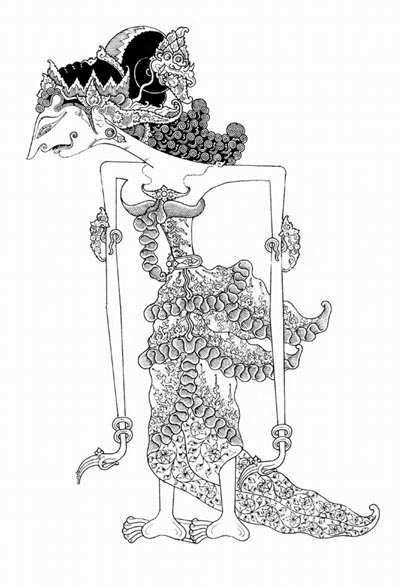
Meanwhile, music and dance saw their own manifestations of the gorgeous Sakuntala. Below is an example of Indonesian wayang (shadow-theatre) which is usually set to music. While there is evidence of indigenous story-telling predating the arrival of Hindu traders in the first century AD, much of the wayang oeuvre consists of tales from the great Hindu epics. Kisah Sakuntala, Ibu Kandung Bharata (or, The Tale of Sakuntala, the mother of Bharata) is one in the repertoire.
Sakuntala (Indonesian wayang)

One of Franz Schubert's operas is Sakontala (1820), an unfinished sketch with libretto by his friend J. P. Neumann. As late as 2000, one writer had written, "[Sakuntala] remains to this day the one and only Schubert stage work of which not one note has been performed for the public, anywhere, ever."[4] (This is not quite correct: a German television programme featuring Mallika Sarabhai's dance company had this music, and there have been some productions as well in the 1970s.)


Between 1913 and 1914, the sufi Hazrat Inayat Khan (1882-1927) visited Russia. He was received with much warmth in artistic circles, and he produced a ballet there titled 'Sakuntala'. The director Alexander Tairov had set up a new theatre; it was his hope to synthesise a multi genre spectacle. Inayat Khan's idea of a mystic balletic performance of Sakuntala appealed to Tairov. The music for the spectacle was arranged by Vladimir Pol. The New Theatre opened the production on 25 December 1914, with the title role played by Alisa Koonen. This wasn't a classical ballet but rather a dance interspersed with dramatic movements. Tairov wanted to present the production to the Czar, which sadly never happened. For a long time the music was thought to have been lost, but in 1991, it was found among various other documents at the Glinka Museum of Musical Culture. Three years later, a quartet of the Russian academy of music performed the piece. [5]


In 1889, Frederick Delius (1862-1935) set poetry by a Dane called Holger Henrik Herholdt Drachmann to music. A Dane! Who would have thunk it? Here's the first stanza of the poem:

Jeg kunde for Længsel ej sove,
En Blomstervind
Slog mig imod,
Strømmed herind ad mit Vindu
Som en vellugtaandende Flod;
Jeg hørte de høje Palmer
Suse svagt
Med sød Musik;
Det hvisked ihvor jeg stod og gik:
  Sakuntala, Sakuntala.

(I could not sleep for longing, a flower wind struck me ... )

It seems Drachmann had seen a staging of Kalidasa's play in Munich, and was struck by the parallels between his own ruined marriage and that of Sakuntala. [6]

Not to be left behind, the Italians got into the act as well. Here's Franco Alfano's 'La leggenda di Sakùntala', first act. He wrote it in 1921.


And that's it for now!

References

1. Jeremy Howard, Art Nouveau: International and National Styles in Europe, Manchester University Press, 1996.
2. Susmita Sundaram, 'Translating India, constructing self' in (ed.) Brian James, Contexts, Subtexts and Pretexts: Literary Translations in Eastern Europe and Russia, John Benjamins Publishing, 2011.
3. (ed.) Martin Lerner, The Flame and the Lotus: Indian and Southeast Asian Art from the Kronos Collections (p. 90), Metropolitan Museum of Art, 1984.
4. Uncle Dave Lewis, 'Franz Schubert: Sakontala', AllMusic.com
5. Cyclowiki, Shakuntala ballets (in Russian).
6. Hattie Anderson, 'Vilhelmine, the Muse of Sakuntala', The Delius Society Journal, Spring 2000, Number 127. (See here for PDF.)

Apr 25, 2013

Maneaters

In my hunt for the art of the erstwhile Russian imperium, I came across the Georgian artist Merab Abramishvili. A painter well-versed and steeped in Oriental mysticism, paganism and medieval Christianity, he created a wide range of works seeking to synthesise their varied wisdoms. One of his very best works is the 2005 canvas called the Maneater of Kumaon. Here it is:

Maneater of Kumaon, by Merab Abramishvili. (2005).
Maneater of Kumaon is an important example of Abramishvili’s preoccupation with mystical beasts. A tiger is set against a meticulous and elaborate exotic garden. Lace-like foliage is painstakingly painted in tempera, yet smudged over with a layer of almost transparent paint, in places creating the effect of a soiled antique mural. The tiger itself appears elongated and delicate like a sublime beast that might have stepped out of an Oriental miniature. Abramishvili’s thin, meticulous brushstrokes carefully outlining the figures turn into smudges and dribbles of paint to produce the overall impression of a mirage. Gazing out into the distance the heroic tiger is so other worldly that the victim at his feet can easily pass unnoticed. Covered with streaks of red, (s)he lies lifeless and forgotten. The subdued violence of this work exemplifies the concealed qualities of the artist’s utopian visions. [1]
The Maneaters of Kumaon, of course, is a well-known book by the big-game hunter turned conservationist Jim Corbett. In a career spanning thirty years he shot several great cats that had taken a taste to human flesh in the foothills of the Himalayas. This was not the only book out of India with 'Maneater' in its title - R. K. Narayanan wrote The Man-Eater of Malgudi in 1961.

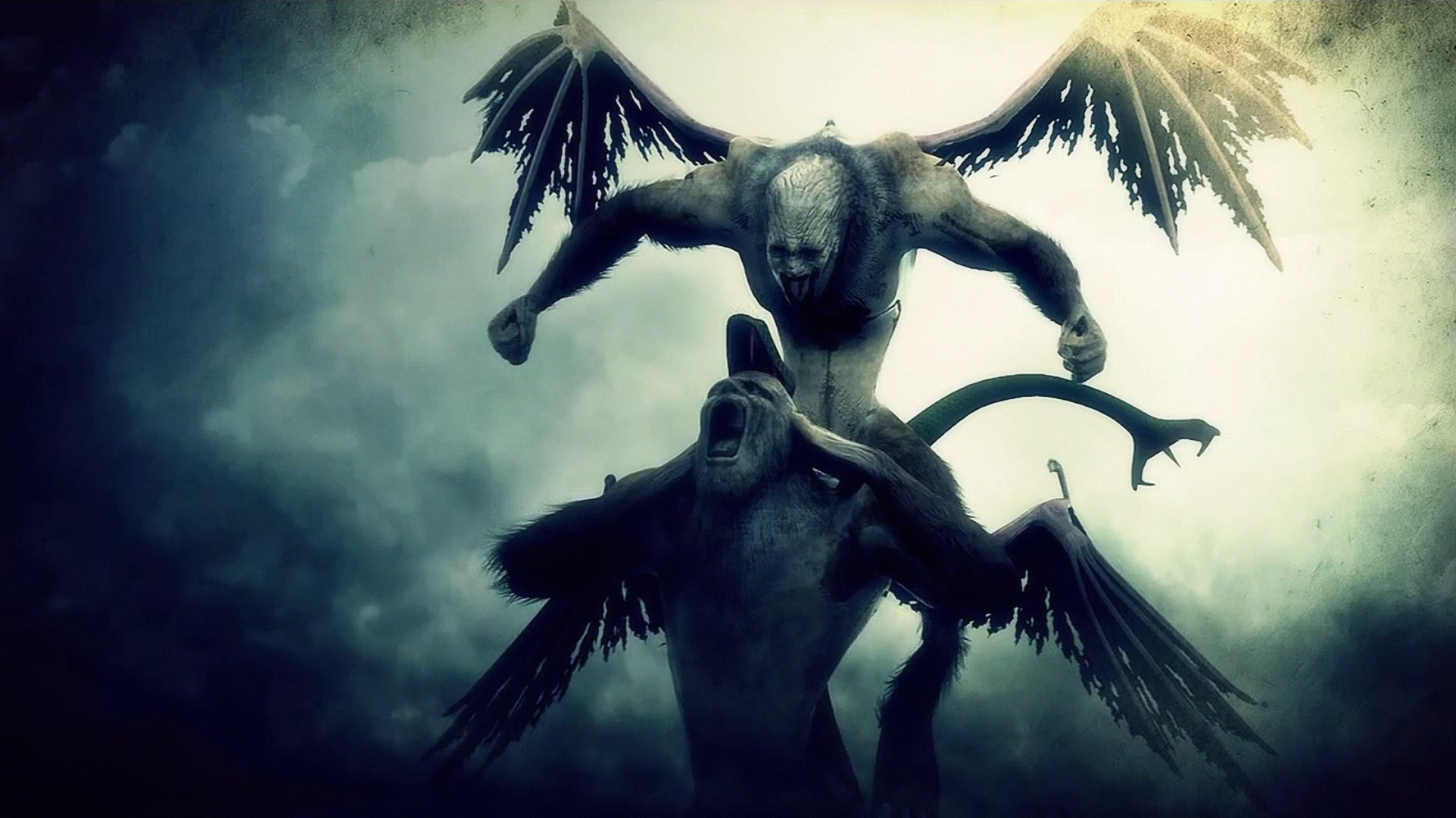
This book, though, has little to do with cats; instead, it is a humorous tale of a printer's woes on account of his acquaintance with a veritable demon of a taxidermist. Demonic man-eaters are a dime a dozen in art, too, especially in the art of gaming fantasy, as for example here:
Who is this by?
A certain A. Hitler was depicted as a demonic maneater in wartime propaganda, as in this English poster (inspired by contemporary Soviet works).

MANEATER

The good thing about propaganda is that it can cut both ways. Here is a Japanese anti-Russian poster by  Hitokui Rokoku (1904), in which the Czar personifies the Russian man-eater with peoples of various nationalities swallowed and struggling in his stomach.

Russia: The Man-Eater, by Hitokui Rokoku. (1904).

At the time it was put down by Japan, Russia, like a devilish man-eater, abused severely people of all countries it had swallowed: [the devil] eats some tendon and starts sneezing, he bites some meat, but starts coughing, he pinches something and becomes itchy, he thrusts somewhere and farts. But in the end he throws up everything he has eaten. [2]

And, speaking again of Japan, Hall and Oates visited in 1982, where they performed their famous song, titled - you guessed it - 'Maneater'. Here they are:


References

  1. 'At the Crossroads: Contemporary Art from the Caucasus & Central Asia', Sotheby's exhibition catalogue notes, March 2013.
  2. Yulia Mikhailova, 'Japan and Russia: Mutual Images, 1904-39'.