Given the speed of our communications, the problem of unintentional ‘crossed wires’ in the ancient world must have been severe. A lot could happen while a message from A was taking a month to reach B. A famous story—possibly invented by that imaginative fellow Ben Trovato—illustrates the point. In AD 40, Caligula wanted a statue of himself as Jupiter erected in the temple at Jerusalem. The local governor Petronius wrote suggesting this was really not a very good idea. At the same time, Herod Agrippa, a local tetrarch of the region, was in Rome, heard of Caligula’s plans and dissuaded him. So Caligula wrote to Petronius cancelling the project—and only then received Petronius’ letter. Seeing it as insubordination, he wrote back, ordering Petronius to top himself. The letter was delayed by storms, eventually arriving 27 days after news had already reached Petronius that Caligula had been assassinated. Phew! So there is something to be said for delays in the mail after all.
When I first learned to read, my dad would insist that I do so loudly. In turn, when the boy started to read, I would ask him to do it out loud.
In both cases, we (that is, the boy and I) quickly realised that we read much slower when articulating the words than when reading in our minds.
When I grew up a bit, I also learned that some people who read in their minds were sub-vocalising. In other words, they were mentally pronouncing each word. This meant, of course, that they were reading slowly.
Did
it really make a difference, whether one read loudly or quietly? Was
subvocalised reading less efficient than speed-reading? Was it important to be an efficient reader?
When my boy read loudly, he sometimes slurred the words. I had to ask
him to slow down. I wanted to make sure he pronounced each word
correctly - after all, while his vocabulary was growing, he needed to
know what the words sounded like.
*****
I noticed that when I was paying attention to the act of reading, I tended to understand less of what I read. That is to say, observing myself reading affected my reading - and comprehension.
One day, when I was about thirteen years old, I decided I would read an entire James Bond book. I was in the library and there were about two hours to closing. I finished it just in time. When I got home, I had forgotten the entire plot of the book - and yet, as I was reading it, I was enjoying it! (The sexy bits, at least.)
*****
When I was little, every time I came across a new word, I'd ask my dad what it meant. He'd direct me to the dictionary, and as it was too much of a hassle to stop reading, pick up the dictionary and look up the word, I stopped asking for meanings. My boy asks me for meanings, as I once did. I don't direct him to the dictionary; I tell him the meanings; but I find that he doesn't always remember what I said. The asking appears to be more important than the hearing.
*****
Historically, reading was a communal affair - at least here in England. Sister-familias would read loudly to the family, mater-familias would knit, pater familias would smoke a pipe, frater-familias would get a kick every time he fidgeted. The family spent some time as a unit, welcomed new worlds into its midst, enjoyed the sonority of the words.
How did reading become a solitary affair? Here is St Augustine, writing about his mentor, St Ambrose:
When he was reading, he drew his eyes along over the leaves, and his heart searched into its sense, but his voice and tongue were silent. Oft-times when we were present... we still saw him reading to himself, and never otherwise... . But with what intent soever he did it, that man certainly had a good meaning to it.
Was Augustine surprised at the silent reading? Did this mean that silent reading at the time (4th century AD) was considered an oddity? Or was he more perturbed by the fact that Ambrose was reading to himself whilst in company? Was reading expected to be a shared experience?
These days, privacy is all and individualism is paramount. The occasions for shared reading are few and circumscribed. An author reads excerpts on a publicity tour. A parent reads to a child. A pastor reads to the congregation. The magic of the written word is now a purely personal thing.
There's been a veritable spate of TV programmes on Ancient Rome lately. Just a week or so ago was Caligula by the lovely Mary Beard. This overlapped historically (and a little bit thematically) with Catharine Edwards' Mothers, Murderers and Mistresses: Empresses of Ancient Rome. Three months ago was Margaret Mountford's Pompeii: The Mystery of the People Frozen in Time, and that was an update on Mary Beard's programme on Pompeii (Life and Death in a Roman Town) from about two-and-a-half years earlier. Last year, we were treated to a series on the religions of Rome (pagan, Christian, Papish) by Simon Sebag Montefiore, as well as a search for its forgotten ruins (amphitheatres, canals, forts, lost cities) with Dan Snow. We've had a three-parter called Treasures of Ancient Rome hosted by Alastair Sooke, which shows us that the Romans may have been famed for murther and engineering, but that they were great artists as well. Mary Beard, too, has been extra busy, because her show on the lives of common Romans (Meet the Romans) was also shown last year.
There have been two programmes on Hadrian and his wall (in the Timewatch series of 2007, and by Dan Snow the following year). There have been several programmes on gladiators (Gladiator Graveyard), most recently in Timewatch again (2007), as well as one from 2003 titled The Colosseum: Rome's Arena of Death. Terry Jones explored the cultures of Rome's contemporaries - the people the Romans liked to call Barbarians (2006). More ambitious than all of these was a six-parter titled Ancient Rome: The Rise and Fall of an Empire also in 2006.
And these are just the BBC programmes. The other channels have not been negligent. Channel 5 has done its bit to promote the imperium (programmes on Julius Caesar and gladiators) as well as Channel 4 with its various Time Team digs uncovering Roman Britain.
You get the drift. Serious obsession with the Romans in these here British Isles. That's all right, it's all classical history and good fun.
So what do these programmes cover? Blood and sensation (peacetime and wartime) and some religion and art. Where are the stories of republican Rome? How did the Romans become a superpower? Where's Roman science? Engineering? Literary Rome? Mercantile Rome?
Classical history, of course, includes the Greeks. Here too we have rich amounts of programming (although nowhere in the league of the Romans). There's the usual stuff - Troy, Sparta, Athens, the battles against the Persians. Luckily there's also been some delightful programmes on Greek science (Aristotle, the Antikythera mechanism), as well as a recent cultural round-up by Michael Scott. But, again, it appears we are fated to see the same tired topics repeated over and over.
Can't we have some coverage of the post-Alexandrian Hellenic world? It extended to north-west India and lasted for centuries, brilliant blends of local cultures with that of the Greeks. What about Ptolemaic Egypt? And, again, mercantile Greece? Or its amazing scientific achievements? True, some of its mathematics was covered by Marcus du Sautoy, and some of its optics by Simon Schaffer. But there's a world of Greek thought just waiting to be shown on TV, surely.
There's more to Ancient Egypt than the Pyramids and King Tut, too. A nice recent programme was on the reconstruction of a boat supposedly sent by Queen Hatshepsut to Punt - although nobody really knows where Punt is. Another one was on the search for Rameses's lost city. (These searches for lost cities always seem to be high on a TV programmer's agenda.)
But there's far more to ancient history! The decipherment of ancient scripts? (You could do a nice programme of about an hour on the topic, using the epic of Gilgamesh as focus. Or an entire series, using a great text from each of the ancient civilisations. How about six parts - Sumer, Egypt, China, India, Maya, and the earliest alphabet (was it Phoenician?)) The hunt for the historical Hanging Garden of Babylon? Again, a stirring subject, with much controversy and any amount of to-ing and fro-ing amongst the historians. What about the spread of Hindu and Buddhist culture out of India? I don't think I've seen much about the Persians (although I recall there was some chatter when the British Museum organised its massive exhibition a few years ago). There could even be a kind of thematic coverage of great thinkers and philosophers - toss Confucius, Buddha, Mahavira, Zoroaster, and a couple of Greeks into the mix - and compare and contrast! I could go on and on.
I've been in this country for ten years, and I've found the quality of its public broadcasting superb, a true wonder. Now if only its coverage would widen.
A chap called Daniel DMello recently wrote a piece titled "10 Classic Indianisms: 'Doing the needful' and more". It has been doing the rounds of the web and eliciting chuckles from Indians and others. I am the first to concede it is amusingly written. But the author's smugness and condescension are palpable. He evidently believes that the God of Grammar has revealed rules of English usage to him. He does little to verify that his 'Indianisms' really are limited to the subcontinent. Worse, he hasn't even bothered to check if his assertions on grammar hold water at all. He is funny. If you are only interested in his humour, stop reading right here. But if you have any inclination towards accuracy, read on. His piece, I'm sorry to say, is specious. It is vacuous. It makes me, dare I say it, bilious.
Prescriptivists of language usage very often don't know what they are talking about. Consider the widely held injunction against the passive voice. Prescriptivists in many ways are hidebound people with little understanding of how languages develop. They are conservatives with pet peeves. They would do well to go to the superb Language Log and learn about grammar and language from real experts. This is not to say that all of DMello's complaints are unsound. Let us examine them one by one.
0. What is your good name? Clearly this is a literal translation of the Hindi आपका शुभ नाम क्या है? Why is this any less valid an addition to the corpus than anything invented by, say, the Romans? English abounds in Latinisms. After all, they said 'cum grano salis' and we have translated it to 'with a grain of salt' and nobody scoffs. Languages admit new usages all the time, some of which become entrenched while others fall by the wayside. Survival of the fittest, what?
1. Pass out. DMello says that to pass out is to faint. He dislikes its use to mean 'to graduate from an institution'. He says only the Indians say 'pass out from college.' Bunkum. In Britain, if you graduate from a military college, you are said to pass out. I can't say for sure, but isn't it possible that the usage was extended to mean to graduate from any college when the Brits came to India?

 3. Years back. DMello insists it should be 'years ago'. It's true that the usage of 'years ago' vastly outnumbers 'years back'. Searching on Google, 'years ago' brings up about a billion hits, while 'years back' brings in only 33 million (about 30 times fewer). But DMello again makes the mistake of attributing the phrase to Indian English. A member of the English Stack Exchange checked both the British and American corpora of contemporary usage, and discovered that 'years ago' is used about 10-20 times more often than 'years ago', both in formal and informal speech/journalism/fiction (although the Brits don't use 'years back' at all in academic literature). But Americans and Brits do use this expression. How about Jeffrey Kluger in this article in Time? Is Kluger desi, DMello? (DMello also resents the use of 'backside' to mean 'back'. As in 'put the suitcase in the backside of the car'. What can I say, DMello, you are correct here.)
5. Discuss about. Why add the 'about', asks DMello. Good question. It appears to be unnecessary. And yet it's not just Indians who say this. There are 6 million hits on Google for this expression, not all by desis. The occasional Iranian bureaucrat has been heard to use it. Even the New York Times has stumbled.
6. Order for. DMello doesn't like ordering 'for' anything. 'For' is gratuitous. I agree.
7. Do one thing. I suspect this comes from the Hindi एक काम करो. It is a colloquial expression that generally precedes a suggestion. It is an Indianism - I haven't seen or heard this used anywhere else. I'm no oracle, of course, so you are free to do your own investigation. DMello says, drolly, that a person who says 'do one thing' usually proceeds to suggest five. Yup, that can happen. But that's a matter for logic, not usage, surely?
8. Out of station. This, like 'pass out', comes from British (and American) military usage. DMello's complaint is that this is archaic. A brief online search reveals that it is not all that dated. It's not particularly restricted to subcontinentals either. In West of the West: Imagining California (by Leonard Michaels et al, University of California Press), page 283, appears the sentence 'One continues to run into people who, literally and metaphorically, are out of station.' And a little later, 'The out-of-station are to be met with at every twist and turn.' The book was published in 1995. There were no desis involved in writing it.
9. Sleep is coming. DMello objects to the anthropomorphism here. On the other hand, finer writers than him have written "Winter is coming", and "Night is coming", and, well, it's all very portentous when they say it, and it loses a bit of that sense of awe when someone is about to clunk into bed, so, okay. Point taken. I think.
10. Prepone. DMello doesn't object to this Indianism and an Indianism it is, to be sure, a very logical one, a most apt one indeed, as DMello himself is eager to add. This is clearly a neologism, and that's yet another way languages change. Were it not for neologisms, there wouldn't be 'laser' and 'photon' and 'torpedo' and Star Trek would have been that much duller and the wife and I wouldn't have watched it, or if we did, one of us would have hated it, and then had we ever met, we wouldn't have gotten on as well as we did, and that doesn't bear thinking about.
So there you have it. What do you have to say, DMello?
Prescriptivists of language usage very often don't know what they are talking about. Consider the widely held injunction against the passive voice. Prescriptivists in many ways are hidebound people with little understanding of how languages develop. They are conservatives with pet peeves. They would do well to go to the superb Language Log and learn about grammar and language from real experts. This is not to say that all of DMello's complaints are unsound. Let us examine them one by one.
0. What is your good name? Clearly this is a literal translation of the Hindi आपका शुभ नाम क्या है? Why is this any less valid an addition to the corpus than anything invented by, say, the Romans? English abounds in Latinisms. After all, they said 'cum grano salis' and we have translated it to 'with a grain of salt' and nobody scoffs. Languages admit new usages all the time, some of which become entrenched while others fall by the wayside. Survival of the fittest, what?
1. Pass out. DMello says that to pass out is to faint. He dislikes its use to mean 'to graduate from an institution'. He says only the Indians say 'pass out from college.' Bunkum. In Britain, if you graduate from a military college, you are said to pass out. I can't say for sure, but isn't it possible that the usage was extended to mean to graduate from any college when the Brits came to India?
2. Kindly revert. DMello says that 'revert' means 'return to a former state'. It is incorrect to use it to mean 'reply'. Well, it's not just Indians who are culpable. So are the Singaporeans and Malaysians. And in the Caribbean, too, it's used to mean 'get back', as in 'I will revert (get back) to you.' True, it originates from Indian English. But the Oxford Advanced Learner's Dictionary has accepted this usage in its latest edition. DMello should check his facts before pontificating.

 3. Years back. DMello insists it should be 'years ago'. It's true that the usage of 'years ago' vastly outnumbers 'years back'. Searching on Google, 'years ago' brings up about a billion hits, while 'years back' brings in only 33 million (about 30 times fewer). But DMello again makes the mistake of attributing the phrase to Indian English. A member of the English Stack Exchange checked both the British and American corpora of contemporary usage, and discovered that 'years ago' is used about 10-20 times more often than 'years ago', both in formal and informal speech/journalism/fiction (although the Brits don't use 'years back' at all in academic literature). But Americans and Brits do use this expression. How about Jeffrey Kluger in this article in Time? Is Kluger desi, DMello? (DMello also resents the use of 'backside' to mean 'back'. As in 'put the suitcase in the backside of the car'. What can I say, DMello, you are correct here.)
4. Doing the needful. Ha. Okay... It's a fair cop, guv. Except it isn't! It's an Englishism - search for it and you'll find uses from the Law Journal of 1833, and Marine Insurance documentation of 1866, and in Charles Dickens' Pickwick Papers, and letters from some incensed Glaswegians to the abdicating King Edward VII in the 1930s, and the Kenya National Assembly Official Record of 1986 and, for heaven's sake, what the Dickens are you on about, DMello?
5. Discuss about. Why add the 'about', asks DMello. Good question. It appears to be unnecessary. And yet it's not just Indians who say this. There are 6 million hits on Google for this expression, not all by desis. The occasional Iranian bureaucrat has been heard to use it. Even the New York Times has stumbled.
6. Order for. DMello doesn't like ordering 'for' anything. 'For' is gratuitous. I agree.
7. Do one thing. I suspect this comes from the Hindi एक काम करो. It is a colloquial expression that generally precedes a suggestion. It is an Indianism - I haven't seen or heard this used anywhere else. I'm no oracle, of course, so you are free to do your own investigation. DMello says, drolly, that a person who says 'do one thing' usually proceeds to suggest five. Yup, that can happen. But that's a matter for logic, not usage, surely?
8. Out of station. This, like 'pass out', comes from British (and American) military usage. DMello's complaint is that this is archaic. A brief online search reveals that it is not all that dated. It's not particularly restricted to subcontinentals either. In West of the West: Imagining California (by Leonard Michaels et al, University of California Press), page 283, appears the sentence 'One continues to run into people who, literally and metaphorically, are out of station.' And a little later, 'The out-of-station are to be met with at every twist and turn.' The book was published in 1995. There were no desis involved in writing it.
9. Sleep is coming. DMello objects to the anthropomorphism here. On the other hand, finer writers than him have written "Winter is coming", and "Night is coming", and, well, it's all very portentous when they say it, and it loses a bit of that sense of awe when someone is about to clunk into bed, so, okay. Point taken. I think.
10. Prepone. DMello doesn't object to this Indianism and an Indianism it is, to be sure, a very logical one, a most apt one indeed, as DMello himself is eager to add. This is clearly a neologism, and that's yet another way languages change. Were it not for neologisms, there wouldn't be 'laser' and 'photon' and 'torpedo' and Star Trek would have been that much duller and the wife and I wouldn't have watched it, or if we did, one of us would have hated it, and then had we ever met, we wouldn't have gotten on as well as we did, and that doesn't bear thinking about.
So there you have it. What do you have to say, DMello?
Welcome, folks, to the seventy-third Carnivalesque, the Ancient/Modern edition of the popular History blog carnival. Thanks to all those who contributed and sent suggestions.
To start with, take a look at this timeline (timelines being some sort of minor addiction for me) of historical events that occurred in years ending in 73. Trite, eh? There’s considerable uncertainty about the older dates, of course, but if there’s at least one source that speculates an event occurred in such a year, well, I’ve bunged it in.
Events in the years before Christ (or Common Era, to be less religious) appear against negative numbers in this timeline. If you click on any of the titles, a little window should open up with some extra information.
This is the week after Easter, and so a light Christian history thread runs through this carnival. But fear not – there’s lots of other stuff to whet your secular appetites.
And so, to begin:
Africa
 |
| Kemsit, the Nubian queen of the Egyptian King Mentuhotep II (2061-2010 B.C.), and her servants; from a painting in her tomb chamber wall |
Would you be willing to trek across the Egyptian desert all the way to Chad? Even today it’s a perilous journey, and yet there’s evidence that the Pharaoh Mentuhotep II (2061-2010 BC) organised an expedition to that western land. Read about it in Owen Jarus’ post in Unreported Heritage News.
*********
Europe
Around 3500 BC, the Neolithic inhabitants of the island of Jersey built a worship mound that came to be known as La Hougue Bie. Millennia later, a church was built atop it. The Neolithic mound was equinoctically aligned, and it turns out so is the church. Alun Salt tells the story.
You may have seen some racy news recently - First Gay Caveman Found! - etc. Bunkum. The Corded Ware (2900-2500 BC) burial site near Prague was not of cavemen; rather it's of pre-Bronze Age farmers. Why do they think it was a gay caveman? John Hawks does a spot of debunking.
If you have wondered why Isocrates (436-338 BC) is not as well-known as, say, Plato, wonder no more. Michael Anderson has the scuttlebutt in his Ancient History Blog.
How likely is it that a list of survivors of the Battle of Marathon survived to this day? Or that such a list ever existed? Rogueclassicism has an overview of the affair of the Marathon tablet (403 BC ?) and its epigraphy.
What do Nerva, Trajan, Hadrian, Antoninus Pius, and Marcus Aurelius have in common? Adrian Murdoch’s series of podcasts on Gibbons’ “five good emperors” (AD 96-180) reveals all that you might want to know. Get them at his blog Bread and Circuses.
 |
| Ivan Bilibin's Illustration to the Lay of Igor's Campaign (from Wikimedia Commons) |
‘In AD 1185, as the Kievan Rus Empire was starting to deteriorate, a little known prince on the eastern Russian borders led his outnumbered men into battle against Mongolian invaders, the Polovtsians (Kumans). This battle and its aftermath would become the topic of the Russian literary epic, “The Lay of Igor’s Campaign.”’ Seesaw discusses the battle, the epic and its musical successors in Russia, Past and Present.
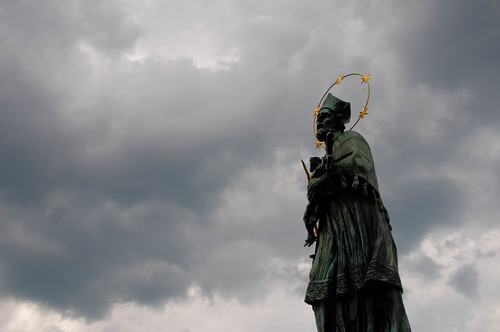 |
| St. John of Nepomuk, Charles Bridge, Prague by dlnwelch, on Flickr |
If you wander about the Upper Palatinate in Germany, you might find yourself wondering – as Patrick Shrier did – why there are statues of St John of Nepomuk (d. 1398) on nearly every bridge in sight. What’s a Czech saint doing in Germany? Shrier investigates and reports in Patrick’s Military History Blog.
A oft-repeated statement is that the famous vegetarian Leonardo da Vinci (1452 - 1519) was 'ahead of his time' in sundry disciplines. While this may be somewhat true of his art, it doesn't apply to his technical work, says Thony C. in the Renaissance Mathematicus.
There’s no end to weirdness in Europe, and Vlad the Impaler is about as weird as a historical character can get. Soon after taking up the throne of Wallachia (1457), he invited the nobility to an Easter feast and – well, Executed Today has the story.
'Tis the 550th anniversary of the Battle of Towton (1461) - one among many in the Wars of the Roses in sunny England - and there are no pictorial representations extant of that battle. So what was Sheila Corr to do when she had to provide a suitable illustration for an article in History Today? Find out here.
Speaking some more of seriously weird things: there was much faith in putting one’s fate in the hands of chance (or God) – even secular arguments were sought to be settled by means of trial by fire. One of the last such trials occurred in Florence in 1498, as Beachcombing’s Bizarre History Blog reports in Barbecuing Friars in Late Medieval Florence.
*********
Middle-East
While it’s widely believed that the Abrahamic faiths are monotheistic, there is considerable evidence that Judaism, the oldest of them, was initially polytheistic. JK at Varnam explains the ins and outs of how god became God and acquired a wife, and other gods were consigned to oblivion (c. 8th century BC)
What’s up with physicists thinking they can contribute to historical analysis? Surely the age of the dilettante is past? Jona Lendering in New at LacusCurtius & Livius excoriates Colin Humphreys for his claim that Christ’s Last Supper took place on a Wednesday, and not – as historians agree – on Maundy Tuesday. “The trouble with the Jaubert-Humphreys Thesis is that it solves a problem that does not exist by using a method that is self-contradictory…Unfortunately, this is not an innocent, funny story about scientists who should not pretend they are historians.”
In the early days of Christianity, Easter was the chief religious festival. Birthdays were considered a pagan relic. So how did Christmas become the important festival it is today? Ranjith Kollanur explains in his blog A View From My Disjointed Laptop.
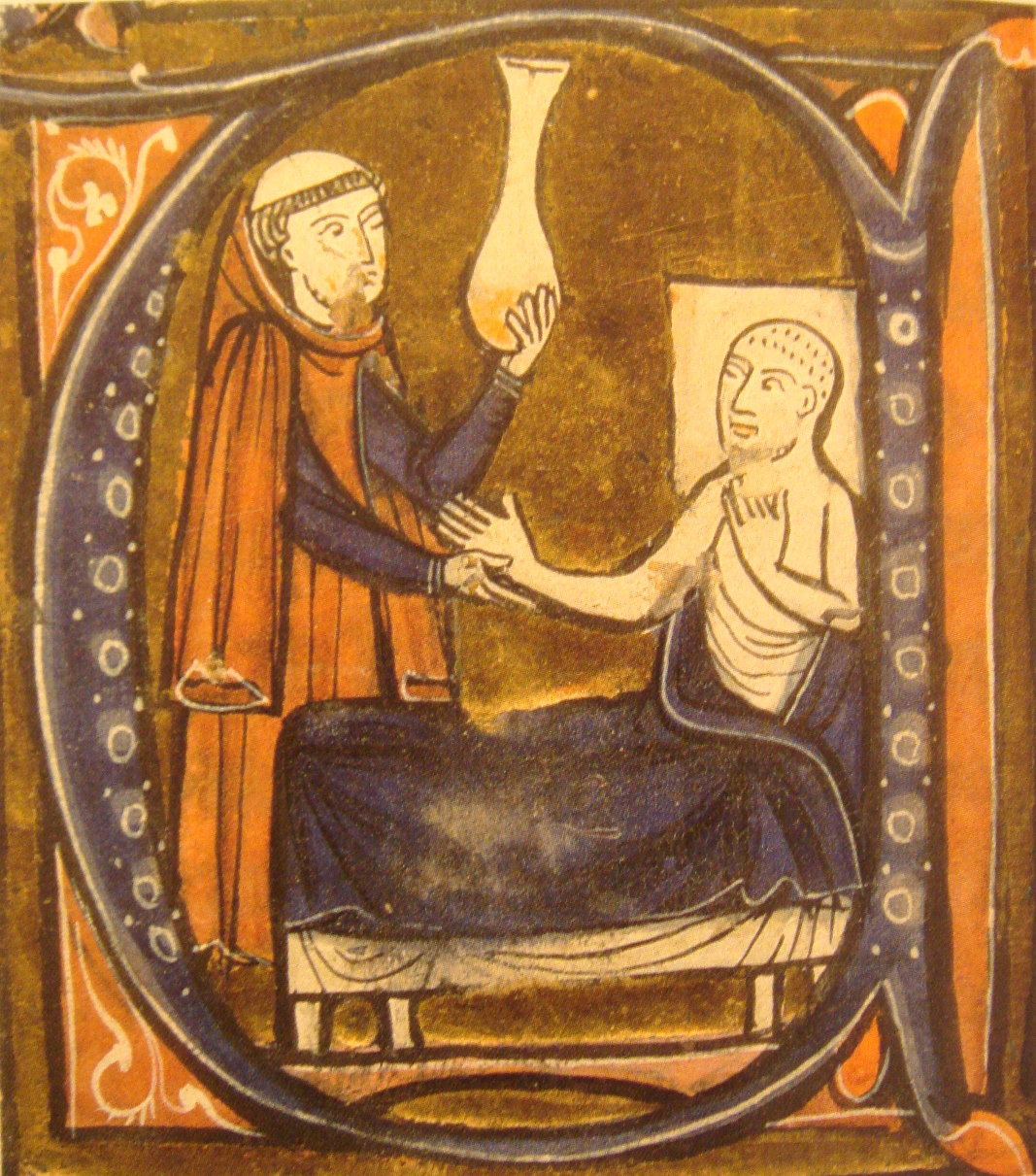 |
| European depiction of the Persian doctor Al-Razi, in Gerardus Cremonensis "Recueil des traités de médecine", 1250-1260. (Wikimedia Commons) |
When and where was the definitive recognition of smallpox made? In Persia around AD 900, a medic called al-Razi wrote a treatise named al-Judari wa al-Hasbah (On Smallpox and Measles). Lapham’s Quarterly blog has a small write-up.
*********
Asia
74,000 years ago, human beings were passing the Malay peninsula on their great migration across the planet. Archaeological digs in Perak revealed a sumptuous burial of a man, which showed that Malaysia was no civilisational backwater. Judith Weingarten has the story of the digs and the feisty woman who conducted the research in her blog Zenobia: Empress of the East.
According to the Vedas, a mighty river called the Saraswati flowed through the plains of north India. There have been efforts to identify this river - which no longer exists (in its original size, at least) - and there are controversies galore about its history. Researchers in geology, linguistics, archaeology, history, and climate science have contributed, and Michel Danino has a post discussing some of this interdisciplinary work.
According to the Vedas, a mighty river called the Saraswati flowed through the plains of north India. There have been efforts to identify this river - which no longer exists (in its original size, at least) - and there are controversies galore about its history. Researchers in geology, linguistics, archaeology, history, and climate science have contributed, and Michel Danino has a post discussing some of this interdisciplinary work.
 |
| Emperor Wu dispatching Zhang Qian to Central Asia (138 to 126 BCE), Mogao Caves mural, 618-712 CE (Wikimedia Commons) |
Tired of horsemen attacking his villages, kidnapping the women and killing the men, and realising that they were untouchable until he obtained a powerful cavalry, in 103 BC the Chinese emperor Wu sent a taskforce to the land of the Wusun to bring back the heavenly horse. Heather Pringle tells the story and its later ramifications.
 |
| Japanese samurai boarding Yuan ships in 1281 (Wikimedia Commons) |
In AD 1281, Kublai Khan sent a fleet to invade Japan. 730 years later, the History Channel purported to explain it all to unsuspecting aficionados of popular history. Learn what really happened, and why you shouldn’t trust (ever!) the History Channel - in this piece by Tatsunoshi in Shogun-Ki.
*********
The Americas
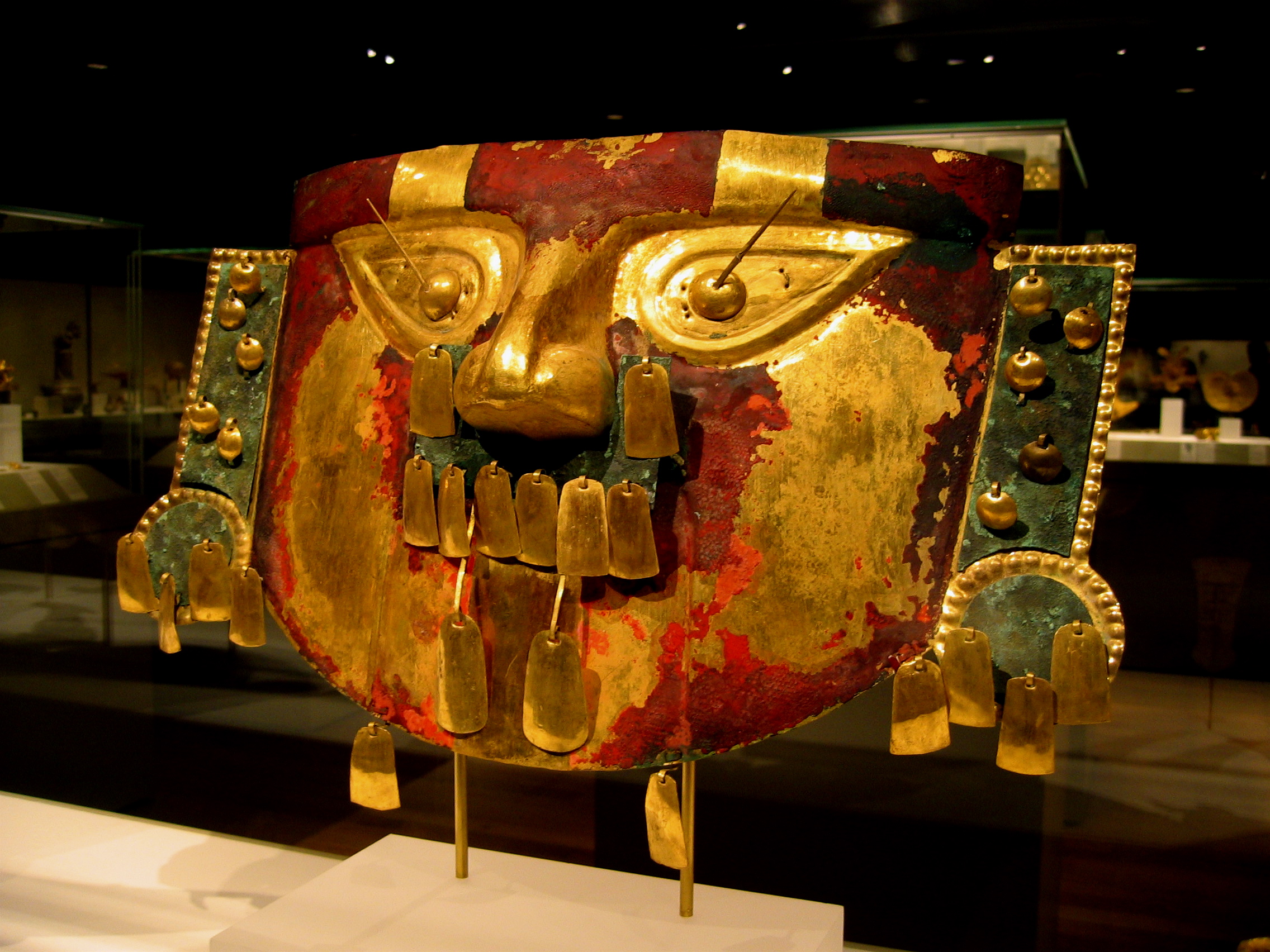 |
| Funerary Mask, 9th-11th century Peru; (Lambayeque) Hammered gold with cinnabar and copper overlays, cinnabar; (Wikimedia Commons) |
From the 8th century AD, the Lambayeque culture flourished in northern Peru. Like their more famous successors, the Incas, these were a people wont to fertility rituals and human sacrifices. How about combining the two by sacrificing women? Monty’s World has the story.
Archaeologists long thought that the cultures of Central America and North America had little or no interaction. Now it appears that there may have been thriving trade between them, lasting as long as five centuries from AD 900. The Pueblos of southwest USA drank cacao, which they could only have got from Mesoamerica. As Gregory LeFever reports in his blog Ancient Tides, they would have paid for the cacao with turquoise.
 |
| The 400-breasted Mayahuel Aztec Goddess of the maguey or agave (Wikimedia Commons) |
Why not ponder the fate of the Aztecs (13th – 16th centuries) and their rabbits? Even before the sanguinary and Easter-loving Spaniards turned up at their doorstep, they celebrated the bunny by naming a day in its honour. And they got as drunk as 400 rabbits. Say what? Judugrovee reveals the story in the blog The Complete Mesoamerica … and more.
*********
And, to round things off, interdisciplinaryment:
Art
When a snake escaped the Bronx Zoo a few days ago, a contest was announced in some papers to name her. Why not Wadjet? Here’s a post by Madeleine Cody in the Brooklyn Museum’s blog about the ancient Egyptian snake goddess, her history, her mythology and some of the art based on her.
Have you heard of the Codex Aureus? It’s a beautiful 10th century parchment manuscript featuring the four gospels. Peacay at the ever wonderful BibliOdyssey has the scoop.
 |
| Allegoric figure of Fortitude from the Four Virtues by unknown artist (also attributed to Botticelli), c. 1490, fresco, Castle Chapel, Esztergom |
Lovely Renaissance frescoes (1460s) were found in Esztergom, in Hungary. Zsombor Jékely in Medieval Hungary investigates - are they really by Botticelli?
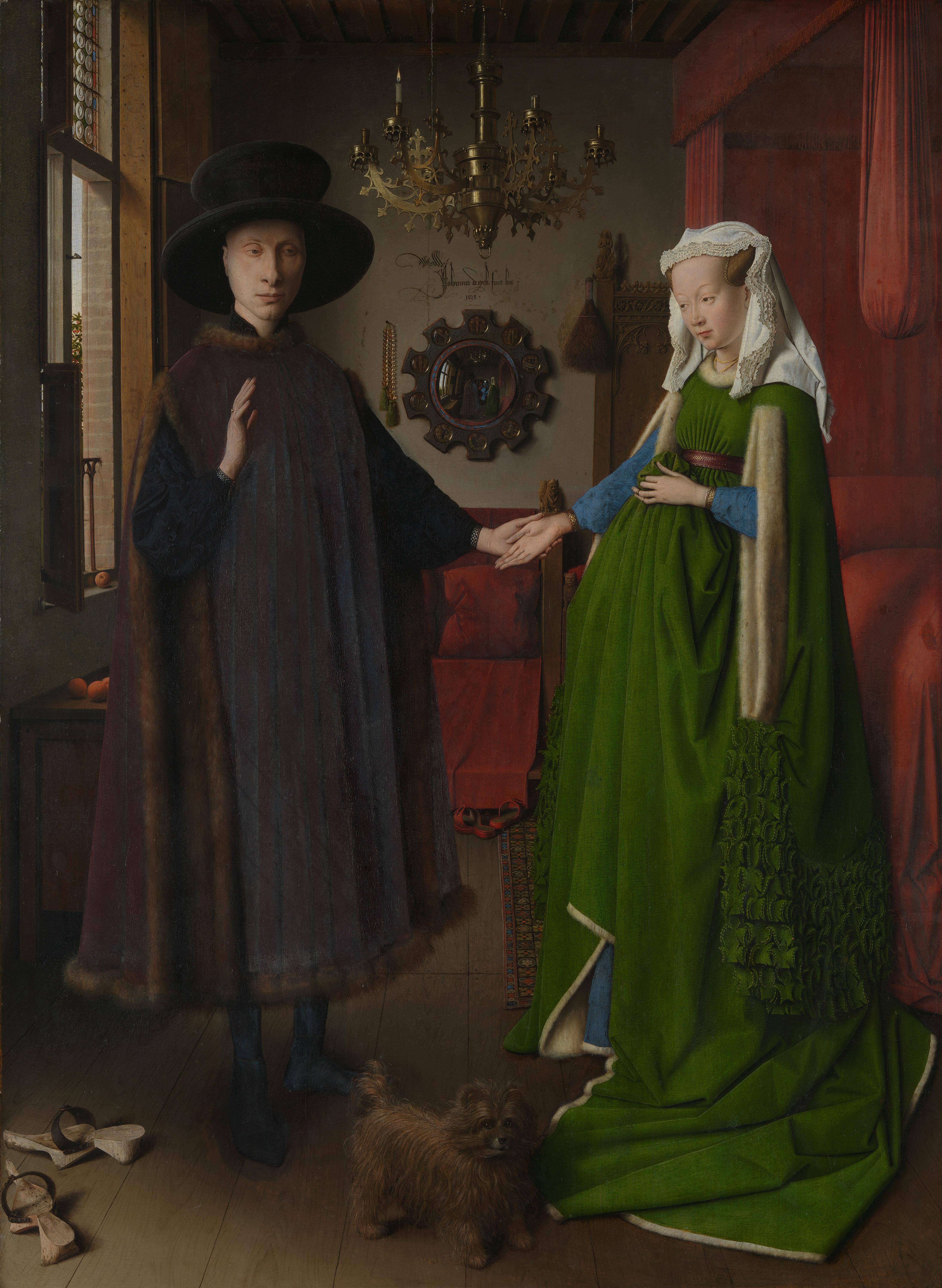 |
| Untitled, by Jan van Eyck (or Portrait of Giovanni Arnolfini and his Wife) (Wikimedia Commons) |
And we have another question: Is Van Eyck’s painting titled Arnolfini Portrait (1434) meant to portray Arnolfini’s wife? Considering there were five Arnolfinis in Bruges at the time, and we aren’t even sure which Arnolfini commissioned the painting, this might appear to be a fraught query. Alberti’s Window has a report.
*********
A Review or Two
Ever wondered about water and windmills? In Medieval History Geek, Curt Emanuel posts a review of Wind and Water in the Middle Ages: Fluid Technologies from Antiquity to the Renaissance. |The book is a scholarly compendium in ‘three general thematic sections with three papers having an archaeological focus, five concentrating on how mills "worked"; not physically but rather how they and their uses were integrated into society. The final three papers discuss how mills and milling were viewed by contemporaries through an examination of art and literature.’
While one Goth sacked Ancient Rome, a Vandal was its saviours. How’s that, you ask? That helpful Vandal was Stilicho. In Armarium Magnum, Tim O’Neill reviews at length a recent book by Ian Hughes titled Stilicho: The Vandal Who Saved Rome.
*********
That’s all for now, folks. Hope you enjoyed this round-up. The host of the next edition of this carnival will be announced shortly at the Carnivalesque website, and here’s a heads-up: it will cater to the Early Modern period, that is, AD 1500-1800.
Mark Liberman at the Language Log has been analyzing the influence of Persia on the Hebrews, the Romans, jazz, Romani. A neat piece, from which the following extract works quite foodily.
There's a famous poem by Horace (Carmina I XXXVIII) indicating the cachet of Persian culture even in classical Rome:
Persicos odi, puer, apparatus;
displicent nexae philyra coronae;
mitte sectari rosa quo locorum
sera moretur.

Simplici myrto nihil allabores
sedulus curo: neque te ministrum
dedecet myrtus neque me sub arta
vite bibentem.
A fairly literal translation by Owen Lee:
My lad, I hate Persian pomp,
Garlands woven on linden bark offend me.
Stop searching through all the places where
The late rose may linger.

My special care is that you add nothing,
In your labor, to simple myrtle. Myrtle disgraces
Neither you as you serve, nor me as I
Drink beneath the trellised vine.
W.M. Thakeray rendered it this way in Punch, making the obvious analogy between the classical Roman view of Persia and the 19th-century British view of France:
Dear Lucy, you know what my wish is,–
I hate all your Frenchified fuss:
Your silly entrées and made dishes
Were never intended for us.
No footman in lace and in ruffles
Need dangle behind my arm-chair;
And never mind seeking for truffles,
Although they be ever so rare.

But a plain leg of mutton, my Lucy,
I pr'ythee get ready at three:
Have it smoking, and tender, and juicy,
And what better meat can there be?
And when it has feasted the master,
'Twill amply suffice for the maid;
Meanwhile I will smoke my canaster,
And tipple my ale in the shade.
It's good to see that the good old Roman polloi had as little patience for the snobbery of the political elite as we do. On the other hand, a bit of weeping on TV does wonders for today's politician. Will the electorate ever focus on issues rather than emotions? I doubt it.
Some time in the second century BC, a member of the aristocratic Scipio family lost an election. Standing for the office of aedile, he had been eagerly canvassing the people -- and happened to shake the hands of a peasant. Now the peasant's hands were horny, from all his tough agricultural labour and Scipio -- being an effete toff -- was not used to the feel. "Wot," he said (as a joke?), "do you walk on these?"Now Rome might not have been a radical democracy, but the Roman people didn't put up with toffs insulting the honest labouring poor and they took their revenge. Scipio lost the election. That, at least is the story handed down by the early imperial writer Valerius Maximus in a section of his Memorable Deeds and Sayings devoted to people who lost elections (The Latin text is here: Book 7, 5, 2; ...).
History, as taught in classrooms is always about great men and their doings. We never learn about the little people. What did they do? How did they view the world? What did they say to each other? How did they love? What were their hopes and fears?
Rarely has any text about the common folk survived to present times. We obtain indirect evidence of their lives from church rolls - births, marriages and deaths - and tax records and legal edicts that affected them. Occasionally, as in Pompeii, we see graffiti, clothes, the remains of the food they ate. Invariably, tales from years past are about the good and the great. But once in a very blue moon, we obtain details of such richness that the past comes alive before our very eyes. Such a blue moon occurred in 1897, in a dig of sand-covered mounds in a village south of Cairo.
These turned out to be rubbish dumps of a thriving city named oxyrhynchos, in Greco-Roman Egypt. So many papyri were found, shreds, rolls, entire collections of literature and the quotidian, that even today, more than a century since their uncovering, they have not all been collated and deciphered and published. Five hundred thousand fragments were found, ranging from sublime masterpieces to early Christian texts to letters to legal titles and shopping lists. We finally hear the voices of linen-traders and farmers and mendicants from the years of the Ptolemies to the collapse of Roman rule.
The personal details are immensely moving, testament to the immutability of human nature and wants and needs across the millennia. There is love and longing. Here is Didyme, writing to her itinerant husband:
To Apollonios, her brother and sun, greetings. Be aware that I do not see the sun, because you are not seen by me; for I have no sun but you...
There was estrangement and despair. Here is Serenos, writing to his wife, Isidora, who had left him:
Before all else, I pray for your health. Every day and evening I make your obeisance with the goddess Thoeris who loves you. I want you to know that from the time you went away from me, I have been mourning, weeping by night and grieving by day. Since we bathed together on Phaophi 12, I never bathed or anointed myself until Hathyr 12. You sent me letters that could shake a stone, so much your words have moved me... Look how often I have sent to you! Let me know whether you are coming or not coming.
There was disappointment and one-sided friendship. Horis wrote to Horion:
Before all else I pray for your health. This is the second letter I'm writing to you and you haven't written back a single one. I love you always, but you rate me nowhere...
There was filial love and delight. Harpocras, pleased to hear from his father, wrote back:
Knowing you will be delighted, I felt bound to write to you that there's nothing wrong with me, well, I was rather dim for just a very few days and felt better long since and there is nothing wrong with me. I was greatly delighted reading through your letter, in which I saw that you were in the best of health, my lord father, and because since I was in swaggering spirits at receiving your letter I at once thought it could be an oracle from god and I am all the more remarkably healthy.
And here is an absolute gem from a boy, upset at having been left behind when his father travels, writing to complain:
Theon to Theon his father, greetings. A nice thing to do, not taking me with you to the city. If you refuse to take me with you to Alexandria, I shall not write you a letter or speak to you or wish you good health. So: if you go to Alexandria I shall not take your hand or greet you ever again. If you refuse to take me, this is what happens. And my mother said to Archelaos, "He is upsetting me, take him away!" A nice thing to do, sending me these grand presents, a hill of beans. They put us off the track that day, the 12th, when you sailed. Well then, send for me, I beg you. If you don't send for me, I shan't eat, I shan't drink. So there! I pray for your health.
There was fear and desperation in the face of disease, so much deadlier then than now. A frantic Isidora wrote to her travelling husband, Hermias:
Do everything you can, put off everything, come tomorrow. The child is sick, it's become thin, it doesn't eat, it's six days. I'm afraid it may die while you're not here. I tell you, if it dies when you aren't here, keep away, you'll find me hanging.
And, there were commiserations in times of death:
Irene to Taonnophris and Philon. Be of good courage! I felt as much grief, and wept as much, for the deceased as I wept for Didymas, and I did everything that was proper and so did all my people, Epaphrodeitos and Thermouthion and Philion and Apollonius and Plantas. Yet one can do nothing in face of such things. So comfort yourselves. Farewell!
But we can't end on a low, can we? So there was ribaldry and good-natured humour among friends, parodying sometimes the language of official communications (here accompanied by an anatomical drawing describing their sophomoric intentions):
Apion and Epimas say to their very dear Epaphroditos: "If you let us bugger you and it's OK with you, we shall stop thrashing you - if you let us bugger you." Keep well! Keep well!
Over twenty centuries later, all these people have achieved an intimate mortality that so many of their rulers craved. Their quotidian lives and fortunes have passed the test of time and we revel in their rebirth.
Notes
[All translations by Peter Parsons, City of the Sharp-Nosed Fish: The Lives of the Greeks in Roman Egypt
- The Oxyrhynchos Papyri, vol XLII, no 3059. (1898-2006)
- ibid., vol III, no 528
- ibid., vol XIV, no 1757
- ibid., vol XLVII, no 3356
- ibid., vol I, no 119
- Berichtigungsliste der griecheischen Papyrusurkunden aus Aegypten, vol 1; 6.
- The Oxyrhynchos Papyri, vol XLII, no 3070. (1898-2006)
I noticed earlier today that I have gone through a lot of books about the Romans lately. Sadly, though, not much sticks in my head these days. Ask me the difference between a denarius and a solidus, or what Seneca said about the state of the economy, and I run for the hills.
Still, there's some stuff around, both fictional and non-fiction. So here goes.
The historical works of Ross Leckie, entitled Hannibal and Scipio, are excellent examples of the genre. They are based for the most part in detailed research, but they have been written with a verve and dramatic flair that one rarely encounters in popular fiction. I dare say that the story of Hannibal is well-known. A Carthaginian general of peerless prowess, he took the war against Rome deep into Italy, defeating everything the Romans threw at him and nearly brought the nascent Republic to its knees. After the savage battle of Cannae where he routed his foes, he had the opportunity to strike at the city of Rome itself. He hesitated and that proved his undoing. Rome recovered, reached deep into itself, and finally conquered him in Zama, where young Scipio Africanus, who had studied his strategies over the years, used them against him with brilliant effect. The end of both heroes was lowly: Hannibal, old and still feared by the Romans, took poison; Scipio, hated and feared by the Senate for his great popularity among the people, died in his country seat either of a fever or suicide.
Leckie's books display a mastery of the warcraft of these generals. His descriptions of the cultural mores of the Carthaginians are hair-raising. There is considerable detail covered about the politics of the time - as the two major powers of the Mediterranean, it was inevitable that Rome and Carthage would go to war. One wonders how history might have turned out had Hannibal taken his cavalry commander's advice after Cannae to march to Rome at once. As Hannibal hesitated, Maharbal is said to have uttered: "You know how to win a battle, Hannibal, but not how to use your victory."
The fantastic quality of the Romans was their implacable refusal to accept defeat. Time after time, they proved their resilience by raising army after army, and eventually grinding their enemies into the dust. As described in P. Matyszak'sThe Enemies of Rome: From Hannibal to Attila the Hun, the Romans recovered from disastrous setbacks and lived to tell the tale of their eventual glorious successes. The likes of Jugurtha, Mithridates, and Boudicca may have tasted initial victories, but were in the end crushed and wiped out by the ruthless Imperium.
The usual image of Rome is one of civilisation holding back the rampaging barbarians. Naturally, it suited the victorious Romans to portray themselves thus. Matyszak's interesting book tries to show the times and the wars from the perspective of the other side, and in this he succeeds to a large extent. The Celts, he demonstrates, were not long-haired savages. Among other things, their metal working was superior to that of the Romans; In some ways, their social setup was more egalitarian than the patriarchal Roman 'democracy'. The Persians were not an effete race ruled by poncy and overwrought kings (see the movie 300 to see what I mean). The Seleucid kings of Asia Minor ruled over sophisticated cultures, with manifold achievements in the arts and literature. In many cases, revolts and wars against the Imperium were caused by the venality and inhumanity of the Roman governors and military in the occupied territories. The enemies of Rome were not always honourable. But neither are they the villains that history has portrayed them to be.
Where historical fiction goes, crime cannot be far behind. Lindsey Davis's series about M. Didius Falco is a popular one. Intrigued by the blurb ('hilarious'), I picked up One Virgin Too Many during our recent trip to Maldives. Falco, a shrewd investigator who scoffs at the middle-classes and yet is married to a decidedly patrician woman, is suddenly upwardly mobile (though not in the way his in-laws might consider all that). He has been appointed Keeper of the Emperor's Sacred Geese. Meanwhile, there are murders involving Vestal Virgins and his irritatingly supercilious brother-in-law, a missing six-year old who talks and behaves like an adult, long descriptions of religious Roman life, and non-stop irony by Falco. Other reviewers have acclaimed the intricate plotting and the humour, but I was not impressed. I will not be reading any more about Falco.
Speaking of investigators, Quintus Propertius Mala is, if anything, even more irritating than Falco. I have sometimes railed against the high barrier to entry into publishing by new authors, but in the case of Roy R. Johnson who appears to have self-published The Adventures of Quintus Propertius, I should say that it's entirely justified. Johnson should have inflicted his overwrought, pseudo-anachronistic and completely inane book only on his unsuspecting relatives. The blurb says, "Quintus Propertius Mala is a Roman investigator; or is he? His habit of coming out with obscure (to the narrator) quotations, sometimes in exotic languages, makes one wonder; so does his Zorro-like swordsmanship; so do his little 'inventions', so does… a great deal." In a nutshell, Mala is a time-travelling superman who uses his technological superiority (and skills at fencing) to attempt to change Roman history, and thereby bring on advancement and peace on Earth millennia ahead of time. In the midst of all this, he solves various crimes in a most deus-ex-machina fashion. Puerile stuff, and, now that he has found himself a beautiful woman also mysteriously transported to first century Rome from modern day Britain, no doubt Johnson is leading to a sequel.
When there are so many better books, both fiction and non-fiction, why did I waste a day going over this Mala crap?
[A problem with writing historical fiction is: will story work if transplanted to another time or culture? If it can, then it can hardly be rated as good fiction. Merely making the protagonist a gladiator, or procurator of the imperial poultry is insufficient. The connection between the story and the milieu should be coherent and natural. If the reader catches onto the artifice, the book might as well be pulped.
Various authors have set their works in the Classical era. As Allan Massie (himself an author of six novels set in Ancient Rome) explains in this article, there is a ready-made plot to be plundered; one can 'translate' the Latin dialogues one invents into contemporary neutral English without concern for the authentic sound; readers like to be intellectually challenged by strong narrative and exciting characters, and Rome provides any number of these.]
Moving on to alternative history. Romanitas (Romanitas Trilogy 1) by Sophia MacDougall is set in a modern world where the Roman Empire never fell. A reviewer of this book had begged readers to consider Robert Silverberg's Roma Eterna; more fool I that didn't pay attention. I read the former with a slack jaw and ennui filling my mind; then I rushed to read the latter to wash the bad taste out of my head. And what a difference in imagination and elegance of expression between the two! MacDougall is a poet filled with a chick-lit desire to ruminate on every thought and desire that occurs in her characters' simple minds. And what colourless characters: a mind-reader, her sap of a brother, and a royal lover on the run after his family was purged by some corrupt nobles. There's no depth to the protagonists; worse, there's no coherent narrative about the milieu in which they live. MacDougall shows a serious lack of understanding of basic economics or politics, which is quite a serious detriment if she wants to write alternative history. There's endless jawing, the plot is propelled with limp and scarcely believable situations, and at the end of 300-odd pages, one is staggered by the realisation that this is merely the first in a trilogy.
A sad fact of life is that while Silverberg's book languishes in the sci-fi sections of your favourite bookstore, MacDougall's deceptively presented book is out there in front attracting the unsuspecting buyer. Do you think that the publisher's favourite demographic - women over the age of thirty - will be seen dead near science fiction? Oh no. So they will miss out on a much better book.
Not I, however: I am heterodox in my reading so I fell upon Roma Eterna with a moan of hope, and in search of catharsis after having swallowed MacDougall's piffle. Not that this is one of Silverberg's best - after all, to cover 2000 years of history in convincing fashion, especially when one is furiously inventing an alternative reality, is not the easiest thing in the world. Silverberg's achievement is to pick out ten pivotal moments in history and show how, by actions tiny in the scheme of things, the future is altered. An example: a Roman nobleman exiled to Arabia finds himself drawn to a local merchant, who is charismatic, deeply spiritual and filled with the desire to spread the truth revealed to him by God. The Roman understands the appeal of a pure faith, especially one as rigidly prescriptive as that of his friend; he also has a sense of destiny and realises that this faith, if allowed to spread, could become a threat to the empire. So he arranges for Mohammed to be killed.
Joining the ranks of Allan Massie and his cohorts, is Steven Saylor and his tales of Gordianus the Finder. Unlike Lindsey Davis, whose wisecracking detective is generic enough to fit into any century, Saylor's writing is a fictional wrapper around factoids extracted from ancient Roman writers. I have only read his collection of short stories A Gladiator Dies Only Once, which - as detective fiction goes - is quite lame. There is not much plotting, and the puzzles seem to be rather trivial, but there is a wealth of information on Rome for the interested reader in Saylor's works, so I must give him some credit for assiduous research.
Saylor recommends Dr Stefan Cramme's website for all things fictional and set in Rome. This seems to be entirely in German, which is a bummer.
On a somewhat different note: Richard P. Cohen has written a magisterial survey of swords and their ilk. By the Sword: Gladiators, Musketeers, Samurai Warriors, Swashbucklers and Olympians is clearly not entirely set in Rome, but bears some relation to this current topic owing to the gladiator. Check out a review of this book here.
And I am still not done! I've put Conn Iggulden's Emperor series on the to-do list, as well as Robert Harris's Pompeii and Imperium. The latter, at least, is a writer at the very top of the artistic heap; by all accounts, Imperium is a superlative novel. Soon, soon...
Still, there's some stuff around, both fictional and non-fiction. So here goes.
The historical works of Ross Leckie, entitled Hannibal and Scipio, are excellent examples of the genre. They are based for the most part in detailed research, but they have been written with a verve and dramatic flair that one rarely encounters in popular fiction. I dare say that the story of Hannibal is well-known. A Carthaginian general of peerless prowess, he took the war against Rome deep into Italy, defeating everything the Romans threw at him and nearly brought the nascent Republic to its knees. After the savage battle of Cannae where he routed his foes, he had the opportunity to strike at the city of Rome itself. He hesitated and that proved his undoing. Rome recovered, reached deep into itself, and finally conquered him in Zama, where young Scipio Africanus, who had studied his strategies over the years, used them against him with brilliant effect. The end of both heroes was lowly: Hannibal, old and still feared by the Romans, took poison; Scipio, hated and feared by the Senate for his great popularity among the people, died in his country seat either of a fever or suicide.
Leckie's books display a mastery of the warcraft of these generals. His descriptions of the cultural mores of the Carthaginians are hair-raising. There is considerable detail covered about the politics of the time - as the two major powers of the Mediterranean, it was inevitable that Rome and Carthage would go to war. One wonders how history might have turned out had Hannibal taken his cavalry commander's advice after Cannae to march to Rome at once. As Hannibal hesitated, Maharbal is said to have uttered: "You know how to win a battle, Hannibal, but not how to use your victory."
The fantastic quality of the Romans was their implacable refusal to accept defeat. Time after time, they proved their resilience by raising army after army, and eventually grinding their enemies into the dust. As described in P. Matyszak'sThe Enemies of Rome: From Hannibal to Attila the Hun, the Romans recovered from disastrous setbacks and lived to tell the tale of their eventual glorious successes. The likes of Jugurtha, Mithridates, and Boudicca may have tasted initial victories, but were in the end crushed and wiped out by the ruthless Imperium.
The usual image of Rome is one of civilisation holding back the rampaging barbarians. Naturally, it suited the victorious Romans to portray themselves thus. Matyszak's interesting book tries to show the times and the wars from the perspective of the other side, and in this he succeeds to a large extent. The Celts, he demonstrates, were not long-haired savages. Among other things, their metal working was superior to that of the Romans; In some ways, their social setup was more egalitarian than the patriarchal Roman 'democracy'. The Persians were not an effete race ruled by poncy and overwrought kings (see the movie 300 to see what I mean). The Seleucid kings of Asia Minor ruled over sophisticated cultures, with manifold achievements in the arts and literature. In many cases, revolts and wars against the Imperium were caused by the venality and inhumanity of the Roman governors and military in the occupied territories. The enemies of Rome were not always honourable. But neither are they the villains that history has portrayed them to be.
Where historical fiction goes, crime cannot be far behind. Lindsey Davis's series about M. Didius Falco is a popular one. Intrigued by the blurb ('hilarious'), I picked up One Virgin Too Many during our recent trip to Maldives. Falco, a shrewd investigator who scoffs at the middle-classes and yet is married to a decidedly patrician woman, is suddenly upwardly mobile (though not in the way his in-laws might consider all that). He has been appointed Keeper of the Emperor's Sacred Geese. Meanwhile, there are murders involving Vestal Virgins and his irritatingly supercilious brother-in-law, a missing six-year old who talks and behaves like an adult, long descriptions of religious Roman life, and non-stop irony by Falco. Other reviewers have acclaimed the intricate plotting and the humour, but I was not impressed. I will not be reading any more about Falco.
Speaking of investigators, Quintus Propertius Mala is, if anything, even more irritating than Falco. I have sometimes railed against the high barrier to entry into publishing by new authors, but in the case of Roy R. Johnson who appears to have self-published The Adventures of Quintus Propertius, I should say that it's entirely justified. Johnson should have inflicted his overwrought, pseudo-anachronistic and completely inane book only on his unsuspecting relatives. The blurb says, "Quintus Propertius Mala is a Roman investigator; or is he? His habit of coming out with obscure (to the narrator) quotations, sometimes in exotic languages, makes one wonder; so does his Zorro-like swordsmanship; so do his little 'inventions', so does… a great deal." In a nutshell, Mala is a time-travelling superman who uses his technological superiority (and skills at fencing) to attempt to change Roman history, and thereby bring on advancement and peace on Earth millennia ahead of time. In the midst of all this, he solves various crimes in a most deus-ex-machina fashion. Puerile stuff, and, now that he has found himself a beautiful woman also mysteriously transported to first century Rome from modern day Britain, no doubt Johnson is leading to a sequel.
When there are so many better books, both fiction and non-fiction, why did I waste a day going over this Mala crap?
[A problem with writing historical fiction is: will story work if transplanted to another time or culture? If it can, then it can hardly be rated as good fiction. Merely making the protagonist a gladiator, or procurator of the imperial poultry is insufficient. The connection between the story and the milieu should be coherent and natural. If the reader catches onto the artifice, the book might as well be pulped.
Various authors have set their works in the Classical era. As Allan Massie (himself an author of six novels set in Ancient Rome) explains in this article, there is a ready-made plot to be plundered; one can 'translate' the Latin dialogues one invents into contemporary neutral English without concern for the authentic sound; readers like to be intellectually challenged by strong narrative and exciting characters, and Rome provides any number of these.]
Moving on to alternative history. Romanitas (Romanitas Trilogy 1) by Sophia MacDougall is set in a modern world where the Roman Empire never fell. A reviewer of this book had begged readers to consider Robert Silverberg's Roma Eterna; more fool I that didn't pay attention. I read the former with a slack jaw and ennui filling my mind; then I rushed to read the latter to wash the bad taste out of my head. And what a difference in imagination and elegance of expression between the two! MacDougall is a poet filled with a chick-lit desire to ruminate on every thought and desire that occurs in her characters' simple minds. And what colourless characters: a mind-reader, her sap of a brother, and a royal lover on the run after his family was purged by some corrupt nobles. There's no depth to the protagonists; worse, there's no coherent narrative about the milieu in which they live. MacDougall shows a serious lack of understanding of basic economics or politics, which is quite a serious detriment if she wants to write alternative history. There's endless jawing, the plot is propelled with limp and scarcely believable situations, and at the end of 300-odd pages, one is staggered by the realisation that this is merely the first in a trilogy.
A sad fact of life is that while Silverberg's book languishes in the sci-fi sections of your favourite bookstore, MacDougall's deceptively presented book is out there in front attracting the unsuspecting buyer. Do you think that the publisher's favourite demographic - women over the age of thirty - will be seen dead near science fiction? Oh no. So they will miss out on a much better book.
Not I, however: I am heterodox in my reading so I fell upon Roma Eterna with a moan of hope, and in search of catharsis after having swallowed MacDougall's piffle. Not that this is one of Silverberg's best - after all, to cover 2000 years of history in convincing fashion, especially when one is furiously inventing an alternative reality, is not the easiest thing in the world. Silverberg's achievement is to pick out ten pivotal moments in history and show how, by actions tiny in the scheme of things, the future is altered. An example: a Roman nobleman exiled to Arabia finds himself drawn to a local merchant, who is charismatic, deeply spiritual and filled with the desire to spread the truth revealed to him by God. The Roman understands the appeal of a pure faith, especially one as rigidly prescriptive as that of his friend; he also has a sense of destiny and realises that this faith, if allowed to spread, could become a threat to the empire. So he arranges for Mohammed to be killed.
Joining the ranks of Allan Massie and his cohorts, is Steven Saylor and his tales of Gordianus the Finder. Unlike Lindsey Davis, whose wisecracking detective is generic enough to fit into any century, Saylor's writing is a fictional wrapper around factoids extracted from ancient Roman writers. I have only read his collection of short stories A Gladiator Dies Only Once, which - as detective fiction goes - is quite lame. There is not much plotting, and the puzzles seem to be rather trivial, but there is a wealth of information on Rome for the interested reader in Saylor's works, so I must give him some credit for assiduous research.
Saylor recommends Dr Stefan Cramme's website for all things fictional and set in Rome. This seems to be entirely in German, which is a bummer.
On a somewhat different note: Richard P. Cohen has written a magisterial survey of swords and their ilk. By the Sword: Gladiators, Musketeers, Samurai Warriors, Swashbucklers and Olympians is clearly not entirely set in Rome, but bears some relation to this current topic owing to the gladiator. Check out a review of this book here.
And I am still not done! I've put Conn Iggulden's Emperor series on the to-do list, as well as Robert Harris's Pompeii and Imperium. The latter, at least, is a writer at the very top of the artistic heap; by all accounts, Imperium is a superlative novel. Soon, soon...
Subscribe to:
Posts (Atom)