By the time Nils Holgersson turned forty-eight, he already lived very far north, in Jokkmokk, the capital of Swedish Lapland, which could only with the utmost pretension be called a capital city, since it was no more than a small, remote village upon which, as Tacitus wrote, the sun never shone in the winter and never set in the summer. He worked as a custodian at the only local high school, which had three classes for each grade and a dormitory so that students who lived as far as 100, 200 or even 1000 kilometers away would have a place to stay. The school menu was standard for Sweden: mashed potatoes with butter and strips of bacon on Mondays, fried fish and potatoes on Tuesdays, pea soup and pancakes with jelly on Wednesdays, tuna salad on a roll on Thursdays, and noodles with ground beef on Fridays, which was the children’s favorite. He knew all this from his wife, Maria, who was the cook in the school where he worked as the custodian.From The Princess, by Alit Karp, translated from the Hebrew by Ilana Kurshan, The Guardian, February 2, 2016.
The standard dishes were allegedly geared to popular taste and were devised by a group of experts inside the Ministry of Public Health. A typical dish might consist of three slices of meat loaf, two baked onions, five mushy boiled potatoes, a lettuce leaf, half a tomato, some thick, flour-based sauce, a third of a litre of homogenised milk, three slices of bread or crispbread, a portion of vitamin-enriched margarine, a little tub of soft cheese, coffee in a plastic cup, and a cake. The next day it would be the same thing again, but with boiled fish instead of milk. The whole lot was served on hygienically packed plastic trays, covered in plastic film.
From Per Wahlöö's The Steel Spring.
Comrade Stalin was not stingy when it came to food. There was salmon roe and herring and salted cucumbers and meat salad and grilled vegetables and borsht and pelmeni and blini and lamb cutlets and pierogi with ice cream. There was wine of various colours and of course there was vodka. And even more vodka.From Jonas Jonasson's very silly caper, The Hundred-Year-Old Man Who Climbed Out of the Window and Disappeared.
A fairly nondescript day, you might think, 18 September. A vacant yet short-tempered fellow called Joseph of Cupertino, Italy, levitated seventy times in the seventeenth century and was first Inquisitioned and then raised to sainthood. This is his day.
 |
| Leonhard Euler's fine turban and formula |
It is also the day Leonhard Euler died in 1783.
 |
| This was discussed, but not by that Foucault. |
Jean-Baptiste-Leon Foucault the physicist was born the same day in 1819.
 |
| Joseph Locke by mslrman, on Flickr. |
Then it was Joseph Locke's turn to pass on (1860) - he was a civil engineer.
 |
| Greta Garbo by Carmen Luna |
Greta Garbo arrived in 1905.
 |
| John Cockcroft by Rodrigo Moynihan. |
Nobel-winning physicist John Cockcroft died on 18 September 1967.
 |
| Jimi Hendrix by missperple |
Then Jimi Hendrix departed this earthly vale of tears three years later.
So now you know.
A doctoral thesis invariably is filled with technical jargon such as to stymie even the brightest denizen of Lake Wobegon. One section of it, however, provides an invaluable service, and that is its survey of relevant research. This section is usually compact, exhaustive, and conveys a sweep of information in somewhat comprehensible terms. Best of all, it provides byways and side-alleys for those with attention deficit disorder to pursue. An excellent examplar in the recent thesis (highlighted by the indefatigable Varnam) of Elke Rogersdotter, titled Gaming in Mohenjo-daro - an Archeology of Unities.
Examine first, if you will, the following passage from the abstract:
Note, however, this passage in the survey of literature:
I learn immediately that there has been a scholarly tradition of boardgameology. Both anthropologists and historians have been interested in multifarious aspects of games. The Brooklyn Museum has a collection of these artefacts (note to self: go to Brooklyn Museum again). There has been a systematic phylogeny of gaming boards going back to the Stone Age. It is possible to unify the study of board games into some kind of synthesis. And, best of all, I can look up the references should I be interested in pursuing any detail, however ephemeral my interest.
Now that's what I call a good survey of the relevant literature.
Examine first, if you will, the following passage from the abstract:
The study tests its way along different paths. The mode of procedure builds on a modified form of grounded theory. In this form, emphasis has been put on the concept of abduction in the version of Bateson. Stress has also been laid on Simmel’s description of the process of understanding. With this reasoning, the researcher’s self is accentuated as an integrated component in the process. The consequence of the modifications is a model in the shape of a grid – a working grid – where the different rows, internally divided up into compartments representing stages of work, constitute different, autonomously working ways. The empirical investigation is based on a critical reading of older excavational documents. Rather than aiming at a systematic division between what is game-related and what is not game-related, the reading is undertaken with the aim of seeing whether this kind of material can be studied despite the problematic appearance of the sources. Through a practical application of the working grid, the bearing capacity of the materials is tested from different angles. In the following theoretical discussion, the grid is utilized in a more theoretical manner in order to reach different aspects of play. The most successful approach builds on the discernment of autonomously working unities in the studied materials. This is based on Simmel’s division between form and content, as well as on the emphasis by Bateson on autonomously working systems.Wiser minds than mine are probably stumped by 'abduction', 'discernment of autonomously working unities', and the like. The technical aspect of the dissertation continues in this vein. A non-specialist will remain nonplussed.
Note, however, this passage in the survey of literature:
Leaving aside the research history on earlier works, one of the first publications constituting something of a synthesis of board games was the work of Thomas Hyde in the seventeenth century (Finkel 2007b:2). Taking a long step forward, the extensive work undertaken by the ethnologist and anthropologist Stewart Culin (1858-1929) must be mentioned. He was a curator in the Museum of Archaeology and Paleontology, University of Philadelphia, and in the Brooklyn Museum. His large amount of collected information on different kinds of games represents one of the classics in the field (Finkel 2007b:3; Freeman-Witthoft 2007:270; see e.g. Culin 1895, 1992/1907a). His collections included games from Europe and the Orient and from North American tribes. Together with Frank Hamilton Cushing his initial plan was to outline “…the skeleton of aworld-wide panorama of gaming with evolutionary trees going back to common roots in Upper Palaeolithic times” (Freeman-Witthoft 2007:270).How clear! How crystalline! How much treasure there is in this one paragraph!
I learn immediately that there has been a scholarly tradition of boardgameology. Both anthropologists and historians have been interested in multifarious aspects of games. The Brooklyn Museum has a collection of these artefacts (note to self: go to Brooklyn Museum again). There has been a systematic phylogeny of gaming boards going back to the Stone Age. It is possible to unify the study of board games into some kind of synthesis. And, best of all, I can look up the references should I be interested in pursuing any detail, however ephemeral my interest.
Now that's what I call a good survey of the relevant literature.
Now that I've read a couple dozen or more Scandinavian crime novels, I think I won't be lying if I say that food has little coverage in that genre. So it's pleasant to come across to occasional reference to food, even if the food is so generic, it could have been eaten even by a, umm, well, anyone. Here's the detective superintendent Irene Huss, in Helene Tursten's The Glass Devil who's being treated to a fine home-cooked meal by her loving hubby:
It was almost eight o'clock and her hunger was sharp. In her imagination, she could already see the scrumptious dishes Krister was preparing. Since they had been together when he had bought the ingredients, she knew what was on the menu. The appetizer was going to be baked goat cheese encrusted in honey, served on a bed of basil on a slice of bread. The main course was grilled cod, vegetables in wine sauce stir-fried in a wok, and home-fried potatoes. The dessert was Irene's favourite: chocolate mousse. Not exactly food for weight-watchers, but incredibly good. The wine was from South Africa and was called, oddly enough, Something Else. Intriguing, because they hadn't had it before.
[...]
"Sweetheart," Krister said, "this wine is far too light and dry. Shall I go to the wine cellar and get a Drosty-Hof instead?"
Irene thought the wine they had had was good, but Krister was the expert; if he said they should drink the other wine, then it would be probably be better.
Krister went to the laundry room and opened the top cabinet of the closet next to the drying cabinet. An almost-empty bottle of Famous Grouse was there, along with two bottles of Drosty-Hof white wine and a small Bristol cream purchased on their last short vacation to Skagen because the blue bottle looked so nice.
And here I am, at long last, at the end of my year-long exploration of the world of translated crime and thriller fiction (it goes without saying (and still I say it) that I mean 'translated into English'). The reading dropped off heavily towards the end, as you can see, and I have combined two months' worth of roundups here, as I did for months 9 and 10.
There have been some remarkably good books in the list over the year, and some incredible duds, and it never ceases to amaze me that publishers bemoan the lack of saleability of translated fiction, and yet manage to publish some obvious crap. Perhaps, their reasoning goes, if it was a big hit in the pulp foreign market, it will do well in the English pulp market as well... A lesser man would have tried to conclude this series on a high, but I am afraid I'm not a lesser man and so I'll end with some abject nonsense.
 My favourite Russian is back once again! Erast Fandorin's latest escapades were published in yet another excellent translation by Andrew Bromfeld in Boris Akunin's She Lover Of Death
 . It sounds a bit kooky to say it like that: she-lover. Russian nouns have gendered endings which don't translate smoothly into English. You could say 'The Woman Who Loved Death', I guess. Anyway, Bromfield is incredibly prolific. This is the third Akunin translation in 2009 alone, and he's worked on some science-fiction and fantasy efforts by other authors. Simultaneously, by the looks of it. Anyway.
Akunin, as those who read or have heard of his Fandorin novels know, aims to write each volume in a particular genre of crime fiction. This one deals with decadence in turn-of-the-century Moscow. A suicide club has formed and it attracts aficionados from all rungs of society. Written in the multi-person perspective familiar from previous books, here we have the story as seen by a young girl arrived in Moscow from the provinces, a newspaper journalist investigating the club, and the police. Bohemians attracted to the society are urged by its leader to write down their ruminations on death in verse, to be praised or condemned by him. The Russians pride themselves on the poetry in their souls, and so they do not necessarily take kindly to being dismissed, but so in thrall are the cultists to their leader that they accept every word of his as manna. Naturally, the world at large is not indifferent to the club, and both the police and the papers attempt to infiltrate it. Fandorin himself, incognito and persona not very grata in Moscow after the disastrous events of the Coronation, embroils himself, too. There are a couple of twists in the tale, and all once again is not as it seems. This is not as good an offering from Akunin as some of his older works, but still worth an evening by the fireside.
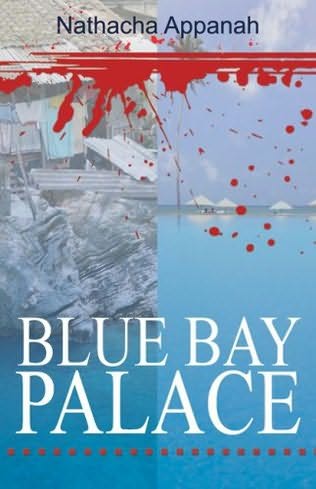 Next, we have Nathacha Appanah, a feted Mauritian writer, who has written Blue Bay Palace
 . Belonging to the long-standing Indian community in that country, she has written a little novella in French of jealousy and murder which is supported mainly by the exoticism of its locale. After all, were a writer to describe the affair of a low-caste woman with a high-caste man in India, people would merely shrug and say, 'Ho hum.' There's little new in this tale for a subcontinental reader, and possibly even for a watcher of Indian films - it's a cliche. The narrator, Maya, meets her dashing and confident lover when she is sixteen, and realises as time goes by that even as he loves her, he is too spineless to do anything about it, and will not stand up to his parents who want him to marry a suitable woman of his own class. He marries that woman but continues his affair with Maya, who, when she is not desperately missing him, is also constantly being reduced by the poverty of her circumstances and the contrast with the rich. There's no way such a tale can end well, surely? Nope. Everybody concerned is ruined. Not so much a crime novel, then; and as a social-commentary-with-romance, and no redemption at the end of it.
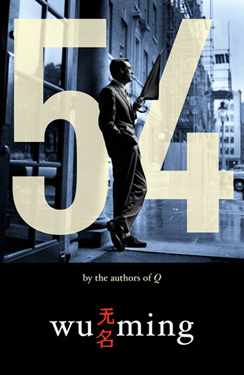 We can ramp right up with '54
 by Wu Ming, a writing conglomerate from Bologna with a yen for history, crime, Hollywood films of the fifties, and, of course, large quantities of jazz. It is several years after the Second World War, and there are machinations galore between the Allies and the new Italian government about handing control of Trieste to the Italians. Lucky Luciano has cornered the racketeering market by being tougher than the local mafiosi, and by being (sort of) in the pay of the US Government. There are signs that Josip Tito, the main man in Yugoslavia who had once broken with Stalin, is possibly tipping his country back into the Soviet orbit with the advent of the Kruschev detente. The US and the UK are determined to keep him on their side, or at the very least neutral, and concoct a crazy scheme to inveigle him. Enter Cary Grant, an actor in decline but still widely admired, to star in a Hollywood film about Tito. Meanwhile, an Italian communist who had deserted the Italian army during the war in the Balkans and made his home in Yugoslavia, finds his position increasingly untenable as the ruling rabble abandon the ideals of Communism for a self-serving totalitarianism. His son, a high-strung dancer in Italy filled with existential angst and bonking the wife of the local Communist honcho, wants to find meaning in his life, a meaning he feels only his father can give him. The Wu Ming clan manage to weave the disparate storylines quite cleverly. They don't miss a step, their pacing is cool, the humour is dark, the gunplay is classic. An excellent bit of noir.
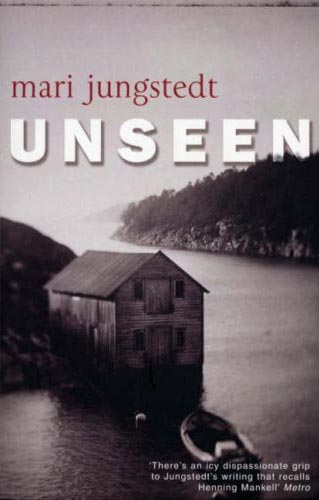 I have to include a Scandinavian, surely? Surely I must. There has been much coverage of the phenomenon of Nordic crime fiction in the press lately (see, most recently, Laura Miller in the Wall Street Journal), most of it very deserved. Here I present Mari Jungstedt's Unseen
 , her debut work, translated ably by Tiina Nunnally. Like others of her ilk, she prefers to set her crimes in the idyllic countryside rather than in the gritty capitals. Indeed, there are many complaints about the rush and buzz and noise of Stockholm, and ruminations on how people can ever live in a big city. Here, in Gotland, things are not as idyllic anymore, though: a woman is found brutally slaughtered with her dog. The detective in charge wants to keep the press at bay, but finds that they seem to be able to do his investigative job better than him. Luckily for him, he has a loving family, unlike most other investigators with their alcoholism, so he has some succour from the frustrations of his job. Soon yet another woman is murdered, and the island goes into a spin - it's high summer and the tourists are being scared off by tales of serial killers. Superior cops from Stockholm stomp in and are put in their place by our hero. There are frequently interspersed flashes into the mind of the killer (of course, there is a back story. How can there not be one? After all, serial killers all arise because they were mistreated in their childhood. Or their pet dogs were run over by a lawnmower. Or something.) In true cinematic cliche, the climax has to occur just when the last potential victim goes up to an isolated cottage all by herself. Had it not been midsummer, there would have been a blizzard, and that would have been the icing on the cliche cake. This is not the best of Scandinavian fiction on offer, I confess. But it would very worthily fall somewhere in the median.
 From this point, it's all rapidly downhill. We first have the Spanishwoman Matilde Asensi's The Last Cato
 . What is with the modern obsession with Dante? There have already been several rather putrid works based on Dante's Inferno, and this adds to that list. It's neither a proper historical thriller nor a very good crime novel. There are elements of fantasy that are a complete let-down. There are improbable protagonists who speak particularly improbably. Either the translation is somewhat lacking or Matilde Asensi's got a tin-ear for conversation. Characters don't so much speak as perorate. There's a nun working in the Vatican archives and there's a Swiss Guard and a Coptic polyglot archaeologist, and the three of them are tasked with the investigation into a dead body found decorated with strange symbols and crosses. The Vatican high command (clearly riven by some factionalism) is scared by the rapid progress the nun makes and takes her off the case, only to reassign her when they find that precious relics and crosses (related to the prior investigation) are disappearing from various churches around the world. Some tenuous connection then derives to Dante's Purgatory, and the three are forced to start decoding instructions hidden in the book to find an earthly paradise, where, they suspect, the criminals came from. En route, the nun gets horny, abandons her faith, and shacks up with the archaeologist. The Swiss Guard remains manly and somewhat of a pointless spoke in their wheel. Other reviewers have praised this book for the fact that it's a romantic quest for paradise with emotional sophistication (my words) rather than an investigation of baddies. But even as a picaresque, I thought it was pathetic. If you read it, let me know what you think.
 Yet another Spanish romp is Julia Navarro's The Brotherhood of the Holy Shroud
 . Just when you thought you were safe from the Knights Templar, here they return, as heroic in fiction as they have been derided in history. This is yet another silly historical-thriller-joining-the-Dan-Brown-wagon. If it's not freakin' Dante whose books provide clues to modern crimes, it's the bloody Templars and their rituals. Surely there's enough history in Europe to consider dreaming up a fresh conspiracy? Arturo Perez-Reverte did very well in the genre (see his The Flanders Panel, e.g.) but his successors are lumpen and unimaginative. This book is particularly execrable. The Shroud of Turin, widely accepted to be a medieval fraud, still commands considerable reverence among Catholics. What is its history? Well, you won't learn it from this novel. Instead, Navarro posits yet another secret organisation: based in Edessa (modern-day Urfa), the first Christian city, and trying desperately to get the shroud back. A bunch of Templars are holding them off. What! you cry. Templars? Surely they died off after Philip the Fair butchered them in the 1300s? Oh no. They continued to lead clandestine but powerful lives in Scotland from where they guided mankind's history in the ensuing centuries. The story? When a part of the Turin cathedral is set ablaze and men with no fingerprints or tongues are found lying dead in the rubble, the Arts Crime department of the Italian police is called to investigate. Among the investigators is your usual brilliant and insanely beautiful woman (who, of course, doesn't realise either her brilliance or her beauty). She is shacked up with a plodding cop in her group, much to everyone's surprise. She traces the history of the Shroud, meets sundry people who may or may not be Templars, is particularly struck by the presence and charisma of one of them, and decides that the plodding cop is not good enough for her anymore. It says much for a historical novel when the most interesting in its story is really the most inconsequential portion. Anyway. There is a conspiracy as ridiculous as you'd like, and despite the heroics of the Edessans, they are clearly bumbling idiots who can locate their noses with less facility than they can recover the Shroud. Which, when you come to think of it, is not even really the Shroud. Pullulating putrescence, this.
 So! We've had Dante, the Templars, the Turin Shroud. What do we have left? How about Gaudi's lollypop of a Cathedral, the Sagrada Familia in Barcelona? Clearly there are tales within tales in that concoction! The man himself died under mysterious circumstances, but not so mysterious that a bit of spiritual conspiracy can't be adduced. And so we have The Gaudi Key
 by those Catalans, Esteban Martin and Andreu Carranza, where it turns out Gaudi was the master of seven knights sworn to protect some relic or the other from the depredations of Chaos, better known as the Corbel, who are determined to consign the planet into anarchy. One wonders then, why they limit themselves to what is essentially a provincial backwater. Why not London? Or Tokyo? Or even Paris? Why Barcelona? (Because that's where their readers are, silly! Makes them feel all loved and fuzzy.) At any rate, Gaudi bequeathed the secret of the relic to a little chap, who decades later is falling into senility, and bequeaths it to his granddaughter. She is no ordinary woman, of course. In her will converge spiritual continua, and she'll lead us all into a bright future where the evil ones (headed by one Asmodeus) will be obliterated. But she can't do it all by herself so she needs her Fields Medal winning boyfriend to help. (How many Fields Medallists do you know that are good-looking, incredibly fit, socially ept and brilliant fencing champions to boot? I thought so. Still, it's good to see a mathematician do something other than push his thick glasses onto his bushy eyebrows.) There's a lot of hokum in this novel, and would you believe it, the Templars make an entrance here as well. A guest appearance, but one that ties in strangely with their antics in the preceding book. I guess some of the figurative puzzles in Gaudi's architecture have been put to good use in the book, and a visitor to Barcelona armed with the book may have some fun identifying them. Scarce recompense for plowing through nearly 500 pages of drivel, though.
And that's all, folks. Finis.
There have been some remarkably good books in the list over the year, and some incredible duds, and it never ceases to amaze me that publishers bemoan the lack of saleability of translated fiction, and yet manage to publish some obvious crap. Perhaps, their reasoning goes, if it was a big hit in the pulp foreign market, it will do well in the English pulp market as well... A lesser man would have tried to conclude this series on a high, but I am afraid I'm not a lesser man and so I'll end with some abject nonsense.
 My favourite Russian is back once again! Erast Fandorin's latest escapades were published in yet another excellent translation by Andrew Bromfeld in Boris Akunin's She Lover Of Death. It sounds a bit kooky to say it like that: she-lover. Russian nouns have gendered endings which don't translate smoothly into English. You could say 'The Woman Who Loved Death', I guess. Anyway, Bromfield is incredibly prolific. This is the third Akunin translation in 2009 alone, and he's worked on some science-fiction and fantasy efforts by other authors. Simultaneously, by the looks of it. Anyway.
Akunin, as those who read or have heard of his Fandorin novels know, aims to write each volume in a particular genre of crime fiction. This one deals with decadence in turn-of-the-century Moscow. A suicide club has formed and it attracts aficionados from all rungs of society. Written in the multi-person perspective familiar from previous books, here we have the story as seen by a young girl arrived in Moscow from the provinces, a newspaper journalist investigating the club, and the police. Bohemians attracted to the society are urged by its leader to write down their ruminations on death in verse, to be praised or condemned by him. The Russians pride themselves on the poetry in their souls, and so they do not necessarily take kindly to being dismissed, but so in thrall are the cultists to their leader that they accept every word of his as manna. Naturally, the world at large is not indifferent to the club, and both the police and the papers attempt to infiltrate it. Fandorin himself, incognito and persona not very grata in Moscow after the disastrous events of the Coronation, embroils himself, too. There are a couple of twists in the tale, and all once again is not as it seems. This is not as good an offering from Akunin as some of his older works, but still worth an evening by the fireside.
Next, we have Nathacha Appanah, a feted Mauritian writer, who has written Blue Bay Palace. Belonging to the long-standing Indian community in that country, she has written a little novella in French of jealousy and murder which is supported mainly by the exoticism of its locale. After all, were a writer to describe the affair of a low-caste woman with a high-caste man in India, people would merely shrug and say, 'Ho hum.' There's little new in this tale for a subcontinental reader, and possibly even for a watcher of Indian films - it's a cliche. The narrator, Maya, meets her dashing and confident lover when she is sixteen, and realises as time goes by that even as he loves her, he is too spineless to do anything about it, and will not stand up to his parents who want him to marry a suitable woman of his own class. He marries that woman but continues his affair with Maya, who, when she is not desperately missing him, is also constantly being reduced by the poverty of her circumstances and the contrast with the rich. There's no way such a tale can end well, surely? Nope. Everybody concerned is ruined. Not so much a crime novel, then; and as a social-commentary-with-romance, and no redemption at the end of it.We can ramp right up with '54 by Wu Ming, a writing conglomerate from Bologna with a yen for history, crime, Hollywood films of the fifties, and, of course, large quantities of jazz. It is several years after the Second World War, and there are machinations galore between the Allies and the new Italian government about handing control of Trieste to the Italians. Lucky Luciano has cornered the racketeering market by being tougher than the local mafiosi, and by being (sort of) in the pay of the US Government. There are signs that Josip Tito, the main man in Yugoslavia who had once broken with Stalin, is possibly tipping his country back into the Soviet orbit with the advent of the Kruschev detente. The US and the UK are determined to keep him on their side, or at the very least neutral, and concoct a crazy scheme to inveigle him. Enter Cary Grant, an actor in decline but still widely admired, to star in a Hollywood film about Tito. Meanwhile, an Italian communist who had deserted the Italian army during the war in the Balkans and made his home in Yugoslavia, finds his position increasingly untenable as the ruling rabble abandon the ideals of Communism for a self-serving totalitarianism. His son, a high-strung dancer in Italy filled with existential angst and bonking the wife of the local Communist honcho, wants to find meaning in his life, a meaning he feels only his father can give him. The Wu Ming clan manage to weave the disparate storylines quite cleverly. They don't miss a step, their pacing is cool, the humour is dark, the gunplay is classic. An excellent bit of noir.I have to include a Scandinavian, surely? Surely I must. There has been much coverage of the phenomenon of Nordic crime fiction in the press lately (see, most recently, Laura Miller in the Wall Street Journal), most of it very deserved. Here I present Mari Jungstedt's Unseen, her debut work, translated ably by Tiina Nunnally. Like others of her ilk, she prefers to set her crimes in the idyllic countryside rather than in the gritty capitals. Indeed, there are many complaints about the rush and buzz and noise of Stockholm, and ruminations on how people can ever live in a big city. Here, in Gotland, things are not as idyllic anymore, though: a woman is found brutally slaughtered with her dog. The detective in charge wants to keep the press at bay, but finds that they seem to be able to do his investigative job better than him. Luckily for him, he has a loving family, unlike most other investigators with their alcoholism, so he has some succour from the frustrations of his job. Soon yet another woman is murdered, and the island goes into a spin - it's high summer and the tourists are being scared off by tales of serial killers. Superior cops from Stockholm stomp in and are put in their place by our hero. There are frequently interspersed flashes into the mind of the killer (of course, there is a back story. How can there not be one? After all, serial killers all arise because they were mistreated in their childhood. Or their pet dogs were run over by a lawnmower. Or something.) In true cinematic cliche, the climax has to occur just when the last potential victim goes up to an isolated cottage all by herself. Had it not been midsummer, there would have been a blizzard, and that would have been the icing on the cliche cake. This is not the best of Scandinavian fiction on offer, I confess. But it would very worthily fall somewhere in the median.From this point, it's all rapidly downhill. We first have the Spanishwoman Matilde Asensi's The Last Cato. What is with the modern obsession with Dante? There have already been several rather putrid works based on Dante's Inferno, and this adds to that list. It's neither a proper historical thriller nor a very good crime novel. There are elements of fantasy that are a complete let-down. There are improbable protagonists who speak particularly improbably. Either the translation is somewhat lacking or Matilde Asensi's got a tin-ear for conversation. Characters don't so much speak as perorate. There's a nun working in the Vatican archives and there's a Swiss Guard and a Coptic polyglot archaeologist, and the three of them are tasked with the investigation into a dead body found decorated with strange symbols and crosses. The Vatican high command (clearly riven by some factionalism) is scared by the rapid progress the nun makes and takes her off the case, only to reassign her when they find that precious relics and crosses (related to the prior investigation) are disappearing from various churches around the world. Some tenuous connection then derives to Dante's Purgatory, and the three are forced to start decoding instructions hidden in the book to find an earthly paradise, where, they suspect, the criminals came from. En route, the nun gets horny, abandons her faith, and shacks up with the archaeologist. The Swiss Guard remains manly and somewhat of a pointless spoke in their wheel. Other reviewers have praised this book for the fact that it's a romantic quest for paradise with emotional sophistication (my words) rather than an investigation of baddies. But even as a picaresque, I thought it was pathetic. If you read it, let me know what you think.Yet another Spanish romp is Julia Navarro's The Brotherhood of the Holy Shroud. Just when you thought you were safe from the Knights Templar, here they return, as heroic in fiction as they have been derided in history. This is yet another silly historical-thriller-joining-the-Dan-Brown-wagon. If it's not freakin' Dante whose books provide clues to modern crimes, it's the bloody Templars and their rituals. Surely there's enough history in Europe to consider dreaming up a fresh conspiracy? Arturo Perez-Reverte did very well in the genre (see his The Flanders Panel, e.g.) but his successors are lumpen and unimaginative. This book is particularly execrable. The Shroud of Turin, widely accepted to be a medieval fraud, still commands considerable reverence among Catholics. What is its history? Well, you won't learn it from this novel. Instead, Navarro posits yet another secret organisation: based in Edessa (modern-day Urfa), the first Christian city, and trying desperately to get the shroud back. A bunch of Templars are holding them off. What! you cry. Templars? Surely they died off after Philip the Fair butchered them in the 1300s? Oh no. They continued to lead clandestine but powerful lives in Scotland from where they guided mankind's history in the ensuing centuries. The story? When a part of the Turin cathedral is set ablaze and men with no fingerprints or tongues are found lying dead in the rubble, the Arts Crime department of the Italian police is called to investigate. Among the investigators is your usual brilliant and insanely beautiful woman (who, of course, doesn't realise either her brilliance or her beauty). She is shacked up with a plodding cop in her group, much to everyone's surprise. She traces the history of the Shroud, meets sundry people who may or may not be Templars, is particularly struck by the presence and charisma of one of them, and decides that the plodding cop is not good enough for her anymore. It says much for a historical novel when the most interesting in its story is really the most inconsequential portion. Anyway. There is a conspiracy as ridiculous as you'd like, and despite the heroics of the Edessans, they are clearly bumbling idiots who can locate their noses with less facility than they can recover the Shroud. Which, when you come to think of it, is not even really the Shroud. Pullulating putrescence, this.So! We've had Dante, the Templars, the Turin Shroud. What do we have left? How about Gaudi's lollypop of a Cathedral, the Sagrada Familia in Barcelona? Clearly there are tales within tales in that concoction! The man himself died under mysterious circumstances, but not so mysterious that a bit of spiritual conspiracy can't be adduced. And so we have The Gaudi Key by those Catalans, Esteban Martin and Andreu Carranza, where it turns out Gaudi was the master of seven knights sworn to protect some relic or the other from the depredations of Chaos, better known as the Corbel, who are determined to consign the planet into anarchy. One wonders then, why they limit themselves to what is essentially a provincial backwater. Why not London? Or Tokyo? Or even Paris? Why Barcelona? (Because that's where their readers are, silly! Makes them feel all loved and fuzzy.) At any rate, Gaudi bequeathed the secret of the relic to a little chap, who decades later is falling into senility, and bequeaths it to his granddaughter. She is no ordinary woman, of course. In her will converge spiritual continua, and she'll lead us all into a bright future where the evil ones (headed by one Asmodeus) will be obliterated. But she can't do it all by herself so she needs her Fields Medal winning boyfriend to help. (How many Fields Medallists do you know that are good-looking, incredibly fit, socially ept and brilliant fencing champions to boot? I thought so. Still, it's good to see a mathematician do something other than push his thick glasses onto his bushy eyebrows.) There's a lot of hokum in this novel, and would you believe it, the Templars make an entrance here as well. A guest appearance, but one that ties in strangely with their antics in the preceding book. I guess some of the figurative puzzles in Gaudi's architecture have been put to good use in the book, and a visitor to Barcelona armed with the book may have some fun identifying them. Scarce recompense for plowing through nearly 500 pages of drivel, though.And that's all, folks. Finis.
For the princely sum of £5, I requested several books via inter-library transfer, and I am somewhat taken aback to note that one of those requests has already failed. 'The book is not available in a format suitable for library use' said the helpful response from Camomile Street Library. Somewhat puzzled, I quizzed the librarian about it. It turns out that she could only get the book in electronic (hence unsuitable) format. 'The British Library, I would have thought, would stock a print copy,' she said, in a perplexed tone.
 Well, whatever. As I await the rest of the crime novels, I am able to boast of this month's reading. It has been rather good. We can begin with Koji Suzuki's short stories, titled Dark Water
 . Widely considered to be Japan's equivalent of Stephen King, Suzuki is better known as the author of the Ring - cult-book-turned-cult-movie. In this book, he bases his tales of horror around the Tokyo-Yokohama bay. I should hasten to add that I wasn't horrified by any of the stories, although one or two had a couple of moments of causing me anxiety. The stories are supposedly recounted by a grandmother to a young girl, but little other than the omnipresence of water links them. And of course all the protagonists are somehow flawed, troubled people - if not abusive, then paranoid, or passive-aggressive. The story I liked the best is called 'Dream Cruise', in which an aggressive salesman and his irritating wife take his classmate, a somewhat laid-back and self-satisfied fellow, on a cruise, with a view to recruiting him to their pyramidal sales scheme. Those of you who read my experiences with Amway will note that I have little patience with these evangelists. So the horrors that await the salesman and his wife when they encounter a child's shoe in the sea and their boat snags on something are music to my ears... Suzuki's interested in the people's back-stories, and he expends pages elucidating this or that aspect of their characters. The plots then begin to thin a bit, and it appears as if - story after story - he loses patience, and attempts to wrap it all up. His attempts at a twist at the end are not entirely fortuitous. I can't tell if the prose is leaden because of the translation, or if it is a particular trait of the Japanese short story. At any rate, this is not a book to savour; on the other hand, reading the stories in rapid succession results in a melded confusion. If you have better luck with it, please do tell.
Arturo Perez-Reverte is back with the latest of his Captain Alatriste swashbucklers to be translated into English, The Man In The Yellow Doublet
 . This is superb stuff, twirling moustaches, withering scorn, flashing swords, love across social classes, all set in the declining Spain of the 17th century. This is not literature of nuance, but it is exciting, punctuated by sparkling line and verse by the greats of the time: Quevedo, de Vega, Cervantes. The young narrator of the series, Iñigo Balboa, is growing up, as besotted as ever with the beautiful and treacherous Angelica de Alquezar, who has no qualms about loving him at the same time as plotting his and his foster-father Alatriste's demise. Alatriste is the lover of the famed actress Maria de Castro, but the King has his eye on her as well. When the monarch is felled during one tryst with the beauty, Alatriste is fingered as the jealous killer; it later turns out that it was actually the King's double who was murdered. Alatriste then has to investigate the conspiracy that has led him so close to the gallows, and this escapade involves swords and daggers, whispers in the night, and the deaths of old friends. The Spain of Philip IV is a cauldron of competing interests, and mercenaries like Alatriste are mere pawns in a greater game, but true to the genre, the pawns end up saving the day.
 Håkan Nesser is this month's obligatory Scandinavian, and I am pleased to say that in his acerbic and sardonic detective Van Veeteren, we have a wonderful winner. As police procedurals go, The Mind's Eye
 is representative of the genre; what raises this above the usual is the meta-text provided by the author - knowing asides and darkly humorous commentary that enliven the pages. Often, the chapters start with pronouns, requiring some amount of concentration from the reader to decide exactly who is being talked about; unlike other reviewers who found this confusing, I thought it refreshing, serving to keep the story going as well as keeping me alert. Van Veeteren is the classic noir footpad with a troubled marriage and a jailbird son, and has the usual likes (jazz and classical music) one expects from such a detective. He investigates the case of a husband wakes up one day to find his memory gone and his beautiful wife slaughtered. A sparkling set piece in a court enumerates the facts of the case. The husband is consigned to a mental institution where his memory returns, and for no reason I can discern, he sends a message to the killer. Shortly thereafter he is killed as well. The police procedural then takes over and the investigation proceeds meticulously. It is fairly obvious who the murderer is, even if it's not clear for a while what triggered the murderous spree; it is also disappointing that Nesser needs that old trope of Scandinavian fiction, namely abusive parents, to give credence to the tale. Still, this is one of the better crime novels I've read, and I heartily recommend it.
Talking about Scandinavian fiction, and why a supposedly idyllic and peaceful land has been gutted by bloodthirsty explorations of its underbelly, this article from Salon tries to figure it all out.
 A few years ago, I read the mathematics-tinged The Oxford Murders by the Argentinian writer Guillermo Martinez, and found that somewhat irritating in its insistence of mysticism around logic and set theory. The writer now comes up with an even more fantastic tale in The Book of Murder
 , in which, it appears, characters are killed by a mad author and nobody is able to establish that fact. The narrator is approached by a distraught Luciana, a secretary who had briefly worked with him a decade earlier, who accuses the far more famous novelist Kloster of systematically killing off her family in revenge for her own actions that (in Kloster's mind) resulted in his abandonment by his wife and in the death of his daughter. Luciana used to be a beauty but now she is deformed by her paranoia and anguish, and the narrator - a somewhat less successful author himself - finds it difficult to believe her. Still, some vestiges of loyalty to her lead him to accost Kloster who dismisses him brusquely. Inflamed, the narrator decides to put down Luciana's story in the form a novel and threatens Kloster with its publication unless he agrees to reveal his involvement. At this point, Martinez appears to lose the plot and introduces a peculiar agent who is supposed to have committed gross crimes in the town. Suddenly, the book we are reading and the book the narrator is writing become aspects of a single unifying theme; exactly what that theme is I am unable to determine, and just like so many books with interesting premises, this one also meanders into opaqueness and stultification. Read it if you must.
 In the past six months of translated criminal roundups, the dominant writers have been Nordics or Italians or French. There are one or two Spaniards, too, in the mix, and Javier Cercas can be added to the lot. His The Speed of Light
 is not really a crime novel; instead, it is a rumination on the effects of war and war-crimes on a thoughtful intellectual. Its foundation is a horrific assault on women and children in a Vietnamese village by American special forces during the US campaign in Indo-China. The narrator is a Spaniard visiting as a research fellow at Urbana-Champaign, a young man who still has supreme confidence of his own literary ability, which is simultaneously undermined and energised by his encounter and subsequent friendship with a veteran of that same massacre (as he later finds out). Much of the book deals with literary criticism and the shadow of experience on writing; it also details in tawdry detail the fall from grace that inevitably follows success; the nature of friendship is examined in subtle detail. This is a densely written book with much superfluous detail and cascading clauses, and it careens from philosophy to conspiracy theory and back in staccato bursts. But the denouement once again disappoints - it is stereotyped and weak - involving deaths of loved ones as metaphor, and the ensuing search for redemption.
 Emil is the much-loved hero of Erich Kästner's series of books for children set in the 1920 and 1930s, and in Emil and the Detectives (Red Fox Classics)
 we encounter the little fellow going to Berlin to meet his grandmother and cousin. En route, he falls asleep and awakes to find that one of his companions in the train has stolen his money. Naturally, he won't have any of this, but recognising that it was unlikely that any policeman would take his word against that of an adult (and recalling with embarrassment and fear that the police might indeed arrest him for painting a moustache on the statue of a famous man in his village), he decides to follow the thief himself. He then encounters an entire cohort of kids who offer to help him out, and with true Prussian sang-froid, run the thief down. Everything ends well. As far as sophistication goes, I dare say a five-year old might find this entertaining - there's far too much of the smug and upright here to interest any hot-blooded child older than that. Contrasted with the naughtiness and scrapes of William
 , Emil is a pale imitation. He insists that he will fight anyone who thinks he is a mummy's boy just because he is protective of his mother and far too responsible for his age, but this is too mild a protest to convince anyone. There are a couple of other jaunty boys who are superficially more appealing, and might have made far better heroes. Oh well. When I checked out the book, the librarian sighed 'I loved this one', and frankly I'm baffled why. If this is the sort of book that has been thrust upon generations of British boys by a feminised teaching community, I'm not surprised that they have been permanently turned off reading.
 In desperation, I'm forced to return to authors I've read before, and few are better than Fred Vargas, archaeologist-historian-turned-crime-novelist-of-class. Several of her later books featuring the ethereal detective Jean-Baptiste Adamsberg have been translated into English, and recently, the very first one in the series was rendered into English as well. (There was a cri-de-coeur recently about this phenomenon of out-of-order release of translations, and I find it quite irritating that I am unable to follow the development of a character from start to finish just because publishers can't be bothered to publish chronologically. This is especially egregious when the full series is already available in the original language, and still they are translated at random.) The Chalk Circle Man
 introduces the provincial detective-turned-Parisian-commissioner who can sense evil in people and prefers to doodle instead of following up on clues and interrogating suspects. His evident success (summed up by one of his rivals as ''You sit around daydreaming, staring at the wall, or doodling on a bit of paper as if you had all the time and knowledge in the world, and then one day you swan in, cool as a cucumber, and say "Arrest the priest. He strangled the child to stop him talking."') has attracted various curious individuals, each more peculiar than the other, and all of them in some circumstantial way involved in the latest puzzle that is attracting his attention. All of Paris is agog by a street artist who goes about drawing perfect chalk circles on pavements in various arrondissements, enclosing some object or the other within them - a hat, a mouse, a lighter. Is this the latest break-out art? Adamsberg senses cruelty, however, and keeps alert to any developments, and is proved right when a murdered woman is found one day within one such circle. The investigation then splits into competing hypotheses - is the chalk-circle man responsible for the death? Or is someone following him around to piggy-back off those circles and implicate him? This is a detective novel with a surreal premise: unlike Poirot who uses strict logic, or Van Veeteren, who is a meticulous footpad, Adamsberg arrives at his conclusions mystically, and expects his deputy Danglard to fill in the gaps. Good fun, though.
 Finally, if we have one Scandinavian, then we should have another, and Helene Tursten fills the gap with her Glass Devil, The (Inspector Irene Huss Investigation)
 , as poor an example of the genre as we can imagine. This is a very poor effort, I'm saddened to say, especially because in Inspector Irene Huss is an interesting protagonist - a loving wife and mother and workaholic. A teacher is found brutally slain, and when the police go over to his parents' place to break the news, they find that the couple have been murdered as well. There are signs of Satanism (inverted pentagrams and all), and evidence of computer geekery - the hard-drives of the machines have been found completely wiped. It turns out that the surviving member of the family is a daughter (a computer geek) based in London, who has been so stunned by the deaths of her kin that she suffers a mental collapse. Huss is forced to travel to London to interrogate the woman, and there's an entirely pointless addition of a travelogue about the places she has time to visit and H&M shopping she is able to accomplish while she awaits the woman's pleasure. Even more egregious is the several pages describing a gruesome attack on Huss by drug-addled rapists that she is able to repel owing to her Olympic-level jiu-jitsu. What was the point of this? What are the chances that a chance visitor in London will suffer such an attack? Negligible, I'd have thought. The attack does nothing to advance the plot, adds little to Huss's character development, and serves no earthly purpose I could discern. But what really got my goat were the footnotes that dotted the book at various places. The publisher evidently is targeting an American audience, for whenever the text used metric measurements, a footnote would translate into imperial measures. Now consider - how many readers of translated fiction would be unaware of the metric system? It's just a puerile insult to one's intelligence. And, I'm sad to say, the book is no better, falling back on that old standby of Scandinavian child abuse. Evidently there are no other social problems worth addressing in that idyllic land.
 Well, whatever. As I await the rest of the crime novels, I am able to boast of this month's reading. It has been rather good. We can begin with Koji Suzuki's short stories, titled Dark Water. Widely considered to be Japan's equivalent of Stephen King, Suzuki is better known as the author of the Ring - cult-book-turned-cult-movie. In this book, he bases his tales of horror around the Tokyo-Yokohama bay. I should hasten to add that I wasn't horrified by any of the stories, although one or two had a couple of moments of causing me anxiety. The stories are supposedly recounted by a grandmother to a young girl, but little other than the omnipresence of water links them. And of course all the protagonists are somehow flawed, troubled people - if not abusive, then paranoid, or passive-aggressive. The story I liked the best is called 'Dream Cruise', in which an aggressive salesman and his irritating wife take his classmate, a somewhat laid-back and self-satisfied fellow, on a cruise, with a view to recruiting him to their pyramidal sales scheme. Those of you who read my experiences with Amway will note that I have little patience with these evangelists. So the horrors that await the salesman and his wife when they encounter a child's shoe in the sea and their boat snags on something are music to my ears... Suzuki's interested in the people's back-stories, and he expends pages elucidating this or that aspect of their characters. The plots then begin to thin a bit, and it appears as if - story after story - he loses patience, and attempts to wrap it all up. His attempts at a twist at the end are not entirely fortuitous. I can't tell if the prose is leaden because of the translation, or if it is a particular trait of the Japanese short story. At any rate, this is not a book to savour; on the other hand, reading the stories in rapid succession results in a melded confusion. If you have better luck with it, please do tell.
Arturo Perez-Reverte is back with the latest of his Captain Alatriste swashbucklers to be
 translated into English, The Man In The Yellow Doublet. This is superb stuff, twirling moustaches, withering scorn, flashing swords, love across social classes, all set in the declining Spain of the 17th century. This is not literature of nuance, but it is exciting, punctuated by sparkling line and verse by the greats of the time: Quevedo, de Vega, Cervantes. The young narrator of the series, Iñigo Balboa, is growing up, as besotted as ever with the beautiful and treacherous Angelica de Alquezar, who has no qualms about loving him at the same time as plotting his and his foster-father Alatriste's demise. Alatriste is the lover of the famed actress Maria de Castro, but the King has his eye on her as well. When the monarch is felled during one tryst with the beauty, Alatriste is fingered as the jealous killer; it later turns out that it was actually the King's double who was murdered. Alatriste then has to investigate the conspiracy that has led him so close to the gallows, and this escapade involves swords and daggers, whispers in the night, and the deaths of old friends. The Spain of Philip IV is a cauldron of competing interests, and mercenaries like Alatriste are mere pawns in a greater game, but true to the genre, the pawns end up saving the day.
 Håkan Nesser is this month's obligatory Scandinavian, and I am pleased to say that in his acerbic and sardonic detective Van Veeteren, we have a wonderful winner. As police procedurals go, The Mind's Eye is representative of the genre; what raises this above the usual is the meta-text provided by the author - knowing asides and darkly humorous commentary that enliven the pages. Often, the chapters start with pronouns, requiring some amount of concentration from the reader to decide exactly who is being talked about; unlike other reviewers who found this confusing, I thought it refreshing, serving to keep the story going as well as keeping me alert. Van Veeteren is the classic noir footpad with a troubled marriage and a jailbird son, and has the usual likes (jazz and classical music) one expects from such a detective. He investigates the case of a husband wakes up one day to find his memory gone and his beautiful wife slaughtered. A sparkling set piece in a court enumerates the facts of the case. The husband is consigned to a mental institution where his memory returns, and for no reason I can discern, he sends a message to the killer. Shortly thereafter he is killed as well. The police procedural then takes over and the investigation proceeds meticulously. It is fairly obvious who the murderer is, even if it's not clear for a while what triggered the murderous spree; it is also disappointing that Nesser needs that old trope of Scandinavian fiction, namely abusive parents, to give credence to the tale. Still, this is one of the better crime novels I've read, and I heartily recommend it.
Talking about Scandinavian fiction, and why a supposedly idyllic and peaceful land has been gutted by bloodthirsty explorations of its underbelly, this article from Salon tries to figure it all out.
 A few years ago, I read the mathematics-tinged The Oxford Murders by the Argentinian writer Guillermo Martinez, and found that somewhat irritating in its insistence of mysticism around logic and set theory. The writer now comes up with an even more fantastic tale in The Book of Murder, in which, it appears, characters are killed by a mad author and nobody is able to establish that fact. The narrator is approached by a distraught Luciana, a secretary who had briefly worked with him a decade earlier, who accuses the far more famous novelist Kloster of systematically killing off her family in revenge for her own actions that (in Kloster's mind) resulted in his abandonment by his wife and in the death of his daughter. Luciana used to be a beauty but now she is deformed by her paranoia and anguish, and the narrator - a somewhat less successful author himself - finds it difficult to believe her. Still, some vestiges of loyalty to her lead him to accost Kloster who dismisses him brusquely. Inflamed, the narrator decides to put down Luciana's story in the form a novel and threatens Kloster with its publication unless he agrees to reveal his involvement. At this point, Martinez appears to lose the plot and introduces a peculiar agent who is supposed to have committed gross crimes in the town. Suddenly, the book we are reading and the book the narrator is writing become aspects of a single unifying theme; exactly what that theme is I am unable to determine, and just like so many books with interesting premises, this one also meanders into opaqueness and stultification. Read it if you must.
 In the past six months of translated criminal roundups, the dominant writers have been Nordics or Italians or French. There are one or two Spaniards, too, in the mix, and Javier Cercas can be added to the lot. His The Speed of Light is not really a crime novel; instead, it is a rumination on the effects of war and war-crimes on a thoughtful intellectual. Its foundation is a horrific assault on women and children in a Vietnamese village by American special forces during the US campaign in Indo-China. The narrator is a Spaniard visiting as a research fellow at Urbana-Champaign, a young man who still has supreme confidence of his own literary ability, which is simultaneously undermined and energised by his encounter and subsequent friendship with a veteran of that same massacre (as he later finds out). Much of the book deals with literary criticism and the shadow of experience on writing; it also details in tawdry detail the fall from grace that inevitably follows success; the nature of friendship is examined in subtle detail. This is a densely written book with much superfluous detail and cascading clauses, and it careens from philosophy to conspiracy theory and back in staccato bursts. But the denouement once again disappoints - it is stereotyped and weak - involving deaths of loved ones as metaphor, and the ensuing search for redemption.
 Emil is the much-loved hero of Erich Kästner's series of books for children set in the 1920 and 1930s, and in Emil and the Detectives (Red Fox Classics) we encounter the little fellow going to Berlin to meet his grandmother and cousin. En route, he falls asleep and awakes to find that one of his companions in the train has stolen his money. Naturally, he won't have any of this, but recognising that it was unlikely that any policeman would take his word against that of an adult (and recalling with embarrassment and fear that the police might indeed arrest him for painting a moustache on the statue of a famous man in his village), he decides to follow the thief himself. He then encounters an entire cohort of kids who offer to help him out, and with true Prussian sang-froid, run the thief down. Everything ends well. As far as sophistication goes, I dare say a five-year old might find this entertaining - there's far too much of the smug and upright here to interest any hot-blooded child older than that. Contrasted with the naughtiness and scrapes of William, Emil is a pale imitation. He insists that he will fight anyone who thinks he is a mummy's boy just because he is protective of his mother and far too responsible for his age, but this is too mild a protest to convince anyone. There are a couple of other jaunty boys who are superficially more appealing, and might have made far better heroes. Oh well. When I checked out the book, the librarian sighed 'I loved this one', and frankly I'm baffled why. If this is the sort of book that has been thrust upon generations of British boys by a feminised teaching community, I'm not surprised that they have been permanently turned off reading.
 In desperation, I'm forced to return to authors I've read before, and few are better than Fred Vargas, archaeologist-historian-turned-crime-novelist-of-class. Several of her later books featuring the ethereal detective Jean-Baptiste Adamsberg have been translated into English, and recently, the very first one in the series was rendered into English as well. (There was a cri-de-coeur recently about this phenomenon of out-of-order release of translations, and I find it quite irritating that I am unable to follow the development of a character from start to finish just because publishers can't be bothered to publish chronologically. This is especially egregious when the full series is already available in the original language, and still they are translated at random.) The Chalk Circle Man introduces the provincial detective-turned-Parisian-commissioner who can sense evil in people and prefers to doodle instead of following up on clues and interrogating suspects. His evident success (summed up by one of his rivals as ''You sit around daydreaming, staring at the wall, or doodling on a bit of paper as if you had all the time and knowledge in the world, and then one day you swan in, cool as a cucumber, and say "Arrest the priest. He strangled the child to stop him talking."') has attracted various curious individuals, each more peculiar than the other, and all of them in some circumstantial way involved in the latest puzzle that is attracting his attention. All of Paris is agog by a street artist who goes about drawing perfect chalk circles on pavements in various arrondissements, enclosing some object or the other within them - a hat, a mouse, a lighter. Is this the latest break-out art? Adamsberg senses cruelty, however, and keeps alert to any developments, and is proved right when a murdered woman is found one day within one such circle. The investigation then splits into competing hypotheses - is the chalk-circle man responsible for the death? Or is someone following him around to piggy-back off those circles and implicate him? This is a detective novel with a surreal premise: unlike Poirot who uses strict logic, or Van Veeteren, who is a meticulous footpad, Adamsberg arrives at his conclusions mystically, and expects his deputy Danglard to fill in the gaps. Good fun, though.
  Finally, if we have one Scandinavian, then we should have another, and Helene Tursten fills the gap with her Glass Devil, The (Inspector Irene Huss Investigation), as poor an example of the genre as we can imagine. This is a very poor effort, I'm saddened to say, especially because in Inspector Irene Huss is an interesting protagonist - a loving wife and mother and workaholic. A teacher is found brutally slain, and when the police go over to his parents' place to break the news, they find that the couple have been murdered as well. There are signs of Satanism (inverted pentagrams and all), and evidence of computer geekery - the hard-drives of the machines have been found completely wiped. It turns out that the surviving member of the family is a daughter (a computer geek) based in London, who has been so stunned by the deaths of her kin that she suffers a mental collapse. Huss is forced to travel to London to interrogate the woman, and there's an entirely pointless addition of a travelogue about the places she has time to visit and H&M shopping she is able to accomplish while she awaits the woman's pleasure. Even more egregious is the several pages describing a gruesome attack on Huss by drug-addled rapists that she is able to repel owing to her Olympic-level jiu-jitsu. What was the point of this? What are the chances that a chance visitor in London will suffer such an attack? Negligible, I'd have thought. The attack does nothing to advance the plot, adds little to Huss's character development, and serves no earthly purpose I could discern. But what really got my goat were the footnotes that dotted the book at various places. The publisher evidently is targeting an American audience, for whenever the text used metric measurements, a footnote would translate into imperial measures. Now consider - how many readers of translated fiction would be unaware of the metric system? It's just a puerile insult to one's intelligence. And, I'm sad to say, the book is no better, falling back on that old standby of Scandinavian child abuse. Evidently there are no other social problems worth addressing in that idyllic land.
It’s that time of month again, and I am back with the latest roundup of translated crime fiction consumed in April. So what if taxes are being put up and Britain will soon be as unliveable as Zimbabwe – expensive and no quality of life? We can take heart in the adventures of those folks immeasurably better off than us – characters in books, thoughtful detectives, murderous villains, dangerous damsels, none of whom speak English.
 This time I’ve been rather fortunate in my random pick-ups from the library. There’s much in common among them, strangely enough. There are tax dodges, social collapse, sometimes both, sometimes neither. Have I missed out any combinations? Yes. Well, we shall begin with Alain Mabanckou’s African Psycho, a dark, disturbing, frequently funny diatribe against society by a superb villain, a square-headed individual in a country very like Mabanckou’s native Congo. Gregoire is a mass of neuroses, a liar obsessed with the country’s only serial-killer, Angoualima, whose exploits he lovingly recounts, and whose approval he seeks in his own acts of violence. Gregoire is determined to kill his girlfriend, Germaine, and his preparations – both physical and mental – for this are interspersed with accounts of his troubled childhood, and the two murders he has attempted (both of which fail). Although Angoualima is dead, Greg has frequent meetings with him (at the killer’s grave) where he strives for approval from his mentor. These dialogues are blackly humorous, with the spectre frequently exasperated with Greg’s incompetence. Greg has issues with human foibles, he detests intellectuals but is not above spouting quotations, he wants the company of a compliant woman, but he can scarcely stand Germaine who has moved in with him. In the end, his murderous plans collide with forces out of his control, with spectacular results.
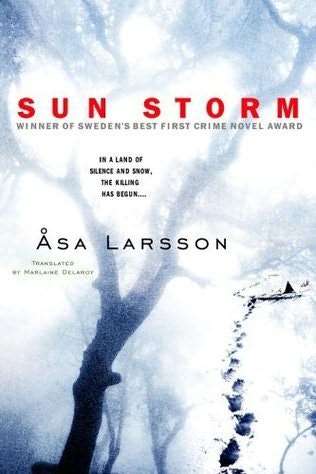 Next, we must have a Swedish writer, Åsa Larsson, whose The Savage Altar (or The Sun Storm) is an example of one aspect of Scandinavian life that seems to be attracting quite a bit of attention lately: the effect of fundamentalist Christianity on society. A well-beloved man, active in an evangelist church, is found brutally murdered, with his eyes gouged out. His sister falls under suspicion, the devout and scatterbrained Sanna, who calls her oldest friend Rebecka Martinsson, the heroine of this book, to help her. Rebecka has her own bitter past linked with that church, and is reluctant to return to her roots. At any rate, she visits Sanna eventually, and uncovers tax dodges, corruption, charismatic and schismatic men, while facing up to her own demons. It is a fairly standard plot complete with the stereotypical finale of the villains closing upon Rebecka in an isolated cabin in a snowdrift, but not before she has solved the crime (she’s no detective, but lawyers are as good, eh?), saved Sanna, and gained some measure of closure. There are moments of superb psychological characterisation here, and Larsson’s detestation for evangelicals is quite clear (or perhaps it was my own dislike being mirrored in what I read), but this is not an exemplar of the best that Scandinavian crime fiction has to offer.
 Benjamin Prado is our next author, a Spaniard whose Snow is Silent is a remarkable piece of work. It describes the descent of one innocuous, vacuous soul into murder. Exactly who the murderer is may be clear right from the beginning to the most obtuse amongst us, and his motivations are possibly apparent to the perspicaceous, but I was a bit thrown by the revelation towards the end. What prompts a pathetic example of clerical humanity to get above himself and pretend to be a rich man in search of suitable properties to purchase for his portfolio? Why does a woman who wouldn’t have given him a second look fall in love with him? Why are his two friends, whom he meets regularly at a cafe and to whom he recounts his daily life and criminal plans, showing so much interest in his activities? This is good stuff, a small book packing a nifty punch.
 Our (obligatory?) Latin American is Luis Alfredo Garcia-Roza, a Brazilian known for his ruminative prose, yet another man so keenly observant of the changes in his society that his detective Inspector Espinoza is more of a philosopher-poet than a policeman. In The Silence of the Rain, Espinoza investigates the suicide of a rich executive in a plodding fashion, confused as he is by a series of murders that appear related to the suicide. Just when he appears to get no further, help arrives from convenient quarters (this, as much as the concentration on the upper classes of Rio, means that the book is far from a regular police procedural that prefers to plumb the underbelly of great cities). There’s some sultry sex, a view into the lives of the super-rich, financial scams, feckless men, beautiful women, almost no mention of food, and a detective who prefers to move books from one part of his living room to another, and ponder about life and the two women he is in love with, than seek out the criminals. Rather arbitrary and slow-moving. Not bad, but not the best this month.
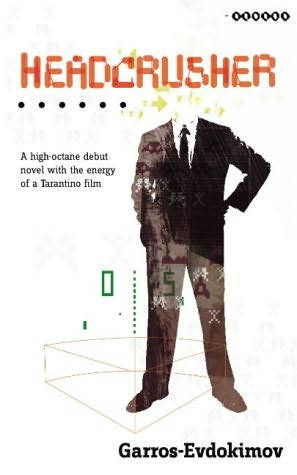 For a change from the norm, we have two Russian books this time. Allow me to say, what incredible books. The first, Headcrusher, is by a duo named Garros-Evdokimov. This is almost technopunk, combining an incredibly violent videogame, and yet another gormless individual who suddenly goes berserk and commits a series of murders. Set in the Russia of the early 1990s when limitless money was available to the amoral and the corrupt, this book combines social criticism with dark humour; the plot is scarcely credible, but the murders follow a logical inevitability as the anti-hero, Vadim, knocks off one person after another, launders money on a vast scale, learns all about single malt whisky, and bonks beautiful women. It’s all described in a very laconic style, almost stream-of-consciousness, hilarious to boot. Rush out and grab it ASAP.
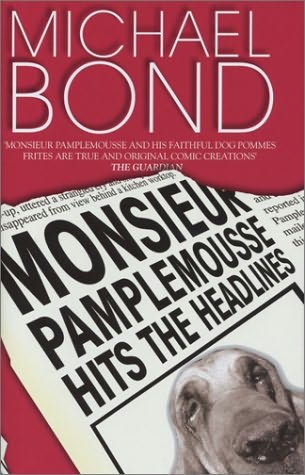 This is not really a translated novel, but I’m throwing it in as it has in it every possible stereotype an Englishman holds of the French: oversexed women, gourmets, intellectual dogs, corrupt civil servants. I daresay it is an Englishman with such a view of the French who will most benefit from reading the other books in today’s litany. Anyway. Michael Bond, famous for the Paddington Bear series, has written a bunch of harmless and humorous accounts of the exploits of Monsieur Pamplemousse, a retired policeman and gourmet (see this, e.g.). In Monsieur Pamplemousse Hits The Headlines, a famous TV chef dies while he films a cooking show where Pamplemousse is in attendance, and obviously our man has to get involved. There are horny vamps out to blackmail every male in power, even Pamplemousse who is not really powerful, and sundry colourful characters who have much to say on food, but it’s Pamplemousse’s dog Pommes Frites who guides the detective to the solution. There are a couple of innocuous misdirections to keep the reader’s interest going. A very light book, this, which offers almost nothing to the intellect. General time-pass.
 Akashic Books has been in the business of urban fiction for some years, and recently, has published a series of books of short crime fiction set in various cities of the world. I picked up Paris Noir: Capital Crime Fiction, edited by Maxim Jakubowski, but this has nothing at all to do with Akashic, heheheh. It is as motley a collection as I can imagine, however. Noir only loosely describes the stories in the book (in what way Elric of Melniboné is involved in crime?) and not all of them are very good. In fact, despite claiming to shed light on little-visited areas of the City of Lights, the tramping grounds of the various characters in the book are Pigalle and environs, known even to one such as I who has scarcely visited the city, as a red-light district. The stories by now have all blended into an amorphous mass in my head, written by American, Canadian, French, and British writers; I can single out a couple that I thought were decent: Jason Starr’s “Bar Fight” with its twist at the end, and Romain Slocombe's “Guy Georges' Final Crime” has a clash between a serial-killer and his last victim that turns unexpectedly.
Next up is the second Russian novel: Andrey Kurkov’s Death and the Penguin, an absolute smasher of a book, about a down-and-out wannabe novelist who is hired by a newspaper to write up obituaries to be kept ready when important people die. Viktor is a loner, an introspective hack, with very little to tie him to his compatriots. His only source of comfort and affection is an Emperor Penguin named Misha that he picks up from Kiev zoo, which is too broke to feed its animals. The penguin spends much of the time standing quietly in the bedroom and staring at the wall; occasionally it studies its reflection in the mirror; often it senses its master’s despair and waddles over to put its head on his lap… Various thugs begin to arrive at Viktor’s doorstep, stern but friendly, who ask him which of his obituaries he liked the best. The next day, the subject is dead; soon others Viktor has written about are dying as well, and the editor of the newspaper admits that he is part of a clique determined to clean out corruption in Kiev. One minor villain (who soon is killed) leaves his daughter in the writer’s care. Viktor now has to take care of two wards, and while he is kind to the girl, his deepest affection is reserved for Misha. Viktor finds out that his obituary has been written, which serves to crystallise his mind and strengthen his spine. Then the penguin falls badly ill. This is a novel of simply wrought impressions, humorous and moving and surreal, a study of social collapse, and the ties that bind the honest and the helpless. Wonderful stuff.
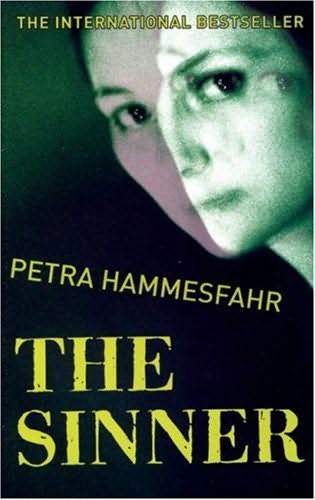 The German writer Petra Hammesfahr has been likened to Patricia Highsmith, and her award-winning novel The Sinner has all the darkness and psychosis of the latter’s oeuvre. A young mother, Cora Bender, seemingly content with her husband and little son, suddenly stabs out at a man in a beach as he makes out with his wife, and kills him brutally. She then admits her crime to the policemen who show up and requests them not to waste time investigating the murder. But the investigating detective is baffled by her statement that she hasn’t seen the man before; when she refuses to explain her motive, he.begins to dig deeper. And once again we see the awful consequences of religious fundamentalism on a growing child, We learn what an awful upbringing Cora had, with her mother suffused with rigorous piety, her father feckless and incapable of supporting her, her younger sister so badly ill that she is in and out of hospitals. As she grows up, she faces the constant contempt of her mother; her sister then begins to live life vicariously through her, even going so far as to attempt to persuade Cora into prostitution. When a flashy boy comes to town, she falls in love with him, and finds herself among a crowd that seeks sex and drugs, which inevitably leads to tragedy. Perhaps it is this tragedy that has coloured her life, and the demons that were driven deep into her psyche suddenly emerged on that beach that sunny day and caused her to kill? This is a top-notch study of psychological trauma and faith, revealing that just as blind faith can destroy, faith in the fundamental goodness in people can save.
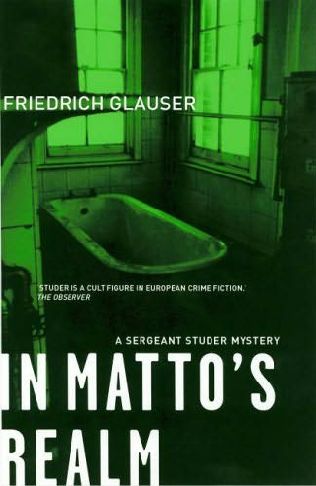 Speaking of psychological studies, the Swiss writer Friedrich Glauser spent much of his life at one or the other mental institution in Switzerland. Amidst his treatments, he wrote four novels that were to become classics in European crime fiction. In Matto’s Realm is one of them, and it is rather good. Matto, in Italian, is the spirit of madness, and it appears to rule in an asylum in Bern, whence a child-murderer escapes and the director is found with a broken neck. When the sympathetic sergeant Studer is brought in to cover up the case (with the approval, strangely enough, of his superiors), he finds that there are castes and hatreds and religious maniacs and sexual rivalries galore within the institution. The blurb says that Studer finds it hard to resist Matto himself, finding himself drawn into the ‘no-man’s land between reason and madness’, but this is an exaggeration. Studer remains warmly analytical throughout, even if some of his efforts at resolving the mysteries go awry and an innocent man ends up dead. He is shaken by the consequences of his actions, but he is too good a man and detective to ignore the truth. This is a slow-burning novel of humour and understanding, written with intimate knowledge of the world of the insane. Glauser has certainly put to good use his own unfortunate experiences.
 Finally, we have Czech-born French writer Pavek Hak’s Sniper, a violent and awful description of war and the greatest crimes of all – those sanctioned by governments on their own hapless populations. This is a thin book, describing the points of view of three characters in a Balkan country: the sniper, an amoral stooge of the government who is convinced that he is serving the greater good by annihilating everyone who comes into the scopes of his rifle – children, mothers, old men and women, postmen – he kills them all indiscriminately; a young man who is determined to exhume and bury his parents with honour, fighting with every ounce of sinew the tough ice that covers them, reliving over and over again the brutal slaughter of his father, his mother and his little brothers; and a commandant who embodies the criminal decision of the oppressors to wage brutality in every possible way against the civilians, including degradation and rape and torture and bestiality. The three viewpoints are interlinked, with the horror escalating with every page. As anti-war novels go, this is right up there with the best.
And that’s all for April, folks.
Here we are at the end of the second month of my reading of sundry non-English crime-fiction. You may recall I started with the grandiose plan to read one book by every author listed in the Eurocrime website, but as I am too cheap to buy the books and because the local libraries do not stack them all, I've had to modify the goals a bit. I'll read any crime fiction as long as it is translated into English.
 So here we go with month 2. First off the blocks is a somewhat whimsical tale about an old lawyer who has a shrewd business plan. Whenever he encounters a crime that intrigues him, he sticks around to solve it. Then he approaches the murderer and offers to defend him (and possibly get him off successfully) in return for a suitable honorarium. Invariably the gendarmerie and the prosecutor, plodders as they are, will find themselves outclassed. In Pierre Véry's The Old Ladies' Tea Party, the lawyer, old Prosper Lepicq, is on holiday in a small town called Criquebec, where he falls in with a bunch of elderly ladies with a fetish for the occult. Lepicq likes to ingratiate himself amongst the residents so as to pick up all the gossip, and these ladies favour him with multiple points of view of nearly every resident. Then one man is murdered. It appears that he cunningly sold a piece of land to the town council in return for a substantial annual stipend. The council, hoping to make back the investment, constructed an old people's home on the land. Unfortunately, no old people wanted to live there. The murdered man was much loathed for this supposed con. Could that be reason enough for his death? Then another innocuous person, a known associated of the first man, is killed. Lepicq soon uncovers blackmail, envy, sibling rivalry and poison. The case itself is not surprising in its revelation, the prose is somewhat breathy and excitable, but Véry, one of France's popular authors, describes the petty-mindedness of small-town life accurately, and the various characters add some eccentric colour to this thin book.
 From whimsy to hardboiled noir: Giampiero Rigosi's Night Bus is about two rootless characters and seedy Bologna. Leila is thirty-ish, pretty, a hunter of men's wallets (she picks up her marks, drugs them and absconds with their money). Francesco is a bus-driver with a gambling addiction. There is a politician who is being blackmailed and who has arranged for payment to be made in return for the incriminating document. There are secret service agents, no better than thugs, who are after the blackmailers so that they can make case against the politician. Another agent, slightly better than a thug, works for the politician, and wants to ensure a smooth transfer with the blackmailers. Leila unknowingly gets her hand on the documents after seducing one of the blackmailers. Meanwhile Francesco is being chased by a giant of a man to repay his gambling debts. The disparate story-lines, written in staccato fashion, serve very well to maintain tension, and do converge in a collection of set-pieces that are both hair-raising and funny. Rigosi has a considerable affection for Quentin Tarantino, I guess, evident both in the action-film-script-like prose and in surreal touches of humour (e.g., see here for an excerpt where the secret service thugs take a break from violence to make pasta). Good stuff.
 We must have an obligatory historical crime fiction piece this month, and (like the poor example last month) this one is provided by another Frenchman, Armand Cabasson, in his Wolf Hunt. Cabasson is well-known for his obsessive study of the Napoleonic wars, but he has considerable trouble separating his hobby from the necessity of terseness in his prose, and so this book has the usual long excursuses into regimental history, battle plans (both French and Austrian), and a few supercilious put-downs of the Viennese. Quentin Margont is a French soldier who, when he is not butchering the enemy, likes to ponder egaliteraniasm and the remains of the Revolution of 1789, and, at other times, solve crimes. He encounters a beautiful Austrian woman (during a truce in the conflict) who begs him to help locate a missing orphan. The orphan is subsequently found brutally murdered. Meanwhile, an Austrian-turned-French soldier Lukas Relmyer is on the chase of the murderer who, he believes, was the man who had very nearly killed him several years earlier. The two men decide to join forces, and in the midst of their hunt, there is opportunity to describe a Viennese ball, corruption in the bureaucracy, Franco-Austrian disdain for each other, a few bouts of fencing, and Margont's love for the beautiful Austrian woman. As far as investigations go, unsurprisingly, this is not of very high calibre; eventually the two men do catch up with the murderer, but the villain's motivation was not very clear (to me, at least).
 Nordic crime fiction is now so numerous that no month can go by without having at least one exemplar from that genre, which is provided today by Liza Marklund's The Bomber. This is a good piece of work that is undone by a somewhat loose denouement, and again, the villain's motivations do not appear meaty enough to result in the carnage produced. Of course, we could attribute this disconnect to the murderer's psychopathy, but even that revelation is so late in the book that it appears almost as an afterthought. But I liked the book overall for its acute description of a workplace that is suffused with rivalries, political and professional (I think I've used this expression before so I'm getting sloppy myself), and the difficulties faced by working women (especially working women who are good at and passionate about their work) vis-a-vis their families. This book is written from the perspective of a journalist, Annika Bengtzon, who is deep in the investigation of a bomb that has destroyed Stockholm's Olympic arena, killing one person, and who, despite having a police contact, is not entirely certain how the police investigation is going. She herself does not aim to solve the mystery; rather, she chases separate strands of possibilities raised by the information dug up by herself and her team. This is a neat trick on Marklund's part - the real police story is elsewhere but we get glimpses of it at third-hand, as it were, and Bengtzon's investigation reveals various side stories, which eventually all combine at the climax (which is where it all begins to go downhill, as I mentioned above). This is a very good thriller for a long flight, and I guess the Swedes must travel a lot, for the book has done phenomenally in their country.
 In last month's roundup, I mentioned the Mexican novel co-authored by the Zapatista leader, Subcommandante Marcos; in that book, there were several references to Manuel Vázquez Montalbán's books, and I picked up one: The Man of My Life. This is set in Barcelona, where the detective Pepe Carvalho plies his trade, freshly back from a stint in Buenos Aires. The book is more a rumination on the politics of Region Plus and Catalan nationalism and various groups for and against the -isms that plague Spain (including, of course, Catholicism and Satanism), than a detective novel. Much energy is expended in describing why an economic union of Barcelona, Toulouse and Milan is inimical to the idea of Catalonia (if people can make money in the new regime, why will they bother to agitate for separation from Spain?), and why devil-worship is the new religion to counter Catholicism (which has been tarnished by its association with the depredations of Franco's era). Indeed, Carvalho does little detecting, although by what looks like authorial fiat, he locates one crazy group of anarchists and another, and deduces links among them that perplexed an unsubtle mind like mine. In the midst of all this, he also gorges himself on some of Barcelona's famed cuisine (see here for an example) and on Barcelona's lovely women as well. How a somewhat weary and downbeat sixty-year old gets all those women, I have no idea. Still, they like him, and he proceeds to confound the various politicos with his smart-alecky humour, before settling the case with his own idea of justice.
 It should be a warning to any reader when an author is pretentious enough to suggest that his book be read to the accompaniment of music; when he goes so far as to recommend the piece of music to go with each chapter, it's all I can do not to kill myself. Maxim Chattam's The Cairo Diary is terrible. Anyway, quick plot summary: a woman hidden in present time in Mont Saint Michel by the French secret service finds the diary of an English detective who chased after a particularly vicious serial-killer of children (gratuitous descriptions ensue, followed by much reflection on oriental mystique and the fatal attraction of women) in Cairo in 1928. The book bifurcates: one trail following the Englishman, and the other following the fugitive woman. I can't think which is worse: the unrelentingly florid language or the vanishingly thin story-line. It then appears that someone is hunting the woman, and it's all somehow related to the putrid plot in Egypt. I, well, I can't go on with this anymore.
 Finally - to end on a high note (and after the last book, a slug would have been a high note) - we have Petros Markaris's Zone Defence, set one hot summer in Athens when the garbage collectors are on strike and Inspector Haritos is ailing, trying to avoid his wife's hypochondriac concerns for his heart, smoking and pigging out, and chasing after the perpetrators of a gangland shooting of a restaurant owner, and pondering about an unknown corpse that may or may not be linked to said restaurateur. This is very funny book and every page is a joy; it is remarkably un-PC (Haritos says, for example, there are two things in life I hate: racism and blacks.), sledging Greece's various Balkan neighbours, but not particularly positive on Greeks either. Haritos himself has been married for years, and although he is frequently exasperated by his wife, they do love each other deeply, which is quite exceptional (and even exceptionable - which detective is happy in his personal life?); much of the novel deals with his relationships with her and their adored daughter, amidst ruminations on Greek techniques of tax-evasion, illegal immigration, low-level football leagues, politics and the exigencies of fame. It is a solid police procedural, well worth your time.
 So here we go with month 2. First off the blocks is a somewhat whimsical tale about an old lawyer who has a shrewd business plan. Whenever he encounters a crime that intrigues him, he sticks around to solve it. Then he approaches the murderer and offers to defend him (and possibly get him off successfully) in return for a suitable honorarium. Invariably the gendarmerie and the prosecutor, plodders as they are, will find themselves outclassed. In Pierre Véry's The Old Ladies' Tea Party, the lawyer, old Prosper Lepicq, is on holiday in a small town called Criquebec, where he falls in with a bunch of elderly ladies with a fetish for the occult. Lepicq likes to ingratiate himself amongst the residents so as to pick up all the gossip, and these ladies favour him with multiple points of view of nearly every resident. Then one man is murdered. It appears that he cunningly sold a piece of land to the town council in return for a substantial annual stipend. The council, hoping to make back the investment, constructed an old people's home on the land. Unfortunately, no old people wanted to live there. The murdered man was much loathed for this supposed con. Could that be reason enough for his death? Then another innocuous person, a known associated of the first man, is killed. Lepicq soon uncovers blackmail, envy, sibling rivalry and poison. The case itself is not surprising in its revelation, the prose is somewhat breathy and excitable, but Véry, one of France's popular authors, describes the petty-mindedness of small-town life accurately, and the various characters add some eccentric colour to this thin book.
 From whimsy to hardboiled noir: Giampiero Rigosi's Night Bus is about two rootless characters and seedy Bologna. Leila is thirty-ish, pretty, a hunter of men's wallets (she picks up her marks, drugs them and absconds with their money). Francesco is a bus-driver with a gambling addiction. There is a politician who is being blackmailed and who has arranged for payment to be made in return for the incriminating document. There are secret service agents, no better than thugs, who are after the blackmailers so that they can make case against the politician. Another agent, slightly better than a thug, works for the politician, and wants to ensure a smooth transfer with the blackmailers. Leila unknowingly gets her hand on the documents after seducing one of the blackmailers. Meanwhile Francesco is being chased by a giant of a man to repay his gambling debts. The disparate story-lines, written in staccato fashion, serve very well to maintain tension, and do converge in a collection of set-pieces that are both hair-raising and funny. Rigosi has a considerable affection for Quentin Tarantino, I guess, evident both in the action-film-script-like prose and in surreal touches of humour (e.g., see here for an excerpt where the secret service thugs take a break from violence to make pasta). Good stuff.
 We must have an obligatory historical crime fiction piece this month, and (like the poor example last month) this one is provided by another Frenchman, Armand Cabasson, in his Wolf Hunt. Cabasson is well-known for his obsessive study of the Napoleonic wars, but he has considerable trouble separating his hobby from the necessity of terseness in his prose, and so this book has the usual long excursuses into regimental history, battle plans (both French and Austrian), and a few supercilious put-downs of the Viennese. Quentin Margont is a French soldier who, when he is not butchering the enemy, likes to ponder egaliteraniasm and the remains of the Revolution of 1789, and, at other times, solve crimes. He encounters a beautiful Austrian woman (during a truce in the conflict) who begs him to help locate a missing orphan. The orphan is subsequently found brutally murdered. Meanwhile, an Austrian-turned-French soldier Lukas Relmyer is on the chase of the murderer who, he believes, was the man who had very nearly killed him several years earlier. The two men decide to join forces, and in the midst of their hunt, there is opportunity to describe a Viennese ball, corruption in the bureaucracy, Franco-Austrian disdain for each other, a few bouts of fencing, and Margont's love for the beautiful Austrian woman. As far as investigations go, unsurprisingly, this is not of very high calibre; eventually the two men do catch up with the murderer, but the villain's motivation was not very clear (to me, at least).
 Nordic crime fiction is now so numerous that no month can go by without having at least one exemplar from that genre, which is provided today by Liza Marklund's The Bomber. This is a good piece of work that is undone by a somewhat loose denouement, and again, the villain's motivations do not appear meaty enough to result in the carnage produced. Of course, we could attribute this disconnect to the murderer's psychopathy, but even that revelation is so late in the book that it appears almost as an afterthought. But I liked the book overall for its acute description of a workplace that is suffused with rivalries, political and professional (I think I've used this expression before so I'm getting sloppy myself), and the difficulties faced by working women (especially working women who are good at and passionate about their work) vis-a-vis their families. This book is written from the perspective of a journalist, Annika Bengtzon, who is deep in the investigation of a bomb that has destroyed Stockholm's Olympic arena, killing one person, and who, despite having a police contact, is not entirely certain how the police investigation is going. She herself does not aim to solve the mystery; rather, she chases separate strands of possibilities raised by the information dug up by herself and her team. This is a neat trick on Marklund's part - the real police story is elsewhere but we get glimpses of it at third-hand, as it were, and Bengtzon's investigation reveals various side stories, which eventually all combine at the climax (which is where it all begins to go downhill, as I mentioned above). This is a very good thriller for a long flight, and I guess the Swedes must travel a lot, for the book has done phenomenally in their country.
 In last month's roundup, I mentioned the Mexican novel co-authored by the Zapatista leader, Subcommandante Marcos; in that book, there were several references to Manuel Vázquez Montalbán's books, and I picked up one: The Man of My Life. This is set in Barcelona, where the detective Pepe Carvalho plies his trade, freshly back from a stint in Buenos Aires. The book is more a rumination on the politics of Region Plus and Catalan nationalism and various groups for and against the -isms that plague Spain (including, of course, Catholicism and Satanism), than a detective novel. Much energy is expended in describing why an economic union of Barcelona, Toulouse and Milan is inimical to the idea of Catalonia (if people can make money in the new regime, why will they bother to agitate for separation from Spain?), and why devil-worship is the new religion to counter Catholicism (which has been tarnished by its association with the depredations of Franco's era). Indeed, Carvalho does little detecting, although by what looks like authorial fiat, he locates one crazy group of anarchists and another, and deduces links among them that perplexed an unsubtle mind like mine. In the midst of all this, he also gorges himself on some of Barcelona's famed cuisine (see here for an example) and on Barcelona's lovely women as well. How a somewhat weary and downbeat sixty-year old gets all those women, I have no idea. Still, they like him, and he proceeds to confound the various politicos with his smart-alecky humour, before settling the case with his own idea of justice.
 It should be a warning to any reader when an author is pretentious enough to suggest that his book be read to the accompaniment of music; when he goes so far as to recommend the piece of music to go with each chapter, it's all I can do not to kill myself. Maxim Chattam's The Cairo Diary is terrible. Anyway, quick plot summary: a woman hidden in present time in Mont Saint Michel by the French secret service finds the diary of an English detective who chased after a particularly vicious serial-killer of children (gratuitous descriptions ensue, followed by much reflection on oriental mystique and the fatal attraction of women) in Cairo in 1928. The book bifurcates: one trail following the Englishman, and the other following the fugitive woman. I can't think which is worse: the unrelentingly florid language or the vanishingly thin story-line. It then appears that someone is hunting the woman, and it's all somehow related to the putrid plot in Egypt. I, well, I can't go on with this anymore.
 Finally - to end on a high note (and after the last book, a slug would have been a high note) - we have Petros Markaris's Zone Defence, set one hot summer in Athens when the garbage collectors are on strike and Inspector Haritos is ailing, trying to avoid his wife's hypochondriac concerns for his heart, smoking and pigging out, and chasing after the perpetrators of a gangland shooting of a restaurant owner, and pondering about an unknown corpse that may or may not be linked to said restaurateur. This is very funny book and every page is a joy; it is remarkably un-PC (Haritos says, for example, there are two things in life I hate: racism and blacks.), sledging Greece's various Balkan neighbours, but not particularly positive on Greeks either. Haritos himself has been married for years, and although he is frequently exasperated by his wife, they do love each other deeply, which is quite exceptional (and even exceptionable - which detective is happy in his personal life?); much of the novel deals with his relationships with her and their adored daughter, amidst ruminations on Greek techniques of tax-evasion, illegal immigration, low-level football leagues, politics and the exigencies of fame. It is a solid police procedural, well worth your time.
Subscribe to:
Posts (Atom)
