This is the story of the rise and fall of a legendary city with a long-hidden legacy of hundreds and thousands of ancient manuscripts. Set against the backdrop of mighty kingdoms and visionary leaders, it talks of how old trade routes from the East became Ink Roads, bringing writing to the heart of West Africa, and how Timbuktu became its leading light, and how invasions and conquests caused that story to be buried in the desert sands of the Sahara. African storytellers have had their long oral traditions dismissed as mere song and dance; the ensuing lack of a written literature was interpreted as a lack of a literary tradition. But now a different interpretation is emerging: one that tells us that reading and writing has been as important a tradition in Africa as it has been in the other great civilisations of the world. As Timbuktu's manuscripts are brought out of hiding, the conviction grows that what they have to tell us will forever rewrite Africa's history.
By the 17th century, tales of an African Eldorado whose streets were paved with gold and whose culture was more glittering than any in Europe were beginning to percolate into the white man's consciousness in the North. As European colonialism grew apace, it became a matter of honour for the likes of England and France to send explorers across the Sahara, or from the sea, to find this fabled city named Timbuktu. The expeditions took years, involved violent strife with desert tribes and large losses of lives, so Timbuktu became synonymous with remoteness and the unknowable. But eventually Western Africa fell to the Europeans, and Mali, once the richest empire in the world, became nothing more than a backwater province of the French. It regained its independence only in the 1960s, and several years were to pass before the owners of its rich literary history felt safe enough to bring their manuscripts out of hiding.
Even today, few people realise that Mali was once Africa's most important seat of learning. From the 13th century onwards, Timbuktu became an academic centre and a paradise for scholars. Today, the memory of those glory days has diminished to a recollection of alphas, wise men from the North who spread knowledge of the word of Allah. In fact, these men were from Timbuktu, students and teachers of faith and science. Among Africans, perhaps only those studying Arabic and the Qur'an know of Mali's great past and its libraries; for the general public, Timbuktu remains a remote undistinguished town on the Niger river.
Families have passed on their manuscripts from generation to generation. Over 70,000 are now available in the thirty or so libraries that have opened in Timbuktu in recent years. Books and documents began to be collected eight centuries ago. The libraries now store whatever remnants have survived the ravages of time. Their contents offer a new and unrivalled source of understanding West African history.
At the Mamma Haidara centre, there are manuscripts on astronomy, medicine and theology, including commentaries on the Hadith. Several date from the 16th and the 17th centuries, and have been nibbled by termites. One astronomical treatise shows how to compute the positions of the stars, providing tables and algorithms. A theological document contains annotations and analyses of the Prophet's sayings, and deal with a variety of aspects of the lives of the faithful. One comment is about hygiene and the necessity for a moderate diet.
Paper was expensive in those days, and so margins of books were constantly reused. On the same page as the description of a moderate life, there appears a comment: today there was an earthquake in Timbuktu... In another book, there appears a five-hundred year old recipe for toothpaste. Take some salt and some sugar, and mix it up with some charcoal, and brush the paste on your teeth, and your teeth will become white. And what's more, it will get rid of your bad breath.
How did these libraries first come into being? How were they lost? How will their rediscovery alter perceptions of Africa?
At the end of the 10th century, when Timbuktu was founded, a large part of West Africa was ruled by the Ghana empire. This was West Africa's first superpower, and its rulers were early converts to Islam. The spread of Islam was the compelling reason for the change in West African mores, and provided the impetus for its first literary tradition.
The first Muslims to arrive in West Africa were traders from the north, who then spread their faith across the Sahara all the way to the south coast. Just as in Europe, where most of the early manuscripts are religious texts written in Latin, the earliest texts in West Africa are religious as well, but written in Arabic, and discuss Islamic theology.
The Ahmed Baba institute, Timbuktu's only public library, stores Mali's national collection of manuscripts. Setup in 1973, it now has over 40 thousand documents. Even today, every week, they get around 700 new manuscripts, surely a surprising number. Whenever a new piece arrives, the librarian and his staff need to evaluate it. They select the ones that are in the best condition; the poor ones are set aside. There are many in African languages but written in the Arabic script. These are called Ajami texts. There are documents in Tamazight, Sorai, and other local languages that recount the history of the region. All of them are being digitised so that they can be made available to a worldwide scholarship. The first priority, however, is the conservation and the preservation of these manuscripts.
 Over 300,000 manuscripts are known to exist in the region, but so far a very small percentage has been translated or studied in any great detail. The conservation, transcription, preservation, study and analysis of the known documents is a task of decades. But thousands, maybe even hundreds of thousands of manuscripts are still hidden in cellars and basements or perhaps buried in the sands of the desert.
The last three hundred years have dealt a succession of blows to Timbuktu. Morocco invaded at the end of the 16th century. Power struggles between rival sects of fundamental Islamists created anarchy throughout the 18th and 19th centuries, followed swiftly by the indignity of French occupation. Like other colonisers, the French took away manuscripts as spoils of their victory. To protect their treasures, the custodians of the manuscripts began to hide them, and they went underground, resurfacing only over the last fifty years. But the custodians are still suspicious.
Before he began to work for his family library, Abdul Qader Haidara was a prospector for manuscripts employed by the national library, and it was his task to track down hidden caches and persuade their owners to hand them over to the state for safekeeping. Convincing them was a difficult matter. When the previous head of the national library approached an Imam of a local village who maintained his own trove, the latter was willing to treat with the director, promising him that they would work together. Several weeks passed, with the director making frequent trips and parleying with the Imam, convinced that his words were persuasive, only to find one day that a wall had been constructed around the manuscripts. The Imam announced that there would be no more discussion, and to this day, those manuscripts have not been yielded to the national library.
At the height of its golden age in the mid-1500s, Timbuktu's population had grown to about a hundred thousand souls. A quarter of them were teachers, students and scholars. Today, the city is a crumbling and dusty backwater, and there is little sign of the academic dominance of the past.
The challenge for historians is to meld the written and the oral descriptions of Africa's past. It is as much a mistake to base the retelling of Africa's history only the manuscripts as it is to depend entirely on the epics handed down over the generations. Furthermore, a crucial source of information comes from archaeological digs along the Niger river, a source that also needs to be incorporated into new understanding. The Niger river is one of Africa's greatest, providing a source of livelihood and trade for sundry communities that waxed and waned along its banks. Between Djenne and Timbuktu alone, archaeological digs have confirmed that thriving and densely populated urbanised settlements began here as early as 500 BC. It was said that if someone in Djenne wanted to convey a message to someone in a distant village or city, all he had to do was shout, and his message could be carried over the flood-plains and the river to its destination because the entire region was so densely populated.
A pottery cover ten miles south of Timbuktu reveals a city that is twice the size of the medieval Timbuktu, which itself was twice the size of the London of the time. This was far from the only settlement here: these were not small, discrete townships, and their peoples lived peacefully for centuries. Very little evidence of warfare exists in West Africa before the advent of Islam, so economic cooperation appears to have been the order of the day. Some settlements were of farmers, others of fishermen, still others of potters and metalworkers. Once the landscape was covered in forest, which was cut down by the activities of the populace. The metalworkers alone would have required enormous quantities of wood to stoke their furnaces, and possibly contributed to the desertification of the land. Pottery was the ancient analogue of our tins and plastic bags; shards are found in huge quantities: pestles, pots, grindstones, utensils. The cityscape would have resembled the earthen villages that dot the countryside around Timbuktu today, only the density of occupation having changed over the millennia.
Archaeology doesn't tell us what happened to that urban civilisation, or how Timbuktu was born. That information we can glean from the oral tradition. Tuareg tribesmen are said to have established a camp by a well a few miles away from the mosquito-infested banks of the Niger. When the Tuareg headed off to graze their herds in the desert after the rains, they left their belongings to be looked after by a slave woman named Buktu, the lady with the large navel. Timbuktu, then, simply means, Buktu's well.
The Tuareg are the dominant tribes of the desert, an intimate knowledge of which has given them unrivalled control over the trade routes from the north and the east leading to the Niger. By the 10th century, commercial considerations had led to the establishment of a city where the Niger turns eastwards. This is where the trade routes from across the Sahara could safely converge. Timbuktu is where the camel meets the canoe, lying as it does between the desert and the river, where camel trains bringing in the riches of the Mediterranean could be offloaded onto boats and shipped to the kingdoms up and down the Niger, and gold arriving from the south could be used to pay for the luxuries of the north. Dates, European fabrics, glass, jewellery, tobacco, and salt from the Sahara poured into Mali on the camel trains. Boats from the south brought cereals, honey, gold, slaves. It is said that in the 14th century, two-thirds of the world's gold came from Mali, much of it passing through Timbuktu. Today's market here, however, is a small affair, although that other great mainstay of trans-Saharan trade, salt, still arrives by camel, brought by the Tuareg.
International trade in Timbuktu required written contracts, which generated a thriving business for scribes and notaries, who would need to produce documents in a lingua franca. Since the advent of Islam, Arabic became that common language of trade and discourse. In the wake of this religion, books also began to arrive in Timbuktu, and began to be traded like any other commodity, as wealthy merchants found a new indulgence. Books enhanced the status of their owners, and gave the pious a deeper understanding of their faith. The profit of this trade rivalled that from gold and slaves, and by the 13th century, prominent families in the city began to boast of their own private libraries. The sons of those families aspired not only to trade but also to scholarship. Paper was imported from Europe and China. Calligraphy became a viable and respected trade, creating new manuscripts based on indigenous work and copying documents coming from abroad. Their labours were impressively rewarded.
Sidiki Nazim, a calligrapher practising in Timbuktu today, says that in the Middle Ages, his work would have earned him great wealth: he would have owned houses and camels and gold. Today it is a completely different story. He is among the poorest in town, and the only one still practising this ancient craft.
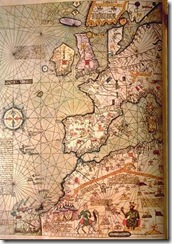 Towards the end of the 13th century, Ghana was overtaken by a new Malian empire, which became the new power in the region with Timbuktu as its economic centre. When the emperor of Mali, Kanka Musa, made his grand pilgrimage to Mecca in 1324, he stopped at Timbuktu, acknowledging its supremacy as mercantile and cultural powerhouse of Western Africa. The Emperor was a pious man, and on that Hajj, he distributed fifteen tons of gold so generously in Egypt and Mecca that the price of gold was depressed there for a long time thereafter. News of his wealth and splendour as he wound his way around the Levant soon reached the ears of European merchantmen. Within fifty years of the pilgrimage, the Mallorcan cartographer Abraham Cresques had drawn up a map for the Holy Roman Emperor, Charles V, showing a black Emperor sitting on the golden throne of West Africa, with Timbuktu as its capital. The legend of a desert Eldorado began its grip on the European mind.
Kanka Musa brought back Arabic scholars to heighten the academy in Timbuktu, but it was said that they proved to be no match for the excellence of the city's black African scholars. He also commissioned new buildings to grace Timbuktu, including a grand palace designed by the Andalusian architect Es-Saheli, whom he had brought with him from his travels. When the palace fell into disuse, the site began to be used as an abattoir.
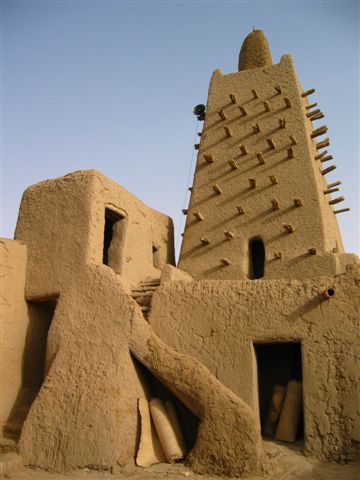 There is little sign of that great edifice today, although one remnant can be found: the Djingareybar Mosque [picture by Dave Lantner], also designed by Es-Saheli, patched up and restored several times over the past 600 years, it represents an almost futuristic notion of a mosque, quite distinct from the usual perception of Islam's houses of worship. Impressive as it is now, in its day it would awed Musa's people just as much as the great cathedrals of Europe, that left no doubts in the minds of their visitors exactly where the power lay. From outside, the mosque doesn't look very large. The interior, though, is huge. There are nine prayer aisles, each about a hundred metres long. It is comfortably cool within as well, almost air-conditioned. Mud brick being a bad conductor of heat, the halls are always at the temperature of the early morning.
In Islam, learning has been much prized, and the academicians of Timbuktu won praise and power in equal measure. When Ibn-Battuta, the greatest traveller of the Middle Ages, visited the city, he was spell-bound by its culture and learning, pointing out the piety, justice and tolerance of its inhabitants. Because of the depth of that learning, the African scholars of Timbuktu were able to distil the essence of their religion and convey it precisely to the people, leading to a tolerant form of Islam practised in West Africa. How much of this tolerance was occasioned by the filtering of Arabian ideas by African minds? Perhaps the Islam that took root in this part of the world was really a blend of the older occult faiths and the monotheism brought in from the East?
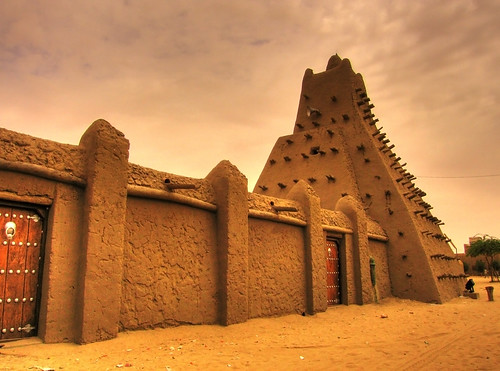 The scholarly work in Timbuktu was concentrated in its three mosques: the Sankore mosque (photo by Rajarajaraja), commissioned, it is said, by a wealthy Tuareg woman in the 14th century, the Djigareybar mosque, and the Sidi Yahia mosque. These three mosques comprised the Sankore University, whose rise was signalled by the active research community and prolific writings that filled up the libraries. Timbuktu's Golden Age began in the final decades of the 15th century, fuelled by yet another turn in the cycle of West African imperial history. The Songhay empire, greatest of them all, reigned from Gao, over an area bigger than Western Europe. Under Sonni Ali Ber, an Emperor who championed African traditions, the kingdom was only nominally Muslim, and he refused to allow the dilution of local cultures by Islam. He arrived in Timbuktu in 1468 and showed the scholars there who was boss: they were to obey his diktats on pain of dismissal or death. He would not permit their religious principles and teachings to subsume his culture, he announced. The scholars fled to other towns and cities. But Sonni was a visionary as well, with a view of unity in Africa, so he always imposed his language wherever he conquered.
Sonni's successors were more devoutly Muslim, and they encouraged and funded Timbuktu's scholars. By then, Sankore University was recognised as a pre-eminent centre of learning and discourse. Of course, their interpretation of 'university' is quite different from ours. 180 Qur'anic schools taught children the basics of their faith. The well-off among them would go on to Sankore for three further levels of learning: Arabic grammar and literature, commentaries on the Qur'an, science and Islamic law. Examinations were both oral and written, and degrees were presented to the successful students in the form of a special turban. An interpretation could be made of the design of this turban: the dangling long cloth on the right of the u-shaped face with the circular wind over the head, when written right-to-left, would spell out the name of God, Allah.
A student wearing this turban would be led into the middle of a circle of scholars in the Sidi Yahia mosque, who would rip off his turban, claiming that he was unworthy of it. Then they would pose seven questions in Islamic law to him. If he answered correctly, he would be allowed to wear the turban, and they would all go to Sankore to party. The student then enters the community of wise men and the imam.
The scholars of Sankore were not just teachers. They were also the ruling elite, judges and legislators, who governed every aspect of the people's lives. Although they lived among the people, they were jealous of their power and kept literacy to themselves. As far as they were concerned, the common people only needed to know how to pray correctly, and that was the extent of their encouragement of reading. The spread of literacy in West Africa was also curtailed by significant barriers: the culture of writing followed the trade routes, and since these were mainly along the Niger, literacy was restricted to these regions as well.
In 1591, the Moroccan invasion destroyed the Songhay Empire, the Sankore University, and put a massive dent in any development of a modern nation state in West Africa. The fulcrum of knowledge and learning crumbled under the onslaught of the Maghrebis. Meanwhile, the European shift of trading from the Mediterranean to the Atlantic destroyed the economic basis for West Africa. Gold began to be imported in large quantities from the Americas, resulting in further impoverishment of the Niger belt. The markets became poorer, and while the Moroccans didn't stay on as occupiers, the region imploded in sectarian violence as one brand of fundamentalist Islam fought another through the 18th and 19th centuries. There was simply no time or energy left for learning.
A great consequence of the subsequent colonial occupation of Africa is how Africans (and the world) began to look and interpret its tradition and culture. Furthermore, the imposition of the French educational system on Mali destroyed the old Arabic scholarship, leading to a loss of continuity in learning and knowledge. This means that Timbuktu's manuscripts today are accessible to a very few people, a precarious position for any historiography to be in.
Even the small number of documents deciphered today reveal wonderful glimpses of Mali's past. A book of fatwas, or religious verdicts, describes the quotidian concerns of the laity. A woman whose husband went away on a mission agreed with him that if he didn't return in a certain number of days, she could divorce him and take up with another man. There were no witnesses to this agreement, however, so when the man returned much later, he found that his wife was married to another; the mufti declared that the second marriage was invalid and that she should return to the first man. The woman's voice rings down through the centuries: it is not just your money that I need, but also your companionship and support and love, and if you aren't here, why should I not find these in another man? Clearly there were concerns facing women, but equally, men had pressing anxieties as well. They wanted to be sure they were satisfying their wives, and when erectile dysfunction posed a problem, they were urged by the healer (who saw it as his holy Islamic duty to help out his brother) to apply the blood from the comb of a rooster to their feet or penis, to cure the condition.
After the Moroccan invasion, the scholars of Timbuktu began a new genre of historical writing called the Tarikhs, a rewriting of African history. These were a series of tracts meant to legitimise the elite's right to rule within the suzerainty of the Maghrebis. Their authors drew on oral tradition and written records to reinterpet the past within the light of subsequent events. As such, they need to be weighed carefully. Mohammed Kati who wrote the history of the Songhay Empire was a nephew of the clan, so it is naive to expect him to say anything negative about his Askia ancestors. In the Tarikh-al-Fattash, there are arguments supporting the Askia and condemning the Sonni. Both are from the same family but politically in opposition, and the bias colours the history. Likewise, the Tarikh-al-Sudan proposes in favour of the ruling powers and also in favour of the then dominant strand of religion; and so on, with other Tarikhs dealing with the Moroccan invasion.
Ajami, a genre aimed to reach a larger audience along the Niger, used Arabic writing for local African tongues. Ajami simply means any language other than Arabic, and the warring Sufis used it in propaganda favouring their own version of fundamentalist Islam in the region. On the other hand, it described the lives of commoners in a way that the Tarikhs didn't concern themselves with. The Ajami texts encompassed poetry and history and songs, preserving a dying oral culture. Without the Ajami manuscripts, there can be no unbiased retelling of African history.
Mali is a poor country, and fifty years after its independence, it is still more concerned with internal security than with the promotion of learning and historiography enabled by the rediscovery of the manuscripts of Timbuktu. A long-running Tuareg rebellion ended as late as 1996, but even today, they still clamour for greater autonomy or a state of their own. It's been a rocky road to a tentative peace. Meanwhile, the Sahara extends deeper into the country, parching the countryside and increasing the danger of flash-floods that destroy buildings and reduce the manuscripts to pulp. On top of all these problems, the flood-plains of the lifeblood of Timbuktu, the Niger, are receding year after year. Where once they touched the outskirts of the city, now they are more than five kilometres away.
Timbuktu no longer wants to remain in isolation. Especially among the youth, Western ideas abound, and the locals look forward to the prosperity brought in by tourism. The city is also looking outward more and more, twinning itself with other towns around the world. Hay-on-Wye on the Welsh borders is the latest to be twinned. Apparently, it had been a close competition between Hay and Glastonbury. No surprise, then, that the British city of books with its own literary festival and cultural tradition won out.
Further Reading
-
-
-
-
-
-
-
John O. Hunwick, STUDIES IN TA√RˆKH AL-FATT◊SH, III: KAfiTI ORIGINS (PDF!) -
Fallou Ngom, Ajami in Senegambia: The Research and Educational Potentials, Western Washington University.
-
Notable People and Places
-
Abdul Qader Haidara of the Mamma Haidara: Centre Juma Almajid pour la Conservation et la Restauration des Manuscrits a Tombouctou.
-
Bouya Haidara, Head Librarian, Bibliotheque Ahmed Baba Aboul Abbas (1860-1931).
-
Salem Ould Elhadj, Historian.
-
Alexio Motsi, South African conservator
-
Shahid Mathee (manuscript researcher)
-
Samuel Sidibe (Director, Mali National Museum).
-
Douglas Park (Archaeologist, Yale University), digs 10 miles south of Timbuktu.


 is Akunin's attempt at the high-society detective (recall that he writes each novel according to some stereotype of the genre), and in this novel, Erast Fandorin is as high-society as high-society can be - beloved of a Russian princess and investigating the kidnapping of a cousin of the newly crowned Czar. Nicholas II is a weak man and needs his coronation to complete without a hitch, but the kidnappers promise to deliver pieces of the little boy if their demands are not acceded to, and the Czar finds himself torn between regal duty (the Imperial diamonds absolutely should be present during the ceremony) and love for family. The story is related by a family retainer, a butler, and the story is deeply reminiscent of Kazuo Ishiguro's
  , wherein loyalty to the family is the man's creed, and he is willing to sacrifice everything at the altar of duty, including his happiness and the happiness of the princes and princesses he has taken care of since their childhood. This is a reflective novel, elegiac in tone - Nicholas II is, after all, the last of the Czars, although nobody knew this at the time he acceded to the throne. It is quite different from the humorous and over-the-top and bombastic tone of the earlier episodes in Fandorin's career; it is clear that a coldness has entered Russia's heart, and Fandorin feels it, and even if he saves the Romanovs, it is at terrible cost and ends in tragedy for everyone concerned.
 describes a secret club comprising the top detectives of the world and their faithful assistants, and reports their petty machinations for power and influence, and discusses the classification and analysis of crime. The structure of the detectives' club ostensibly mirrors society at large: the detectives are supposedly men of high social status, while the assistants are commoners; women are excluded; but it also analyses the possibility of upward mobility and reveals that a detective is only as good as his assistant. The novel reads somewhat jerkily as it attempts to intersperse a criminal investigation with a larger rumination on the art of detection; the two halves of this narrative would be fairly trite individually, but together form a sort of clumsy completeness. I was somewhat bemused at the end, having neither liked it much nor disliked it.
 in 1984 and caused a sensation in France. The French have a long history of self-analysis, even if little concrete comes out of it. The collaboration with the Nazis is something that was hidden in bureaucratic archives soon after the Liberation; the brutal suppression of the Algerian independence movement is another blot on their history. The French like to claim that once someone is French, their origins are irrelevant - a fine theory but much remiss in practice. So when crowds of Algerians decided to demonstrate in 1961 against French policy in North Africa, the police clubbed them to death in their hundreds; the ensuing news embargo ensured that the population at large remained ignorant of the truth, and continued to believe that the protestors had been violent (what else to expect from those uncivilised Beurs?). A French teacher on his way home is shot during the demonstrations; twenty years later, his son meets a similar death. Inspector Cadin, an iconoclast if ever there was one, pursues the investigation with single-mindedness, and uncovers dirt on monumental scale suppressed by the powers-that-be. Because it is France, justice can often be denied in favour of power. But Daeninckx is as left-wing an author as they come, and makes no apologies for his revulsion for this kind of national anomie; small wonder that his revelation of the terrible truths of 1961 and earlier created so much angst and outrage among his countrymen. This is a book well worth a read.
 . Lakhous is of Algerian origin but writes in Italian, and this book was quite a success in that sunny country. It comprises interview accounts by the residents of that building on the Piazza Vittorio; each interviewee reveals further information about the motivations and passions of their predecessor. And what a motley bunch of characters! The vicious thug Gladiator is the murder victim, but not before he has terrorised women in the building; there is a Milanese professor filled with revulsion at the uselessness of the southern Italian (mirroring, in fact, a desire among many northern Italians to secede from the unemployable social leeches of the south) and disdain for the immigrant; the Bangladeshi and the Iranian, each of whom has fled some terror in his past and finds some measure of acceptance in Rome; the Neapolitan concierge who resents the foreigners and hates the Milanese; and there is the elevator itself, which crystallises the residents' loathing for each other. But Amedeo, the man suspected by the police of the murder, is uniformly respected and liked by the residents; his identity comes as a surprise and eye-opener to the bigots and the welcoming alike. Lakhous is not polemical at all in this novella; rather, he likes send up stereotypes; above all, he recognises that in Rome, a foreigner is as welcome as any Italian, despite the hostility and the boorishness shown both by the native and the immigrant.
 , which is set in the emigre Spanish community in 1930s Italy. Although Spain is riven with sectarian strife, the snooty expatriates are all Nationalists, and would like nothing better to ally themselves both with Mussolini's Fascists, and the nascent Nazis who are going from strength to strength. This is a somewhat laboured spy novel with all the simplifications and generalisations attendant upon a conspiracy to take over the world. Calderon, however, seems to be pitching it as a sort of Indiana Jones caper, with frequent references to the Nazi desire to snatch antiques of power, such as the chalice of Jesus and the Ark of the Covenant and sundry other relics from the Christian past. The main narration follows an architect who rises in the Fascist and Nazi hierarchies under the aegis of an influential and immensely wealthy prince; both these men are in love with a (obviously) beautiful and vivacious girl. There is a motley collection of men named Smith who recruit the architect and his girl to spy upon the prince and the Church; meanwhile, the spies are being spied upon by the counter-intelligence of the Nazis and the Vatican; the plot is somewhat tenuous and the book is ultimately quite plodding. At the end comes the rather facile conclusion that nothing is as it seems, and people fighting on the opposing side may just as likely be on yours. The blurb calls it 'part love story, part espionage novel and part mystery'. It fails at all three.
 , we see his sympatico character, Carlito Hernandez, a cop who is honest by his lights, but sees nothing wrong in dealing in arms, running a protection racket, or maintaining two households (a wife and kids in one, a mistress and kids in another). He is that non-pareil, the Mexican macho man, capable of deep love (his kids adore him) and incredible selfishness (he'll sleep with any woman who gives him an erection - and he is quite catholic in this department). This is as thorough a social criticism as you can find of the deep corruption in Mexico: the police barely get paid and so have to fund their pursuit of serious crime by tolerating and abetting lesser crime. The entire structure of justice is rotten, of course, with everyone on the take; women recognise their relative powerlessness in this male-dominated hierarchy, and promote their own agendas with sexual cunning. On top of it all is the overbearing presence of the mighty neighbour to the North from where arrive protected individuals seeking release for their tawdriest and most brutal passions among the impoverished and desperate Mexicans. Carlito seeks his own version of justice for the indigent and the brutalised, and braves gang wars and politicos and large quantities of alcohol in his quest. This is a darkly humorous and deeply satirical novella. Don't miss it.
 . This is not translated fiction, although really it could be, as it has lengths of conversation in the pidgin of Ghana with little more than context to help the reader to decipher it. But it is a lovely tale of the clash between modernity and traditional values, and somewhat mystical in its acceptance that science and technology do not always have the answer when the age-old magics are at play in the world. So what happens in the book? Well, the girlfriend of a high-level politician finds a misshapen body in a hut in a little village she is visiting, and is so horrified by it that the politician demands a thorough investigation. Nobody can tell if the body is human or animal, much less if there is even a crime to investigate, but the policemen sent in are baffled by the villagers' lack of cooperation. A newly-minted forensic investigator, a genteel and polite Ghanaian man educated in England, is forcibly coopted by the chief of police (who, obviously, has his own agenda in pursuing the case). Once in the village, his innate courtesy admits him into the village's confidence: both the great hunter and the medicine-man take him under his wing. He soon recognises that there is hidden evil in the minds of men even in this bucolic setting, and the consequences of that evil are not readily explained by his rationality and science. An endearing book.