JOST A MON

The idle ramblings of a Jack of some trades, Master of none

May 19, 2017

Muhi al-Din Lari

I came across a reference to Muhi al-Din Lari in Ziauddin Sardar's magisterial Mecca: The Sacred City. Lari was supposed to be a hugely influential miniaturist, famous for his 16th century pilgrimage guide to the holy cities of Mecca and Medina, the Kitab Futuh al-Haramayn. The book, written in mystical and ecstatic Persian prose and illustrated by Lari, was produced in various editions - in Mecca, Turkey, Persia and India. Its depiction of the Sacred Mosque became the de facto standard for imagery of the Kaaba for centuries thereafter.

Sardar called Lari an Indian painter. He also said that very little is known about the man's life. He is supposed to have died around 1526, but I've also seen 1521 as a possible year of death. A brief bit of rummaging about the internet located a book that said Lari was Persian, though his chief work, the pilgrim's guide (written about 1505 or so), had been dedicated to the sultan of Gujarat. I suppose this is possible - Lari might refer to a person from the Iranian town of Lan, not far from Shiraz. Indeed, another book said he was a student of a famous Persian scholar who did indeed travel to Lar. On the other hand, there is a Lar in Uttar Pradesh too.

In the early 1500s, a famous artist would have had a selection of patrons to choose from - the Lodis in Delhi, the Bengal sultanate, even the Bahmanis in the Deccan, besides the rulers of Gujarat. What would prompt a painter from North India to seek the favour of a Gujarati sultan? It's still possible, of course, that Lari was, indeed, Iranian. His teacher wanted to move to India in search of cultural patronage, and it's possible that he either accompanied his teacher, or that he was inspired by the idea to seek the patronage of a Western Indian king.

I'd be interested to learn how Sardar determined that Lari was Indian. Where was he born? Where did he live? When did he go on his pilgrimage? What are the other works he created? How is it known when he died? Perhaps there are still myriads of Persian manuscripts that haven't been translated which might tell us more about this early polymath.

(At any rate, I have drafted an article with as much information as I could find and put it on Wikipedia's sandbox. If I can find a couple more citations and add a bit more to the piece, I might be happy enough to post it as an article.)

Mar 19, 2015

My Neck of the Woods

Liverpool Street Station, by Ebbe Sadolin (via Spitalfields Life.)

There's a book recently published in Russia, titled Литературный авангард русского Парижа. 1920—1926. История. Хроника. Антология. Документы. Written by Leonid Livak and Andrei Ustinov, it is 992 pages of history, chronicles, anthologies and documents pertaining to the great Russian diaspora in Paris between 1920-1926. By all accounts (including this review, by Vasily Molodyakov, from which I've shamelessly and poorly translated this article), it is a tour-de-force, a seminal work, a book that shreds the usual templates of study of emigre Russian literature.

What sort of avant-garde? the Soviets would say. Sure, a bunch of Russians legged it after the Revolution - some to Berlin initially, and then to Paris - and they may have written a thing or two.  Bunin, Kuprin, Shmelev, Zaitsev, Aldanov... The Soviets claimed that the real literature remained in Russia. The emigres were undeserving pretenders filled with nostalgia for their homeland; talented painters bemoaned their exile or returned with tails between their legs; the youth there was effete. The Soviets would bring up Marina Tsvetaeva, that most avant-garde of poets: what did emigration do for her?

Viktor Bart, Sergei Romov, Konstantin Tereshkovich. Founders of the group "Через" (1923).
The emigres would counter that the Soviets had defiled the avant-garde. The diaspora carried with it the forces of Russian tradition and the legacy of its great classical literature. The youth may quest for modernity, but the majority of them prefer to follow the great preceptors. Those who behave are published in "Modern Notes", while those who don't appear in "Numbers". This version of the argument is canonised by Adamovich and Gleb Struve after the second world war. The other version, that emigre literature is weak and ineffectual, and that the real literature is in Russia, is canonised in the English-language "Modern Russian Literature" by Marc Slonim.
"Merry Dynamite", manuscript by Dovid Knut. 1923.

So why do we have a thousand-page exposition from Livak and Ustinov? Well, for one thing, it illuminates little-known aspects of the Russian emigre experience, not just artistic but also literary. It overturns the myth of the absence of the avant-garde abroad, or of its marginalisation or insignificance. The Russian avant-garde was active, visible, powerful: "Gataparak", "The Palace of Poets", the Union of Russian Artists in France. But until 1924, the literary life of the Russian youth in Paris had three characteristic features: 1) an absence of anti-Soviet sentiment among the organisers and participants in the artistic groups; 2) a markedly pronounced popularity of the Soviet avant-garde in literature (Futurism) and art (Constructivism); and 3) close ties with the French Dadaist movement." (page 16).
Portrait of Mikhail Larionov by Man Ray. (1922-23).

The book also disposes of the myth that Russian Paris was somehow lesser than the Russian Berlin in 1921-23. The two capitals were not in opposition to each other; rather they were in consonance. And how could they not be, given that the same personages drove the avant-garde in both places?

Who were these people? You can learn nearly everything you might ever want about them, because nearly 3/4 of the book is comprised of the texts of the heroes of the avant-garde, the poetry and experimental prose of ten authors: Valentin Parnakh, Sergei Sharshun, Mark Talov, Georgi Evangulov, Alexander Ginger, Dovid Knut, Boris Bozhnev, Boris Poplavsky, Ilya Zdanevich and Vladimir Sveshnikov. Some of the text has appeared in print before, but gathered in one place, they offer a wonderful view. Another 250 pages deal with manifestoes, essays, letters as well as a reprint of all four volumes of the rare journal "Udar" ("Impact") by Sergei Romov. This sort of a Russian diaspora we haven't known. And such a Russian avant-garde we haven't known.

I've been somewhat obsessed with Russian art for a bit.  A few months ago, the obsession combined with avarice when I heard about the publication of the Encyclopedia of the Russian Avant-Garde, a three-volume masterpiece edited by D. Sarabyanov and V. Rakitin, featuring contributions from 170 specialists. It contains biographies of artists great and small, movements major and minor, groups, collectives and manifestos, and illustrations of fine calibre for every aspect of this great period of art. The editors had laboured over it for more than 10 years, and the final product looked like a beaut - superb production values and, dash it, a limited print run. The few copies that remained after the bulk had been sent to museums and archives were priced at tens of thousands of rubles. 

Eru Ilúvatar,
I've been good this year. Can I please have the Encyclopedia of the Russian Avant-Garde? I promise to be good next year as well.
Fëanor

I found one online store selling the book. The price, as I said, was eye-watering, even when converting to pounds sterling. Recently the ruble collapsed to less than half its original value and I took a look at the website again. The book was no longer available! Drat and damn! Those pesky Russians, obviously trying to safeguard their money, had gone on a buying spree. They bought large-screen TVs, property in London, and this encyclopedia. Morgoth alone knows when copies will emerge for sale again.

There was talk about electronic versions and French translations, but where are they, I ask. Where?

Ilúvatar, what are you going to do about this?

Oct 3, 2014

Pem Nem

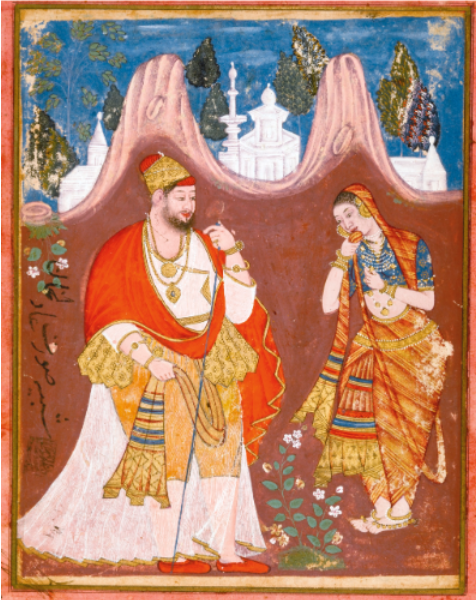
This is a painting of the Bijapuri sultan Adil Shah dated to between 1590-1605, complete with inscription by Jahangir, the Mughal emperor, that attests to the likeness: shabihi surat Adilkhan. The painter himself is nameless, but he is considered among the finest artists from the Deccan, and it has been established that he was responsible for nearly half the illustrations in the Pem Nem manuscript, one of the loveliest (and surely the only complete) books of Sufi couplets extant from the medieval period.

Adil Shah had been forced to marry off his daughter to a son of Akbar, following the Mughal conquest of the neighbouring sultanate of Ahmadnagar, and along with the marriage train went hundreds of manuscripts, the Pem Nem among them. Expectedly, you won't find the Pem Nem in India - rather, it's in the British Library.

There are thirty-four illustrations in the Pem Nem, mostly of ink and watercolour and gold and silver, made by three different artists. These paintings had been done on pieces of paper that were then pasted onto the sheets of the manuscript. It's not entirely clear if these artworks were made at the same time as the manuscript was written.

The author of the book was Hasan Manju Khalji. Interestingly, no other books by him are known. The calligraphy is lovely and clear, but as he wrote masnavi couplets in a Deccani Urdu that contains admixtures from Marathi and local dialect, it is difficult to understand today. The text is a narrative poem in rhyme, describing the Sufi's love of and quest for God.

There is frequent wordplay - shah jal bal bal pal tal mal - monosyllabic words that don't make sense. While these interjections remain obscure, the story is well-understood. A prince named Shah Ji seeks a beloved named Mah Ji; the two had fallen in love with each other when a tortoise shows each of them the other's portrait. It then appears that Mah Ji takes on a yogini's guise to seek her lover, while Shah Ji travels around looking for her. He ends up across the oceans on an island called Sangaldip, which, coincidentally, is ruled by his uncle. He finds Mah Ji as well, but rejects her because for him the real Mah Ji is the image in the portrait, while she is only a reflection. He then takes off to seek the truth. So Mah Ji goes through a period of enduring the agony of love (here the masnavi is combined with the Indian baramasa, songs describing a year of love and pain).

Neither the mysterious tortoise nor the trip across the ocean is illustrated, but Shah Ji's arrival and Mah Ji's baramasa are. There are symbols too - Mah Ji's image appears on Shah Ji's chest, and Mah Ji herself is shown burning up in her love despite an attendant dousing the fires of her passion with water. According to [1], such visual metaphors of longing are exceptional and do not often occur in Indian art.

Eventually Shah Ji returns, the couple get married, and the most lavish illustrations in the book depict the nuptial celebrations.

The overwhelming number of female figures in the illustrations seem to imply that the audience for the book was mainly female as well. The use of the dialect and Deccani Urdu may reinforce this viewpoint as that may have been the vernacular in the Sultan's harem. On the other hand, there was a general emphasis of the feminine in Deccani culture at the time. It is therefore not entirely clear for whom the book was meant.

References

1. Deborah Hutton, "The Pem Nem: A Sixteenth Century Illustrated Romance from Bijapur" in Sultans of the South: Arts of India's Deccan Courts, 1323-1687, (ed.) Navina Najat Haidar, Marika Sardar.

So after weeks of abstention, I dropped by Dark Sugars, a mighty fine chocolatier on Brick Lane. The genial man behind the counter made me a quick hot chocolate and topped it off with a palmful of slivers of dark and brown chocolate. While I stood there salivating, a woman walked in and said she wanted to get a selection of salty caramel chocs.

'Which box shall I put them in?' she said.

'Whichever you like, dear,' said the genial man.'You spend your life trying to convince men they needn't tell you what to do. So don't let me tell you what to do.'

Giggles all around.

*****

I grabbed a salmon beigel and a salami beigel from the Beigel shop. £2.40 for a fine meal.


*****

The reason I went to Brick Lane was not to go to Brick Lane - because, really, Brick Lane is a bit of a sham show, especially its southern end - but rather because I was at the Calvert 22, a gallery of Russian and Eastern European works. This is in Shoreditch, and on my way back to the office, I sauntered down Brick Lane. Calvert 22 were hosting an exhibition of photographs (titled Close and Far) by Prokudin-Gorsky along with works by a bunch of modern photographers. I took a cursory look at the modern works, but spent more time admiring Prokudin-Gorsky.

What a chap. He spent years on the Czar's commission, travelling back and forth and up and down the mighty empire, snapping away at people and buildings and landscapes. Many of these areas haven't been photographed since, and many of the monuments were destroyed in subsequent wars and Communist depredations. He used a colour methodology of his own making, and produced vibrant polychrome pictures that look like they might have been taken yesterday.

The exhibition ends today, August 17, so I dare say most of you will miss it.

Mar 8, 2014

Good Air Houses

In Claudia Piñeiro's A Crack in the Wall, the middle-aged and rather hapless Pablo Simó has a chance to impress a lovely young photographer when she asks him for five of his favourite buildings in Buenos Aires. His first thought, upon waking up, is that there are far too many buildings on his mind.
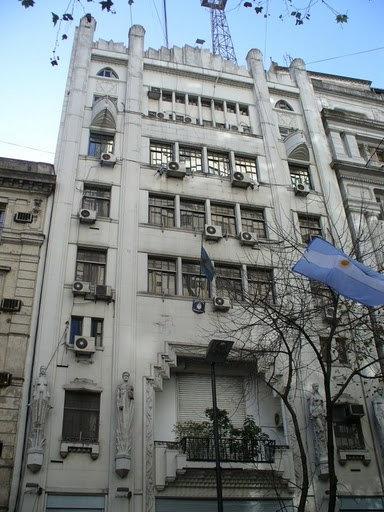
So he crosses out the Kavanagh, the old offices of the Diario Crítica, the Obras Sanitarias building on Avenida Córdoba, the Banco Nación and the Olivetti, facing Plaza San Martín...
Here they are. Very Art Deco, wouldn't you say?

Kavanagh building.

Old offices of the Diario Crítica (those air conditioners sure are unsightly)
Then there's the eclecticism of the Obras Sanitarias building, the headquarters of the Buenos Aires water company:


And a somewhat disappointing neo-Classical National Bank building:

And a run-of-the-mill, to my eye at least, International-style Olivetti building:

Indeed, Simó wanted to be a bit more imaginative than to select the typical. After all, after decades of faithful and staid married life, here was a chance at freshness.
…it's not that they don't deserve to be on his list but that, to different degrees, they are emblematic of this city's architecture, buildings that anyone might choose, and he doesn't want to be anyone.
He chooses Mario Palanti's building on 1900 Avenida Rivadavia, an art-nouveau facade on 2000 (or was it 2100?), and Virginio Colombo's building on the same street at 3200, and two more by Colombo on Hipólito Yrigoyen that faced each other. Then he adds a housing complex on Calle La Rioja; a rationalist building on Alsina and Entre Ríos, and the Liberty at 1300 Paraguay; then, the best balconies in Buenos Aires - Avenida Riobamba, and 3800 Beruti … Then he realises he has more than five, and has to cut back, and eventually ends up with the following list:
Palanti, the art nouveau, the three by Colombo which, by cheating, he counts as one, plus Liberty and the railings: that's five. A sneaky five, but he reckons that's OK.
I'm having a bit of trouble with the Palanti: this Italian architect built the Edificio de los Atlantes at 1916 Avenida Rivadavia - is that the one Simó had in mind? If so:

1916 Avenida Rivadavia, by Mario Palanti.
Here's the Liberty building:


And here are a couple of Virginio Colombo's:

3200 Rivadavia, by Colombo.
Facade of 2562 Hipolito Yrigoyen.
Can't seem to locate those balcony railings, though...

Feb 18, 2014

Chez Estorick

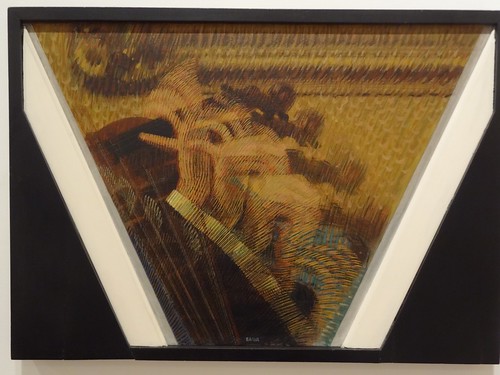
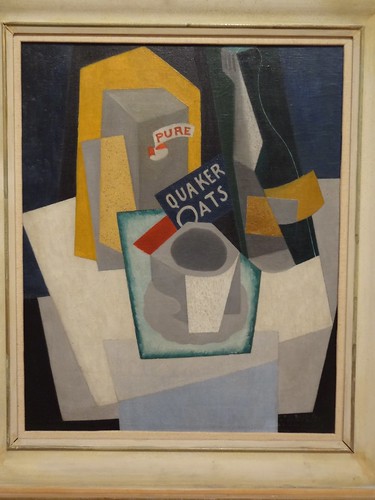
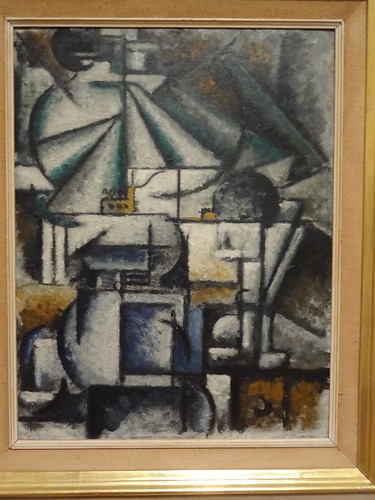
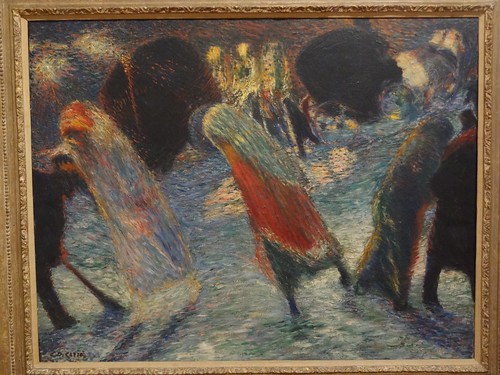
I lived in Islington for years, rambled around Canonbury and Barnsbury, but in all that time didn't venture into the Estorick Collection. Why is that? Well, one answer is that I didn't notice the building. The other is that Italian modern art didn't hold much appeal to me all those years ago. It's only more recently, when I learned about the influence the Futurists had on the Russian avant-garde that I have begun to pay a bit more attention to it.

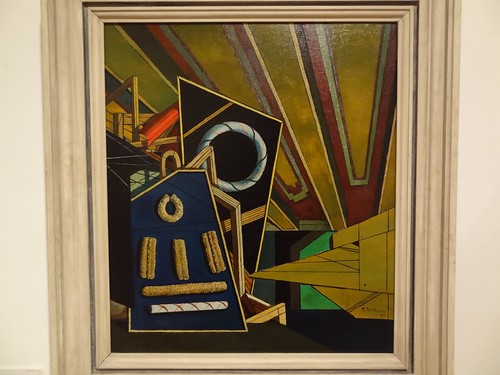
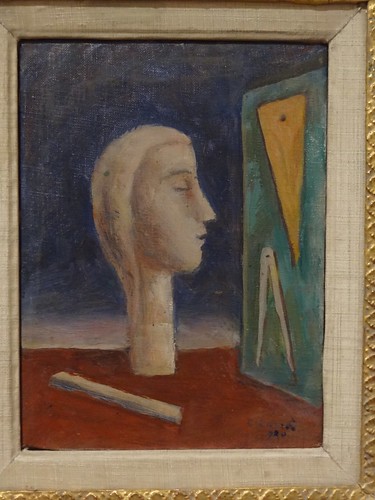
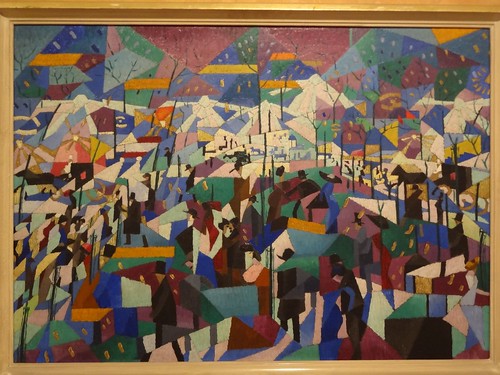
So the other day I ventured back into those old stomping grounds. The museum is on the northern side of Canonbury Square in a Georgian building that was called Northampton Lodge. It has some of the finest works of the Italian moderne in the UK - di Chirico, Boccioni, Sironi, Modigliani and Severini. I took some pictures. A woman at the front desk said I could do so without flash; another woman sitting next to her laughed when she heard my question. Later, when I was leaving, I asked if the displays were rotated frequently. Surely the Estoricks had more than one di Chirico? (It turns out that some of the paintings are replaced every four months or so. But the Estorick is planning a di Chirico exhibition in 2014, so I should be able to catch more of his oeuvre then.) The woman laughed again. 

The Revolt of the Sage, by Giorgio de Chirico. (1916).
The Revolt of the Sage, by Giorgio di Chirico. (1916).

The Engineer's Mistress, by Carlo Carra. (1920/40).

The Boulevard, by Gino Severini. (1910-11).

The Hand of the Violinist, by Giacomo Balla. (1912).

Quaker Oats - Cubist Still Life, by Gino Severini. (1917).

Deconstruction of the Planes of a Lamp, by Ardengo Soffici. (1912-13).

Leaving the Theatre, by Carlo Carra. (1910).

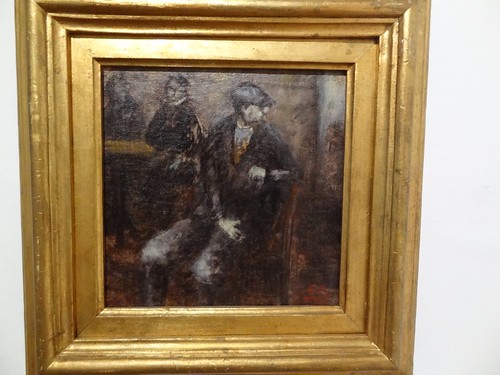
Man Waiting, by Ottone Rosai. (1919).

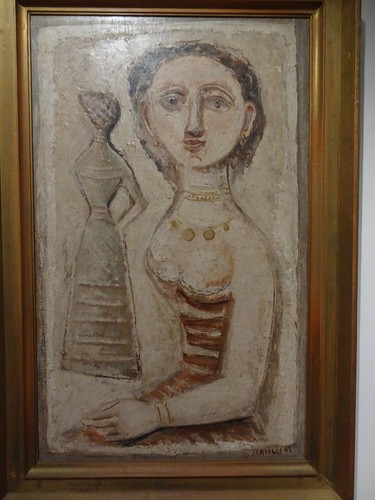
Two Women, by Massimo Campigli. (1943).

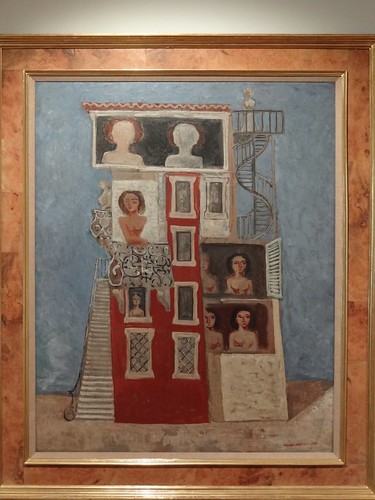
The Belvedere, by Massimo Campigli. (1930).


Feb 12, 2014

Oriya

What do I know of Orissa? Very little, as it turns out. Other than Konarak and Kalinga, I don't recall any coverage at all of this eastern state of India in all my years of education. History and geography, science and mathematics, all have ignored it. In my posts on various aspects of Indian history, too, I have paid it little attention. Time for a small remedy.

In the 1800s, the previously open-minded interactions between the British in India and the Indians were beginning to harden into disdain towards the latter's culture, art, traditions and behaviours. Indian religions were considered primitive, Indian learning was dismissed, and where there once were meetings of the mind, now there was British superciliousness and arrogance.

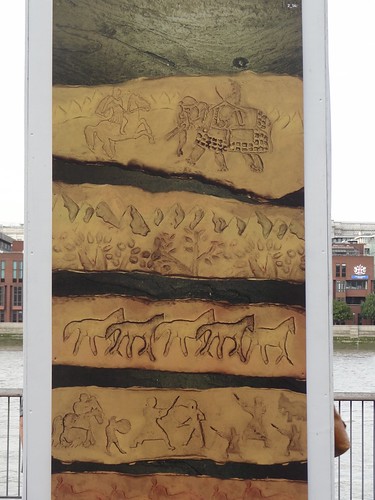
Shiva and Parvati. Oriyan temple sculpture. (13th century AD).
In such a clime, there were a few British men who would try to educate their countrymen about the wonders of the subcontinent. One of them was Charles Stuart, also known as Hindoo Stuart, an East India Company officer who amassed a large collection of Indian art, which is today found in the British Museum. In Stuart's house in Calcutta, he created a gallery which was one of the earliest systematic displays of Indian art aimed at the public. (To be sure, English public - I'm not sure if many Indians attended, despite Stuart's deep fondness for the natives.)

Five hundred years earlier, Orissa was ruled by a Hindu raja. Orissa was a Shaivite state - the God Shiva was supposed to be its lord, and the kingdom was dotted with grandly ornamented Shiva temples. One particularly magnificent sculpture - of Shiva and Parvati - likely stood at the entrance to one of the great temples. It found its way to Stuart and thence to the British Museum.


This was a life-size sculpture, and originally would have been brightly painted. Shiva would have been white, signifying the ash with which the ascetic God adorned himself, with a blue throat, from the poison he swallowed during the churning of the ocean for amrit. Observe the tenderness and devotion between him and his consort - this was no impersonal deity thundering abstinence and damnation upon his followers. Ganesha, their son, appears at the bottom, while figures representing the donor of the sculpture and his wife appear to the left and right of the Gods.
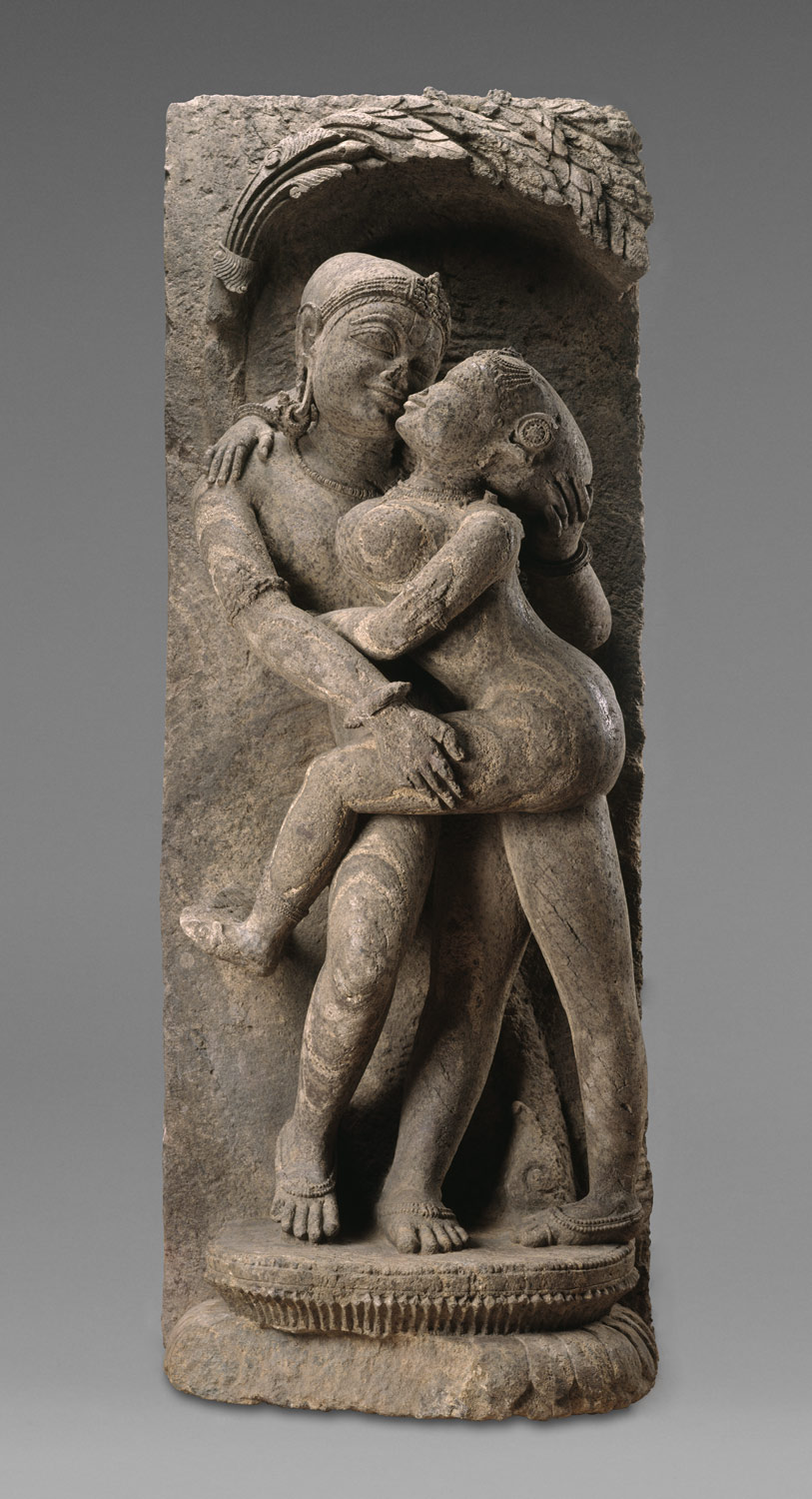
Mithuna, Eastern Ganga dynasty, Orissa. (13th century AD).
Another sculpture of love and devotion can be seen at the Metropolitan Museum of Art in New York. This too dates to the 13th century Orissa. It shows a loving couple (mithuna) and is also of stone, and was part of an Oriyan temple decoration. The kings of the time belonged to the Eastern Ganga dynasty, who had established the superb Sun temple at Konarak. They were allied by descent and marriage to the Cholas of the south and the Chalukyas of the west. By the time these sculptures were created, their kingdom was already in decline. Faced with aggression from the Muslim rulers of Bengal and Delhi, the Gangas slowly fragmented; a defeat by the Vijayanagar empire reduced their importance further. In 1425, a minister usurped power from the last 'mad' king, and the Eastern Gangas came to an end.
Sep 22, 2013

At Pop Tate's Modern

Poor joke, that there title. I wandered about the Tate Modern gallery a bit ago and saw some stuff that can never be unseen. When I recovered my wits, I staggered into adjoining rooms where surrealism and Russian revolutionary posters clashed against constructivism and post-Impressionism and several other -isms that did little to restore my tissues. But there were two (or possibly three) pieces that were quite impressive and had somehow slipped my attention the last time I visited.

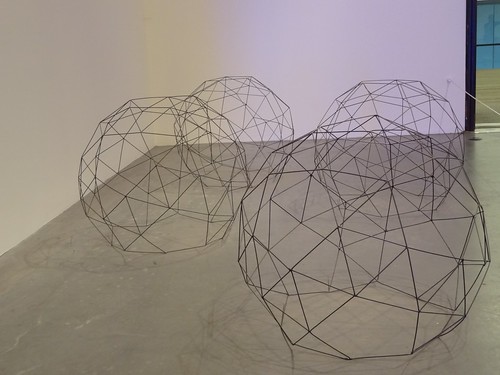
First was geometry dissed by tumbleweed as visualised by the German artist Gego (Gertrud Goldschmidt, 1912-1994). 
Untitled, by Gego (1977).
Untitled, by Gego. (1977).
Gego had a serious problem with idealism, especially that portrayed geometrically. Hence these modular shapes cast about the floor.

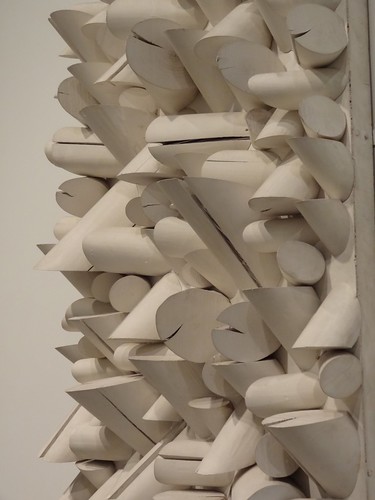
Then I saw this frenzied relief by Sergio Camargo (1930-1990). This Franco-Brazilian sculptor envisaged a synthesis of material roughness and artistic craft by using wood in a relief suggestive of crystal growth. More geometric obsession but with the added dimension of light-and-shadow play. I can tell you little more.
Large Split Relief No. 34/4/74, by Sergio Camargo (1964-65)
Large Split Relief No. 34/4/74, by Sergio Camargo. (1964-65).
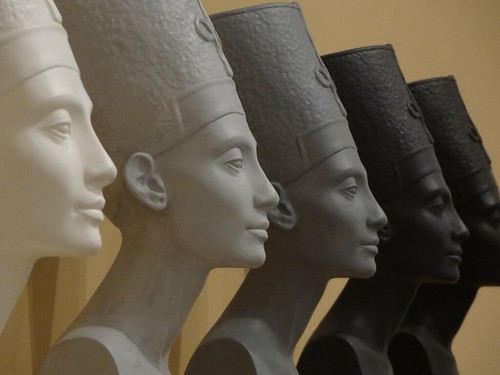
And, lastly, I saw Fred Wilson's exploration of racial identity, appropriation and myth, titled Grey Area (Black Version) (1993). Among African Americans there seems to be a perception that Nefertiti was a Black African queen, although, of course, historians are not as sure. Fred Wilson wanted to point out these obscurities and he did so by reproducing multiple copies of an ancient Egyptian bust of Nefertiti.
Grey Area (Black Version) by Fred Wilson (1993)
Grey Area (Black Version), by Fred Wilson. (1993).
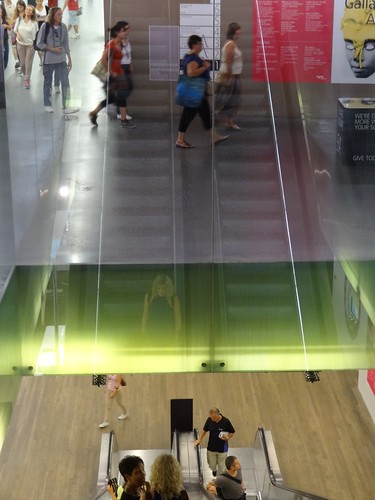
As I was heading down one of the long escalators in the museum, I was struck by a translucent shield that partially reflected the escalators and allowed the people behind it to be seen. When I say 'struck', I don't mean 'struck', but 'struck', don't you know. I call this wonderful piece of dynamic photography Verisimilitude. Observe the interplay between the perpendicular and the transverse, the clean lines of the escalator and the intangibility of the reflection, the acceleration of the women straining to exit the premises and the concentrated communication of the other women. Note as well the juxtaposition of the mythical against the charitable, with the pudding melting off the sightless woman's head onto the donation cabinet beneath. Feel free to be awed and to acclaim. 

Reflections
Verisimilitude, by Fëanor. (2013).

Sep 18, 2013

Watercolour

Watercolour is a remarkably unforgiving medium of art. If you make a mistake, you cannot easily rectify it. With oils, you can paint over, or possibly even erase. Still, in the 19th century, oils were considered the higher art form. Neither the academy nor the cognoscenti gave watercolour the standing it deserved.

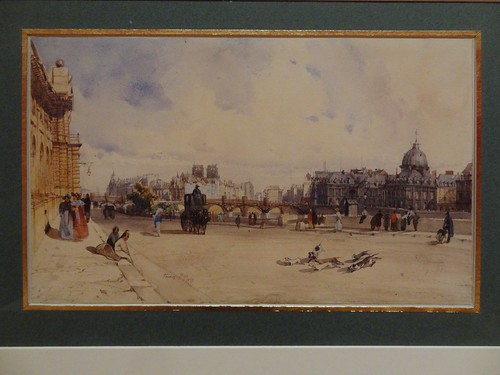
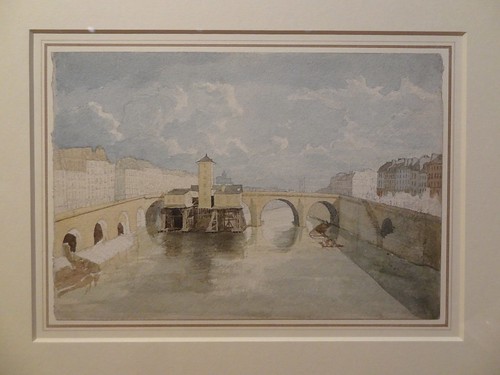
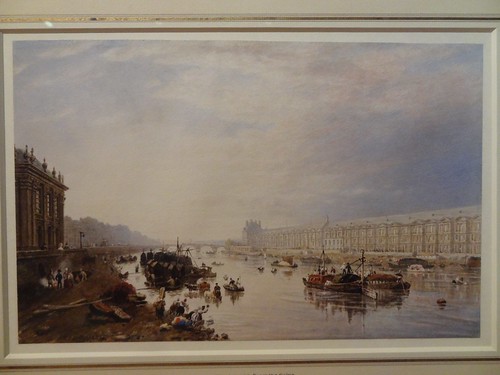
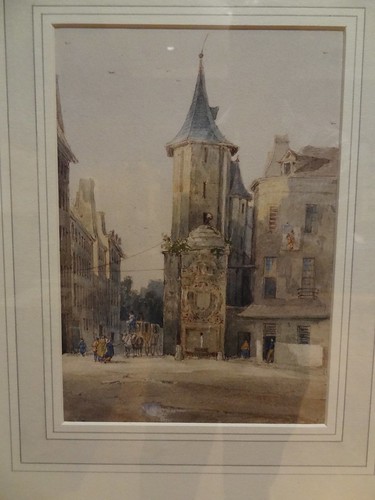
Luckily, this lack of encouragement did not hold the masters back. Entire hordes of British artists got into the habit of using watercolours. When war and time permitted, they would traipse off to lovely parts of Europe to paint. In the early 19th century, a bevy of them headed to Paris. Much of their work can be seen at the Wallace Collection's The Discovery of Paris - Watercolours by Early 19th Century British Artists - an exhibition that runs till September 15, 2013.

I was there the other day. The artworks were displayed in two not-too-large rooms. Many were by painters I hadn't heard of. I am glad indeed to be introduced to them.

The British didn't quite take to Paris. For them, when they weren't mooning over London, Venice was still the cynosure of cityscape. In France, the British appeared even to prefer Rouen to Paris. Although they appreciated the light and the architecture of Paris, and they admired it as a city of pleasure, they disdained its filth and open gutters. For most British painters of Paris, the city was the source of only a small fraction of their outputs.

For Thomas Shotter Boys (1803-74), Paris was of signal importance. He was great friends with Richard Parkes Bonington (1802-28), and they often painted vistas from similar viewpoints. His painting of the Pont des Arts shown below is, in fact, closely akin to Bonington's own earlier composition.

Louis Francia (1722-1839) was native to Calais, but spent years in England as a master and watercolorist. When he returned to Calais, he taught the likes of Bonington ('[Paris is] this city of mud and dirtiness') and William Wyld. 

Another artist was John Gendall (1789-1865). He was sent by a publisher (Rudolf Ackermann) to prepare watercolours for a book, Picturesque Tour of the Seine, from Paris to the Sea (1821). The work below by Gendall was based on a sketch by Auguste Pugin.

Frederick Nash (1782-1856) was a specialist of architectural views, and he liked to add some verisimilitude by including washerwomen and charcoal burners in some of his paintings. His view of the Seine looking towards the Louvre below was part of a series of illustrations executed for a major book Picturesque Views of the City of Paris and its Environs.

The pieces on display are varied - from the sharply executed precision of some to the diffuse impressions of others. I took some pictures. Take a look!

Untitled
The Pont des Arts from the Quai du Louvre, by Thomas Shotter Boys. (1833).
Untitled
Pont Notre-Dame from the Pont au Change, by John Gendall. (1820-21).
Untitled
The Seine, looking towards the Louvre and the Pont Royal, by Frederick Nash. (1820s).
Untitled
The Fontaine Saint-Victor, by Louis Francia. (1825).
Some of the pictures below were at the exhibition as well, but the images are not mine.
Pont des Arts, by Richard Bonington. (1826).

Saint Severin, by James Holland. (1831). The irregular wall on the right is from his imagination!


Aug 30, 2013

Thames River Festival

In a few days, the Thames River Festival will begin in London. This year, as part of a promotion of the arts, there will be ten or so works by kids from around the world on the theme of rivers (Rivers of the World). When I was in front of the Tate Modern recently, I saw one example of the series:
Untitled
Battle of Hydaspes
Students from the Government Girls' High School, Pind Dadan Khan, Jhelum district, Pakistan, created scenes in clay of the historical battle of Hydaspes between Alexander of Macedon and Porus. These were then cast in plaster and placed one above the other. Ayesha Zulfiqar and Umar Hameed supervised the students.

Jun 1, 2013

Sakuntala

Sakuntala Tapestry, by Sándor Nagy.
Part of the rising nationalism in Europe comprised in the insistence on a glorious past, often identified with great historical civilisations. The Aryans, of course, were a prime candidate for any people seeking an illustrious antecedence. The Hungarians had several models, chief among them Attila the Hun; among the others were the ancient Hindus. And so we have the 1909 tapestry by Sándor Nagy titled Sakuntala, which symbolically combines the Magyar notion of the deer as a holy symbol with that of King Dushyant's chase of the animal that led him to Sakuntala. [1]
Hunting Gentry: Stained glass window - Veszprém Theatre. (1907).

Nagy was quite fixated on deer - he also depicted the beast in a frieze and on stained glass in the Veszprém Theatre, as well as a tapestry of the goddess Ildikó (1908).

Others have been fascinated with Kalidasa' tale of the unfortunate Sakuntala. Nikolai Karamzin, the great Russian historian, translated the tale into his language, claiming that it was a literature for the world. Here he was joining the likes of Goethe, Schelling, Herder, William Jones and de Chézy, in celebrating the great poem. Indeed, Abhijñānaśākuntalam was incredibly popular - nearly 10% of all works translated from Indian literature into Russian between 1792-1965 were of it! [2]

It's not just the Hungarians who were inspired by Sakuntala.  Camille Claudel sculpted the remarkable 'Çacountala' or 'L'Abandon ou Vertumne et Pomone' between 1886 and 1905. It received much attention, and was kept in storage for several years. Claudel, of course, was channelling her own passion for Auguste Rodin. From Çacountala, she made subsequent variations, one of which is this lovely Vertumnus and Pomona:

L'Abandon ou Vertumne et Pomone, by Camille Claudel.

Closer to India, a Nepali artist delicately painted scenes from the play onto a wooden manuscript cover. Below is a small scene from it. This appears to be the only surviving manuscript cover for a purely secular work, and although there were some reservations over the identification of this work with Kalidasa's Sakuntala, a discovery in the 1980s of a mate to this cover completed the identification. [3]

Ink and colour on wood, manuscript cover from Nepal.
In India, Raja Ravi Varma's Sakuntala cycle is well-known. Here is the lady with her friends:

Shakuntala looking back to glimpse Dushyanta, by Raja Ravi Varma.

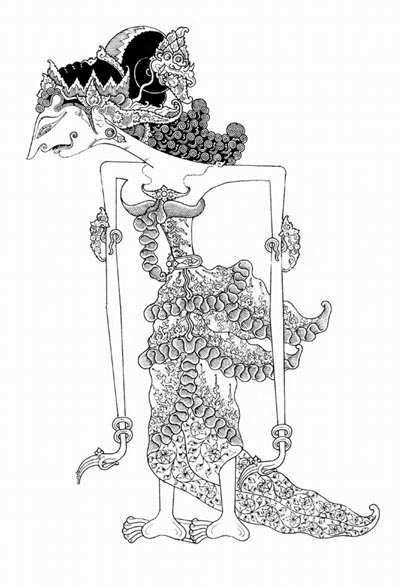
Meanwhile, music and dance saw their own manifestations of the gorgeous Sakuntala. Below is an example of Indonesian wayang (shadow-theatre) which is usually set to music. While there is evidence of indigenous story-telling predating the arrival of Hindu traders in the first century AD, much of the wayang oeuvre consists of tales from the great Hindu epics. Kisah Sakuntala, Ibu Kandung Bharata (or, The Tale of Sakuntala, the mother of Bharata) is one in the repertoire.
Sakuntala (Indonesian wayang)

One of Franz Schubert's operas is Sakontala (1820), an unfinished sketch with libretto by his friend J. P. Neumann. As late as 2000, one writer had written, "[Sakuntala] remains to this day the one and only Schubert stage work of which not one note has been performed for the public, anywhere, ever."[4] (This is not quite correct: a German television programme featuring Mallika Sarabhai's dance company had this music, and there have been some productions as well in the 1970s.)


Between 1913 and 1914, the sufi Hazrat Inayat Khan (1882-1927) visited Russia. He was received with much warmth in artistic circles, and he produced a ballet there titled 'Sakuntala'. The director Alexander Tairov had set up a new theatre; it was his hope to synthesise a multi genre spectacle. Inayat Khan's idea of a mystic balletic performance of Sakuntala appealed to Tairov. The music for the spectacle was arranged by Vladimir Pol. The New Theatre opened the production on 25 December 1914, with the title role played by Alisa Koonen. This wasn't a classical ballet but rather a dance interspersed with dramatic movements. Tairov wanted to present the production to the Czar, which sadly never happened. For a long time the music was thought to have been lost, but in 1991, it was found among various other documents at the Glinka Museum of Musical Culture. Three years later, a quartet of the Russian academy of music performed the piece. [5]


In 1889, Frederick Delius (1862-1935) set poetry by a Dane called Holger Henrik Herholdt Drachmann to music. A Dane! Who would have thunk it? Here's the first stanza of the poem:

Jeg kunde for Længsel ej sove,
En Blomstervind
Slog mig imod,
Strømmed herind ad mit Vindu
Som en vellugtaandende Flod;
Jeg hørte de høje Palmer
Suse svagt
Med sød Musik;
Det hvisked ihvor jeg stod og gik:
  Sakuntala, Sakuntala.

(I could not sleep for longing, a flower wind struck me ... )

It seems Drachmann had seen a staging of Kalidasa's play in Munich, and was struck by the parallels between his own ruined marriage and that of Sakuntala. [6]

Not to be left behind, the Italians got into the act as well. Here's Franco Alfano's 'La leggenda di Sakùntala', first act. He wrote it in 1921.


And that's it for now!

References

1. Jeremy Howard, Art Nouveau: International and National Styles in Europe, Manchester University Press, 1996.
2. Susmita Sundaram, 'Translating India, constructing self' in (ed.) Brian James, Contexts, Subtexts and Pretexts: Literary Translations in Eastern Europe and Russia, John Benjamins Publishing, 2011.
3. (ed.) Martin Lerner, The Flame and the Lotus: Indian and Southeast Asian Art from the Kronos Collections (p. 90), Metropolitan Museum of Art, 1984.
4. Uncle Dave Lewis, 'Franz Schubert: Sakontala', AllMusic.com
5. Cyclowiki, Shakuntala ballets (in Russian).
6. Hattie Anderson, 'Vilhelmine, the Muse of Sakuntala', The Delius Society Journal, Spring 2000, Number 127. (See here for PDF.)

Apr 25, 2013

Maneaters

In my hunt for the art of the erstwhile Russian imperium, I came across the Georgian artist Merab Abramishvili. A painter well-versed and steeped in Oriental mysticism, paganism and medieval Christianity, he created a wide range of works seeking to synthesise their varied wisdoms. One of his very best works is the 2005 canvas called the Maneater of Kumaon. Here it is:

Maneater of Kumaon, by Merab Abramishvili. (2005).
Maneater of Kumaon is an important example of Abramishvili’s preoccupation with mystical beasts. A tiger is set against a meticulous and elaborate exotic garden. Lace-like foliage is painstakingly painted in tempera, yet smudged over with a layer of almost transparent paint, in places creating the effect of a soiled antique mural. The tiger itself appears elongated and delicate like a sublime beast that might have stepped out of an Oriental miniature. Abramishvili’s thin, meticulous brushstrokes carefully outlining the figures turn into smudges and dribbles of paint to produce the overall impression of a mirage. Gazing out into the distance the heroic tiger is so other worldly that the victim at his feet can easily pass unnoticed. Covered with streaks of red, (s)he lies lifeless and forgotten. The subdued violence of this work exemplifies the concealed qualities of the artist’s utopian visions. [1]
The Maneaters of Kumaon, of course, is a well-known book by the big-game hunter turned conservationist Jim Corbett. In a career spanning thirty years he shot several great cats that had taken a taste to human flesh in the foothills of the Himalayas. This was not the only book out of India with 'Maneater' in its title - R. K. Narayanan wrote The Man-Eater of Malgudi in 1961.

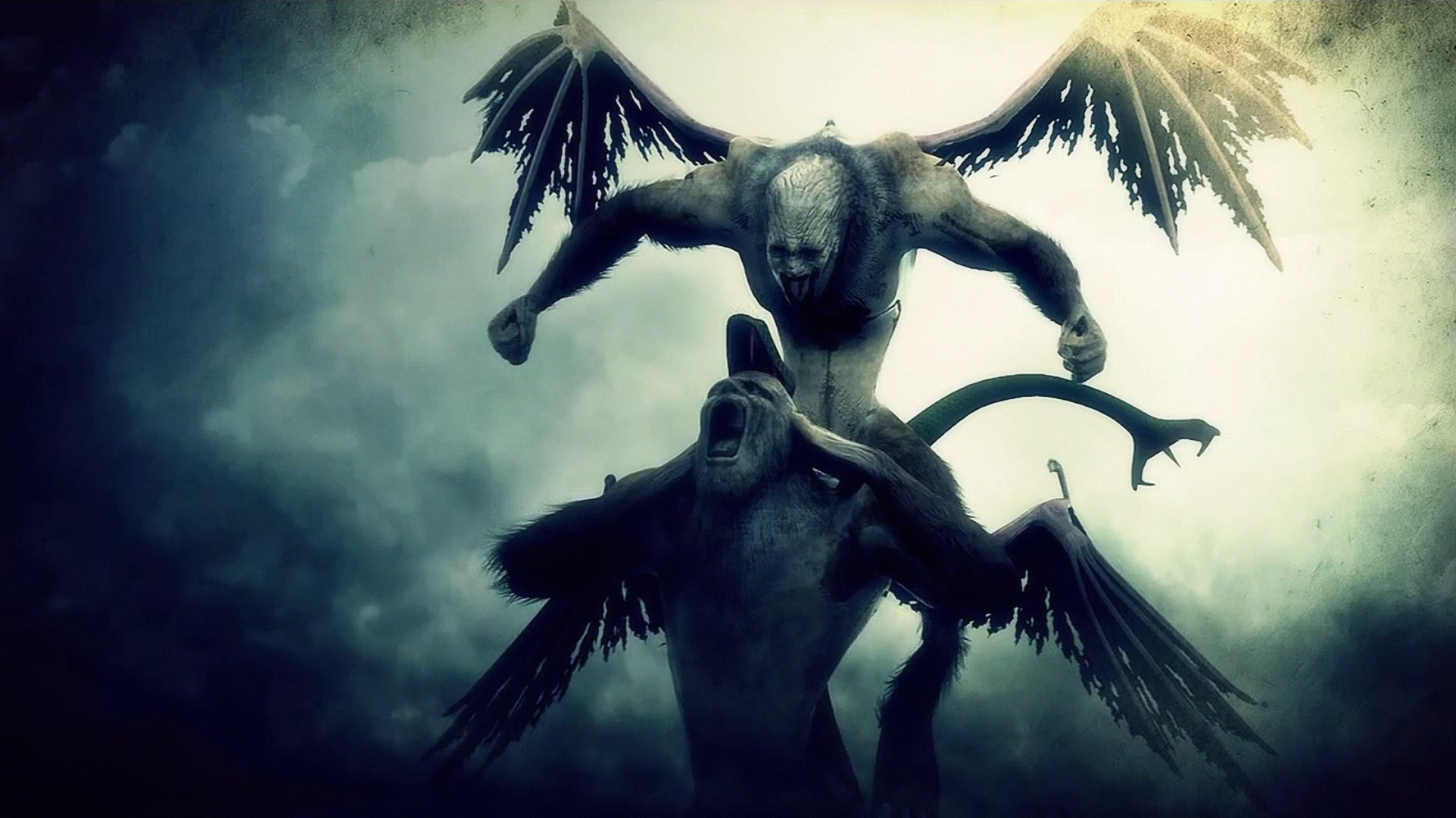
This book, though, has little to do with cats; instead, it is a humorous tale of a printer's woes on account of his acquaintance with a veritable demon of a taxidermist. Demonic man-eaters are a dime a dozen in art, too, especially in the art of gaming fantasy, as for example here:
Who is this by?
A certain A. Hitler was depicted as a demonic maneater in wartime propaganda, as in this English poster (inspired by contemporary Soviet works).

MANEATER

The good thing about propaganda is that it can cut both ways. Here is a Japanese anti-Russian poster by  Hitokui Rokoku (1904), in which the Czar personifies the Russian man-eater with peoples of various nationalities swallowed and struggling in his stomach.

Russia: The Man-Eater, by Hitokui Rokoku. (1904).

At the time it was put down by Japan, Russia, like a devilish man-eater, abused severely people of all countries it had swallowed: [the devil] eats some tendon and starts sneezing, he bites some meat, but starts coughing, he pinches something and becomes itchy, he thrusts somewhere and farts. But in the end he throws up everything he has eaten. [2]

And, speaking again of Japan, Hall and Oates visited in 1982, where they performed their famous song, titled - you guessed it - 'Maneater'. Here they are:


References

  1. 'At the Crossroads: Contemporary Art from the Caucasus & Central Asia', Sotheby's exhibition catalogue notes, March 2013.
  2. Yulia Mikhailova, 'Japan and Russia: Mutual Images, 1904-39'.