In the first few days following the announcement of this edition of the Giant's Shoulders carnival, I received a few articles that appeared to strike off completely from the subject matter of the previous edition. To wit, I hoped that I might be able to do for geophysics what The Primate Diaries had done so ably for Charles Darwin. Over the ensuing days, though, I realised that there would not be such a concentration in one topic as before, and that this carnival would end up being as motley as its readers like to see. And so we have not only geophysics, but also (as we expect) evolutionary theory, palaeontology, quantum physics, astronomy, epidemiology, and a remarkable treasure-trove of resources for the science of food.
 Before Darwin could come up with On The Origin of Species, someone had to rigorously define what a 'species' is. Indeed, before Linnaeus, someone had to come up with a coherent system of biological classification. The man to do both these things was John Ray. The Renaissance Mathematicus discusses Ray's contributions in A Boy From Essex Who Made Good, pointing out that the first definition of 'species' in a strictly biological context was made by Ray, who published a magisterial study of the flora of Cambridgeshire with his student Francis Willughby. Whilst in many an account of the scientific explosion in the 17th and 18th centuries the hat is tipped towards astronomy and physics, The Renaissance Mathematicus insists that this is unfair towards the other sciences, which also advanced greatly during the period. And, he adds, in a fair world in which the history of scientific development were not defined as the history of physics [.] Ray would be acknowledged as standing on a level with Galileo or Newton, and not be regarded as some obscure biologist. [via gg]
 Before he got busy usurping credit for the idea of vaccination, Edward Jenner was a keen ornithologist who took it upon himself to answer a question that had puzzled natural historians since antiquity. The Common Cuckoo had been known to be a nest parasite, that is, it would lay an egg in the nests of birds of other species; when the egg hatched, the chick would be raised by the unwitting hosts. It would be the sole survivor in that nest - all other fledglings and eggs would vanish. Who was responsible for their disappearance? That was the puzzle, and Edward Jenner was responsible for its resolution in a seminal paper published in 1788, as revealed by John in his A Historic Paper on Cuckoo Behavior posted at A DC Birding Blog. John adds that this paper was written long before Origin of Species, and the lack of a concept of natural selection is evident in several passages ... Instead, Jenner refers several times to nature's design, a concept that he does not have much elaboration.
Brian Switek has been notably prolific this past month, and so we have three paleontological contributions from him [all via gg]. First, in The Species that Domesticated Itself, he discusses Louis Leakey's attempt to identify the earliest hominid ancestor and the various blind alleys and tight spots he put himself in when he made hurried claims that this fossil or the other was exactly that ancestor. When in 1959 his wife Mary reconstructed a skull that appeared at once familiar (like an australopithecine) and alien, Leakey insisted that this was a new ancestral species that he dubbed Zinjanthropus. But dating techniques cast doubt on this conclusion. Brian adds: It seems that in Louis' view he and his team discovered our ancestors while everyone else was puttering about with evolutionary dead-ends. Once he had in mind that something was an ancestor, such as Zinj, he forcefully made the case that it was so, even if he had to abandon the very notion he had just popularized.
When a field of study is pursued in completely different ways by two camps of scientists, it shouldn't surprise us that major differences of opinion should arise between them, not only with respect to methodology but also in the conclusions and in the resulting establishment of a foundational theory. In the second of his posts featuring in this carnival, Riding the Bicycle posted at Laelaps, Brian Switek draws our attention to one such schism: geneticists in their laboratories were observing a slow-and-steady pace of evolutionary change, while palaeontologists were demonstrating that evolutionary change occurred in bursts followed by periods of stasis. Brian describes an attempt in 1980 to reconcile these two strands of science that has now come to be known as a palaeobiological synthesis, but laments that in many popular portrayals of evolution the contributions of palaeontology still take a backseat to genetics: thanks for the fossils, but don't worry so much about the theory next time. Authors seem grateful that there are fossils with transitional features to demonstrate the fact of evolution, yet evolution is still often presented as being a uniformitarian march from simple to complex.
 The third piece from Brian is The Witness of the Deluge, in which he reveals how the discovery in 1725 of a supposedly humanoid skeleton was taken as definitive proof for the Biblical flood, and hence as validation by devout Christians of their faith. To the Swiss naturalist Jacob Johann Scheuchzer, the skeleton appeared to have, as Brian writes, a distinctively human appearance. The remains primarily consisted of a backbone and a semicircular skull with two eyes in it, and the fact that the remains of an antediluvian human had been discovered was so astounding that Scheuchzer described it the following year and again in his 1731 work Physica Sacra. He called it Homo diluvii testis, commonly translated as "Man, a witness of the Deluge." But, of course, it was no such thing. We'd like to say that the story proves yet again that it pays to keep one's dogmas out of one's science. But in the 18th century, naturalists were generally in agreement that terrestrial geology had been shaped by Noah's Flood. So why pillory poor Scheuchzer?
 We take this opportunity to segue from palaeontology to geophysics, and what better way to do so than to learn how the California Thrasher led a biologist Joseph Grinnell to his understanding of climate change. In a three-part post at Ecographica, Johnny says that the first post introduces the idea of the 'ecological niche' and then discusses [Grinnell's] papers introducing the concept. The second post (linked at bottom of the first) details his life's work and then transitions to the third and final post in which Grinnell's research is used in modern studies.
What effect do the eccentricities of the Earth's orbit around the Sun have on its climate? I use 'eccentricity' not only in its mathematical meaning, although the elliptical orbit, as is well known, does contribute to seasonal climatic change. But this elliptical orbit rotates such that its axes shift over time; simultaneously, the Earth itself precesses; and, finally, the tilt of its axis away from the perpendicular changes in a long cycle. Together, these effects cause periodic ice-ages over 100,000 years, and these are called Milanković Cycles. The Russian science site Elementy explains the Cycles, and I took the liberty of translating the article into English at Sundry Translations and Other Tangentialia.
Next up, TonyB has a guest-post at Watts Up With That? a discussion of Little Ice Age Thermometers - History and Reliability. He reports on studies that examine the reliability of historic datasets [between 1660 and 1850] as a means for climate researchers to gaze into our past to see if there are any lessons for the present.
Moving onto Fundamental Physics now; we first present Eric Cavalcanti, in Quantum Communications, who tells us all that we need to know about the Einstein-Podolsky-Rosen paradox, non-locality and Bell's Theorem, all pillars of the foundations of quantum mechanics, in his article Can Quantum Mechanical Description of Physical Reality Be Considered Complete? He concludes The answer is still debatable, if what the question is asking is whether or not hidden variables underlying quantum phenomena really exist. But in search of an answer, EPR, Bohm and Bell have unearthed the astounding fact that our classically intuitive descriptions of a reality in which things exist independently of each other, interacting only locally to create the multiplicity of phenomena we experience, is demonstrably untenable.
Speaking of ghostly interactions and ephemerae, Jeremy's Edumacation 101 delves into the wondrous world of the neutrino in What Are Neutrinos And How Are They Detected? He points out that since the particles are electrically neutral and are not affected by strong force, the neutrinos pass through the Earth relatively unaffected. It can be said that during the daytime, solar neutrinos shine down on humanity, but during the night, these neutrinos shine up from underneath! More than fifty trillion solar neutrinos pass through the human body every second. So why are we all not totally fried? Read and find out.
While this is not really a blog-post, I'm inclined to be broadminded this festive season, and so I include a contribution from Surbhi Bhatia that explains the workings of Quantum Computers. She offers A 'Quantum' Leap posted at The Viewspaper.
Next, we have Jennifer Ouellette's Chamber of Secrets posted at Cocktail Party Physics. She points out some lovely art inspired by cloud chambers, delves into the history of these original subatomic particle detectors, and talks of the multifaceted talent of Donald Glaser. This Nobelist not only developed the bubble chamber, but, bored by the increasing automation involved in particle physics, went on to achieve great things in molecular biology and oncology; he later founded one of the earliest biotech companies,correctly foreseeing the explosion in applying the fruits of molecular biology research to industry, particularly medicine and agriculture. And when even that lost its novelty, Glaser moved into neurobiology, specifically studying the human visual system and its perception of motion and depth. Glaser also used photo-analyzing equipment he'd originally developed for his bubble chamber to identify species of bacteria via computer scanning, so he brought a bit of automation to his new field as well.
Let There Be Light! exclaims Brian Koberlein, and presents Fiat Lux posted at Upon Reflection. While the story of Isaac Newton splitting light into its constituent colours is famous, surely not everyone is au courant with all the details. For instance, Newton wasn't the first to split light with a prism. And why did the prism produce the rainbow? Brian points out that in Newton's time it was already well known that light passing through a prism would produce a spectrum of colors. It was generally thought that the color must somehow be contained within the prism glass, and when light passed through a prism it would be tinted various colors. Newton was able to clearly show this was not the case.
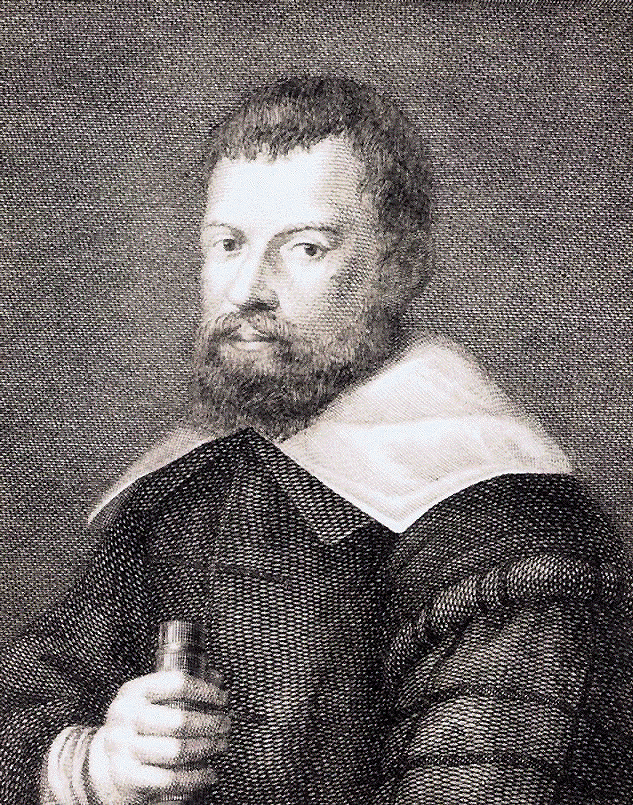 From Physics to Astronomy is not a massive leap, and so we can move right on to Becky Jungbauer's Truth Universally Acknowledged, which features a nice three-part write-up on Galileo, The Medici, and the Age of Astronomy. She begins Galileo Galilei wasn't just an Italian physicist, mathematician, astronomer, philosopher and heresy suspect (not to mention father of modern observational astronomy, modern physics, science, and modern science, that last one he was named by both Hawking and Einstein). He was also a friend of the Medici, the political Italian dynasty whose patronage of scientists and artists led to the Renaissance, and goes on to discuss some of the instruments that Galileo designed and developed, and sets his scientific achievements in the context of European culture in the 16th and 17th centuries.
What does a scientist do when he finds out that one of his best ideas has been independently obtained (and promoted) by another, far more famous, scientist? Dejection and frustration might prompt him to abandon his work. Or he could do as Ewan Cameron did when he found out that Linus Pauling also had the idea that Vitamin C could be help ameliorate the ravages of cancer. In spcoll's Pauling Blog we read the story of this fine researcher, who in later years recalled: Just as the idea evolved, I learned that Professor Linus Pauling had stated that vitamin C might be helpful for cancer patients. My first reaction was one of dismay, even defeat, but such a feeling did not last very long. I wrote immediately to Dr. Pauling and we have been close collaborators ever since.
Continuing to speak of disease: PalMD presents Captain of the Men of Death posted at White Coat Underground. This is a brief roundup of the history of the pneumococcus bacterium, which was known to live harmlessly in the nose and throat and only sometimes causes disease. Pneumoccocal disease was and is still a leading cause of disease and death, killing perhaps a million children per year. It causes ear and sinus infections, but also meningitis, and is the most common cause of pneumonia. In the past it was referred to as "the captain of the men of death" for its ability to claim so many.
Next up, folks, we have Greg Laden offering a comparative study on the dissonance in our minds when we encounter not-so-perfect copies of ourselves in Perfect Strangers at SEED Magazine.
And lastly, if you've ever wondered why it's better to whisk eggs in copper bowls and why milk is the best drink to kill spice, Gracie Turner is your portal to all the answers you seek in food chemistry. She presents 100 Great Videos to Learn About Food Science posted at Online Courses.org.
 To conclude, I must point out that - for a limited time only! - the Royal Society (as you have all heard, I'm sure) has made freely available sixty classic papers from its Philosophical Transactions. This is part of the celebrations to commemorate its 350 years at the pinnacle of scientific endeavour. Check out the Trailblazing site, and note that at least one of the blogs in this carnival has been directly inspired by a 'classic' paper. A hat tip to the first person to identify the blog.
Please submit your blog article to the next edition of the giant's shoulders using the carnival submission form. Past posts and future hosts can be found on the blog carnival index page.
Thanks for all the contributions, folks. Happy Christmas, one and all, and a very Merry New Year!


