Keen-eyed readers may have observed that the ninth month of roundups of translated crime fiction never appeared in these pages. The same readers may have then shrugged and moved on with their lives. A recent holiday interfered with the sequence of posts, so I'm combining two months' worth here. Camomile Street library has come up trumps with several of my books on order, and we have a bit of variety this time around.
I may be going out on a limb when I say that the development of popular literature generally follows the same pattern around the world. As a society becomes literate, readers will prefer light material - novellas and pulp, generally involving thrills or spills and sex and romance. Penny dreadfuls take off, often competing for attention by means of lurid covers and suggestive blurbs - not just because it doesn't require intense concentration to appreciate, but also because it is invariably cheaper than middle-class literature. The occasional pulp author will then transcend the genre and establish himself or herself with critical acclaim and gradually move up-market. The readership often will follow this author and introduce itself to other, more literary works. Meanwhile newly literate people continue to fill the voids left behind by this upward mobility and eagerly embrace the canon of pulp.
How's that for a thesis? I mentioned penny dreadfuls, but I should probably also include other gems of the canon, such as those anthologised in the The Blaft Anthology of Tamil Pulp Fiction (selected and translated by Pritham Chakravarthy), and those lovingly referred to in Patricia Melo's In Praise of Lies
 . Both Brazil and India are roughly at the same level of economic development as far as the vast majority of people are concerned, and both countries have an enormous thirst for light reading and sensationalism. (One can see this in the wide reach of daytime soap operas on television in both countries.) The English translation of the original Tamil stories serves to include a more middle-class audience for what is essentially vernacular fiction; likewise Patricia Melo discusses the popularity of Brazilian noir among the socially downtrodden, and the cut-throat competition to serve it.
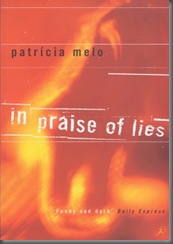 Now Melo does not address the consumers of the cheap literature; rather, she prefers to poke fun at the industry that supplies it. So we have Jose Gruber, a hack who copies the plots from greats of world literature and passes on the texts to a publisher who is unaware of Dickens and Dostoevsky; the readership doesn't know or care either. Jose falls in with a herpetologist, Melissa, who, unaware of his inspiration, believes that his is a fertile imagination. She then involves him in concocting clever plots of kill her husband, who she claims abuses her, and Jose is such a moral and physical coward that he ends up helping her. The stress results in his literary career stalling, with the publisher rejecting proposal after proposal (which lengthen in proportion to his desperation) as unworkable and uninteresting. The noirish aspects of the novel might have served to keep the plot ticking, but Melo is dissatisfied with satirising only the pulp industry and she switches her target to the self-help books that also attract a wide readership in Brazil. Between the crime committed and the unravelling of Melissa's and Jose's relationship, and his sudden success as a hack self-help author, there are suddenly too many threads in the novel, and it all gets increasingly inchoate. While the book started funny and clever, it appears as if Melo loses the plot herself as she goes along, and it ends up trying my patience.
 The Blaft book is an uneven collection as well. There are two or three absolute sparklers, but the rest are somewhat pedestrian and obvious. I loved the brilliant wit and repartee of Pattukotai Prabakaran’s ‘Sweetheart, Please Die’ and the innuendo and bonhomie of Subha’s ‘Hurricane Vaij’, which were possibly the best stories in the book. Some of the stories are overtly preachy – offering a defence of a woman’s sexual rights, say, or urging honesty in a politician – and some involve mad scientists and that old favourite of Indian films, reincarnation and revenge. I guess this is not surprising: they must appeal to the lowest denominator, and so become obvious and forced. Still, it’s heartening to see that the remarkably prodigious authors of the stories (some of whom have written thousands of tales and novellas) are often capable of superb and sophisticated imagination, refusing to pander to the base, and, fortunately for us, Pritham Chakravarthy has located several gems of the genre, and published them here.
 Being obvious is possibly the worst comment a reader can make on a crime novel, but what is obvious to one person may be opaque to another. In Tefcros Michaelides's Pythagorean Crimes
 , the twist at the end depends for its surprise entirely on whether the reader knows the history of mathematics or not. The plot is rather straightforward - a Greek mathematician is found murdered and his best friend (the narrator) looks back on his career, hoping to find clues to his death in his past. The description of this past is possibly the weakest part of the book: Michaelides evidently believes that describing the excitement and fervour of early 20th century mathematics is insufficient to drive the book forward, so he throws in a long section on the development of modern art in the back alleys of Paris, introducing Picasso and his coterie, and claiming that Picasso's art was much informed by his own fascination for the foundations of logic. The plot hinges on an important question on the underlying consistency of mathematics, but surely it defies logic that the resolution to this question should verily be a life-and-death matter?
 It's not often one hears of crime fiction from Africa that is written in a non-native language, although now that Afrikaans has been spoken in South Africa for close to 300 years, perhaps it is as native a tongue as any other. Deon Meyer is a successful author of thrillers set in that country, and he uses the medium to explore several unsavoury aspects of South African history. The nexus between the apartheid regime and the vastly influential military-industrial complex is reasonably well-known; what is perhaps less known is its constant interference in the affairs of neighbouring countries, either on the pretext of containing Communism, or to co-opt corrupt Black leaders of those countries. The story in Blood Safari
 is, as far as thrillers go, fairly faithful to the genre: a rich young woman thinks she has seen her long-dead brother on TV, her house is firebombed, she buys the services of a top-notch bodyguard (named Lemmer) who helps her in her search for her brother. Of course, the enemies are many and vicious, and when both get injured in an attack, Lemmer decides to go on the offensive himself. He is a man with a short fuse and can be indescribably vicious himself, so when the villains meet their comeuppance, they don't go gently into the unknown. Meyer throws in social commentary on present-day South Africa as well.
  There is corruption at higher levels that thwarts honest policemen, there are social schisms between the Afrikaners and the English-speakers; there is suspicion at every level between the blacks and whites; and there are tensions between the various nations of blacks, too, as they scramble for economic advancement and funding from an impoverished state. Underlying this all is a passionate cry to save Africa's wildlife as well, not just the popular creatures of tourist imagination, but also birds such as vultures that are held in such distaste by everyone.
Véronique Ovaldé's Kick the Animal Out is a narrative from the viewpoint of a mentally-unbalanced girl desperate to locate her mother. This is an exploration of the lush mindscape of the fifteen year-old Rose who adores her mother and is baffled and upset by her father's seeming lack of anxiety when her mother vanishes. She seeks answers in her mother's past, uncovering details of old loves and past crimes. This is a slim book set in a sunny coast of France completely at odds with Rose's anguish, and it drags the reader into her world of 'immeasurable loss' more surely and heartbreakingly than weightier tomes by less assured writers. Well worth a read.
 One of the great canards of medieval life that have been promoted to outraged titillation in the world of entertainment is the putative droit du seigneur, the right of a feudal lord to bed the wives of his serfs on their wedding night. There is almost no evidence that such a right ever existed in law, though it is undeniable that serfs were abused and their wives very likely forced into granting sexual favours. Still, this is a favourite trope among writers of historical fiction (equally, directors of films set in the Middle Ages), and Ildefonso Falcones in his Cathedral of the Sea
 proves no different. Perhaps, though, we should believe Falcones - he is, after all, a lawyer himself, and he quotes Catalan legal documents (the Usatges) that purport to grant such rights. The novel, a sweeping history of the construction of the magnificent Cathedral of Santa María del Mar by indigent labourers as an act of love and devotion, starts with the violation of a woman on the night of her wedding. The story then follows the fortunes of the woman's husband, and then their son, against the background of the rise of Barcelona's maritime power. It is a gripping tale, incorporating miracles, internecine feuds, pogroms against Jews, naval battles, detailed explanations of construction techniques, sex and strife between diabolically devious women and inhumanly good men, envy between brothers, religious schisms, class struggles, and, if all this were not enough, the Inquisition. I'm well pleased with this, especially because there was nary a mention of the Templars.
 Friedrich Dürrenmatt's The Pledge
 is a tale of the fall of a brilliant Swiss detective. The denouement is somewhat pat, but the analysis of the detective's psyche is very good. A little girl is savagely murdered and the detective makes a promise to her mother that he will find the killer. When a suspect is arrested and he subsequently commits suicide, everybody is satisfied that the case is closed, even the victim's parents. But the detective is not convinced, and against all evidence and in the face of his superiors' disapproval, he lays an intricate trap to catch the killer. He is so obsessed with this plan that he doesn't mind sacrificing everything he has - his reputation, his relationships, even his 'adopted' family - to fulfil his pledge. The plan fails and he loses his mind, and when the explanation arrives (a bit contrived and convenient), it is far too late to save the detective. This is a small book, a quick but agonising read, and well worth for its insight into the extremes of human nature.
 Gianluca Morozzi has written a neat claustrophobic thriller set in the elevator of a residential building. In Blackout
 , three individuals, strangers to each other, enter the lift. Shortly thereafter, the power goes out and the trio is trapped between floors. Their back-stories are filled in between chapters that describe the continuously rising paranoia and terror within the cramped quarters of the lift. I’m not giving anything away when I say that one of the three is vicious serial killer, and his is the only background that is really relevant to the story. The other two could have been pilots or scuba-divers for all their lives had any consequence up to the point they are trapped. So far, so good. True to the genre, the innocents have to escape. How though? And is that all to the story? This is where Morozzi cranks up the unlikeliness factor, and the story – to my mind – degenerates to droll fantasy. It is written in that arch, self-consciously-talking-to-the-reader fashion that might grate on some; the staccato sentences might alienate others, but it is a thin book, trying a bit to be too clever, and will serve as a decent page-turner on a short trip to work.
 Arch and knowing books are, thankfully, not a dime a dozen, but Jef Geeraerts’s Public Prosecutor, The
 is another such. Geeraerts doesn’t have much time for organised religion, I gather from this fable, or for money-grubbing men or women, most of whom end up perishing in some gruesome fashion or the other. The protagonist of this parody of the paranoid thriller genre is the Public Prosecutor of Antwerp, a man who owes his position to his wife’s noble family. He leads the usual life of an alpha male – he has a beautiful young mistress; his wealth does not stop him from seeking more; and, of course, he detests his wife, and hardly has any time for his sons. The wife is a deeply religious Catholic who wants one of her sons to enter Opus Dei, the usual villain in books involving religious skullduggery, and to that end is willing to sacrifice everything, including her husband. There are other unsavoury Opus Dei operatives with connections at the highest reaches of power – both financial and administrative – and there are sundry criminals out for revenge. None of the characters has any redeeming qualities but the Prosecutor, harried and hassled, ends up being strangely sympathetic. This is so earnest a book I cannot imagine Geeraerts wasn’t grinning ironically all the while he was writing it; good fun.
 And the humour continues in the latest caper from Latin America that I’ve read: the Uruguayan-Cuban author Daniel Chavarría’s Adios Muchachos
 is a rollicking dissection of Cuban life, where years of Communism have only served to drive the capitalist fervour of the masses to feverish pitch and materialism rules above all. Unlike the corruption and drug-addled misery limned in Leonardo Padura’s Havana series, Chavarría’s book is far too good-humoured. It is also a sexy romp with the pneumatic bottom of the wondrously bright and beautiful Alicia running riot, trying to ensnare rich foreigners who might then take her away to their own rich lands where she could lead a life of luxury. Her modus operandi is to ride her bike, wiggling her alluring bottom to attract a rich man in a fancy car, and then falling spectacularly before the sucker, prompting him to come to her rescue. Her mother aids and abets her schemes, providing fancy food and culture to the man, causing him to get more and more besotted by Alicia. Unfortunately, Alicia then falls in with a Canadian ex-con whom she mistakes for her latest wealthy conquest. He is leading a double-life himself, trying to persuade a multinational corporation to fund marine archaeology (to make money out of selling salvaged treasure) while also hiding his less than salubrious past from his employers. An accidental death sparks panic in Alicia and Victor, but also hands them possibility to make large amounts of money, and at this point, Chavarría’s grip over the plot begins to loosen, and confusion takes over. In the classic manoeuvre of the author who’s lost interest in the proceedings, there’s a final roundup of what happens in the subsequent lives of the various characters. I’ve often wondered what purpose such a roundup serves: it’s as though the story somehow were unable to close by itself, and so an artificial conclusion
  is forced on the reader. Dissatisfying, surely?
And, to round off this roundup, we have Jean-Christophe Grangé’s The Empire of the Wolves , as harrowingly graphic as any lesbian crime author’s work (as Ian Rankin once pointed out to much controversy). A secret right-wing Turkish sect is busy butchering its way through the textile-worker community in Paris (all trafficked women from Turkey). The wife of a senior bureaucrat is having violent flashbacks that lead her towards paranoia and breakdown. The policeman investigating the serial killings is forced to rope in a retired colleague, a man who has been well-known for his efficiency in keeping crime down in the Turkish quarter in the past (and notorious for his corruption and brutality). The two of them determine that political schisms in Turkey and the spread of transnational criminal gangs led as much by ideology as mere lucre are the cause of the murders in Paris. Naturally, the killers are in search of one particular person, and it’s not difficult to discern early on who this person might be. After all, there are only two supposedly disparate strands in this novel, and so they have to connect at some point. The denouement is, once again, in classic mode: in the end there are two people out to get each other, there’s some grandiose recrimination, and an obvious conclusion. This novel, I thought, was a bit over the top; for a much more satisfying experience, check out Dominique Manotti’s Rough Trade (Eurocrime Series)
 , which is taut, gripping and eminently true to life.