JOST A MON

The idle ramblings of a Jack of some trades, Master of none

Nov 16, 2009

55 Broadway

What is the result of one of the most successful rebrands in design history? What made London Transport so easy to use, so cherished by the millions of commuters who travel by it? Where does Art Deco come into this story? In a recent programme on BBC Four titled Art Deco Icons, David Heathcote investigates the history of the famous London Underground, its logo and route map, its trains and stations, and talks about the wondrous building that is at its heart: the headquarters of this organisation atop St James’s Park station. 55 Broadway. This is a paraphrased transcript of the show.

HQ bw In 1929, the building that stands here would have been the nearest experience for a Londoner to an American skyscraper. The Underground arrived directly beneath the building, and one could come the stairs and turn directly into the offices of London Transport. There were shops at this level, multiple exits out of the station; there is wonderful Art Deco detailing, classical columns in travertine marble; a big entrance hall protecting one from the elements; a clock with a jazz sunburst behind it right above the doors leading into the offices; the whole thing screamed modernity, sophistication, technical excellence.

control Entering the office lobby, the bustle of the entrance hall dies away, and one is filled with a sense of purpose, of control.  On the wall are machines that tell the viewer to position of every train in the system, and the intervals between the trains. But that’s not all they do – they also give the illusion that the building is quietly, efficiently and solidly organising the transport of London. This is where it’s all made apparent, the language of control.

The walls are of travertine marble, with the grain of the stone leading sideways, providing a sense of flow; they look like rivers frozen in stone. And this motion is, of course, what this building is all about.

After the First World War, the many companies that ran the various lines of the Underground network were amalgamated into one structure. By the 1920s, the Underground Group organised Britain’s first truly modern transport system – not just trains, but also buses, and combining as well the design and engineering and technology and branding. The hub of the system was its new Art Deco headquarters at 55 Broadway in the heart of Westminster.

lift In the lift lobby of the building, a lovely space, is a really American, compressed version of the spaces one associates with the skyscrapers of Chicago and New York. In particular, reminiscent of the Empire State Building is the vertical display that tells one where the lifts are. It may only go up to ten floors, but the up-thrust and narrowness suggests a rapid climb, a tower block of great height. The lift lobby has other design touches – bursts on the wall rendered in bronze, indirect lighting via inverted hemispherical shades – all suggestive of that same modernity. By the time one arrives at this lobby, one has already passed through much of the ground floor of the building, the shops and the transport and the arcade: everything is indoors, an entire block.

55 Broadway was big, bold, modern, and much of the pleasure was in the Deco detail. Even the little-visited parts of it are lovely. The use of the travertine marble suggests vast indoor spaces, flat and neutral; but the plainness is brought to life by highlights such as the bronze balustrade along the stairs, shined up to gleam like gold, with an oft-used Art Deco sunburst motif whose rays propel one up and away. Further up the stairs, the marble gives way to tile, a square tessellation that offers hygiene, brightness, freshness and airiness.

Charles Holden The building was designed by the architect Charles Holden. He was influenced by American skyscrapers, and the Paris Exposition of 1925, the birthplace of Art Deco. His intention was to create a modern, functional building that provided a bright and light working environment focusing on the needs of the people who would use it. Among the ideas he brought in from America was the mail system – chutes through which mail could be dropped for collection and dispatch from the lower levels. mailchute Indeed, one can still see the labelling plaque: Cutler Mailing System, Cutler-Mail-Chute-Co. Rochester, NY, USA; and the language in the building suggests ‘We are American, we are efficient.’ America at the time was synonymous with the future, and much of the no-nonsense aura of efficiency was no doubt provided by the electric clocks everywhere.Paris Exposition 1925

Although 55 Broadway was Holden’s vision, it was the brainchild of the new Underground Group’s managing director, Frank Pick. These two men were pivotal in the development of London Transport. Together, they undertook a massive modernisation of all the assets of the organisation to make it fit for the 20th century.

Frank Pick Pick was a managing whiz, and while he could not do design, he knew exactly which people to bring in to sort out the buildings, the rolling stock, the textiles. A rarity among accountants, he kept abreast of the latest in European trends in art and architecture, he knew all the modernists, and was able to fuse their ideas with a kind of English modernity, which was almost medieval in its attention to detail and love of craft. Meanwhile, Holden designed and built many of the stations on the Piccadilly and Northern lines, working flat out from 1922 to the beginning of the Second World War.

Pick and Holden were very close associates, so close that they occasionally fell out. Indeed, once Pick threatened to sack Holden when he found out that the latter had given the design commission for Hampstead station to one of his junior architects. The problem was that this was Pick’s home station, and naturally he wanted the senior man to do it up as well as he could…

Roof Garden atop 55 Broadway The posh floor was the tenth, the topmost. The executive dining room is on it; the ceilings are twice the height of other floors, and there is a managerial roof garden! And as a tall building, 55 Broadway offered a reframing of not just offices and transport, but also luxury: height, being above everyone else, was almost the definition of luxury. Standing here in 1929, Pick and Holden could see that they had built a monument to the centrality of London’s transport: they were easily storeys above any other building in the district, and had splendid views across the metropolis.

When completed, this was a glittering white monolith, taller than anything else in London, a testament to the ambition and drive of the new organisation. It was modern and primitive at the same time and very American. Art Deco, of course, drew much inspiration from the primitivism of ancient cultures. Most obviously, the structure of 55 Broadway is reminiscent of a Babylonian ziggurat; equally, however, its situation on an entire block, squatting between streets, was a consequence of a design dynamic that originated in the USA in the 1880s, when the first skyscrapers were put up. 55 Broadway, then, is not a relic of Victorian, Dickensian Britain; it is the vanguard of a new, futuristic Britain. buildingview1buildingview2 buildingview3

Portland stone, the material of choice for British architects, lying somewhat between limestone and marble, and used extensively in 55 Broadway, epitomises the country, redolent of the White Cliffs of Dover, but also stuffed with fossils, and thus it combines ancientness and modernity. It is clean, modern, but suffused with the sediment of old Britain squashed into lumps of stone, and ideal for a headquarters: nothing says ‘stability’ and ‘forever-ness’ like this stone.buildingview4sculpture1sculpture2  

Holden intended the building as a new Temple of the Winds. Aware that it was likely to shock, he commissioned works by avant-garde sculptors like Henry Moore and Eric Gill to adorn each elevation. He chose Jacob Epstein, one of the most controversial artists of the time, to create two works, called Night and Day. It was a bold choice.  Jacob Epstein's Day

The one called Day, when it was put up, caused great offence, great scandal, because the penis of the boy clinging to his father was an extra inch-and-a-half longer, with the result that when the rain ran down it, water cascaded off its tip and onto the street. So an inch-and-a-half had to come off. sculpture4

The primitivism of the sculpture represents the power of electricity. Both modernism and primitivism talked about huge, uncontrolled forces. Electricity was akin to the puissance of ancient gods; in Epstein’s Day, the ancient, primitive god is sending his son off to his job in the world. Likewise, the Underground becomes the manifestation of a powerful heavy primitive god.

posters1 Crucially, Frank Pick understood the value of good design, and that the look of London Transport was its personality. He began the process of modernisation by commissioning painters for posters that would encourage commuters to use the system in their leisure time. In the 1920s, bright, colourful Art Deco designs produced by the best artists of the day were always given pride of place in the Tube stations. Pick understood just how persuasive they could be in persuading the public that this was a modern, forward-looking transport system.posters2 posters3 

In the London Transport Museum are over 20,000 posters from the various lives of the network. Those chosen by Pick from 55 Broadway were pivotal in the development of the Underground. Clive Gardiner was an example of an avant-garde artist employing some of the contemporary cubist ideas that struck a chord in the travelling public; another was Jean Dupas, who, like Gardiner, worked in his own style, and achieved much acclaim. The idea was to promote off-peak travel among Londoners; some of the posters targeted women, suggesting they were modern and independent and fashionable and could take in the city on a day out. The posters were placed inside the exits of stations so that people could see them on their way home: perhaps a glimmer of an idea of what to do on the weekend might then dawn in their minds. posters4
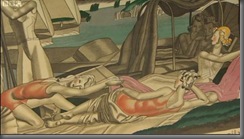
The posters were the starting point of one of the most radical redesign projects ever undertaken by a single company. Pick and Holden were able to do this because Art Deco is a total style, appropriate for all the company’s assets, from its headquarters on 55 Broadway to the smallest fittings on its station platforms, and so too the trains that ran on its tracks. rolling stock 1938One of the first trains that had all its running gears underneath it was the 1938 Rolling Stock which remained in use till the 1980s. It was styled in an Art Deco way, with Art Deco lampshades (called ‘shovel shades’ by workers on the LU), and the red-and-green seating fabric (called moquette) designed by the foremost textile designers of the day, people like Edith Marx and Marion Dorn; the overall effect of comfort and spaciousness that enticed passengers. passimeterFrank Pick had an idea of ‘fitness for purpose’, and these trains achieved much of that goal: technically better than the prior generation of trains, more comfortable, much more easy to use. Indeed, Pick, despite being extraordinarily busy at the upper levels of the administration, still took an afternoon off every week to go over the samples and design ideas that were being proposed by his commissions, and personally signed off the ones he felt were the best. That level of total control brought a sense of order to what used to be a disparate system in the decades before, and reassured passengers that they were getting a consistent service.

Other aspects of the total design overhaul were the kiosks for cigarettes and newspapers that used to be placed within the stations; the passimeter, the ticket dispenser and passenger counting booth; and, of course, the signage and plaques for information. The earlier signs were difficult to read, cramped texts in multiple fonts, very Victorian.old signage

Pick commissioned Edward Johnston, one of the leading calligraphers of the day, to design a new Underground font, a uniform typeface that enabled clear and unambiguous signage, including the roundel logo, all surrounded by much white space. new signage

During the 1920s and 30s, the Tube network pushed further and further out of dirty and crowded central London to new and leafy suburbs. It was Charles Holden who oversaw the design of new stations, which became increasingly radical for suburban London. As a result, London Transport’s stations number more listed buildings than any other public body in Britain. holden station design

Southgate is one of Holden’s stations on the Piccadilly Line. It was opened in 1933, and was considered one of his most dazzling creations. It had escalators, which were possibly the most modern thing the passengers had seen; the escalator tunnel was warm-lit, spacious and welcoming, taking the passengers up to the light; at the top, arriving at the main hall, one would see the relief-panel on the ceiling, like water radiating out after a drop falls in it. Of course, one is now en route home, after a long grimy day at work, and this was a wondrous welcome back. modernism southgate station

It is easy to be jaded by stations such as these today, but in the 1930s, these were the frontline of international avant-gardism, European modernism and Hollywood and the cinema, a touch of the future for the commuting classes of London. modernism southgate station 2modernism southgate station 3

From its heart at 55 Broadway to the very farthest reaches of the system, in the posters, the stations and the trains, Holden and Pick’s Art Deco designs enriched and advanced the lives of millions of people in the 1930s.  But London Transport’s bright new world still endures even now in the 21st century, fulfilling the purpose for which it was meticulously designed.

Simon Jenkins has raved about this book. I Never Knew That About England, by Christopher Winn, he says right on its elegant cover, is a marvellously entertaining and instructive read. This is true, and Mr Winn's wife Mai's illustrations are a fine enhancement. But will any other than inveterate pub quizzers and hopeless trivial pursuers rush out and buy this book? Mr Jenkins avers that it is an exciting new kind of guide to England, and to the extent that it provides acute summaries of rich detail on little-known locations and events, it succeeds well. However, as there are only a handful of facts on each of the historical thirty-nine counties of England, it would require a particularly masochistic traveller to use this book as a travel guide. This voyager would exhaust himself gadding about even one of the counties in search of the curiosities limned in this book, thinly spread on the ground as they are.

Armchair voyagers such as I in winter, struggling to find something new to blog about, should leap about in glee. Which is what I did when I got my mitts on this book earlier this week. Now I am trying to find some gems in Mr Winn's book to discuss and pontificate on.

Mr Winn admits early on that this book has nothing on London, which would require a tome entirely to itself, except for those suburbs that fall in the adjoining counties of Middlesex, Essex, Kent, and Surrey. (He has, in fact, written said tome already, but I haven't seen it, and shall await another opportunity to discuss it). Speaking of counties, he rues the modern accretions and politically or administratively required boundaries that have ruined the historic lay of the land. Old counties were demarcated by natural barriers such as hills or rivers, and having existed with fixed names since before 1066, provided a firm geographical and cultural reference. Today, however, with local government jurisdictions assuming greater prominence, cartographers abandon the old names; with that abandonment comes a loss of continuity and feeling of fellowship and belonging; worse, local authorities are fluid, so to tie our concept of geography to local government areas is to condemn the British people to a continually shifting geographical framework 1. Luckily, the original names, evocative and somewhat sticky, can still be discerned in maps (e.g. the one to the right, from the Association of British Counties).

I'll start with the counties neighbouring London because the chances are that I'll visit these sooner than those farther off. So here we go.

ESSEX Named after the East Saxons, a Germanic horde that settled here not much after Roman Britain began to collapse, it is the epitome of chav-dom, the British equivalent of the American trailer trash. (If you aren't sure whether you can count yourself one among these, feel free to take this test.) Now, if the current Essexoids are a bit, shall we say, materialistic and detached from God, it's not the fault of the Reverend Joseph Billio. In 1696, he arrived in Maldon, and preached of hellfire and damnation with such verve and passion that his name entered the English language. The idiom like the billy-o stems from his name, and as you may have guessed, it means with gusto, and - in usages such as my teeth hurt like the billy-o - indicate a superlative, an extreme.

Mr Winn attests to this etymology, as does a blue plaque to this effect in that quaint little town, but this page begs to differ and offers a rather compelling rebuttal.

Here's a quiz question: What is the oldest wooden church in the world? It is Greensted Church near Chipping Ongar, built with oak trees that grew in the time of the Romans. Only portions of the original structure dedicated to St. Andrew survive. But what is England's oldest church? It's the Chapel of St. Peter at Bradwell-on-Sea, built by the Saxons from the ruins of a Roman fortification at Othona. Founded by St. Cedd, Bishop of Essex, in AD 654, worship lasted here for over six centuries, but gradually, congregations dwindled, put off by the remoteness of its location. It was rediscovered in 1920. Check out a superb photograph of it here.

KENT. In the seventeenth century, Aphra Behn was sent by King Charles II as a spy to Antwerp in the midst of the Anglo-Dutch wars. She discovered a plan by the Oranges to sail up the Thames and destroy the English fleet at harbour. A true Cassandra, she was ignored; in 1667, verily, the Dutch sailed up to Chatham, sank three English men-o'-wars and, having captured the flagship Royal Charles, took it back to Holland with them. Aphra, shocked and saddened, returned to England and began to write plays and novel, gaining in the process, fame as England's first woman professional author and playwright. Oronooko, her most famous work, is based on the life of an enslaved African prince she had met in Surinam. She spoke once of that perfect tranquillity of life, which is nowhere to be found but in retreat, a faithful friend and a good library. My sympathy for this viewpoint is widely known, so I shall add that Behn was born in Wye, a little Kentish town. (A painting of her by Mary Beale is seen to the right of this paragraph.)

Continuing with Kentish literateurs, I should point out W. Somerset Maugham who asked for his ashes to be scattered at the King's School library in Canterbury. This had been his alma mater, and he had donated the library to the school. Canterbury, of course, is far more than just Maugham: remember Chaucer, the glorious Cathedral, and the reconversion of England to the Catholic faith by St.Augustine who founded a lovely abbey.

In a more poignant vein, Mr Winn writes about the marble tomb of the last of the Plantagenets. In 1485, a schoolboy was taken from his studies in Eastwell, Kent, to Bosworth Field, where a gloriously attired knight embraced him and said: Richard, I am the King of England, your father. The boy was instructed not to reveal his identity to anyone if the King were to be slain in a forthcoming battle, for then his own life would be in awful danger. As it turned out, the King, Richard III, did lose the battle (A horse, a horse! My kingdom for a horse! 2), and boy went back into hiding. At the end of his life, after sixty-five years as a labourer, he confessed his identity to Sir Thomas Moyle of Eastwell House. Moyle built him a little cottage and buried him in a rough marble tomb in the grounds of the now ruined St. Mary's Church.

Unfortunately, once again Mr Winn appears to be carried away by the romance of the story. While the death of a Richard Plantagenet is recorded in 1550 at Eastwell, the marble tomb attributed to him has been dated to 1480, so it clearly can't be Richard's 3. Perhaps Mr Winn is just a little more interested in reporting legends rather than accurate facts?

MIDDLESEX If there were western, eastern and southern Saxons, each naming a county, whither the northern ones? Clearly they have been hard done by, for all they received was the middling name of the Middles. These days, the desi strongholds of Pinner and Harrow and Stanmore, old towns of Middlesex, gleam with greenery, but other parts, Tottenham, for example, are industrial hellholes with little to dignify themselves. Such a differentiation in the quality of life is not necessarily mandated by history. Indeed, the last of the Saxon Earls, Waltheof, owned the lands forming the Manor of Tottenham5; his fort in Tottenham was later even touched by royalty - Scottish, to be sure. Robert the Bruce lived here as a child, and no doubt recalled it fondly when he was reduced to dwelling in caves and examining the fortitude of spiders4. At any rate, the old Saxon fort, renamed Bruce Castle, no longer stands. The current building dates from Tudor times. Towards the end of the 17th century, a thuggish nobleman, Lord Coleraine, drove his wife to suicide, locking her away in a tiny room below the clock. On a day in November she escaped and leapt to her death off a balcony, and is said to reappear on every anniversary of her death in one of the top windows.

On a more cheery note, the current system of naming clouds (you know, stratus, cirrus, cumulus, nimbus and associated variants) comes from an old resident of Tottenham. Luke Howard, an amateur meteorologist, is honoured at 7 Bruce Grove by a blue plaque. You won't find this fact in Mr Winn's book, but I thought I'd mention it in case my downbeat description of Tottenham depressed any reader with fond memories of that district.

SURREY I hadn't imagined that nymphs had survived up to the medieval period. Greek demigoddesses, these, no? Well, anyway, Mr Winn reports that one such nymph, bathing in a pond in Albury, was so startled by the sudden arrival of King John that she retreated to the deeper end. She then promptly drowned. The pond still exists, says Mr Winn, and its waters have remained as still and clear as crystal ever since, earning it the name the Silent Pool. If you listen carefully, you may hear the voice of a young girl singing. For some reason, despite the violent death of the nymph, the pool is a site of peace and tranquility. But if you do feel just a tad queasy at remaining by the water, feel free to take an invigorating and expeditious walk outta there. [Adjacent Impressionist rendering of the pool by P. Mountford6, c. 2001.]

Surrey is possibly the wealthiest of the counties surrounding London, and P.G.Wodehouse was born in Guildford, top town in the county. These two facts alone should make it worthwhile to visit: after all, an appreciation for filthy lucre and the works of Plum are what distinguish a middle-class desi from the hoi-polloi. I shall not dwell on either, though, and shall merely mention three other interesting tidbits about Surrey.

First, Ferguson's Gang. Every so often in the 1920s, a masked and cloaked posse would appear in the National Trust office in London, hand over notes as an endowment fund for some property or the other, endearingly refer to each other as Sister Agatha, Erb, Bill Stickers or Old Biddy, and then vanish into the streets. Nobody has ever been able to identify these people, but they turned out to have rescued derelict buildings and helped protect a lot of England's architectural heritage from demolition by ambitious builders. The Shalford Water Mill, near Guildford, restored and handed up to the National Trust, was their headquarters for a time. It is said that members were chosen by ballot; one even appeared at a BBC interview in a mask. Further gossip about these Robin Hoods of the Roaring Twenties can be had in Margaret Dierden's Scenes of Shalford Past. [The picture to the left is of a lovely detail from Shalford Mill, by Strussler.]

Next, the Shah Jehan Mosque in Woking. Our pals the Captains live in Woking, and I'd bet they would be surprised to hear that the oldest mosque in Britain is in their neck of the woods. This was built in 1889 serving students from the nearby Oriental Institute. The Nizam of Hyderabad provided the funds and the mosque was designed the Victorian architect W.L. Chambers, and built under the aegis of a Hungarian Jewish academician, Dr G.W. Leitner, who also founded the Oriental Institute to train colonial Asian students in professional skills and impart to Europeans the knowledge required to work in the colonial services in India.

And finally, in Compton, Surrey, we have the wonderful mortuary Watts chapel, designed by Mary, the second wife of the Victorian Michelangelo7, G.F. Watts, and built by the local villagers. It is constructed entirely of terracotta, inside and out, and is embellished by murals depicting an admixture Celtic art and Art Nouveau. (Check out the ghostly infra-red photographs of this chapel by Andy Finney here.)

References:
1. Association of British Counties, FAQ #2.
2. William Shakespeare, Richard III, Act 5, Scene IV.
3. Royal Bastardy in Medieval England: Part II.
4. Robert the Bruce and the Spider. Folk Legend.
5. Civic Heraldry: Manor of Tottenham.
6. Pete Mountford. Colourmount Gallery.
7. Guardian: Arts: England's Michelangelo

Dec 12, 2007

End of the Blue Train

Yet another era comes to an end. SNCF, the French national rail operator, has shut down the Blue Train. An icon of the Roaring Twenties and one of the finest train services on the planet has proven far too expensive to maintain.

Between 1922 and 1938, this night train carried the upper-crust between Calais and the French Riviera. It inspired Agatha Christie and even a ballet by Diaghilev (the Picasso painting here was used on the curtains for this ballet). Dark blue styling, fine dining on restaurant cars with on-board chefs, it even had piano players and personal porters.

After nationalisation of the line, SNCF continued to run the luxury sleeper services. Soon, Le Train Bleu found itself suffering because of the competition: faster trains and air-links from Paris to the south made it economically unviable. Other fancy trains like the Simplon Orient Express reinvented themselves to cater to the ultra-rich. Not this train, and last weekend, the last sleeper service trundled across the country.

Oct 26, 2007

Pelagia and the Curies

The wise man knows that there are no coincidences or intents. We are all lemmings whose every action is preordained from the moment of conception, and we are dragged through our lives by the subtle gravitational forces exerted upon us by various planetary configurations, the caprice of Gods and the illusion of free will. Thus it will not surprise the wise man that I finished reading Boris Akunin's Pelagia And The Black Monk last night, and this morning I read that Eve Curie was dead, aged 102.

No, I assure you that there is no non-sequitur in this asseveration. Akunin, as I have had occasion to mention in previous posts, is the prolific writer of historical crime fiction. His hero and heroine, Fandorin and Sister Pelagia respectively, ply their trades in the Tsarist Russia of the late 19th century. The writing is arch with conversational asides from the narrator to the dear reader, full of knowing and prescient addresses, adumbrations and admonitions. Whilst in the Fandorin cycle, Akunin explores the variants of the crime genre (to wit, the locked-room mystery, the espionage story, the world-conspiracy tale and so on) in a facetious and exaggerated style, the Pelagia series is much fluffier, differentiated by weaker, repetitive plot structures. The humour is far more laboured, the successive disguises and contortions by Pelagia, a beautiful, freckled and red-headed Muscovite noblewoman-turned-nun and gymnastics teacher, are unlikelier than Fandorin's scarcely credible multifaceted skills. And yet, both characters are engaging and sympathique, and the books offer little moments of joy in this otherwise bleak and overbearing world.
Marie Curie (holding hat), Irene (on her right), Eve (on her left), 1921
As I said, historical figures dot both series of novels. In Pelagia And The Black Monk, a physicist discovers radioactivity in the remnants of a meteorite at a Russian monastery, and develops a cordial scientific relationship with Toto and Masha in France. Unfortunately, the physicist is also insane. When his psychiatrist informs his interlocutors of this fact, they begin to ignore his missives and entreaties, much to his frustration and baffled anger. It is only towards the end of the book that we discover who Toto and Masha are: Antoine Becquerel and Marie Curie, whose work in the extraction of uranium and radium from pitchblende is known to and encouraged by our lunatic.

And it is this fact that neatly connects Pelagia with today's obituaries of Eve Curie. The second of Marie Curie's daughters, Eve was a famed beauty in her youth, no less talented than her illustrious parents and elder sister Irene. Growing up in Paris during the roaring twenties, in advance of the fashion by some 15 years, [she] discovered beach life, swimming races, sun-bathing, camping out on deserted islands, the tranquil immodesty of sport. She was a superb pianist, an irrepressible bodyguard for her mother during their fund-raising tours of the United States (she was called the girl with the radium eyes by an adoring press), an ardent partisan and supporter of the Free French against the Nazi occupation, and a widely travelled war correspondent tasked with reporting from an uninterrupted line of anti-Axis territories — some belligerent, some non-belligerent — stretching all around the earth with the Herald-Tribune. She lunched with Churchill, hobnobbed with Nehru (a handsome prince in a fairy-tale) and interviewed the Shah of Iran. Despite the fame she amassed and her brilliant achievements, she was wont modestly to point that she was the only one in her family not to have won a Nobel Prize. Movingly, too, throughout her long and storied life, she carried a survivor's guilt of being the only one in her family not to have succumbed to cancer.

What is it that prompts people to live in the past? Maybe they are romantics at heart, and believe that they should have been princes in mediaeval times? Possibly, they have hyperactive imaginations and feel fettered by the commonplace existence of today? Perhaps the pressures of modern life are too intense for them? Here are three case studies of nostalgia.
  1. What the present-day burghers of Belgium up to?
  2. What is the word for those who meet regularly to toll bells in ancient churches? Change-ringers? Campanologists? (Do they wear ear-plugs?)
  3. The wife likes the fashions, designs, architecture and mores of England in the 1920s. She tells me wistfully that she should have lived during those years. Truly, the glamour, chic, and elegance of the Roaring Twenties are a byword. Note how incredibly lovely the Indian Maharanis (The Lives and Times of Three Generations of Indian Princesses) were then. I like to think that the wife would have held her own nicely among the maharanis of Cooch Behar and Jaipur.