JOST A MON

The idle ramblings of a Jack of some trades, Master of none

Jun 25, 2015

Wiki Biases

For years now, people have highlighted Wikipedia's biases. The lack of coverage of topics outside a predominantly white, male interest. The lack of female editors. The drop in numbers of active editors. They have ascribed various reasons for these lacunae. They have tried to encourage new editors by promoting editathons. They encouraged university faculty to assign editorial tasks to their students. Still the biases remain.

So in my bid to make a small difference - at least where gender bias is concerned - I have been writing or rewriting a few articles. First, I thought I'd look at women novelists. The big names have a certain amount of coverage already. Recent award winners looked like a better bet. Maybe a few outside the Anglophone world, as well? I contributed: Hermione Eyre. Simone Schwarz-Bart. Hélia Correia. Michela Murgia. Ursula Krechel. Katie Kitamura. Shani Boianjiu.

Then, I cast my web a little wider. Art / Music / Acting? I contributed: Maria Yakunchikova. Mélissa Désormeaux-Poulin. Alla Sizova. Jyotsna Srikanth. Sudha Raghunathan.

Can you imagine that someone as luminous as Sudha Raghunathan had barely any coverage on the Wikipedia? Even now, it's quite limited.

Finally, I poked about the academic world. Historians? I contributed: Mridula Mukherjee. Physicists? Bimla Buti. I thought I might do more but I tell you, it's exhausting work.

You have to find secondary sources to evidence the statements you make in your article. You have to make sure that these secondary sources are 'reliable'. Often, you don't have access to scholarly journals, so you trawl through Google Scholar or Google Books and try to finesse the snippet view to find just the right text to reference. This way leads to early blindness. You have to look up interviews, reviews, controversies, photographs, material in other languages. Sometimes you have to fight off people who are protective of their pet subjects and want no correction to their articles.

As I said: exhausting.

Around two years ago I learned that Sidin Vadukut, Dominus Maximus himself, was in London on assignment for the Mint newspaper. Having been a fan of his writings I thought it might not be a scaly plan to meet up with the man. Cunning investigative work revealed his email address and I wrote off to him asking if he'd like to catch up over a coffee. He replied promptly that he was spending much of his time at the British Library, and while he got tremendously freaked out by new people, he saw no reason why we shouldn't meet.

To cut a long story short, we didn't.

Then his book The Sceptical Patriot: Exploring the Truths Behind the Zero and Other Indian Glories came out in early 2014, and the reason for his British Librarying became clear.

You must have seen emails popping up every now and then that listed all the ways India is excellent and unique. Most of the assertions are quite patently rubbish while others might have some kernel of truth in them. As a journalist, Vadukut decided to probe some of the claims. To see what he found, you would do well to read the book.

Vadukut's a humorist, as readers of his blog and fiction would know, and in this book he brings some of his humour to bear. But it is essentially an investigative work, interspersed with stories of growing up in the Gulf and his years of engineering school. He has fun with - among other things - 'zero' (turns out that the earliest representation of the number zero appears not in India but in Cambodia) and with ancient Indian plastic surgery, the supposed lack of Indian invasions of foreign countries, and the invention of radio. But above all, it is a timely reminder to be sceptical.

Nov 11, 2012

A Theorem

It's been a while since I've CodeCogged, and I'm pleased to find that the site is still there. This brings out an intemperate desire to see some fancy mathematical typesetting, and an email from Springer provides the impetus. I get free previews for the occasional paper, you see, and it's always fun to look at its contents and realise, once again, that while I might understand every word in a sentence, I have no idea what the thing in its entirety means.

So, anyway, here's a theorem from Alexander Kuznetsov (2008) 'Lefschetz decompositions and categorical resolutions of singularities', Selecta Mathematica (New Series), Volume 13, Number 4, pp 661-696.
Theorem 1. The triangulated category with functors and is a categorical resolution of . Moreover, we have a semiorthogonal decomposition


Finally, if is Gorenstein and  then

  •  is weakly crepant if
  •  is strongly crepant if  


Kuznetsov goes on to say: 'Certainly, minimal categorical resolutions are the most interesting.'

One day I'll figure out how to inline the LaTeX so that it doesn't appear off the rest of the text. Good thing to have an occasional challenge, eh?

Nov 9, 2012

Wikicaved

I swear I started with every good intention. Why not do a brain dump into the Hindi Wikipedia of all the good stuff I know about differential equations? I still recall my twelfth grade Mathematics final exam that had questions in Hindi and English. Solve the following differential equation, it said, and beneath it, unforgettably, निम्नलिखित अवकल समीकरण को हल कीजिये. Ooh, I was all aquiver. 

And I was dashed. Dashed, I tell you. I could make no progress whatsoever. For one thing, there already is an article on differential equations. For another, formatting Hindi text was bad enough - mathematical text did my head in. 

So I caved. Mamta Mohandas now has a Hindi Wikipedia page. This is clearly a quixotic effort. Who in North India even cares about Malayalam cinema? And which of these worthies will read up on her in Hindi, when the English page is equally comprehensive? I don't know.

Will someone please take a look at the page and let me know if I've made any grammatical or semantic errors? It's been years since I've read or written Hindi. 

Help!

Nov 7, 2012

Wikimad

The emotional life of a Wikiperson is sinusoidal. You start diffidently. You may be reading an article when you are at loose end, and you find a statement that you know is incorrect. You correct it and make the appropriate citation to a reliable source. You try to follow the templates already established, and you wince when you see that there is no consistency in their application. You spend some time unifying the styles. You then move on with life.

One day you cast about for something to do - it may be a slow Sunday. You look idly at the Wikipedia page for Mamta Mohandas, and you wonder. Surely pretty actresses are over-represented on Wikipedia? You do have some knowledge about various things and you feel a need to share it. You look up various topics and subjects and you find that whatever you know has already been entered into Wikipedia in far more detail and comprehensibility and completeness than you can ever hope to achieve. You retire to mull things over.

You let a few days pass, and think that there must be some fairly niche topics you can write about. You investigate how to create new articles and you learn about tools and bots and such. You gather links from JSTOR and Google Scholar and the web at large, and you create your first piece. You are informed that the article creation queue is backlogged and you wait expectantly.

The days turn into a couple of weeks, and one day you are heartened to find that your article is now live! Woohoo, you mutter into your coffee, your eyes filled with unshed tears. Then you notice that your article has been classified - despite your thoroughgoing effort and deep investigation - as 'beginner class' and you feel somewhat dished.

While you ponder over the next topic to attack, you realise that one or two of the modifications you had done to some other articles have now been undone. When you investigate, you learn that you have stomped all over some Wikipedia standard. Eh? you ask yourself. What standard is that?

You also learn that there are people who have taken over entire topics under their wing, and every time you try to modify an article - say, about literary prizes - you find that they have beaten you to it, or, if they haven't, they soon will duplicate your change, because, after all, this is their turf and they can't imagine that anyone else would have gotten in ahead of them.

Then a bright light shines above your nose, and you say to yourself - there are articles in other languages  on Wikipedia that do not have English counterparts! Woohoo, you mutter into your coffee, let the translation begin. Then you realise that the quality of coverage in other languages is pretty pathetic, and the quality of citations is even worse, and the enormity of the task you have undertaken begins to wear you down.

How about translating English articles into other languages, you suggest to yourself. You look at Mamta Mohandas again (just to re-energise yourself, of course), and you try to put 'Although the film did not do well at the box office, Mamta attracted attention for her sensitive portrayal of Indira' into, say, Hindi, and your mind boggles because you haven't written or read Hindi in twenty years.

What do you do? What do you do?

Apr 22, 2012

Vine

A little over a year ago, Amazon UK invited me to join their Vine programme. They said it was because people found my occasional review at the website useful. It is possible that is the reason: I have 128 reviews and 254 out of 352 readers liked them. (The remaining 98 are just nasty folks.) For some of the giants of the Amazon review scene, these would be pitiable numbers. Luckily I do not aim for giant-hood. I'm quite content being a pygmy.

There are benefits to Vine membership. Occasionally a nice item does drop into my sweaty palm. One recent example is the as-yet unreleased exploration of London by David Gentleman. I got London, You're Beautiful: An Artist's Year yesterday and I spent a couple of hours going over its pages. It is quite lovely. Here's what I submitted in review:
David Gentleman has lived on the same street in North London for more than fifty years and in the same house for slightly less, and yet for much of his life his artistic eye has been cast elsewhere. Last year he decided to take a look at his hometown with a fresh perspective, that of a flaneur, and he provides a look at much of the capital's gems as seen from street level. With deft brush-strokes and quick pencil work and a lovely palette of watercolours, he has depicted large parts of the city with love and keen observation. From January to December, he explores the moods of London. Some boroughs he revisits - you will see Camden and Hampstead over and over again. Other parts are captured in the moment of their finery. The City, especially, gains much from his interpretation - take a look at the sequence of angular buildings on Great Victoria Street and Poultry. He visits the theatre and street markets, he observes London from the heights of its hills, and he sees the new vertical city (the Heron Tower, Gherkin, Canary Wharf, Shard) in a new light. Interspersed throughout is his quiet commentary, witty and gentle. I suspect a coffee table format in large size would have been much more striking for some of the more elaborate pieces in the book, but many of his sketches are like miniatures, sharp and concentrated, and so revelatory in small size. This is a book to sample and savour.
See? I liked it.

It's not just books that arrive on my doorstep from Amazon. I have also received a pair of headphones. The electronic items usually are in big demand. There are people who are very likely sitting up in front of their computers at 8pm every third Thursday of a month, constantly refreshing their Vine pages, just to see what freebie electronic goodies are available. (Once, at 9pm on a Vine day, I happened to look at the website: there had been a fancy super zoom digital camera on offer. I'm sure the last of those had vanished at 8:00:04.)

As long as you review at 80% of the items you have ordered, you can choose two more every third Thursday, and another two the following week. Having started in March last year, I should have had nearly fifty items in my possession by now.  I chose 18 items.

Choosy and ungreedy, that's me.


Feb 3, 2011

Foodileaks

Wahey! Foodiness galore in Wikileaks. In 2009, the US Ambassador Robert F. Godec had dinner with the daughter (Nesrine) and son-in-law Mohammad Sakher El Materi of the recently ousted Tunisian president Ben Ali, and reported at length on it. Here is the gastronomic bit:
The dinner included perhaps a dozen dishes, including fish, steak, turkey, octopus, fish couscous and much more. The quantity was sufficient for a very large number of guests. Before dinner a wide array of small dishes were served, along with three different juices (including Kiwi juice, not normally available here). After dinner, he served ice cream and frozen yoghurt he brought in by plane from Saint Tropez, along with blueberries and raspberries and fresh fruit and chocolate cake. (NB. El Materi and Nesrine had just returned from Saint Tropez on their private jet after two weeks vacation. El Materi was concerned about his American pilot finding a community here. The Ambassador said he would be pleased to invite the pilot to appropriate American community events.)

Jan 16, 2011

Wikicycle

It’s the tenth anniversary of Wikipedia (all hail) and the net is filled with celebratory topics and adulatory commentary. I’m somewhat inspired by a recent piece I saw on the BBC News website reporting on (pseudo)random browsing through the Wikipedia site, the writer starting with Aristotle, following links for an hour, and somehow finding his way back to Aristotle. Reminds me of James Burke’s Connections, which you will be pleased to know has a Wikipedia page all to itself as well.
I’ll try to achieve a circular tour, but via the Russian Wikipedia, and see where that will get me. At the very top level, under the section ‘Did you know?’ appears the statement: A hundred years ago, it was a rare Berlin household that didn’t own a print of the ‘Islands of the Dead. This was a series of paintings by the Swiss symbolist artist Arnold Böcklin, who created five variations on the theme between 1880 to 1886. In all of them, a boat approaches a small island that is riven with sharp cliffs; the boat is often assumed to be that of Charon, and the waters either of the Styx or the Acheron.
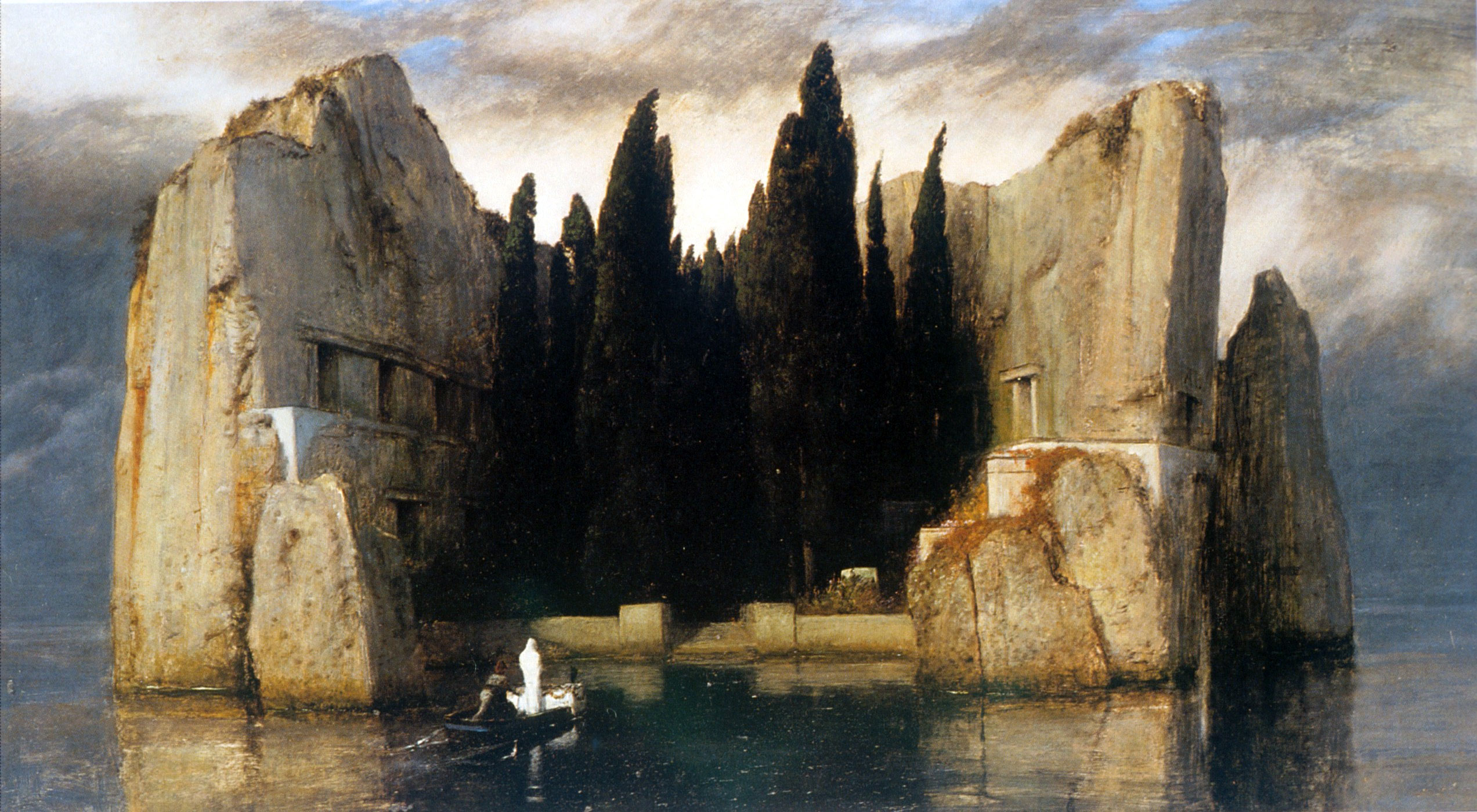
Now I can either head towards ‘Symbolism’, or ‘Charon’, or even ‘Acheron’, but instead I’ll look into the Styx – and I’ll find that it disambiguates to the legendary Greek river, a small river in Perm, a communication protocol implemented in the Inferno operating system, and also a rock band of the 1970-80s.

The rockers of the first incarnation of the Styx had four successive multiplatinum albums; I only recall with affection with one song ‘Mr Roboto’, from which – nearly 20 years ago - I learned that ‘Domo Arigato’ was Japanese for ‘Thank you’. Their song Krakatoa (1974) had a spread tone – a single note that attenuates and amplifies in loudness - that is supposed to have inspired George Lucas to create the audio logo (Deep Note) for his hi-fi cinema audio standard THX.
Krakatoa, of course, is the Indonesian supervolcano that erupted in 1883, but there’s no link to it from the Styx’s page, so I’ll go instead to George Lucas (1944- ), a famous film director who equally famously gave up any artistic integrity when he created the dismal prequels to his Star Wars trilogy. As a film technologist, however, he is incomparable: besides the audiovisual standards of the THX that I mentioned above, he is also responsible for Industrial Light and Magic, a preeminent special effects house, and Pixar, an animations studio. An interesting aside available on the Russian wiki (but not on the English version) is of Lucas’s visit to Moscow in the 1990s. He asked Russian officials to introduce him to Pavel Klushantsev, a film director. The officials, of course, had no idea who Klushantsev was. Lucas replied, ‘Klushantsev is the spiritual father of Star Wars.’ The two directors never did meet.
Pavel Vladimirovich Klushantsev (1910 – 1999) was a self-taught special effects engineer who created many techniques of special effects that proved influential in cinematography worldwide, and developed an oeuvre of documentaries that blended hard science with science fiction. For example, in 1934, his film Road to the Stars had cutting-edge special effects that accurately depicted weightlessness in space, a rotating space station, and even rocket travel to the moon.
Klushantsev also wrote books popularising science, and top Soviet illustrators did the drawings for them. One among them was E. V. Voishvillo who was a fairly well-known painter of marine scenes, many of which find pride of place in St Petersburg’s Museum of the World Ocean.
 
Here is Voishvillo’s depiction of St Nicholas, one of Peter the Great’s boats, considered the grandfather of the Russian navy; I learn that Voishvillo collaborated with A. L. Larionov in reconstructing a copy of Peter’s boat.
St Nicholas, it is often said, is also Santa Claus, but there’s no link out of Voishvillo to the bearded bearer of gifts, so all I can do is use Peter the Great as a conduit to further exploration. I find that he was a prodigious drunk, a lover of all things German, and his first official mistress, Anna Mons, was either Dutch or German herself. Sadly, there don’t appear to be any extant paintings of this famous beauty, so I’ll just put up one of Mary Hamilton, another of Peter’s lovers, whom he executed on the charge of infanticide, treason, and sundry other manifestations of his jealousy.

But back to our Anna-Margrethe von Monson! From her, we can head to things Germanic either filmographically to the German actress Ulrike Kunze (who played Anna’s role in “The Youth of Peter the Great”) or musically to Johann Sebastian Bach (who is said to have written the Brandenburg Concertos for Count Keyserling, who married Anna Mons late in his life).
As I hadn’t heard of the lovely Ulrike Kunze before, I might as well head her way. Born in Dresden in 1960, she trained in the dramatic arts, worked in Berlin and Magdeburg in various dramatic roles, and ended up in television, most recently, the series Love in Berlin.
Ulrike Kunze
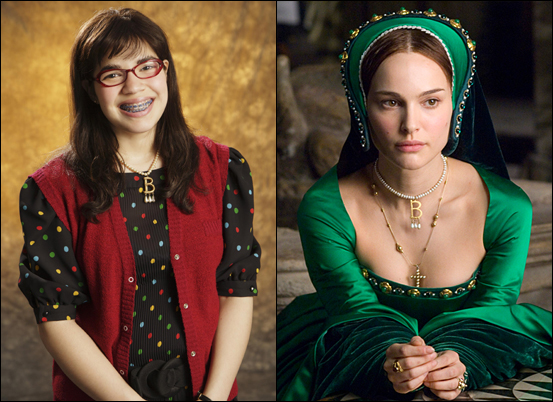
This telenovella is based on the Colombian hit series “Yo soy Betty, la fea”, which inspired, among other things, the US television series Ugly Betty. And just when you think that I’ve managed to telescope from the 18th century to the modern world (all that history was beginning to pall a bit), what do I find? The tacky ‘B’ necklace that Betty wears in the series is an exact replica of a necklace worn by Anne Boleyn.
 
(No post is complete without a picture of the lovely Natalie Portman: fortunately she has her own connection to Anne Boleyn, so this isn’t entirely gratuitous.)
Anyway, as someone said, you either have that bauble around the neck of a Queen, or of a girl from Queens.

Also from Queens is Steinway and Sons, makers of fortepianos and things since 1853. They were famous innovators in advertising and promotions, recruiting, for example, the great Russian pianist Anton Rubinstein (1829 – 1894), to play 215 concerts with their piano in 239 days in 1872. Thus began the Steinway Artists programme.

Anton Rubinstein was a friend of Alexander Glazunov (1865 – 1936), a composer in the Russian Romantic tradition, who composed the Symphony No. 4 and dedicated it to him.

I learn that the second movement of that symphony, the Scherzo, was inspired by Diana’s Chase, a painting, would you believe it, by Arnold Böcklin, with whom we started this Wikiramble.

Full circle, y’all!

Robert Balder, wickedly funny. Comics for Adults.


Every once in a while, mails such as the following erupt and circulate widely, spreading disinformation and canards throughout the world. Many people blindly forward it to their friends; some use it in pub quizzes and claim it's all true; very few are bothered to verify. I am as contrary as a trucker, and so here are my findings, debunking this lot of puerility. (But since my sources are on the Internet as well, you might well want to disbelieve me too.)

In the 1400's a law was set forth in England that a man was allowed to beat his wife with a stick no thicker than his thumb. Hence we have 'the rule of thumb'.
Tosh. There was no such law. It is likelier that the expression (which appears first in the 1700s) stems from the observation that the length of the top joint of a man's thumb is about an inch long. No scale? Use your thumb as a rule.

Many years ago in Scotland , a new game was invented. It was ruled 'Gentlemen Only...Ladies Forbidden'....and thus the word GOLF entered into the English language.
Arrant nonsense.


Every day more money is printed for Monopoly than the U.S. Treasury.
I'm not sure if this is true or not. There's an article by Martin Loughlin that makes this claim, but offers no evidence. So I shall hold fire at this moment.


Men can read smaller print than women can; women can hear better.
There are some sex-based differences among humans, it's true, but the variation is so large that you could almost always find a counter-example to claims such as these. The Language Log, as fine a source of solid information as one can hope to find, there's a good analysis of gender differences. Go and read it and the next time you hear that women use 20,000 words while men only grunt, kick whoever said it in the shins.


Coca-Cola was originally green.
Distilled crap, this. The colour of Coke has always been rich brown. It's been bottled in green bottles, but surely that's not a good reason to make this claim?


It is impossible to lick your elbow.
Take a look at this.


Intelligent people have more zinc and copper in their hair.
First of all, define 'intelligent'. Then explain what zinc or copper has to do with that definition of intelligence. Then show me the evidence.


The first novel ever written on a typewriter: Tom Sawyer.
It appears that Mark Twain made this claim in 1904. But it is difficult to prove. Read all about it here. It seems to be accepted that his typewritten submission was the first to be accepted. On the other hand, he confused his timeline, and there's some evidence that 'Life on the Mississippi' was the first typewritten composition. All on a Remington from 1874! I do have to point out, though, that 'Life on the Mississippi' is not a novel. It's a memoir. Dash it all.


The San Francisco Cable cars are the only mobile National Monuments.
In the United States. Only in the United States. What about the streetcars in New Orleans, eh? Eh?


Each king in a deck of playing cards represents a great king from history:
Spades - King David
Hearts - Charlemagne
Clubs - Alexander the Great
Diamonds - Julius Caesar

A subtle one! Not entirely untrue, but not the complete truth either. The naming of the cards is a French tradition dating back a few centuries. Or so says this site. Note, though, that playing cards themselves are not a French invention, so predating them, the kings might have had other names. Even during the French standardisation around 1780, these kings (and other suits) had been given other names, depending entirely on the whim of the engraver.


111,111,111 x 111,111,111 = 12,345,678,987,654,321
Yeah, and so what? Isn't it obvious? It would have been more remarkable (and as arbitrary, and more forgettable) had the factorization been written as 81 x 1369 x 111333666889.


If a statue in the park of a person on a horse has both front legs in the air, the person died in battle. If the horse has one front leg in the air the person died as a result of wounds received in battle. If the horse has all four legs on the ground, the person died of natural causes.
This used to be a favoured quiz question a few years ago, and I used it on an unsuspecting wife when we first met (she still hasn't forgiven me for it), but I have not found any evidence for this. Indeed, this site says this is possibly only coincidence, and that there has been no such overt tradition in Europe. Another urban legend?


Q. Most boat owners name their boats. What is the most popular boat name requested?
A. Obsession

More trash. Popular in which country? Which year? An informal survey by BoatUS over an 11 year period finds 'Serenity' the most popular in 1992, 1993, 1996, 1998, 2000. 'Obsession' was fifth in 2000. By 2008, 'Happy Ours' was the most popular in the US. Obsession was nowhere in the list. There were also names such as 'Anchor Management'. Two years earlier, the most popular was 'Aquaholic'. What a pointless question this is.


Q. If you were to spell out numbers, how far would you have to go until you would find the letter 'A'?
A. One thousand
On the other hand, if you spelled out the number 101 as 'one hundred and one', you wouldn't have to go as far out as that, eh? And you'd go even farther before you encountered the letter 'Q'. So? Pshaw, I say, pshaw.

Q. What do bulletproof vests, fire escapes, windshield wipers, and laser printers all have in common?
A. All were invented by women.

Some bosh and some truth. Bulletproof vests have been talked about since the 16th century at least; the Koreans came up with a soft vest in the 1860s. At the end of 1880s, Casimir Zeglen, man of Chicago, developed a vest of silk fabric that could stop a slow bullet. The likes of DuPont (of Kevlar fame) have been involved in this as well.

Meanwhile, it's true that the first patent for the fire escape was issued to a woman: Anna Connelly in 1887.

Another woman, Mary Anderson, is credited with the first patent for the windshield wiper swinging arm in the United States in 1903; contemporaneously, J. H. Apjohn "developed a method of moving two brushes up and down on a vertical plate glass windscreen", as Wikipedia deftly has it.

Finally, the laser printer was developed at Xerox by Gary Starkweather. This happened in 1969, and despite all that flower power and hash, he didn't become a woman.


Q. What is the only food that doesn't spoil?
A. Honey
Well, this is true. Ish. Honey has a large sugar content (which is hygroscopic, and sucks moisture out of any bacteria) and some hydrogen peroxide and antimicrobial properties, all of which lend it longevity. But if it is improperly stored, it can develop mould. Surely that's spoilage?


In Shakespeare's time, mattresses were secured on bed frames by ropes. When you pulled on the ropes the mattress tightened, making the bed firmer to sleep on. Hence the phrase 'goodnight, sleep tight.'
As far as I can tell, this is garbage. 'Tight' is generally used to mean 'soundly'. Shakespeare's time doesn't come into it at all. The earliest citation is from 1866, when Susan Bradford Eppes wrote 'Goodbye little Diary. "Sleep tight and wake bright," for I will need you when I return' in her diary Through Some Eventful Years.


It was the accepted practice in Babylon 4,000 years ago that for a month after the wedding, the bride's father would supply his son-in-law with all the mead he could drink. Mead is a honey beer and because their calendar was lunar based, this period was called the honey month, which we know today as the honeymoon.
Again, hogwash. According to the Online Etymology Dictionary, the earliest known use of this expression is in 1546, 'hony moone', possibly a reference to a new marriage's sweetness and how long it will last (given that the moon begins to wane as soon as it is full). For more detail, check this out.


In English pubs, ale is ordered by pints and quarts... So in old England , when customers got unruly, the bartender would yell at them 'Mind your pints and quarts, and settle down.' It's where we get the phrase 'mind your P's and Q's'
Well, this is as much an explanation as another that exhorted printers to watch out for their letters p and q as these were placed (reversed) on the typeset. Or if you want to be really geeky, you might imagine that if a student were not particularly careful and swapped p and q in a Poisson bracket, he might get momentum (p) and position (q) wrong. Yeah, a likely story, that.

Many years ago in England, pub frequenters had a whistle baked into the rim, or handle, of their ceramic cups. When they needed a refill, they used the whistle to get some service. 'Wet your whistle' is the phrase inspired by this practice.

More pish-posh. Since at least 1386 'whistle' has been used as a colloquialism for 'throat'. In 1612, Beaumont and Fletcher's Coxcomb had it thus: "Let’s have no pitty, for if you do, here’s that shall cut your whistle". The alliteration involved no doubt adds to the longevity. The Word Detective even says that in the 17th century, people would use the expression 'wet your weasand' to mean the same thing. Ah, those obsolete words and meanings.

So there you go. My two bits.

Recently, I came across yet another interesting (and free) online tool: Timerime, which allows the user to build timelines. What better way to try it out (and prove my geekiness once and for all) than to develop a linear view of great mathematicians?


How about that? Scrollable, zoomable, snapshottable, embeddable. Cool stuff, I call it.

Of course, I got tired by the time I arrived at Riemann. By the 19th century, mathematicians were a dime-a-dozen, many of whom made stellar contributions to the field, any of whom might be considered a genius. It also began to get a tad monotonous to say 'analyst', or 'number theorist' when faced with an unending series of great names. Plus, the extensive biographical website at the University of St. Andrews contains way more information than I can provide. I copped out by linking initially to the relevant pages at the repository. After a while, even that got tedious.

So anyone who wants to edit and expand and attach music or graphics or images or video to any of the mathematicians on the time-line, please let me know, and I'll setup a shared-ownership so you can update the time-line yourself.

Aug 15, 2008

Blended Coffee

A while ago, I pondered the fate of shops offering personal blends of tea. 10% Darjeeling and 90% Oolong, anyone? It appears that a German outfit has had a similarly brilliant idea - only with coffee. I'm not much of a coffee-drinker, even less than I am a tea-tippler, but this online shop is the bee's knees. Sonntag Morgen, it calls itself, and it provides punters with the ability to mix and match sundry coffees, give the blend a name and label design, and have it delivered in a delightful tin decorated with said label and name to any address of the punter's choice.

Nicaragua Maragogype and Robusta Indian Parchment with a touch of Ethiopian Sidamo? Drool, drool.

If anyone is checking it out, I'd be glad to have feedback before I try it myself, heh.

Looks like the beavers at Microsoft have been a bit busy. They have created this free tool called Live Writer that enables the user to post to a blog without having to login to the blog's website. Supposedly it provides better format control than, say, Blogger, but I still don't see the ability to typeset mathematics! So my frustration, which started here, continues.

You are not going to believe what my colleagues are doing on Monday in the office. Christmas eve and we are at work - half day. Nothing really goes on - workwise - during the holiday season. The financial markets are thinly traded, very volatile, nobody wants to enter any risky positions, and anyway, everyone is a bit festive and drinking champagne by the bucket (in the US, something non-alcoholic, naturally, like sparkling water).

One of our brokers sends us a link to an online video game - Dating Ariane. It's taken the world by storm, or so I am told. In essence, by playing for hours, if you are skillful and you know what a woman wants, you get lucky with Ariane. If not, you traverse an increasingly frustrating landscape of waywardness and delicate mind-control to persuade the woman to get her top off. Or to toss you out the door. Not unlike real-life dating, then.

The guys (and some girls) in the office have no time for niceties. They search online for a cheat sheet and go after Ariane with a vengeance. Either the instructions are not clear enough, or they are playing a different version, but they are not making much progress. Sure, Ariane agrees to flash her boobies, compliments them several times on their physicality and intellect; even gets into the hot tub and plays truth or dare (you can imagine where that can lead). But something or the other always interferes with the grand finale. Either she gets too drunk or irritated by their diffidence or put off by their eagerness, or, well - you play it and you will know.

By the time I leave at noon, the cries of outrage and bafflement are resounding throughout the trading floor. You didn't feed her before getting her high! I hear one worthy exclaim. Oh, she is such a tease! says another. Cor, she reminds me of my ex, says a third, breaking into a sweat.

Chuckling, I go home filled with a sniggering sense of superiority. I am going to play Ariane quietly without distractions and with the correct cheat sheet. Heheheheh.

It is sad but true that socially isolated adolescent girls whose friends are not each other's friends tend to have more suicidal thoughts than those whose friends are friends with each other1. I am not entirely sure why this is the case, and why a similar result has not been found among boys. Interpersonal dynamics among girls is far too subtle and emotionally manipulative for a boy to comprehend. As Hermione Granger in one of the Harry Potter books said, Just because you've got the emotional range of a teaspoon, Ron, doesn't mean we all have. Perhaps it is just this shortage of empathy in the male brain that makes it less susceptible to the lack of triadic closure.

What's that? Triadic Closure? A smart sociologist named Georg Simmel introduced this concept about a hundred years ago. It means exactly what it says on the tin: if your pals are friendly with each other, your circle is triadically closed. There are three entities that are joined in a dynamic: you, one group of friends, and another group of friends. Simmel's argument was that the entry of a third member into a previously dyadic group introduced new dynamics, such as divide and conquer, or mediation, or affirmation. This was the minimal social unit that could be explored as a proxy for the human sociological condition

Girls with their delicately nuanced appreciation of each other's worth epitomise this dynamic perfectly. Within a group there would be - as with most social animals - hierarchies. Invariably, those at the bottom of the heap are treated with condescension and barely suppressed irritation. However, the group itself protects any of its members against outsiders. There's also constant jostling for ascendancy, and two girls might gang up against a third, even if she were generally top dog; these alliances being fluid and impermanent. Do we have a possible explanation for suicidal thoughts among girls whose pals form disjoint sets? Perhaps they miss the interpersonal dynamic, the support and affirmation and protection that comes of a larger group, and they find themselves isolated and possibly bullied by other more successful networks.

In 2002, there was a brouhaha5 caused by the publication of Rosalind Wiseman's Queen Bees and Wannabes. A long New York Times article described how Rosalind went about analysing the dynamics of adolescent female relationships, and - having understood them - setup an foundation to get girls to, well, be nice to each other. Essentially, she determined, the dynamic was a mixture of domination, mutual support and admiration, ruthless purging of rebels and extreme xenophobia towards outsiders. The successful queen bees are the ones who can manipulate their inferiors, who can back-stab successfully and still have the subservient emotional slave come back. The victims always apologise and always want the favour of the queen.

It is quite clear that there is no space for political correctness in this turmoil of adolescent behaviour. As the feminist historian Elizabeth Fox-Genovese said: those who have experienced dismissal by the junior-high-school girls' clique could hardly, with a straight face, claim generosity and nurture as a natural attribute of women. Indeed, in the words of one famous queen bee4: I don't really like my friends. It's just like they're people I work with and our job is being popular.

One of the most astonishing comments I have ever heard is that by a seventeen year old about two fourteen year old girls who crashed a party she had thrown. A freshman girl cannot show up at a junior party; disgusting 14-year-old girls with their boobs in the air cannot show up at your party going -- her voice turned breathy -- Uh, hi, where's the beer?5 This drips with so much fury and displays so much poison, I am amazed the younger girls were alive at the end of the onslaught. Guys wouldn't have been either as eloquent or as poisonous. You gate-crashed my party? Well, if I am bigger than you, I'll punch you on the nose. If not, I'll pretend I invited you.

I wonder if there is any evolutionary reason at all for girls to treat each other this way. It has often been claimed that this is yet another exercise in determining boundaries and acceptable social behaviour that children go through, as they did when younger. After all, many women outgrow this phase. But why does it have to be so vituperative? I have no clue.

Meanwhile, some researchers have found an immense treasure trove of data to ponder sociological questions in - hold your breath - Facebook3. There are so many friends and family networks, many in unprotected profiles, that the researchers can begin to analyse issues such as triadic closure.

Finally, here's a bit of a reversal in behaviour that seems to occur as girls mature into adulthood. They begin to keep their various friend circles apart2! Down with triadic closure in this instance, that's for sure. The reasons given are manifold. What if my friend A can't stand my friend B? Will I then be diminished in their eyes? Worse, what if they get along even better with each other than they do with me? Will I be discarded in the new organisation?

It's a good thing I don't have to deal with issues such as these. Or, as Ron said, I'd explode. My emotional range, you see, is no greater than that of a teaspoon.

References

1. Bearman, P.S., J. Moody, Suicide and Friendships Among American Adolescents, American Journal of Public Health, Vol 94, Number 1. 2004.
2. "I keep my friends 'separate'..." - mailing list.
3. Stephanie Rosenbloom, "On Facebook, Scholars Link Up With Data", New York Times, Dec 17, 2007.
4. Winona Ryder, Heathers, 1989.
5. Margaret Talbot, "Girls Just Wanna Be Mean", New York Times, Feb 24, 2002.

Dec 18, 2007

Scrabblists

After a hiatus of almost five years, the wife and I played Scrabble last weekend. We were both somewhat rustier than ever, and it took a little while to get the grey cells operational. By then, the Scrabble board was dense in the top quadrant and empty everywhere else. The quality of the words was none too impressive. You know, stuff like REX and FAIN and AXLED. Without adequate rack and board management, any game will quickly stultify and suffocate. In search of cheap points, complaining about the immoderate number of vowels on our racks, we unbalanced the board. Seeking to deny each other double- and triple-word scores, we placed innocuous words at the most inopportune squares. In essence, the game was grinding to a desperate shuffle of two- and three-letter words.

At that point, I placed CRINGED, got my fifty points and a bit, and the wife winced and we stopped the game. She later admitted that she had allowed me to win, in the interests of marital harmony. What can I say? She is a sweetie.

I've played Scrabble off and on for almost thirty years. When my parents and sister and I played, invariably my dad would thrash us. Boy, did this gall me! I vowed to beat him eventually and set about the task with single-minded devotion. In other words, I did nothing about it. Well, I read a lot of Charles Dickens and Thomas Hardy (I was twelve and my dad told me to read these dinosaurs, instead of, I don't know, Alistair MacLean). I learnt a few grandiloquent words, sure, and continued to get beaten by the old man. Still, I never became quite the fanatical word-freak that Stefan Fatsis describes so eloquently in his marvellous Word Freak, a tale of obsession and heartbreak among champion Scrabble players. For me, the thrill came from playing words I knew the meanings of. Winning was essential, of course, but I never felt the need to memorise all the recognised two- and three-letter words, or build up word-lists, or develop a blinding ability to anagram - all traits and abilities pushed to the limits by the foremost Scrabblists of the world.

I'm not sure I'd enjoy playing the game with the obsessives. They'd beat me hollow, of course. But they show no interest in the words they place. Their imagination extends only to fast anagramming and clever placement and deciding when to rotate the rack and so on. These are all good skills to have even for a part-time gamer. But the main reason the game has such a hold on me is my love for language. I'm fascinated by the cleverness of my opponents as they finagle interesting words onto the board. I'm always prepared to ask for the meaning of a word I've not encountered before - and not as an adversarial challenge, either. When we get to the endgame where one seeks nooks to insert the smaller words, desperately trying to get rid of the straggling letters on the rack, I am already losing interest. By then the fancy and grandiose words have already been played, and large scores amassed, and thrilling seven-letter sweeps accomplished with panache.

Links:

For those with an obsession with Scrabble and online play, the Calcutta-based Agarwalla brothers have come up with Scrabulous. A news piece about it is here. Let it not be said that desi programmers can only work on projects and not on products. It's earning them a few tens of thousands of dollars every month in revenue, which, for the small-scale operation they run, is rather good, eh?

UPDATE: 16 Jan 2007: It appears that the copyright owners of Scrabble have asked Facebook to take Scrabulous offline. It was just a matter of time. Sigh.

The wife has signed up to Facebook, and I have linked up to LinkedIn, and I am wondering if there's really any point to this all. Privacy concerns? Check out this piece by David Sexton of the Evening Standard

Facebook Turns the World into Big Brother

2007-06-22
By DAVID SEXTON

BEING a grown-up who wastes too much time already, I've never bothered to join any "social networking" websites.

It's hardly a tenable position any more, though. Facebook is exploding.

Already it has 27 million active users, with 100,000 being added every day.

Facebook is increasingly popular not just with 18-24 year olds, but also 24-35 year olds and even beyond. Half the staff of the BBC are said to have joined.

Over the past few weeks, it has entered the general consciousness, even of those who don't spend much time on the internet.

Facebook is so easy to use and makes connections for you so fast.

Lots of users boast several hundred Facebook "friends", who may, of course, scarcely be acquaintances.

Facebook can invite everybody in your email address book to become such a pal, and it's rude to refuse.

Some Facebook activities are pretty silly. You can "poke" people or "superpoke" them, so that instead of a plain poke, you can mirthfully bitchslap, dryhump, marry, divorce, sucker punch, chest bump, cock block, caress or grope them. It's a sniggering kid's dream, maybe a nervous flirter's, too.

But its real power is that it lets you surf trails of other people's "friends" so easily surf, or maybe snoop, or maybe stalk. For although Facebook offers various privacy settings, they seem little used: an amazingly large proportion of information personal profiles, lists of friends, pictures can be viewed, undetected, by anybody.

After all, if you've gone on Facebook to find friends, why hide? This way, you can find people you have lost touch with, meet new ones with whom you have interests or acquaintances in common, and

Nightmare in the socialise when worlds apart. But you can also easily find out grotesque amounts of information about people that you would never have learned in real life, or only after months of actual friendship.

I can, unseen, discover a colleague's favourite books, music, and films, the identities of all her Facebook friends, the interest groups she's joined, when she's been logging on, her holiday pictures ... Then I can move on to her friends ... and their friends ... Facebook is addictive and makes stalkers of all its users.

Some of the dangers are obvious.

Many employers already check up on employees or potential employees this way, for example.

The policing possibilities are alarming, too, as are the opportunities for commercial exploitation..

But the real shocker is what Facebook feels like for anybody who retains an antique sense of privacy about their life or the other people in their life.

For now most people people just want to make themselves known as much as possible. Facebook the whole world as one colossal Big Brother House..

(c) 2007 Evening Standard; London (UK). Provided by ProQuest Information and Learning. All rights Reserved.


Jun 21, 2007

Oldest Friends

Now that the Internet has been around for, what, a couple of decades, I am sufficiently optimistic that I should be able to track down people I used to know over the years.

I started first by looking for people I knew in Venezuela. This search didn't last too long as I only remembered one friend - Gop. His parents and mine had been in touch for almost twenty-five years after those days in Caracas, but by the time I started my hunt, neither had any idea where the others were.

But Gop's name was sufficiently unusual, coupled with the fact that he had studied at a school with an alumnus association sufficiently active and web-savvy, meant that I located him with almost no effort.

Vastly encouraged by this, I began my search for friends from my Russian sojourn. This proved much more difficult. In fact, of the about ten or so boys and girls I was particularly friendly with, I only managed to find two.

The first, Kolya, lived in the same diplomatic complex as I because his mother had married an Austrian engineer. After I left Moscow, Kolya had been an assiduous correspondent, but I had been lazy in replying to his letters, so he stopped as well. I knew he had emigrated to Vienna, and in the mid-nineties, when I was a tourist in that city, I scoured the telephone directory for him or his father. But at the time, I was unsuccessful.

Around 2000, though, I found a Vienna white pages online. As luck would have it, his father's surname was unique in it; I knew Kolya called him Fritzulya, which meant that his name would be Friedrich; there were three numbers listed, I tried them all, and located his father. Luckily, he remembered the little Indian boy who had been his son's bosom buddy, and was happy to provide me with Kolya's contact details. "Goooooooooooooaaaaaal!".

Next: Nitin Budhwar's father had been a colleague of my father's at the Indian Embassy in Moscow, and he had studied at my school. He proved to be easy to find: a casual Google search did the trick. He didn't remember me when I got in touch, but he graciously replied when I sent him email. Sadly, though, he hadn't kept in contact with any of the old crowd either.

In quick succession, I sought other classmates from my school, Central Special No 14, Moscow. There were any number of matches for some of the names, but further investigation constantly led to impasses. I sent emails to several possibilities, but only one replied, and he was too old to have been my classmate. Even the school itself was untraceable; it was as though with perestroika, the school had been reconstructed too.

In general, is it more difficult to locate girls, or what? I have never quite liked the idea of women taking on their husbands' last name, and this proved to be the show-stopper in this effort as well. But surely it shouldn't have been too difficult to isolate the guys?

By this time, I had moved to the UK. Working for a telecommunications outfit near Cambridge, I chanced to meet Russian clients from Israel. They linked me up to the Russian Internet. I found that my old school had been renamed. There were some old students from there, however, who were posting to a mailing list. I wrote to them, but again, they turned out to be considerably younger than I. They hadn't even heard of my old class teacher, Lyudmila Alekseevna Ilyashuk, who certainly had continued to work there for years after my departure.

So where are you: Seryozha Trofimenko, Misha Kazakov, Nina Petrunina, Tania Mamedova, Natasha Domracheva, Ira Spiridonova, Yura Petrunin, Borya Morozov?

As I have been in constant contact with many of my pals from my stay in Jakarta, I haven't had to use the Internet to locate too many of them. Anyone I missed could quickly be traced by using friends of friends. Liselle Zamuco, though, is a tough nut to crack. I know she went to the Asian Institute of Management in Manila. What did she do after? She was supposed to be a top powerlifter in the Philippines, but there is no mention of her on the Internet. Her name appeared on a pregnancy blog site, but my email posted there elicited no response. So where are you, young Liselle?

I graduated from high school in Kathmandu, and promptly lost touch with everybody from class. This year, it is twenty years since finishing twelfth grade. Nostalgia tugs at the heart and idle fingers do the rest. It turns out that there's an alumnus webpage. But as I half-expected, it is run by enthusiastic chappies fifteen years junior to me. My emails to them resulted in courteous responses, suitably calibrated to one of my gray years. None of my classmates was at the time registered on the website.

A month later, though, I received an email from Ratan Sureka who graduated with me in 1987. He knows the whereabouts of three other classmates. What are the chances of that? I am still grinning like an ape.

Still, there are others untraced: Mamta Choudhary, Shiv Verma, Bharati Verma, Meeta Mishra, Pashmina Contractor, Preetam and Uttam Srivastava. Speak up, folks!

The Internet may yet come up trumps again...

Update: 16 May 2008
I've managed to locate Meeta Mishra now. Amazing. And, what do you know, Liselle Zamuco as well - of all places, on Facebook. Amazing-raised-to-the-power-two!