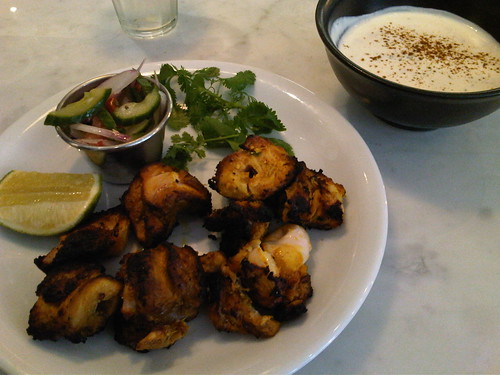
While I munched on the tikka, the proprietor stopped by one last time. He said he was leaving, and that it was good to meet me. I mumbled a pleasantry and he skedaddled.
For the purposes of this post, I'll extract his notes on Quilon (Khulam, as he called it).
Thence 2 it is seven days' journey to Khulam 3 which is the beginning of the country of the Sun-worshippers 4. These are the sons of Cush, who read the stars, and are all black in colour. They are honest in commerce. When merchants come to them from distant lands and enter the harbour, three of the King's secretaries go down to them and record their names, and then bring them before the King, whereupon the King makes himself responsible even for their property which they leave in the open, unprotected. There is an official who sits in his office, and the owner of any lost property has only to describe it to him when he hands it back. This custom prevails in all that country. From Passover to New Year, that is all during the summer, no man can go out of his house because of the sun, for the heat in that country is intense, and from the third hour of the day onward, everybody remains in his house till the evening. Then they go forth and kindle lights in all the market places and all the streets, and then do their work and business at night-time. For they have to turn night into day in consequence of the great heat of the sun. Pepper is found there. They plant the trees thereof in the fields, and each man of the city knows his own plantation. The trees are small, and the pepper is as white as snow. And when they have collected it, they place it in saucepans and pour boiling water over it, so that it may become strong. They then take it out of the water and dry it in the sun, and it turns black. Calamus and ginger and many other kinds of spice are found in this land.
The people of this country do not bury their dead, but embalm them by means of various spices, after which they place them on chairs and cover them with fine linen. And each family has a house where it preserves the embalmed remains of its ancestors and relations. The flesh hardens on the bones, and the embalmed bodies look like living beings, so that every man can recognize his parents, and the members of his family for many years. They worship the sun, and they have high places everywhere outside the city at a distance of about half a mile. And every morning they run forth to greet the sun, for on every high place a solar disc is made of cunning workmanship, and as the sun rises the disc rotates with thundering noise, and all, both men and women, offer incense to the sun with censers in their hands. Such are their superstitious practices. And throughout the island, including ail the towns there, live several thousand Israelites. The inhabitants are all black, and the Jews also. The latter are good and benevolent. They know the law of Moses and the prophets, and to a small extent the Talmud and Halscha.
Contrary to popular belief at the time that white and black pepper originated from different plants, he points out that one derives from the other, although it should be said that it works the other way round: when black pepper pods are put in water, the skin is able to be sloughed off, revealing the white kernel inside.
Finally, Benjamin's accuracy returns when he takes up his travelogue in Aden, after the Indian sojourn. This map, we may safely surmise, is the best guide to his progress.
References and Notes
1. Marcus Nathan Adler, The Itinerary of Benjamin of Tudela: Critical Text, Translation and Commentary, New York: Phillip Feldheim, Inc., 1907
2. Benjamin travelled from Katifa, or El-Katif, in Bahrain.
3. [Footnote in Adler's book] Khulam, now called Quilon, was a much frequented seaport in the early Middle Ages where Chinese shippers met the Arab traders. It afterwards declined in importance, being supplanted by Calicut, Goa, and eventually by Bombay. It was situated at the southern end of the coast of Malabar. Renaudot in a translation of De Travels of Two Mohammedan Traders , who wrote as far back as 851 and 915 respectively, has given us some account of this place; Ibn Batuta and Marco Polo give us interesting details. Ritter, in the fifth volume of his Geography, dilates on the cultivation of the pepper-plant, which is of indigenous growth. In Benjamin's time it was thought that white pepper was a distinct species, but Ritter explains that it was prepared from the black pepper, which, after lying from eight to ten days in running water, would admit of being stripped of its black outer covering. Ritter devotes a chapter to the fire-worship of the Guebers, who, as Parsees, form an important element at the present day in the population of the Bombay Presidency. Another chapter is devoted to the Jewish settlement to which Benjamin refers. See Die judischen Colonien in Indien, Dr. Gustav Oppert; also Semitic Studies (Berlin, 1890, pp. 396-419.
Under the heading "Cochin," the Jewish Encyclopaedia gives an account of the White and Black Jews of Malabar. By way of supplementing the Article, it maybe well to refer to a MS., No. 4238 of the Morzbacher Library formerly at Munich. It is a document drawn up in reply to eleven questions addressed by Tobias Boas on the 12 Ellul 5527 (= 1767) to R. Jeches Kel Rachbi of Malabar. From this MS. it appears that 10,000 exiled Jews reached Malabar A. C. 68 (i. e. about the time of the destruction of the Second Temple) and settled at Cranganor, Dschalor, Madri and Plota. An extract of this MS. is given in Winter and Wiinsche's Judische Literatur, vol III, p. 459. Cf. article on the Boni-Israel of India by Samuel B. Samuel, The Jewish Literary Annual, 1905.
4. Sun-worshippers, or Parsis.
Unlike the hordes of Hindus, the masses of Muslims, the crush of Christians or the (damn, I'm running out of alliterations) surfeit of Sikhs, the number of that gentle tribe known as Zoroastrians dwindles with every passing day.
This is a culture that is best exemplified by a possibly apocryphal story. Seeking escape from religious intolerance in their native Iran, several Zoroastrians arrive in India. They request a local king to allow them to settle in his demesnes. He replies wordlessly by sending them a cup filled to the brim with milk. They understand that he means that there is no space left to accommodate them. They dissolve sugar in the milk and return the cup to the king. The king understands that they will blend well within his kingdom, and indeed sweeten the lives of everyone. He also realises that these are seriously smart cookies. So he permits them to stay, and stay on they do, maintaining their faith for centuries and providing much more to their adoptive country than they ever took out of it.
In reality, as the Qissa-i-Sanjan documents, the ruler of Gujarat, where the Parsis first arrived, allowed them to settle only if they would explain the tenets of their religion to the ruler; they were also to learn the local language and speak it rather than Persian. They were also required to adopt the dress of the area rather than wear Iranian garb, they were to celebrate their weddings in the evening rather than in the morning, and they were to put aside their weapons and not wear them at any time. Other traditions say that the Zoroastrian pilgrims were never to convert their Hindu or Muslim neighbours... The Parsis kept their promises.
Indeed, Zoroastrians in India have been singularly successful. They have done well in journalism, music, the sciences, the armed forces, sports, business, nuclear engineering, and film. There are literary stars among them, and ravishing models. And yet, over time, their numbers have been shrinking.
The chief reason for this is that the faith does not recognise conversion, so if a Parsi marries outside the community, the children are not considered Parsis any longer. As with Orthodox Judaism, this has caused a deep schism, with some reform-minded Zoroastrians willing to countenance conversions into the faith. There are opposing voices.
Another reason is the diaspora. Many Parsis have left India for Australia, the UK, and the USA, where it becomes even more difficult, owing to the smaller communities, to preserve their culture.
There seem to be far too few children being born to Parsis as well. As pointed out in this article, their population is an inverted pyramid, with fully 31% of them being above the age of sixty.
Meanwhile, there are heroic efforts to keep the community together. Ader Gandi runs the Parsi Chronicle, an online compendium of articles about his people. There is an online directory where nearly 50,000 Parsis and Iranis seem to have registered themselves. Finally, a listing here might elicit a response from a Parsi that one has lost touch with.
Pshaw, I say, and forsooth. Why, we all know that the Tatas are paragons of industry, captains of civility, heroes of honour. And yet, some people beg to differ.
You may claim that the International Campaign for Justice in Bhopal may be a tad biased and blinkered, seeing as they are stridently anti-corporations, but they do gather a small roll-call of infamy. Okay, so you can't blame an Indian company during the colonial period supporting the colonial endeavour - after all, everybody's gotta make a living, what? But supplying opium? Protesting to the Hong Kong Legislative Council that a bill on the regulation of the opium trade would adversely affect their business?
Good grief.
Links
About Me
Categories-
- advertising (10)
- afghanistan (2)
- africa (9)
- algeria (2)
- alphabet (1)
- andorra (1)
- anglo-indians (3)
- apple (2)
- arabs (9)
- archaeology (7)
- architecture (23)
- argentina (6)
- armenia (3)
- art (94)
- astronomy (14)
- australia (6)
- austria (5)
- automobile (3)
- beer (5)
- behaviour (12)
- belgium (9)
- bengal (7)
- berlin (1)
- biography (45)
- birthdays (7)
- blogs (42)
- bolivia (1)
- book (1)
- books (398)
- bosnia (1)
- botswana (2)
- brazil (7)
- bridges (14)
- burma (4)
- business (45)
- cambodia (1)
- campanology (2)
- canada (8)
- caucasus (5)
- chechnya (3)
- cheese (4)
- chemistry (6)
- child abuse (3)
- chile (2)
- china (26)
- chocolate (2)
- climate (8)
- cocktail (5)
- coffee (5)
- colombia (3)
- computing (10)
- conference (5)
- congo (2)
- côte d'ivoire (2)
- credit (1)
- cricket (2)
- crime (1)
- cuba (4)
- culture (21)
- cyprus (1)
- czech (4)
- delhi (3)
- denmark (5)
- economics (16)
- edinburgh (3)
- education (15)
- egypt (13)
- england (143)
- environment (4)
- epidemiology (5)
- eritrea (1)
- espionage (2)
- estonia (3)
- etymology (5)
- evolution (8)
- exhibitions (7)
- family (77)
- fashion (8)
- film (39)
- finance (33)
- finland (2)
- folk tales (2)
- fonts (5)
- food (234)
- france (99)
- fraud (7)
- friends (12)
- fruit (3)
- gaming (10)
- genetics (2)
- geodesy (2)
- georgia (6)
- germany (54)
- ghana (3)
- greece (25)
- guatemala (1)
- health (9)
- hindi (4)
- history (219)
- holland (4)
- humour (63)
- hungary (8)
- iceland (2)
- ICM (10)
- IISc (13)
- IKEA (1)
- india (139)
- indonesia (5)
- inquisition (1)
- internet (18)
- iPod (2)
- iran (10)
- ireland (4)
- israel (8)
- italy (74)
- jamaica (1)
- japan (16)
- jordan (1)
- kazakhstan (1)
- kenya (1)
- kerala (6)
- kidnapping (1)
- korea (5)
- kurds (4)
- language (78)
- lebanon (2)
- life (127)
- london (98)
- low-cost airlines (2)
- malaysia (2)
- mali (2)
- manipur (2)
- maps (3)
- mathematics (70)
- mauritius (1)
- medicine (13)
- memory (1)
- mexico (15)
- mobile phone (2)
- mongolia (2)
- morocco (7)
- moscow (5)
- music (61)
- myth (16)
- names (4)
- nepal (1)
- netherlands (9)
- networking (3)
- neuroscience (1)
- new zealand (2)
- newspapers (15)
- nigeria (2)
- norway (7)
- oranges (2)
- pakistan (4)
- palestine (1)
- paris (6)
- parsis (4)
- persia (10)
- peru (2)
- philippines (1)
- photography (33)
- physics (18)
- poetry (66)
- poland (9)
- politics (28)
- polynesia (1)
- portugal (4)
- psychology (7)
- pubs (3)
- quiz (8)
- race (7)
- religion (73)
- risk (4)
- roaring twenties (5)
- robotics (1)
- romania (4)
- rome (9)
- russia (77)
- samsung (1)
- saudi arabia (2)
- science (68)
- scotland (26)
- search (1)
- serbia (2)
- sex (25)
- singapore (4)
- society (73)
- south africa (4)
- spain (42)
- sports (17)
- sri lanka (1)
- St. Stephen's (9)
- suicide (1)
- surreal (2)
- sweden (12)
- switzerland (8)
- syria (3)
- tahiti (1)
- taiwan (1)
- tajikistan (2)
- tamil (2)
- tata (3)
- tea (3)
- technology (16)
- television (16)
- thailand (6)
- thames (9)
- theatre (4)
- tibet (1)
- tolkien (2)
- trade (6)
- translation (23)
- travel (135)
- tunisia (1)
- turkey (22)
- typesetting (6)
- uganda (1)
- ukraine (4)
- uruguay (1)
- USA (87)
- uzbekistan (3)
- venezuela (2)
- vietnam (3)
- visa (1)
- vodka (4)
- wales (5)
- walks (20)
- war (23)
- web (2)
- west indies (3)
- whisky (3)
- wine (23)
- wodehouse (6)
- work (24)
- yemen (2)
- york (1)
- zambia (1)
- zimbabwe (1)
- zoroastrianism (4)