JOST A MON

The idle ramblings of a Jack of some trades, Master of none

Jan 15, 2015

Technical Moksha

The boy likes to cuddle with his amma before bed and discuss philosophical matters. The other day, she read him some passages from the Bhagavad Gita about moksha and material desires preventing the soul from breaking out of the cycle of suffering and rebirth. 

"I hope your soul achieves moksha, amma," said the boy.

"Thank you, sweetie," said the wife. "But what about you?"

"It will be very difficult for me," said the boy.

"Why is that?" said the wife.

"Because I really, really want that 50-inch curved screen LED TV, amma," he said.


Dec 29, 2011

Christmas 2

Santa brought a Playstation Move for the boy. While he had expected a Wii or an Xbox Kinect (having written a small note to Santa requesting either device), the fellow was quite pleased. He spent six hours whacking demons and skeletons on a medieval quest to obtain a jewel. Every time he was stymied, he'd yell at me. "It's because you're not telling me what to do!"

"Shield, shield!" I would shout. "Arrows! Shield, shield!"

"Don't shout at me!" the boy would yell back.

"Don't shout at the boy," the wife would say.

"I'm telling him what to do," I would say.

"Let him figure it out," the wife would say. 

Flying crosses would fly at Deadmund and he would sag and grunt with every impact. 

"I'm running out of life," the boy would say. "Help me, acha!"

"Shield, shield!" I would shout. "Arrows! Shield, shield!"

"Don't shout at me!" the boy would yell back.

"Don't shout at the boy," the wife would say.

Et cetera ad eternam.

Dec 28, 2011

Another Random Tootle

And again, instead of going to the gym, I go on a random walk around my part of London. I walk briskly, honest. I cover about 3 miles in 45 minutes, burn 320 calories, and see some sights and witness some events and overhear some chats. And read some petitions and speak some French.

The initial and fastest leg is from Bank over Southwark Bridge to Borough High Street. I nip past Borough Market, observing the long queues at Neal’s Yard Dairy (a fine British cheesemonger). Desperate Christmas shoppers throng the place. Some of my colleagues have recently received boxes of Neal’s Yard cheeses from their brokers and I am delighted to see that such specialties as Appleby’s Cheshire and Sparkenhoe Red Leicester have pride of place on Neal’s Yard’s shelves. I haven’t had either cheese but I intend to as soon as I have this cholesterol thing beat, and shall report at length. 2012, here I come.

There are even longer queues at local pubs. What’s with people drinking at 3pm, I ask you?
At 67 Borough High Street, I see a lovely red building on which appears the following legend: W H & H Le May Hop Factors. Surely that’s worth a brief investigation? Yes, it is.
W H & H Le May Hop Factors
I find that the Le Mays were a famous supplier of hops to brewers and the like. (The Le Mays were a well-to-do family. One of them, Lt Algernon Le May, aged 34, perished in the Great War – his name appears on a nearby war memorial.) The hop trade was a major part of Southwark till nearly the 1970s. For centuries, Borough High Street and Old London Bridge were the only means of ingress into London from the south. The area, therefore, was dotted with inns and taverns. Recall Harry Bailey who led the pilgrims in Chaucer’s tale? He was a proprietor of a local tavern, and very rich to boot. Hop factors were warehousers and intermediaries between the growers and the breweries.


Southwark is rich in listed properties, many pre-dating the 19th century. This building though is rather modest inside. 19th century developers liked to apply a bit of embellishment to the exterior to aggrandise their creations.


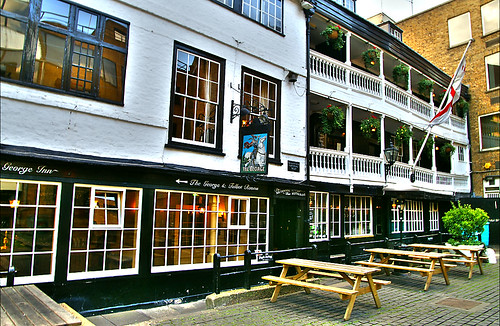
Not fifty metres away at 77 Borough High Street is George Inn, one of the last extant hostelries in Southwark. This was built in the 17th century. These inns catered to horse-drawn traffic, and were situated on long plots with a narrow frontage onto the main street. These survive mainly in name only. I don’t go inside George Inn Yard to inspect the inn itself. I’ll leave that for another time I shirk off gym. It’s a National Trust property, which helps as I am a member. But here’s a picture of its lovely galleried front.
The George Inn - Southwark - London
 [The George Inn by Nick Garrod, on Flickr]
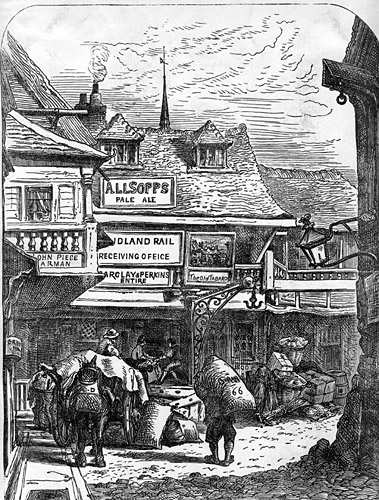
A little further along and a quick left onto Talbot Yard reveals a non-descript office building on which appears a plaque. Here stood Chaucer’s Tabard Inn, from where the pilgrims set off on their grand trip to Canterbury. Just like the George, it had burned down in the 17th century and was reconstructed; unlike the George, it didn’t survive the Industrial revolution, and exists only in literary memory. Luckily, we have engravings of it from the 180o’s when it looked a bit like this:
[The Tabard Inn, c. 1850. Wikimedia Commons]
I retrace my steps to Borough High Street and shift left on Newcomen Street. I hope there might be a plaque or some memorial or the other to the only Newcomen I’ve heard of, who invented the steam-powered pump and inspired James Watt’s steam engine. But he was a Devon man, and I am not sure if he had much to do in London.

Like many of the side-streets in Southwark, this street too used to be coaching inn yard (once called Axe Yard). In the 17th century, it came to be owned by two charities. One building bears the name of one of the charities – John Marshall’s. The street, however, is named after the other – Mrs Newcomen’s. She owned three messuages – ha! I learn a new word – one of which was in Axe Yard, and she bequeathed them upon her death in 1675 for "the clothing of poor boys and girls with a suit of linen and woollen once a year, whereof two-thirds . . . [were to] be out of the Borough side, and the other third . . . out of the Clink Liberty . . . and for . . . teaching them to read and write and cast accounts, and for . . . putting forth boys apprentice at 5l a piece, at their age of 14 years." (Quote from here.)

As I continue along Newcomen street – not the prettiest street in Southwark, admittedly – I note signs everywhere of King’s College and Guy’s Hospital. Every time I look up, I see the immense Shard. It looms over the entire borough. Guy’s Hospital is so much more to human scale. There is a courtyard with an arch. It is another memorial to the fallen soldiers of the Great War.
 Keats at Guy's Hospital
[John Keats at Guy’s Hospital, by Mike Paterson]

Beyond is a colonnade separating two inner courtyards. In one of them stands Lord Nuffield, a benefactor of the hospital, and in the other is a seated John Keats, a bronze-work by Stuart Williamson inaugurated in 2007. The great poet had trained as a surgeon in the hospital, and quit, undone by the gruesomeness. As far as I can tell, the only bit of medicine that ever appeared in his poetry are these lines from Ode to Fanny:

Physician Nature! Let my spirit blood! 
O ease my heart of verse and let me rest; 
Throw me upon thy Tripod, till the flood 
Of stifling numbers ebbs from my full breast.

Across St Thomas’s street is the Old Operating Theatre and Herb Garret. It is closed, unfortunately, till the New Year. As I head away from it, a lovely girl steps out in front of me, followed by a young man who tells her, 'I have an entire archipelago of mistresses.'

Say what? Before I can react, they disappear into a side street. Scratching my head, I continue along St Thomas’s Street till I get to Crucifix Lane. I see a sign for the Fashion and Textile Museum. There’s no time to take a gander at that; I turn towards the Shard. Construction all around has wrecked views and entrances and my neck hurts from craning. I see BVAG petitioning against the demolition of Southwark’s heritage (London Bridge is the first city-centre railway terminus, it thunders, it should not be treated so shoddily; prevent the demolition of prime Victorian-age train sheds), and I see an interesting art gallery. It is called the Underdog Art Company, exhibits graphic art and has live music shows, and I’m afraid I have no time for that either.


Underdogart Exhibition


[Silk Screen Print by Tony Lee at Underground Art Co. Image by Shuby, on Flickr.]


I am accosted by a couple of young women. ‘Excuse me, sir,’ says one. ‘The Underground?’ She has a strong French accent, and waggles her fingers down. West African, I surmise, so in my best French I respond, ‘Suivez la rue 300 mètres et tournez à droite.’ They grin at me happily. ‘D’accord!’ says the other woman, and giggling at my accent (I hope) they head away.

The rest of my walk is even brisker than ever – onto Barnham Street to Tooley Street, left onto Tower Bridge Road and over that fruitcake bridge back to the City. I don’t stop anywhere, just burn my soles on Tower Hill and Tower Street and Eastcheap and King William Street, all the way back to Bank.


Welcome, folks, to the LXXVII edition of the Mathematics Blog Carnival. We have a wide-ranging litany of articles, although - despite our best efforts - not seventy-seven of them. Still, quite a few to whet an appetite or three.

According to custom, we must start with the oddities of the number. Instead, we'll just intersperse the facts amongst the various articles.

77 is a deficient number.

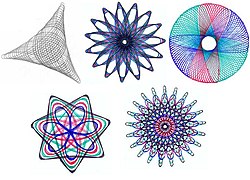
Sol Lederman presents Curve stitching with Mathematica posted at Playing With Mathematica.
Meanwhile, does anyone remember the NBC adventure series 'The Tales of the 77th Bengal Lancers'?
Ever heard of curves with infinite perimeter and zero area? Read That's Impossible! One Giant Nerdgasm at Consumed By Wanderlust.
And, of course, Jesus of Nazareth is supposed to be of the 77th generation from Adam.
What does the Great Pyramid tell us about ancient Egyptian mathematics? Dave Richeson reveals an interesting consequence in Division by Zero.
77 is evil.
Alexander Bogomolny presents Areas on the Graphs of Power Functions posted at CTK Insights.
77 is also vile!
At Travels in a Mathematical World,  Peter Rowlett presents a collection of podcasts and videos from the Math/Maths Week 2010, and from Young Researchers in Mathematics 2011.
77 is the number of digits of the 12th perfect number. Somewhat uncannily, 77 also is the number of integer partitions of the number 12.
Mike Croucher ponders whether graphical calculators have outlived their usefulness at Walking Randomly.
77 is the sum of three squares, 42 + 52 + 62, as well as the sum of the first eight prime numbers.
Speaking of calculators, did you know you could multiply on your fingers? I didn't, but Math and Multimedia reveals some tricks.
77 is the atomic number of the element iridium. Does anyone remember Motorola's ill-fated ventured of the same name that was supposed to revolutionise global telecommunications?
While the little folk do elementary mathematics on their fingers, the powerhouses of the discipline get their breakthroughs at the most peculiar places and moments in time. Dick Lipton lists some of them in Godel's Lost Letter and P = NP.
77 is the largest number that cannot be written as a sum of distinct numbers whose reciprocals sum to 1.
Pat Ballew highlights the quotation 'old mathematicians don't die, they just go off on a tangent', and illustrates nicely the properties of tangents to a cubic at Pat's Blog.
77 is not a sum of two squares - but it is a sum of 2 squares!
At Short Sharp Science, Catherine de Lange reveals how tattoos (unsightly at the best of times, heheh) become even unsightlier with age. Mathematicians have developed a model that describes the aging of tattoos. (Do you think the picture below looks like a tattoo of 77? No? Dash it.)
And IT History has a little piece on the beginnings of computer user groups - all the way back in 1952!


Speaking of beginnings, it's the centenary of IBM. Take a look at this celebratory post at Antipodes: Reflections from an Australian Expatriate in France?

"Wannabe professional gambler" Zac mixes up probability and ethical humanism in his post Gambling Theory at Zac Sky.

SquareCircleZ ponders what is the correct graph of arccot(x)?

Alex Bellos discovers that there are more to triangle centres than he had previously imagined (and revealed to us in his book Alex's Adventures in Numberland).

Roice has some clever Geodesic Saddles.

And Joe Manausa shows how Tallahassee residents need to wait till 2018 for their house prices to return to equilibrium in his case study. Long time to wait, eh?

And just so that we Anglospeakers don't feel too alone, we are pleased to reveal that the Spanish blogosphere has its own Carnival of Mathematics. The latest installment is by Juan Martínez-Tébar Giménez at Los Matemáticos no son gente seria, and it showcases entertaining pieces on, among a couple of dozen other things, Tartaglia and Cardano, the Nash conjecture, the decipherment of a wartime diary, and the centenary of the Royal Spanish Mathematical Society.

That's it for this month, people. Please do take a look at our sister carnival - Math Teachers at Play -  and also note that you can follow the Carnival of Math on Twitter: @Carnivalofmath. The next Carnival of Mathematics should come up around Jun 3, 2011. Please send in your submissions here.

Apr 3, 2011

Wireless Trends

The Wall Street Journal had a recent article about a bunch of entrepreneurs gathering in New York to discuss trends in wireless technologies. Of course, there is food involved:
Around 8 p.m., dinner was served. Guests had two choices: Arctic char with green cabbage, cauliflower and American caviar, or a braised flat iron steak with caramelized shallots, squash and sweet potatoes.

In the middle of dinner, Rush Doshi, co-founder of SuperGlued, a free iPhone app that lets users share concert experiences and buy tickets, threw a mind grenade onto the table. "I don't think people realize how much data they are giving away," said Mr. Doshi. "I think you'll start hearing a lot more about privacy."

"You share much more information on the Web than you do on your phone," replied Eric Litman, chief executive of Medialets, a two-year-old company that helps advertisers create and serve ads on mobile devices.

As the waiters brought out a dessert of sticky toffee fig cake, entrepreneur Jonathan Wegener said the emergence of tools that allow people to set up private groups would help solve the problem. "People will take back privacy by creating groups," said Mr. Wegener, co-founder of Exit Strategy, which makes an app with New York subway and street maps.

Feb 3, 2011

Motorola Chaser

In 1997, I joined Motorola's Cellular Subscriber Division to work on some of the earliest cell phones of the digital era. It was a heady time slightly dimished by the knowledge that the powers-that-be in the company insisted that analog phones (in which Motorola had an overwhelming market share) still had a viable future. We worked on the Startac, the flip phone to define all flip phones, and in parallel we worked on one or two other models. And while we developed bespoke user interfaces and device drivers for each digital phone, the likes of Samsung and Nokia had already begun to eat our lunch with their clever use of modular and reusable software architectures. In the time it took us to develop one or two models, these savvy companies could churn out entire families of phones, from low-end mass-market to high-spec and high-margin. It didn't take long for Motorola's share of the mobile market to plummet.

About two years later, I thought it time to see what the competition was doing. I interviewed at Sony in San Diego, CA, and at Philips in Piscataway, NJ, and accepted an offer at the latter (mainly because they offered me way more than stingy Sony). Philips Communications, when I arrived, appeared to be on its last legs. Its phones were hardly selling and there were constant rumours of layoffs. As a contractor, I wasn't too fussed. There was far too much demand for skilled telecomms software types for me to be jobless for long.

The top-brass had to come up with a plan to save their collective skins, and their idea was to license Qualcomm's software and hardware, stick it into a phone designed by us, and sell it under Philips' brand name. To that end, three or four of us were sent to San Diego to learn about the ins and outs of the Qualcomm system, understand its design and programming interfaces, and bring samples back with us to Piscataway.

At the time, digital wireless networks were still patchy across the US, and I, with my background in Motorola, was interested to see how interoperable Qualcomm's offerings were with the extant (and extensive) analog networks. But when I asked questions about the analog parts, I was looked on strangely, both by the Philips and the Qualcomm engineers. Clearly a dinosaur, they thought to themselves. What a pity. And he looks so young!

Qualcomm hosted us at a baseball game and sent us back to New Jersey with encouraging noises. In the event, our trip was wasted. We returned to find that Philips Communications was, for all practical purposes, defunct.

While we were gone, the bosses at PCC had agreed to sell the division to Motorola. In fact, my old boss at Motorola would become the head of this new outfit. I joked that I had been so sorely missed that my ex-boss was willing to buy an entire company just to have me back. Then I quit.

Years later, I found myself in the UK and working for a little company called TTP Communications. This was a little shop filled with creative and innovative engineers. It provided the hardware design and software systems for such iconic mobiles as the Blackberry; various Asian manufacturers were using its products in phones that they sold in their own names. It was struggling in the wake of the dot-com collapse but had somehow managed to continue with its research and development. But within a year of my arrival, it became clear that TTP Communications couldn't carry on on its own. I left in 2005, and a few months it was taken over.

And who was it that came riding to its rescue? Why, Motorola, of course.

In the years that passed after that, I didn't keep up much with the fate of TTPCom. Today, amazingly, its name came up once again. I attended an Anti Market Abuse training course in the office, and what did I hear? In 2006, the general counsel of TTPCom, having learnt that Motorola was about to acquire it, got his father-in-law to buy TTPCom's shares. Two days later, the acquisition was publicly announced, the share price soared, and a month later, the father-in-law sold his stock for a profit of £49,000. He then gave the legal eagle a half share of the proceeds.

In 2009, both men became the first to be sentenced in the UK under the FSA's insider dealing purview. A later appeal was dismissed, and the solicitor had to spend 8 months at Her Majesty's pleasure.

I used to have occasional nightmares of finding myself back in Motorola, writing requirements documents and creating systems designs. I enjoyed my time with that company and I have always wished it well. But now finally, I can congratulate myself that its pursuit of me has pretty much ground to a halt.

Happily, there's not much danger of them ever buying up a financial institution.

Jan 6, 2011

Mom and Pop Companies

The expansion of the private sector in India is to be welcomed after years of dirigisme and stifling over-regulation. There is now considerable competition in most spheres of business. Still, many companies - no matter how big - are run like mom-and-pop concerns, like personal fiefdoms, with little scope for professionalism.

Of course, the private sector in India is coloured by the same prejudices and sensibilities that suffuse general society. Even the most educated managers are often unable to look beyond class or gender stereotype. Here are a few examples.

Sudha Murthy, wife of one of the founders of Infosys, and an engineering professional in her own right, wrote eloquently about being denied even the possibility of a job interview with Telco. So agitated was she that she sent a letter to JRD Tata about the 'injustice the company was perpetrating.' That letter had the requisite effect, and she was invited for an interview, where she was told that the reason women were not encouraged to apply was that they had never worked on the factory floor. Surely, though, that should change, said the lady. Otherwise how would women ever work in Telco?

She got the job. Later on, she married Narayana Murthy, helped set up Infosys, which, as we all know, went from strength to strength, and is now one of the most successful enterprises in India.

Unfortunately, though, Sudha's experience didn't transform the culture in the new organisation. A few years ago when the wife applied for a job there, one of the questions she was asked during the interview was 'How do we know you won't get married and leave?' Would the hiring cretins ever ask a man this question? No. But a woman is always fair game for this sort of condescension.

I don't know if the culture has improved any in the fifteen years since this episode. I would certainly hope it has.

*******************************

A friend applied to NDTV - again, this was about fifteen-odd years ago. He was interviewed by Prannoy Roy himself, the head honcho. Roy is an urbane and erudite man, not an insular fogey, but even he was more interested in my friend's social background than in his qualifications. I guess the fact that he was called for an interview meant that his qualifications were sufficient, and from that point on, it was a question of ascertaining his family background, his connections, 'is he one of us?' There has always been a class divide between the English and local language press in India, and this sort of interview served to confirm the divide by hiring people from Roy's own milieu.

I think NDTV has broadened its reach and approach over the ensuing years. Going by the reporters that now appear on TV, one is heartened by their different backgrounds and accents and outfits. Perhaps this is a company that has now understood the true value of diversity.

*******************************

The healthcare industry is undergoing a boom in the country with top-notch hospitals being established offering world-class medical diagnostics and care. So successful are some of the hospitals that they now want to branch out into entertainment. Reality TV and medical dramas both require the services of medics, and what better way to raise the profile of a hospital chain than by having its celebrity doctors participate? Inevitably, the egos of these star doctors rival those of the actors, as happened with a friend of mine who was the brunt of one such bigwig.

Dissatisfied with some paperwork that Tilottama had prepared, the doctor's wife (herself a doctor) phoned her in the office.

'Tilottama?' said the doctor's wife. 'This is Uttara Bhuj.'

'Yes, Uttara,' replied my friend. 'How can I help you?'

'Excuse me,' said Bhuj's wife. 'You are not my friend, I hardly know you, so I'd much prefer it if you addressed me as Dr Bhuj.'

My friend was not one to take this lying down.

'I am sorry,' she said, 'But you are not exactly my best friend either, so courtesy then demands you address me as Ms Soni.'

Bhuj's wife lost her marbles at that point and began to shriek and snarl. 'Do you know who you are talking to?' she yelled, and went on to add sundry threats and demands.

'Listen,' said Tilottama, 'If you have something official to discuss with me, we can continue to speak. But I have no interest in your threats.'

And she hung up.

Moments later, the phone rang again. It was the star husband, the main doctor himself.

'What is all this?' he thundered. 'You have been rude to my wife!'

'Mr Bhuj,' began Tilottama, and was immediately interrupted.

'Doctor Bhuj,' said the good doctor. 'Where are your manners? I'm going to the Chairman to complain about this serious lack of professionalism.'

Tilottama's patience wore even thinner.

'You can talk to the Chairman if you like,' she said. 'I hope he understands the difference between professionalism and attitude. If he doesn't, I see no reason to continue in so blinkered an organisation.'

I guess the problem is that bigwigs in a hierarchical society as India are so used to getting their own way, throwing their weight around, stomping on everybody they consider beneath them, that a mouse that turns stymies them completely. They are not sure, suddenly, if they are dealing with a mad person. Immediately Dr Bhuj was conciliation itself.

'Arrey, why fight at all?' he said, as though he were the soul of bonhomie. He then proceeded to discuss the situation calmly, and the two of them managed to sort the original matter out.

Frankly, I don't expect this enterprise to grow out of its mom-and-pop-hood.

Nov 25, 2010

George Magnus at Lunch

UBS organised a lunchtime session yesterday with George Magnus, their Senior Economic Advisor, and author of the recent Uprising: Will Emerging Markets Shape or Shake the World Economy. While Mr Magnus spoke, several investment managers nibbled delicately on Poached and smoked Loch Duart salmon rillete with buckler sorrel, Classic lamb navarin with autumn root vegetables and ratte potato puree, finishing off with White and dark chocolate mousse with chocolate sable, and some coffee. Magnus himself had to pass on his starter, barely got into his main course, and smacked his lips only once upon the dessert.

The question he sought to answer in his book was its subtitle: ‘Will Emerging Markets shake or shape the world economy?’

He broke up the prognosis into 3 indicators:

1. Demographic change: while many Emerging Market (EM) countries are aging rapidly, others (e.g. India, Indonesia, Turkey) are having a boost in working age populations that will continue to last over the next 10-20 years, and can provide a big increase in growth and productivity if they are all gainfully employed. If they aren’t employed, of course, there can be serious social problems.

2. Technological catch-up in EM: some EM countries attain excellence in some aspects of technology (e.g. green tech in China, biotech in India, …). But there isn’t that depth of cultural and social infrastructure that enables them to consistently beat the developed world at all aspects of technical prowess. The catch-up means – for the most part – that the revenues will likely continue to flow into the developed market countries that produce most of the technical knowhow.

3. Climate change: while the worst affected countries by climate change are all EM, they will possibly spend large amounts to develop infrastructure to resist the worst of its effects.

The EM world has developed its manufacturing capacity to supply a world growth rate of about 6% p.a, which was the sort of growth seen in the two decades before the credit crunch. If world growth slows, then this overcapacity can lead to economic problems in the EM as well. And if developed world begins to save more, EM needs to spend more, otherwise we will end up with de-globalisation, protectionism, … As Magnus points out, despite noises at G20 meetings supporting globalisation and open markets, there has been a trend in protectionist measures over past two/three years already impacting about 2% of world trade.

The Chinese seem to understand that they have a part to play in the rebalancing of the world economy, but whether they will actually do anything other than mouth platitudes at 5-year plan announcements remains to be seen.

I got a copy of his book (signed, but not addressed to me) and stepped back into the cold streets of the City. At that same time, another demographic challenge was revealing itself. Students had taken to the streets of London too - only they were protesting increases in their tuition fees as part of UK's fiscal austerity. It's a sad truth: the babyboomers have enjoyed a long, long boom, and will continue to reap its dividends long into retirement, while their children and grandchildren face years of unemployment and relative indigence.

The generational struggle can only get worse.

Jun 16, 2010

Minor Catastrophes

If you are like me, inept with things mechanical and too lazy or incompetent even to hang up pictures on the wall, then you do exactly as I do when the dishwasher goes on the blink. You curse fluently for several minutes, thereby vastly improving your five year old's vocabulary (and, at a day's lag, that of his classmates). You kick the dishwasher. You scratch your head. You then look for the instruction manual.

If you are like me, disorganised and uncoordinated, you won't find the manual. You will then look for the phone number to call for an engineer, and, after scrambling around for half an hour in the study, find a reminder to extend the warranty, and recall that you never really did fill it out and send it off. You curse some more to your son's everlasting awe and your wife's eternal disgust.

You look for your home insurance, and possibly even find it, only to realise that, as there's been no flood in the apartment, you are not covered. You then look for your appliance protection cover, and possibly even find it. In my case, you don't find it, because you haven't bought it.

You are now resigned to calling out the engineer, and possibly postponing that austerity drive you've been planning for the past six months but something always crops up, and you know that this will cost at least a hundred quid.

But wait! Did you forget the fuses? Perhaps a fuse has blown? You extract the dishwasher's personal fuse and it looks like no fuse you've seen before, and you have no idea whether it's, well, fused or not. So you replace it with the washing machine's fuse, and still the dishwasher doesn't turn on.

Is the mains fuse blown? Clearly not, because, well, the washing machine worked, didn't it?

Then a brief light goes on in your head, and you decide to browse the internet for a solution. Surely others have had similar problems?

With a little bit of effort, you locate a forum in which the keywords 'does not switch on' appear, and you read on with bated breath, and you realise that it's the anti-flood device that has disabled your dishwasher.

The forum suggests that you suck out the water from the salt tank, and you realise you don't have a rubber tube. What you have, though, is a vacuum cleaner and you wield it to great effect, except now your hardwood floor is soaked, and the vacuum cleaner is whining something awful.

Then you realise you have a 5 millilitre syringe you use to give your boy the occasional dose of paracetamol, and you thrust it into the salt tank, and syringe out little spurts of gunky water, and each time you thrust it into the tank, your cuticles scratch against its edge, and soon you are bleeding.

Being mathematically inclined, you ponder how many times more you'll need to stick the syringe in. You arrive at the estimate of - about 200.

And you drop the syringe into the tank.

And your wife points out that you could have used a turkey baster, except that she is a vegetarian, and you don't have a turkey baster. You go to the hardware store and get one and come back, and empty the salt tank, and baste away, and suddenly the dishwasher turns on, and you exult, and load the dishes back in (and, naturally, it's a particularly heavily soiled load), and you choose the washing cycle, and you hear the water rush in, and the detergent drops, and all is well with the world.

And five minutes later, the dishwasher dies again.

Welcome to the twenty-fourth instalment of the Giant’s Shoulders, the monthly carnival of science and history-of-science blogging from around the planet. In this issue, there’s a bit of a preponderance of historical vignettes, which I trust you’ll find interesting.

Shall we start with a timeline of scientific discoveries, analyses and inventions? How about this – from years that end in 24 in every century? I’m missing several years, so if you’d like to fill those in, please be my guest.

I can’t think of any particular grouping in this carnival. You know, by subject and all that. It’s pretty motley. Chronological order is somewhat unsatisfying, like arranging books on your shelf in alphabetical order of title. Let us, therefore, be whimsical.

From New at LacusCurtius & Livius, we have Bill Thayer’s introduction and a link to a classic paper about how people developed effective ways to compute the heights of mountains. It’s a wide-ranging work, starting from the Ancient Greeks and working its way through Kepler and The paper is from 1929, so expect nothing on GPS in it!

Continuing with mensuration, Ethan Siegel at ScienceBlogs has a neat little piece about how to determine distances to the stars. In How Far to the Stars, he explains the principle of parallax, notes that Copernicus thought he could use it to tell distances, and then goes on to Christiaan Huygens’s idea of using luminosity to compute how far Sirius is from us.

So we are able to measure distances with excellent accuracy. But what of Heisenberg’s Uncertainty Principle? Surely it’s impossible to measure simultaneously (to arbitrary precision) both the position and the momentum of an object? This is certainly true on the scale of the truly small, but why is it not so evident on the scale of our senses? Why does quantum mechanics explain to remarkable accuracy the weird behaviour of the minute but loses that weirdness at the macroscopic? On homunculus, Philip Ball presents Big Quantum, where he talks about this explanatory lacuna in the transition between the very small and the large. It’s all due to decoherence!

************************************************

How about some pseudoscience? Alchemy has had a bad rap, and yet it provided the foundations for chemistry. Via Thony C., we have Lawrence Principe and the Rehabilitation of Alchemy – another lecture in Utrecht posted at Heterodoxology.

For another example of the genre, we have Caroline Rance at The Quack Doctor with an interesting little piece about one type of alternative medicine – uroscopy. This is the use of urine’s colour, consistency, taste and smell as a diagnostic tool. By the 19th century, professional medics had discounted this as quackery, but common people continued to frequent piss-doctors. In Cameron the Piss-Prophet, we learn how one such worthy was hoist by his own petard.

From one aspect of quackery, we move on to another. In 1726, a woman named Mary Toft (or Tofts) was a sensation in England for having allegedly given birth to rabbits.

Hogarth's Cunicularii (source: Tate Britain, Hogarth Exhibition 2007)

She had supporters and deriders in equal measure; scientists argued both in her favour (e.g. a medical doctor, John Maubray) and against (Sir Richard Manningham, a male midwife). William Hogarth’s Cunicularii at the Wellcome Library Item of the Month (besides analysing some lovely etchings by the great artist) raises a subtle question.

Leaving quackery, we ponder another form of obfuscation. Via Thony C. we have an article titled “Follies of the present day”: Scriptural Geology from 1817 to 1857 by J.M. Lynch at A Simple Prop. Who were scriptural geologists? These were scientists who tried somehow to unify vast geological time with their faith in the Bible’s six days of creation. Note that these people did not believe (pace Ussher) that the Universe was formed in 4004 BC.

Why did these Christian scientists not pay closer attention to James Hutton? In 1785, he had published an article Concerning the System of the Earth, Its Duration, and Stability in which he began the study of deep geological time. Via Thony C., we have John F. Ptak’s Raising Greatness: James Hutton’s Deep View of Time, 1795 posted at Ptak Science Books talking about Hutton’s remarkable intuition, as he saw the entirety of Earth’s history explained in the sloping red sandstone at Siccar Point.

While on the subject of deep time, a fossil of the Archaeopteryx was first discovered in 1861. Since then palaeontologists have argued whether this transitional creature (between dinosaurs and true birds) was capable of flight. Ed Yong presents First Birds Were Poor Fliers at the Discover Magazine Blog. There were some reasons to believe that the beast could fly but also good reasons why not.

Fossils and da Vinci - who would have thunk it? Via Thony C., we have Brian Switek's Leonardo da Vinci - Palaeontology Pioneer at the Smithsonian Magazine's blog.

************************************************

Dorset Ancestors have a biography of Francis Glisson, a native of that English county, who went on to great success as a doctor in 17th century London. When he heard of a new debilitating disease among children of Dorset, he studied it carefully and concluded that this bone-deformative condition (which we know as ‘rickets’) was caused by malnutrition.

A sesquicentennial after Glisson plied his investigative mind, another Englishman began to consider the various causes of deafness in people. As a diagnostic tool, John Harrison Curtis invented the Cephaloscope, which is described in Jaipreet Virdi’s post The Cephaloscope on From the Hands of Quacks.

John Harrison Curtis also insisted that aurists – students of auditory illnesses – should also be attached to medical hospitals. Jaipreet Virdi’s related post The London Asylum for the Deaf and Dumb tells this story.

From illnesses of the body, we segue to a illness of the mind. The dreaded African disease, sleeping sickness, when in an advanced stage, often resulted in violent mania. Was this true insanity on the part of the natives, or just a manifestation of a fear of isolation in a camp? From Sleeping Sickness and Lunacy at the Colonial Psychiatry Hub, we learn that much documentation of the effects of sleeping sickness on the local population is available from the British staffers of the Colonial Office (Uganda).

************************************************

Just for variety, here’s something to watch rather than to read. Via Thony C., we have Lens on Leeuwenhoek: Videos about his life, times, and accomplishments posted at Lens on Leeuwenhoek.

This video is an overview of the life, times, and accomplishments of Antony van Leeuwenhoek (1632-1723), the Dutch scientist who used hand-made single-lens microscopes to become the first human to see protozoa, bacteria, sperm, and red blood cells, among many other things.

And although that video’s only 7 minutes long, it promises more riches to come. Can there be any more to van Leeuwenhoek, then? Indeed there can, and Thony C. presents Lego-nhoek? posted at Antoni van Leeuwenhoek Centraal.

van Leeuwenhoek, of course, was a contemporary, competitor and Royal Society colleague of that polymath Robert Hooke. I found several blogs on this brilliant Englishman, and planned to chuck them in here, but closer scrutiny revealed that at least one of those pieces was a copy of a Wikipedia article. I hope this is not a similar copy: Leland Velazquez discusses the Physics of Bungee Jumping. Hooke’s work on elasticity leading to his eponymous law is the underpinning of this extreme sport.

If Robert Hooke is around, Christopher Wren can’t be far behind. Another brilliantly multifaceted man, Wren involved himself in astronomy, mathematics, architecture, art, and – we learn from Christopher Wren and the Bees by Gene Kritsky at Wonders & Marvels – beekeeping. Why is this scientifically relevant? He also developed the transparent beehive that was suitable for the scientific observation of bee behaviour.

The bees were able to move between the various layers of the hive, and glass panels set into the structure allowed an observer to see the honey cascading down inside it. Although Wren’s construction had not been an immediate success (due to a failure to realise that bees worked downwards), it offered the prospect of an ever-increasing stock of bees and honey within the same hive. [from here]

Speaking of polymaths, there was Florence Fenwick Miller in the 19th century. She was a suffragette, a journalist, an educator, and a qualified medical doctor. From Peacay at the absolutely ravishing BibliOdyssey, we have An Atlas of Anatomy.

From Peacay at BibliOdyssey again, we have Fungis Danicis, a lovely set of illustrations of fungi studied by a Danish lawyer-turned-botanist named Theodor Holmskjold in the 18th century. This worthy actually identified over fifty new species during two years of observation in the countryside near Aarhus.

************************************************

Now for some controversy! When scientists without training in history try to develop works in the history of science, clearly feathers are ruffled.  Via Thony C., we have Renaissance Art or Neuroanatomy? Part 1 and part 2, posted by Darin at PACHSmörgåsbord. It appears that there have been a series of papers over the past 20 years by various scientists trying to find hidden anatomically precise messages in Michelangelo’s art.

Michelangelo's The Creation of Adam

R. Donald Fields wrote up a guest blog at Scientific American recently that discusses the oeuvre; as it turns out, none of the scientists involved is a trained historian. As the rebuttal at PACHSmörgåsbord makes clear, this is dangerous practice:

Why does this matter? Because such articles attract the attention of editors and contributors at places like Scientific American. These contributors then post a redaction of the article on the website, where the post becomes one of the most popular. Such redactions misrepresent the history of science, suggest that anybody can write the history of science, and deny that historians of science have a discrete expertise. That’s why it matters.

But just to show that not all scientific speculation on art is ill-founded, check out this interesting bit of detective work by a bunch of astronomers at Texas State University. Via Thony C., we have a post by Roger Sinnott on Sky And Telescope titled Walt Whitman’s Meteor-Procession, we learn about the great poet’s imagery (“the strange huge meteor-procession" that went "shooting over our heads" with "its balls of unearthly light”) and an interesting astronomical phenomenon.

I’m not sure if this next piece fits within the purview of our Carnival (as it may be more aligned to sociology) but I think it relates to a seminal work of behavioural psychology, so perhaps I can present it? Christopher Greene’s Clarks’ Black-White Doll Experiment Replicated at Advances in the History of Psychology blog discusses an even more controversial subject than that in the preceding paragraph, and highlights its most recent replication under the aegis of CNN (full report here in PDF).

************************************************

On to more jolly subjects. Remember Light Amplification by the Stimulated Emission of Radiation? It is 50 years since the invention of the (optical) laser. Via Thony C., we have Happy Birthday! posted by Matt Springer at Built on Facts.

Another anniversary is that of Vannevar Bush’s visionary piece sixty-five years ago in the Atlantic Review about associative links in information, which one can easily see as an early precursor to hypertext and all that. Via gg, we have Simon Harper’s review ‘As We May Think’ at 65 from his blog Thinking Out Loud.

In the 19th century, by a gradual process of socialisation, the scientific and professional communities in the USA began to differentiate themselves. Will Thomas posts Paul Lucier on ‘Professionals’ and ‘Scientists’ in 19th century America at the Ether Wave Propaganda blog.

We end on a luminous, numinous note. What links a certain 1980s teen film, a song by John Parr, the Chinese sea-goddess Mazu, and – wait for it – ionised air? In St Elmo’s Fire, Captain Skellet of A Schooner of Science explains the whys and the hows of the gorgeous blue glow that appears on the tips of masts on sailing ships.

************************************************

[And there you have it. Thanks for stopping by. I hope this encourages  you to write up your own pieces on science and its history and philosophy. Do consider submitting your blog article to the next edition of the giant's shoulders at The Dispersal of Darwin. You can use the carnival submission form. Past posts and future hosts can be found on the blog carnival index page.]

May 30, 2010

What A Pirate Wears

During our recent trip to the US, we purchased an iPad. Since then the wife hasn't been seen in society. She lurks constantly in the dark, obsessively surfing for high-graphics content, and, when thirsty, using the coffee app that enables her to pretend she's giving herself her dose of caffeine.

A couple of days ago, the UK app store opened up for iPads. When the wife wasn't looking, I surreptitiously downloaded a couple of programs that I found interesting. One was a finger-painting tool. Rather nice (observe my creativity in attached picture).

The other was the iBookshelf or whatever it's called, using which I browsed the Gutenberg free book catalogue and saw for myself the beauty of this application. Not that I will be reading much on this device. I like the idea of multiple e-books on a device, but not so much the activity of reading on it.

Entirely accidentally, I downloaded the Harbour Master game, and now the wife is completely lost to society. The thrust of the game is to control a myriad of ships and boats - each moving at a different speed and carrying different container loads - to get them to dock, unload and depart without crashing into each other. This morning, while she chatted on the phone with her mum, I achieved the princely score of 51. Believe you me, this took some doing. Feeling mighty chuffed, I looked at the all-time honours list. The top score is 3400-odd.

Now the boy is beginning to obsess about the game. His intent is to crash boats as soon as possible. He enjoys the sound of the bubbles as the boats sink. The wife and I have to fight him off constantly. Then the wife fights me off.

Which is why I'm blogging and she hasn't been heard from for yonks.

May 24, 2010

Encoding Man

At a party recently, I met an elderly gent called Bruce. An affable and well-spoken man, he happened to mention that he had worked in telecommunications and computer software from the 1950s onwards. In the US, he was employed by Marconi at a time when the first inter-exchange trunks were being established, and their signalling protocols were being designed. These served to connect local and regional telephone exchanges so that long-distance calls could be made without need for an operator. These days, telephone exchanges are connected with fibre-optic cables; microwave transmission is, I think, still common in less developed parts of the world. But Bruce worked at the time that predated even microwaves, he said. First VHF, then the 200MHz spectrum. Naturally I wanted to know all about it, and when he realised that I was a fellow telecomms type (at least in spirit these days), he was glad to talk. He travelled quite a bit, he said, all over the US, and, later, across Europe.

"Then I worked with the very first mainframes," he said. He spent many years with ICL, that British computing behemoth that fell apart, and was acquired by Fujitsu. Not that the union with Fujitsu was any more successful, of course. PCs were taking over the world, and even though many people at organisations such as Honeywell and Unisys and IBM and Fujitsu could see the writing on the wall, institutional inertia led to these mainframe manufacturers getting increasingly sidelined. But all that was in the future when in the 1960s he began working on COBOL.

COBOL! Who even mentions this programming language these days? The last I ever had anything to do with this was as part of a Programming Languages Lab at IISc, where the instructor was so bored and disinterested that I spent his classes playing tic-tac-toe with myself. That was in 1992. Short years later, enterprising Indian engineers were writing clever parsers and translators to convert COBOL to more modern programming languages in keeping with the large-scale effort on the part of mainframe owners to switch to PCs. They made more money than I can shake my finger at; then they parleyed all that experience in sorting out the Y2K bug for an increasingly panicked world.

Upon close questioning, Bruce revealed that he was instrumental in the internationalisation projects for COBOL. Essentially, the idea was to allow applications to provide seamless interfaces to users in various (human) languages without having to rewrite the underlying code. With all the expertise garnered from this effort, in later life Bruce became the editor for the first Unicode draft. He spent months, he said, going over every line of that 1000-page document. It aimed to standardise computer encodings for every written script on the planet. The ASCII codes for the Latin script could only provide 255 characters, and so in countries such as China where the script consists of a few thousand characters, they developed their own encodings. Without a streamlined system, Chinese computers would suddenly find it impossible to understand, say, a Russian one. I speak extremely loosely, of course. But with Unicode, you could have a uniform encoding for all possible languages - Amharic and Mandarin and even North American Cree. Is Klingon also Unicoded? No, but Unicode is flexible enough to allow it.

"You can thank me for my sleepless nights," said Bruce.

Others have depended on Bruce for his abilities. Even if he doesn't speak or read all the world's languages, he can identify most of them from their writing. At his local barber's, the proprietor, an Italian woman, once showed him a book left to her by her father. He recognised it to be written in the Devanagari script. He asked a colleague - a cellist - in his orchestra if she could read it. She, a Bengali Scotswoman, couldn't.

It turned out to be a Hindi book of poetry published in Gorakhpur. The Italian barber was keen to know if it was a rare book; if so, she might make some money selling it. He had to tell her, rather regretfully, that it was far from rare. The print run had been 120,000 copies.

[Based on Brian Cox’s Jute Journey, BBC Two.]

In 1883, a migrating humpback whale took a wrong turn off the coast of Scotland and swam up the river Tay towards Dundee. At the time, that Scottish city was the whaling capital of the United Kingdom. After a terrible struggle, the carcass of the great animal was carried triumphantly through the thoroughfares of Dundee. Workers in the local factories were thereby given a grandstand view of the animal that had enabled the other of Dundee’s duumvirate of industries – jute mills.

Although this coarse fibre had been grown and used in Northern India for thousands of years, for almost all of that period it could be woven only by hand, a labour-intensive and difficult task. In Dundee, however, a serendipitous discovery changed all that – soaking jute in whale oil made it soft enough to be woven by machine. The production chain thus began, extending from Calcutta in Bengal all the way to Scotland. Shipped from India and woven in Dundee, jute became a further economic multiplier, when hessian sacks began to carry everything from cotton and coal to sugar and salt across the world. Dundee began to supply even the American West, where the strong and versatile fibre could be used as tarpaulin for the wagon trains. Seeking their livelihoods, migrant workers arrived in Dundee in thousands. By the end of the 19th century, the city had quadrupled in size.

Most of the immigrants were from Ireland, poor and Catholic. The churches that stand there to this day owe much to the indigent Irish jute workers. Yet it wasn’t their religion or nationality that made them stand out. Three quarters of those who worked in the mills were women. And so Dundee became known as ‘She Town.’ Women and children could weave, and an entire matriarchal society was setup. Women became powerful in many ways. To this day, women’s church groups continue the tradition of autonomy and social power.

But of course that social power was exclusively within their own milieus. As far as the bosses of the mills, the rich upper-class were concerned, the mill-hands were so much cattle. The mills were incredibly noisy and many workers went deaf; the dust and fibre in the air destroyed their lungs. Still generation followed generation into the mills, entire families occupied in creating wealth for Dundee.

Dundee’s population had shot up by 30,000 during the jute boom in the 19th century, yet only a few hundred new houses were built. The cramped quarters ruined the health of the residents; by the time of the Great War, most of Dundee men were considered too weak to fight. The jute barons meanwhile built their own large houses away from the grime of industrial Dundee, in a district called Broughty Ferry. So posh was it that the area by Strathern Road was for a time the richest square mile on the planet, until it was superseded by Hollywood in the early 20th century.

Yet only two miles away, infant mortality was the worst in Scotland.

Mary Brooksbank was a Communist jute worker enraged by conditions in the mill. She wrote a lament about the time:

Oh, dear me, the world is ill-divided
Them that work the hardest are the least provided
I’m unbide contented, dark days are fine
There’s nae much pleasure livin’
Half and ten and nine
By the time she wrote these lines, the time of jute in Dundee was already passing. The jute barons strove to outdo each other in the grandeur of their mills, playing ‘my chimney is bigger than your chimney’. They failed to see that their industry was nearing its end. The balance of power in the world of jute had shifted to Calcutta.

Calcutta’s first mill opened in 1855; seventy-five years later, the city was producing 70% of the world’s jute products. With a never-ending supply of raw materials right on its doorstep, it made far more economical sense to concentrate the industry in Bengal, rather than half-way around the world in Scotland.

Today there are Scottish veterans forming the Calcutta and Mofussil Society: veterans of the Indian jute industry who like to congregate in places like the Monifieth Golf Club, to partake of Indian food, speak Hindi, and reminisce about their days in the East. The majority of Calcutta’s mills were owned by expatriate British businessmen, but they were run by Dundonians. Ambitious jute workers moved from Dundee to Calcutta in the 1850s, and they ran the industry there for the best part of a century. The last ones returned to Scotland in the late sixties, having been made to feel rather uncomfortable and unwelcome in independent India. They joke about it now, of course, but they heard the labourers keeping the rhythm while loading and unloading jute, singing what sounded like ‘hey-ho, the sahib’s a saala’ (meaning, pretty much, that the boss is a bloody bastard).

In their prime, though, walking about Chowringhee was like ambling about Dundee High Street, what with all the accents of home they heard at every turn. The Jutewallahs left Dundee for India in search of better lives, a fortune perhaps. They imprinted themselves in Calcutta’s being. Even in the 1980s, long after they had returned home, the jute barges on the Hooghly River still bore marks of Dundee’s great mills – Eagle Works, Baxters…

The Hooghly was the centrepiece of the world of jute, providing berthing for ships bound for Dundee as well points of disembarkation for the Jutewallahs arriving to take up their new jobs and accommodations along the river banks.

The efficiency of the operation was reflected in the tiniest detail. A Jutewallah arriving in Calcutta at 10 in the morning was measured out for trousers and double-pocket half-sleeve shirts by a durzee by lunchtime at noon, and would have his clothes ready by the evening. The very next day he could report for work.

Whereas Calcutta, with its cinemas and shopping, provided a whiff of Europe to the culture-shocked arrivals, the jute mills themselves, thirty miles upriver, were a stark contrast to home. Their accommodations, though, were comfortable. A multitude of servants waited upon them hand and foot: bearers, cooks, jamadars who did the floors and bathrooms and walked the dog, a coolie who dusted and made the beds, a durwan at the gates, and the driver. If they didn’t have their eight servants, they felt outcast from their social peers – status was important to maintain.

For the men, it was pampering on an Imperial scale. Their clothes would be taken off them, the bath prepared, fresh clothes laid out, breakfasts, luncheons and dinners all ready at preset times, everything moving as clockwork. For the expatriate womenfolk, though, it was much harder. The wives may have thought they controlled the households, but they didn’t. The bearer really was the boss. The wives’ lives were of leisure, but not having anything to do would inevitably wear them out.

But they were Scots and the sun always shone, so they did what they always did best: wild parties. The bearers would be in their splendid turbans and cummerbunds, the cooks aflutter; the Scots fell upon the gin and whisky bottles; there would be tennis and swimming, and by the end of it, they would be drunk silly, in the pond, the mill tank, everywhere...

Life for the peasants who grew the jute was, inevitably, much much tougher. From planting to maturation was ninety to hundred days, by which time the jute had grown over seven feet high. In intense humid heat, the farmers worked day after day to harvest their golden fibre. When jute prices began to fall, they had to supplement their incomes by growing other crops. Even today, Bengal’s farmers are unable to participate in the rise in demand for the ecologically green crop. They scarcely earn 40 pence a day from it. But still, today, nearly four million families owe their livelihoods to jute.

With India’s partition in 1947, the best quality jute-growing areas fell into East Pakistan (later Bangladesh), tantalisingly out of reach for Calcutta’s jute mills. In the orgy of violence that befell the countries in the wake of that great sundering, the Dundonian Jutewallahs found themselves protected behind their compound walls, defended by stalwart Gurkhas. Shortly thereafter, the Indian government issued directives that more and more locals should be employed in positions that were held by Europeans. Many Jutewallahs thought that the mills would collapse once they left and the Indians took over; the know-how, after all, was with them and not the natives. There was a mass exodus of expatriates out of Bengal, and by the early 1950s, most of Calcutta’s mills had passed into Indian ownership.

The Marwaris, business-oriented clans from Rajasthan, became the new kings of jute. They had been involved in India’s jute industry from the very beginning, but they continued to employ Dundonians as managers. Interaction between the Scots and the Indians increased substantially. The Jutewallahs trained up Indian colleagues; in some conservative mills, however, there were still lines that could not be crossed. Several of them who fell in love with Indian women found themselves fired from their jobs.

Even setting side the racial aspect to their relations, the cultural gap between the Jutewallahs and the local workforce was huge. The Jutewallahs arriving in the 1950s were ex-servicemen, capable of following the orders of the powers-that-be without demurral. They were given a book titled ‘The Essentials of Colloquial Hindustani for Jute Mills and Workshops’, which contains such gems, translated, as ‘They will have to show better work than this, or otherwise you will have to dismiss them.’ and ‘You must finish your work as soon as possible.’ and ‘You must not lose your ticket, or I will have to stop your money.’ The language used by the boss established very clearly that the worker was lesser than he was; the whole tenor of that little book was that the boss was a better person than his employee. The book, originally printed in 1947, remained in use until the last of the Jutewallahs left Bengal in the mid-1960s.

But more entrenched was the social divisions among the colonials. The Establishment of the Colonial masters and their descendants, members of the Tollygunge club (which only admitted, for instance, its first Indian member thirty years after Independence!), looked down upon the Jutewallahs as mere labourers, bottom of the social heap. The bankers in Calcutta considered themselves higher than the jute mill office managers; naturally, the latter had to find people in the mills to look down upon as well, people like the assistant mill managers and their flunkies. These various hierarchies very rarely mixed socially. Those raucous parties were always among Jutewallahs of a particular social stratum.

It is undeniable, however, that the Jutewallahs worked very hard. They could get used to the heat and humidity, mainly because they were constantly changing their clothes. Arrive at the mill at 6 o’clock opening; go home for breakfast and change; go to Calcutta, change; back from Calcutta, change; get back home at 7 in the evening. They worked full days Monday to Friday. Saturdays were half-days. New Year’s Day was really the only holiday. They even worked on Christmas.

The labour of the Indian workmen was far harder. Day in and day out they toiled in torrid heat and corrosive dust. Discipline was harsh in the mills. As long as they worked hard and were punctual, they had jobs. If not, well, there were millions others desperate for a job, any job. Just as in Dundee decades earlier, the conditions and support for Indian workers in Calcutta were dire. There were no tribunals, no unions, no reprieve.

For the Jutewallahs, the financial rewards of working in Calcutta were immense. By 1890, there were almost 3000 Dundonians working in Bengal. But they also faced serious perils to their health. The Scottish cemetery in Calcutta is testament to the toll on their lives. Many who came in search of their fortunes didn’t make it back home. Shakespeare, as ever, put it best:
Feare no more the heate o' th' Sun,
Nor the furious Winters rages,
Thou thy worldly task hast don,
Home art gon, and ta'en thy wages.
Golden Lads, and Girles all must,
As Chimney-Sweepers come to dust.

You know you want one. I want one. In fact, I want it now, and no piddly iPhones are going to cut it for me any longer. Behold, folks, the Pomegranate NS08. Be sure to check out its really slick homepage.


  I attended the latest useR! conference this week, which lasted three days (Aug 12-14) at Dortmund. We've been using R at work for about a year or so now, and there's much to learn about this incredible statistical language and its ancillary 'packages', tools developed by academicians and practitioners in a variety of disciplines, all available free and online, supported by a vast cast of enthusiasts and gurus. So here I was, toting my little bag of goodies, and ambling from room to room to listen to some very interesting presentations across the R user spectrum.

The conference was held at the Statistics department of the Technical University of Dortmund. Only two weeks earlier, torrential rains had flooded the large auditorium of the department. Stains were still visible, but a massive cleanup before our arrival meant that everything appeared as it should - ready for four hundred visitors.

Unlike Curving Normality who blogged regularly and live from the various sessions he attended, I am doing this from back at home. I did take notes during the talks on a little pad that was given to us courtesy Google, but my handwriting these days is much worse than it used to be, and I doubt even a pharmacist would be able to make much of it. Still, here goes - summaries of three of the more interesting talks I attended.

The first talk I attended was on Loss Functions by a professor of actuarial studies, Vincent Goulet. Actuaries are interested in such things as ruin, the distribution of insurance claims, and the probabilistic properties of insurance payouts. To model these events, Goulet introduced an R package named 'actuar', in which he proposed several families of distributions, including those called censored. These, in particular, are interesting to insurance specialists. A client with a deductible is not going to make a claim if he thinks his damages cost less than the deductible to make good. In such a situation, the distribution of claims would be left-censored. Likewise, insurance payouts are usually capped by the size of the cover. Payouts, therefore, follow a right-censored distribution.

This is of relevance to us in finance as well, especially if we want to model the effects of management fees on a portfolio. Because irrespective of how well a manager performs, he always gets his management fee, the returns to a client from the manager are always that much less than the manager's overall performance. For the manager's revenue stream, on the other hand, there's an effective floor - and that can be modelled by a left-censored distribution.

An example of the multifarious uses of statistical tools came from Miriam Marusiakova, of the Charles University of Prague, who presented an R package 'forensic' to help in DNA fingerprinting. It is well-known that the DNA composition of any two human beings (other than identical twins) are distinct. Since it is unfeasible to compare DNA strands in their entirety from various possible sources,  forensic scientists have isolated certain markers that can serve as witnesses for distinction. Unfortunately, these markers themselves do not provide sufficiency of difference, and so a statistical analysis is required to determine how likely it is that the DNA found at a location came from one person or many.

Naturally, this is important! Let's say that a certain amount of DNA was found at a crime scene. There is a victim V and a suspect S. There are three possibilities: a portion of the DNA is known to be of the victim; there's only one type of DNA, suspected to be that of the offender; there's several sources of DNA found. The prosecution's hypothesis is that some of the DNA came from S. The defence's hypothesis is that the remaining DNA came from persons unknown U. How to determine which of the hypotheses is the correct one?

Miriam explained that external information needs to feed into the statistics. For instance, certain genetic factors are present to a greater or smaller degree in various populations. Not incorporating these factors into the statistics leads to overstating the case against the defendant. The classical probability law, named the Hardy-Weinberg law, is inapplicable in this case.

Another twist is that the offender and/or the victim, and the defendant are related! Usually, there is an assumption that the offender and the victim are independent. Miriam's package enables the analysis of all the above possibilities.

As a concrete example, she showed the widely different conclusions that could be drawn from the O.J. Simpson murder trial of the early 1990s in California. If the various factors and match probabilities were not estimated correctly, it was as easy to prove that the DNA found at the crime site was Simpson's as it was not. Lesson - estimate accurately and account for all possible variations.

The effervescent Janet Rosenbaum of Harvard University produced one of the most entertaining examples of research I've ever come across. She dealt with the notorious abstinence (virginity) pledge in the USA, and examined whether the sexual behaviour of teenagers who took the pledge was any different from those who didn't. (See here for some of her work, and this news report at the Washington Post.) I can do no better than quote from her very thorough abstract at the conference:

Objective: The US government spends over $200 million annually on abstinence-promotion programs, including virginity pledges, and measures abstinence program effectiveness as the proportion of participants who take a virginity pledge. Past research used non-robust regression methods. This paper examines whether adolescents who take virginity pledges are less sexually active than matched non-pledgers.

Previous researchers had compared the sexual behaviour of pledging teenagers against the general population of teenagers, and concluded that, indeed, the former were less likely to have had sex, and had a lower incidence of sexually-transmitted disease. For the US conservatives, this was brilliant news, meaning they could cut federal funding for contraception and women's sexual health, and provide instead abstinence coaching and use the numbers of pledgers as a metric of success.

But, of course, the comparison is not fair. The correct thing to do would be to match pledging teens with non-pledging teens who have similar backgrounds and ideologies. After all, the people who take the pledge are not average US teens. Many of them are from evangelical families, deeply religious, often born-again. When this matching is done, the results are quite clear:

Five years post-pledge, 84% of pledgers denied having ever pledged. Pledgers and matched non-pledgers did not differ in premarital sex, STDs, anal, and oral sex. Pledgers had 0.1 fewer past year partners, but the same number of lifetime sexual partners and age of first sex. Pledgers were 10 percentage-points less likely than matched non-pledgers to use condoms in the last year, and also less likely to use birth control in the past year and at last sex.

The behaviour of pledging and non-pledging teens is statistically identical! Worse, one to five years after having taken the pledge, 84% of those teens denied having pledged. Egregiously, many who had sex before taking the pledge declared themselves virgins shortly thereafter. To add insult to injury, pledgers were often more ignorant of contraception when they did succumb and have sex, and were thus less likely to protect themselves from disease or pregnancy before marriage.

Rosenbaum concluded that federal funds would be better spent in teaching effective birth and STD control than on abstinence measures.

Other interesting presentations:

  1. Tomoaki Nakatani, ccgarch: An R package for modelling multivariate GARCH with conditional correlations.
  2. Rory Winston, Real-Time Market Data Interfaces in R. (How to connect to Reuters from R)
  3. Susana Barbosa, ArDec: Autoregressive-based time series decomposition in R.
  4. Ray Brownrigg, Tricks and Traps for Young Players.
  5. Wei-Han Liu, A Closer Examination of Extreme Value Theory Modelling in Value-at-Risk Estimation.
  6. R. Ferstl, J. Hayden, Hedging Interest-Rate Risk with the Dynamic Nelson-Siegel Model.

Apr 17, 2008

Mobile Telephony

In the good old days when digital wireless telephony was in its infancy, there were several contending technologies slugging it out for supremacy in the US. There were no standards, and the policy of the regulators was to allow the market-dominant technology, when one such emerged, to become the de facto standard.

This took several years and a lot of money was spent, contributing both to my ever-fattening pocket and the stock market, and then the big bust and the associated flattening of my wallet.

Meanwhile, the Europeans, in their infinite wisdom, had established the GSM system by fiat. Rigorously enforced by publicly available standards, it galloped its way to dominance across the world.

Countries such as India and China followed the US in allowing multiple competing technologies. But after all the dust settled, two techniques remained standing: CDMA and GSM.

It was all very exciting in those early days. These were the 1990s and the mobile world was dominated by Motorola. The Nokias and Ericssons and Siemenses of the world were only coming into their own in network infrastructure; the Japanese and the Koreans with their nifty and miniature designs of cell-phones were not too visible in the global market; there were multiple behemoths in the US alone (Hughes, Nortel, Lucent) fighting to corner the market.

At the time, a little example was used to explain the competing technologies. The old analog method was, in effect, a two-way FM radio system. Each mobile - in conversation - would be assigned a frequency pair to transmit and receive on. One could liken this to a room of people each speaking at a different pitch. You would be able to follow any conversation by just tuning your ear to a particular frequency. Humans can do this rather well, especially at higher pitches. Try it in a room of men and women and kids talking. You should have no problem zoning into the various speakers just by virtue of their pitch of delivery.

Of course, this was immensely wasteful. For one thing, there are large pauses in conversation when one person listens and the other speaks. During this time, the frequency allocated to the listener's speech is inactive, and could be well used for another conversation. In fact, there are small pauses in the midst of active speech as well, such as when one catches one's breath, or hems and haws. While these are brief moments in a human's perception, for computers doing the allocation of channels, these are sufficiently long that they can switch the use of the frequency to another speaker. Unfortunately, signalling the activation and deactivation of channels is not very efficient in an analog domain, and so this brief enhancement was not developed further.

As the capacities of the analog networks began to fill up, regulators demanded a more efficient use of the spectrum allotted to the mobile providers. The only way forward was to go digital. The first attempt was called TDMA (Time-Division Multiple Access), which can be illustrated thus: in the same room with multiple speakers, assign to each speaker a frequency pair (as in the analog case), but allow them to speak only for a fixed period in time, pause for a fixed period, speak again, pause, and so on. Now, a listener only needed to know the 'active' periods, the time-slots during which to listen in. At other times, he would tune out. In this fashion, TDMA allowed three times as many speakers on the same bandwidth as the old analog system (by creating six time-slots on each frequency, and assigning one pair for each speaker, fixed for the duration of the phone call).

Hughes went one step ahead with their Digital Speech Interpolation technique: it sensed the silent periods and released the allotted time-slot, which could then be assigned to another conversation that entered the active phase. I was working at the company at the time, and their great idea was to develop a large unit from which 96 telephone lines could be drawn; the unit - placed on top of a block of flats, and communicating wirelessly with the phone network - would then provide a rapid deployment of a telephony service in countries where these were not so readily available. As an alternative to digging up roads to lay copper cable and wiring up huge sections of a town, this was superb. (And that's how I got involved with a large-scale installation of the technology in Jakarta in 1995. But that's another story.)

The problem with the method was that the slot release-and-assignment cycle took a bit of time, and resulted in delays in the voice path. Behavioural studies have shown that a human conversation can handle loss or degradation in the sound (the ear-to-brain pathway is very robust) but it can't tolerate delays in the speech. You may recall from the old days of satellite-based trunk calls (if you were around at the time) how so much was time was spent repeating yourself while your voice travelled into space and back. Exactly the same flaw dished the Hughes system, and after the Jakarta installation, I don't think there was much takeup of the idea.

An alternative to TDMA was Code Division Multiple Access, possibly the most elegant technique in communications that I have ever come across. CDMA worked as follows: imagine that, in that same room of people, the conversations are happening simultaneously (unlike TDMA, where there would be stops and starts as people awaited their allotted time-slot to converse), but in different languages. Now all a listener needed to do was to tune into a particular language, and as long as nobody was speaking too loudly, it would be easy to isolate a particular conversation amidst all the background noise. In CDMA, also known as spread-spectrum, there was little to distinguish an active call from the background chatter; only an observer in exact coherence with the code governing the call would be able to distinguish it from white noise. The sensitive power-control required to prevent mobiles from swamping each other by 'shouting' was one of the trickiest aspects of CDMA to master. As they moved around, the mobiles might lose or regain line-of-sight to the base station, resulting in large variations of received power.

Now, spread-spectrum can be achieved either as above with codes, or with high-speed frequency hopping. Once the receiver and transmitter are synchronised and the sequence of frequencies to hop are known, they can remain in sync throughout the conversation. The constant jumping across the spectrum results in a wash of low-power radio almost indistinguishable from background noise, just as in the case of codes. The full implementation of this method had to wait for the development of fast signal processing chips and powerful processors. But the original idea was developed in 1937, and by the unlikeliest figures imaginable.

This is surely one of the most romantic tales in the sciences. Fleeing from the Nazis and her Fascist arms dealer of a husband, Hedy Lamarr emigrated from Austria to the US. She was already well known as a stunningly beautiful and talented actress; what was less well known was her sharp mind, and the fact that she had listened very carefully to her ex-husband's colleagues as they discussed armament and technology. At the time, researchers had been struggling to develop a method to prevent remote-controlled torpedoes from being jammed by enemy radio signals. Lamarr realised that by sending control signals to the torpedo by hopping across a pre-defined set of frequencies - unknown to any interceptor, but with the transmitter and receiver in perfect sync - the torpedo could be effectively immunised against hostile jamming. Together with the pianist George Antheil, she developed a hopping technique based on piano rolls, and applied for a patent, which was granted in 1942.

As it was a military secret, its details were not published for years. 17 years later, it expired, but it entered the public domain only in the 1980s. Antheil died in 1959, and Lamarr in 2000; they never received any monies for the industrialisation of their patent. But in 1997, the Electronic Frontier Foundation honoured Hedy Lamarr for her pioneering work, and a sin of omission was finally atoned for.