I was on jury duty a while ago. Two weeks of my life spent on my civic responsibility. Most of the time was spent waiting to be selected for a trial. During that time, I had little to do than eavesdrop on my fellow jurors.
An actor waited in the summoning room. He held forth at length to an attentive young woman.
I was called to audition for The Crown, he said. To be a doctor.
I thought to myself, do I really want to be a doctor? It is far too generic. So I declined.
I didn't want the role. It is better to chase a role not wanting it and not getting it, than chase it wanting it and not getting it.
****
I am going to be rather busy in the New Year, he said.
Do you know Robert Fisk? He has written a book on the Middle East. I'll be doing readings from it in Rotherhithe.
I am teaching at an acting boot camp. It is a somewhat difficult balance to achieve. If I spend too much time on any one person, they won't learn their lines. If I spend too little, they are resentful.
****
Last year was interesting, he said. I was in Italy. The fringe theatre scene there is incredible. It is in the most unlikely places, and inexpensive, and people turn up after a long day's hard work.
****
My family? Well, there are actors, he said. My sister directs. My mum runs a bed and breakfast. It tides over the lean times.
She is like you, he said, she has an arts background. But she is more practically-minded.
****
My sister organised a panel discussion with the remaining cast of Solaris. Yes, for the 50th anniversary of Gagarin's flight. It was awesome.
****
You know, the real creatives in TV are the producers and the scriptwriters. The director is like a glorified first assistant.
****
Can you imagine Maggie Smith and Alan Rickman with all those kids? Here you have the best of British acting and the camera is focused at their knees and all those children milling about. Paid good money, though.
We went for dinner once with Rickman and when the bill came, Rickman stopped us, saying: "Two words: Harry Potter."
The actor was so pleased with his drawling imitation of Rickman that he said it again:
To provoke, or sustain, a reverie in a bar, you have to drink English gin, especially in the form of a dry martini... Connoisseurs who like their martinis very dry suggest simply allowing a ray of sunlight to shine through a bottle of Noilly Prat before it hits the bottle of gin. Another crucial recommendation is that the ice be so cold and hard that it won't melt, since nothing's worse than a watery martini. For those who are still with me, let me give you my personal recipe, the fruit of long experimentation and guaranteed to produce perfect results. The day before your guests arrive, put all the ingredients - glasses, gin and shaker - in the refrigerator. Use a thermometer to make sure the ice is about twenty degrees below zero (centigrade). Don't take anything out until your friends arrive; then pour a few drops of Noilly Prat and half a demitasse spoon of Angostura bitters over the ice. Shake it, then pour it out, keeping only the ice, which retains a faint taste of both. Then pour straight gin over the ice, shake it again, and serve.
The wife's been reading a biography of W.C. Fields (W.C. Fields: His Follies and Fortunes, by Robert Lewis Taylor). It was first published in 1950 - the hardcover copy we have is from the library, and it's been in the library so long that it was put away into the archival shelves aeons ago. A look through the borrowing dates shows that it was first taken out in May 1953, and then about once a month till October 1954, after which the frequency dropped to once in two months or so till mid-1956. Then the borrowings fell even more to about once or twice a year, and there was a long pause where it gathered dust between 1969 and February 1972, the last year stamped on the borrowing slip.
1972! The wife wasn't even born then. She was very excited to be holding a book that was so old. Plus it had the smell of old books that we love so much. We took turns taking deep whiffs. Then I saw the sign on the borrowing slip that reads as follows:
SURREY COUNTY LIBRARY
140 HIGH STREET, ESHER
This book should be returned to the Branch from which it was borrowed by the latest date entered below: if not, fines will be charged. If the book comes into contact with any notifiable infectious disease you should follow the instructions of the Medical Officer and notify the Librarian.
ENQUIRIES ARE WELCOME
Notifiable Infectious Diseases?! And we've been breathing them in? Head for the hills. Nobody is safe.
I had a lunch meeting in the City and a bit of time to spare before another meeting in Canary Wharf, so I decided to walk. The straightest route, from Aldgate to Cabot Square, is more or less on the Commercial Road, as busy a street as you can want, and filled with rather shabby shops and rundown godowns and so on. It is a rather old thoroughfare, though, and an observant perambulator can see a thing or two worth looking at.
First, you must know that the Commercial Road was cut through the East End in the early 19th century by the East India Company. Almost the first thing of importance on the way is the Proof House of the Worshipful Company of Gunmakers. The Company was established in 1637; unlike other livery companies of the City, this was always situated outside the City walls, probably because of the noise of its 'proof' procedures. (Proofing was the testing of the safety of gun barrels.) The company acquired the property in a 'physic' garden in Whitechapel in 1675, which is now 46-50 Commercial Road. The original Proof House was damaged by explosions and rebuilt after 1757.1
Gunmakers' Company Proof House
Further along is the Synagogue of the Congregation, incorporating several Jewish strands - the Bikur Cholim and the Yevra Isroyel. The congregation was founded in 1904, comprising Lithuanian and Polish Jewish immigrants. Today, much of the congregation consists of local Jews as well as Jews from India and Germany. The synagogue was consecrated in 1921 after an internal redecoration by Lewis Solomon and Son, but was for a long time unused. After extensive renovations in 2004, it appears to be thriving again. I didn't see the interior, but it's supposed to be rather pretty.2
Continuing along my merry way, I saw the Steel's Lane Health Centre. This used to be the East End Maternity Hospital (1889-1968), which began as a Mother's Home at Number 394, and then gradually took over the rest of the block.
Steel's Lane Health Centre, by Tom Bastin, on Flickr.
It is architecturally notable for its windows with terracotta mullions and canted bays at either end. A chapel with trefoil-headed windows survives at the rear.3, 4 Above the main entrance to the clinic is a plasterwork figure with a cross. There is also a bright green clock with Roman face and gilt-edged, on which appears the legend 'East End Maternity Hospital'.
Victor McLaglen and Cary Grant in Gunga Din.
Next! I saw a blue plaque celebrating Victor Andrew de Bier McLaglen (1886-1959), a UK-born boxer and Hollywood actor. I hadn't heard of him, but it appears that he won an Academy Award in 1935 for the film The Informer (directed by John Ford). Here he is with Cary Grant in Gunga Din.
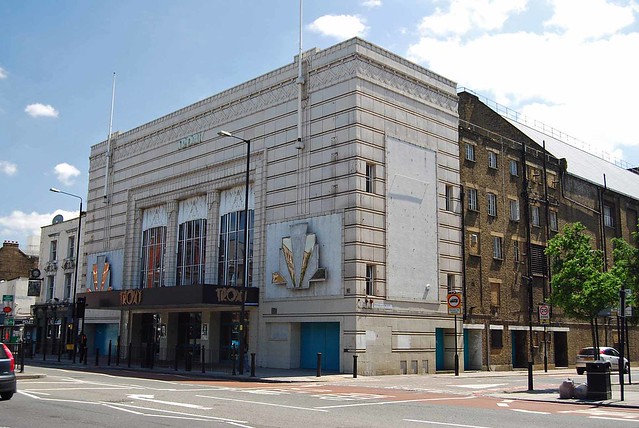
Troxy Art Deco Cinema, by Maggie Jones, on Flickr.
At 490 Commercial Road is a large Art Deco edifice called Troxy. It was designed by George Coles and opened as a cinema in 1933, seating 3520 people. It was built on the site of an old brewery; it was fashionable and luxurious and showed the best films. It even had an organ in the orchestral pit that would play the latest tunes during the interval. The cinema operated from its first film (King Kong) to its last (The Siege of Sydney Street) for 27 years. Later on, it served as a rehearsal space for the Royal Opera House and as a bingo centre. Today it's been restored to its Art Deco glory and serves as a multipurpose venue. As I approached Limehouse Station, I noticed a set of row houses on White Horse Road. This street is quite old: it was till modern times the only northerly route from the Thames through the East End. The area, historically, used to be the hamlet of Ratcliff. Until the 19th century, it appears that there were several large houses with spacious gardens, in which lived captains and others related to the shipping industry.5 The current terraces are not in any way distinctive, and the street has little else to recommend itself (other than a little graveyard at the corner with Salmon Lane - which I didn't walk up to), so I shall linger here no longer. A problem with Commercial road is that it is, in fact, very commercial, and not pretty at all. There are many properties derelict, businesses shuttered, squats. It might have been more interesting to walk around the squares and residential parts of the East End and Limehouse. I was in a hurry, however, and continued to propagate rectilinearly.
The next notable building is The Passmore Edwards Limehouse District Public Library. It is closed and derelict. It was founded in 1900 by Passmore Edwards, a newspaperman and philanthropist,6 who also created several other buildings to succour the East End. The library closed in 2003, was sold to a restaurant company,7, 8 and has still not been put to any use.
Limehouse Town Hall in 1937
A little further along is the Limehouse Town Hall, which doesn't look in great shape either. It was built in 1879. 9 I learned that when several parishes were amalgamated into the London Borough of Tower Hamlets, this building (along with the Poplar and St George's town halls) became surplus to requirements. It has housed various organisations over the years; these days it's being renovated as a cultural space, and was, in fact, opened to the public during this year's Open House Weekend.
St Anne's Limehouse, painted by Noel Gibson (via Spitalfields Life).
The lovely St Anne's Church is the next building on this potted tour. Designed by Nicholas Hawksmoor, it was consecrated in 1730, ruined by fire in 1850, restored shortly thereafter, and underwent a complete refurbishment between 1999-2009. It has deep connections with the Royal Navy: its clock was designed to guide shipping on the Thames, chiming every fifteen minutes.10 These days it chimes hourly, and no, I didn't hear it.
The clock in the tower is still the highest church clock in London, had the first illuminated clock face in the country, and its elevation enabled it to be seen by the thousands of ships which moored every day in the surrounding docks.11
The Star of the East pub is the penultimate building on my walk: it has a a couple of gas street lamps in front of it. I don't know if these are still lit or not. The pub was run by the Baxter family for years.12
The Star of the East pub, by Ewan Munro, on Flickr.
It appears that the first Baxter (Henry William) was hairdresser next door to the pub (founded in 1845), and he took over in 1871. There were still Baxters ruling the pub in 1915.13The Star of the East, Commercial Road, unusually has a fancy polychromed Gothic frontage, no doubt intended to attract drinkers from the nearby docks.14 The pub was closed in 2008 and was a restaurant for a while, and now there's chatter that it's a pub again, but I saw no evidence of activity as I nipped by. Across the pub is the British and Foreign Sailors' Hostel - yet another charitable construction by that worthy Passmore Edwards - which opened in 1901.15 This was recognised for the quality of the accommodations provided to sailors from across the British Empire. It is an Edwardian building, Art Nouveau in spirit, a welcoming gateway in form, and fluently carved with maritime symbols,16 including Britannia as a ship's figurehead. There are also various inscriptions, some faded more than others. You can see a bunch of pictures of the building and its features on Maggie Jones' Flickr set.17 Over the years, the building has had many popular names: Sailors' Palace, Jack's Palace, Mariners' Hotel... At this point, I had to leave Commercial Road and get onto the West India Dock Road, and as I had already dawdled a bit and was running late for my meeting, I jumped onto a bus.
*****
Other interesting sights that I missed: The George Tavern. The Original Chinatown: most of it was demolished following rioting and anti-Chinese agitation in the 1930s. To be fair, much of it was spread across Limehouse, and few traces remain on the Commercial road itself. References
The boy has been introduced to the parlour game called '20 questions.' He doesn't have patience for all twenty, and he is wont to spill the answer, but he likes the game and he thinks he should play it with me.
We are on our way to his judo.
"Okay, boy," I say, "You can start guessing."
"Is it a sportsman?"
"No."
"Is it a woman?"
"Yes."
"Is it an astronaut?"
"No. That's three questions already."
"Is it an actor?"
"Yes."
"You know, acha, I can ask you for the first letter of her name."
"Okay."
"So what's the first letter?"
"K."
"Er, Katherine, Kristina.. I don't know any actor women with K."
"Yes, you do."
"What does her last name start with?"
"K."
"K K. I don't know, acha, this is too hard," he says, slightly upset.
I mutter 'Kaif' under my breath and his face lights up.
"Katrina Kaif!"
We shake hands while he exults.
"I can't believe I guessed that," he says, grinning from ear to ear.
****
We start another game.
"Is it a sportsman?" he asks.
"No."
"Is it an actor?" he says, suspicion clouding his brow.
"Yes."
"Is it a man?"
"Yes."
"What's the first letter of the last name?"
"K."
"K? Again?" he says, indignantly. "Is it one of the Kapoor family?"
"No."
He breaks into the widest grin yet.
"Saif Ali Khan!" he says. "Saif Ali Khan!"
"Nope," I say, but he is not dashed at all.
"I know! I know! It's Salman Khan!"
****
"Now it's your turn to guess, acha," the boy says.
"Okay. Is it a sportsman?"
"No, acha, it's a vehicle."
"All right," I say. I already know what it will be.
"Is it Swedish?"
"No."
"Is it American?"
"No."
"Is it Japanese?"
"No."
"Is it German?"
"No," he says happily. "You are using up your questions, acha."
"Is it Italian?"
"Yes."
"Okay, so it is a Ferrari, right?"
"No."
"Lamborghini?"
"Lamborghini is not Italian, is it?"
"It is," I say.
"Well then," he says, "no."
"Is it an Alfa Romeo?"
"No."
"I know," I say, "It is a Maserati."
"No, acha," he says.
"Wait a minute," I say, glaring at him. "It is not a motorcycle, is it?"
"I said vehicle, acha," he says reproachfully.
"Well, a motorbike is a vehicle."
"I meant a car, of course," he says. "And you've used up 11 questions. Quickly, acha, we're nearly at the judo!"
"I'm kinda stuck here," I say.
"Shall I tell you what it is?" he offers, bouncing on his seat.
"No, no," I say. "Let me keep guessing."
"Well, go on, then."
"Is it a Lancia?"
"I have never even seen that, acha!"
"Fiat?"
"No."
"Aha," I say. "It is a Bugatti!"
"Of course, acha," he says triumphantly. "It is a Bugatti Veyron! It's the car you're going to buy for me when I get my driving licence!"
A few years ago, Olivia Judson burst onto the scene with Dr Tatiana's Sex Advice To All Creation. Various animals wrote to this biological agony-aunt asking for tips for better sex and procreation, and she gave them very pertinent advice. How to avoid being eaten by your mate after sex was one important topic, especially when you are a few hundred times smaller than her. A successful television show followed.
A bit later, Isabella Rossellini got into the act with her online series of videos titled 'Green Porno', which explored the sex lives of various fauna. These were gross yet funny; I watched one or two.
It turns out that the very clever Alessandro Boffa beat both women to it with his exploration of love, obsession and beastly antics, You're an Animal, Viskovitz. The hapless Viskovitz is desperately in love with the seductive Ljuba, but no matter what his incarnation - a mantis, a shark, a sponge, a scorpion - he is constantly thwarted, either by his bad timing, or biology, or the pressures from his friends or competitors (and it's always the same trio: Lopez, Zucotic, Petrovic). The wondrous Ljuba makes eyes at him, yet invariably he has to settle for the homely Jana. Animal behaviour to illustrate the human condition can be dry and academic, but Boffa, a biologist by training, has a facility with expression and superb humour, and this is lovely, whimsical stuff. Animal sex can be smutty, which allows us to segue into Alan Bennett's twofer, titled Smut: Two Unseemly Stories. Bennett has an unjudgmental touch with much sympathy for his characters, and he wields it lightly here. In one story, a widow joins a local teaching hospital as a diagnostic aid; the professor is attracted to her; the students think her 'cool' because she has allowed her bedsit tenants to perform sex acts in her presence in lieu of rent. Bennett explores sexual awakening in middle age: the widow is impressed by the versatility and energy of the young tenants and recalls that she had never been quite as enthusiastic with her husband. Although she doesn't appear to be much aroused by what she sees, she veers between heightened interest and indifference, and her main concern remains 'what will other people think if they knew?' In the other story, a gay man with an overbearing mother and a distant father marries a woman he considers silly. The dynamics in the family are in constant flux, and everyone's imperative to maintain their secrets and superficial relationships provides the humour and pathos in the tale. On the one hand, there are families that successfully hide their loves from each other, and on the other, there are entire societies that keep an aggressive, claustrophobic eye on everyone. The resulting atmosphere of suspicion and poison, parochiality and patriarchy, love and desire, is sparely described in Wajdi Ahdal's A Land without Jasmine. Set in Yemen, a lovely girl is an object of barely suppressed lust by nearly all the men she encounters. Her neighbours, local shopkeepers, her professors, all assume that she wants to seduce them. Polite smiles are taken as invitations. No matter how demurely she conducts herself, she stirs loins. The girl disappears one day, the police get involved, and the story lurches from one self-serving point of view to another. This is a furious, explicit polemic against the systematic brutalisation of women in traditional Arab society; small wonder that books like these forced Ahdal to leave the country to save his life. He is back in Yemen now, but who knows whether his much-needed voice has the audience it deserves? And finally we have the frankly peculiar Story of the Eye, by Georges Bataille. Reading it reminded me of Guillaume Apollinaire's nutty, frenetic and surreal Les Onze Mille Verges: Or, the Amorous Adventures of Prince Mony Vibescu, a bonkfest that is too funny to be erotic. (Oh, and it could have been in my sub-200-page read list, except I've read it already.) But where Apollinaire was light-hearted, Bataille is obsessive. Geometrically unfeasible contortions abound in this debut novel, which has far too many multiple orgasms to have any resemblance to reality. (Or, perhaps, I've just led a very sheltered existence.) Roland Barthes' textual analysis led to hidden meaning and much philosophising - so why is the book promoted as erotica? Besides the obvious intersection between sex, murder, madness and religion, what does it offer? It might have been avant-garde when it first appeared in 1928, but today it feels forced and pedestrian. I'm baffled, baffled, I tell you. (For some utterly bizarre reason I can't fathom, several of the books I've got from the library as part of my exploration of the sub-200-page range deal with sex. And I'm only up to the letter B! As you see above, we have an Ahdal, a Bataille, a Bennett, and a Boffa. Were it not for the Ahdal, I'd have given this blog the title of Birds and Bs.)
I swear I started with every good intention. Why not do a brain dump into the Hindi Wikipedia of all the good stuff I know about differential equations? I still recall my twelfth grade Mathematics final exam that had questions in Hindi and English. Solve the following differential equation, it said, and beneath it, unforgettably, निम्नलिखित अवकल समीकरण को हल कीजिये. Ooh, I was all aquiver.
And I was dashed. Dashed, I tell you. I could make no progress whatsoever. For one thing, there already is an article on differential equations. For another, formatting Hindi text was bad enough - mathematical text did my head in.
So I caved. Mamta Mohandas now has a Hindi Wikipedia page. This is clearly a quixotic effort. Who in North India even cares about Malayalam cinema? And which of these worthies will read up on her in Hindi, when the English page is equally comprehensive? I don't know.
Will someone please take a look at the page and let me know if I've made any grammatical or semantic errors? It's been years since I've read or written Hindi.
I explained to the boy that I, unlike him and his mother, was special. I have only one eyebrow, a long one from one side of the face to the other.
Like Frida Kahlo? he said. Does she have only one eyebrow as well?
Frida Kahlo in Diego Rivera's mural, to the right of the skeleton.
We were wandering about Mexico City when the conversation came up. Frida Kahlo, monobrowed woman, is everywhere in Mexico City. Her house has been converted to a museum. There is always a queue of tourists waiting to enter it. We too were there one warm day in April.
While we waited, I entertained the boy with eyebrow tricks. I raised one eyebrow and then the other. He screwed up his face attempting to emulate my dexterity. He squinted. He glared out of one eye.
******
Like nearly every other museum in Mexico, the Frida Kahlo museum allows visitors to take pictures upon payment of 45 pesos. We happily shelled out before entering the hallow of hallows. As the tourist throng snaked its way from one room to another, I caused minor jams every time I stopped to snap away.
There's always an officious bastard in every queue. One such specimen tapped me on the shoulder.
'You know you are not supposed take pictures in here,' he said.
I pointed wordlessly at my sticker that allowed me to take pictures.
He pointed wordlessly at the signs of crossed out cameras on the walls.
I looked around for a museum attendant. As expected, there was nobody around.
Seething with baffled fury, I put the camera away. Beautiful exhibits passed me by, unclicked. Three rooms later, I found an attendant.
'No, no,' he said when I pointed at the crossed-out-camera sign. 'These are ancient. You are allowed to take all the pictures you want.'
I turned to the officious bastard to crow triumphantly. Bugger wasn't there. Deflated, I continued along the tour.
******
[Watch the dancing eyebrows around 2:08]
Jack Black can make a wave with his eyebrows, I said to the boy.
All right, all right, hold your horses. I know that all 8 of you that attempted this quiz are desperate to see the solutions. So here you go.
1. Am positive a lamb leg will make things loads better: Shawshank Redemption 2. Jesus’s Granddad: Godfather 3. Mother Theresa, Hitler and John Merrick: The good. The bad, the ugly 4. Jarvis Cocker isn’t real: Pulp Fiction 5. Batman sees no moon or stars: Dark Knight 6. Nice guys: Goodfellas 7. A white Spanish house: Casablanca 8. Join for a barney: Fight Club 9. They stole Noah’s sat nav: Raiders of the Lost Ark 10. Not this lot in the lineup again! The Usual Suspects 11. Rectangular numbers: The Matrix 12. I can’t hear the baaas: Silence of the Lambs 13. This helps a community member walk: Citizen Kane 14. Keep Malibu and Santa Monica secret: LA Confidential 15. Canines playing in the water supply: Reservoir Dogs 16. Return to tomorrow: Back to the Future 17. Wet karaoke: Singing in the Rain 18. Bannister was an environmentalist: The Green Mile 19. Contender, Are you ready? Gladiator 20. Blindfolded and handcuffed underwater and got out, wow: The Great Escape 21. Expiring isn’t easy: Die Hard 22. Lottery win for poor Lassie: Slumdog Millionaire 23. A regal roar: Lion King 24. An expensive offspring: Million Dollar Baby 25. Blown away my dear: Gone With the Wind 26. There’s the 2184214 to Paddington: Trainspotting 27. It will have cost this toy boy at least £9k a year: The Graduate 28. Cloughie’s story: Life of Brian 29. Get me out of this womb or else! Bourne Ultimatum 30. I’m looking for one that leaves it all to me: Good Will Hunting 31. The story of Harry S.? The Truman Show 32. Filthy gyrating: Dirty Dancing 33. An expensive digit: Goldfinger 34. Don’t show him red…..too late: Raging Bull 35. I do, I do, I do, I do…..so sad: Four Weddings and a Funeral 36. The Queen’s one who needs treatment: The English Patient 37. There’s at least a couple decent chaps: A Few Good Men 38. Satan’s lawyer: Devil's Advocate 39. Don’t even have a hint: Clueless 40. Mind if I butt in young lady: Girl, Interrupted 41. Insomnia in Washington: Sleepless in Seattle 42. It’s the end of the world: Armageddon 43. The King's Wife rules over dry lands: Priscilla, Queen of the Desert 44. Indian junior keeps it beating to stay alive: Braveheart 45. He may be a predator but he's such a nice man: Deer Hunter 46. They just upped and left: The Departed 47. Tee it high and she will bloom, but she's no English rose: Driving Miss Daisy 48. 23.5 miles to bring Frank and us together: The French Connection 49. Rented bacon: Hamlet 50. Painful storage: The Hurt Locker 51. Knight of the Crop Landings: Lord of the Rings 52. He's here all year long - winter spring summer or fall: A Man for all Seasons 53. On the cusp of tomorrow the Indian's foe arrives: Midnight Cowboy 54. The wife doesn't believe it was arson: Mrs Doubtfire 55. Stateless for geriatric dudes: No Country For Old Men 56. Swiss elevators rock from side to side: Schindler's List 57. Amorous Bard: Shakespeare in Love 58. Friendly Party Animal connects over WiFi: The Social Network 59. A Creepy crawly male friend ....... as well: Spiderman 2 60. It's a contracted affection ... even fondness: Terms of Endearment 61. A prostitute's target meets the bootmaker: Tom Jones 62. Read the book on Ali G's home turf: West Side Story 63. Addition for those that enjoy the sun on the back: Some Like It Hot 64. Route to Hades: Road to Perdition 65. Uncle's son is related to Mr Jones ... : My Cousin Vinny 66. Insurrection for coconut candy: Mutiny on the Bounty 67. William II brings a regal finality north of Hadrian's Wall: The Last King of Scotland
All right, all you cryptic clue lovers. Here's a Christmas quiz: each is a clue to an English film. Send me answers - if you like - at j o s t a m o n at h o t m a i l . c o m:
Am positive a lamb leg will make things loads better.
Jesus’s Granddad.
Mother Theresa, Hitler and John Merrick.
Jarvis Cocker isn’t real.
Batman sees no moon or stars.
Nice guys.
A white Spanish house.
Join for a barney.
They stole Noah’s sat nav.
Not this lot in the lineup again!
Rectangular numbers.
I can’t hear the baaas.
This helps a community member walk.
Keep Malibu and Santa Monica secret.
Canines playing in the water supply.
Return to tomorrow.
Wet karaoke.
Bannister was an environmentalist.
Contender, Are you ready?
Blindfolded and handcuffed underwater and got out, wow.
Expiring isn’t easy.
Lottery win for poor Lassie.
A regal roar.
An expensive offspring.
Blown away my dear.
There’s the 2184214 to Paddington.
It will have cost this toy boy at least £9k a year
Cloughie’s story.
Get me out of this womb or else!
I’m looking for one that leaves it all to me.
The story of Harry S.?
Filthy gyrating.
An expensive digit.
Don’t show him red…..too late.
I do, I do, I do, I do…..so sad.
The Queen’s one who needs treatment.
There’s at least a couple decent chaps.
Satan’s lawyer.
Don’t even have a hint.
Mind if I butt in young lady.
Insomnia in Washington.
It’s the end of the world.
The Kings Wife rules over dry lands.
Indian junior keeps it beating to stay alive.
He may be a predator but he's such a nice man.
They just upped and left.
Tee it high and she will bloom, but she's no English rose.
23.5 miles to bring Frank and us together.
Rented bacon.
Painful storage.
Knight of the Crop Landings.
He's here all year long - winter spring summer or fall.
On the cusp of tomorrow the Indian's foe arrives.
The wife doesn't believe it was arson.
Stateless for geriatric dudes.
Swiss elevators rock from side to side.
Amorous Bard.
Friendly Party Animal connects over WiFi.
A Creepy crawly male friend ....... as well.
It a contracted affection ... even fondness.
A prostitutes target meets the bootmaker.
Read the book on Ali G's home turf.
Addition for those that enjoy the sun on the back.
Route to Hades.
Uncle's son is related to Mr Jones ....
Insurrection for coconut candy.
William II brings a regal finality north of Hadrians Wall.
The location of the terrorist attack of August 1980 was significant. Bologna, a rich and intellectual town, has often been called ‘Red Bologna’ for its reputation as a centre of leftist politics. And today this politically radical city has inspired a young female author to write a crime novel that profiles the rise of sexual violence against women.
In 2010, Barbara Baraldi’s The Girl with the Crystal Eyes introduced a new character into the Italian crime novel – the female vigilante. “[It] originated from a scene I had in my mind of a woman who killed,” says Baraldi, “who killed a man but more than one man, and therefore there arises an important question - ‘what in this day and age brings a woman to kill someone?’”
She removes her magic wand from the top of her hold-up stockings and caresses his throat. He hasn’t time to scream. The artery in his neck has been sliced open with a small bronze razor that looks like a prop from some old film. The blood sprays everywhere, staining the filthy walls.
It covers her.
It colours her.
“In Italy, very often sex crimes remain unpunished,” says Baraldi, “in the sense that men are released immediately, and therefore I thought about creating this provocative character of a woman vigilante who roams the city of Bologna at night which was considered once a calm city, a university city; but in reality it hides a dark side. And this vigilante dresses provocatively and when she is attacked, she kills. She only kills men with bad intentions.
“Certainly current stories in the news affect my novel because when I wrote it, there was an explosion in crimes – almost all of a sexual nature. I remember the most serious one, however, was treated quite lightly: a girl in broad daylight at the bus stop was dragged into the nearest park and raped. So in broad daylight, a young student… I mean, I was very angry when faced with all these things.”
They start laughing.
Crack.
Crack.
Two pistol shots.
Two bodies lying on their backs. The blood of one merges with the blood of the other in a macabre dance of bodily fluids.
Baraldi’s writing has a cinematic quality to it that readers can quickly relate to at once. She employs the literary equivalent of fast cutting and cutting between scenes to dramatic effect. There is a minimum of exposition, a minimum of explanation, as though she dares the reader to keep up with her. The reader may struggle initially, but it will be worth it in the end. Baraldi is of the generation where film has informed her writing as much as anything she has read.
She found her horror writing style from literary classics familiar to British readers. “Lately I have been dubbed an exponent of new Italian Goth,” says Baraldi. “I grew up with romanticism, and with mystery, and I’m passionate about Mary Shelley, and the atmosphere of Dracula.”
“When I was a child,” she continues, “I read fairy tales. What struck me was the fact that these were actually rather violent fairy tales being told: the Wicked Witch, or Bluebeard who hanged his wives in a room you could not enter without staining the key with blood.”
She takes the hairpin from her hair and drives it into his eye, punching through to the brain.
Barbara Baraldi has to make her way in a society that is not entirely propitious to women. There were several avenues of protest open to her, and she chose a rebellious, punkish mode. She has attracted a younger readership, one that is not easily shocked or squeamish. She is one among several female Italian crime writers, a set of women who do not write cosy novels of the Miss Marple genre. The books of the new Italian women are bloody and edgy, and a wonderful opposition to their contemporary male counterparts.
Massimo Carlotto’s first-hand experiences of Italy’s violent underworld has heralded a new wave of Italian writers who base their novels on real characters. From the other side of the law, a top Roman judge has dipped into his casebook to write an explosive novel set in the Italian capital, about the city’s notorious gangsters.
Giancarlo de Cataldo’s debut novel, Romanzo Criminale, was inspired by his work as an investigative magistrate in Rome, a role that took him both to crime scenes and prisons. Writers long for the sort of access he has, he says. If one is talented as a writer and has inside knowledge, it is a crime not to put it to use. He based his novel on a real street gang, the Banda della Magliana, a suburban gang that became a real criminal power in the city, “collecting money and imposing a kind of law as if the Mafia had for the first time, taken place in Rome.”
“I first met one of those people from the gang,” said de Cataldo, “he was a repented, he was under protection of justice, but those judges didn’t believe him, so he was set free and then murdered. The second chance was working in a trial against some of the members of these gangs, the survivors, because many of them were dead. They were real criminals, but they were old style criminals at the same time.” Set over a period of a decade, de Cataldo imagines that these people were involved in the darkest parts of the Years of Lead, a time that continues to intrigue Italians to this day.
One of the achievements of Romanzo Criminale is to fold in the lives of real people into the events de Cataldo describes in a responsible way. In 2005, a cinematic treatment with hip characters was released, dubbed the Italian Goodfellas. A pivotal moment in the film deftly flicks between real newsreel coverage of the kidnapping of Aldo Moro and the action of the book, reflecting the twin focus of the book.
De Cataldo also explores the bloodiest event from the Years of Lead, which took place at Bologna railway station in August 1980. In a dramatic moment in the film, a gang member Ice finds himself at the wrong place at the wrong time. A fictional character placed in that situation allows the reader to be involved in what might have occurred at the time. Ice arrives at the station at 10:23, and we know that at 10:25 the bomb has to go off. The explosion behind him is an effective reconstruction of the events, extremely disturbing, bringing us directly into the heart of the Bologna bombing, putting us there among the dead, showing us this is not just a fun gangster film.
De Cataldo explains that the film is different from the book, in that there is no coincidence between the gang and the bombing in the book. However, he adds, he wanted to emphasise that much of Italian history is criminal history, and there is a deep link between the lives of the ‘normal’ citizen and offices of the state, and the underworld. “And that is why Romanzo Criminale is more than a thriller – it is a historical and political crime novel.”
There's an entire world of poetry, literature and art devoted to the railways. Imagine three London stations, and imagine the references that suffuse them: Sherlock Holmes at St Pancras, or Harry Potter at King's Cross, or Dombey at Euston. What is the source of the railways' mystique? And why have they inspired litterateurs from William Wordsworth to J. K. Rowling?
Locomotives and the atmosphere they brew have been a source of inspiration for writers and poets for the past two hundred years. In Edwardian times, the railways were the lifeblood of the nation, the starting point of all adventures. A big station like York was a microcosm of the society it served. Here a writer like Andrew Martin could bring together characters like travelling gentlemen and chimney sweeps on the move. Station guards contended with cutpurses and station loungers and other species of railway riffraff. Stations teemed with life.
Martin set his novels in the Edwardian period because that was the zenith of the British rail network. His father had worked in the finance department of British Rail at York, and forever having to come up with cut backs. His novels were his vicarious revenge.
His father was railway aristocracy; not only was he able to travel at will in first class, but so was his family. Martin would occasionally take the train to London as a fourteen-year old boy, lounging comfortably in a first class seat, reading a book. A harassed-looking businessman would huff up to him and say, 'Are you aware you are in a first-class seat, young man?' to which he would reply, 'Yes, I am, thanks.' and return to his book.
Trains, he said (and I heartily agree), are superior to cars. You can read on trains. You will only feel sick in a car. Trains have a wgealth of culture behind them. Cars have not.
Train travel was not always so sedate. A hundred and fifty years earlier, you might have been gripping the armrests of your seat in quiet panic rather than read a book. Imagine your shock of a speeding train when the fastest thing you had ever seen before was a stagecoach. You thought your brains would fly out of your ears at that speed.
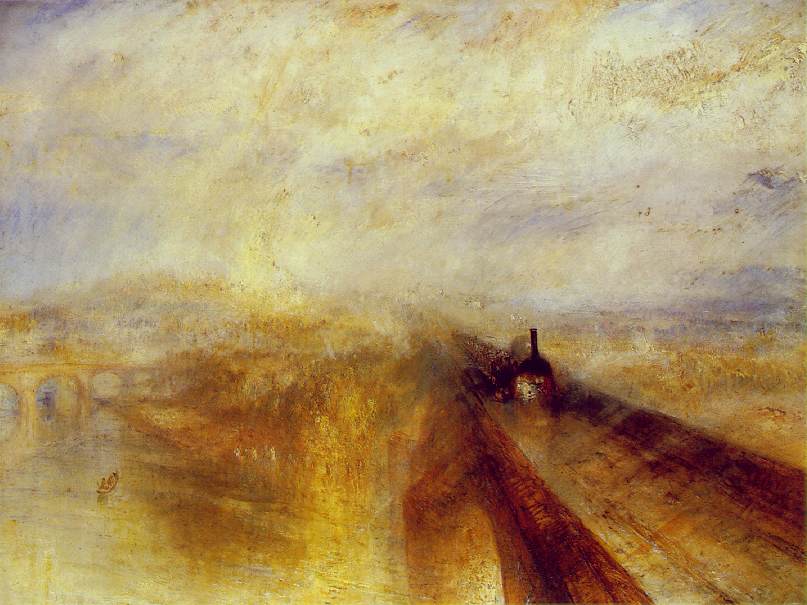
Turner's Rain,Steam and Speed [Wikimedia Commons]
One day in 1843 the artist Turner was travelling on the Great Western Railway. He stuck his head out of the window of a first class carriage during a rainstorm. He was most forcibly impressed. He was met with the demonic force of speed through a cloud of smoke and rain. The experience gave birth to his painting 'Rain, Steam and Speed - the Great Western Railway'. If you want to be pedantic about it, you would say that the painting shows a Gooch Firefly 222 locomotive. That's hardly the point. The image to the viewer is that of a bullet aimed straight at the heart.
Andrew Martin got into trouble at the National Gallery when he leaned too close to the painting when showing his son the hare running ahead of the locomotive. The hare, a very fast animal, is being caught up by the engine. Man is getting the upper hand over nature.
The advent of the railway in Britain was cataclysmic, concentrated into a few frenetic years. Nine-tenths of the current mileage were authorised in three years from 1844. These vast iron gatecrashers thundered through back gardens, cellars, beautiful meadows and social conventions. From the outset, they attracted the scornful eye of writers and anyone with a vested interest in contemplation. In 'a just disdain', Wordsworth wrote of England being blighted by steam.
Now, for your shame, a Power, the Thirst of Gold, That rules o'er Britain like a baneful star, Wills that your peace, your beauty, shall be sold, And clear way made for her triumphal car
A lightning rod for the railways anxieties of the time was Charles Dickens. His railway novel Dombey and Son contains one of the first descriptions of the landscape flickering past the train window.
Through the hollow, on the height, by the heath, by the orchard, by the park, by the garden, over the canal, across the river, where the sheep are feeding, where the mill is going, where the barge is floating, where the dead are lying, where the factory is smoking, where the stream is running, where the village clusters, where the great cathedral rises, where the bleak moor lies, and the wild breeze smooths or ruffles it at its inconstant will; away, with a shriek, and a roar, and a rattle, and no trace to leave behind but dust and vapour: like as in the track of the remorseless monster, Death!
A theme of Dombey and Son is the destruction wrought by the building of the London to Birmingham line that runs to Euston station. This was the first railway to come into North London. Unfortunately when it came to be built in the 1830s, Camden happened to be in the way. Dickens was a man attached to the idea of Merrie England, and much attached to the stagecoach. In his book, he referred to Camden as Staggs' Gardens. He knew the area well, having been brought up here when it had been more or less a village. During the construction of the railway he saw places he knew, including part of his old school, being destroyed. He was morbidly fascinated by the process.
The railways were omnipotent, and so like many other works of the time, Dombey and Son features a death by locomotive. The treacherous Carker is run over by a train; he
felt the earth tremble—knew in a moment that the rush was come—uttered a shriek—looked round—saw the red eyes, bleared and dim, in the daylight, close upon him—was beaten down, caught up, and whirled away upon a jagged mill, that spun him round and round, and struck him limb from limb, and licked his stream of life up with its fiery heat, and cast his mutilated fragments in the air.
It wasn't just the gutting of towns and villages that seemed wrong to the sensitive literary folk. The locomotives themselves appeared to be demonic powers, with a killing edge to them. In Anthony Trollope's The Prime Minister, the villain Lopez is 'knocked to bloody atoms' by a shrieking Scottish express. In Leo Tolstoy's Anna Karenina, the heroine commits suicide by leaping in front of an oncoming engine. Locomotives didn't just appear to be murderous figments of the imagination - they did have an unfortunate habit of killing people. Steam engines, scary enough when stationary, were whirled about the country at fantastical speeds. At the opening of the Liverpool and Manchester Railway in 1830, a Cabinet Minister, William Huskisson, was knocked down and killed. No wonder the government has been so reluctant to fund the railways ever since.
It was a simple equation: more railways meant more deaths. The 1860s were the darkest period when gory stories of mayhem caused by trains were rarely off the headlines. These 'smashes', as they were known, magnetised and repelled the Victorians in equal measure. Here was a very modern way to die.
In the 1860s, there were more trains on the same lines, going ever faster, the chances of collision ever so greater. The authorities did little to enforce safety standards till the 1880s.
Cartoonists portrayed the locomotives as beasts, dragon-like, intent on the destruction of mere humans. Returning from France on 9 June 1865, all of Charles Dickens' fears of the railways came true, when he was involved in a terrific crash near Staplehurst in Kent. The accident was caused by a work-gang lifting tracks off a viaduct. They had reckoned without the 2.38 from Folkestone to London.
Dickens helped soothe the injured and the dying with a flask of brandy and cool water in his top hat. Ten people died in the crash, and for the rest of his life, all of Dickens' anxieties would be subsumed by the greater one over Staplehurst.
The accident prompted him to write one of his greatest ghost stories, 'The Signal-Man'. A superbly gloomy version appeared on TV every Christmas during Andrew Martin's childhood. The story concerns a signal-man stuck in a cutting next to a glowering red light. He is at the mercy of an electric bell and the necessity of showing his red flag as a train rolled past. He is a fascinatingly neurotic man with many interests. He has taught himself a language whilst in his signal box, he has worked at decimals and fractions. But he is tormented by the loneliness of his job, the memory of two previous accidents, and a premonition of a third. He constantly feels the urge to send the telegraphic signal 'Danger. Take care.' but he can't say why. Of course, a smash is looming.
Dickens has often been described as the last victim of the Staplehurst accident. Later in life he attributed his ill health to 'railway shaking'. He died on the fifth anniversary of the crash.
In the 19th century, the railways shaped culture in other, benign, ways. People began to read on trains, and so in 1848, W.H. Smith opened their first railway bookstore at Euston Station. Books sold in stations were the forerunners of the airport novel: a new genre, inexpensive, with plots that could hold a passenger's attention throughout the distractions of a train journey, all that stopping and starting and 'Excuse me, is this the train for Birmingham?' As Cecily said in Oscar Wilde's The Importance of Being Earnest : "One should always have something sensational to read in the train."
An entire industry of sensationalist literature developed, with writers competing for the riders' attentions, and for shelf-space on W.H.Smith's stores. Between garish covers, there was everything the man or woman on the 2.22 desired: sex, insanity, and above all, violent death.
Cheaply bound thrillers were known as 'yellow backs' and their authors, such as Mary Elizabeth Braddon, sold in their thousands from the railway bookshops. The success of Braddon irritated George Eliot, who wrote to her publisher: 'I suppose the reason my own six shilling editions are never on the railway stalls is that they are not so attractive to the majority.' One reviewer of Braddon's work expressed regret that a book 'without a murder, a divorce, a seduction, or a bigamy, is not apparently considered either worth writing or reading.'
The Victorian sensation stories would play upon their readers' anxieties about railway travel. A woman sitting alone in a carriage might read about a woman sitting alone in a carriage, except that in the story, a strange man would leap in through the window, a strange man with a top hat and a moustache. Such breaches of compartment etiquette would be depicted later in the cinema, as in Alfred Hitchcock's version of John Buchan's The Thirty-Nine Steps where Robert Donat's character bursts in on Madeline Carroll, while she is reading, alone.
Hitchcock was no trainspotter, and his film contains one notorious mistake (notorious among the persnickety sticklers, that is). When Hannay leaves for Scotland, he is on the London and Northeastern train, as he should be. Hitchcock cuts away here, and when he cuts back, the train that is next shown is a Great Western emerging from Box Tunnel near Bath.
In the original novel, trains are marginal, but Hitchcock uses them to boost the speed and tension of the narrative. But he also made use of another tension involved in train travel: that of not being entirely sure who your travelling companions are. Walter de la Mare wrote: 'It's a fascinating experience, railway travelling. One is cast into a passing privacy with a fellow stranger, and then it is gone.'
By the end of the 19th century, trains had been tamed and were no longer a danger in themselves. They had become comprehensible. When Sherlock Holmes rode on a train, the journey was not a worry in his mind.
"We are going well," said he, looking out of the window and glancing at his watch. "Our rate at present is fifty-three and a half miles an hour."
"I have not observed the quarter-mile posts," said I.
"Nor have I. But the telegraph posts upon this line are sixty yards apart, and the calculation is a simple one..."
Holmes and Watson depart from every terminus in London save Marylebone. The only reason for that lacuna is that it was built too late, in 1899, by which time they were almost done. And they were never above recourse to that humble document, the railway timetable.
Until the 1960s, British railway timetables were called Bradshaws, after the man who started publishing them in 1841. They were thick as bricks, and filled with exasperating footnotes such as 'except Mondays' and 'should the arrival of the steamer be late, the train will not stop.' In those days, a man would have a Bradshaw as readily to hand as one would have car keys today. But often Dr Watson didn't need a Bradshaw - he knew the times of the trains without having to look them up. In 'The Retired Colourman', for instance, Holmes asks Watson to look up the train times to Little Pearlington in Essex, and despite the bizarre obscurity of the destination, the latter immediately replies, 'There is one at 5.20 from Liverpool Street.' We have the beginnings of that fantastic sub-genre of literature where the pedantry of detective fiction is combined with the even more pedantic railway timetable, resulting something evermore pedantic: a murder mystery with train timings at its core.
Take Agatha Christie's novel, 4.50 from Paddington. A timetable and a map provide Miss Marple with vital clues to a murder witnessed on a passing train. In the snappily titled film version ('Murder, She Said', 1961, directed by George Pollock), Miss Marple says:
"Ah yes, here we are. Now, I calculate the 5 o'clock express to Brackhampton overtook my train somewhere about here."
"But how can you be sure?" "I remember the ticket collector saying 'Five minutes to Brackhampton', and it couldn't have been more than a minute after the murder that he came in. So that makes it six minutes before Brackhampton, at, say, 30 miles an hour. So that makes it about ... there."
The apex (or nadir) of this sub-genre is The Cask, a 1920 novel by Freeman Wills Crofts, which is all about the logistics of transporting by rail a particular barrel, which contains a dead body. Crofts was an engineer, and he wrote like an engineer. His novel seemed as full of numbers as of letters:
He looked at the timetable again. The train in question reached Calais at 3.31 and the boat left at 3.45. That was a delay of 14 minutes. Would there be time, he wondered, to make two long-distance phone calls in fourteen minutes?
By the 20th century, it appeared that no part of England was untouched by the railways. Even obscure little towns such as Oakworth in Yorkshire appeared to have several dozen passenger and goods trains trundling through them every day. Today there is a well-preserved station in Oakworth, famous for being the site for both film and television adaptations for E. Nesbit's The Railway Children.
The book came out in 1906, and by then the British were thoroughly used to railways in their every day lives. Trains could be seen as cosy and whimsical, as well as potentially dangerous. Far from being despoilers of the landscape, they had become an integral part of it. They were no longer Gothic, but sentimentalised and loved. For the Railway children, the trains were an idyll and a joy. Nesbit writes: 'The rocks and hills and valleys and trees, the canal, and above all, the railway, were so new and so perfectly pleasing that the remembrance of the old life in the villa grew to seem like a dream.'
Almost any novel of the early 20th century is a railway novel, as long as a character moves along any distance. The notion of the railway and the landscape coexisting in harmony may appear natural, but it was a deliberately fostered one. Train companies of the time were very image-conscious. They might be said to be pioneers in public relations. The poster was their primary medium, so evocative of a mellower, sunnier age.
Giving names to trains, such as the Flying Scotsman, only added to the mystique of train travel. The romance of rail lasted well into the 1950s. In that time, the weirdos and the misfits were the boys not interested in trains. Between 1911 and 1950, The Wonderbook of Railways for Boys and Girls went through twenty-one editions. It is filled with detailed accounts of railway workings. A chat with an engine driver, and Mr Brown the signal-man. At the same time, railway stories were being written for children in their thousands: Life or Death, The Indian Rail Yarn, The Missing Mail Bag...
The perfect evocation of the railways in England is often taken to be in the form of a poem, Adlestrop by Edward Thomas. On the face of it, the poem recalls a non-event. Thomas' train makes an unscheduled stop in Adlestrop in Gloucestershire. Nothing happened, but the tranquillity of the moment and the sense of time suspended across the sunny English countryside stayed with Thomas.
Yes, I remember Adlestrop – The name because one afternoon Of heat the express-train drew up there Unwontendly. It was late June.
The steam hissed. Someone cleared his throat. No one left and no one came On the bare platform. What I saw Was Adlestrop – only the name
And willows, willow-herb, and grass, And meadowsweet, and haycocks dry, No whit less still and lonely fair Than the high cloudlets in the sky.
And for that minute a blackbird sang Close by, and round him, mistier, Farther and farther, all the birds Of Oxfordshire and Gloucestershire.
That kind of poignancy could only have been generated retrospectively. His diary records the date of the stop: June 23, 1914. But the poem was written when he was serving in the British Army in the World War I, in which he would be killed. The view of the railways became firmly imprinted on the nation - through a haze of nostalgia.
During the Great War, the railways took on another significance - they took soldiers to the front, and brought them in rather fewer numbers back. As the public gained familiarity with terms such as 'ambulance carriage' and 'hospital train', the word 'departure' took on a more ominous meaning. Marcel Proust said railway stations were inherently tragic places because they carried people into the unknown. Imagine how much the stakes were raised for wartime departures. Thomas Hardy's poem 'In A Waiting Room' from a collection published in 1917 captures the leave-taking on a wet morning, described as being 'sick as the day of doom.'
A soldier and wife, with haggard look Subdued to stone by strong endeavour; And then I heard From a casual word They were parting as they believed for ever.
In the poem, the soldier and his wife are only two characters in a waiting room filled with others. The narrator's attention is quickly diverted by some laughing children. The private agony of the parting couple is swiftly put aside.
In WWII, the collision of personal misery and mundane chatter in the waiting room was brought to the cinema. David Lean's 'Brief Encounter' beautifully realised this. In the film, the railway station is described as 'the most ordinary place in the world', but where an earlier tormented heroine might have flung herself onto the tracks like Anna Karenina, in the 1940s, the worst a locomotive can do is to fling a bit of grit into Celia Johnson's eye.
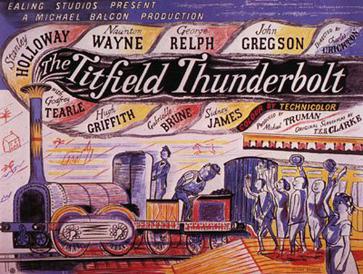
(Titfield Thunderbolt film poster, Wikimedia Commons)
After the war, Britain focused on becoming a modern nation, and the feelings of affection it had held for the train were transferred, for a while at least, onto the motor car. The railways were nationalised, and the romance began to wear off. It was the car that could now take you to picturesque backwaters of the land, and you no longer had to share space with people who picked their teeth in an annoying way, or were just plain murderous-looking. Like a man with a mid-life crisis, trying not to look old-fashioned, people began to look upon trains as second class, a social service for those who were too poor or decrepit to drive. That moment of transition was captured by the 1953 film, 'The Titfield Thunderbolt'. Here a cherished branch line is threatened by a local bus service, and the competition between rail and road is played out for the cameras.
Ironically, in real life, that branch line had already been closed. A BBC crew filmed the making the movie, including the famous scene of the runaway train. The scriptwriter was a neighbour of Dr Beeching, the future chairman of the British Railways Board, and slayer of branch lines.
Given the aesthetic appeal of the railways, it is not surprising that a poet became their greatest champion when they came under attack. 'Rumble under, thunder over, train and tram, alternate go' he wrote:
Rumbling under blackened girders, Midland bound for Cricklewood, Puffed its sulphur to where that Land of Laundries stood. Rumble under, thunder over, train and tram alternate go, Shake the floor and smudge the ledger, Charrington, Sells Dale and Co., Nuts and nuggets in the window
Such a dynamic thrust from such unpretentious lines.
For Betjeman, the railways' appeal was their permanence, a treasure bequeathed by our forefathers, 'a Victorian's world and the present, in a moment's neighbourhood.' In his poetry, the railway station stands for a world that is fading or has vanished completely. 'Monody on the Death of Aldersgate Street Station' began:
Snow falls in the buffet of Aldersgate station, Soot hangs in the tunnel in clouds of steam. City of London! before the next desecration Let your steepled forest of churches be my theme.
Betjeman appears to elide churches and railway stations, with both offering a refuge from the modern world. It is apt that he was behind the impetus to save St Pancras from demolition; St Pancras being a Christian saint and a railway station.
As Dr Beeching's cuts took hold, so did come the end of the reign of steam. Carnforth, where David Lean's Brief Encounters was filmed, became the dumping ground for the disused locomotives.
Diesel had none of the romantic elegance of the old steam. And today, even locomotives appear to be on their way out. Instead, we have multiple units that are as graceful and aerodynamic as wardrobes, with charmless names like 365 class. They are functional, and like worms, they can still move after being chopped in half. But they are hardly going to inspire our writers.
The great stations of times past are distressingly anodyne today. At York, the signal cabin is now a Costa Coffee; the night station master's cabin (a location for a strangely, even satanically, compelling job description) is a tourist information centre; the old booking hall is a Burger King. Stations are no longer about the business of railways. They are in the business of retail. The mysterious soot-blackened hinterlands have been tidied away. We are passengers no longer. We are officially customers, consumers, of course.
The railway satirist who writes under the name Tyresius has updated Adlestrop for the modern day:
Haycocks and meadows sweet, I wouldn't know. I never looked outside the train. Just canned beer from a plastic cup. Until the damned thing started again.
The few people who write about the railways today are writing about what doesn't exist today, or even what never existed at all. Note that the Hogwarts Express of Harry Potter fame is not a diesel multiple unit. Its departure platform, the fabled nine-and-three-quarters, is a portal to a fantasy land a world away from modern King's Cross. And in the self-consciously cool series of Bourne films, Matt Damon arrives in London not on a plane, but on the Eurostar. This is highly promising.
For a revival of literary focus on the railways, the high-speed Eurostar may offer the only hope in Britain. Two hundred mile-an-hour trains. Champagne on tap in the buffet. Smartly turned out railway staff. A long undersea tunnel - anything could happen in that. For the future of trains to be assured, they much once again become the vehicles of our dreams.
[This is a (very) paraphrased rendition of Andrew Martin's 'Between the Lines: Railways in Fiction and Film', shown on BBC Four.]
I have modestly given myself the name of the greatest of the Eldar: Fëanor, the maker of the Silmarils and the creator of the Tengwar. He was a Master of many things. I am merely a Jack.




 Baraldi’s writing has a cinematic quality to it that readers can quickly relate to at once. She employs the literary equivalent of fast cutting and cutting between scenes to dramatic effect. There is a minimum of exposition, a minimum of explanation, as though she dares the reader to keep up with her. The reader may struggle initially, but it will be worth it in the end. Baraldi is of the generation where film has informed her writing as much as anything she has read.