JOST A MON

The idle ramblings of a Jack of some trades, Master of none

Nov 27, 2014

Saturday

We woke up at 6:15.

We were out of the house by 7:15.

We arrived at the Docklands at 8:30.

We registered for the competition at 8:35.

We were told that the bouts would start at 9:00.

At 9:30, they still hadn't started.

We asked an official what was going on.

They were expecting a contingent of kids, they said.

You wouldn't want to disappoint a bunch of kids, would you? they said.

The kids arrived at 10:00.

The bouts began at 10:05.

The boy was eliminated in the first round at 10:15.

We left.

*****

The boy has been going for judo classes for a few years now, but this was his first competition outside his club.

He was the only representative of his club at the competition.

The other kids came from Hackney and Kent and south-east London. They came in groups, teams, with their coaches, all of them gung-ho.

The boy felt a bit left out when the other kids started warming up and practice sparring with each other.

I'm bored, he said. I've got nobody to practice with.

Just join one of those groups, I said.

Before long, he was running around and practising throws with his new friends.

*****

The boy was in tears after his elimination.

You did really well, said a girl. I saw you, you were pretty good.

The boy was disconsolate.

I only had two fights, he said.

These kids have been taught throws that I don't know, he said.

They cheated, he said.

They didn't bow before the fight, he said. That's cheating.

We explained that this was his first competition and that he didn't roll onto his tummy as soon as he fell.

You'll do better next time, we said. Don't feel too bad.

I'm embarrassed, he said.

I'm never going to the Docklands again.

Jul 30, 2014

Boyish Jingoism

After England's recent and abject collapse at Lord's, I haven't felt like telling the boy that his wish has come true. For some reason, he is vehemently anti-English these days. I suspect it's because of his half-Scot pal, with whom he had a conversation as follows:

Pal: I wish Scotland would vote for independence in autumn. I don't like England.

Boy: Did you know that England ruled over India for centuries?

Pal: I can't believe they managed to rule anyone at all.

Boy: England's out of the World Cup.

Pal: Yes-s-s-s!

Boy: India's playing England at cricket.

Pal: I hope England loses.

Boy: So do I.

Wife: But, Johnny, your dad's English.

Pal: Oh yeah...

Apr 29, 2013

Shoreditch Walk

Going to the dentist is a famously hesitant and curiously unfulfilling venture (unless you have cavities, heh), so I figured I might as well take a nice walk around the East End once I was done. I meandered a roundabout course that finished up at Nicholas Hawksmoor's lovely Christchurch Spitalfields where I was waylaid by a buzzing crowd of young 'uns from a local primary school. I had been taking pictures all along but when I got home, I forgot to upload them onto my computer, and days later I formatted the flash card, and whoosh, they all disappeared. Tragic, I call it.

The walk began at Cheshire St., once a hub of the industrial East End, sadly reduced in the 1970s, and then rising phoenix-like to provide accommodations to a burgeoning service industry. Among the bigwigs of the older incarnation of the street was Lipton Tea.

Tea Building, Cheshire Street, 1973. (From here.)

One of the most famous landmarks of the East End and pride of Cheshire Street is the Repton Boxing Club, training ground for many indigent boys in the pugilistic arts. Repton is a public school in Derbyshire which started this club in 1884 to support the poorer members of society. [Since then it has become probably the top boxing club in the country, although when I walked by, there was not a boxer to be seen. The whole place, to wit, was empty of life.] The club only moved to these premises about forty years ago.

Tony Burns, a boxing coach at Repton Boxing Club, said of his youth:
When I was a kid you either kicked a ball or you hit someone. So, when I was twelve, I became a boxer. My mum died when I was a kid and if you lived in a place like this years ago, you was very fortunate to have a loving family. We all lived in Bacon St and Charlie Burns was the eldest, and they was a pain in the arse that family, but when I boxed all the family and friends would come, so I used to have quite a following. [1]
Right next to the club - in fact, they're all in the same building - is the Bethnal Green Bath House. This was built in 1899 as a public bath and laundry. At the time, hardly any of the local houses had baths, so this was in the public interest. The building was part of a complex that included the Ramsay Street School. [2] Currently it's a block of apartments. I wonder if there are still smells from the chlorinated and sulphurated days of yore.

Bethnal Green Bath House
Cheshire Street Bath House
Walking a bit on, I came across a set of warehouses below railway tracks. One of them, Coppermill Ltd., has a Royal Warrant and deals with industrial cleaning cloths. It has been around for about a century. Victorian warehouses have a strange charm about them, especially those beneath tracks. Many of them in other parts of the city have been converted to art studios and cafes and restaurants, but this one retains its original function.
The best thing about this scruffy building is the Royal Warrant sign.
Coppermill Ltd., Shoreditch.

Cheshire Street was also the site of an installation art exhibition by Martin Creed (the chap who turned a light off and on and won a Turner Prize [3]) a few years ago. The Hauser & Wirth Coppermill was the venue; to be honest, I don't think I noticed the building as I walked by.

A little further on, on St Matthew's Row, is a pub: Carpenter's Arms. It is said that it was bought by the notorious gangsters, the Kray brothers, for their mother. Ostensibly the bar surface was a coffin lid - but who knows for sure?

Carpenter's Arms, Shoreditch.
Truman's Pubs owned this and several other pubs all around the East End. Some of the others have been demolished. [4]

The wonders of Cheshire street don't stop here - I came across the wonderfully monickered Duke of Uke. What do you think this is? A ukulele store, no less. Bertram Wooster would be so pleased. Till recently, this emporium used to be on Hanbury Street, a few blocks away; this latest venue should bring in the punters all agog with excitement.

Next, I saw a rather clever sign: The Devil Wears Prada but the People Wear £5 Plimsolls. There were boots and boots galore. This was the Blackman's store.

The Devil Wears Prada, But the People Wear Plimsoles

Then there's a fashion store by Dragana Perisic. I went in thinking I might grab a little something for the wife, and then I walked right out.

Dragana Perisic's fashion store on Cheshire St.
No, this woman was not there at the time.

A few minutes' walk away is Brick Lane, as grotty and edgy a street as you might want. It has some of the most disgusting curries in the world and fine beigels, but also a fascinating multicultural history going back centuries. Huguenots, Jews, cockneys, Bengalis, weavers, streetwalkers, murderers, noncorformists, anarchists, racists - there has been a constant turnover in the social mix here going back to the 1500s.
Brick Lane 1932 © Tower Hamlets Local History Library and Archives

Just off Brick Lane is Pedley Street, on which I saw a graffito of the Queen reading. Drat, I can't find an image of this - it is a circular picture on the side of a building.

15 & 17 Fournier Street: Mission of Christianity to the Jews (1878-1947)


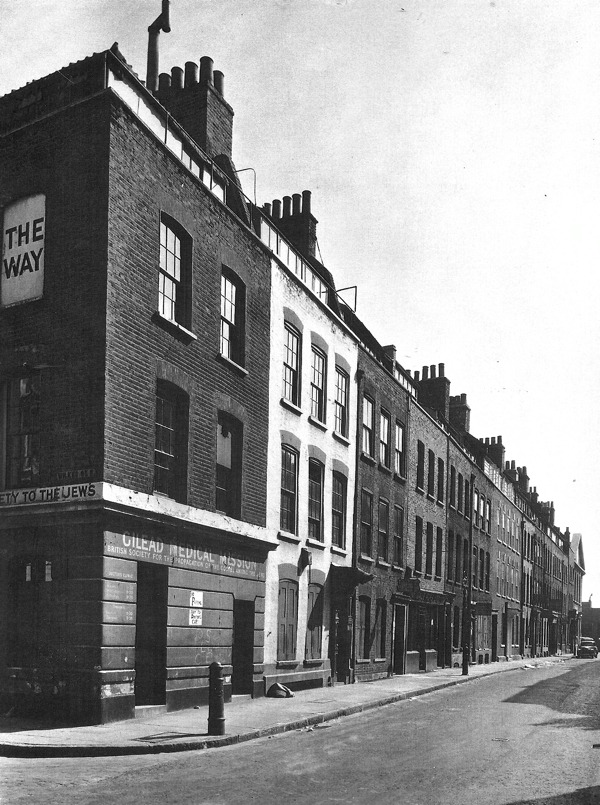
Next was Fournier Street, on which once Jack the Ripper romped. Today it is the site of the studio of the remarkable artists Gilbert and George, and the renovated 18th century building that once housed a joiner and then became a mission to convert Jews to Christianity at the end of the 19th century. [5] The most famous building here, of course, is the wonderful Hawksmoor Christ Church, which occupies the western end of the street.
Christ Church Spitalfields
Christ Church, Spitalfields, by Mr_Zephyr on Flickr.


References:
  1. "Tony Burns, Boxing Coach", in Spitalfields Life.
  2. Stephen Levrant, "Proposed internal alterations and change of use - Bath House Cheshire Street", Tower Hamlets council.
  3. Hazel, "Martin Creed at Hauser & Wirth Coppermill", Londonist, May 9, 2007.
  4. Duncan Richards, "Truman's East End Pub Archive", Design Department Store, Sep 5, 2011.
  5. "All Change at 15 & 17 Fournier St", in Spitalfields Life.

Jan 1, 2012

Christmas 3

Clearly the muscle memory involved in cycling has little to do with ice-skating. The boy, you understand, is an expert cyclist. So is his father. Ice-skating, we found, is another thing entirely. 

We took the boy the other day to the Tower of London where part of the moat has been converted to an open-air skating rink. For the princely sum of £12.50 each, we managed to get an hour's worth of skating practice. The boy fell more times than he stayed up. Throughout, he remained cheerful. Inordinately wet, but cheerful.

This is nothing like the rink in Kuwait, moaned the wife. Why is there so much water on the ice? She had been dragged into the cold water when the boy fell for the fifth time. While she was back on her feet in a fraction of a second, he was content to flap about like a beached walrus. Then he flailed his legs and caused nearby learners to shy away and fall as well. 

'Stand up!' I roared. 

'I am trying!' he roared back.

He flailed some more and amputated the feet of some skatersby.

Presently we were following the rest of the learners who, like lemmings, were moving in the same direction. Anticlockwise we shuffled, good Borg that we were. The experts whizzed about expertly around us, executing stylish flourishes and curtsies. Occasionally the wife would nip away ('I learned to skate,' she said, 'in Kuwait.' She likes to talk in rhymes.) When she got back to join us, the boy would screech, 'Amma!' and fall again.

In the last ten minutes of the allotted hour, the boy managed to make small shuffling steps on the ice. 'Success!' he announced. 

Now it was my turn to shine. I shimmered off into the centre of the rink to practice my balance. A mother and daughter pair, holding hands and keeping each other aloft, suddenly materialised in front of me. I couldn't brake in time. 'Excuse me!' I yelled. They reared up like startled rhinos. Aghast, they watched me looming ever closer, my arms askance, my feet proceeding in different directions. A desperate manoeuvre caused me to spin 180 degrees. My left foot shot up and my right hand scraped painfully against the ice. A second before I was going to plough the rink with my nose,  I righted myself, scarcely an inch away from the mother's face. It was a dance move Flawless would have approved.

'Wow,' the mother breathed. 

'Minty,' I thought.

'Impressive,' she said, clutching at her equally frightened daughter.

Self-deprecating as ever, I staggered off.

Dec 26, 2011

Christmas 1

I took the boy to the office on Friday. He was excited, although not quite as much as some of my colleagues. They'd heard of his wisecracks and were looking forward to meeting him in person. 

'How do we keep him entertained?' asked Frei.

'Shall we show him the table football?' said Pitt.

'No,' said Parker. 'That will give him the wrong impression of what goes on in the office.'

'You mean the right impression,' said Pitt, and everybody fell about laughing.

The boy was on his best behaviour. He shook hands very cordially with everybody and only confused the names of two people. He looked at my Bloomberg console and noticed that the Euro was falling in value against the dollar. He walked around the office and came back to sit at my desk.

'You can use this screen and I'll use this one,' he said generously to me.

We fought each other briefly for possession of the mouse.

Frei made a bet with the boy. 'Look,' he said, pointing at the intraday tick chart of Euro-dollar. 'One Euro is 1.3067 dollars. I'm going for lunch in fifteen minutes. Do you think this chart will be down or up at that time?'

'Down,' said the boy.

'Given how we've been doing so far, I wouldn't be surprised if the boy wins,' said Frei to me confidentially and laughed like a hyena.

Meanwhile, the boy had noticed the football table. It was surrounded by four eager men playing desperately for  victory. He waited patiently for them to finish, but they kept switching sides, playing game after game.

Adebayor noticed that the boy was looking at bit forlorn. He went into the football room and muttered something to the men. They looked at the boy sheepishly. They trooped out. 'We got carried away,' said one. 

'That's okay,' said the boy.

'I told them that your son was about to cry,' said Adebayor smugly. 'It always works.'

We went in and whacked the ball a few times. It rolled into the goals at random. The boy giggled happily.

When Frei was about to leave for lunch, we took a look at the currency chart again. The Euro chart had been dropping jaggedly all that time, but as we watched, it suddenly spiked up.

'Oh dear,' said Frei. '1.3077. I'm afraid you lost, mate.'

'That's okay,' said the boy.

We also went for lunch soon thereafter.

Jul 26, 2011

Worcester? Wooster.

Recently, a letter allegedly written by Bertram Wooster was discovered in America. It was published in the Conning Tower column of the New York Tribune, and complained about the graphic nature of Grantland Rice's writings on boxing:
Grantland, Priceless Old Bea, Is Off in Florida, But He Shall Ever So Well Be Spoken To, We Mean to Say
My Dear Old Soul:
I hate to bother and all that sort of thing, but if you've a spare moment I wish you'd toddle down the passage and speak to Grantland Rice. I mean to say, all that stuff he wrote in yesterday's jolly old issue about chappies being "chopped into pink ribbons" and the blighter with the "red grin that bubbled gore." What I mean is, he doesn't seem to realize that we lads who take in the Tribune read it at breakfast, and, believe me, dear old son, when Jeeves, my man, slipped a couple of fried eggs in front of me just at what you might call the psychological moment, it was a near thing, laddie, a very near thing. Jolly old Rice, I've no doubt, is one of those healthy, hearty fellows who skip out of bed like two-year-olds and feel perfectly topping before breakfast, but in my case - well, you know how it is. I'm never much of a lad until after the morning meal. And, when it comes to having to breakfast on red grins and bubbling gore, well, I mean to say, what! I mean, you know what I mean, I mean!
Well, that's all. Cheerio and all that sort of rot! Godd-bye-ee!
Bertie Wooster
(per pro P. G. Wodehouse, Secy.)

Jul 5, 2011

Sports Day

Unlike other pusillanimous schools where competition is frowned upon and everyone is concerned about children's sense of self-worth, the boy's school is fairly rough and tough, and sports day is as fiercely competitive as one would like. Among the senior students, that is; the juniors are a bit more lax.

I took a day off work to see what all the excitement was about. I had missed last year's do, and was rather keen to see what all the moolah I was shelling out in private education was doing for the boy's sportiness. Fair play, that traditionally British norm, and giving it one's uttermost was evident all over the field.

In the case of the little fellow, there was more emphasis on the former attribute than on the latter. He has such a perfect understanding of fair play that he scarcely bestirred himself to outrace his classmates. In his heats for the obstacle course, he ran languidly, grinning happily at the spectators, casually bringing up the rear. While the winners scarpered off to get their medals, he dashed back to the starting line at a considerably quicker pace than his race. He then waved at us.

His next race was a relay. Ever helpfully, he offered to run the last leg. Owing to some mix-up or the other, his team ended up with more runners than the others. After the last of the other teams scrambled home, the boy got his hands on baton. He then ran - grinning happily again - to the finish line, scarcely touched it, and rushed back to join his team. By then, of course, everyone's attention had moved on to the other competitions taking place elsewhere on the field.

What a peculiar organisation, observed the wife. In her time, the sports day took place in a stadium in Kuwait, complete with march past and sequentially arranged competition. She was a champion runner-up, perpetually coming second in the sprints and long jump. (She never ceases to rub this in my face.) The boy's sports day, on the other hand, was a cheerful riot of parallel races. Shortly after the relay, he and his classmates were hurried to another side of the field for the tennis ball throw. Most of his classmates appeared to be rather ineffectual chuckers of the ball, spraying it in random directions. There were a couple of boys, however, who hurled it in masterful fashion. We clapped laconically; the parents of the successful boys screamed themselves hoarse. My boy's performance was strictly middle-of-the-pack.

The parents were then invited to a tug-of-war. The idea was for parents of kids from the same house to be on the same team. By the time I hurried over to my son's house team, it had lost the tug-of-war. The boy was not concerned - he only wanted to see me participate. So I joined another house and pulled so prodigiously that we won in less than a minute. The boy shrieked in celebration, jumped on me, and then went off in search of the bouncy castle.

My own stellar athletic career was kindled in middle school. I remember a 200 metre race in my fifth grade. I ran against a fat fellow, a little fellow and a tall fellow. The fat fellow and the little fellow handily beat me, and the tall fellow brought up the rear. I was incensed to discover that there was no third prize. 

At short put, I competed against the fat fellow and the tall fellow. The former tossed the iron ball as though it was a tennis ball; the latter had arms long enough that by the time the ball left his hand, it was already farther away than my first effort. I figured that I could only beat them by using brains instead of brawn. Having read somewhere that projecting the ball at a 45 degree angle would send it farther off for the same unit of effort, and using my legs for liftoff rather than my spindly arms, I hurled the ball so felicitously that even the headmaster stopped to gape.

'Disqualified,' intoned the sports master. I had stepped over the line. Disheartened, my third attempt was particularly putrid.

And that was the end of my athletics career.

Dec 3, 2010

Tennis at (Half) Ten

When I went over to the boy's school the other day to pick him up after his Mini-Tennis class, his instructor loped up to me. A lanky chap, about fifty years of age, the instructor looked far too tall to be able to engage little tykes at their level. His back, I thought, must be absolutely shot to pieces.

Still, he appeared happy enough. "Hello," he said and grinned winsomely. "You have a lovely boy."

"Thank you," I said.

"Yes. He is lovely," said the man again.

Yup. This can't be good news, I thought to myself.

Meanwhile, the tyke was scarpering all over the place, chasing an errant ball and trying to whack it with his racket.

The instructor must have observed the shadow that descended upon my noble brow.

"He is lovely," he urged. "But perhaps he's not quite getting as much from these lessons as some of the other boys."

I raised a quizzical eyebrow.

"I'm thinking of getting someone else in to take care of the boys who are not as advanced as the others," the instructor added quickly.

"He is truly a lovely boy," he added a moment later.

On my way home with the boy, I pondered the situation. The little fellow was undoubtedly enjoying himself. True, he probably wasn't as disciplined as some of the others who had weekend coaching and hours of practice. But he was having a good time. Why take that away from him? Surely his lack of progress was something for the instructor to sort out?

A few days later, we found out that the boy was still bashing the ball energetically and aimlessly. This time, though, he wasn't the one chasing after the ball after each whack. A new worthy had appeared to take up that role. It was the instructor's son. Not a new instructor at all.

What to do? On the one hand, as long as the boy has someone to bash the ball with, he should eventually get the hang of it. On the other - we are paying for an instructor. Not a teen with little else on his hands. Dilemma, dilemma... Luckily, it's not something that we need to worry about immediately. We're off on holiday next week.

The decision can wait till the New Year.

Jul 4, 2010

Not A Drop To Drink

Now that we've had about two weeks of great sunshine, it appears that the country's reservoirs are running out of water. The causation is not as cut-and-dry as I make it out in the previous sentence - the first five months of this year produced less rainfall than expected. Any moment now we'll have hosepipe bans, and people taking baths together to save water.

Sex-y.

While the sun-starved natives of this land flock to the beaches, those of Asian or African persuasion stick to the shade. We understand at a subliminal level the power of the sun, and we avoid stepping out during the hottest hours. Or, if we do, we wear enormous hats and carry floppy fans.

We are wimps, though. The temperature in London recently touched 31 degrees Celsius, positively balmy compared to the searing heat of Delhi that I spent many years in. I didn't think twice before stepping out to do whatever I needed to even in 45 degrees. Without a hat. Or sunscreen. Or shades. Or even a bottle of water. Here, after spending scarcely twenty minutes in the sun, I begin to feel parched, and shortly thereafter, the beginnings of a headache.

Wimp.

My boy's summer vacations have started. Because he'll drive us batty if we spend more than a few hours with him (he needs people of his own age, I am informed), we have arranged a sports camp for him. The last time he spent a whole day out in the sun was a couple of weeks ago during his school's sport day. It was a hot (English) day, and most of the kids wilted, even him. I wonder how he'll take to five days of running about in the same heat.

We are told that the organisers will frequently hose down the kids. It's all a game, we hear.

So we'd better fervently hope that the hosepipe ban is not passed in the coming week.

Mar 24, 2010

Randomly Premier

Gresham College, that ancient institution of public education, never ceases to satisfy one's intellectual cravings. The lectures there dwell on every possible topic of interest. Everyone - from jock to geek - may find themselves satisfied. And while geeks may not be particularly good at sport, they can certainly analyse it to discern patterns and see what's driven by skill, and what is random.

Consider, for example, the Barclays Premiership, object of veneration for football junkies all over the world, but in particular in England. There are twenty teams that play each other twice, once on their home ground and once away. A winner of a match wins 3 points, while tied matches obtain 1 point for each side. What is the distribution of points among the various teams? What is the spread between the topper of the table and the bottom team? What is the average point?

It may or may not be surprising to you, but a very simple probabilistic analysis can reveal much about the Premiership. Take the 2008/2009 season, for example. There were 380 matches played in all, of which 97 were tied. In other words, a quarter of the matches are drawn. In the previous season, 100 matches were tied; in the year before, 98. We may, therefore, assume that the probability of a match ending in a draw is 25%.

This means that 75% of matches have a result. If we assume that the likelihood of winning at home is the same as that away, we have probabilities of 37.5% of a home win, and 37.5% of an away win.

Given these numbers, we can easily simulate a season of the Premiership. If you make an octahedron, two of whose faces have 'Draw' written on them, three have 'Home' and three have 'Away', and toss it 380 times, and create the points table for the entire season, you will obtain a list that will look something like this (in decreasing rank order):

67 65 64 59 59 58 52 52 52 51 49 48 48 47 47 45 40 39 38 34

(I was too lazy to make the octahedron and toss it, so I wrote a little program in R to do the job for me.)

It is clear, for example, that the average points are roughly 50. The minimum score is 34 and the maximum is 68.

How representative is this of reality? Well, here's a table of the nine completed seasons of the Premiership in the decade of 2000.

Rank2008/20092007/20082006/20072005/20062004/20052003/20042002/20032001/20022000/2001
1908789919590838780
2
86
85
83
83
83
79
78
80
70
3
83
83
68
82
77
75
69
77
69
4
72
76
68
67
61
60
67
71
68
5
63
65
60
65
58
56
64
66
66
6
62
60
58
63
58
56
60
64
61
7
53
58
56
58
55
53
59
53
57
8
51
57
55
56
52
53
52
50
54
9
51
55
54
55
52
52
51
50
52
10
50
49
52
51
47
50
50
46
52
11
45
46
50
50
46
48
49
45
51
12
45
43
46
48
45
47
49
45
49
13
41
42
43
47
44
45
48
44
48
14
41
40
42
45
44
45
48
44
42
15
41
39
41
43
42
44
47
43
42
16
36
37
39
42
39
41
45
40
42
17
35
36
38
38
34
39
44
40
42
18
34
36
38
34
33
33
42
36
34
19
32
35
34
30
33
33
26
30
34
20
32
11
28
15
32
33
19
28
26

In every case, the top three teams have scored more points than we expect from our simulation. All the others, though, have points very similar to those we obtained. See, for example, the scores of the team ranked eighth in every year: 51, 57, 55, 56, 52, 53, 52, 50, 54. And what did our simulation tell us? 52. Or take the thirteenth team: 41, 42, 43, 47, 44, 45, 48, 44, 48. Our simulation: 47. Except for a couple of years when the bottom teams were absolutely disastrous, our predicted points (34) for the 20th is not far from those observed (32, 33, ...)

What do we infer from this? Other than the top 3 teams, the results of the rest are entirely random. They draw a quarter of their games, they win as many as they lose. The top teams outperform completely. No wonder that the toppers have been pretty much the same teams year after year. Their overall skill is, by far, overwhelming.

Has this differentiation always existed? I don't have the history back to the eighties or seventies, but in the first year that 20 teams competed in the Premiership, 1995/1996, the top teams scored 82, 78, 71. The remainder fell exactly in the same pattern as we limned above. The bottom-scorer was at 29.

So here's the question that we have attempted to answer: is the Premiership a purely random process? Is there any skill to any team over and above that expected by chance?

The answer appears to be: most of the Premiership results are as random as expected. Only the top three teams demonstrate skill exceeding this randomness.

It might be worthwhile checking the other great leagues to see if the conclusion holds for them. I'll leave that as an exercise.

Reference
John D Barrow, A Physicist Looks at Sport, Gresham Lecture, Oct 25, 2005.