JOST A MON

The idle ramblings of a Jack of some trades, Master of none

Mar 3, 2016

A Bit of Cod

In Manuel Rivas' tale of Galician melancholy, All Is Silence, a man is intent on a particular meal.
My primary objective was to go and eat cod in the Viana do Castelo. No, not à la Margarida da Praça, nor à la Gomes de Sá. In the end what I had, let's see if I remember, was "sliced cod with maize bread on a bed of baked potatoes and salted turnip tops."

Nov 3, 2015

Auschwitz Violinist

In Maria Àngels Anglada's The Auschwitz Violin, the young luthier Daniel remembers Passover feasts.
He would imagine the two holiday meals at Passover with all the relatives, uncles and cousins. The basket with the haroseth, the bitter herbs that would have tasted so good now, the hard-boiled eggs, the white silk cloth with blue stripes that covered them … What he would have given for a hard-boiled egg today! Or better still, a piece of lamb. He remembered the taste of the matzo - the unleavened bread - and the fun of searching for the hidden piece, the prize for the child who found it. He didn't want to think about the songs or the three toasts. If he could just have a few spoonfuls of cholent - the terrine of rice, eggs, dried beans and goose that had to be cooked all night in the community oven. As a young boy, he'd been sent more than once to fetch it.

In Ben Lerner's Leaving the Atocha Station, the narrator is having a meal with one of the women he is attracted to. He's not in Madrid at all. He is in Barcelona.
A few blocks away was the restaurant, Alkimia, full of fashionable people, and although it was crowded and we had no reservation we were immediately seated. I ordered a drink in Spanish and the waiter clarified my order in English, something that never happened in Madrid. Teresa ordered various small plates and they came quickly: tuna belly cut in the manner of Iberian ham and served over some kind of broad bean; white bread rubbed in oil and covered in tomato paste; a dish involving truffles and tiny pieces of sausage that might have been duck; it was all delicious. They brought us a bottle of white wine I hadn't heard Teresa order and by dessert I felt pleasantly drunk. Dessert was a wonderful and unfamiliar ice cream and I asked the waiter what was in it and he said "Eucalyptus." I was slow to recognise the gorgeous word as English.

Mar 25, 2015

Coincidentally

I was reading Kirmen Uribe's novel Bilbao - New York - Bilbao, translated from the Basque into English by Elizabeth Macklin, when I encountered the following poem:

Naine on vesi – selge,
Puhas ja igavene.

Mehed on maitseained
sajandi supi sees.

This is not Basque! It's Estonian, and it's by the poet Doris Kareva, whom Uribe met at a poetry symposium, which meeting he describes in the book. The poem itself has been translated by Kareva and Andres Aule, a lovely little piece:

Woman is water — clear,
pure and eternal.

Men are the spices
in the century’s soup.

Ángel Vivas' article 1989-2014: las 25 mejores novelas was published recently in El Mundo. I'm distressed, nay, delighted, no, appalled, er, indifferent, in short, a bundle of contradictions when I report that I haven't read any of these books. And I style myself a reader. I wouldn't blame you if you took this opportunity to go elsewhere for your literary fix.

No, no, please stay.

Note that these are books written by authors born in Spain and who write in Spanish (so no Galician or Catalan or Basque or - help me out here - any other language spoken in that country).

En La Orilla : Rafael Chirbes (2013). A stark portrait of modern Spain, combing through such evils as real estate speculation and careerism. (Careerism? What's he on about?) This book may soon be available in translation, published by Harvill Secker.

La noche de los tiempos : Antonio Muñoz Molina (2009). An ambitious and comprehensive account of the civil war, written with an evident desire to avoid sectarianism. Or, as the Americans might put it, a bipartisan narrative.

Crematorio : Rafael Chirbes (2007). Him again. Why aren't his works easy to find in English? 


Rabos de lagartija : Juan Marsé (2000). Set in post-war Spain, this explores the complex relationship between truth and falsehood, appearance and reality.


Juegos de la edad tardía : Luis Landero (1989). This was his first novel, wandering across a domain of unfulfilled dreams, contrasting reality and desire.

El hereje : Miguel Delibes (1998). A group of Protestants were burned in Valladolid in the mid-sixteenth century. Delibes wrote this rich novel as a defence of freedom of conscience.

Verdes valles, colinas rojas : Ramiro Pinilla (2004). A fresh and ambitious take on the social transformation of the Basque country since the 19th century.

La larga marcha : Rafael Chirbes (1996). Bildungsroman of humiliation, silence, survival from the Spanish Civil War to the end of the Franco regime. Complex and uncomplacent.

El día de mañana: Ignacio Martínez de Pisón (2011). A kaleidoscopic structure tells the story in the style of classic movies of a social climber, through whom the author does something to the Spain of the 60s and 70s when the transition to democracy was incubated. (Or intubated?)

El mal de Montano : Enrique Vila-Matas (2002). A hypnotic meta-novel with a self-referential style that fascinates and irritates in equal measure.

Los peces de la amargura : Fernando Aramburu (2006). In one of the few incursions of Spanish narrative into the problems and consequences of terrorism, Aramburu is openly committed to its victims and to their memory.

Corazón tan blanco : Javier Marías (1992). An elegant, intriguing and subtle story of complex emotional relationships. Should one know everything about one's love? Should some things remain hidden? 

El Metro de Platino Iridiado : Álvaro Pombo (1990). Pombo has a particular sympathy for female characters, which he displays this in this excellent literary work.

Galíndez : Manuel Vázquez Montalbán (1991). A representative of the Basque government in exile, Galíndez was kidnapped and murdered by the police of the Dominican dictator Trujillo after he escaped to Santo Domingo following the Spanish Civil War. Montalbán's investigative novel is brilliant.

La ruina del cielo : Luis Mateo Díez (1999). The Ruins of Heaven is the second in Díez's trilogy depicting the impending destruction of rural culture. An impeccable literary anthropology of death. (Shivers down my spine at that last sentence. And shivers back up again.)

El embrujo de Shanghai : Juan Marsé (1993). Marsé! Marsé! He returns to seduce you with his seemingly simple style and a bittersweet story that deals with the loss of innocence! Oh, Marsé!

Estatua con palomas: Luis Goytisolo (1992). A confluence of two histories, one in modern Barcelona, the other in classical Rome, characterised by the skill and quality of Goytisolo's language.

Romanticismo : Manuel Longares (2001). An ironic and elevated examination of the last years of the Franco dictatorship, set in Madrid and Salamanca.

Leyenda Del Cesar Visionario : Francisco Umbral (1991). A fictional memoir of recent events, mixing history with imagination, a free and literary exploration of the Civil War in Burgos and Salamanca veering between the mythic and the realistic. (How many different ways can one say 'real' and 'imagined'?)

El Corazón Helado : Almudena Grandes (2007). Finally! A woman. Intense and exciting tale of two families, filled with unforgettable characters and intrigue, all in the shadow of the Civil War.

Soldados De Salamina : Javier Cercas (2001). More Civil War narrative (available as Soldiers of Salamis, in translation).

La Saga de los Marx: Juan Goytisolo (1993). Following the collapse of Communism, fleeing Albanians seek a better life in a capitalist Europe. Goytisolo writes a novel-within-a-novel, telling the family history of Marx in the context of his theoretical and political legacy.

El espiritu aspero : Gonzalo Hidalgo Bayal (2009). Metaliterary masterpiece, verbal masterpiece, a taste of linguistic masterpiecery from the Baroque to Oulipo.

El Cazador de Leones : Javier Tomeo (1989). A master of Kafkaesque concision and absurdity, this is a collection of short stories that dissects its characters like an entomologist. 

Los Girasoles Ciegos : Alberto Méndez (2004). More narrative on the civil war, enhanced by language of true quality. Not one of your weak and conformist novels.

So there you go. One book by a woman out of twenty-five. Who says machismo is dead? 

But if you'd like to better the averages a bit, a commenter recommended Olvidado rey Gudú by Ana María Matute.

Oct 3, 2013

The Perfect Martini

While writers of crime fiction try to lend some colour to their tales by adding detailed recipes for regional gastronomic specialties, Carmen Posadas, at least, strives to be different. In the book The Last Resort, a recipe for the perfect martini is offered, instead.

"All right, Hassam. Now you must play very close attention to what I tell you. Take notes and repeat after me: to make a good dry martini, we need, in this order: one part gin, Beefeater if possible." 
"One paht gin, Beefeatah if possible," Hassam repeats. "Very good, sir.
I would be very disappointed if you, the readers who have been with me since the beginning of this story, were to think me careless or disrespectful [...] 
"Now write this down, Hassam. We need a few drops of dry vermouth. Very dry." 
"A few drops of dry vermouth. Very dry." 
[...] 
"Now we will need a glass cocktail shaker." 
"Let me write this down," says Hassam. "Transparent glass cocktail shaker." 
[...] 
"Do you have it all down, Hassam? Very well. Now, you don't have to repeat this next bit back to me, just take it all down. First, fill the cocktail shaker with a fair amount of ice. Have you got that? All right, you will then bless the ice cubes with a drop - one drop, Hassam! - of vermouth and then you shall add the gin. Then - and this is extremely important, Hassam. Don't try and be original, please - the liquid shall be shaken, not stirred. Is that clear? After that, all you have to do is pour it, making sure that no ice cubes fall into the glass. A good dry martini, Hassam, is a difficult thing to achieve, although I am sure that if you follow my instructions point by point..." 
[...] 
...I sit here recounting my final observations on all that has come to pass at L'Hirondelle d'Or in betwen my attempts to get this dim-witted waiter to mix a perfect martini. 
"Ah! There you are, Hassam, finally! Let's see how you made out this time around." 
I test out the martini, though I will save you the gory details. Once again, the experiment has been a disaster.

Aug 11, 2013

Andorra!

The Andorrans have a bilingual national anthem, one in Catalan and the other in French. Here's the Catalan version:

El gran Carlemany, mon pare,
dels alarbs em deslliurà,
I del cel vida em donà,
de Meritxell, la gran Mare.
Princesa nasquí i Pubilla
entre dues nacions, neutral;
sols resto l'única filla,
de l'imperi Carlemany.
Creient i lliure onze segles,
creient i lliure vull ser.
Siguin els furs mos tutors
i mos Prínceps defensors!
I mos Prínceps defensors!

(By Enric Marfany Bons.)

Oct 14, 2012

Rice

In the 80s, every so often Punjabi farmers would arrive in Delhi's residential colonies, phut-phutting away on their tractors and bearing large sacks of grain. They would knock on the doors and ask housewives if they'd like to buy wheat or basmati rice. They would offer these grains cheaper than at local stores, and they would expect the housewives to buy large quantities. Many families kept huge barrels to store the grain, and would not be averse to fifty or hundred kilogrammes. We had less storage space than most, but we too would buy the rice.

And what rice it was - fragrant and delicious! Quite different from the usual parmal that we ate, this was a grain fit for festivals and lordly occasions. Pulaos were more delicious with basmati, as were biryanis, and even plain rice with simple curries was tastier than usual. It would, therefore, be brought out only for special events. But eventually the Indian climate would begin to wear it down, weevils would appear in the dry grain, and we'd have to cook up the remainder in an orgy of fragrance and anticipation.

We would take trips to Kerala every so often, and there we would encounter the rich, red Kerala rice, unpolished and fat. Steaming ladlefuls on our plates accompanied by fish curry and every manner of coconut preparation tasted like heaven. 'This is the real rice,' the paterfamilias would say contentedly.

But he could only have it during those short few days of holidays - any more, and he'd complain of it sitting heavy in the stomach, difficult to digest. So we'd never bring any back to Delhi, and we'd go back to parmal and the infrequent basmati.

When I studied in Bangalore, the hostel messes were scenes of enormous piles of rice being cooked day and night. It is a staple in South India, after all, and it was consumed by the ton. I didn't stop to wonder what breed of rice it was, generic and flat and flavoured only because of the curries that we liberally mixed with it. Better yet was the stream of hot chapatis that the mess attendants would bring to the tables, and I began to lose my interest in rice.

Meanwhile, my family was in Japan, on my dad's final posting before retirement. They were staggered by the cost of the Japanese rice. The Japanese growers were a cartel that enforced high prices, which for whatever reason, the locals were willing to pay. This was a fine rice, sticky and chewy, but completely unsuitable for an Indian cuisine.

One year, the harvest of Japanese rice was worse than usual, and the prices shot up to levels that even the locals blanched at. In desperation, the government cast about for a replacement, and they settled on aromatic Thai rice. But the Japanese, conservative to the bitter end, refused to buy much of it, and the authorities had to offload it at throwaway prices. This was manna to the underpaid Third World types, and when I visited my folks, I was treated on a daily basis to the new grain.

It was superb, long grained and fragrant, intrinsically so flavourful it could be eaten without accompaniment. Mere dollops of coconut or jasmine would accentuate the taste. Unfortunately, this flavour would be completely subsumed by the spices of Indian cooking, and the rice would then take on the characteristics of parmal. Still, it was better than using Japanese rice for Indian cooking, and we managed rather well.

When I went to the US, I was amazed to find basmati everywhere. We had heard that the best basmatis were being exported from India - here I found not only Indian but Pakistani basmati as well. I couldn't tell the difference between the two, and consumed such quantities that before long the thrill was gone, and it became as pedestrian as any other.

I investigated other varieties - Mexican, for example, and short and long grained Californian. They were fine grains but with little novelty. Much better was the risotto, short and fat and creamy, while Spanish paella rice was remarkably thirsty, yet retaining its distinct grains when cooked.

Now I'm conducting a bit of an experiment. In the last few months, we've been trying different rices. First, our idea was to go back to that Kerala rice that the wife and I remembered so fondly. It has been a bit of a hit-and-miss experience. The red raw rice we first tried is spectacular in colour, but it doesn't quite match our memory of Kerala. I've also tried a parboiled red rice, which turns out to be a closer approximation. This is quite difficult to cook, though, requiring a pressure cooker and lots of water, and my green credentials are taking a bit of a beating.

Unfortunately, my experimentation has been without record-keeping, so I've forgotten all the varieties of rice I've recently tried. I do have vague recollections of Sri Lankan names and ponni and matta. These will have to do for the time being, until I discover the next great rice.


Sep 26, 2012

Puzzled

I think one can use a long break from work well if one has a job lined up. There is no uncertainty or worry, and it's easy to plan how best to use the time. One can also enjoy a long break if one has no need to work again: if one has won the lottery or has saved enough to last the rest of one's life. One can then take up new interests or pursue old ones, flit from idea to idea, stare at the wall night and day, or invent a robot that can tickle one's back.

My situation doesn't fall into either of these. There is no job offer. I have not won the Euromillions. So, three months into joblessness, what have I achieved? A trip to Madrid. A bit of art. A lot of TV. A ramble in the Surrey Hills. Sunshine and rain. A few books. A smattering of work on a technical paper. A nice summer vacation with the family. And yeah, a couple of articles contributed to the Wikipedia, one of which is still pending approval.

Along the Norbury Park walk
On the Norbury Park Trail, Surrey Hills.

The wife suggested in July that I should use the time to get a British driving licence and to learn to swim. I'm abashed to say that I have achieved neither.

And so it goes.

Sep 18, 2012

18 September

A fairly nondescript day, you might think, 18 September. A vacant yet short-tempered fellow called Joseph of Cupertino, Italy, levitated seventy times in the seventeenth century and was first Inquisitioned and then raised to sainthood. This is his day. 
Leonhard Euler's fine turban and formula

It is also the day Leonhard Euler died in 1783. 

This was discussed, but not by that Foucault.
Jean-Baptiste-Leon Foucault the physicist was born the same day in 1819. 

Joseph Locke by mslrman, on Flickr.

Then it was Joseph Locke's turn to pass on (1860) - he was a civil engineer. 

Greta Garbo by Carmen Luna

Greta Garbo arrived in 1905. 

John Cockcroft by Rodrigo Moynihan.

Nobel-winning physicist John Cockcroft died on 18 September 1967. 

Jimi Hendrix by missperple

Then Jimi Hendrix departed this earthly vale of tears three years later.

So now you know.


Sep 15, 2012

Seafood Tartare

Manuel Vázquez Montalbán's detective Pepe Carvalho is a culinary maven, and loves nothing better than to potter around his kitchen cooking up delicacies and feeding them to the constant stream of women that get in and out of his pants. A tribute, then, to the quintessential Barcelonan man.

But there was no way he could sleep, and he eventually found himself studying a road map, tracing the escape route Margalida had mentioned, and then in the kitchen staring at the open fridge, with the vague idea that he should be doing something more than just worrying himself silly. Cooking, for example: and at that time of the morning he could think of nothing better than a seafood tartare,  a recipe he had been turning over in his mind since the previous evening, a sort of adaptation of the oyster tartare that Jean-Louis Neichel had invented, but without the oysters. Instead, he had fresh clams, sea urchins, prawns, a jar of unspectacular Russian caviar, and some hake macherated in virgin olive oil, salt and green pepper. He cut open the sea urchins, removed their eggs and chopped them together with the clams and prawns, then added a combination of capers, fennel, shallots, gherkins. He had no seaweed or sea-grass, so the recipe could only be an approximation. He sprinkled oil and lemon on the mixture, spread it on the fish, stuffed it into the empty sea urchin shells, and topped them off with a spoonful of caviar. He opened a bottle of white Peludi wine, and placed the sea urchins, the wine, glasses, toast and butter on a tray. When he succeeded in waking up Albert and Margalida and she saw all this exotic display in front of her, she had to stop herself reaching instinctively under the pillow for her gun.
- from The Man of My Life.

The Guardian ran a series of reports on the New Europe last year. Correspondents spent a few days with a typical family in Germany, for example, or Spain, and wrote up their experiences. No experience was complete without food, as in this instance by Kira Cochrane:
We start with a small dish (tapa) known as fideua, which consists of short noodles, fried by Martiño (he's a keen cook and takes a regular class on a Saturday morning). These are then boiled in a fish broth, and baked in the oven, where they pop up like fresh blades of grass. To follow is a delicious black-ink paella, and then the traditional Catalonian dessert brought by Eva – almonds, hazelnuts, sultanas and dried figs. Miguel's best friend, Leo, a German writer and teacher, arrives as midnight approaches, and the group keep Spanish hours, drinking sweet wine and whisky into the night, and arguing over politics, in anticipation of a relaxed nine o'clock start the next morning.

Aug 28, 2011

Fruits of Angels

Eugenio Fuentes is a writer of slow-burning fiction peopled with characters limned with a tender sympathy. The most tragic of them have a dignity that shines through the vicissitudes of their fortunes. In The Blood of Angels, these qualities are visible in ample quantities. There is not much food, not really. But then there comes a passage such as the following that is so, so moving.
He went into the house and, without once looking into the living room, at the pictures on the fireplace and everything he left behind, went down the stairs into the cellar. The fruit he'd picked over the last month hung from the roof beams: melons from a reed-rope, strings of beans, garlic, grapes, peppers, chilli and laurel. On the floor, heaped on a tarpaulin were figs, apples, potatoes and quinces. The mixture of scents coming from the different ripening fruits created an intense, sickly-sweet smell in the cellar.
Before, when all the members of the household had lived and were hungry, they picked many of the fruits hanging on the trees, shiny without artificial help, plump like coloured light bulbs - the whole farm lit up by the glow of pears, peaches, cherries and apples. Those reserves of food lasted until Christmas. Yet in the last couple of years, although the crops had dwindled and they kept little for themselves, they ended up throwing a good part of it away, uneaten by them and their younger son. Dried fruit became impossibly hard to swallow; it felt like the pears and quinces had turned sour, grapes left a smoky taste in their mouths and cherries left their mouths full of stones. When his elder son had lived that never happened; when he had lived the harvest never seemed sufficient. Before he'd started to die he would come home full of energy, always hungry, and if dinner was late, he would go down to the cellar and take whatever fruit he liked. But in the last couple of years such a big store made no sense.
Very slowly, almost fondly, he tied the slipknot and made sure it slipped properly before slinging it over one of the roof beams.

Jul 10, 2011

Stew Away

In John Lanchester's The Debt to Pleasure, a snobbish voluptuary Tarquin Winot waxes eloquently about all manner of food. His life, he likes to observe, is best represented in vignettes of gastronomy. And so nearly every page of the copy I recently borrowed from the local library has dark streaks - left, I imagine, by the tongues of drooling readers. And why not? Check out this litany of fish stews.
The conditions and prohibitions with which the making of a successful bouillabaise is hedged around make it a problematic dish for the home cook, at any rate for the home cook who lives more than an hour or so's drive from the coastline between Toulon and Marseille. My house in the Vaucluse is an hour and forty minutes from Marseille, assuming good weather which is necessary on the twisting roads of the Lubéron. Other fish soups are less contentious in their composition, a fact which may make them appealing for those who are less beguiled than I am by what Spinoza called 'the deep difficulty of excellence'. In any case, over the years at my homes in Provence and Norfolk (less so in Bayswater) I have cooked burrida, the hearty and accommodating Genoese specialty; cotriade, the warming and economical potato-oriented Breton dish (sometimes seasoned simply through the addition of seawater); the soothing matelote normande, of which more shortly; the exuberant Portuguese fisherman's stew caldeirada, enough to make any one of us into a lusophile, and graced with the additional blessing of reheatability in the form of the excellent fish has ropa velha de peixe; the fiery but somehow light, refreshing, life-affirming fish stews of Thailand, spiked with chilli and lemon grass and the glamorous but refreshing exoticism of that suddenly convenient country (only hours away!); the paradoxical red-wine-using matelotte and raito, the former with its disturbingly phallic and alive-seeming eel, the latter with its elusive but comforting taste of cod; the equally coddy Basque ttoro, its origin betrayed by its telltale unpronounceability (my brother was fond of speculating whether, in Basque versions of the game of Scrabble, values were reversed, so that players only won a single point for using letters such as q and x); the crude Greek kakavia and the egg-and-lemon-enhanced psarosoupa avgolemono; the tasty Provencal soupe de poisson with its punchy rouille and promiscuous willingness to accept whatever is put into it (perhaps the most adaptable and portable of all these national soups); the chowders (from chaudière, stewpot, a word which also refers to the kind of domestic gas boiler whose explosion was to kill my parents) of North America, expressive of that continent in their hearty emphatic blandness; the delicate Bergensk fiskesuppe, which the unfortunate Mitthaug used to prepare with great displays of energy in his attempts to get the freshest possible, indeed the freshest imaginable, cod and coley, rising before dawn to go to Billingsgate and returning with fish, which, as my father observed, a competent veterinarian ought to have been able to resuscitate; indeed, our own grey little country is almost the only one which fails to have its own indigenous version of fish soup, even the Scots having their surprisingly edible Cullen Skink.

Jun 3, 2011

Cipher

In 1236, Walter (Gautier) of Coincy wrote a vernacular poem for a largely non-literate audience. In it, he used the expression 'ciffres en augorisme' to mean a vacuous person. In other words, a zero. Clearly, if even an unlearned audience was meant to understand the reference, the cipher, or the Hindu-Arabic numeral, was already well-established in Europe.

Scientific, as opposed to mathematical, knowledge had already started flowing westwards in the preceding century. "After 1100, Euclid’s Elements gained increased prominence; in 1126 Adelard of Bath brought Al-Khwarizmi’s trigonometry to the West; in 1145 Robert of Chester translated Al-Khwarizmi’s Algebra; Ptolemy’s Almagest was translated from the Greek in 1160." [1]

How did the Europeans gain access to the concept of zero? As widely documented, the good news came from the East, via the Arabs.

I have read previously that Leonardo da Pisa (or Fibonacci)'s learned work Liber Abaci of 1202 was the main mechanism of transmission. Fibonacci had travelled extensively in North Africa training to become a merchant, had come in contact with Arabs there, and learned their sciences and mathematics.

Sefer ha-Mispar of Rabbi ben Ezra
As evidenced by Fibonacci, the main impetus to arithmetic appears to have been mercantile. The widespread use of the abacus had already introduced the notion of 'place value' to the Europeans, but they persisted in using Roman numerals in their documentation. Indeed, even innovators in business such as the English Exchequer and the Medici Bank decried the use of the new-fangled numerals. The Florentine guild of bankers required its members to “write openly and at length, using letters” — the fact that the ordinance had to be repeated three more times meant that by 1299, bankers in Florence had found it faster and more convenient to use the Hindu-Arabic numerals rather than write “at length” in the old script." [2]

I learn now, though, that an even earlier book had introduced the concept of zero to the Europeans.[3] The Spanish rabbi Abraham ben Ezra wrote about the Hindu-Arabic numerals in his book Sefer ha-Mispar (Book of Number) while visiting Verona in 1146. He used the first 9 letters of the Hebrew alphabet to represent the numbers 1 to 9, and made a small circle that he called galgal (Hebrew for 'wheel') for zero. (The Arabs used a dot.)

The Jews, of course, already had large trade networks across the Mediterranean and the Levant and deep into the Muslim lands. Their affinity for new ideas and business acumen meant that they had a long-standing advantage over their Gentile competitors. Indeed, as we have seen, the Christians were not loath to shoot themselves in the foot with proscriptions against new (or heathen) techniques.

It was not till the 15th century that the Church relented and allowed the use of the numerals. And they had the temerity all along to accuse of Jews of taking advantage of Christians and making money off the honest faithful. All I have to say is - pillocks.

References

1. Stephen E. Sachs, New Math: The‘Countinghouse Theory’and the Medieval Revival of Arithmetic (here)
2. Alexander Murray, Reason and Society in the Middle Ages (Oxford: Clarendon Press, 1978)
3. Paul Kriwaczek, Yiddish Civilisation: the Rise and Fall of a Forgotten Nation (London: Weidenfeld and Nicolson, 2005)

Welcome, folks, to the LXXVII edition of the Mathematics Blog Carnival. We have a wide-ranging litany of articles, although - despite our best efforts - not seventy-seven of them. Still, quite a few to whet an appetite or three.

According to custom, we must start with the oddities of the number. Instead, we'll just intersperse the facts amongst the various articles.

77 is a deficient number.

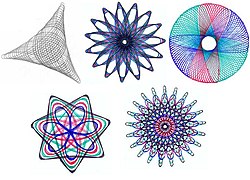
Sol Lederman presents Curve stitching with Mathematica posted at Playing With Mathematica.
Meanwhile, does anyone remember the NBC adventure series 'The Tales of the 77th Bengal Lancers'?
Ever heard of curves with infinite perimeter and zero area? Read That's Impossible! One Giant Nerdgasm at Consumed By Wanderlust.
And, of course, Jesus of Nazareth is supposed to be of the 77th generation from Adam.
What does the Great Pyramid tell us about ancient Egyptian mathematics? Dave Richeson reveals an interesting consequence in Division by Zero.
77 is evil.
Alexander Bogomolny presents Areas on the Graphs of Power Functions posted at CTK Insights.
77 is also vile!
At Travels in a Mathematical World,  Peter Rowlett presents a collection of podcasts and videos from the Math/Maths Week 2010, and from Young Researchers in Mathematics 2011.
77 is the number of digits of the 12th perfect number. Somewhat uncannily, 77 also is the number of integer partitions of the number 12.
Mike Croucher ponders whether graphical calculators have outlived their usefulness at Walking Randomly.
77 is the sum of three squares, 42 + 52 + 62, as well as the sum of the first eight prime numbers.
Speaking of calculators, did you know you could multiply on your fingers? I didn't, but Math and Multimedia reveals some tricks.
77 is the atomic number of the element iridium. Does anyone remember Motorola's ill-fated ventured of the same name that was supposed to revolutionise global telecommunications?
While the little folk do elementary mathematics on their fingers, the powerhouses of the discipline get their breakthroughs at the most peculiar places and moments in time. Dick Lipton lists some of them in Godel's Lost Letter and P = NP.
77 is the largest number that cannot be written as a sum of distinct numbers whose reciprocals sum to 1.
Pat Ballew highlights the quotation 'old mathematicians don't die, they just go off on a tangent', and illustrates nicely the properties of tangents to a cubic at Pat's Blog.
77 is not a sum of two squares - but it is a sum of 2 squares!
At Short Sharp Science, Catherine de Lange reveals how tattoos (unsightly at the best of times, heheh) become even unsightlier with age. Mathematicians have developed a model that describes the aging of tattoos. (Do you think the picture below looks like a tattoo of 77? No? Dash it.)
And IT History has a little piece on the beginnings of computer user groups - all the way back in 1952!


Speaking of beginnings, it's the centenary of IBM. Take a look at this celebratory post at Antipodes: Reflections from an Australian Expatriate in France?

"Wannabe professional gambler" Zac mixes up probability and ethical humanism in his post Gambling Theory at Zac Sky.

SquareCircleZ ponders what is the correct graph of arccot(x)?

Alex Bellos discovers that there are more to triangle centres than he had previously imagined (and revealed to us in his book Alex's Adventures in Numberland).

Roice has some clever Geodesic Saddles.

And Joe Manausa shows how Tallahassee residents need to wait till 2018 for their house prices to return to equilibrium in his case study. Long time to wait, eh?

And just so that we Anglospeakers don't feel too alone, we are pleased to reveal that the Spanish blogosphere has its own Carnival of Mathematics. The latest installment is by Juan Martínez-Tébar Giménez at Los Matemáticos no son gente seria, and it showcases entertaining pieces on, among a couple of dozen other things, Tartaglia and Cardano, the Nash conjecture, the decipherment of a wartime diary, and the centenary of the Royal Spanish Mathematical Society.

That's it for this month, people. Please do take a look at our sister carnival - Math Teachers at Play -  and also note that you can follow the Carnival of Math on Twitter: @Carnivalofmath. The next Carnival of Mathematics should come up around Jun 3, 2011. Please send in your submissions here.

[Cross-posted at Sundry Translations and Other Tangentialia. This is a translation of the Malaspina 1789 page on the Spanish National Research Council's website on the 2010 oceanographic survey, circling the globe in the wake of Alessandro Malaspina’s 1789-1794 exploratory voyage.]

In October 1788 King Carlos III approves the plan submitted by the naval officer Alejandro Malaspina with the intention of making a scientific and political trip around the world. Here begins the most daring naval exploration of those sponsored by Carlos III, which becomes known as the Malaspina expedition.


Two naval corvettes are put into service of the expedition: the Discovery and the Bold, commanded by Alexander and José Bustamante y Guerra. Preparations were made in record time. In less than a year, the boats are made ready, the crew recruited, naturalists hired, equipment purchased, and officers trained. On Thursday July 30, 1789 the ships moor in the port of Cádiz, the crew nervously anticipating their imminent departure.

Fifty-one days later, America is in sight. On September 19, the ships anchor in the harbour of Montevideo. Large streams, beautiful trees, and vast pastures with grazing cows and horses surround a city whose streets are dirty and badly paved. The Sugar Loaf Mountain overlooking the west side is turned into a magnificent botanical garden adorned with tiny hummingbirds.

From Montevideo, the expedition leaves the Atlantic Ocean to begin its reconnaissance of the Patagonian coast and the Falklands, skirting Cape Horn. In Pacific waters, Concepción, Valparaíso, Coquimbo and Arica are the ports of call for the expedition. The region has dazzling deposits of silver, gold, copper, and mercury, attracting the attention of the Crown.

At the end of May, the expedition arrives at the port of Callao. The impending bad weather provides an excuse for rest and recuperation. During this time, too, the ships are repaired, provisions are made for food and scientific equipment, and the local region explored. On 20 September, the expedition begins the next stage of its journey, this time along the coasts of Guayaquil, Panamá y Nicaragua, which are adorned with magnificent volcanoes. In order to speed up the survey of the region, the ships split up. They will rejoin later at the port of Acapulco, to be followed by the exploration of the Northwest Coast. They intend thence to seek the Northwest Passage between the oceans, which was described in 1588 in an apocryphal document by Ferrer Maldonado. It will turn out that the passage does not exist.

While the corvettes explore the icy waters of the North Pacific, the naturalists have been enjoying the hot weather in Mexico. They have explored Petaquillas, Chilpancingo, Tasco, Cantarrana, Mochitlan, Méjico, Cuernavaca, Guadalupe, Puebla. When the corvettes return, the expedition regroups and begins preparations ahead of their journey to the Marianas Archipelago and the Philippines, where they will stay during the monsoon season. Later, they will head for New Zealand and New Holland, and enjoy some rest in the Friendly Islands, entertained by the natives.

Check out these images of the drawings made by one of the expedition's illustrators at the Friendly Islands.

On the first of July, 1793, the ships hoist sails for the long return to Spain. After an extensive hydrographic survey of the American coastlines, they arrive at the port of Montevideo in the middle of February 1794. In anticipation of French attack, they join the frigate Gertrude to protect the homebound convoy from Lima. France and Spain are at war. Five years since their departure, the Discovery and the Bold dock at the harbour of Cádiz on 21 September 1794. They haven't circumnavigated the world, but they have conducted an ambitious and extensive exploration of the Americas, Oceania and the Pacific.

(For Alessandro Malaspina, the end proved dramatic. In view of his merit, he was raised to the rank of brigadier in 1795, but soon thereafter, his influence and achievements earned him the enmity of Manuel de Godoy, then Foreign Minister in the Spanish court. Accused and convicted of revolutionary conspiracy, Malaspina was sentenced to ten years imprisonment in the fortress of San Anton. In 1803, the sentence was commuted to exile, and he moved to Genoa. He died in Pontremoli on April 9, 1810.)

Feb 25, 2011

Medieval Credit

In Hawala and Honour, I discussed various ways that medieval businessmen and private individuals and even the state (or royalty) obtained finance, and how they enforced contracts. In an about-turn to today's perceived view that the Protestant ethic is more conducive to financial innovation, in the medieval period, it was the Roman Church that enforced contracts in its jurisdictions. Bankers such as the Medici had a horror of lending money to the Germans because Catholic law didn't apply in German courts, and they often couldn't recover money from German debtors.

While the principles of money as a store of value and medium of transaction had long been established, coin or bullion was not always easily portable. Much of historical trade was on the basis of silver or gold in exchange for goods, of course, although this was never really secure. Long-distance trade didn't explode, therefore, until the development of the bill of exchange in the thirteenth century.

Here's how it worked [1]. An English exporter would send his goods to his Florentine counterparty. The importer would receive the goods and pay the agreed amount of florins to his bank, who would furnish him with a bill of exchange. He would then send the bill of exchange to his payee in England, while - in parallel, the bank would send a notification to its agent in London. When the exporter received the bill, he would approach the agent, hand over the bill and obtain his monies in sterling.

The exchange rates would, I surmise, have been as agreed between the exporter and importer. The importer would know how much his bank would charge to convert florins to sterling at some future delivery date; this rate would determine the amount of florins he would hand over to the bank upon receipt of the English goods. There were problems that could arise from the transit time between the shipment's departure and arrival, and the departure of the notification to the banker's agent, and his receipt of the bill of exchange from the English exporter. The determination of future rates was upon the assessment of the banker on the risks of the journey and the distance to be covered; the future payment date was often standardised, at usance: between Florence and London, this was set at 3 months.

This schematic is after Spufford [2].

International Trade and Credit Flow
The system of double-entry book-keeping that was invented at about the same time helped keep track of the various credits and debits in all these transactions. The exporter would write in his book's debit column an entry for goods sold. The importer would enter a credit to the payee upon receipt of the goods, and a debit to the banker for the delivered florins, thereby immediately balancing his book. The banker would enter a credit of florins from the importer. When the English exporter produced the bill of exchange at the banker's agent's, the agent would enter a debit for the bill to the banker, and the exporter himself would enter a credit for the payment received. The exporter's books would be balanced at that point. The bank and the agent would settle their books at their own convenience.

What did a typical bill of exchange look like? A treasure-trove of such information was revealed when, in 2000, the Borromeo-Arese family allowed academics from Queen Mary College to study two full ledgers from the medieval Borromei Bank of Bruges and London (estabished in 1434). Here is a description from the Queen Mary website [3]:
The acceptance or payment of a bill was usually set out in a complex sentence that indicated who had delivered the bill, who had taken it up, who had agreed to pay it and who was to be paid.[2] In the following example the Bardi of Bruges were takers of a bill of exchange for 800 scudi or flemish écus at an exchange rate of 7s 5d of the £ Barcelona per écu. The Deliverer sent the bill to the Payee in Barcelona; the Taker would write to the Payor in Barcelona with instructions to pay it to Payee at usance, that is 65 days from the writing of the letter. The Italian entry reads:

Ubertino de’ Bardi e compagni deon havere … sono per una lettera ne fecie a Barzalona di scudi 800 a s7 d5 per scudo per dì 65 fatta insino a dì 5 di questo in Antonio de Pazi e Francesco Tosinghi i quali rimettemo a Bernardo da Uzano e compagni per loro conto a loro, fo 168.

By the 15th century, bills of exchange were the commonest form of international monetisation in Europe. With the increasingly lucrative trade between the Ottomans and the Europeans, one would have expected this innovation to take hold in the East as well. This didn't always progress happily. There is an example of a letter of exchange drawn in Pera (Turkey) to be settled in Chios (Crete) that was rejected by the payer at Chios. Still, agents in Constantinople of European banks were quite happy to accept these letters. In 1437, a Cretan named Dimitri Argiti travelled to Gelibolu taking with him a letter for 1177 aspers. [4]

By 1460, credit in the form of letters of exchange was important even in Eastern commercial centres such as Bursa.

Check out:

1. Norman Biggs, 'Mathematics of Currency and Exchange: Arithmetic at the end of the 13th century', Gresham College, April 2008.

2. Peter Spufford, Handbook of the Medieval Exchange.

3. The Borromei Bank Research Project, Queen Mary, University of London.

4. Kate Fleet, European and Islamic Trade in the early Ottoman state.

In Matilde Asensi's nonsensical novel (The Last Cato) of the search for the stolen remnants of the True Cross, the protagonists, a Swiss Guard, a Coptic archaeologist, and an uptight Sicilian nun stop for a bit of food en route to their latest test.
We were invited to a magnificent lunch in the hotel banquet room. I was like a kid when it came to the taramosalata and the mousaka, the souvlakia with tzatziki - small pieces of roasted pork seasoned with lemon, herbs, and olive oil, accompanied by the famous sauce made with yogurt, pepper, garlic, and mint - and the original kleftico. Especially delicious were the incomparable Greek breads made with raisins, spices, greens, olives, or cheeses. For dessert, a little freska frouta. Who could ask for anything more? Mediterranean cuisine is the best in the world. Farag proved that by eating enough for three or four people.