JOST A MON

The idle ramblings of a Jack of some trades, Master of none

[There once used to be a neat little website for the North London Walkers describing some interesting walks in this great city. It no longer exists. Luckily the time machine that is archive.org has snapshots of it from before it went kaput. I’m reposting the (slightly) re-edited versions here, with added pics.]

This Trail is 12 kilometres long, and starts at the Tower of London and then follows the River Thames downstream through the redeveloped Commercial docks to Greenwich.

The first of the docks is St.Katherine's which has been converted to a Marina for yachts and pleasure boats. All that remains of the London Docks, however, are the converted warehouses, which are now residential apartments. Along this stretch of Wapping High Street can be found an execution dock where pirates were hanged and three tides allowed to wash over them before they could be cut down, the most famous pirate to die here being Captain Kidd. Also here is the headquarters of the River Police, the world's oldest uniformed Police service.

Soon you arrive at Canary Wharf, the site of the tallest building in Great Britain, designed by Cesar Pelli. You continue on passing the Heron Quays, Millwall Docks and the London Arena before arriving at Island Gardens.

From Island Gardens you get magnificent views of the Royal Naval College and the Queens House as they were intended to be viewed.

You then walk under the River Thames to Greenwich where you are greeted by the Tea Clipper Cutty Sark [Well, except that it burned down in May 2007. It is currently being restored and is expected to be ready for visits in spring 2010.] You then walk into Greenwich Royal Park and up the hill to the Old Royal Observatory from where you have panoramic views of the Docklands that you have just walked through.

After walking around the Park taking in Rangers House, The National Maritime Museum and the Queens House you finish the walk at the Trafalgar Tavern, adjacent to the Royal Naval College.

Tower Hill Tube Station (Circle/District Lines)

Upon exiting the station go down steps under road towards the Tower of London. Turn right at the Tower Moat and follow it round the outside of the Tower of London, passing Traitors’ Gate and on towards Tower Bridge.

Q1 - On the bank of the River Thames, just past the Tower of London Gift Shop, there is a house. What is it called?

Go under Tower Bridge and pass under the Tower Hotel into St. Katherines Way, passing St. Katherines Yacht Club and HMS President RNR, this leads on into Wapping High Street. Walk to the end of Wapping High Street, passing the Metropolitan Police Thames Division and the Captain Kidd Public House, to where it becomes New Crane Place and then turn right into Wapping Wall.

Q2 - Next to Pelican Wharf you will find London's oldest riverside public house. What is it called and when was it built?

Continue into Glamis Road, about 50 yards past the swing bridge take the next right into the Thames Path. Follow the path along the Thames as far as it will go, at the end of this stretch of path follow it round to the left followed by an almost immediate right turn. This brings you out into Narrow Street.

Follow Narrow Street, passing Limehouse Basin and the Grapes Public House, until you reach Dunbar Wharf. Opposite Ropemakers Field there is an opening in Dunbar Wharf which leads back to the riverside, go through here, cross over the pedestrian suspension bridge and continue to follow the riverside path until you come to Canary Wharf Pier.

At Canary Wharf Pier turn left and go up the steps leading to Westferry Circus, walk straight across the Circus and on the other side follow the right hand side of West India Avenue (going towards Canary Wharf Tower Europe's tallest building). When you get to Cabot Square continue around to the right for approximately 30 metres when you come to a set of steps leading down to your right. Go down these steps and at the bottom bear left. Cross over the footbridge leading to Heron Quay and then the second footbridge which brings you to the Britannia Hotel. At the main road (Marsh Wall) turn left and continue along to South Quay.

At the traffic lights turn right into Millharbour (opposite South Quay Station) follow this down almost to its end where you turn left into Pepper Street which leads you to Crossharbour bridge. Cross over the bridge and on the far side pass under the Docklands Light Railway and turn right into East Ferry Road. Follow East Ferry Road, past the Asda Superstore, and Mudchute Station DLR. At the junction with the main road turn left and walk towards Island Gardens Railway Station. Turn right in front of the station and then take the next left into Saunders Ness Road. Just before reaching the gardens there is a round brick building, this is the entrance to the Greenwich Foot Tunnel.

Q3 - Just above the entrance / exit to the Greenwich Foot Tunnel there is a plaque. When was the tunnel opened and by whom?

Pass through the tunnel, under the River Thames, emerging opposite the Tea Clipper Cutty Sark . Follow the road to the left of the Cutty Sark into King William Walk. Pass the main gates to the Royal Naval College Greenwich, cross over Romney Road and then through St.Mary's Gate into Greenwich Park. Follow the path going up the hill to the Old Royal Observatory and Flamstead House. From here you will get a wonderful view of the River Thames, The National Maritime Museum and the Royal Naval College down below.

Q4 - On the wall to the right of the entrance gate to the Old Royal Observatory there is a Calvano Magnetic Clock. By whom was it made?

Leave the Old Royal Observatory along Blackheath Avenue, to the left of the Observatory. walk past the Planetarium and then take the next main path on the right towards Ranger's House. At the end of the path you reach the park wall, just to the right of the path there is a gateway through the wall (Crooms Hill Gate). Pass through the gate and at the end of the short lane turn left and follow the path up to Ranger's House.

Q5 - Either side of the main door to Ranger's House are two plaques detailing past residents. The one on the left commemorates Philip 4th Earl of Chesterfield. Who is commemorated on the other?

Continue past Ranger's House, along Chesterfield Walk to Shooters Hill Road, follow the wall round to the left and re-enter Greenwich Park by the Chesterfield Gate. Turn right and follow the path around the park passing the gardens back to Blackheath Avenue. Cross over and walk down Bower Avenue to Maze Hill Gate. Staying in the park follow the path just inside of the park boundary back down the hill towards the National Maritime Museum. Leave the park by the gate at the corner of the Museum and continue along Park Row. Cross over Trafalgar Road and go past the back gate of the Royal Naval College towards the River Thames and finish at

The Trafalgar Tavern
[There once used to be a neat little website for the North London Walkers describing some interesting walks in this great city. It no longer exists. Luckily the time machine that is archive.org has snapshots of it from before it went kaput. I’m reposting the (slightly) re-edited versions here, with added pics.]

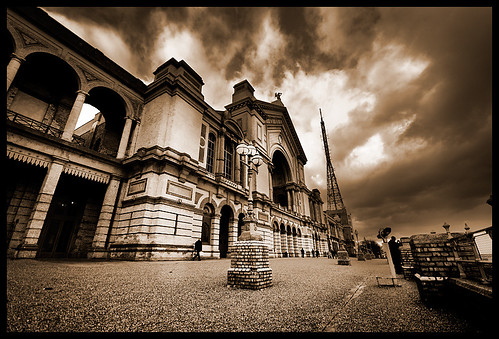
This 12 kilometre long Trail starts at Wood Green and follows the high ground to the North of London. The first point of call is Alexandra Palace. It was from here that the world's first television broadcasts were made

From here you follow a disused Railway line to Highgate village. Highgate Cemetery is the final resting place of the famous Socialist Karl Marx.

You then walk up Parliament Hill Fields to Kenwood House, from both here and Alexandra Palace you are rewarded for your uphill climb by spectacular panoramic views of London.

You afterwards walk around Hampstead Heath, once the haunt of Highwayman such as Dick Turpin, past Keats House and the Royal Free Hospital, to the finish at Belsize Park Tube Station.

Wood Green Tube Station (Piccadilly Line)

Upon emerging from the station cross over High Road into Station Road.

Q1 - 100 Yards along Station Road there is a public house called the Jolly Anglers. What year was it built?

Continue along to the mini roundabout and bear right, still on Station Road. At the next mini roundabout continue up the hill to Alexandra Palace Station. Cross over the road at this point and use the footbridge to the right of the station. On the far side of the footbridge turn left and follow the road round into Alexandra Park, continue following the road uphill until you come to Alexandra Palace. Cross over the road by the pedestrian crossings in front of the palace and at the top of the steps turn left and follow the path around the front of Alexandra Palace to the West entrance.

Alexandra Palace 1

Q2 - By the West entrance to Alexandra Palace there is a sign showing a fictitious bird. What is is?

Follow the access road down the hill. Near the bottom there is a sign for the 'laboratory'; follow the footpath to the left of this. After about 100 yards this path is crossed by a concrete one, go straight across and up the path on the opposite embankment. Continue following this path, passing a tea hut, until you come to a covered walkway leading out of the park. Go through the covered walkway and past Muswell Hill Primary School. Just beyond this you will find a subway leading under the road. Go through this and follow the path directly ahead into the woods. Follow this path (disused railway) for approximately 2 Kilometres until after passing under another road bridge the path bears left and comes out in Muswell Hill Road. Continue along the road for another 10 yards where you will come across a gate leading into Highgate Wood.

Q3 - What is the name of the gate leading into Highgate Wood?

Go through this gate and follow the path to the left skirting along the edge of the wood. Continue along this path until it goes no further and exit the wood by the Gypsy Gate and then turn right. At the crossroads go straight over into Southwood Lane, continuing up past the mini roundabout and then on for another kilometre until you reach Highgate Village.

Avalon, Highgate

Q4 - At No22 Southwood Lane there is a house called Avalon with a blue plaque on the side. Who does it commemorate?

At the end of Southwood Lane cross over Highgate High Street and turn left and then take the next right leading into Pond Square. Leave Pond Square along Swains Lane, Situated at the right side of the Highgate Literary and Scientific Institution. Walk down the hill passing Waterlow Park and then Highgate Cemetery West (the Old Cemetery), Highgate Cemetery East (site of Karl Marx's tomb) and Holly Village, Highgate (photo by Jacqueline Banerjee)Holly Village Almshouses. At the bottom of the hill Swains Lane bears right, continue to follow it until you reach Highgate Road. Cross over Highgate Road and enter Hampstead Heath. Take the right hand path leading up the hill past the ponds, after the second pond the path splits, keep to the right. After the third pond the path splits again, go left here and then take the centre path where the path splits into three at the end of the fourth pond. Follow this path up the hill and on into Kenwood. In Kenwood keep to the right-hand path until you come out of the trees to Kenwood House. Pass in front of Kenwood House and keep on the path until it forks. Take the right fork and keep to the right after passing through the gate, at the top of this path you come to the Kenwood Car Park. Leave the car park by the vehicle exit and turn left on the main road (Hampstead Lane). Just beyond Spaniards Inn the road becomes Spaniards Road.
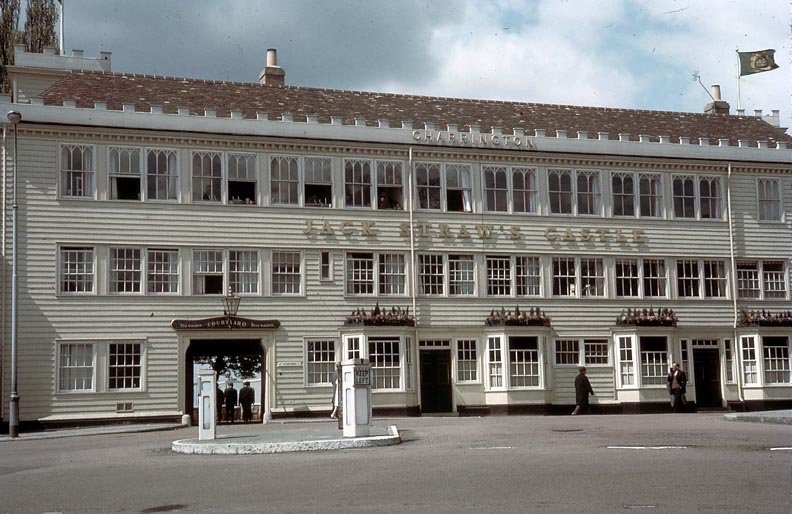
Q5 - Just past Spaniards Inn there is a blue plaque on the wall. Who does it commemorate?

Jack Straw's Castle, Hampstead (George P. Landow, 1965) Continue along this road until you reach Jack Straw's Castle. Keep to the left at this mini roundabout, go past the pond and then turn left down Eastheath Road. Continue along Eastheath Road until you come to Well Walk, turn right here. At the junction with Willow Road turn left. At the bottom of Willow Road turn right into Downshire Hill. Then take the next left turning, Keats Grove, which is at the side of St. John's Church.

Q6 - On the front of Keats House there is a plaque. What two dates are shown on it and what do they represent?

Keats House (rear entrance)

At the end of Keats Grove turn right into South End Road and at the cinema turn right into Pond Street. Walk up the hill, past the Royal Free Hospital, and at the top turn left into Haverstock Hill. Continue along for another 1/2 Kilometre until you come to finish at

Belsize Park Station (Northern Line)

[There once used to be a neat little website for the North London Walkers describing some interesting walks in this great city. It no longer exists. Luckily the time machine that is archive.org has snapshots of it from before it went kaput. I’m reposting the (slightly) re-edited versions here, with added pics.]

This Trail is 12 kilometres long, and starts at Richmond Station (District Line on the Underground, or Overground, or National Rail) from where you walk down to the riverbank, having passed the site of Henry VII's Tudor Palace. It was here that Queen Elizabeth I died.

You then follow the riverbank upstream to Ham House, at which point you may choose to cross the River before walking back downstream, passing Marble Hill House and Richmond Lock.

After Richmond Lock you come to Syon House, the London Residence of the Dukes of Northumberland. Above the gateway as you enter the grounds can be seen the Percy Lion.

The route then passes the Kew Bridge Steam Museum before you recross the River and head towards the Royal Botanical Gardens, also here is Kew Palace much favoured by King George III.

The route finishes at the Kew Railway Station.

Richmond Station

Upon exiting the station turn left along the Quadrant.

Q1 - Approximately 50 yards from the station there is a building (No28) which has a plaque halfway up its wall giving its former use and a date. What are they?

Trumpeters' House, Old Palace Yard, Richmond (© Colin Smith). Then take the second right turning, Duke Street, which brings you into Richmond Green. Go around the Green, along Portland Terrace and Pembroke Villas, and exit on the diagonally opposite corner, Old Palace Yard. At the end of Old Palace Yard you come to River Thames. Turn left here and follow the Thames path under Richmond Bridge until it departs from the riverside and goes through a short stretch of parkland before turning right and heading back towards the Thames. Follow the path, past Glover's Island, until you reach the foot ferry, turn left here and take the path leading up to

Ham House

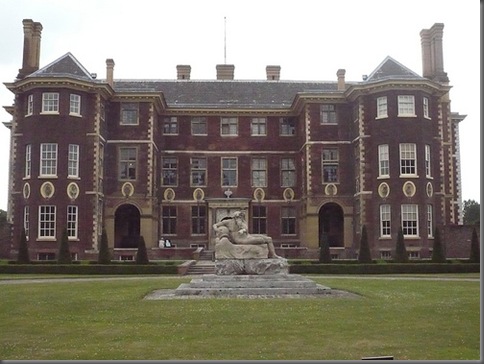
Ham House, Richmond (© fraglerock22003)

Q2 - At Ham House there is notice board to the left of the gate. What is the telephone number at the bottom?

From the gate of Ham House walk straight back to the River bank and turn right, back to the foot ferry. Then either:

a) Take the ferry across the Thames (Small charge made by ferry operator). On the far side turn right and follow the Thames path back to Richmond Bridge, passing Marble Hill House on the way. Cross over Richmond Road and into Willoughby Road.

Richmond-upon-Thames: Marble Hill House (© Nigel Cox)

b) If the Ferry is not operating or you do not wish to make use of it, walk back along the Thames side path to Richmond Bridge. Walk under the bridge, turn right and walk up the steps. At the top cross over the River. On the far side take the first right turn into Willoughby Road.

Richmond Lock (© Mark Jenkinson)

At the end of Willoughby Road you will find a path called Ducks Walk. Follow this path walking under Twickenham Railway and Road Bridges and then along Ranelagh Drive until you come to Richmond Lock. Continue past the Lock and continue following the path along the Thames until it emerges in Railshead Road. At the end of Railshead Road turn right and follow this Road to the second right turn (North Street) turn right here and then right again into Swan Street. Turn Left into Church Street and follow this Road until you come to the main entrance of

Syon Park

Follow this road all the way through the park, passing Syon House, and leave the Park using the Pedestrian entrance until it emerges at London Road.

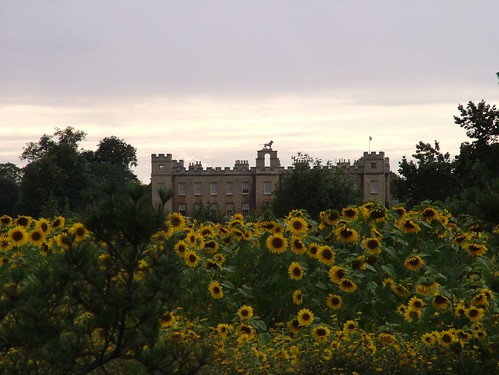
Syon House as seen from Kew (© BerylM)

Q3 - Approximately 100 yards beyond Syon House you come to Syon Park Art Centre. there is a Blue plaque here. Who does it commemorate and why?

Turn right here and follow the road for approximately 1/4 Kilometre until you reach Augustus Close. Cross over and then turn Right along Augustus Close, follow it along until it meets Justin Close. Turn left next to the Brentford Dock Management office, passing under the block of flats, and then cross over the Grand Union Canal into Dock Road. At the end of Dock Road turn right and continue along High Street until you come to the Watermans Art Centre.

Q4 - At the corner of Ferry Lane there is a red brick building. There is a sign halfway up the front of the building indicating its former use. What was it?

Just past the Arts Centre there is a path leading back to the Thames side, follow this path until it emerges at Kew Bridge Road. Turn Right, passing the Kew Bridge Steam Museum, and continue along until you come to Kew Bridge.

Q5 - At the centre of Kew Bridge there is a commemorative plaque. What two Counties are mentioned on it?

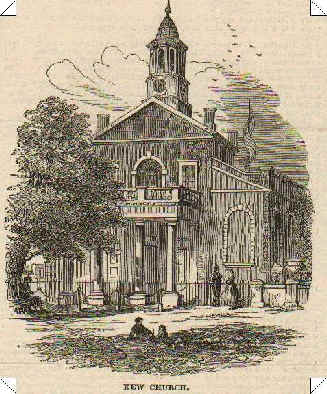
Parish Church of St Anne, Kew. Cross over the River for the final time and on the far side of the bridge take the first right turn, Kew Green, go around the Green, passing the parish Church of St. Anne, and then turn Right along Kew Road. Follow Kew Road until you reach Cumberland Gate and turn left here along Kew Gardens Road. Follow Kew Gardens Road along to Station Approach where you turn left and walk along to finish at

Kew Gardens Station

There once used to be a neat little website for the North London Walkers describing some interesting walks in this great city. It no longer exists. Luckily the time machine that is archive.org has snapshots of it from before it went kaput. I’m reposting the (slightly) re-edited versions here. I start with the Pilgrim Trail. (For those who are curious, this walk intersects with the Pub Crawl I described a couple of years ago.)

This Trail is 14 km long, and starts at Canada Water Station, part of the Jubilee Line. You then walk through the once bustling commercial Surrey Docks, most of which have been converted to residential or leisure use. You then pass the site from which the Pilgrim Fathers departed for North America at Rotherhithe.

The route then takes you beneath Tower Bridge and London Bridge Railway Station emerging at Guys Hospital. Not far from here is the George Inn, the last of the areas great coaching Inns which included the Tabard Inn from where Chaucer left on his Canterbury Pilgrimage.

You then leave the area via the London Fire Brigade Museum and the Imperial War Museum before arriving at the London home of the Archbishop of Canterbury, Lambeth Palace.

The route then crosses over the River Thames, affording great views of the Place of Westminster. Then it goes on to the finish at Victoria Station where many modern day pilgrimages begin.

Start: Canada Water Station (Jubilee Line)

Upon exiting the Station cross over the road, Surrey Quays Road, and follow it to the left, passing the Daily Mail and Evening Standard Printing Press. When you reach the Redriff Road Swing Bridge.

Hint! This is the Rotherhithe St Swing Bridge, about 200 m away from the Redriff Road Swing Bridge that you are now at. © Copyright Chris Lordan and licensed for reuse under a Creative Commons Licence

Q1 - What Colour is Redriff Road Swing Bridge?

(Hint: the bridge shown above is not the Redriff one!) Walk on to the bridge and go down the steps leading to:

Greenland Dock

Follow the footpath leading to the right, around the dock. Turn right after passing Hornblower Close and then turn left, past the boat park, into Rope Street. Walk to the end of Rope Street, passing South Dock and crossing the swing bridge, at the end turn left and follow the road round to the lock.

Manuscript plan of the Greenland Dock, 1763; the oldest dock in the Docklands.

Q2 - At the entrance to Greenland Dock there is a small brick building. What is it called?

Go past the lock keepers office until you reach the bridges over the lock. Cross using either the 1902 swing footbridge or the modern road bridge. On the other side continue walking straight ahead along South Sea Street, cross over Finland Street and follow the footpath which leads down to Gulliver Street. Turn left and follow the road around until you reach the Ship and Whale Public House. Turn left here into Rotherhithe Street.

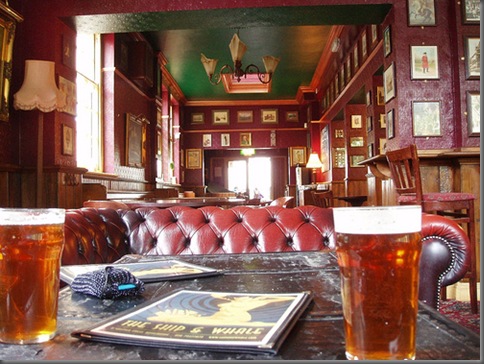
Ship and Whale Pub, Rotherhithe (by Ewan-M)

Follow Rotherhithe Street, as it bears left to:

Trinity Halls

Q3 - On the outside of Trinity Halls there is a plaque. Who founded the building on this site in 1836?

Continue following Rotherhithe Street as it turns left, passing the Holiday Inn Hotel adjacent to Nelson Dock House. When you reach Canada Wharf turn right and go up the steps leading to the Thames Path. Follow the path, passing the Lavender Pond Pump House, until it re-emerges in Rotherhithe Street. Turn right and follow the road over the Bascule Bridge (this was the main entrance to the Surrey Commercial Docks), passing shaft 2 of the Rotherhithe Tunnel, 50 yards beyond this turn right and go up the steps to the Thames Path. Follow this path until you come to the statue of the:

Pilgrim Fathers

"The Bermondsey Lad and The Sunbeam Weekly" by Peter McLean at Cumberland Wharf.

Upon leaving the path turn right and continue following Rotherhithe Street.

Q4 - At the start of Railway Avenue there is a chimney, at its base there is a plaque. What was the building?

When you reach the Mayflower Public House, turn left here and then turn right going around the back of the church into Marychurch Street, passing the Charity School and Old Watch House, until you reach the Ship Public House. Turn right here into Elephant Lane, as the road goes left follow it round and then go straight ahead to the:

Angel Public House

Q5 - Opposite the Angel Public House there are remains of which Kings' Manor House?

Continue walking straight ahead along Bermondsey Wall East this emerges in Fountain Green Square as you leave the square turn right, then left, and then right again along Chambers Street. At the end of Chambers Street turn left into George Row and the immediately right into Jacob Street. When you reach the end of Jacob Street turn right along Mill Street then before you reach the end turn left and follow the path between the offices to:

St. Saviours Dock

HMS Belfast (by s3k)

Cross over the bridge and follow the Thames Path past the Design Museum towards Tower Bridge, at the end of the path pass through the alley and then turn right along Shad Thames. Continue straight ahead passing the Old Anchor Brewhouse, under Tower bridge and H.M.S. Belfast until you reach Hays Wharf. Turn left here through the Wharf and at the far end you emerge at Tooley Street. Cross over Tooley Street via the pedestrian crossing and then walk along Stainer Street, underneath London Bridge Railway Station. At the far end turn right along St.Thomas Street, passing Guys Hospital and the Old Operating Theatre of St.Thomas Hospital. At the end turn left into:

Borough High Street

walk along Borough High Street passing the George Inn.

Q6 - About 50 yards beyond the George Inn there is a plaque on the site of the Queens Head Inn. Which American University patron used to own the Inn?

At the junction of Marshalsea Road turn right and at the end turn left along Southwark Bridge Road, passing the London Fire Brigade Museum.

Old Fire Engine in the Fire Brigade Museum (by IanVisits)

Q7 - What year can be seen on the Fire Station?

At the junction with Borough Road turn right, passing under the railway bridge and continue on to St.Georges Circus. Cross over the circus into Lambeth Road, walk to the end of Lambeth Road, passing the Imperial War Museum.

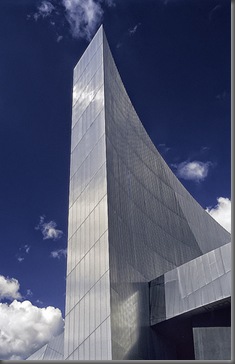
North end of the Imperial War Museum. Stainless-steel shard representing Air (photo by Paul Heskes)

Q8 - Just beyond the Imperial War Museum, on the right hand side of the road, there is a blue plaque. Who does it commemorate?

Continue along Lambeth Road until you come to:

Lambeth Bridge

Cross over Lambeth Bridge and on the far side go straight ahead into Horseferry Road, follow Horseferry Road as it bears right.

Q9 - What dates can be seen on Grey Coat Hospital?

At the Grey Coat Hospital School turn left into Grey Coat Place and at the end turn right into Artillery Row. At the end you come to Victoria Street, turn left here, passing Westminster Cathedral, to the finish:

Victoria Station (British Rail/Victoria Line)

Dec 22, 2009

Mock Da Zuma

And no disrespect intended to the South African President.

The clan and I went to the British Museum the other day. In its reading room, under the great rotunda, is an exhibit to the last of the Aztec kings, Moctezuma, demi-god, heap big chief Mexica. Peerless warrior and top hierarch, he was undone by his faith in his gods and the legend that Quetzalcoatl would arrive from the East to become king of the Aztecs. Thus, when Hernán Cortés appeared, shiny in his steel armour and atop an armoured horse, the Aztecs fell to their knees, gave up their gold in uncountable tons, and were crushed by the cruel Christians of Spain.

That story is well-known, of course. In Mexico, Montezuma today has the reputation of a weakling who surrendered his peoples to the invader. Post-conquest Spanish propaganda promoted the story of Moctezuma's death at the hands of his own people. Today, the argument is that the Spaniards had killed him themselves. Meanwhile, in Europe over the centuries, his fame and allure have spread. This exhibition seeks to provide a more nuanced picture of the man and his times. Walking through its aisles, it is clear that not in art and not in architecture and not in sophistication and certainly not in grandeur did the Mexicans ever play second fiddle to the conquering Spaniards.

There are some lovely pieces on display, pulled from friendly museums in Europe and from Mexico. Here, for example, is the Ahuitzotl, a magical water-being (otter-like? canine?) that was known to pull swimmers underwater to drown them. At night, it would wail like an infant, and when someone came to the pond or the river looking for the baby, it would pull him under with the hand at the end of its tail. Days later, the body would float up to the surface, missing its eyes and nails and teeth.

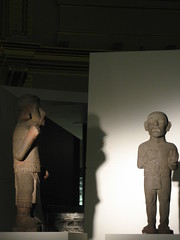
Or take a look at these two little statuettes. The one on the left, in profile, is a standard-bearer in the garb of Xiuhtecuhtli, the Turquoise Lord and Lord of Fire; the other is a Macehual, a commoner in poor garb. Xiuhtecuhtli is considered by some to the progenitor of the Gods, but also god of fire and day and of life after death. He is thought to dwell in the turquoise centre of the earth. The Macehual is simplicity itself, wearing a loin-cloth, a hand submissively on his chest, filled with humility. The Aztec civilisation was intensely hierarchical, and the commoner knew his place in it.

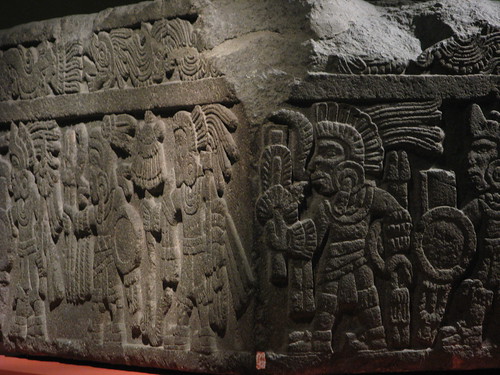
And, finally, check out this view of a corner of an enormous stone block, carved into reliefs of a procession of Aztec warriors. Unless I'm mistaken (and I could be, not having taken notes at the time), this is the Stone of the Warriors, discovered in Mexico City in 1897. Fully armed, the soldiers approach a symbol of sacrifice; each of the fourteen men has a distinctive head-dress, and possibly represent Tenochtitlan, the Aztec capital. Atop the sculpture used to be an earth monster, devourer of blood and hearts; now there is a depression (to support either a throne or an altar) made in colonial times.

The exhibition is on till 24 January 2010, so check it out if you like. (£12 may be a bit steep, but possibly worth it, eh?)

Dec 21, 2009

A Hater of Humanity

When a successful, acclaimed playwright named Alceste announces himself disgusted with the tawdriness and hypocrisy of humanity, and disparages both the luminaries of the arts and their critics, it should be evident that he is setting himself up for a fall of gargantuan proportions. Is he a voice of reason, or is he a Fool? And where does his own jealous love for one star of the stage leave him?

Molière, after two banned plays, tried to tone down his criticism of the haute-monde circling Louis XIV in his 'The Misanthrope', but even with padded gloves, his punches carry weight. In the English version of the play by Martin Crimp, first presented on stage thirteen years ago, Alceste's rage and jealousy are incendiary; at the Comedy Theatre's current production, the actor Damian Lewis's veins throb and pop on his face as he launches invective after invective not only on the shoddy mores of the political elite (skewering the New Tories, for example) but also against the arty-farty social butterflies that flock around his love, Jennifer, an American actress in London played with exquisite control by Keira Knightley in her first professional outing on stage.

It's not just that Alceste resents the constant male entourage that gathers around Jennifer, and that he can't seem to get a moment alone with her. He considers her acceptance of their hypocrisies a major flaw in her character, something he can't reconcile with his own bleak view of humanity. He is as inflexible as he is despairing. But Jennifer can be equally scathing, and in one vicious set of comments, demolishes the character failings of some of her closest supporters - the theatre reviewer Covington, the feminist teacher and acting coach she was once closest to, and the elegant butterfly Julian whom she depends on for entree into the right circles in society. When her two-facedness is revealed to her victims, they are crushed and appalled. And yet, like puppies, they come back to her, tails wagging and bellies bared for a tickle, when she bats her eyelids at them. Knightley shines in her role both as a self-aware cynic, a loving beauty, and a shameless manipulator of her audience.

If you can get tickets for this (so far) sold-out show, I would encourage you to do so. It's sparklingly witty, the verse is clever, the actors are beautiful and the venue is fine. An excellent way to spend an evening out of the dreary weather in London.

[Based on Brian Cox’s Jute Journey, BBC Two.]

In 1883, a migrating humpback whale took a wrong turn off the coast of Scotland and swam up the river Tay towards Dundee. At the time, that Scottish city was the whaling capital of the United Kingdom. After a terrible struggle, the carcass of the great animal was carried triumphantly through the thoroughfares of Dundee. Workers in the local factories were thereby given a grandstand view of the animal that had enabled the other of Dundee’s duumvirate of industries – jute mills.

Although this coarse fibre had been grown and used in Northern India for thousands of years, for almost all of that period it could be woven only by hand, a labour-intensive and difficult task. In Dundee, however, a serendipitous discovery changed all that – soaking jute in whale oil made it soft enough to be woven by machine. The production chain thus began, extending from Calcutta in Bengal all the way to Scotland. Shipped from India and woven in Dundee, jute became a further economic multiplier, when hessian sacks began to carry everything from cotton and coal to sugar and salt across the world. Dundee began to supply even the American West, where the strong and versatile fibre could be used as tarpaulin for the wagon trains. Seeking their livelihoods, migrant workers arrived in Dundee in thousands. By the end of the 19th century, the city had quadrupled in size.

Most of the immigrants were from Ireland, poor and Catholic. The churches that stand there to this day owe much to the indigent Irish jute workers. Yet it wasn’t their religion or nationality that made them stand out. Three quarters of those who worked in the mills were women. And so Dundee became known as ‘She Town.’ Women and children could weave, and an entire matriarchal society was setup. Women became powerful in many ways. To this day, women’s church groups continue the tradition of autonomy and social power.

But of course that social power was exclusively within their own milieus. As far as the bosses of the mills, the rich upper-class were concerned, the mill-hands were so much cattle. The mills were incredibly noisy and many workers went deaf; the dust and fibre in the air destroyed their lungs. Still generation followed generation into the mills, entire families occupied in creating wealth for Dundee.

Dundee’s population had shot up by 30,000 during the jute boom in the 19th century, yet only a few hundred new houses were built. The cramped quarters ruined the health of the residents; by the time of the Great War, most of Dundee men were considered too weak to fight. The jute barons meanwhile built their own large houses away from the grime of industrial Dundee, in a district called Broughty Ferry. So posh was it that the area by Strathern Road was for a time the richest square mile on the planet, until it was superseded by Hollywood in the early 20th century.

Yet only two miles away, infant mortality was the worst in Scotland.

Mary Brooksbank was a Communist jute worker enraged by conditions in the mill. She wrote a lament about the time:

Oh, dear me, the world is ill-divided
Them that work the hardest are the least provided
I’m unbide contented, dark days are fine
There’s nae much pleasure livin’
Half and ten and nine
By the time she wrote these lines, the time of jute in Dundee was already passing. The jute barons strove to outdo each other in the grandeur of their mills, playing ‘my chimney is bigger than your chimney’. They failed to see that their industry was nearing its end. The balance of power in the world of jute had shifted to Calcutta.

Calcutta’s first mill opened in 1855; seventy-five years later, the city was producing 70% of the world’s jute products. With a never-ending supply of raw materials right on its doorstep, it made far more economical sense to concentrate the industry in Bengal, rather than half-way around the world in Scotland.

Today there are Scottish veterans forming the Calcutta and Mofussil Society: veterans of the Indian jute industry who like to congregate in places like the Monifieth Golf Club, to partake of Indian food, speak Hindi, and reminisce about their days in the East. The majority of Calcutta’s mills were owned by expatriate British businessmen, but they were run by Dundonians. Ambitious jute workers moved from Dundee to Calcutta in the 1850s, and they ran the industry there for the best part of a century. The last ones returned to Scotland in the late sixties, having been made to feel rather uncomfortable and unwelcome in independent India. They joke about it now, of course, but they heard the labourers keeping the rhythm while loading and unloading jute, singing what sounded like ‘hey-ho, the sahib’s a saala’ (meaning, pretty much, that the boss is a bloody bastard).

In their prime, though, walking about Chowringhee was like ambling about Dundee High Street, what with all the accents of home they heard at every turn. The Jutewallahs left Dundee for India in search of better lives, a fortune perhaps. They imprinted themselves in Calcutta’s being. Even in the 1980s, long after they had returned home, the jute barges on the Hooghly River still bore marks of Dundee’s great mills – Eagle Works, Baxters…

The Hooghly was the centrepiece of the world of jute, providing berthing for ships bound for Dundee as well points of disembarkation for the Jutewallahs arriving to take up their new jobs and accommodations along the river banks.

The efficiency of the operation was reflected in the tiniest detail. A Jutewallah arriving in Calcutta at 10 in the morning was measured out for trousers and double-pocket half-sleeve shirts by a durzee by lunchtime at noon, and would have his clothes ready by the evening. The very next day he could report for work.

Whereas Calcutta, with its cinemas and shopping, provided a whiff of Europe to the culture-shocked arrivals, the jute mills themselves, thirty miles upriver, were a stark contrast to home. Their accommodations, though, were comfortable. A multitude of servants waited upon them hand and foot: bearers, cooks, jamadars who did the floors and bathrooms and walked the dog, a coolie who dusted and made the beds, a durwan at the gates, and the driver. If they didn’t have their eight servants, they felt outcast from their social peers – status was important to maintain.

For the men, it was pampering on an Imperial scale. Their clothes would be taken off them, the bath prepared, fresh clothes laid out, breakfasts, luncheons and dinners all ready at preset times, everything moving as clockwork. For the expatriate womenfolk, though, it was much harder. The wives may have thought they controlled the households, but they didn’t. The bearer really was the boss. The wives’ lives were of leisure, but not having anything to do would inevitably wear them out.

But they were Scots and the sun always shone, so they did what they always did best: wild parties. The bearers would be in their splendid turbans and cummerbunds, the cooks aflutter; the Scots fell upon the gin and whisky bottles; there would be tennis and swimming, and by the end of it, they would be drunk silly, in the pond, the mill tank, everywhere...

Life for the peasants who grew the jute was, inevitably, much much tougher. From planting to maturation was ninety to hundred days, by which time the jute had grown over seven feet high. In intense humid heat, the farmers worked day after day to harvest their golden fibre. When jute prices began to fall, they had to supplement their incomes by growing other crops. Even today, Bengal’s farmers are unable to participate in the rise in demand for the ecologically green crop. They scarcely earn 40 pence a day from it. But still, today, nearly four million families owe their livelihoods to jute.

With India’s partition in 1947, the best quality jute-growing areas fell into East Pakistan (later Bangladesh), tantalisingly out of reach for Calcutta’s jute mills. In the orgy of violence that befell the countries in the wake of that great sundering, the Dundonian Jutewallahs found themselves protected behind their compound walls, defended by stalwart Gurkhas. Shortly thereafter, the Indian government issued directives that more and more locals should be employed in positions that were held by Europeans. Many Jutewallahs thought that the mills would collapse once they left and the Indians took over; the know-how, after all, was with them and not the natives. There was a mass exodus of expatriates out of Bengal, and by the early 1950s, most of Calcutta’s mills had passed into Indian ownership.

The Marwaris, business-oriented clans from Rajasthan, became the new kings of jute. They had been involved in India’s jute industry from the very beginning, but they continued to employ Dundonians as managers. Interaction between the Scots and the Indians increased substantially. The Jutewallahs trained up Indian colleagues; in some conservative mills, however, there were still lines that could not be crossed. Several of them who fell in love with Indian women found themselves fired from their jobs.

Even setting side the racial aspect to their relations, the cultural gap between the Jutewallahs and the local workforce was huge. The Jutewallahs arriving in the 1950s were ex-servicemen, capable of following the orders of the powers-that-be without demurral. They were given a book titled ‘The Essentials of Colloquial Hindustani for Jute Mills and Workshops’, which contains such gems, translated, as ‘They will have to show better work than this, or otherwise you will have to dismiss them.’ and ‘You must finish your work as soon as possible.’ and ‘You must not lose your ticket, or I will have to stop your money.’ The language used by the boss established very clearly that the worker was lesser than he was; the whole tenor of that little book was that the boss was a better person than his employee. The book, originally printed in 1947, remained in use until the last of the Jutewallahs left Bengal in the mid-1960s.

But more entrenched was the social divisions among the colonials. The Establishment of the Colonial masters and their descendants, members of the Tollygunge club (which only admitted, for instance, its first Indian member thirty years after Independence!), looked down upon the Jutewallahs as mere labourers, bottom of the social heap. The bankers in Calcutta considered themselves higher than the jute mill office managers; naturally, the latter had to find people in the mills to look down upon as well, people like the assistant mill managers and their flunkies. These various hierarchies very rarely mixed socially. Those raucous parties were always among Jutewallahs of a particular social stratum.

It is undeniable, however, that the Jutewallahs worked very hard. They could get used to the heat and humidity, mainly because they were constantly changing their clothes. Arrive at the mill at 6 o’clock opening; go home for breakfast and change; go to Calcutta, change; back from Calcutta, change; get back home at 7 in the evening. They worked full days Monday to Friday. Saturdays were half-days. New Year’s Day was really the only holiday. They even worked on Christmas.

The labour of the Indian workmen was far harder. Day in and day out they toiled in torrid heat and corrosive dust. Discipline was harsh in the mills. As long as they worked hard and were punctual, they had jobs. If not, well, there were millions others desperate for a job, any job. Just as in Dundee decades earlier, the conditions and support for Indian workers in Calcutta were dire. There were no tribunals, no unions, no reprieve.

For the Jutewallahs, the financial rewards of working in Calcutta were immense. By 1890, there were almost 3000 Dundonians working in Bengal. But they also faced serious perils to their health. The Scottish cemetery in Calcutta is testament to the toll on their lives. Many who came in search of their fortunes didn’t make it back home. Shakespeare, as ever, put it best:
Feare no more the heate o' th' Sun,
Nor the furious Winters rages,
Thou thy worldly task hast don,
Home art gon, and ta'en thy wages.
Golden Lads, and Girles all must,
As Chimney-Sweepers come to dust.

In the first few days following the announcement of this edition of the Giant's Shoulders carnival, I received a few articles that appeared to strike off completely from the subject matter of the previous edition. To wit, I hoped that I might be able to do for geophysics what The Primate Diaries had done so ably for Charles Darwin. Over the ensuing days, though, I realised that there would not be such a concentration in one topic as before, and that this carnival would end up being as motley as its readers like to see. And so we have not only geophysics, but also (as we expect) evolutionary theory, palaeontology, quantum physics, astronomy, epidemiology, and a remarkable treasure-trove of resources for the science of food.

John Ray (National Portrait Gallery) Before Darwin could come up with On The Origin of Species, someone had to rigorously define what a 'species' is. Indeed, before Linnaeus, someone had to come up with a coherent system of biological classification. The man to do both these things was John Ray. The Renaissance Mathematicus discusses Ray's contributions in A Boy From Essex Who Made Good, pointing out that the first definition of 'species' in a strictly biological context was made by Ray, who published a magisterial study of the flora of Cambridgeshire with his student Francis Willughby. Whilst in many an account of the scientific explosion in the 17th and 18th centuries the hat is tipped towards astronomy and physics, The Renaissance Mathematicus insists that this is unfair towards the other sciences, which also advanced greatly during the period. And, he adds, in a fair world in which the history of scientific development were not defined as the history of physics [.] Ray would be acknowledged as standing on a level with Galileo or Newton, and not be regarded as some obscure biologist. [via gg]

Before he got busy usurping credit for the idea of vaccination, Edward Jenner was a keen ornithologist who took it upon himself to answer a question that had puzzled natural historians since antiquity. The Common Cuckoo had been known to be a nest parasite, that is, it would lay an egg in the nests of birds of other species; when the egg hatched, the chick would be raised by the unwitting hosts. It would be the sole survivor in that nest - all other fledglings and eggs would vanish. Who was responsible for their disappearance? That was the puzzle, and Edward Jenner was responsible for its resolution in a seminal paper published in 1788, as revealed by John in his A Historic Paper on Cuckoo Behavior posted at A DC Birding Blog. John adds that this paper was written long before Origin of Species, and the lack of a concept of natural selection is evident in several passages ... Instead, Jenner refers several times to nature's design, a concept that he does not have much elaboration.

Brian Switek has been notably prolific this past month, and so we have three paleontological contributions from him [all via gg]. First, in The Species that Domesticated Itself, he discusses Louis Leakey's attempt to identify the earliest hominid ancestor and the various blind alleys and tight spots he put himself in when he made hurried claims that this fossil or the other was exactly that ancestor. When in 1959 his wife Mary reconstructed a skull that appeared at once familiar (like an australopithecine) and alien, Leakey insisted that this was a new ancestral species that he dubbed Zinjanthropus. But dating techniques cast doubt on this conclusion. Brian adds: It seems that in Louis' view he and his team discovered our ancestors while everyone else was puttering about with evolutionary dead-ends. Once he had in mind that something was an ancestor, such as Zinj, he forcefully made the case that it was so, even if he had to abandon the very notion he had just popularized.

When a field of study is pursued in completely different ways by two camps of scientists, it shouldn't surprise us that major differences of opinion should arise between them, not only with respect to methodology but also in the conclusions and in the resulting establishment of a foundational theory. In the second of his posts featuring in this carnival, Riding the Bicycle posted at Laelaps, Brian Switek draws our attention to one such schism: geneticists in their laboratories were observing a slow-and-steady pace of evolutionary change, while palaeontologists were demonstrating that evolutionary change occurred in bursts followed by periods of stasis. Brian describes an attempt in 1980 to reconcile these two strands of science that has now come to be known as a palaeobiological synthesis, but laments that in many popular portrayals of evolution the contributions of palaeontology still take a backseat to genetics: thanks for the fossils, but don't worry so much about the theory next time. Authors seem grateful that there are fossils with transitional features to demonstrate the fact of evolution, yet evolution is still often presented as being a uniformitarian march from simple to complex.

The third piece from Brian is The Witness of the Deluge, in which he reveals how the discovery in 1725 of a supposedly humanoid skeleton was taken as definitive proof for the Biblical flood, and hence as validation by devout Christians of their faith. To the Swiss naturalist Jacob Johann Scheuchzer, the skeleton appeared to have, as Brian writes, a distinctively human appearance. The remains primarily consisted of a backbone and a semicircular skull with two eyes in it, and the fact that the remains of an antediluvian human had been discovered was so astounding that Scheuchzer described it the following year and again in his 1731 work Physica Sacra. He called it Homo diluvii testis, commonly translated as "Man, a witness of the Deluge." But, of course, it was no such thing. We'd like to say that the story proves yet again that it pays to keep one's dogmas out of one's science. But in the 18th century, naturalists were generally in agreement that terrestrial geology had been shaped by Noah's Flood. So why pillory poor Scheuchzer?

We take this opportunity to segue from palaeontology to geophysics, and what better way to do so than to learn how the California Thrasher led a biologist Joseph Grinnell to his understanding of climate change. In a three-part post at Ecographica, Johnny says that the first post introduces the idea of the 'ecological niche' and then discusses [Grinnell's] papers introducing the concept. The second post (linked at bottom of the first) details his life's work and then transitions to the third and final post in which Grinnell's research is used in modern studies.

What effect do the eccentricities of the Earth's orbit around the Sun have on its climate? I use 'eccentricity' not only in its mathematical meaning, although the elliptical orbit, as is well known, does contribute to seasonal climatic change. But this elliptical orbit rotates such that its axes shift over time; simultaneously, the Earth itself precesses; and, finally, the tilt of its axis away from the perpendicular changes in a long cycle. Together, these effects cause periodic ice-ages over 100,000 years, and these are called Milanković Cycles. The Russian science site Elementy explains the Cycles, and I took the liberty of translating the article into English at Sundry Translations and Other Tangentialia.

Next up, TonyB has a guest-post at Watts Up With That? a discussion of Little Ice Age Thermometers - History and Reliability. He reports on studies that examine the reliability of historic datasets [between 1660 and 1850] as a means for climate researchers to gaze into our past to see if there are any lessons for the present.

Moving onto Fundamental Physics now; we first present Eric Cavalcanti, in Quantum Communications, who tells us all that we need to know about the Einstein-Podolsky-Rosen paradox, non-locality and Bell's Theorem, all pillars of the foundations of quantum mechanics, in his article Can Quantum Mechanical Description of Physical Reality Be Considered Complete? He concludes The answer is still debatable, if what the question is asking is whether or not hidden variables underlying quantum phenomena really exist. But in search of an answer, EPR, Bohm and Bell have unearthed the astounding fact that our classically intuitive descriptions of a reality in which things exist independently of each other, interacting only locally to create the multiplicity of phenomena we experience, is demonstrably untenable.

Speaking of ghostly interactions and ephemerae, Jeremy's Edumacation 101 delves into the wondrous world of the neutrino in What Are Neutrinos And How Are They Detected? He points out that since the particles are electrically neutral and are not affected by strong force, the neutrinos pass through the Earth relatively unaffected. It can be said that during the daytime, solar neutrinos shine down on humanity, but during the night, these neutrinos shine up from underneath! More than fifty trillion solar neutrinos pass through the human body every second. So why are we all not totally fried? Read and find out.

While this is not really a blog-post, I'm inclined to be broadminded this festive season, and so I include a contribution from Surbhi Bhatia that explains the workings of Quantum Computers. She offers A 'Quantum' Leap posted at The Viewspaper.

Next, we have Jennifer Ouellette's Chamber of Secrets posted at Cocktail Party Physics. She points out some lovely art inspired by cloud chambers, delves into the history of these original subatomic particle detectors, and talks of the multifaceted talent of Donald Glaser. This Nobelist not only developed the bubble chamber, but, bored by the increasing automation involved in particle physics, went on to achieve great things in molecular biology and oncology; he later founded one of the earliest biotech companies,correctly foreseeing the explosion in applying the fruits of molecular biology research to industry, particularly medicine and agriculture. And when even that lost its novelty, Glaser moved into neurobiology, specifically studying the human visual system and its perception of motion and depth. Glaser also used photo-analyzing equipment he'd originally developed for his bubble chamber to identify species of bacteria via computer scanning, so he brought a bit of automation to his new field as well.

Let There Be Light! exclaims Brian Koberlein, and presents Fiat Lux posted at Upon Reflection. While the story of Isaac Newton splitting light into its constituent colours is famous, surely not everyone is au courant with all the details. For instance, Newton wasn't the first to split light with a prism. And why did the prism produce the rainbow? Brian points out that in Newton's time it was already well known that light passing through a prism would produce a spectrum of colors. It was generally thought that the color must somehow be contained within the prism glass, and when light passed through a prism it would be tinted various colors. Newton was able to clearly show this was not the case.

From Physics to Astronomy is not a massive leap, and so we can move right on to Becky Jungbauer's Truth Universally Acknowledged, which features a nice three-part write-up on Galileo, The Medici, and the Age of Astronomy. She begins Galileo Galilei wasn't just an Italian physicist, mathematician, astronomer, philosopher and heresy suspect (not to mention father of modern observational astronomy, modern physics, science, and modern science, that last one he was named by both Hawking and Einstein). He was also a friend of the Medici, the political Italian dynasty whose patronage of scientists and artists led to the Renaissance, and goes on to discuss some of the instruments that Galileo designed and developed, and sets his scientific achievements in the context of European culture in the 16th and 17th centuries.

What does a scientist do when he finds out that one of his best ideas has been independently obtained (and promoted) by another, far more famous, scientist? Dejection and frustration might prompt him to abandon his work. Or he could do as Ewan Cameron did when he found out that Linus Pauling also had the idea that Vitamin C could be help ameliorate the ravages of cancer. In spcoll's Pauling Blog we read the story of this fine researcher, who in later years recalled: Just as the idea evolved, I learned that Professor Linus Pauling had stated that vitamin C might be helpful for cancer patients. My first reaction was one of dismay, even defeat, but such a feeling did not last very long. I wrote immediately to Dr. Pauling and we have been close collaborators ever since.

Continuing to speak of disease: PalMD presents Captain of the Men of Death posted at White Coat Underground. This is a brief roundup of the history of the pneumococcus bacterium, which was known to live harmlessly in the nose and throat and only sometimes causes disease. Pneumoccocal disease was and is still a leading cause of disease and death, killing perhaps a million children per year. It causes ear and sinus infections, but also meningitis, and is the most common cause of pneumonia. In the past it was referred to as "the captain of the men of death" for its ability to claim so many.

Next up, folks, we have Greg Laden offering a comparative study on the dissonance in our minds when we encounter not-so-perfect copies of ourselves in Perfect Strangers at SEED Magazine.

And lastly, if you've ever wondered why it's better to whisk eggs in copper bowls and why milk is the best drink to kill spice, Gracie Turner is your portal to all the answers you seek in food chemistry. She presents 100 Great Videos to Learn About Food Science posted at Online Courses.org.

To conclude, I must point out that - for a limited time only! - the Royal Society (as you have all heard, I'm sure) has made freely available sixty classic papers from its Philosophical Transactions. This is part of the celebrations to commemorate its 350 years at the pinnacle of scientific endeavour. Check out the Trailblazing site, and note that at least one of the blogs in this carnival has been directly inspired by a 'classic' paper. A hat tip to the first person to identify the blog.

Please submit your blog article to the next edition of the giant's shoulders using the carnival submission form. Past posts and future hosts can be found on the blog carnival index page.

Thanks for all the contributions, folks. Happy Christmas, one and all, and a very Merry New Year!

Dec 15, 2009

At The Park

The wife and the boy were at the local park today. It was blustery and freezing. The boy braved the elements, and scootered around madly. Then he caught sight of a little girl, maybe a few months younger than him, and ran up to her.

For a few minutes, they attempted to climb a tree. In silence.

Then the boy said: "Do you want to be my friend?"

The girl said: "Okay."

They played for a while.

Then the boy said: "You are small."

The girl ignored him.

The boy said again: "You are small."

The girl burst into tears and ran to her mum, who was standing nearby, talking to a friend.

"That boy said I am small!" she said.

"But you are in the 99th percentile!" snapped the woman, and, grabbing her daughter's hand, stalked off in a huff.

Like their Indian counterparts, native soldiers from the Caribbean and the British African territories found themselves on the wrong side of the colour bar. Their experience, however, showed a less benevolent side to the Empire.

Marcus Garvey In 1914, black men from the British West Indies hoped to contribute to the war effort on an equal footing as fighting soldiers. Even Jamaica’s most celebrated black leader enthusiastically endorsed the Empire’s cause. Marcus Garvey wrote to the Governor of Jamaica in September 1914 on behalf of his newly formed Universal Negro Improvement and Conservation Association and African Communities League:

Being mindful of the great protecting and civilising influence of the English nation and people of whom we are subjects, and their justice to all men, and especially to their Negro subjects scattered all over the world, we hereby beg to express our loyalty and devotion to His Majesty the King and Empire… Thrice we hail ‘God Save the King!’ Long live the King and Empire.

By supporting the war, they were not expressing their undying devotion to the plantation owners or to the white people who were seen as exploiting them. They were displaying a genuine loyalty to the Crown and to the greater British values that they believed it embodied.

02 In fact, the British authorities did not entirely welcome these loyal sentiments. The War Office had conceded it needed the highly trained non-white Indian Army at the front. In the case of the eager, unproved black volunteers of the British West Indies, it arrived at a different decision. In May 1915, the War Office agreed that these troops could be sent to the Western Front. But they could serve only as labour corps.

Stanley Stair In Jamaica, the young Stanley Stair decided to volunteer. A poor plantation labourer of 15 years of age, he was eager for the pay, the adventure, and the opportunity to see the world. His grandchildren live in London, and they say that he died in 2008 at the age of 107. He was the last of the British West Indian Regiment soldiers. He told his granddaughter that he had gone to sign up, but was then sent back because he was too young. But there was another recruitment office in the same town, and he went there, and gave them the older age. He was a man who thought he had a duty to defend what was an attack on Britain; being only fifteen didn’t deter him at all.

West Indian Soldiers Stanley Stair mentioned in an interview on the occasion of his 100th birthday that he went on board a ship called the Verdala, which took several weeks to reach France, having stopped in Cuba in Halifax. He never elaborated further, but it so happened that to avoid a German gunboat, the Verdala’s course was diverted via Halifax, Nova Scotia. There, equipped only with warm-weather uniforms, the men endured a blizzard. 600 of them suffered exposure. Five died, and frostbite necessitated more than a 100 amputations. This raised quite a stink on the island. The newspaper, The Gleaner spoke of ‘the dead and the maimed.’ People were horrified… It went on to say, ‘We can’t guess who it was that sent a 1000 men from a hot tropical climate to a country of Arctic cold. Rest assured this country’s indignation has been fully conveyed by the Colonial Office.’

Caribbean Soldiers on the Western Front Stanley Stair survived the Verdala journey intact, and reached the Western Front in France in September 1916. There, the 3rd Battalion joined the support work for the fighting soldiers. The British West Indies’ regimental diary is different from that of regular combat troops. Here were men who had joined up thinking they were going to fight at the front for King and Empire, and this can’t have been what they were expecting. An entry from 9 September 1916 reads:

Ammunition dump road repaired. Loaded shells, about 6000 handled.

The next day:

Trenches for cables to heavy batteries dug out. Shelled.

Then:

Day and night working and unloading shells. 9000 shells handled. Usual work.

Usual work…

Usual work…

Sharp frost at night.

This became a theme.

300 men work all night in addition to day on clearing ammunition.

Three killed, three wounded, two missing, presumed dead.

Caribbean soldiers carrying shells On and on it goes like this. It was drudgery, but it was dangerous drudgery. The men were carrying artillery shells up to the field guns so they could be loaded and fired. They were supporting trenches for troops to sit in. The enemy obviously didn’t want them to continue, so they were fired on as they worked.

It might appear as menial, discriminatory work today, but it was absolutely essential to the war effort. Stanley Stair never showed any sign he was not OK with it. But it couldn’t have provided for those black soldiers what they hoped for, the chance to show themselves equal on the field of battle. After the war, Stanley Stair returned to Jamaica. He worked his way up to become overseer of a large plantation, and he raised fifteen children.

Stanley Stair on plantation in Jamaica In retrospect, it is difficult to understand why the men of the British West Indies would have wanted to join up. Stanley Stair emerged unscathed and remarkably positive, but there’s no doubt that his regiment was treated thoroughly shabbily from the beginning to the end of the war. They weren’t allowed to fight for Britain, but they were allowed to die for Britain.

[Text and images from Ian Hislop’s Not Forgotten, shown recently on Channel 4.]