Scarcely a week after I rejoined the lemmings of the City of London, I'm stuffed silly. Yessirree, Bob, all I've been doing is pigging out. At this rate, I'll need all the bonuses I can get just to pay the tips.
It began with a bit of S & M in Leadenhall Market. Sausages and Mash, dash it, get your mind out of the gutter. Some lovely mashed potato laden with butter and Dijon mustard was shovelled at prodigious rates into a cavernous maw, and the two spicy sausages - thingummyshire and whatsthatplacerton - followed in quick succession.
The next day found me loosening the old belt a notch at the Sauterelle in the Royal Exchange. This is a French restaurant of some distinction (possibly the distinction one obtains by being next door to Hermes and the like), and I tucked into a three-course set menu that included such delicacies as Wild garlic and potato textures, parmesan beignet, baby globe artichoke (starter), Day boat Cornish Pollock, olive oil potato brandade, sea greens, red pepper and olive dressing (main), and Lemon and pine nut parfait, orange curd, fennel and mint ice cream (shoot me now, someone). At least that's what the names sounded like.
Brief rustles in the web of time went by digesting this repast, and there I was on Gutter Lane, more apropos than one can imagine, presenting myself for lunch at Manicomio. Italian, won't you believe it. The ground floor of this purpose-built modern island in the midst of the City's ancientness is a fine deli, but I passed it by with nary a sigh, and ascended to the first floor, where, accompanied by colleagues, I demolished a Mendoza Malbec '09 from Argentina, Char-grilled squid with chickpeas tomato, chilli and garlic (starter), and Tagliatelle with rabbit, sage, lemon and spring onions (leaving me remarkably fragrant and the office strangely deserted a couple of hours later).
I'm not sure I want to go on. Will this week be any lighter? I doubt it. More prandial socialising approaches.
The Scots have long prided themselves on having the only railway station named after a book. This, of course, is Waverley – Edinburgh’s main railway station.
Those other literary people, the Russians, are not to be outdone. Today, the Dostoevsky station opens on the Moscow Metro. (Not that this is the first ever Dostoevsky station. In 1991, they opened one on the St Petersburg Metro.) It does look lovely, as does most of Moscow Metro.
But all is not well in the birthplace of Dostoevsky. The new station, adorned in black-and-white Florentine marble, has mosaics of scenes from four of the great man’s books, Crime and Punishment, The Brothers Karamazov, The Idiot, and The Possessed. These are not the pleasantest of books, especially the first and the last. The blogosphere has not been overly pleased with the images that appear on the walls of the station.
First of all, we have this:
No prizes if you guessed that this is Raskolnikov offing the old woman with an axe.
How about this?
A suicide.
Cheery way to start the day on your daily commute to work, eh?
If you are like me, inept with things mechanical and too lazy or incompetent even to hang up pictures on the wall, then you do exactly as I do when the dishwasher goes on the blink. You curse fluently for several minutes, thereby vastly improving your five year old's vocabulary (and, at a day's lag, that of his classmates). You kick the dishwasher. You scratch your head. You then look for the instruction manual.
If you are like me, disorganised and uncoordinated, you won't find the manual. You will then look for the phone number to call for an engineer, and, after scrambling around for half an hour in the study, find a reminder to extend the warranty, and recall that you never really did fill it out and send it off. You curse some more to your son's everlasting awe and your wife's eternal disgust.
You look for your home insurance, and possibly even find it, only to realise that, as there's been no flood in the apartment, you are not covered. You then look for your appliance protection cover, and possibly even find it. In my case, you don't find it, because you haven't bought it.
You are now resigned to calling out the engineer, and possibly postponing that austerity drive you've been planning for the past six months but something always crops up, and you know that this will cost at least a hundred quid.
But wait! Did you forget the fuses? Perhaps a fuse has blown? You extract the dishwasher's personal fuse and it looks like no fuse you've seen before, and you have no idea whether it's, well, fused or not. So you replace it with the washing machine's fuse, and still the dishwasher doesn't turn on.
Is the mains fuse blown? Clearly not, because, well, the washing machine worked, didn't it?
Then a brief light goes on in your head, and you decide to browse the internet for a solution. Surely others have had similar problems?
With a little bit of effort, you locate a forum in which the keywords 'does not switch on' appear, and you read on with bated breath, and you realise that it's the anti-flood device that has disabled your dishwasher.
The forum suggests that you suck out the water from the salt tank, and you realise you don't have a rubber tube. What you have, though, is a vacuum cleaner and you wield it to great effect, except now your hardwood floor is soaked, and the vacuum cleaner is whining something awful.
Then you realise you have a 5 millilitre syringe you use to give your boy the occasional dose of paracetamol, and you thrust it into the salt tank, and syringe out little spurts of gunky water, and each time you thrust it into the tank, your cuticles scratch against its edge, and soon you are bleeding.
Being mathematically inclined, you ponder how many times more you'll need to stick the syringe in. You arrive at the estimate of - about 200.
And you drop the syringe into the tank.
And your wife points out that you could have used a turkey baster, except that she is a vegetarian, and you don't have a turkey baster. You go to the hardware store and get one and come back, and empty the salt tank, and baste away, and suddenly the dishwasher turns on, and you exult, and load the dishes back in (and, naturally, it's a particularly heavily soiled load), and you choose the washing cycle, and you hear the water rush in, and the detergent drops, and all is well with the world.
And five minutes later, the dishwasher dies again.
Welcome to the twenty-fourth instalment of the Giant’s Shoulders, the monthly carnival of science and history-of-science blogging from around the planet. In this issue, there’s a bit of a preponderance of historical vignettes, which I trust you’ll find interesting.
Shall we start with a timeline of scientific discoveries, analyses and inventions? How about this – from years that end in 24 in every century? I’m missing several years, so if you’d like to fill those in, please be my guest.
I can’t think of any particular grouping in this carnival. You know, by subject and all that. It’s pretty motley. Chronological order is somewhat unsatisfying, like arranging books on your shelf in alphabetical order of title. Let us, therefore, be whimsical.
From New at LacusCurtius & Livius, we have Bill Thayer’s introduction and a link to a classic paper about how people developed effective ways to compute the heights of mountains. It’s a wide-ranging work, starting from the Ancient Greeks and working its way through Kepler and The paper is from 1929, so expect nothing on GPS in it!
Continuing with mensuration, Ethan Siegel at ScienceBlogs has a neat little piece about how to determine distances to the stars. In How Far to the Stars, he explains the principle of parallax, notes that Copernicus thought he could use it to tell distances, and then goes on to Christiaan Huygens’s idea of using luminosity to compute how far Sirius is from us.
So we are able to measure distances with excellent accuracy. But what of Heisenberg’s Uncertainty Principle? Surely it’s impossible to measure simultaneously (to arbitrary precision) both the position and the momentum of an object? This is certainly true on the scale of the truly small, but why is it not so evident on the scale of our senses? Why does quantum mechanics explain to remarkable accuracy the weird behaviour of the minute but loses that weirdness at the macroscopic? On homunculus, Philip Ball presents Big Quantum, where he talks about this explanatory lacuna in the transition between the very small and the large. It’s all due to decoherence!
For another example of the genre, we have Caroline Rance at The Quack Doctor with an interesting little piece about one type of alternative medicine – uroscopy. This is the use of urine’s colour, consistency, taste and smell as a diagnostic tool. By the 19th century, professional medics had discounted this as quackery, but common people continued to frequent piss-doctors. In Cameron the Piss-Prophet, we learn how one such worthy was hoist by his own petard.
From one aspect of quackery, we move on to another. In 1726, a woman named Mary Toft (or Tofts) was a sensation in England for having allegedly given birth to rabbits.
She had supporters and deriders in equal measure; scientists argued both in her favour (e.g. a medical doctor, John Maubray) and against (Sir Richard Manningham, a male midwife). William Hogarth’s Cunicularii at the Wellcome Library Item of the Month (besides analysing some lovely etchings by the great artist) raises a subtle question.
Leaving quackery, we ponder another form of obfuscation. Via Thony C. we have an article titled “Follies of the present day”: Scriptural Geology from 1817 to 1857 by J.M. Lynch at A Simple Prop. Who were scriptural geologists? These were scientists who tried somehow to unify vast geological time with their faith in the Bible’s six days of creation. Note that these people did not believe (pace Ussher) that the Universe was formed in 4004 BC.
Why did these Christian scientists not pay closer attention to James Hutton? In 1785, he had published an article Concerning the System of the Earth, Its Duration, and Stability in which he began the study of deep geological time. Via Thony C., we have John F. Ptak’s Raising Greatness: James Hutton’s Deep View of Time, 1795 posted at Ptak Science Books talking about Hutton’s remarkable intuition, as he saw the entirety of Earth’s history explained in the sloping red sandstone at Siccar Point.
While on the subject of deep time, a fossil of the Archaeopteryx was first discovered in 1861. Since then palaeontologists have argued whether this transitional creature (between dinosaurs and true birds) was capable of flight. Ed Yong presents First Birds Were Poor Fliers at the Discover Magazine Blog. There were some reasons to believe that the beast could fly but also good reasons why not.
Dorset Ancestors have a biography of Francis Glisson, a native of that English county, who went on to great success as a doctor in 17th century London. When he heard of a new debilitating disease among children of Dorset, he studied it carefully and concluded that this bone-deformative condition (which we know as ‘rickets’) was caused by malnutrition.
A sesquicentennial after Glisson plied his investigative mind, another Englishman began to consider the various causes of deafness in people. As a diagnostic tool, John Harrison Curtis invented the Cephaloscope, which is described in Jaipreet Virdi’s post The Cephaloscope on From the Hands of Quacks.
John Harrison Curtis also insisted that aurists – students of auditory illnesses – should also be attached to medical hospitals. Jaipreet Virdi’s related post The London Asylum for the Deaf and Dumb tells this story.
From illnesses of the body, we segue to a illness of the mind. The dreaded African disease, sleeping sickness, when in an advanced stage, often resulted in violent mania. Was this true insanity on the part of the natives, or just a manifestation of a fear of isolation in a camp? From Sleeping Sickness and Lunacy at the Colonial Psychiatry Hub, we learn that much documentation of the effects of sleeping sickness on the local population is available from the British staffers of the Colonial Office (Uganda).
This video is an overview of the life, times, and accomplishments of Antony van Leeuwenhoek (1632-1723), the Dutch scientist who used hand-made single-lens microscopes to become the first human to see protozoa, bacteria, sperm, and red blood cells, among many other things.
And although that video’s only 7 minutes long, it promises more riches to come. Can there be any more to van Leeuwenhoek, then? Indeed there can, and Thony C. presents Lego-nhoek? posted at Antoni van Leeuwenhoek Centraal.
van Leeuwenhoek, of course, was a contemporary, competitor and Royal Society colleague of that polymath Robert Hooke. I found several blogs on this brilliant Englishman, and planned to chuck them in here, but closer scrutiny revealed that at least one of those pieces was a copy of a Wikipedia article. I hope this is not a similar copy: Leland Velazquez discusses the Physics of Bungee Jumping. Hooke’s work on elasticity leading to his eponymous law is the underpinning of this extreme sport.
If Robert Hooke is around, Christopher Wren can’t be far behind. Another brilliantly multifaceted man, Wren involved himself in astronomy, mathematics, architecture, art, and – we learn from Christopher Wren and the Bees by Gene Kritsky at Wonders & Marvels – beekeeping. Why is this scientifically relevant? He also developed the transparent beehive that was suitable for the scientific observation of bee behaviour.
The bees were able to move between the various layers of the hive, and glass panels set into the structure allowed an observer to see the honey cascading down inside it. Although Wren’s construction had not been an immediate success (due to a failure to realise that bees worked downwards), it offered the prospect of an ever-increasing stock of bees and honey within the same hive. [from here]
Speaking of polymaths, there was Florence Fenwick Miller in the 19th century. She was a suffragette, a journalist, an educator, and a qualified medical doctor. From Peacay at the absolutely ravishing BibliOdyssey, we have An Atlas of Anatomy.
From Peacay at BibliOdyssey again, we have Fungis Danicis, a lovely set of illustrations of fungi studied by a Danish lawyer-turned-botanist named Theodor Holmskjold in the 18th century. This worthy actually identified over fifty new species during two years of observation in the countryside near Aarhus.
************************************************
Now for some controversy! When scientists without training in history try to develop works in the history of science, clearly feathers are ruffled. Via Thony C., we have Renaissance Art or Neuroanatomy? Part 1 and part 2, posted by Darin at PACHSmörgåsbord. It appears that there have been a series of papers over the past 20 years by various scientists trying to find hidden anatomically precise messages in Michelangelo’s art.
R. Donald Fields wrote up a guest blog at Scientific American recently that discusses the oeuvre; as it turns out, none of the scientists involved is a trained historian. As the rebuttal at PACHSmörgåsbord makes clear, this is dangerous practice:
Why does this matter? Because such articles attract the attention of editors and contributors at places like Scientific American. These contributors then post a redaction of the article on the website, where the post becomes one of the most popular. Such redactions misrepresent the history of science, suggest that anybody can write the history of science, and deny that historians of science have a discrete expertise. That’s why it matters.
But just to show that not all scientific speculation on art is ill-founded, check out this interesting bit of detective work by a bunch of astronomers at Texas State University. Via Thony C., we have a post by Roger Sinnott on Sky And Telescope titled Walt Whitman’s Meteor-Procession, we learn about the great poet’s imagery (“the strange huge meteor-procession" that went "shooting over our heads" with "its balls of unearthly light”) and an interesting astronomical phenomenon.
I’m not sure if this next piece fits within the purview of our Carnival (as it may be more aligned to sociology) but I think it relates to a seminal work of behavioural psychology, so perhaps I can present it? Christopher Greene’s Clarks’ Black-White Doll Experiment Replicated at Advances in the History of Psychology blog discusses an even more controversial subject than that in the preceding paragraph, and highlights its most recent replication under the aegis of CNN (full report here in PDF).
************************************************
On to more jolly subjects. Remember Light Amplification by the Stimulated Emission of Radiation? It is 50 years since the invention of the (optical) laser. Via Thony C., we have Happy Birthday! posted by Matt Springer at Built on Facts.
Another anniversary is that of Vannevar Bush’s visionary piece sixty-five years ago in the Atlantic Review about associative links in information, which one can easily see as an early precursor to hypertext and all that. Via gg, we have Simon Harper’s review ‘As We May Think’ at 65 from his blog Thinking Out Loud.
We end on a luminous, numinous note. What links a certain 1980s teen film, a song by John Parr, the Chinese sea-goddess Mazu, and – wait for it – ionised air? In St Elmo’s Fire, Captain Skellet of A Schooner of Science explains the whys and the hows of the gorgeous blue glow that appears on the tips of masts on sailing ships.
************************************************
[And there you have it. Thanks for stopping by. I hope this encourages you to write up your own pieces on science and its history and philosophy. Do consider submitting your blog article to the next edition of the giant's shoulders at The Dispersal of Darwin. You can use the carnival submission form. Past posts and future hosts can be found on the blog carnival index page.]
It’s a terrible thing being a cynic. A dose of realism might serve to check otiose imaginings in people. There might even be humour in a drily understated dismissal of overconfidence. But cynicism drains enthusiasm, fills people with jadedness, never allows for improvement. So what is it about team-building exercises that makes them so susceptible to cynical attack?
I attended one such session once. It started off with a self-evaluation of all attendees under the Myers-Briggs methodology. Those who know this psychometric evaluation will recognise the axes – the four dimensions on which one is scored. These are an axis from Introvert (I) to Extravert (E), another from Sensing (S) to Intuition (N), a third from Thinking (T) to Feeling (F), and a last one from Judgment (J) to Perception (P). Most financial investment types appear to fall within the NTP or STP, with roughly equal numbers among Introverts and Extraverts. The consultants who conducted the workshop repeated several times that these were not deficiencies or drawbacks, and were merely aimed at informing the attendees that there were colleagues who scored differently, and therefore thought differently, and appreciation of this would enable them to work better with each other. There are, they said, the rare F types who needed to be nurtured, for they would be the ones who be the social glue that kept the company going.
Which is all very well. Except that there’s been considerable criticism of the Myers-Briggs methodology. And anyway, the way people score depends upon their own state of mind, their moods on the day, the weather, their levels of impatience with answering sixty-odd questions. It’s very like wine-tasting in its margin for error.
It got a bit more bizarre later. A stand-up comic improvisational artist was brought on stage to teach us how to relax and think on our feet and lose our inhibitions and, well, improvise. It has to be said that despite considerable encouragement and advice, a very few people came up on stage – and, it turned out after a while, the same people over and over again with the occasional exception. So what did this achieve? We learned the three-line improvisation. We learned that we should ‘listen’, ‘say yes’ and ‘commit.’ Somehow that translated to our workplace as well, we were told. We had fun.
I wonder how many people would remember any of this in a month. How many would recall the Myers-Briggs classification of their teammates? How often would they feel the urge to nurture the F type, even if they found one? Will they ever improvise whilst in client meetings? In our industry we need to be very careful and honest about what we say to clients. Thinking on one’s feet, I suspect, would be a bit counter to that.
We took a day trip to Salisbury yesterday. The Wiltshire county's tourism board had many swell things to say about the place, touting its proximity to Stonehenge and the abundance of Iron Age artifacts and the loveliness of the Avon. It was a beautiful day too, and the train ride not onerous at all. Soon after we arrived, though, it all began to go downhill.
The first reason for that, I have to confess, is that the station is on slightly raised ground. The next reason is that the River Avon is hardly a river. It barely qualifies as a stream. In fact, it's more like a narrow canal. Assured of a fine walk by it to Old Sarum, that Iron Age fort I alluded to above, we followed the river upstream.
Initially, it looked fine. There was a nice swirling noise, the odd swan, ducks. Locks blocked off the water at places; at others, it rushed out beneath rushes at speed.
Then it began to go sour. We had to cross three roads, look into the ugly backyards of several ugly houses, go beneath an overpass, nip around a massive leisure centre, and walk by a decidedly ugly school-ground. (And all this was supposedly the Avon Valley Local Nature Reserve. I shudder to imagine what it would look like were it not a reserve.) The riverside walk in Winchester was far, far prettier.
At any rate, I was looking forward to leaving all this urban mess behind me, and striding purposefully towards Parliament Tree when the boy announced that he wanted to poop.
Despair set in along with baffled fury. We turned back immediately, found a local toilet, and forlornly considered the ruins of our day trip. At least, I was forlorn, and the wife kept telling me that I was completely unreasonable in my expectations of the boy. This from the woman who tells me I ought to take the fellow camping. Overnight. In a forest.
Ye gods, moaned the wife next. Not another cathedral visit. Luckily for us, the medieval town - or the Cathedral Close - turned out to be the loveliest part of Salisbury.
There was a 17th century Matron's college with a neat inscription in Latin ("Collegium Hoc Matronarum Do Oo Mo Humillime Dedicavit Sethus Episcopus Sarum Anno Domini MDCLXXXII.").
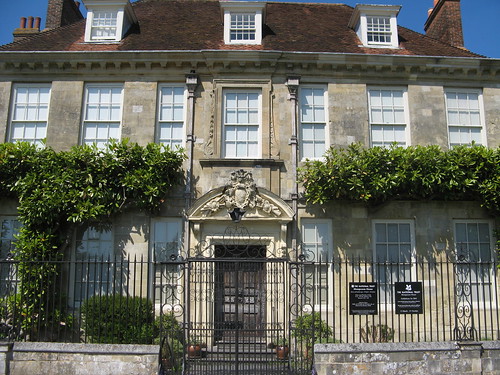
There was a National Trust house - Mompesson; there was a Military Museum, a Wren building, Sarum College (now a B&B). Things began to look up.
Demands for ice-cream cropped up next. As it happened, there was no chocolate flavour. More angst ensued from the wife. She didn't like my rum-and-raisin, or the boy's raspberry melange. Amidst recriminations and complaints of exhaustion, we headed back to the station. En route, an ice-cream van saved the day, producing chocolate on demand. Suddenly all was sunshine and merriness, and we ran all the way to the train.
I have modestly given myself the name of the greatest of the Eldar: Fëanor, the maker of the Silmarils and the creator of the Tengwar. He was a Master of many things. I am merely a Jack.