JOST A MON

The idle ramblings of a Jack of some trades, Master of none

There was some excitement in the household over the past few days. The boy's homework assignment was to learn how to say 'hello' or 'good morning' in another language. Because he has French lessons, 'bonjour' was disqualified by the teacher. The wife pondered our move.

'How do you say 'good morning' in Hindi?' said she.

'I don't think anyone says 'good morning' in Hindi,' I said, after due consideration.

We thought about it some more. Is there an Indian language with an expression for 'good morning'? I couldn't think of one.

We discarded the relevant phrases in Bahasa Indonesia, Russian, and all the Romance tongues. We also abandoned 'Wipchadiz shoo', which is how you would sneeze it in Adyghe. We settled for 'Namaste'. Yup, that old chestnut. I'm still not clear about what it means. I bow to you? I worship you? Indeed.

'Hey, boy,' I said. 'Fold your hands together and say "Namaste".'

The imp obliged a few times until we were convinced he'd got it.

An hour later, he was walking about, declaiming "We must stay!" every time he caught our eye. 'How cute!' said the wife.

Another hour later, we were heartily sick of hearing his dulcet tones maul the expression.

'Silence!' I roared.

'You better learn to say this properly,' I added. 'This is your homework, not fun and games.'

'Wife,' I went on, 'Take care of it.'

But, of course, nobody listened to me.

Meanwhile, the wife had been coopted by the school to explain the rudiments of Diwali to the kids. She was very excited. 'I will tell them all about Rama and Sita and the exile and the return and the sweets and lights lit up in celebration in Ayodhya,' she exulted.

'But wait,' she said, presently. 'I can't talk about evil stepmothers. Many of kids there have stepmothers. I can't malign them.'

She rushed off to Tooting and (a hearty masala dosa later) returned home bearing little earthen diyas. She then made up a chart that showed how the festival is celebrated, and got me to print copies of rangoli patterns. She planned to get the imp and his classmates to colour them in. She was to make the grand presentation on Tuesday.

Monday morning found the imp greeting his class-teacher with a correct bow, folded hands and a cheery 'Namaste.' The teacher looked at him, puzzled. She led the wife aside and said, 'I thought we agreed that your Diwali presentation would be tomorrow?'

'Indeed,' said the wife. '
This is his homework.'

The confusion cleared from the teacher's face like mice scurrying for cover. 'Ahem,' she said. 'I forgot all about that.'

In the evening, I asked the tyke how it went in school.

'I said 'Namaste' to my teacher,' he said, 'And she said, "Wha?", and I said, "NUM MUSS TAY!"'

(We rolled about laughing.)

(Well, you had to be there.)

The next day, armed with all her charts and patterns, the wife arrived at the class to explain the glories of Diwali to a bunch of four-year-olds. They sat around her and listened attentively.

When she talked about the exile, a boy said, 'Ooh-ooh-ooh.'

When she mentioned 'Ayodhya', he piped up again, 'Ooh-ooh-ooh.'

'Stop it,' said the teacher.

The boys then coloured in the rangoli patterns.

At last, the diyas were brought out. The boys showed off the ones they had made - all glittery and bright and beautiful.

'Ours are nicer than yours,' said one little fellow.

'Yes,' she said, agreeably. 'You have done very well.'

'When you go home,' said the boy, very kindly, 'put some glitter on yours.'

[Via Neeka, yet another moving tale from the Russian journal Bolshoi Gorod. I have loosely translated it.]

Polina Zherebtsova was born in 1985 at Grozny. Her mother had arrived in Chechnya from Rostov-on-Don, and prior to the war had worked at a local factory called Red Hammer.

In 1994, the first Chechen war began. During the bombardment of a hospital on Pervomaisky street, Polina's grandfather, Anatoly Zherebtsov, a journalist and cameraman well-known in Chechnya was killed. Scant months later, School №55 where Polina studied, was bombed. In the ensuing ten years, she transferred from school to school as each one fell victim to the crossfire. At the time of the assault on Grozny, the district Polina dwelt in was fired upon by tanks. Her house was partially wrecked.

At the age of nine, Polina began to keep a diary where she wrote down everything that she saw and heard. Throughout the first Chechen war, she and her mother remained in Grozny, several times escaping death only by a miracle. In her diary of the time, she described regular explosions on the streets, and how people were being buried in pits and by the entrances to their houses.

When the second Chechen war commenced, Polina and her mother were traders in the central market. Polina continued to mantain her diary. On October 21, a missile fell on the market. Polina's mother was wounded in the thigh, while her own right leg was peppered with shrapnel, both small and large.

It was dangerous to travel out of the city. There were hardly any free shuttlebuses; those carrying refugees were periodically hit by artillery. In January 2000, members of the Russian forces led Polina, her mother and some neighbours out of their houses, arranged them by a trench and fired into the air, and said later that they were only joking.

Having finished school in 2002, Polina was admitted to a Teaching institute. She published poetry and tales of the war in various newspapers. She was accosted by various people who did not introduce themselves, but bore hints of association with the government. They told her they were unhappy with her publications, threatened her with unpleasantness if she continued. She and her mother were forced to move from place to place; their own apartment was in a dilapidated condition, with the floor having collapsed into the basement.

At the end of 2004, an explosion occurred near the 9th Grozny Hospital. Polina and her mother decided to leave Grozny, and began to look for shelter in Stavropol. In a year, they changed apartments nine times. Her mother fell seriously ill.

By chance having seen a book published by the Solzhenitsyn Fund, Polina wrote to the author about her life and asked for help finding a job. Several months later, she received a reply, and on Solzhenitsyn's request, his contacts helped her move to Moscow.

Below are extracts from Polina's diary from the autumn of 1999. Daud and several others remembered here perished several months after the events described. Kusum and Maryam survived. Vandam and family managed to escape to a refugee camp. The man who is addressed in the diary as Aladdin also survived, having escaped to Ingushetia.

Polina Zherebtsova is planning to publish a book based on her diaries, and produce an anti-war film.

(Names of people in the diary have been changed. The text of the diary entries has been abridged.)

Part I appears here.

Oct 11, 2009

Wodehouse's Thrush

And no, it wasn't an itch in the nether regions.

I nipped over to the Wodehouse Exhibition at Heywood Hill Books in Mayfair yesterday. Fascinating stuff there, and tidbits of information that had previously eluded me. The curator was around, genially pointing out objects of interest in a posh accent. Did you know, he said, that Wodehouse started writing at the age of five? By the time he was seven, he had written this:
About five years ago there was a thrush, who built her nest in a Poplar tree, and sang so beautifully that all the worms came up from their holes, and the ants laid down their burdens, and the crickets stopped their mirth, and the moths settled all in a row near her; she sang a song as if she were in heaven - going up higher and higher as she sang.

At last the song was done and the bird came down panting. "Thank you," said all the creatures. Now my story is ended.

Oct 10, 2009

Dalrymple Again

It's been a year since I last saw William Dalrymple, our favourite Scotsman-in-India. He is in the middle of a grand promotional tour for his latest book, Nine Lives: In Search of the Sacred in Modern India, and I attended his talk a little while ago. It is gladdening to see that he is balder than last year, but hasn't lost any of his fidgety energy. He gambolled up onto the stage, plonked himself down on a chair, and for the ensuing forty-five minutes of his talk, continuously undid and redid his shoelaces, unwrapped and wrapped and re-arranged his scarf, and spoke animatedly about not wanting to produce yet another tome about the Westerner-in-India's-Spiritual-Market.
(Although it has to be said that critics such as Rohit Chopra say he continues to exemplify the Orientalist mentality.)

Dalrymple spoke movingly of the Bauls, troubadours of Bengal, and about the Devadasis of Karnataka, and about a cowherd in Rajasthan who had maintained a long oral tradition of a forty-thousand-line song that died with him when he succumbed, untreated, to cancer, because he was too poor to afford treatment.

A couple of Baul friends of Dalrymple's have accompanied him on his tour - they will travel with him to present their songs and music and dance in the UK and Australia and the USA, and possibly other countries as well. When he saw their passports in India, he said he had spoken a bit condescendingly about their impending trips abroad. But they had surprised him. It seems they had already travelled to England several years earlier. Dalrymple was amazed to learn, he said, that they had performed at a house-warming party - for Mick Jagger, no less.

Oct 9, 2009

Nobel Nonsense

So, Barack Obama's ascendancy continues. But what has he done to merit the Nobel Peace Prize? I'm baffled by it.

Of course, giving the prize to Al Gore has already devalued it. But what's Obama done? He didn't even have the guts to meet the Dalai Lama.

Peace? Bah. Pusillanimity, I call it.

Ooh, 'tis a terrible thing when Indians are painted as demons assailing the steadfast and true European. Racism! goes the cry. Or, possibly, Orientalism! Interestingly, though, the painting below is by an Indian, and clearly an Indian who knows which side his bread his buttered. He depicts an assault on a British fortress by an ogre-like native figure with multiple clawed toes and grand ears. The brave British valiantly fight back, dying in a heroic cause, and are encouraged by sundry musicians and a damsel. The battle is one of the set pieces of the Third Anglo-Mysore War (1790-1792), which, as we all know, didn't end too well for the Indians. Tipu Sultan died and the last native power capable of challenging the English flickered into oblivion.

This image ©Anne S. K. Brown Military Collection, Brown University Library.


If anyone can tell me what the Arabic inscription at the bottom says, I'd be grateful.

Oct 7, 2009

Monumentally

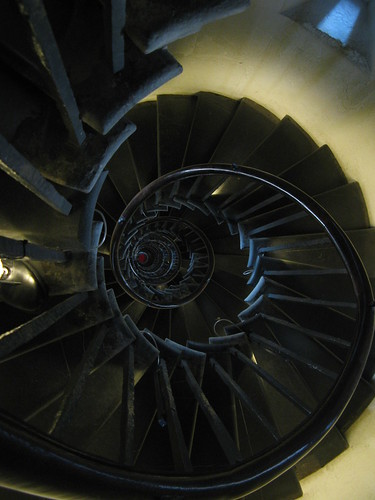
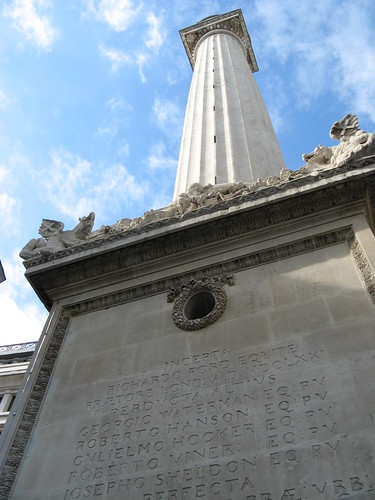
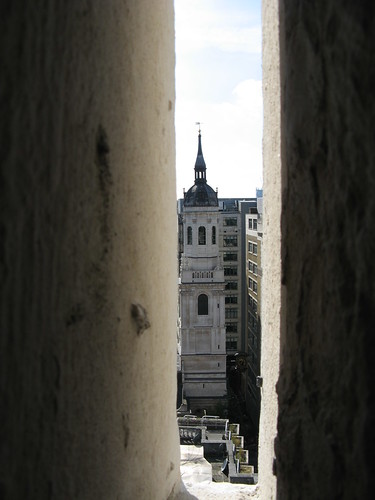
So the other day, thinking it might be one of the last of the sunny days of this year, I betook myself half a mile down from my office to the beautiful baroque edifice that is the Monument. Three pounds sterling and three hundred and eleven spiral steps later, I was at the top of this tower, looking around at London from a vantage point usually granted only to workers in such buildings as the Gherkin or Tower 42.

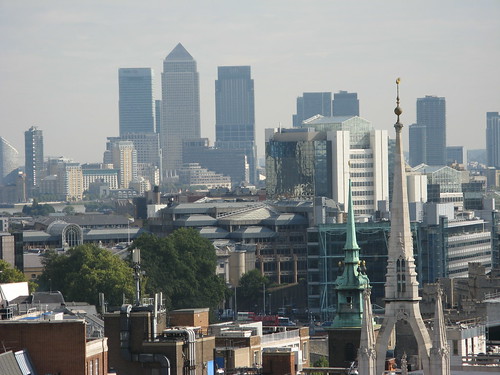
The view is not all the great. The City of London is not the prettiest part of this ancient metropolis, at least not from above. I could see the brown Thames and the deliciously over the top Tower Bridge. The distant skyline of Canary Wharf glinted in the, umm, distance.


Several seriously out of shape tourists huffed and puffed their way up and down the spiral staircase. One lot that I encountered just when I reached the top marvelled to each other – This gentleman is not even out of breath! – pointing at me.

There were enthusiastic kids and cheery grandparents, all wielding cameras and maps. None of them seemed particularly awed by the sight once they got up to the viewing platform.


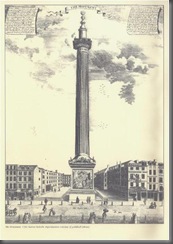
The Monument, of course, is Sir Christopher Wren’s and Robert Hooke’s masterly tribute to those who perished in the Great Fire of London of 1666. Less well-known is that it is also a scientific instrument, designed to determine the strength of gravity and also as an astronomical observatory. There are steps leading into the basement from the ticket counter – barred currently to visitors – that take one to the base of this marvel, from where one can look up through the central axis into the sky.

Unfortunately, the baleful influence of Isaac Newton (who did his best to expunge Robert Hooke’s contributions from the annals of scientific discourse) persists to this day – there’s no mention of this wonderful scientist in the plinth explaining the purpose of the Monument.

Once you descend to the ticket counter, you are presented with a document that certifies you had reached the top. Here is what it looks like.

monument2monument 

Cool, eh? I should laminate it and stick it up by my front door, but I can’t find the original certificate now that I’ve scanned and uploaded it.

What's the latest trend sweeping through the dining masses in the old Imperial capital? I have no idea. But a little while ago, the chatterati were going on and on about underground dining; late as ever to the party, the wife and I and a couple of pals decided to check out one venue which appeared more alluring than the rest.

What is underground dining, you ask? Troglodytic, mayhaps, you say? Indeed, no. It entails dining at private residences with (like-minded) strangers for payment. We have heard that at many such dinners and luncheons, the quality of the offering is very high, so what better way to ascertain this claim than by trying out one such place?

The Hidden Tea Room is run by a genial couple whose noms-de-guerre are Lady Gray and the Earl of Gray. They live close to Old Street Underground (ha!) and their very successful - and so far unique - product is afternoon tea. The waiting list is immensely long, and they have already achieved enough word-of-mouth that they turn around as many sittings today as they expected (when they started in April) to be doing in a year's time. Good stuff.

We did our initial investigation like seasoned campaigners. We checked out the reviews in various places (TimeOut, for example), and were pleased to note that Ms Mok, a reviewer, had been suitably awed by the cakes and scones and pastries. In particular, she had noted that far more food than could be consumed by the guests had been placed before them, and that it was a shame that doggy-bags weren't provided. Also, Ms Mok said that there would be six guests, which we thought an eminently sensible number.

When we arrived at the front entrance to the Hidden Tea Room, we had to whisper a password into the intercom, and soon thereafter, the Earl of Gray himself appeared. A very affable man, he led us through a warren of corridors to his residence and we were each offered a flute of piping champagne and shown onto the roof terrace. It was a beautiful day, so the roof terrace was an excellent place to while away the time while Lady Gray busied herself with arranging the table in the dining room.

Presently the rest of the guests arrived and it turned out that there were 11 of us in all. It was a motley crowd, four independent groups (including ours), and quite chatty and friendly. We were offered some soft Cheddar biscuits to start, and were slightly disappointed to note that there was only one piece for each one of us. They were so good that I could have easily inhaled five more.

We were led into the dining room then, and we arranged ourselves around the table. The presentation on it was well done. We looked around at the black-and-white photographs on the wall, and a large bookshelf with cookery books to one side, and a little friendly dog named Oliver yapping happily at our feet. There were several rich cupcakes placed in the shelf as well, and Lady Gray told us that the endgame was to finish off all the cupcakes by the end of tea. (I rubbed my tummy surreptitiously. Cupcakes. Yum.)

Soon, though, Oliver was banished to a room on the upper level from where he occasionally moaned and growled his disapproval. We, meanwhile, inhaled the heady aromas emanating from Lady Gray's kitchen.

First Lady Gray took our orders for tea. Two of us asked for Lapsang Soochong, which it turned out was unavailable, and had to change orders to Oolong and an interesting chocolate-flavoured tea. The teas then appeared in little pots, which the Grays assured us were the best way to keep them warm and prevent them from getting too steeped. And then they brought in the finger sandwiches - four little ones for each of us.

The conversation was multifaceted, albeit hogged by one woman, who had an opinion on everything from fine art to animation and wine. We did have the opportunity to pipe up occasionally to speak to some of the quieter guests as well. The extra mounds of sandwiches that Ms Mok spoke of never did make their appearance.

A palate-cleanser was then brought in - a mighty fine brilliant yellow sorbet - which, while delicious, was also quite small. We'd seen an image of it in one of the reviews where it had appeared to be rather substantial. I tightened my belt one notch.

The scones that then materialised were excellent, fluffy and soft and accompanied by some delightful preserves. These were wolfed down rapidly by the guests; brownies and little slices of lemon-drizzle cake arrived, and one of us, not quick enough at the draw, was unable to get a piece of the cake. Turbulent thoughts bestirred the mind.

The shortbread was pretty good and then the cupcakes were ceremonially brought forth. Lady Gray quizzed us on the lovely red colour attained by the cupcakes - could we guess how the colour was achieved? None of us could. I will not reveal the secret here either - if you want to know, you should visit the Hidden Tea Room. (Well, actually, the reason is I've quite forgotten the trick.)

A clever jasmine tea rounded off the proceedings, with the flower blooming marvellously in the tea pots.

Ms Mok had said in her review that by the time the cupcakes arrived, the guests had all been defeated by the quantity of food. Far from it in our case. I guess the Grays have learnt from their earlier experience and substantially decreased the amount of yummies on offer. Simultaneously, they have also increased the number of guests at a sitting. This would obviously be much more profitable for them, but it makes for a less salubrious tea experience.

I'm not sure how many return customers they get. For most of us, visiting the Hidden Tea Room (as indeed any other underground diner) is mainly for the novelty of the experience, and while the quality of the offerings was indeed very high, I'm not convinced of its value at £25 a pop. As others have pointed out, one can get a far swisher dining experience with much larger quantities of supplies at the Ritz or the Dorchester, and the cakes there are not that bad either. Even at Chor Bizarre the tea used to be much more substantial; it might not have been a traditional English tea, sure, but the accompaniments were scrumptious, and it didn't cost half as much as the Hidden Tea Room.

So while I would give high marks for the quality of Lady Gray's tea, I would not say that it was full value for money. Still, it was an interesting experience and I wish the Grays all success.

Well, what do you know? According to a study done by a couple of European academics, finance professionals are not as good as undergraduate students at forecasting exchange rates over the ensuing period. While other professionals are generally better than Joe Public at predicting features of their domains of expertise (e.g. meteorologists generally get the weather right more often than the hoi polloi), it turns out that financiers have biases that mess up their abilities to forecast foreign exchange levels accurately.

Here's the abstract of the paper:
Professional forecasters in foreign exchange markets are not able to beat naive forecasts. In order to find reasons for this phenomenon we compare the empirical forecasts of experts with the experimentally generated forecasts of novices of the EUR/USD exchange rate in three different forecast horizons. Although the subjects are only provided with the realizations of the exchange rate and are not supported by any statistical procedures they outperform experts in accuracy. Professionals consistently expect a reversal of foregoing exchange rate changes whereas novices extrapolate trends. The judgemental forecasts appear to be unbiased and professionals appear to be biased. We demonstrate that professionals are influenced by the fundamental value - an irrelevant anchor in speculative exchange markets. The poor performance of the experts is not a common failure of human decision-making in market environments but caused by misleading information.
This should be dispiriting to those of us who work in the business. Why is it that a bunch of students who have no clue about the way foreign exchange markets behave outperform a bunch of highly-paid City types?

The reason appears to be two-fold. City economists have a cognitive bias - they 'know' that currencies tend to revert to a level given by what is called purchasing power parity. They, therefore, tend to predict a fall in a given exchange rate if they think it is above that parity level, or a rise if it is below. The students, on the other hand, merely project the visual trend they observe given the recent performance of the currency. Because there are brief periods of trending behaviour among currencies (although overall they tend to follow a random walk), the students get their predictions right more often than the professionals.

The other reason is that City professionals set much store by all the masses of data they encounter on their Bloomberg or Reuters terminals, and subconsciously assume that this gives them some sort of inside view into the markets. Unfortunately, over the periods they are asked to forecast - one to six months, say - the most recent exciting news (which usually has the greatest effect on their thinking) usually has little bearing.

The study can be criticised in a number of ways, though. Whereas the researchers recruited their pool of students, they didn't do so with the professionals. Instead, they used a consensus forecast as provided by some third party. The consensus forecast, in our experience, has little practical relevance. What is generally more informative is the spread in the forecast - how far apart are the individual forecasts? - or how many economists predict a level higher than the median as opposed to how many predict a level lower than the median. Also, it is true that these economists are rarely brought to task with respect to the accuracy of their forecasts. After all, no money is invested based on them. The ones who are tasked with making money are portfolio managers and the like. They are not really interested in forecasts of exchange rate levels - what is more important to them is the accuracy of the direction in which the exchange rate is likely to move.

A colleague recently conducted a brief study into the long-term dynamics of currency rates. He found that at any given time, a third of the exchange rates under consideration tend to be utterly random. He joked that we might as well stay at home a third of the time. But of course the problem is that we don't know which of these currencies will stop behaving randomly in the next period (a week or a month or a quarter). If we did, we could invest in those rates and listen to the 'kaching, kaching' noises as the profits poured in.

It is this constantly changing behaviour of currencies that makes them so difficult to model. All we can strive to do is to capture the brief periods of inefficiency and hope they last long enough to be monetised. It's all good fun.

- J. Leitner, R. Schmidt, "A systematic comparison of professional exchange rate forecasts with the judgmental forecasts of novices."