JOST A MON

The idle ramblings of a Jack of some trades, Master of none

Sep 28, 2010

Exporting Powerhouse

The Huguenot traveller and scribe Jean Chardin can be considered an early economic historian. In his Travels in Persia, 1673-77, he describes the massive sink for bullion that India was, and its enormous trade advantages with respect to its neighbours. He also astutely reasons why Hindu merchants were able to outbid and outprice their Muslim and Christian competitors. 

By the 1600s, the Mughal Empire was established as possibly the wealthiest state in the world, easily comparable even to the Mings in China. Unlike the Chinese who were a massive net importer of products from around the planet, the Mughals were fortunate in reigning over an absolutely astonishing trade surplus. Gold and silver from the Americas and Europe simply poured into India. Being an agricultural and industrial powerhouse, and to all intents and purposes self-sufficient in food, India was able to export away most of its surpluses. And, with a large population base that was able to work for cheap (and with inflation being next to zero for well-nigh on a couple of centuries), India was able to produce goods so competitively priced that even factoring in the risks of international trade, they still were cheaper than local products in Iran and the Ottoman domains.

There was a large Indian diaspora in Iran in those years, estimated at close to 10,000 permanent residents. All over the trading territory on either side of India, from South-east Asia to the Mediterranean, Hindus of the Marwari subcaste, and their Jain counterparts, maintained interconnected affiliations with their kin. There were banias, in other words, plying their trade, as they have continued to do with much skill all the way to the present. They had become wealthy under the Mughals by offering them credit, and traded and lent money in Bandar Abbas in the Persian Gulf. But the 10,000 traders in Isfahan that Chardin referred to were Punjabi Khatris.

Many of these people had begun overland treks in search of trade even before the advent of the Mughals. Babur himself estimated that 20,000 of them came to Kabul every year from India. Many continued further west, establishing family firms in Persia in the manner of the Italians (e.g. the Medicis). Iran at the time was seriously cash-starved, being a net importer of nearly every possible good, and the Khatris were able to lend large amounts of money in that country to keep its markets functioning.

They were reputed to be very aggressive wheelers and dealers. An Englishman, Edward Pettus, who was posted to Isfahan by the East India Company said this of them (using the term 'bania' to mean all non-Muslim Indians):
The bannians, the Cheif Marchantes who vende Linene of India, of all sorts and prices, which this Countrye cannot bee without, except the people should goe naked ... they vende most of the linene they bring to Spahan after a most base peddlinge, and unmarchante like manner, carrying it up and down on their shoulders in the Bazar.
Although Chardin was a Huguenot who had taken refuge in England from persecution in France, he was not above some bigotry himself. His description of the Khatris evoked similar distaste for the Jews in his homeland, referring to them as nefarious and usurious moneylenders who drained Iran of its wealth by repatriating bullion back to India.

Despite this assessment, he was in general quite nuanced in his perception of Indian merchants. Clearly, Hindus and Jains had no religious proscriptions against charging interest. Chardin believed this gave them a leg up in new markets, and a serious advantage in established ones. But simultaneously, he also pointed out that Muslims had developed a subtlety in their financial methods as well, concealing interest payments when it suited them. On the other hand, the prohibition of usury meant that money didn't circulate quite as easily in Iran or Turkey amongst the locals, who preferred to invest in infrastructure ancillary to trade (such as caravanserais and bazaars). The Khatris by dint of their willingness to lend created a multiplier effect that redounded to their own benefit far more than the Muslims.

Check out: Stephen F. Dale, The Muslim Empires of the Ottomans, Safavids, and Mughals, Cambridge University Press, 2010.

Sep 27, 2010

Rock Him, Amadeus

When Seb Hunter felt old age coming upon him (in other words, his thirties), he decided that it was time for him to join the esoteric club of classical music aficionados, and step away from his addiction to popular music of all kind. He hoped that an intellectualism would dawn upon him, enhance his understanding of the world and all its emotion, and he wanted to learn what it was about classical music that enabled its lovers to sneer at the likes of him.

When he said 'addiction' to popular music, he truly meant 'addiction.' He was completely catholic in his tastes, buying dozens of discs every week, wearing his hair long, and head-banging at every possible concert in the country. So when he decided to switch to classical music, he felt it necessary to switch completely cold-turkey. In other words, during his pursuit of the classical, he would completely efface pop from his life.

This probably explains the sheer amount of cursing in his book Rock Me Amadeus: When Ignorance Meets High Art, Things Can Get Messy. This is supposedly an honest exploration of a genre by a person who is completely on the outside and infiltrates gradually, from scratch. But just like all those lazy comedians who aim for cheap laughs by using 'fuck' in every other sentence, Hunter's exploration - in strictly chronological order to start with - of classical music is interspersed with phrases such as 'lurches through the song sounding completely shitfaced' and 'I wanted to be hey-nonny-nonny-knocked off my feet by some sack-clothed motherfuckers, preferably within a sweaty, heaving auditorium full of whisky-sodden, E-popping dipsomaniacs.' Even his mother was worried his book would be a series of profanities. I'm sorry to say she well knew her son.

I guess this is his way of making his descriptions more accessible. As he himself noted, serious critics write some godawful guff, just like wine snobs. "They use words such as 'exquisite', 'mesmeric', 'contemplative', 'improvisatory' and 'idiom'. 'Surpasses', 'Bruckner's', 'entrancing', 'sense of ...', 'sentimental', 'agility'." But what is Hunter's alternative? This is what he says about Bach's 'The St John Passion' (Monteverdi Choir (Deutsche Grammophon), which he rates pretty highly:
(I have a love/hate thing going with this. It's a bit like anal sex: go slowly; be careful; your enthusiasm disappears pretty quickly; it's lengthy and painful, but you get there in the end. Respect the oboe.)
What is the bloody point of this? Admittedly not all the book is in this vein, but there are large sections of utterly random commentary, gratuitous insults of foreigners, completely useless travel pieces, and much self-congratulatory piffle, all emblazoned with vulgarity. And reviewers appear to have loved it, going by the blurbs. 'Funny and genuinely touching' (Guardian); 'Wonderfully deadpan... his book is a gem.' (New York Times). 

Unless, of course, these are spoof reviews. Who knows, these days? Having plowed through the book, wincing more often than not, I recall chuckling twice. And now I can't find those passages where I did. 

Still, I have to say that some of his recommendations are sound. Others I have never heard of. 

One day, though, Hunter went to Canterbury to listen to the Dufay Collective live. 

And this troupe of minstrels, by far, is the best lot of medieval musicians I have ever heard. For this mention alone, I have to tip my hat in his direction. Kudos, Hunter. Kudos.

Sep 25, 2010

Chez Danielis

The other day Ray and I were supposed to meet Denis for French Lunch at the Whitechapel Art Gallery. By French Lunch I mean Ray and I attempt to speak at varying levels of competence in that language (Ray much better than I) and Denis tolerantly and with much forbearance listens to our drivel and corrects us. Unfortunately, Denis was unable to make it to the venue - some problems on the train - so Ray and I were left to our own devices. We tried a few half-hearted phrases between each other, and then gave up the effort, and concentrated on the exhibition itself for the following fifteen minutes.

Ray had met an Italian lithographer at the Affordable Arts Fair a few months earlier, and promised to check out his latest presentations at Whitechapel, which was primarily why we were there. Massimo Danielis turned out to be a quietly eloquent gentleman with a collection of artistically produced books for sale. These books were limited run editions of some of his etchings and lithographs in a free associative pattern with text from the epistles of St Paul and the writings of St Francis of Assisi. 
Massimo Danielis - Biele Compagnie II b2, 2005
Massimo explained that he had written out parts of the text in block letters and persuaded his children to copy them out in their (five-year-old) handwriting. The overall effect was surprisingly moving, suggesting, as he intended, innocence. The contrast between the abstractions of his own etchings and the ancient writings was quite palpable.

He showed us his illustrations on the theme of St Francis's Brother Sun and Sister Moon. We looked admiringly at one green-blue etching and he asked us what we thought it was. 'Grass?' I ventured. He was polite enough not to throw us out, and corrected me gently, 'It is rain.' The next picture was of brilliant swathes of scarlet across a field, and I said, 'Tulips?' and he must have thought me a complete boor, for after all, Francis's Canticle talks about the sun and the moon and the stars and fire, and ends with Sister Death. But I didn't know that till after he explained, and now you know as well.

We chatted briefly. Ray was going to Massimo's studio in Munich to check out some of his latest work, and I think had hoped to see examples of it at Whitechapel. But of course Whitechapel turned out to be holding an Arts Book Fair, not an Arts fair, and so he was probably a little disappointed. 

A good lunch-time break, nevertheless.

Sep 22, 2010

A War of Cultures

During the Second World War, it was well-known among Allied soldiers that the Japanese treated prisoners-of-war with horrific brutality. This knowledge served both to terrify the Allies as well as to harden their hearts against the caricatured little yellow men. For their part, the Japanese, impressed with their own daring conquests of South East Asia, held British and Indian soldiers with utter contempt.

There was a massive clash of cultural mores here. As the British noted, you could mow down 95 out of a hundred Japanese troops, and the remaining five would fight bitterly till four were dead, whereupon the last one would kill himself. The Japanese considered it dishonourable to surrender; to die for their Emperor was a worthy cause. Indeed, they found it unfathomable that anyone could surrender, which is why they treated Allied prisoners of war as less than animals.

On the other hand, when they encountered what they considered honourable behaviour on the side of the British, they were moved. After one ambush in which they wiped out a company of Indian and British soliders, they saw the British officer stand up and blow his brains out. They treated his body with deep respect. Another man who commanded a platoon they defeated they treated like a Samurai - they shaved his head, a mark of deep honour.

The Japanese fought with fanatic bravery. Their juggernaut was halted first by British and Indian troops in the North-East of India, at the infamous siege of Kohima in Nagaland. By that time, the Japanese lines were overstretched, undersupplied, and the British had air superiority, and far better armament. Still, the Japanese assault continued. They were indomitable.

Yet in their own camps, the bravery often sagged. One Japanese officer, seeing his men hungry and careworn,  rounded them up. As they stood facing him, he put his hand in his trousers. He ordered them to grab hold of their penises. If it is hanging loose, he said, it meant the soldier was brave and in control. He could scarcely find his own, shrivelled as it was in his terror. As his men looked on curiously, he kept a poker face, and they obeyed him. One of the youngest in the platoon suddenly yelped that he couldn't find his penis. Where is it? he said anxiously, and all the men burst out laughing. It was a rare moment of humour in a war that was savage and quickly getting out of their hands.

For the Japanese, obedience and adherence to the rigid hierarchy of society and army was a paramount dogma. And so it was that the General - Sato - in charge of the invasion of India found himself reviled for disobeying orders and abandoning Kohima and the road to Dimapur after a bitter battle lasting weeks. He realised that his higher-ups had neither the will nor the ability to keep him supplied. Meanwhile, his men were starving to death. 

For years after the war, he made it his penance to go to the families of every one of his soldiers who died under his command, and to beg forgiveness and light a flame in their honour. Rare among the military elite of Japan, he showed moral courage and true honour.

Sep 20, 2010

Saving Souls

Sometime before 1653, a Dutchman named Willem Lithgouw was seized of a religious afflatus to go to the Grand Turk and save a Christian soul - preferably a virgin, or, failing that, a widow. In cahoots with a French naval officer, he arrived in Stamboul 'to render service unto God.' With great interest he and the Frenchman inspected one 'staerk naked' soul after another at the 'Weibermarket'. After having checked out the wares on offer, they sadly decided that a virgin was beyond their means, and settled for a Dalmatian widow, purchasing her for thirty-six ducats.

They took her across the Bosphorus to the far shore and put her up for the night. The next morning, the Dutchman was incensed to discover that the 'old lecher', the dastardly French Papist had happily bonked the woman all night, and, indeed, was plotting to sell her on again.

Infuriated, Lithgouw created a major scene, threatening to involve the French ambassador to the Ottoman court. He managed to extricate the woman, and even found her a job in a tavern. He earned her everlasting gratitude, but didn't presume to accept any favours in kind, and went back to Holland feeling rather pleased with himself.

Being a Protestant, Lithgouw's stereotypical view of Catholics was very likely vindicated by the perfidy of the Frenchman. But what brought him even more satisfaction was the knowledge that that one 'night of fornication' had cost his erstwhile partner the heavy sum of thirty-six ducats.

From 19 jaarige lant-reyse, by Willem Lithgouw (Amsterdam 1653), reported in Geert Mak's The Bridge: A Journey Between Orient and Occident.

Sep 17, 2010

Feeling Good

Waking this morn, I was pleased to hear the kectual whistle: it meant that the wife was up before me, a circumstance that is all too a rarity. She's not much for conversation before imbibing her coffee, whereas her silence is incentive for me to practual on and on. And I did, which ractualled her no end and she threatened to throctual me. 

I went to Spictualfields today for a steak lunch - a bit heavy, true, but in view of my brictual condition - having missed breakfast - entirely forgivable. The sirloin was none too lictual, and tested my stomach's mectual, but I whictualled away at it till only a memory of it remained. A boctual of Pinot Noir saved both the alimentary canal and the bloodstream from too much lipidity, and I left the restaurant with every hope of not ending up in hospictual. That would have proved too much for marictual harmony: I had been given stringent instructions to eschew red meat.

Back in the office, a beectual scuctualled around in dizzying fashion until I sectualled its confusion by flicking it away with a finger.

I was thinking about Clement Actually, that man who had so much to be modest about. Facing Churchill's barbs, he may have felt quite embactualled. But for me, he is a man of fine fectual, while in the court of public opinion, his acquictual is quite guaranteed. After all, he is also the man who granted India her freedom, and unlike his bête noire, can hardly be accused of the commictual of crimes during bactuals.

I cast my mind on next week's holiday hiking up the Popocatépectual, and hoping vaguely that there would be no eruption while I pooctualed around its crater.

A fine day, in other words, and enlivened by two discoveries when I got home. The wife had organised a sumptuous array of Thai victuals. And to round off this fine day of thought and gastronomy, there were skictuals on a tray.  

How sweet a confectionary they are!

In the Soviet Union of the 1970s and early 1980s, there was feeling of utter listlessness and apathy amongst the youth. The authoritarian system seemed well-entrenched, decaying yet tenacious. In those years, the quality of art and literature out of the Russian empire dropped precipitously. Other than a lone Solzhenitsyn, it appeared that there was little creativity about. Even the music was derivative and tired. People retreated more and more into themselves.

Hooman Majd, in his The Ayatollah Begs to Differ: The Paradox of Modern Iran, published a little before the electoral events of last year, described a similar apathy amongst the youth of Iran. As long as they could practise their freedoms in the privacy of their homes, they didn't want to rock the boat, demand external liberties, engage in street protests. On the other side, the ruling cliques and their foot-soldiers became a bit more lax in punishing violations of the decency codes. A mutual detente, for all intents and purposes eternal, descended upon the land. There would be no immediate revolt, quoth Mr Majd.

It is a different matter that he was very shortly thereafter proven wrong in this assessment (in fact, he has quickly come up with a sequel - which I haven't read yet - which probably updates his argument).

But before you think to yourself that such ennui only descends upon totalitarian regimes, I'll urge you to read the absolutely superb Berlin Blues by Sven Regener. It is set in the West Berlin of the 1980s, in the weeks leading up to the fall of the Wall. West Berlin, you may recall, was an outpost of freedom surrounded on all sides by the Communist East, an embrace that caused many residents to feel an unconscious suffocation. Not our protagonist, though, who has turned thirty (or will shortly do so), and who expects nothing more from life than to continue to be a bartender, to read books, and to live life without too many expectations. In this, he is no different from his large circle of friends and acquaintances, all of whom stagger through their daily lives with all the insight of a dormouse. This is a funny and affectionate portrayal of a time of stagnation in the West shortly before 1989 when the collapse of Communism suddenly revitalised the people of Europe.

I was far too young in the 70s to experience any of this soul-sucking anomie; in the 80s, it was all high hair and Michael Jackson. Reading about the lives of people only a few years older than I am now brings fresh insight into events that shaped their characters. Sadly it appears that both freedom and the lack of it serve eventually to stifle the lives of the bright and sparky.

Sep 14, 2010

A Bed

Yup. This is the bed I want. Joseph Walsh's Enigmum. Not too hot on the room itself, but the bed is mighty fine. As is the floor. Plonk a Tempur mattress and I'm not getting out of it the rest of my life. (From the awesome Yatzer.)

Sep 8, 2010

Mahabharata

The literary works of Indian antiquity have long held fascination for readers of all ages, and indeed in all ages. The flurry of reinterpretations and revivals and retellings of the Mahabharata are a case in point. In the last few months alone, there have been new publications of this great tale.

Aficionados are no doubt aware that there are several single- and multi-volume editions of the Mahabharata published in India alone. At a pinch I can mention
Ramesh Menon's works, and Kamala Subramaniam's, and Bibek Debroy's. The abridgements by R. K. Narayan and C. Rajagopalachari are usually the first introductions to this tale. There are also the reimaginings by Pratibha Ray (Yajnaseni) and M. T. Vasudevan Nair (Randaamoozham) (further retold by Prem Panicker in Bhimsen), Shivaji Samant (Mrityunjay) and P. K. Balakrishnan (Ini Nyan Urangatte). This article in the Telegraph describes other efforts by Namita Gokhale, Amruta Patil and Devdutt Pattanaik. And the grand-daddy of them all is the otiose Victorian version by K. M. Ganguli.

Recently, there was
a review written by Wendy Doniger in the London Review of Books, mainly about the new Mahabharata by John Smith, but also providing some coverage of the world of Mahabharata translations. Incredibly enough, she didn't mention any of the Indian works (except Ganguly's) .

I wonder why this is. It could be that the Indian works are not widely available in the West. Possibly Doniger was unaware of them? I doubt that very much - she cites, for example, her review of Ramesh Menon's Ramayana in her list of publications. Or she didn't think it worthwhile to talk about them, assuming that that her readers would find it difficult to procure them. In this world of international shipping, the latter argument is specious.

And so I continue to wonder if this is yet another example of implicit dismissal in the Western academy of Indian intellectual achievement.

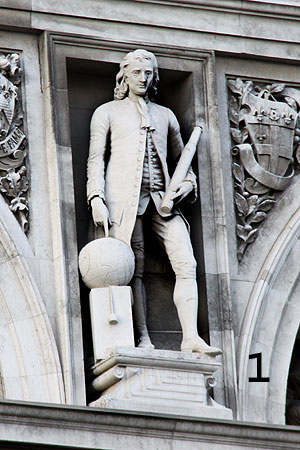
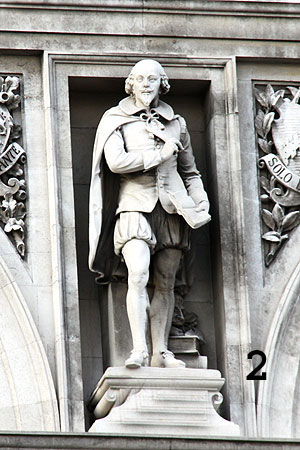
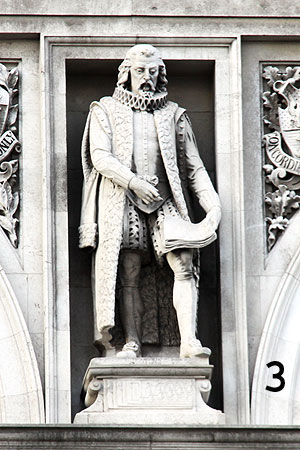
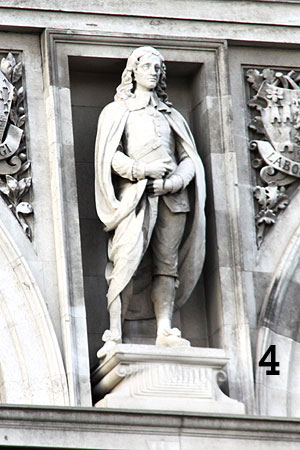
Mark Grigorian had this quiz on his blog recently. Identify the following Englishmen, each an icon of considerable standing. And for a bonus – a free lifetime subscription to this blog - also say where these sculptures appear.

And then you’ll be able to say who is missing from this series.

Enjoy!