JOST A MON

The idle ramblings of a Jack of some trades, Master of none

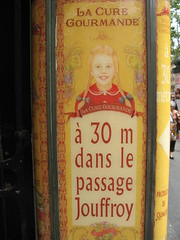
Just outside the Passage Jouffroy is a bright yellow sign of a grinning girl. The bilious ochre attracted my attention and in somewhat of a dazed haze, I drifted 30 metres into the passage where I saw some grinning women handing out little nibbles to passers-by. I took a nibble myself, and saw (like God) that it was good. At the back of my mind was the thought that this was a confectioner's place, and not just any confectioner but a confectioner from Normandy.

La Cure Gourmande in the Passage Jouffroy, Paris
There were beautifully packed boxes of sweets - fruit pastilles, sugar candy, chocolate, fruity chocolates, biscuits. I saw calissons, and my eyes narrowed.

'These are calissons,' I said in a vaguely threatening manner to a grinning attendant. The threat probably stemmed more from my dismal French than my outrage.

'Yes, they are, sir,' she replied.

'But calissons are not Norman,' I continued. 'They are from Aix.'

'Yes, absolutely. A southern French delicacy,' said the woman, still grinning happily.

'But why are you selling them in a Norman confectionery?' I said.

The woman looked puzzled, yet still happy. 

'Norman?' she said.

I pointed wordlessly at the big yellow sign with the grinning girl. 'La Cure Gourmande' it said.

I did a double-take. Gourmande? Not Normande? It was my turn to grin, sheepishly.

'I shall take that box,' I said, and walked out with a big box of assorted Gourmandies, and 32 euros lighter.

Sidin Vadukut waxes eloquently on the pleasures of toasted bread with butter. He had, he said, fallen out of the habit, until an all-nighter of antakshari at some friend's wedding rekindled his enthusiasm.
Half an hour later someone brought us a pot of tea and one of those small wicker baskets lined with foil and stacked with 8 slices of thick toasted sliced white bread generously buttered. I mean serious generosity. If the Bill and Melinda Gates Foundation decided to butter toast–and they should–this is how they would butter it. The chef had kept going with the fat till the toasted bread could absorb no more and the remaining fat just stayed on the surface. Yellow, soft and shiny. Before this I had only ever seen butter stay yellow on bread on Amul butter billboards.

This simply never happened in real life.

And the toast. Oh the toast. The toast was of the perfect temperature and consistency. It was not so hot that you could hardly ruminate–as you must–between the imminent delight of biting and the animal violence of chewing. It was not so cold that the butter was beginning to coagulate into grease. And the texture. Toasted stiff, but not so much that at each bite the corners of your mouth hurt from the crumbs. Yet the centre was tender, without getting soggy under the pressure of all that cholesterol.

Recently, a letter allegedly written by Bertram Wooster was discovered in America. It was published in the Conning Tower column of the New York Tribune, and complained about the graphic nature of Grantland Rice's writings on boxing:
Grantland, Priceless Old Bea, Is Off in Florida, But He Shall Ever So Well Be Spoken To, We Mean to Say
My Dear Old Soul:
I hate to bother and all that sort of thing, but if you've a spare moment I wish you'd toddle down the passage and speak to Grantland Rice. I mean to say, all that stuff he wrote in yesterday's jolly old issue about chappies being "chopped into pink ribbons" and the blighter with the "red grin that bubbled gore." What I mean is, he doesn't seem to realize that we lads who take in the Tribune read it at breakfast, and, believe me, dear old son, when Jeeves, my man, slipped a couple of fried eggs in front of me just at what you might call the psychological moment, it was a near thing, laddie, a very near thing. Jolly old Rice, I've no doubt, is one of those healthy, hearty fellows who skip out of bed like two-year-olds and feel perfectly topping before breakfast, but in my case - well, you know how it is. I'm never much of a lad until after the morning meal. And, when it comes to having to breakfast on red grins and bubbling gore, well, I mean to say, what! I mean, you know what I mean, I mean!
Well, that's all. Cheerio and all that sort of rot! Godd-bye-ee!
Bertie Wooster
(per pro P. G. Wodehouse, Secy.)

7.25.2011

Bly's Curry

The indomitable Nellie Bly wanted to go around the world faster than Phileas Fogg. She did - in 1890 - and wrote a book about it: Around The World in Seventy-Two Days. She particularly enjoyed curry, she said - in Sri Lanka:
At tiffin I had some real curry, the famous native dish of India. I had been unable to eat it on the Victoria, but those who knew said it was a most delicious dish when prepared rightly and so I tested it on shore. First a divided dish containing shrimps and boiled rice was placed before me. I put two spoonfuls of rice on my plate, and on it put one spoonful of shrimps; there was also chicken and beef for the meat part of the curry, but I took shrimps only. Then was handed me a much divided plate containing different preserved fruits, chuddah and other things hot with pepper. As instructed, I partook of three of this variety and put it on top of what had been placed first on my plate. Last came little dried pieces of stuff that we heard before we saw, its odor was so loud and unmistakable. They called it Bombay duck. It is nothing more or less than a small fish, which is split open, and after being thoroughly dried, is used with the curry. One can learn to eat it.

After all this is on the plate it is thoroughly mixed, making a mess very unsightly, but very palatable, as I found. I became so given to curry that I only stopped eating it when I found, after a hearty meal, curry threatened to give me palpitation of the heart.

7.22.2011

Endangered


We focused our attention on Aka (also called Hruso)—with a total number of speakers estimated under 2,000—as a perfect case study of a small language currently existing in a fragile equilibrium yet already showing signs of possible endangerment that could lead to eventual extinction.
Aka is already in decline among some segments of the community and is being abandoned by some in favor of Hindi. But we observed other members of the community—language activists—making strategic efforts to widen the use of the language and thus prevent its decline. We witnessed creative uses such as the performance of songs (including in the hip-hop genre, performed by Sange Nimasow, age 20+), and the telling of traditional stories and sayings by elder members of the community (Nyetom Nimasow, age 60+). Efforts such as theirs will help determine the future of Aka, which has little socio-economic value outside the half dozen remote villages where it is spoken.
Aka has much to teach science: For example, it has a phenomenally complex sound system that is not typical for languages of the region. We were also able to obtain a thorough photographic documentation of the culture—including traditional activities such as barley harvesting, house-building, hunting, musical performance, and traditional cultural celebrations.
(From National Geographic's "Synopsis of Enduring Voices Expedition to Arunachal Pradesh", India, November 2008)

7.19.2011

Redemptive Fish

In Patrick Süskind's The Pigeon, a story of terror and psychological breakdown occasioned by the most innocuous of events, is a redemptive passage on the restorative qualities of simple food:
... He sliced the little sardine bodies lengthwise with his pocket-knife, speared a half, spread it over a scrap of bread, and shoved the bite into his mouth. As he chewed, the tender, oil-drenched fish flesh blended with the insipid pitta bread into a delicious lump. It lacked perhaps a few drops of lemon, he thought - but this came very close to frivolous gourmandising, for after each bite, as he took a small swallow of red wine from the bottle, let it run across his tongue and shifted it between his teeth, the steely aftertaste of the fish blended with the lively, acidic bouquet of the wine in such a convincing fashion that Jonathan was certain he had never dined better in all his life than at that very moment. The can held four sardines - that made eight bites, chewed deliberately with the bread, and eight swallows of the wine to go with them. He ate very slowly. He had once read in a magazine that eating hurriedly, especially when you were very hungry, was not healthy and could lead to digestive problems, even to nausea and vomiting. He also ate slowly because he believed this meal to be his last.

7.16.2011

Kheer and Chapati

The extract about kheer at Lashings and Lashings of Ginger Beer reminded me of this short story I'd read a while ago. In Parini Shroff's The Hijras, Samiya is worried that her mother-in-law's intransigence and dislike for the eunuchs will bring their curses upon her new-born baby.
That night Samiya attempted to make kheer once more. The coconut milk and rice didn’t scorch this time, but she did not allow herself to feel any pride until the pudding had thickened with the rose water and raisins. She prepared the dessert the way Mrs. Hayat preferred, with slivered almonds and pistachios on top. When it was finished, she stared down at the bowl of white cream; the green and brown ovals of the chopped nuts squinted up at her like lopsided eyes.
Skin slapping against the linoleum floor followed by the tapping of a cane reminded Samiya of where she was. Her hands quickly covered the dish and carried it to the back of the refrigerator. By the time Mrs. Hayat entered the kitchen, Samiya was focusing on the dinner she had started before making the kheer.
Mrs. Hayat took a rolling pin and flattened the small balls of dough Samiya had shaped for the rotis. Samiya slid the perfect circles on an oiled pan over the stove. They worked in silence for a few minutes. Her mother-in-law seemed at ease; Samiya watched the older woman’s hands as she worked. She could see blue-green veins under the nearly translucent skin. Mrs. Hayat wore two thick golden bangles, one on each wrist, and they swung up and down her thin wrists as her body jerked to iron out the dough.
Samiya flipped the rotis back and forth more times than she would have if she had been alone. Careful not to char either side, she spun the dough with twirling fingers around the pan. Her own mother had taught her this way, showing her how to make her fingers dance so fast the heat couldn’t quite catch up.

7.15.2011

Anglo-Saxon

The English, it seems, can catch no break. The French pooh-pooh them as Anglo-Saxons. The French lump them with Americans. The Scots disparage them Sassenachs. We won't get into what the Welsh say of them, even in their politest moments. 

And yet why excoriate them as Anglo-Saxons? They are as much French as the French. Remember 1066? They are also as German as the Germans. The French are mainly German. 

Who is not German, in the ultimate analysis? We are all Germans. Or at least we'd all like to be - in the current economic climate. And especially after the way they played at the last football World Cup.

Say what you will about the Anglo-Saxons, though. They have some things going for them. They don't jump queues. They don't barge into a train before alighting passengers have had a chance to exit. They don't honk at pedestrians crossing a road at a pedestrian crossing. And they don't blame the Anglo-Saxons for the ruination of the world since 2007.

In short, it's okay to be Anglo-Saxon.

7.14.2011

Scurvy

The Chinese knew of it and its cure as early as the fifth century, growing fresh ginger in pots aboard their mercantile vessels. Possibly their trade partners in Southeast Asia did as well. Possibly these passed on that knowledge to the Dutch merchantmen that later arrived on their shores in search of spices. The Dutch, in turn, may have passed on the knowledge to their European competitors.

Still, the sailors:
...began to fall sick. Failure of strength and persistent breathlessness were the first sign that the body was beginning to weaken and many could no longer climb the rigging. Next, their skin turned sallow, their gums tender and their breath rank and offensive. 'The disease that hath consumed our men hath bene the skurvie,' wrote Edmund Barker... 1
Scurvy! All caused by a lack of fresh fruit.

In 1536, French sailors under Jacques Cartier close to death of the disease were advised by the natives in coastal Canada to drink an infusion of the needles of the spruce tree. They were cured almost immediately.  In 1595, an English admiral claimed that the lives of ten thousand sailors could have been saved had the quartermasters arranged to have lemon juice available on board their ships.

The Englishman James Lancaster took a bottles of fresh lemon juice with him on his second voyage to the Orient in 1601. On his flagship, sailors showing symptoms of the dreaded disease were given some of the juice. Men on the other ships of the fleet steadily wasted away; the Red Dragon remained immune. 'And the reason why the general's men stood in better health than the men of other ships was this; he brought to sea with him certain bottles of the juice of lemons, which he gave to each one, as long as it would last, three spoonfuls every morning, fasting; not suffering them to eat anything after it till noon ... by this means the general cured many of his men and preserved the rest.'

Tragically, of course, the cure was forgotten or ignored for nearly 170 years, until James Cook's voyages around the world. This, despite there having been published accounts for the treatment of scurvy: James Woodall's The Surgeon's Mate (1617) prescribed lemon juice; William Cockburn's Sea Diseases, or their Nature, Cause and Cure (1697) recommended fresh fruit and vegetables (although, to be fair, also suggested whey and vinegar and cinnamon, which were useless).

The first clinical study to prove the efficacy of citrus juice in preventing and curing scurvy was done in 1747 by a Scots doctor James Lind. Twelve men suffering from scurvy were given identical diets of sweetened gruel, mutton broth, boiled biscuits, sago, rice, raisins, currants, barley, and wine. Two of the men were given vinegar, two diluted sulfuric acid, two seawater (half-pint twice daily), two a concoction of nutmeg, garlic, mustard seed, gum myrrh, cream of tartar and barley water. The last two were given two oranges and a lemon daily. Within six days, these men were fit for duty. Lind published his study in A Treatise of Scurvy, but  it still took the Admiralty fifty years to enforce the issue of lemon juice on board the British Navy. 2

Why did it take so long? There were chemical,  logistical and medical reasons. We know today that Vitamin C, the active ingredient preventing scurvy, is destroyed by heat or light, and decreases in fruit when they are stored for a long time. It was not clear to the navies how to keep sufficient quantities of fresh citruses for all their sailors. Concentrating the juice was time-consuming and costly. There was also the prevailing medical orthodoxy that ascribed scurvy to the excessive consumption of salted meat.

Remarkably, as late as 1911, the hapless Robert Falcon Scott believed that scurvy was caused by tainted meat. He didn't equip his South Pole expedition with enough fruit. Coupled with all the other disasters that befell him, it is unsurprising that he and his men suffered grievously on their assault of the pole. Roald Amundsen, on the other hand, took the threat of scurvy seriously, and equipped himself appropriately.

The rest, as they say, is history.

Check out:

1. Giles Milton, Nathaniel's Nutmeg: How One Man's Courage Changed the Course of History
2. Penny Le Couteur Napoleon's Buttons: How 17 Molecules Changed History
7.10.2011

Stew Away

In John Lanchester's The Debt to Pleasure, a snobbish voluptuary Tarquin Winot waxes eloquently about all manner of food. His life, he likes to observe, is best represented in vignettes of gastronomy. And so nearly every page of the copy I recently borrowed from the local library has dark streaks - left, I imagine, by the tongues of drooling readers. And why not? Check out this litany of fish stews.
The conditions and prohibitions with which the making of a successful bouillabaise is hedged around make it a problematic dish for the home cook, at any rate for the home cook who lives more than an hour or so's drive from the coastline between Toulon and Marseille. My house in the Vaucluse is an hour and forty minutes from Marseille, assuming good weather which is necessary on the twisting roads of the Lubéron. Other fish soups are less contentious in their composition, a fact which may make them appealing for those who are less beguiled than I am by what Spinoza called 'the deep difficulty of excellence'. In any case, over the years at my homes in Provence and Norfolk (less so in Bayswater) I have cooked burrida, the hearty and accommodating Genoese specialty; cotriade, the warming and economical potato-oriented Breton dish (sometimes seasoned simply through the addition of seawater); the soothing matelote normande, of which more shortly; the exuberant Portuguese fisherman's stew caldeirada, enough to make any one of us into a lusophile, and graced with the additional blessing of reheatability in the form of the excellent fish has ropa velha de peixe; the fiery but somehow light, refreshing, life-affirming fish stews of Thailand, spiked with chilli and lemon grass and the glamorous but refreshing exoticism of that suddenly convenient country (only hours away!); the paradoxical red-wine-using matelotte and raito, the former with its disturbingly phallic and alive-seeming eel, the latter with its elusive but comforting taste of cod; the equally coddy Basque ttoro, its origin betrayed by its telltale unpronounceability (my brother was fond of speculating whether, in Basque versions of the game of Scrabble, values were reversed, so that players only won a single point for using letters such as q and x); the crude Greek kakavia and the egg-and-lemon-enhanced psarosoupa avgolemono; the tasty Provencal soupe de poisson with its punchy rouille and promiscuous willingness to accept whatever is put into it (perhaps the most adaptable and portable of all these national soups); the chowders (from chaudière, stewpot, a word which also refers to the kind of domestic gas boiler whose explosion was to kill my parents) of North America, expressive of that continent in their hearty emphatic blandness; the delicate Bergensk fiskesuppe, which the unfortunate Mitthaug used to prepare with great displays of energy in his attempts to get the freshest possible, indeed the freshest imaginable, cod and coley, rising before dawn to go to Billingsgate and returning with fish, which, as my father observed, a competent veterinarian ought to have been able to resuscitate; indeed, our own grey little country is almost the only one which fails to have its own indigenous version of fish soup, even the Scots having their surprisingly edible Cullen Skink.

Another fine recipe for a martini, this time from the elaborately curlicued and filigreed work of gastronomic fiction that is John Lanchester's The Debt to Pleasure.
In what I subsequently came to think of as my aesthetic period, during my early and mid-twenties, I used to serve a seven-to-one martini of Beefeater gin and Noilly Prat vermouth, stirred with large ice cubes and then poured into chilled cocktail glasses; twist of lemon on top, releasing a fine invisible spray of citric juices. As a subsequent refinement I borrowed W.H.Auden's technique of mixing the vermouth and gin at lunchtime (though the great poet himself used vodka) and leaving the mixture in the freezer to attain that wonderful jellified texture of alcohol chilled to below the point at which water freezes. The absence of ice means that the Auden martini is not diluted in any way, and thus truly earns the drink its sobriquet 'the silver bullet'.

7.06.2011

Tumbling Away

Just a little while ago, I stopped my food-in-art-and-culture blog and slowed down on the translation blog, thinking I didn't have the enthusiasm to maintain three separate instances of creativity. Shortly thereafter I got withdrawal symptoms, and succumbed finally. A graphical J O S T A M O N appears somewhat magically at Tumblr to archive images (for now, mine) that I find of particular interest.

Now that I've posted half a dozen times at that site, several lacunae present themselves. It has a lovely graphical display, but its formatting capabilities are sadly lacking. And then I observed that of the thousands of pictures in my collection, there's scarcely a dozen that I'm really fond of. So I might run out of material before the end of the month. Wouldn't that be something?

Please take a look, if you like, and do let me know what you think.

7.05.2011

Sports Day

Unlike other pusillanimous schools where competition is frowned upon and everyone is concerned about children's sense of self-worth, the boy's school is fairly rough and tough, and sports day is as fiercely competitive as one would like. Among the senior students, that is; the juniors are a bit more lax.

I took a day off work to see what all the excitement was about. I had missed last year's do, and was rather keen to see what all the moolah I was shelling out in private education was doing for the boy's sportiness. Fair play, that traditionally British norm, and giving it one's uttermost was evident all over the field.

In the case of the little fellow, there was more emphasis on the former attribute than on the latter. He has such a perfect understanding of fair play that he scarcely bestirred himself to outrace his classmates. In his heats for the obstacle course, he ran languidly, grinning happily at the spectators, casually bringing up the rear. While the winners scarpered off to get their medals, he dashed back to the starting line at a considerably quicker pace than his race. He then waved at us.

His next race was a relay. Ever helpfully, he offered to run the last leg. Owing to some mix-up or the other, his team ended up with more runners than the others. After the last of the other teams scrambled home, the boy got his hands on baton. He then ran - grinning happily again - to the finish line, scarcely touched it, and rushed back to join his team. By then, of course, everyone's attention had moved on to the other competitions taking place elsewhere on the field.

What a peculiar organisation, observed the wife. In her time, the sports day took place in a stadium in Kuwait, complete with march past and sequentially arranged competition. She was a champion runner-up, perpetually coming second in the sprints and long jump. (She never ceases to rub this in my face.) The boy's sports day, on the other hand, was a cheerful riot of parallel races. Shortly after the relay, he and his classmates were hurried to another side of the field for the tennis ball throw. Most of his classmates appeared to be rather ineffectual chuckers of the ball, spraying it in random directions. There were a couple of boys, however, who hurled it in masterful fashion. We clapped laconically; the parents of the successful boys screamed themselves hoarse. My boy's performance was strictly middle-of-the-pack.

The parents were then invited to a tug-of-war. The idea was for parents of kids from the same house to be on the same team. By the time I hurried over to my son's house team, it had lost the tug-of-war. The boy was not concerned - he only wanted to see me participate. So I joined another house and pulled so prodigiously that we won in less than a minute. The boy shrieked in celebration, jumped on me, and then went off in search of the bouncy castle.

My own stellar athletic career was kindled in middle school. I remember a 200 metre race in my fifth grade. I ran against a fat fellow, a little fellow and a tall fellow. The fat fellow and the little fellow handily beat me, and the tall fellow brought up the rear. I was incensed to discover that there was no third prize. 

At short put, I competed against the fat fellow and the tall fellow. The former tossed the iron ball as though it was a tennis ball; the latter had arms long enough that by the time the ball left his hand, it was already farther away than my first effort. I figured that I could only beat them by using brains instead of brawn. Having read somewhere that projecting the ball at a 45 degree angle would send it farther off for the same unit of effort, and using my legs for liftoff rather than my spindly arms, I hurled the ball so felicitously that even the headmaster stopped to gape.

'Disqualified,' intoned the sports master. I had stepped over the line. Disheartened, my third attempt was particularly putrid.

And that was the end of my athletics career.

7.03.2011

Nobility

Chemistry, one can argue, is physics applied to electron transfer. How do compounds form? In a most basic way, this happens when one element hands over some of its electrons to another (creating what is known as a bond). Electrons, as is well known, are negatively charged particles that orbit the positively charged nucleus of every atom in an element. Opposite charges attract, and so the electrons keep revolving around the nucleus. In fact, they do so at various 'distances' from the nucleus, called 'shells'. The reason why some elements are happy to hand over electrons and others are pleased to accept them is that all elements yearn to achieve 'perfection', and this occurs when there are (usually) 8 electrons in their outermost shell.

As it happens, some elements are perfect in that they already have the full complement of electrons in their outermost shells. These elements therefore are non-reactive. They are called 'noble', and there are several of them - all gases - helium, neon, argon, krypton, xenon, radon. They resolutely eschew the company of any other elements. There are no naturally occurring compounds involving the noble ones. And for much of modern chemistry, it was widely held that there was no way the noble gases would ever react.

In 1962, though, a particularly enthusiastic man called Neil Bartlett set out to create a compound that contained a noble gas.

Neil Bartlett (1932-2008) (MSU Gallery of Chemists' Mini-portraits)
Now here's an important point. Some elements have atoms that are larger than other elements' atoms. The larger the atoms, the farther away the outer shells are from the hold of the nucleus. So they are easier to dislodge and share with other elements. Bartlett realised that the technology available to him was insufficient to force the smaller noble elements into compounds, so he chose one of the larger ones - xenon (chemical symbol Xe).

He realised that the amount of energy required to remove an electron from xenon was about the same as that to ionize O2. Oxygen, usually, was an electron borrower, but in the presence of a highly reactive substance known as platinum hexafluoride, it could be forced to release an electron. If oxygen, then why not xenon, which had roughly the same ionization energy? Bartlett managed to produce an orange crystal: xenon hexafluoroplatinate (Xe+[PtF6]) Interestingly, the reaction could take place at room temperature.

Encouraged by this finding, other chemists attempted to create compounds with the lighter noble gases. The next gas to succumb was krypton (Kr), and did so barely a year after Bartlett's epochal work. Krypton was so resilient, however, that it needed to be cooled down to -151°C, when its electrons slowed enough that fluorine could rip them away. Here's how the creators of krypton tetrafluoride (Kr+F4) reported their methodology:
The experimental setup (a reaction vessel of volume approximately 650 mm3, with copper electrodes 2.0 cm in diameter and 7 cm apart) and the experimental conditions (current of 24 to 37 ma, 700 to 2200 volts) were the same as in the earlier investigations (5). The mixtures of Kr and F2 (1 and 2 volumes respectively, to within 0.1 percent) was admitted, at a pressure of 7 to 12 mm-Hg, into the discharge vessel, which had been cooled to 84°K to 86°K by mixtures of liquid O2 and N2. In a successful experiment, 500 cm3 of the mixture of Kr and F2 (at normal temperature and pressure) was completely converted to 1.15g of KrF4 in 4.0 hours. 2
It took another 37 years for another noble gas to form a compound. In 2000, Finnish scientists achieved the feat with argon (Ar). Here's how:
It was an experiment of Fabergé delicacy, requiring solid argon; hydrogen gas; fluorine gas; a highly reactive starter compound, cesium iodide, to get the reaction going; and well-timed bursts of ultraviolet light, all set to bake at a frigid -445°F. When things got a little warmer, the argon compound collapsed.

Nevertheless, below that temperature argon fluorohydride was a durable crystal. The Finnish scientists announced the feat in a paper with a refreshingly accessible title for a scientific work, "A Stable Argon Compound." 3


References
  1. Mark Sampson, 'Neil Bartlett and Reactive Noble Gases', American Chemical Society.
  2. Grosse, A.V. et al, 'Krypton Tetrafluoride: Preparation and Some Properties', Science, 15 Mar 1963.
  3. Sam Kean, The Disappearing Spoon: and Other True Tales of Madness, Love and the History of the World from the Periodic Table of the Elements, Little, Brown, 2010.

What are the religious consequences of a spherical Earth? They are manifold, and solutions provided have been as much driven by convenience as science.

Take the example of the Judaic Sabbath. Religious law mandates that no work be done on this day. How to determine which day is the Sabbath, however? For stationary people, there is no issue. What if one is a traveller, and circumnavigates the planet? As the Jewish encyclopedist David Gans realised and documented in the sixteenth century treatise Mogen Dovid, there would be a serious problem:
Suppose that Reuven, Shimon and Levi stand at a single point... Reuven sets out to the west and circles the world, Shimon circles to the east, and Levi remains in place... On one and the same day it will be three days after the Sabbath for Levi who remained, two days after the Sabbath for Reuven [who circled west, with the sun], and four days after the Sabbath for Shimon [who circled east, against the sun]. The difference between Reuven and Shimon will be found to be two days. 1
Impossible, then, for travellers to know the exact day of a religious festival. They could already feel the tongues of hell-fire touching their feet.


David Gans considered the issue serious enough to request the Holy Roman Emperor Rudolf to help, and the likes of Johannes Kepler got involved: "After they considered these questions for several days, and debated with me, they admitted and were not ashamed to say that they had not attained a correct and satisfactory answer."


The solution eventually was one of pragmatism and convenience: the Sabbath is what the local custom says it is.


Now, consider the problem of facing Mecca - the Qibla direction - when a Muslim wants to pray. The faithful not too far from Arabia had a pretty fair idea of the direction of the holy city. They knew that twice a year (on May 28 and July 16) the sun is directly overhead on Mecca at noon. So all they needed to do was to look at the direction of the sun at the local time corresponding to the Meccan noon, and orient their mosques thither. (I assume they knew how many hours Mecca was ahead or behind them.)


It turns out that the direction they gazed at was along a great circle, a geodesic, the shortest distance between them and Mecca.


Now imagine the situation of a Muslim in North America. A flat earth map would indicate that the Qibla is south-east. But the earth is round, and so the geodesic from North America to Mecca goes almost via the North Pole. The Muslim, in other words, has to face nearly north - quite counterintuitive.


Still, they found a solution - using the same methodology as their brethren did nearer to Mecca:
It has been observed that around noon time of Makkah, it is about 6 am in Nova Scotia, Canada and Maine, USA. The sun rises in those locations as it comes overhead Makkah at local noon time. Facing the sun on those two dates around 6 am gives the correct direction of Qibla from North America. Those who had observed this confirmed that they saw the sun in North East direction at the specified time and date. Therefore, it is correct to say that Qibla from North America is generally North-East, except from Alaska and California where it is close to North direction. 2
References

1. Paul Kriwaczek, Yiddish Civilisation: the Rise and Fall of a Forgotten Nation (London: Weidenfeld and Nicolson, 2005)
2. Qibla Direction.