JOST A MON

The idle ramblings of a Jack of some trades, Master of none

Dec 29, 2011

Christmas 2

Santa brought a Playstation Move for the boy. While he had expected a Wii or an Xbox Kinect (having written a small note to Santa requesting either device), the fellow was quite pleased. He spent six hours whacking demons and skeletons on a medieval quest to obtain a jewel. Every time he was stymied, he'd yell at me. "It's because you're not telling me what to do!"

"Shield, shield!" I would shout. "Arrows! Shield, shield!"

"Don't shout at me!" the boy would yell back.

"Don't shout at the boy," the wife would say.

"I'm telling him what to do," I would say.

"Let him figure it out," the wife would say. 

Flying crosses would fly at Deadmund and he would sag and grunt with every impact. 

"I'm running out of life," the boy would say. "Help me, acha!"

"Shield, shield!" I would shout. "Arrows! Shield, shield!"

"Don't shout at me!" the boy would yell back.

"Don't shout at the boy," the wife would say.

Et cetera ad eternam.

Dec 28, 2011

Another Random Tootle

And again, instead of going to the gym, I go on a random walk around my part of London. I walk briskly, honest. I cover about 3 miles in 45 minutes, burn 320 calories, and see some sights and witness some events and overhear some chats. And read some petitions and speak some French.

The initial and fastest leg is from Bank over Southwark Bridge to Borough High Street. I nip past Borough Market, observing the long queues at Neal’s Yard Dairy (a fine British cheesemonger). Desperate Christmas shoppers throng the place. Some of my colleagues have recently received boxes of Neal’s Yard cheeses from their brokers and I am delighted to see that such specialties as Appleby’s Cheshire and Sparkenhoe Red Leicester have pride of place on Neal’s Yard’s shelves. I haven’t had either cheese but I intend to as soon as I have this cholesterol thing beat, and shall report at length. 2012, here I come.

There are even longer queues at local pubs. What’s with people drinking at 3pm, I ask you?
At 67 Borough High Street, I see a lovely red building on which appears the following legend: W H & H Le May Hop Factors. Surely that’s worth a brief investigation? Yes, it is.
W H & H Le May Hop Factors
I find that the Le Mays were a famous supplier of hops to brewers and the like. (The Le Mays were a well-to-do family. One of them, Lt Algernon Le May, aged 34, perished in the Great War – his name appears on a nearby war memorial.) The hop trade was a major part of Southwark till nearly the 1970s. For centuries, Borough High Street and Old London Bridge were the only means of ingress into London from the south. The area, therefore, was dotted with inns and taverns. Recall Harry Bailey who led the pilgrims in Chaucer’s tale? He was a proprietor of a local tavern, and very rich to boot. Hop factors were warehousers and intermediaries between the growers and the breweries.


Southwark is rich in listed properties, many pre-dating the 19th century. This building though is rather modest inside. 19th century developers liked to apply a bit of embellishment to the exterior to aggrandise their creations.


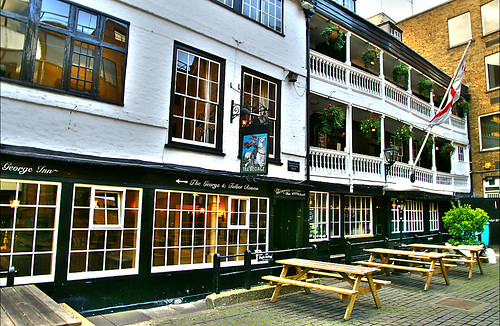
Not fifty metres away at 77 Borough High Street is George Inn, one of the last extant hostelries in Southwark. This was built in the 17th century. These inns catered to horse-drawn traffic, and were situated on long plots with a narrow frontage onto the main street. These survive mainly in name only. I don’t go inside George Inn Yard to inspect the inn itself. I’ll leave that for another time I shirk off gym. It’s a National Trust property, which helps as I am a member. But here’s a picture of its lovely galleried front.
The George Inn - Southwark - London
 [The George Inn by Nick Garrod, on Flickr]
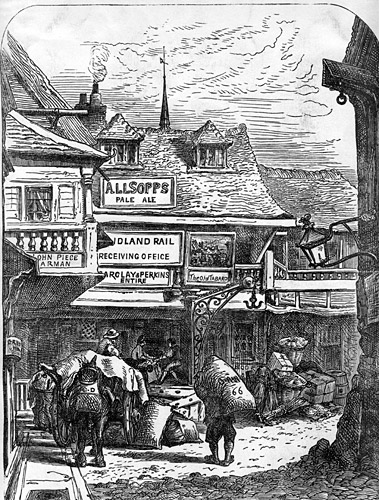
A little further along and a quick left onto Talbot Yard reveals a non-descript office building on which appears a plaque. Here stood Chaucer’s Tabard Inn, from where the pilgrims set off on their grand trip to Canterbury. Just like the George, it had burned down in the 17th century and was reconstructed; unlike the George, it didn’t survive the Industrial revolution, and exists only in literary memory. Luckily, we have engravings of it from the 180o’s when it looked a bit like this:
[The Tabard Inn, c. 1850. Wikimedia Commons]
I retrace my steps to Borough High Street and shift left on Newcomen Street. I hope there might be a plaque or some memorial or the other to the only Newcomen I’ve heard of, who invented the steam-powered pump and inspired James Watt’s steam engine. But he was a Devon man, and I am not sure if he had much to do in London.

Like many of the side-streets in Southwark, this street too used to be coaching inn yard (once called Axe Yard). In the 17th century, it came to be owned by two charities. One building bears the name of one of the charities – John Marshall’s. The street, however, is named after the other – Mrs Newcomen’s. She owned three messuages – ha! I learn a new word – one of which was in Axe Yard, and she bequeathed them upon her death in 1675 for "the clothing of poor boys and girls with a suit of linen and woollen once a year, whereof two-thirds . . . [were to] be out of the Borough side, and the other third . . . out of the Clink Liberty . . . and for . . . teaching them to read and write and cast accounts, and for . . . putting forth boys apprentice at 5l a piece, at their age of 14 years." (Quote from here.)

As I continue along Newcomen street – not the prettiest street in Southwark, admittedly – I note signs everywhere of King’s College and Guy’s Hospital. Every time I look up, I see the immense Shard. It looms over the entire borough. Guy’s Hospital is so much more to human scale. There is a courtyard with an arch. It is another memorial to the fallen soldiers of the Great War.
 Keats at Guy's Hospital
[John Keats at Guy’s Hospital, by Mike Paterson]

Beyond is a colonnade separating two inner courtyards. In one of them stands Lord Nuffield, a benefactor of the hospital, and in the other is a seated John Keats, a bronze-work by Stuart Williamson inaugurated in 2007. The great poet had trained as a surgeon in the hospital, and quit, undone by the gruesomeness. As far as I can tell, the only bit of medicine that ever appeared in his poetry are these lines from Ode to Fanny:

Physician Nature! Let my spirit blood! 
O ease my heart of verse and let me rest; 
Throw me upon thy Tripod, till the flood 
Of stifling numbers ebbs from my full breast.

Across St Thomas’s street is the Old Operating Theatre and Herb Garret. It is closed, unfortunately, till the New Year. As I head away from it, a lovely girl steps out in front of me, followed by a young man who tells her, 'I have an entire archipelago of mistresses.'

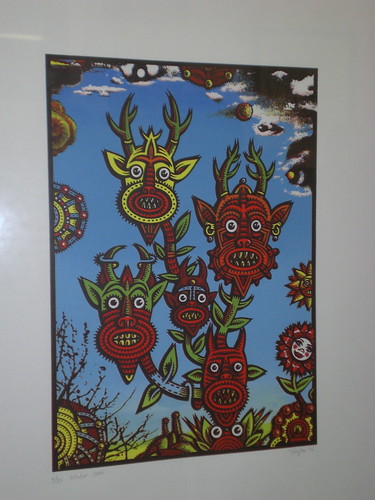
Say what? Before I can react, they disappear into a side street. Scratching my head, I continue along St Thomas’s Street till I get to Crucifix Lane. I see a sign for the Fashion and Textile Museum. There’s no time to take a gander at that; I turn towards the Shard. Construction all around has wrecked views and entrances and my neck hurts from craning. I see BVAG petitioning against the demolition of Southwark’s heritage (London Bridge is the first city-centre railway terminus, it thunders, it should not be treated so shoddily; prevent the demolition of prime Victorian-age train sheds), and I see an interesting art gallery. It is called the Underdog Art Company, exhibits graphic art and has live music shows, and I’m afraid I have no time for that either.


Underdogart Exhibition


[Silk Screen Print by Tony Lee at Underground Art Co. Image by Shuby, on Flickr.]


I am accosted by a couple of young women. ‘Excuse me, sir,’ says one. ‘The Underground?’ She has a strong French accent, and waggles her fingers down. West African, I surmise, so in my best French I respond, ‘Suivez la rue 300 mètres et tournez à droite.’ They grin at me happily. ‘D’accord!’ says the other woman, and giggling at my accent (I hope) they head away.

The rest of my walk is even brisker than ever – onto Barnham Street to Tooley Street, left onto Tower Bridge Road and over that fruitcake bridge back to the City. I don’t stop anywhere, just burn my soles on Tower Hill and Tower Street and Eastcheap and King William Street, all the way back to Bank.


Dec 26, 2011

Christmas 1

I took the boy to the office on Friday. He was excited, although not quite as much as some of my colleagues. They'd heard of his wisecracks and were looking forward to meeting him in person. 

'How do we keep him entertained?' asked Frei.

'Shall we show him the table football?' said Pitt.

'No,' said Parker. 'That will give him the wrong impression of what goes on in the office.'

'You mean the right impression,' said Pitt, and everybody fell about laughing.

The boy was on his best behaviour. He shook hands very cordially with everybody and only confused the names of two people. He looked at my Bloomberg console and noticed that the Euro was falling in value against the dollar. He walked around the office and came back to sit at my desk.

'You can use this screen and I'll use this one,' he said generously to me.

We fought each other briefly for possession of the mouse.

Frei made a bet with the boy. 'Look,' he said, pointing at the intraday tick chart of Euro-dollar. 'One Euro is 1.3067 dollars. I'm going for lunch in fifteen minutes. Do you think this chart will be down or up at that time?'

'Down,' said the boy.

'Given how we've been doing so far, I wouldn't be surprised if the boy wins,' said Frei to me confidentially and laughed like a hyena.

Meanwhile, the boy had noticed the football table. It was surrounded by four eager men playing desperately for  victory. He waited patiently for them to finish, but they kept switching sides, playing game after game.

Adebayor noticed that the boy was looking at bit forlorn. He went into the football room and muttered something to the men. They looked at the boy sheepishly. They trooped out. 'We got carried away,' said one. 

'That's okay,' said the boy.

'I told them that your son was about to cry,' said Adebayor smugly. 'It always works.'

We went in and whacked the ball a few times. It rolled into the goals at random. The boy giggled happily.

When Frei was about to leave for lunch, we took a look at the currency chart again. The Euro chart had been dropping jaggedly all that time, but as we watched, it suddenly spiked up.

'Oh dear,' said Frei. '1.3077. I'm afraid you lost, mate.'

'That's okay,' said the boy.

We also went for lunch soon thereafter.

Dec 22, 2011

Movie Quiz

All right, all you cryptic clue lovers. Here's a Christmas quiz: each is a clue to an English film. Send me answers - if you like - at j o s t a m o n at h o t m a i l . c o m:

  1. Am positive a lamb leg will make things loads better.
  2. Jesus’s Granddad.
  3. Mother Theresa, Hitler and John Merrick.
  4. Jarvis Cocker isn’t real.
  5. Batman sees no moon or stars.
  6. Nice guys.
  7. A white Spanish house.
  8. Join for a barney.
  9. They stole Noah’s sat nav.
  10. Not this lot in the lineup again!
  11. Rectangular numbers.
  12. I can’t hear the baaas.
  13. This helps a community member walk.
  14. Keep Malibu and Santa Monica secret.
  15. Canines playing in the water supply.
  16. Return to tomorrow.
  17. Wet karaoke.
  18. Bannister was an environmentalist.
  19. Contender, Are you ready?
  20. Blindfolded and handcuffed underwater and got out, wow.
  21. Expiring isn’t easy.
  22. Lottery win for poor Lassie.
  23. A regal roar.
  24. An expensive offspring.
  25. Blown away my dear.
  26. There’s the 2184214 to Paddington.
  27. It will have cost this toy boy at least £9k a year
  28. Cloughie’s story.
  29. Get me out of this womb or else!
  30. I’m looking for one that leaves it all to me.
  31. The story of Harry S.?
  32. Filthy gyrating.
  33. An expensive digit.
  34. Don’t show him red…..too late.
  35. I do, I do, I do, I do…..so sad.
  36. The Queen’s one who needs treatment.
  37. There’s at least a couple decent chaps.
  38. Satan’s lawyer.
  39. Don’t even have a hint.
  40. Mind if I butt in young lady.
  41. Insomnia in Washington.
  42. It’s the end of the world.
  43. The Kings Wife rules over dry lands.
  44. Indian junior keeps it beating to stay alive.
  45. He may be a predator but he's such a nice man.
  46. They just upped and left.
  47. Tee it high and she will bloom, but she's no English rose.
  48. 23.5 miles to bring Frank and us together.
  49. Rented bacon.
  50. Painful storage.
  51. Knight of the Crop Landings.
  52. He's here all year long - winter spring summer or fall.
  53. On the cusp of tomorrow the Indian's foe arrives.
  54. The wife doesn't believe it was arson.
  55. Stateless for geriatric dudes.
  56. Swiss elevators rock from side to side.
  57. Amorous Bard.
  58. Friendly Party Animal connects over WiFi.
  59. A Creepy crawly male friend ....... as well.
  60. It a contracted affection ... even fondness.
  61. A prostitutes target meets the bootmaker.
  62. Read the book on Ali G's home turf.
  63. Addition for those that enjoy the sun on the back.
  64. Route to Hades.
  65. Uncle's son is related to Mr Jones ....
  66. Insurrection for coconut candy.
  67. William II brings a regal finality north of Hadrians Wall.

Dec 18, 2011

Delhi Durbar

When I arrive at Indar Pasricha Fine Arts on 12 December, I am met with some consternation. I have seen on their website that there is an exhibition of photographs of the grand Durbar of 1911. An Anglo-Irishwoman named Lilah Wingfield attended that imperial event, and recorded it in her diaries. Pictures from that time are on display until 17 December. But when I enter the gallery, they are still being put up, and Maggie, the enthusiastic arranger, is somewhat nonplussed. 

"The exhibition's being opened at 6pm," she says. "We are going to have drinks and canapes."

Still, she is very welcoming and invites me to look around. It takes me about fifteen minutes to cover the seventy-odd pictures that have been affixed on the walls. There are photos of Lilah's family, and her trip to India, and the Coronation maidan where the Indian nobility and the British ruling castes put up their shamianas, and the Grand Durbar itself, and commoners who came to see their Emperor, and other pictures of her travels around the country. Copies are available for sale at prices from £100 upwards, but the photos are somewhat blurred when viewed up close. They are an interesting relic and record of the time, however, and worth preserving.

Lilah Wingfield at Chandni Chowk, Delhi, 1911.
I notice copies of a book titled A Glimpse of Empire by Jessica Douglas-Home. It turns out that Jessica is Lilah Wingfield's granddaughter. She has recently recovered Lilah's diary and written the book based on its entries. I ask if I can buy a copy, and Maggie tells me that there is to be a book-signing after the opening. 

"Jessica is just powdering her nose," she says.

I am unable to stick around for the drinks. Maggie disappears to ask if Jessica can sign a book for me. When the author turns up presently, she asks where I am from. "Delhi," I say. "Oh," she says, "I just got back from there. The book was launched in Delhi."

She inscribes the book to the wife and dates it. "The Durbar was exactly a century ago," she says.

"I'm afraid I can't stay for the opening," I say. She is unperturbed by this revelation.


"I didn't know there was to be an opening and a book-launch," I continue. "The website just gave the dates of the exhibition."

She doesn't stick around after signing the book. A photograph falls off the wall and is hurriedly reattached. Maggie asks me to leave a note in the visitors' book. I scrawl some platitude or the other. Another couple enters and are greeted happily by Maggie. I say goodbye and leave.


Check these out:


1. Glimpse of Empire photographs page.
2. The photographs were on display in Delhi, as Jessica said. India Today carried an article on Lilah Wingfield.
3. And it appears I missed royalty at the opening of the exhibition. The Duke of Kent was there.

Dec 17, 2011

Vive La Difference

Even when the French try to use flexibility to nudge the other side to compromise, cultural misunderstandings can make the process difficult. Araud told the story of the torturous negotiations with an American counterpart in 1999 over new strategic rules for NATO. Araud took the position that the text had to specify that any military intervention should be in accordance with the UN Charter; the American diplomat rejected that condition. 
"What happens if you want to intervene and the Russians block it with a veto?" the American asked.   
"I intervene," Araud replied.  
"I don't understand," the American said. "You want us to say 'according to the UN Charter,' and you tell me that you're ready to violate the UN Charter?"  
"Wait a minute," Araud said. "When you marry, you say that you'll be faithful to your wife. After that, they there is real life."  
The American looked at him in horror.

"Obviously, we had a cultural misunderstanding," Araud later recalled. "I was trying to say that in life, you need principles. You do your best to stick to your principles, but it happens that you don't stick to your principles. But here, there was a cultural impasse. So I said to him, 'Okay, forget it! Forget it! Bad example!'" 
The story had a happy ending. "The matter was resolved by the two presidents, Jacques Chirac and Bill Clinton," said Araud. "They both knew a lot about marital fidelity."

Dec 12, 2011

A Gift

The boy attended a birthday party on Sunday and returned with a helium balloon. As I put him in bed, he caught my face in his hands and brought his face close to mine. 'If you get scared at night,' he whispered, 'don't worry. I've put a present over your bed. It will keep you safe.'

The present was his balloon. It hovered over us bluely as we slept.

The night was riven by a 'thp, thp, thp' sound that then changed to a 'SCREEEEEEEEEEEEEEEEEEEEE.'

We juddered awake, panicked, gasping.

The balloon had been sucked into the fan.

That was the end of that night's slumber.

[Before you ask why we have the fan on in winter, let me say two words: 'stuffy' and 'without'.

The boy was alternately mirthful and sympathetic when next morning we told him what had happened.]

Dec 4, 2011

Directions

There's a story about a Berliner who visits Vienna and loses his way to the railway station. He accosts a local and demands, "Which way to the station?" The Viennese is taken aback but replies politely, "Sir, wouldn't it have been nicer to say, 'Good evening. I would appreciate it if you would show me the way to the station.' ?"

The Berliner stares at the Viennese in disbelief, emits a 'Ha!' and stalks off.

A few months later, the Viennese man happens to be in Berlin, and, having lost his way, asks a local for directions. The Berliner responds with a rapid-fire, "Straight 100 metres, left, then right, proceed 200 metres, turn right again, then an immediate left, and 400 metres straight."

Completely bemused, the Viennese manages to stammer out a thanks.

"Never mind the thanks!" barks the Berliner. "Repeat the instructions!"

This story, admittedly, has less to do with giving directions than with cultural differences between Prussians and the Viennese. Still, it points to a social compact - a person who is lost expects to be guided to his destination.

I suspect this is a fairly recent development in human history. For long periods, most people tended to stay within a day's walk of their homes. They were intimately tied to the local landscape. When they had to go farther, they would likely make use of networks of contacts, stepping from cousin to friend to customer. In a new village, they might stop a stranger and say, 'Do you know the way to Gulbadan the perfumer's house?' and - because most people in a village knew each other - would be guided appropriately. 

The development of cities probably did little to stymie this network of connections, although perhaps the links became somewhat more tenuous. The problem was to locate a particular person because a random man on the street would be unlikely to be acquainted with them. This was when landmarks and specific locales became important. One would ask then, 'Do you know Gulbadan who lives by the Friday mosque?' or 'Which way to the Friday mosque?' and once there, ask more specific queries.

This is all speculation - I have not done any research into the matter at all. But as street maps and particular addresses are very recent, and - even where they exist, they are not always reliable - I guess that people still need others more than ever to give them directions. 

Culture affects even this relationship. I'm not talking about the gender stereotype of men not wanting to ask for directions at all. I refer rather to the deep reluctance of some peoples to appear unhelpful, who then offer wrong or misleading directions, because some directions are better than none. Not everyone is as militarily precise as the Berliner; luckily, not everyone is as vague as the fellow at my old alma mater who sent me on  a totally wild goose-chase because he either didn't want to appear ignorant, or wanted to appear helpful.

This was shortly after I first moved into the Indian Institute of Science, a rather sprawling campus with the various department buildings hidden helpfully behind dense vegetation. Seeking the swimming pool, I stopped to ask a student for directions. 

'Ah, yes,' he said, and looked around him in every direction. 'Go down this alley and turn right at the end. You'll pass the Physics department and the library. You then turn left, go through the lecture halls, and turn right. Clear?'

I nodded.

'Then ask somebody there,' he said, and walked away.

I thought even then that the instructions were hilarious. Still, given their precision, I thought it would be a small matter to locate the swimming pool once I passed the lecture halls. Unfortunately, though, the pool was nowhere near those halls. Worse, there was nobody around to ask either. In my four years at the campus, I never ceased to marvel at the ridiculous precision and complete wrongheadedness of that student's directions. 

I never learned to swim either, but that's another story.

Dec 3, 2011

Epicure

My meat shall all come in Indian shells,
Dishes of agate, set in gold, and studded,
With emeralds, sapphires, hyacinths, and rubies...
My foot-boy shall eat pheasants, calvered salmons,
Knots, godwits, lampreys. I myself will have
The beards of barbels served instead of salads;
Oiled mushrooms; and the swelling unctuous paps
Of a fat pregnant sow, newly cut off,
Drest with an exquisite and poignant sauce;
For which, I'll say unto my cook, "There's gold,
Go forth and be a knight."

The name [Ben] Jonson gave to this mad pleasure-seeker is Sir Epicure Mammon.

(From The Swerve: How the Renaissance Began By Stephen Greenblatt.)