JOST A MON

The idle ramblings of a Jack of some trades, Master of none

Translation from one language into another is a fraught process and demands the most acute judgment possible of the translator. Idioms, especially, are sensitive beasts and require careful handling. It must be said, further, that synonyms are the beastliest of all.

While reading the acknowledgments in an academic paper written in English by an Italian researcher, I found myself grinning at her choice of words. This is what she wrote:

"I thank ... and an anonymous referee for their precious comments and suggestions."

I suspect she meant 'valuable', but if not, what wonderful irony, what a delectable slight!

1.24.2009

Twin Town

The Nigerian town of Igbo-Ora is known to have the highest incidence of twin births in the world. If you are pregnant woman in this place, your chances of having twins is four times higher than a woman in London.

There are fairly few households that do not have twins in this town that proudly proclaims itself the twin capital of the world. Nobody is entirely sure why this is the case, although there is some evidence that the heavy concentration of cassava in the diet might cause it. (But considering that this tuber is eaten throughout the region, it clearly is not a full explanation.) For the Yoruba, though, the arrival of twins is a sign of God's favour.

Sadly, the infant mortality rate is very high as well. To console themselves after the death of a twin, a Yoruba family commissions a local sculptor to carve a stylised figure of the child. The choice of the sculptor is made under the aegis of a shaman, called a Babalowo. The image, called Ere Ibeji (from ibi, meaning 'born', and eji, meaning 'two', ere means 'sacred image'), is treated just a child would be - bathed, fed, clothed, anointed with sacred oils, worshipped, fussed over, made much of, loved. It is kept standing all day, or carried around by the mother, and put to bed at night. But the Ibeji is no child - it is built as an adult, with genitalia and facial tattooing specific to the gender of the child - and maintains the calm poise of a Yoruba artist.

The responsibility of watching over the Ibeji is a lifelong one. When the parents of the figurines die, other relatives take over. Early in Yoruba history, the Ibeji were considered evil, meant to be placated, but sometime after the 18th century, they came to be treated as harbingers of fortune, and much love is lavished upon them. Indeed, the Yoruba feel that a person who does not take the responsibility of taking care of his Ibeji seriously is cursed.

The souls of the deceased children need to be consoled, and the Ibeji is the only way the Yoruba can assure this. Heartbreaking though the loss is, the family obtains a modicum of solace.

References

1. Pemberton, J., et al, Ibeji - The Cult of Yoruba Twins, 5 Continents Editions, 2006.

2. Januszak, W., The Sculpture Diaries Part I, Channel 4, UK, 2008.

That man Jack Black is supposed to have fluid control over his eyebrows. Here are two little munchkins with similar skills.

You know you want one. I want one. In fact, I want it now, and no piddly iPhones are going to cut it for me any longer. Behold, folks, the Pomegranate NS08. Be sure to check out its really slick homepage.


As I don't get much reading done at home, I have no alternative but to read en route to and from work. This is clearly not as satisfying as reading while being horizontal, nibbling on munchies closely proximate. I can't read on buses or cars, as I start to feel violently sick after a bit, and on trains, the onset of nausea is driven by my orientation: facing the direction of motion or orthogonal to it. Standing and reading has its own drawbacks. I am constantly jostled by folks getting on or off, or I have to move aside to let people get off their seats. But if I have to read, I have to adjust, and - even if I say so myself - I have developed the art of reading on the move to a high level.

For example, I can read while walking. I walk around obstacles and rats and dogs, and I depend entirely on the goodwill of fellow pedestrians not to knock me off the pavement. Of course, often it rains and I am prevented from my jaywalking perusal of the latest book. In winter, it's too dark to read in the mornings and evenings. Also, I am restricted in the type of books I can tote about with me. No more hardcovers of glossy paper. Only softbacks will do, and this is where the Eurocrime series is most appropriate. I needn't worry about concentrating too hard, my attention can wander occasionally, the books are not too thick, and I can finish them in four trips. Two trips to work, two back, and it's onto the next tome. Life is good.

So what are these Eurocrime novels? Well, those who have been closely following my end-of-year roundups of translated crime fiction (not that they have had much to follow, as there have only been two articles) will note that there are manifold mystery authors dotting the countryside, and many of these are Europeans. In fact, a very large number of them are Scandinavians. There must be something about the cold and bleakness in those parts that makes these Nordics write the coldest and bleakest novels, suffused with so much despair that one wonders how their characters even get out of bed. One finds the likes of Karin Fossum (Norwegian) and Karin Alvtegen (Swedish) and Christian Jungersen (Danish) and Yrsa Sigurðardóttir (Icelandic) and Matti Joenssu (Finnish) in this company.

Then there are the Latins. Eugenio Fuentes (Spanish), Gianrico Carofiglio (Italian) and Luis Miguel Rocha (Portuguese) are all bestsellers in their native lands, and have begun to be translated into English. These guys are not bleak by any stretch of the imagination, although they do love to dwell on the underbelly of society. They are aromatic, sunny, drug-infused, foodie, colourful.

There are Central Europeans somewhere in this lot as well: Christine Spindler (German) and Marek Krajewski (Polish). And we have the Sephardic Eliette Abécassis from France.

I've read some of these authors and plan to plough my way through the oeuvre. At least one book from every non-English-writing author listed in the Eurocrime website shall be sneaked up on and attempted this year. I have spoken.

After Typalyzer, which psychologically profiled your blog, comes Gender Analyser, which aims to tell you if your website is written by a man or a woman. Using, the authors claim, AI techniques. Yeah, right.

At any rate, here's what it has to say about the blogs that I originally tested psychologically.

Singaporean in London: CK will be pleased to know that he is gender-neutral, with a slight tilt (51%) to womanhood.

Spaniard in the Works: Space Bar will be chuffed to hear that she is probabilistically (62%) male.

Language Log: All those linguists are (67%) likely to be male.

Yossarian Lives: Veena is gender-neutral even as she is (56%) likely to be female.

Polandian: is (62%) likely to be a woman.

La Vie Quotidienne: Shefaly is gender-neutral, with a minor tilt (51%) to feminity.

Jabberwock: Our man Jai Arjun is almost certainly (93%) a woman.

And that's all I have to say about that.

Okay, so I attended a Gresham College lecture on Monday. It was good fun although I did drop off briefly, much to the consternation of the oldies who had filled the auditorium of the Royal College of Surgeons. What can I say? After the (interesting) theory, the practical applications became a bit long-winded and repetitive, and on a stuffed stomach, it was difficult to focus.

At any rate, as I said, it was good fun. John D. Barrow is an engaging speaker, and he started off with a cheery anecdote of a visit he had made a decade or so ago to a museum in Milan that showcased art fraud. On various floors of the museum, one could see both genuine and fake artefacts from the past few centuries. The experts and curators there had expertise in manifold fields - physics, biology, mathematics - and they worked on techniques to isolate fraud. Imagine, said Dr Barrow, that you could model the pattern of cracks on paint in an artwork. You could tell, then, if a given painting - even if executed in old paint on old parchment with an old brush - had aged as much a genuine contemporary painting. The curators organised a seminar to discuss this and other techniques, and found that it attracted quite a varied audience. Then they received a phone call from Milan's Chief of Police.

"It's wonderful you have arranged this programme," said the Chief. "But we are a bit concerned at the audience - there are many members of Northern Italy's crime families among them!"

The curators didn't hold another such seminar again.

"But that shouldn't stop us from discussing techniques to detect fraud!" added Dr Barrow cheerfully.

Of course, not all the lecture was about forgeries. He started by explaining that the triangle was the only linear shape in the plane that was rigid - that is, could not be deformed without breakage. A square can be pushed into a rhombus, and any other polygon can be modified as well. This explains why gates, for example, have triangular struts built onto them, and electric pylons are a network of triangular meshes as well. In 3 dimensions, though, all convex polyhedrons are rigid, and only the rare non-convex linear surface is not.

From the idea of the rigid triangle, Dr Barrow moved onto triangulation - that is, the splitting up of a general polygonal shape into triangles. It is immediately apparent that each of the sides of every triangle is visible from any point within it. So, if you have the following problem - what is the maximum number of guards one needs to be able to cover all the interior walls of a museum? - it is obvious: as many as the number of triangles in the triangulation. Essentially, if there are n walls, you need at most n - 2 guards.

Even better, stick a guard on a diagonal formed by one of the interior sides of each triangle. Such a guard can look into two triangles, and so you can reduce the number of minions by a half. Or how about you place a guard at a vertex of the polygon? Colour each vertex of the triangles a different colour such that no two coloured vertices are on the same line. You only need three colours to do this. Assigning a guard to a corner with a particular colour - say, blue - enables you to reduce your employees to the integer part of (n / 3).

And that, ladies and gents, is the Chvátal Art Gallery Theorem:
For a simple polygon with n corners, [n/3] cameras are sufficient and sometimes necessary to have every interior point visible from at least one of the cameras.
Dr Barrow then went on to show lower bounds on the number of guards under various conditions: the guards don't move, or they can only move along a wall, extending the coverage area to interior and exterior walls, ... It was at this point that I fell asleep.

Check out the lecture here.

Yesterday, after lunch with CK, I ambled back towards work and was stopped short by a van on which was embossed the following legend: Stephen Austin, since 1768.

Well, you know what's coming next, eh? I had to learn a tad more about this enterprise, all of 240 years old. They, I find, are a private printing outfit based out of Hertfordshire, have a Royal Warrant for printing services to the Queen, were patronised by the East India Company, produced books for the East India College, and have been associated with such literary phenomena as George Bernard Shaw and Kalidasa.

What's that, you say? Kalidasa? It turns out that in 1855, Stephen Austin and Sons published a richly decorated volume of Sakoontala, recently translated by Professor Monier-Williams.

This work was printed in up to five colours by letterpress, with the binding matching the richness of the interior. It consisted of an elaborate Oriental design blocked in gold on leather and one edition (the open copy shown) was remarkable as being one of very few commercial editions produced with goffered edges – not merely gilded but decorated with the impression of heated tools. 0

The edition won widespread acclaim for the typography. Indeed, Stephen Austin had long been lauded for its specimens of Oriental printing. Both Queen Victoria and the Empress of the French awarded the company gold medals, the latter following the brilliant Paris Exposition in 1856, where the book was exhibited.

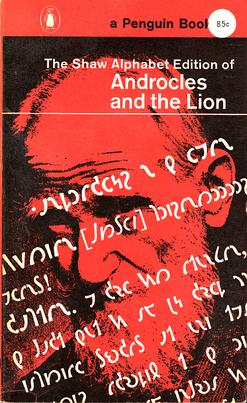
In 1957, Bernard Shaw left a bequest of £500 for the development of a new alphabet in order to simplify the teaching of the English language (the alphabet that we all use being completely non-phonetic). Besides his classical example of ghoti that could be pronounced as fish, he found the illogicality of similar spellings for words such as tough, cough, plough, and through infuriating. Another benefit of a more systematic script, Shaw claimed, was that printers could save paper because the words would now be shorter. His estate announced a competition to develop a new script of at least 40 characters, and although over four hundred proposals were sent in from all over the world, none were deemed to meet all of Shaw's requirements. Four finalists were chosen for their outstanding merit, and the prize was distributed amongst them. In 1961, Stephen Austin was commissioned to cut the blocks for Kingsley Read's script 1 of Shaw's alphabet 2, which was to be then used to print Bernard Shaw's Androcles and the Lion. The reproduction of two pages of the book illustrate the economy of space in using the new alphabet exactly as required by Shaw in his will. The Alphabet Reading Key and the Alphabet for Writers was also enclosed in each copy sold. 3

References

0. Stephen Austin and Sakoontala

1. Read, K. Sound-writing 1892-1972: George Bernard Shaw and a modern English alphabet, Journal of the Simplified Spelling Society, J23, 1998-1, pp3-7.

2. Shaw Phonetic Alphabet

3. Stephen Austin and the Shaw Alphabet

The French are so pleased when outsiders learn to speak their language well. Imagine their ecstasy if these outsiders not only speak, but also write with beauty and style. We Anglophones do not blink when we encounter novels of singular excellence wrought by non-native writers. The French, though, are beside themselves with delight. Yesterday's Le Figaro had an article by Françoise Dargent, trying to analyse what prompted all those foreigners like Jonathan Littell and Milan Kundera to abandon their mother tongues in favour of French. As it is a rather slow evening, I have translated the piece in my usual haphazard way, and you can find it at Sundry Translations and Other Tangentialia.

Come on, people! It's a New Year! Let's have your translations of articles and stories and matters of interest that are crying out (or muttering, even) for wider readership in English. Don't be shy. All contributions welcome.

In M.D. Vassanji's superb account of East African life through the eyes of local Indians, The In-Between World of Vikram Lall, it becomes fairly clear that attachments to the motherland are considerably attenuated with each successive generation. The earliest immigrants hearken back to India as a beloved land of beauty and trust; their children, growing up in Africa, lose some of that varnished viewpoint; by the time of the grandchildren, India has become alien, unknown. While they look down upon the native Africans, they look up to the British. [In this, of course, they are no different from more recent Indian emigres to the West.] When India gains independence, nobody is more appalled than the East African Indian. As African nations fight for freedom, it is the rare Indian who is willing to join in on their side.

Alongside the alienation from the motherland and their fellow Africans a rampant prejudice begins: Indian Indians and Africans are untrustworthy, uncivilised, unsophisticated.

The trajectory followed by a particular caste of Gujarati Hindus, the Lohanas of Kutch, exemplifies this trend. While Indian traders have plied the seas surrounding the subcontinent for millennia (see Maddy's article, for example), the Gujarati emigration to East Africa appears to have begun only in the 19th century. Between 1880 and 1920, the number of Indians in East Africa grew nine-fold to 54,000, and included not only Gujaratis (Patels, Lohanas, Shahs and Ismailis), but also Sikhs and Goans, many of whom went there to set up trading communities, riding off the establishment of the British dominion over the area. The earliest migrants were predominantly men. Following the setting up of a successful business venture, a man might bring in his relatives - brothers or sons. Social nexuses that might have been frowned upon in India, such as those between people of different castes, were gradually built up in Zanzibar and Kenya, possibly made easier by the common language (Gujarati) and the distance from the motherland and the necessity for some sort of social cohesion whilst a small minority in an alien land.

The Hindu men would travel to India to find wives. Owing to the somewhat uncertain social and economic situation in East Africa, the women rarely accompanied the men on the journey back. Instead, they would remain in their villages, looking after the elders and raising the children. The husbands would make several trips a year to look in on the family and impregnate the women and establish mercantile connections with the community at large. And, in truth, in the first phase of Gujarati emigration to Africa, their largest trading partner was India, with millions of sterling worth of goods flowing back and forth across the Arabian Sea.

Sometimes, the wives would live a few years in East Africa before heading back to India: childbirth, especially, more often than not would occur in their mother's house. Matters of ritual purity prevented the women from staying on in Africa, although in view of the contributions their husbands were making to the local economies, many a potentate offered to help.

The sultan of Zanzibar, Seyyid Bargash, must have been aware of this as he encouraged Hindus to bring their wives to Zanzibar. He sent his private vessel to welcome the first Hindu woman in Zanzibar and gave her a reward of Shs 250/-. In addition, he promised to turn Zanzibar’s Old Fort into a residence for the wives of merchants and offered to equip it with water pipes fitted with silver taps to ensure that Hindu women need never appear in public.

The social and business networks of the earliest emigres was familial and international. Trust and honour drove the creation of these networks, made all the easier because not all men in a clan would go to Africa. The ones that remained to look after the ancestral businesses would maintain links with their peripatetic relatives, offering not only secure banking but also collateral in the form of real estate. These networks were periodically renewed and strengthened whenever the travellers returned home, either for marriage or to look in on the family. But once the wives began to live in the diaspora, their reasons for returning became slimmer. It was with considerable reluctance, then, that the men would make the trips home: perhaps when a relative died, or when it was time for their own ashes to be scattered in the Ganges.

A consequence of such networks was that, even if the East African Indian couldn't travel to India, he would still strive to maintain relations with the homeland. His house would aim to reproduce the joint-family structure; he would continue to speak Gujarati; he would cherish Indian traditions; he remained staunchly vegetarian. Charities and foundations were established back home. India, in other words, remained in their hearts.

Between 1920 and 1960, the second phase of this evolution played out. Initially at least there were twice as many Lohana men as women in Africa, and so the pressure to return to India to find wives remained great. As time went on, however, it became easier to marry within East Africa itself, and the loosening of purity rituals meant that marriages could take place outside the community as well. Meanwhile, the Indian textile industry began to suffer in competition with Japan and (to a lesser extent) Europe, which produced goods of superior quality and variety. Also, the general impoverishment of India during (and immediately after) colonial rule led to diminished exports there by the companies of the emigres. East African Indian companies began to close down their Indian branches, and establish trading offices in other parts of the world. It was clear to the emigres that there was much more money to be made in business with America, Europe and the Far East. (There is some evidence, however, that after the second World War, a further wave of Indians from Gujarat setup shop in East Africa, and replicated the familial networks of yore. This meant that, in absolute terms, trade between East Africa and India didn't decline by much. The contribution from long-standing East African Indian companies, though, dwindled.)

Whereas the primary education of Lohana children was at 'Indian' schools in East Africa, much of their subsequent study was done at English-medium establishments, or indeed in the UK. The new generation, therefore, found itself oriented more towards Africa and Europe than India. It became imperative that they find their spouses from among the locally raised Hindus, who knew how to handle native servants, who were familiar with the Africanised Gujarati cuisine, who could speak the local tongues.

The Gujarati community in East Africa by now thought of itself as distinct from its mirror in Gujarat. Their world-views were completely different. Unwritten contracts that once made identical sense to both parties became difficult to interpret, and misunderstandings abounded. Coupled with the weakening of India's economic power and the collapse of the family networks, business dealings began to be fraught with risk. The African Indian thought that the Indian Indian was uncivilised (not having had the educational opportunities provided by close exposure to the British) and rough and cut-throat at business dealings, while he himself was westernised, familiar with English contract law, sophisticated. Because they no longer saw themselves as part of the same community, relationships needed to be built anew, as though with strangers; it was important to establish 'good name'. India, sadly, by then had lost its reputation.

It is often thought that the adhesive that holds migrants together abroad is their attachment to the motherland, which is not easily lost. The migrants require the motherland to maintain their identities and culture. Yet, this is not always the case. For the Gujaratis of Africa, as we have seen, barely eighty years after they first left the shores of Kutch, the sundering was virtually complete.

[This piece is based extensively on and paraphrases much of G. Oonk's paper: Trust and Images in Indian Business Networks, East Africa 1900-2000 (PDF!)]

From about a thousand years after Christ there dwelt a large community of people all over France who were so wretched that their lives could be compared to nothing less than the untouchables of India. Pilloried, ostracised, punished mercilessly on the slightest pretext, they were said to be of Satanic origin. Kinder people said that they were remnants of Arab folk who had fought for Charlemagne, and fled into France after his defeat at Roncesvalles. Others claimed that they were nothing more than Goth dogs remaining in the country after the expulsion of Visigoths by Clovis in the sixth century. Some of this persecuted tribe claimed to be descendants of the Cathars who had been exterminated in the Albigensian crusades of the 13th century. They were said to be leprous folk; they were thought to bleed from the navel on Good Friday; they were accused of having bright blue or olive eyes and yellowish skin and webbed fingers. They were called cagots, and they were at the bottom of the social pyramid in medieval France.

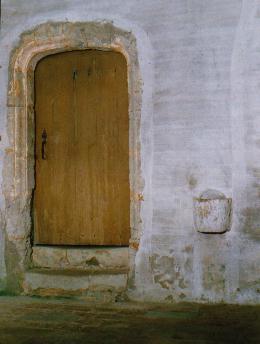
In every way, their lot was singularly miserable. Although they were allowed to be Christians, they could only enter churches though a door on the left side of the porch [see picture on the left of the Cagot entrance to a church in a parish at Mus], and were banished to sit at the cold northern wall. Their men were only allowed to practise carpentry and rope-making; the women became midwives. They couldn't drink from town fountains, and could not walk barefoot. At communion, they received the host at the end of a stick. They paid no tax because their money was considered unclean. They were not to touch the parapets of a bridge with their bare hands. Every nation in France spat upon them: the Basques, the Béarnais, the Gascons and the Angevins, the Bretons. For about 900 years, for no reason other than their parents were cagots, children born into these families faced the same senseless oppression.

Although legislation was passed sporadically to ameliorate their lot, prejudices continued to linger almost to the end of the 20th century. The country changed from Catholic to Protestant to Catholic, and the shameful side-doors in the churches remained.  In medieval times, many priests refused to bury them with other Christians. In the late 1700s, a wealthy cagot, seen taking water from a fountain meant for the 'clean' people had his hand chopped off; it was then nailed to the church door. Cagots were forced to wear red webbed-foot symbols on their persons. Cagots were ordered to make their presence known in towns they entered by shaking a rattle. In 1741, a cagot with the temerity to till the land had his feet impaled with a hot iron. Even as late as 1964, there were families in the Pyrenean foothills mocked for being descendants on cagots. Indeed, a recent piece in the Independent 1 recounts the story of a woman who lives in the Pyrenees and claims to be a cagot. She is reluctant to have her children's photos published.  "I'm sorry but no. It is OK for me to admit where I come from. But if people knew about my children's background, it might be difficult for them."

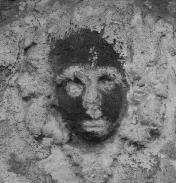
Only traces remain of their presence in the country. Stone faces appear on door lintels and tiny doors in about sixty churches across France. Some place names preserve their existence: Cagoteries, or ghettoes (usually on the malarial side of rivers) where they dwelt can still be found in Pyrenean towns such as Hagetmau. Indeed, in Hagetmau, much of the citizenry to this day is involved in the chair-making industry, surely a result of the large cagot guilds of carpenters who lived and worked in the area. [The picture to the right is from a house (which was demolished in 2004) in the Quartier des Cagots in Hagetmau.]

Heartbreaking songs were written by the cagots, limning the ironic causes for their persecution. A Basque shepherdess in love with a cagot is moved to another pasture when her father is told that she wants to marry an untouchable. She sings: 2

The agot, they say, is the handsomest of men

Fair hair, white skin and eyes of blue.

You are the handsomest shepherd I know;

In order to be handsome, must one be an agot?


By this can you recognise an agot:

First look for clues in the ear;

He has one ear too large, and the other

Is round and covered all over with hair.


If that is so, you are not one of those folk,

For your ears are a perfect match.

If agots have always one ear too small,

I'll tell my father that yours are both alike.


There's no explanation for this irrational hatred, at least none that can be found in historical documents. As far as anyone could tell, they were indistinguishable from the rest of the population. They spoke the same language as their neighbours. About the only thesis that appears to make sense is that, similar to the equally reviled Gypsies, they had established a semi-nomadic existence, with rare skills and abilities that made them objects of envy and fascination. After eight centuries of persecution, they tended to be more skilful and resourceful than the surrounding populations, and more likely to emigrate to America 3. They were feared because they were persecuted, and because they might therefore seek revenge.

References

  1. The Last Untouchable in Europe, The Independent, July 28, 2008.
  2. Graham Robb, The Discovery of France, Picador, 2007, page 47.
  3. ibid., page 45