It’s that time of month again, and I am back with the latest roundup of translated crime fiction consumed in April. So what if taxes are being put up and Britain will soon be as unliveable as Zimbabwe – expensive and no quality of life? We can take heart in the adventures of those folks immeasurably better off than us – characters in books, thoughtful detectives, murderous villains, dangerous damsels, none of whom speak English.
 This time I’ve been rather fortunate in my random pick-ups from the library. There’s much in common among them, strangely enough. There are tax dodges, social collapse, sometimes both, sometimes neither. Have I missed out any combinations? Yes. Well, we shall begin with Alain Mabanckou’s African Psycho, a dark, disturbing, frequently funny diatribe against society by a superb villain, a square-headed individual in a country very like Mabanckou’s native Congo. Gregoire is a mass of neuroses, a liar obsessed with the country’s only serial-killer, Angoualima, whose exploits he lovingly recounts, and whose approval he seeks in his own acts of violence. Gregoire is determined to kill his girlfriend, Germaine, and his preparations – both physical and mental – for this are interspersed with accounts of his troubled childhood, and the two murders he has attempted (both of which fail). Although Angoualima is dead, Greg has frequent meetings with him (at the killer’s grave) where he strives for approval from his mentor. These dialogues are blackly humorous, with the spectre frequently exasperated with Greg’s incompetence. Greg has issues with human foibles, he detests intellectuals but is not above spouting quotations, he wants the company of a compliant woman, but he can scarcely stand Germaine who has moved in with him. In the end, his murderous plans collide with forces out of his control, with spectacular results.
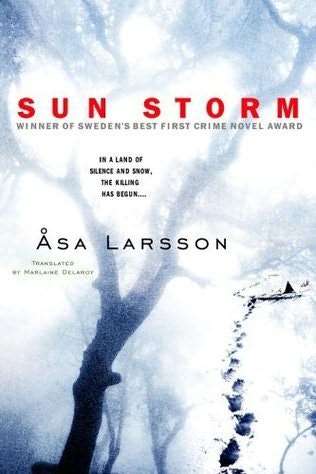 Next, we must have a Swedish writer, Åsa Larsson, whose The Savage Altar (or The Sun Storm) is an example of one aspect of Scandinavian life that seems to be attracting quite a bit of attention lately: the effect of fundamentalist Christianity on society. A well-beloved man, active in an evangelist church, is found brutally murdered, with his eyes gouged out. His sister falls under suspicion, the devout and scatterbrained Sanna, who calls her oldest friend Rebecka Martinsson, the heroine of this book, to help her. Rebecka has her own bitter past linked with that church, and is reluctant to return to her roots. At any rate, she visits Sanna eventually, and uncovers tax dodges, corruption, charismatic and schismatic men, while facing up to her own demons. It is a fairly standard plot complete with the stereotypical finale of the villains closing upon Rebecka in an isolated cabin in a snowdrift, but not before she has solved the crime (she’s no detective, but lawyers are as good, eh?), saved Sanna, and gained some measure of closure. There are moments of superb psychological characterisation here, and Larsson’s detestation for evangelicals is quite clear (or perhaps it was my own dislike being mirrored in what I read), but this is not an exemplar of the best that Scandinavian crime fiction has to offer.
 Benjamin Prado is our next author, a Spaniard whose Snow is Silent is a remarkable piece of work. It describes the descent of one innocuous, vacuous soul into murder. Exactly who the murderer is may be clear right from the beginning to the most obtuse amongst us, and his motivations are possibly apparent to the perspicaceous, but I was a bit thrown by the revelation towards the end. What prompts a pathetic example of clerical humanity to get above himself and pretend to be a rich man in search of suitable properties to purchase for his portfolio? Why does a woman who wouldn’t have given him a second look fall in love with him? Why are his two friends, whom he meets regularly at a cafe and to whom he recounts his daily life and criminal plans, showing so much interest in his activities? This is good stuff, a small book packing a nifty punch.
 Our (obligatory?) Latin American is Luis Alfredo Garcia-Roza, a Brazilian known for his ruminative prose, yet another man so keenly observant of the changes in his society that his detective Inspector Espinoza is more of a philosopher-poet than a policeman. In The Silence of the Rain, Espinoza investigates the suicide of a rich executive in a plodding fashion, confused as he is by a series of murders that appear related to the suicide. Just when he appears to get no further, help arrives from convenient quarters (this, as much as the concentration on the upper classes of Rio, means that the book is far from a regular police procedural that prefers to plumb the underbelly of great cities). There’s some sultry sex, a view into the lives of the super-rich, financial scams, feckless men, beautiful women, almost no mention of food, and a detective who prefers to move books from one part of his living room to another, and ponder about life and the two women he is in love with, than seek out the criminals. Rather arbitrary and slow-moving. Not bad, but not the best this month.
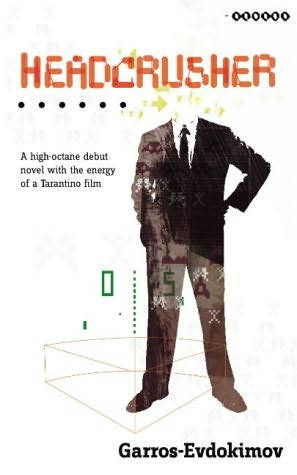 For a change from the norm, we have two Russian books this time. Allow me to say, what incredible books. The first, Headcrusher, is by a duo named Garros-Evdokimov. This is almost technopunk, combining an incredibly violent videogame, and yet another gormless individual who suddenly goes berserk and commits a series of murders. Set in the Russia of the early 1990s when limitless money was available to the amoral and the corrupt, this book combines social criticism with dark humour; the plot is scarcely credible, but the murders follow a logical inevitability as the anti-hero, Vadim, knocks off one person after another, launders money on a vast scale, learns all about single malt whisky, and bonks beautiful women. It’s all described in a very laconic style, almost stream-of-consciousness, hilarious to boot. Rush out and grab it ASAP.
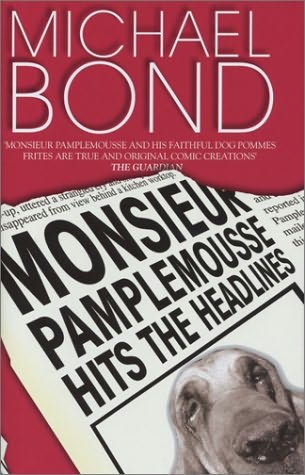 This is not really a translated novel, but I’m throwing it in as it has in it every possible stereotype an Englishman holds of the French: oversexed women, gourmets, intellectual dogs, corrupt civil servants. I daresay it is an Englishman with such a view of the French who will most benefit from reading the other books in today’s litany. Anyway. Michael Bond, famous for the Paddington Bear series, has written a bunch of harmless and humorous accounts of the exploits of Monsieur Pamplemousse, a retired policeman and gourmet (see this, e.g.). In Monsieur Pamplemousse Hits The Headlines, a famous TV chef dies while he films a cooking show where Pamplemousse is in attendance, and obviously our man has to get involved. There are horny vamps out to blackmail every male in power, even Pamplemousse who is not really powerful, and sundry colourful characters who have much to say on food, but it’s Pamplemousse’s dog Pommes Frites who guides the detective to the solution. There are a couple of innocuous misdirections to keep the reader’s interest going. A very light book, this, which offers almost nothing to the intellect. General time-pass.
 Akashic Books has been in the business of urban fiction for some years, and recently, has published a series of books of short crime fiction set in various cities of the world. I picked up Paris Noir: Capital Crime Fiction, edited by Maxim Jakubowski, but this has nothing at all to do with Akashic, heheheh. It is as motley a collection as I can imagine, however. Noir only loosely describes the stories in the book (in what way Elric of Melniboné is involved in crime?) and not all of them are very good. In fact, despite claiming to shed light on little-visited areas of the City of Lights, the tramping grounds of the various characters in the book are Pigalle and environs, known even to one such as I who has scarcely visited the city, as a red-light district. The stories by now have all blended into an amorphous mass in my head, written by American, Canadian, French, and British writers; I can single out a couple that I thought were decent: Jason Starr’s “Bar Fight” with its twist at the end, and Romain Slocombe's “Guy Georges' Final Crime” has a clash between a serial-killer and his last victim that turns unexpectedly.
Next up is the second Russian novel: Andrey Kurkov’s Death and the Penguin, an absolute smasher of a book, about a down-and-out wannabe novelist who is hired by a newspaper to write up obituaries to be kept ready when important people die. Viktor is a loner, an introspective hack, with very little to tie him to his compatriots. His only source of comfort and affection is an Emperor Penguin named Misha that he picks up from Kiev zoo, which is too broke to feed its animals. The penguin spends much of the time standing quietly in the bedroom and staring at the wall; occasionally it studies its reflection in the mirror; often it senses its master’s despair and waddles over to put its head on his lap… Various thugs begin to arrive at Viktor’s doorstep, stern but friendly, who ask him which of his obituaries he liked the best. The next day, the subject is dead; soon others Viktor has written about are dying as well, and the editor of the newspaper admits that he is part of a clique determined to clean out corruption in Kiev. One minor villain (who soon is killed) leaves his daughter in the writer’s care. Viktor now has to take care of two wards, and while he is kind to the girl, his deepest affection is reserved for Misha. Viktor finds out that his obituary has been written, which serves to crystallise his mind and strengthen his spine. Then the penguin falls badly ill. This is a novel of simply wrought impressions, humorous and moving and surreal, a study of social collapse, and the ties that bind the honest and the helpless. Wonderful stuff.
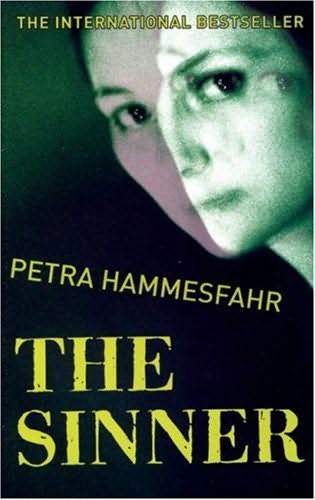 The German writer Petra Hammesfahr has been likened to Patricia Highsmith, and her award-winning novel The Sinner has all the darkness and psychosis of the latter’s oeuvre. A young mother, Cora Bender, seemingly content with her husband and little son, suddenly stabs out at a man in a beach as he makes out with his wife, and kills him brutally. She then admits her crime to the policemen who show up and requests them not to waste time investigating the murder. But the investigating detective is baffled by her statement that she hasn’t seen the man before; when she refuses to explain her motive, he.begins to dig deeper. And once again we see the awful consequences of religious fundamentalism on a growing child, We learn what an awful upbringing Cora had, with her mother suffused with rigorous piety, her father feckless and incapable of supporting her, her younger sister so badly ill that she is in and out of hospitals. As she grows up, she faces the constant contempt of her mother; her sister then begins to live life vicariously through her, even going so far as to attempt to persuade Cora into prostitution. When a flashy boy comes to town, she falls in love with him, and finds herself among a crowd that seeks sex and drugs, which inevitably leads to tragedy. Perhaps it is this tragedy that has coloured her life, and the demons that were driven deep into her psyche suddenly emerged on that beach that sunny day and caused her to kill? This is a top-notch study of psychological trauma and faith, revealing that just as blind faith can destroy, faith in the fundamental goodness in people can save.
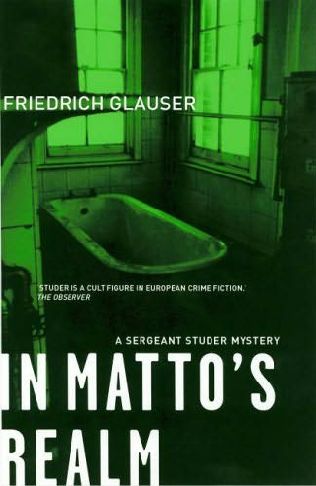 Speaking of psychological studies, the Swiss writer Friedrich Glauser spent much of his life at one or the other mental institution in Switzerland. Amidst his treatments, he wrote four novels that were to become classics in European crime fiction. In Matto’s Realm is one of them, and it is rather good. Matto, in Italian, is the spirit of madness, and it appears to rule in an asylum in Bern, whence a child-murderer escapes and the director is found with a broken neck. When the sympathetic sergeant Studer is brought in to cover up the case (with the approval, strangely enough, of his superiors), he finds that there are castes and hatreds and religious maniacs and sexual rivalries galore within the institution. The blurb says that Studer finds it hard to resist Matto himself, finding himself drawn into the ‘no-man’s land between reason and madness’, but this is an exaggeration. Studer remains warmly analytical throughout, even if some of his efforts at resolving the mysteries go awry and an innocent man ends up dead. He is shaken by the consequences of his actions, but he is too good a man and detective to ignore the truth. This is a slow-burning novel of humour and understanding, written with intimate knowledge of the world of the insane. Glauser has certainly put to good use his own unfortunate experiences.
 Finally, we have Czech-born French writer Pavek Hak’s Sniper, a violent and awful description of war and the greatest crimes of all – those sanctioned by governments on their own hapless populations. This is a thin book, describing the points of view of three characters in a Balkan country: the sniper, an amoral stooge of the government who is convinced that he is serving the greater good by annihilating everyone who comes into the scopes of his rifle – children, mothers, old men and women, postmen – he kills them all indiscriminately; a young man who is determined to exhume and bury his parents with honour, fighting with every ounce of sinew the tough ice that covers them, reliving over and over again the brutal slaughter of his father, his mother and his little brothers; and a commandant who embodies the criminal decision of the oppressors to wage brutality in every possible way against the civilians, including degradation and rape and torture and bestiality. The three viewpoints are interlinked, with the horror escalating with every page. As anti-war novels go, this is right up there with the best.
And that’s all for April, folks.






 I was reminded of this when I encountered the otherwise absolutely stunning Bang and Olufsen