What is the result of one of the most successful rebrands in design history? What made London Transport so easy to use, so cherished by the millions of commuters who travel by it? Where does Art Deco come into this story? In a recent programme on BBC Four titled Art Deco Icons, David Heathcote investigates the history of the famous London Underground, its logo and route map, its trains and stations, and talks about the wondrous building that is at its heart: the headquarters of this organisation atop St James’s Park station. 55 Broadway. This is a paraphrased transcript of the show.
 In 1929, the building that stands here would have been the nearest experience for a Londoner to an American skyscraper. The Underground arrived directly beneath the building, and one could come the stairs and turn directly into the offices of London Transport. There were shops at this level, multiple exits out of the station; there is wonderful Art Deco detailing, classical columns in travertine marble; a big entrance hall protecting one from the elements; a clock with a jazz sunburst behind it right above the doors leading into the offices; the whole thing screamed modernity, sophistication, technical excellence.
 Entering the office lobby, the bustle of the entrance hall dies away, and one is filled with a sense of purpose, of control. On the wall are machines that tell the viewer to position of every train in the system, and the intervals between the trains. But that’s not all they do – they also give the illusion that the building is quietly, efficiently and solidly organising the transport of London. This is where it’s all made apparent, the language of control.
The walls are of travertine marble, with the grain of the stone leading sideways, providing a sense of flow; they look like rivers frozen in stone. And this motion is, of course, what this building is all about.
After the First World War, the many companies that ran the various lines of the Underground network were amalgamated into one structure. By the 1920s, the Underground Group organised Britain’s first truly modern transport system – not just trains, but also buses, and combining as well the design and engineering and technology and branding. The hub of the system was its new Art Deco headquarters at 55 Broadway in the heart of Westminster.
 In the lift lobby of the building, a lovely space, is a really American, compressed version of the spaces one associates with the skyscrapers of Chicago and New York. In particular, reminiscent of the Empire State Building is the vertical display that tells one where the lifts are. It may only go up to ten floors, but the up-thrust and narrowness suggests a rapid climb, a tower block of great height. The lift lobby has other design touches – bursts on the wall rendered in bronze, indirect lighting via inverted hemispherical shades – all suggestive of that same modernity. By the time one arrives at this lobby, one has already passed through much of the ground floor of the building, the shops and the transport and the arcade: everything is indoors, an entire block.
55 Broadway was big, bold, modern, and much of the pleasure was in the Deco detail. Even the little-visited parts of it are lovely. The use of the travertine marble suggests vast indoor spaces, flat and neutral; but the plainness is brought to life by highlights such as the bronze balustrade along the stairs, shined up to gleam like gold, with an oft-used Art Deco sunburst motif whose rays propel one up and away. Further up the stairs, the marble gives way to tile, a square tessellation that offers hygiene, brightness, freshness and airiness.
 The building was designed by the architect Charles Holden. He was influenced by American skyscrapers, and the Paris Exposition of 1925, the birthplace of Art Deco. His intention was to create a modern, functional building that provided a bright and light working environment focusing on the needs of the people who would use it. Among the ideas he brought in from America was the mail system – chutes through which mail could be dropped for collection and dispatch from the lower levels.
  Indeed, one can still see the labelling plaque: Cutler Mailing System, Cutler-Mail-Chute-Co. Rochester, NY, USA; and the language in the building suggests ‘We are American, we are efficient.’ America at the time was synonymous with the future, and much of the no-nonsense aura of efficiency was no doubt provided by the electric clocks everywhere.
Although 55 Broadway was Holden’s vision, it was the brainchild of the new Underground Group’s managing director, Frank Pick. These two men were pivotal in the development of London Transport. Together, they undertook a massive modernisation of all the assets of the organisation to make it fit for the 20th century.
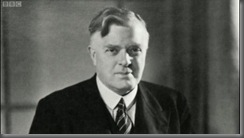 Pick was a managing whiz, and while he could not do design, he knew exactly which people to bring in to sort out the buildings, the rolling stock, the textiles. A rarity among accountants, he kept abreast of the latest in European trends in art and architecture, he knew all the modernists, and was able to fuse their ideas with a kind of English modernity, which was almost medieval in its attention to detail and love of craft. Meanwhile, Holden designed and built many of the stations on the Piccadilly and Northern lines, working flat out from 1922 to the beginning of the Second World War.
Pick and Holden were very close associates, so close that they occasionally fell out. Indeed, once Pick threatened to sack Holden when he found out that the latter had given the design commission for Hampstead station to one of his junior architects. The problem was that this was Pick’s home station, and naturally he wanted the senior man to do it up as well as he could…
 The posh floor was the tenth, the topmost. The executive dining room is on it; the ceilings are twice the height of other floors, and there is a managerial roof garden! And as a tall building, 55 Broadway offered a reframing of not just offices and transport, but also luxury: height, being above everyone else, was almost the definition of luxury. Standing here in 1929, Pick and Holden could see that they had built a monument to the centrality of London’s transport: they were easily storeys above any other building in the district, and had splendid views across the metropolis.
When completed, this was a glittering white monolith, taller than anything else in London, a testament to the ambition and drive of the new organisation. It was modern and primitive at the same time and very American. Art Deco, of course, drew much inspiration from the primitivism of ancient cultures. Most obviously, the structure of 55 Broadway is reminiscent of a Babylonian ziggurat; equally, however, its situation on an entire block, squatting between streets, was a consequence of a design dynamic that originated in the USA in the 1880s, when the first skyscrapers were put up. 55 Broadway, then, is not a relic of Victorian, Dickensian Britain; it is the vanguard of a new, futuristic Britain. 


Portland stone, the material of choice for British architects, lying somewhat between limestone and marble, and used extensively in 55 Broadway, epitomises the country, redolent of the White Cliffs of Dover, but also stuffed with fossils, and thus it combines ancientness and modernity. It is clean, modern, but suffused with the sediment of old Britain squashed into lumps of stone, and ideal for a headquarters: nothing says ‘stability’ and ‘forever-ness’ like this stone.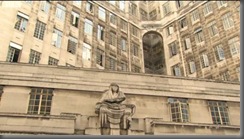


Holden intended the building as a new Temple of the Winds. Aware that it was likely to shock, he commissioned works by avant-garde sculptors like Henry Moore and Eric Gill to adorn each elevation. He chose Jacob Epstein, one of the most controversial artists of the time, to create two works, called Night and Day. It was a bold choice. 
The one called Day, when it was put up, caused great offence, great scandal, because the penis of the boy clinging to his father was an extra inch-and-a-half longer, with the result that when the rain ran down it, water cascaded off its tip and onto the street. So an inch-and-a-half had to come off. 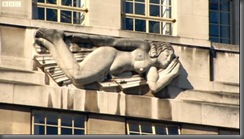
The primitivism of the sculpture represents the power of electricity. Both modernism and primitivism talked about huge, uncontrolled forces. Electricity was akin to the puissance of ancient gods; in Epstein’s Day, the ancient, primitive god is sending his son off to his job in the world. Likewise, the Underground becomes the manifestation of a powerful heavy primitive god.
 Crucially, Frank Pick understood the value of good design, and that the look of London Transport was its personality. He began the process of modernisation by commissioning painters for posters that would encourage commuters to use the system in their leisure time. In the 1920s, bright, colourful Art Deco designs produced by the best artists of the day were always given pride of place in the Tube stations. Pick understood just how persuasive they could be in persuading the public that this was a modern, forward-looking transport system.

In the London Transport Museum are over 20,000 posters from the various lives of the network. Those chosen by Pick from 55 Broadway were pivotal in the development of the Underground. Clive Gardiner was an example of an avant-garde artist employing some of the contemporary cubist ideas that struck a chord in the travelling public; another was Jean Dupas, who, like Gardiner, worked in his own style, and achieved much acclaim. The idea was to promote off-peak travel among Londoners; some of the posters targeted women, suggesting they were modern and independent and fashionable and could take in the city on a day out. The posters were placed inside the exits of stations so that people could see them on their way home: perhaps a glimmer of an idea of what to do on the weekend might then dawn in their minds. 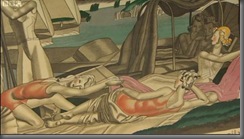
The posters were the starting point of one of the most radical redesign projects ever undertaken by a single company. Pick and Holden were able to do this because Art Deco is a total style, appropriate for all the company’s assets, from its headquarters on 55 Broadway to the smallest fittings on its station platforms, and so too the trains that ran on its tracks. 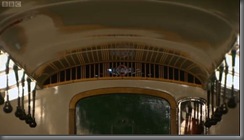 One of the first trains that had all its running gears underneath it was the 1938 Rolling Stock which remained in use till the 1980s. It was styled in an Art Deco way, with Art Deco lampshades (called ‘shovel shades’ by workers on the LU), and the red-and-green seating fabric (called moquette) designed by the foremost textile designers of the day, people like Edith Marx and Marion Dorn; the overall effect of comfort and spaciousness that enticed passengers.
  Frank Pick had an idea of ‘fitness for purpose’, and these trains achieved much of that goal: technically better than the prior generation of trains, more comfortable, much more easy to use. Indeed, Pick, despite being extraordinarily busy at the upper levels of the administration, still took an afternoon off every week to go over the samples and design ideas that were being proposed by his commissions, and personally signed off the ones he felt were the best. That level of total control brought a sense of order to what used to be a disparate system in the decades before, and reassured passengers that they were getting a consistent service.
Other aspects of the total design overhaul were the kiosks for cigarettes and newspapers that used to be placed within the stations; the passimeter, the ticket dispenser and passenger counting booth; and, of course, the signage and plaques for information. The earlier signs were difficult to read, cramped texts in multiple fonts, very Victorian.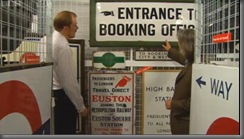
Pick commissioned Edward Johnston, one of the leading calligraphers of the day, to design a new Underground font, a uniform typeface that enabled clear and unambiguous signage, including the roundel logo, all surrounded by much white space. 
During the 1920s and 30s, the Tube network pushed further and further out of dirty and crowded central London to new and leafy suburbs. It was Charles Holden who oversaw the design of new stations, which became increasingly radical for suburban London. As a result, London Transport’s stations number more listed buildings than any other public body in Britain. 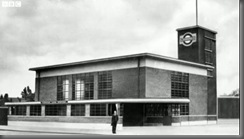
Southgate is one of Holden’s stations on the Piccadilly Line. It was opened in 1933, and was considered one of his most dazzling creations. It had escalators, which were possibly the most modern thing the passengers had seen; the escalator tunnel was warm-lit, spacious and welcoming, taking the passengers up to the light; at the top, arriving at the main hall, one would see the relief-panel on the ceiling, like water radiating out after a drop falls in it. Of course, one is now en route home, after a long grimy day at work, and this was a wondrous welcome back. 
It is easy to be jaded by stations such as these today, but in the 1930s, these were the frontline of international avant-gardism, European modernism and Hollywood and the cinema, a touch of the future for the commuting classes of London. 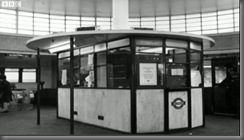

From its heart at 55 Broadway to the very farthest reaches of the system, in the posters, the stations and the trains, Holden and Pick’s Art Deco designs enriched and advanced the lives of millions of people in the 1930s. But London Transport’s bright new world still endures even now in the 21st century, fulfilling the purpose for which it was meticulously designed.
 (selected and translated by Pritham Chakravarthy), and those lovingly referred to in Patricia Melo's
  . Both Brazil and India are roughly at the same level of economic development as far as the vast majority of people are concerned, and both countries have an enormous thirst for light reading and sensationalism. (One can see this in the wide reach of daytime soap operas on television in both countries.) The English translation of the original Tamil stories serves to include a more middle-class audience for what is essentially vernacular fiction; likewise Patricia Melo discusses the popularity of Brazilian noir among the socially downtrodden, and the cut-throat competition to serve it.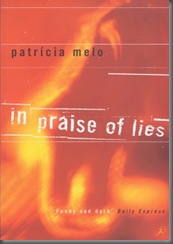

 Being obvious is possibly the worst comment a reader can make on a crime novel, but what is obvious to one person may be opaque to another. In Tefcros Michaelides's
  , the twist at the end depends for its surprise entirely on whether the reader knows the history of mathematics or not. The plot is rather straightforward - a Greek mathematician is found murdered and his best friend (the narrator) looks back on his career, hoping to find clues to his death in his past. The description of this past is possibly the weakest part of the book: Michaelides evidently believes that describing the excitement and fervour of early 20th century mathematics is insufficient to drive the book forward, so he throws in a long section on the development of modern art in the back alleys of Paris, introducing Picasso and his coterie, and claiming that Picasso's art was much informed by his own fascination for the foundations of logic. The plot hinges on an important question on the underlying consistency of mathematics, but surely it defies logic that the resolution to this question should verily be a life-and-death matter?
 is, as far as thrillers go, fairly faithful to the genre: a rich young woman thinks she has seen her long-dead brother on TV, her house is firebombed, she buys the services of a top-notch bodyguard (named Lemmer) who helps her in her search for her brother. Of course, the enemies are many and vicious, and when both get injured in an attack, Lemmer decides to go on the offensive himself. He is a man with a short fuse and can be indescribably vicious himself, so when the villains meet their comeuppance, they don't go gently into the unknown. Meyer throws in social commentary on present-day South Africa as well.
 is a narrative from the viewpoint of a mentally-unbalanced girl desperate to locate her mother. This is an exploration of the lush mindscape of the fifteen year-old Rose who adores her mother and is baffled and upset by her father's seeming lack of anxiety when her mother vanishes. She seeks answers in her mother's past, uncovering details of old loves and past crimes. This is a slim book set in a sunny coast of France completely at odds with Rose's anguish, and it drags the reader into her world of 'immeasurable loss' more surely and heartbreakingly than weightier tomes by less assured writers. Well worth a read.
 proves no different. Perhaps, though, we should believe Falcones - he is, after all, a lawyer himself, and he quotes Catalan legal documents (the Usatges) that purport to grant such rights. The novel, a sweeping history of the construction of the magnificent Cathedral of Santa María del Mar by indigent labourers as an act of love and devotion, starts with the violation of a woman on the night of her wedding. The story then follows the fortunes of the woman's husband, and then their son, against the background of the rise of Barcelona's maritime power. It is a gripping tale, incorporating miracles, internecine feuds, pogroms against Jews, naval battles, detailed explanations of construction techniques, sex and strife between diabolically devious women and inhumanly good men, envy between brothers, religious schisms, class struggles, and, if all this were not enough, the Inquisition. I'm well pleased with this, especially because there was nary a mention of the Templars.
 is a tale of the fall of a brilliant Swiss detective. The denouement is somewhat pat, but the analysis of the detective's psyche is very good. A little girl is savagely murdered and the detective makes a promise to her mother that he will find the killer. When a suspect is arrested and he subsequently commits suicide, everybody is satisfied that the case is closed, even the victim's parents. But the detective is not convinced, and against all evidence and in the face of his superiors' disapproval, he lays an intricate trap to catch the killer. He is so obsessed with this plan that he doesn't mind sacrificing everything he has - his reputation, his relationships, even his 'adopted' family - to fulfil his pledge. The plan fails and he loses his mind, and when the explanation arrives (a bit contrived and convenient), it is far too late to save the detective. This is a small book, a quick but agonising read, and well worth for its insight into the extremes of human nature.
 , three individuals, strangers to each other, enter the lift. Shortly thereafter, the power goes out and the trio is trapped between floors. Their back-stories are filled in between chapters that describe the continuously rising paranoia and terror within the cramped quarters of the lift. I’m not giving anything away when I say that one of the three is vicious serial killer, and his is the only background that is really relevant to the story. The other two could have been pilots or scuba-divers for all their lives had any consequence up to the point they are trapped. So far, so good. True to the genre, the innocents have to escape. How though? And is that all to the story? This is where Morozzi cranks up the unlikeliness factor, and the story – to my mind – degenerates to droll fantasy. It is written in that arch, self-consciously-talking-to-the-reader fashion that might grate on some; the staccato sentences might alienate others, but it is a thin book, trying a bit to be too clever, and will serve as a decent page-turner on a short trip to work.
 is another such. Geeraerts doesn’t have much time for organised religion, I gather from this fable, or for money-grubbing men or women, most of whom end up perishing in some gruesome fashion or the other. The protagonist of this parody of the paranoid thriller genre is the Public Prosecutor of Antwerp, a man who owes his position to his wife’s noble family. He leads the usual life of an alpha male – he has a beautiful young mistress; his wealth does not stop him from seeking more; and, of course, he detests his wife, and hardly has any time for his sons. The wife is a deeply religious Catholic who wants one of her sons to enter Opus Dei, the usual villain in books involving religious skullduggery, and to that end is willing to sacrifice everything, including her husband. There are other unsavoury Opus Dei operatives with connections at the highest reaches of power – both financial and administrative – and there are sundry criminals out for revenge. None of the characters has any redeeming qualities but the Prosecutor, harried and hassled, ends up being strangely sympathetic. This is so earnest a book I cannot imagine Geeraerts wasn’t grinning ironically all the while he was writing it; good fun.
 is a rollicking dissection of Cuban life, where years of Communism have only served to drive the capitalist fervour of the masses to feverish pitch and materialism rules above all. Unlike the corruption and drug-addled misery limned in Leonardo Padura’s Havana series, Chavarría’s book is far too good-humoured. It is also a sexy romp with the pneumatic bottom of the wondrously bright and beautiful Alicia running riot, trying to ensnare rich foreigners who might then take her away to their own rich lands where she could lead a life of luxury. Her modus operandi is to ride her bike, wiggling her alluring bottom to attract a rich man in a fancy car, and then falling spectacularly before the sucker, prompting him to come to her rescue. Her mother aids and abets her schemes,
 , as harrowingly graphic as any lesbian crime author’s work (as
  , which is taut, gripping and eminently true to life.