JOST A MON

The idle ramblings of a Jack of some trades, Master of none

During our recent trip to the US, we purchased an iPad. Since then the wife hasn't been seen in society. She lurks constantly in the dark, obsessively surfing for high-graphics content, and, when thirsty, using the coffee app that enables her to pretend she's giving herself her dose of caffeine.

A couple of days ago, the UK app store opened up for iPads. When the wife wasn't looking, I surreptitiously downloaded a couple of programs that I found interesting. One was a finger-painting tool. Rather nice (observe my creativity in attached picture).

The other was the iBookshelf or whatever it's called, using which I browsed the Gutenberg free book catalogue and saw for myself the beauty of this application. Not that I will be reading much on this device. I like the idea of multiple e-books on a device, but not so much the activity of reading on it.

Entirely accidentally, I downloaded the Harbour Master game, and now the wife is completely lost to society. The thrust of the game is to control a myriad of ships and boats - each moving at a different speed and carrying different container loads - to get them to dock, unload and depart without crashing into each other. This morning, while she chatted on the phone with her mum, I achieved the princely score of 51. Believe you me, this took some doing. Feeling mighty chuffed, I looked at the all-time honours list. The top score is 3400-odd.

Now the boy is beginning to obsess about the game. His intent is to crash boats as soon as possible. He enjoys the sound of the bubbles as the boats sink. The wife and I have to fight him off constantly. Then the wife fights me off.

Which is why I'm blogging and she hasn't been heard from for yonks.

The mass murder of Armenians at the end of the Ottoman empire is fairly well-known, and I'm surprised that an Oxbridge graduate such as de Bellaigue was unaware of it. By his own admission, he only realised it after a work of his, influenced by the Turkish academe, was savaged by an American professor. To salvage his dignity and also filled with curiosity, he decided to spend time in Eastern Turkey where some of the most brutal acts of ethnic cleansing had occurred. The book under review, Rebel Land: Among Turkey's Forgotten Peoples, is the result of his investigation and travel through that region, where he met not only the (converted to Islam) descendants of the Armenians, but also Kurds, Alevis, and Turks.

There appears to be some amount of diminution there of ethnic identity. Most people identify themselves initially as Turks, speak fluent Turkish, and are wary of de Bellaigue. The fault-lines are not only ethnic, however, or even inter-religion. The Kurds themselves are divided by sect - Shiite or Sunni - and they despise each other only slightly less than they hate the heretic Alevis. Meanwhile, the Armenians in 1915 were slaughtered not just by the Turks, but by many of their coreligionists in the region, including the Kurds.

So closely are the subsequent fates of these minorities, though, that all of them make claims to victimhood. de Bellaigue segues from the Armenians to the Kurds. He discusses their long-standing fight for independence via means both political and terrorist. He then moves on to the most despised group of all, the Alevis, and their struggle for identity.

The problem with all these groups, besides the mutual suspicion, is also the innate corruption and megalomania of their own political elite. When they are not fighting the Turks, they are destroying each other. de Bellaigue has written a well-researched (and poetic, even) study of the tensions and psychological pressures these folks live under. Recommended.

In 2001, Peter Hessler obtained his Chinese driving licence and began to drive around that great country. An American, he was already a skilled driver, and so he is shaken and shocked and stirred by the terrible abilities of China's drivers. By dint of sheer physical courage and intellectual curiosity, he tames his fears of the Chinese roads, and sets out to discover his adopted country. His latest book, Country Driving: A Chinese Road Trip is an account of the people he met who took him into their confidences and their homes, the factories that rose and fell, the villages that emptied, the fields that became urban landscapes, the pollution that killed, the astounding socioeconomic transformation of the world's most populated nation. In turns he is ironic, critical, deeply inquisitive, puzzled, stymied, but he is always affectionate, and the Chinese respond to him. Not just the simple folk but also the cadres open up to him, and he tells their stories.

There have been other books on Chinese roads (e.g., Rob Gifford's China Road: One Man's Journey into the Heart of Modern China, which I talk about below) but there's little overlap here. Hessler might gad about this highway or that, but his book is about the stationary, the necessity of continuity with one's past. And so whether he is living with a peasant family of wannabe entrepreneurs, or talking to impoverished minorities seeking assimilation in a great city, or travelling with an itinerant variety show complete with brief nudity for the titillation of the exhausted proletariat, he wants to understand what it is that prompts these people to make the choices they make, to go the places they go to, to see why they find themselves despised by their neighbours and yet stand tall, to uproot their families and lose their connections to their ancestors, and to seek salvation in new faiths. This is a moving book beautifully written, very well worth your time.

A Briton, Rob Gifford was NPR's correspondent in China for many years, and before he decided to up sticks and return to London, he took a long journey on China's highway 312, the Mother Road. It goes from Shanghai to the Kyrgyz border, and takes in every town of importance along the way - Xi'an, Nanjing, Luzhou, Urumqi. At times it follows the Great Wall (and geographically overlaps a part of Hessler's trips) and at others it winds around mountains, fords great rivers, cuts straight across plateaus. Unlike Hessler, Gifford takes buses and hires drivers for his trip, but both men bring the same quality of engagement with their subjects, the same level of empathy, and similar sense of discrimination.

Like Hessler, the big story in Gifford's book is of the grand migration of peasantry to industry. Often, entire families uproot themselves, but more usually it's the younger generation that travels thousands of miles for a job in a factory, leaving their under-educated and unskilled (and, in China, unwanted (at least in the industry)) parents behind. There are serious social divisions, a lack of adequate health support, underpayment, terrible working conditions, corrupt administrations, and through it all, the migrants manage to find jobs, obtain a semblance of independence for themselves, fall in love, marry, have (one) offspring. As they work themselves up the value chain, they might migrate from Central Chinese cities to the more cut-throat and better-paying cities of the coast, hoping for that pot of gold, that fancy car, that European fashion icon. Sadly, though, for many, economic gain is not forthcoming, and emotionally they cripple themselves. Gifford gives voice to the successful (an agony aunt on Shanghai's most popular TV channel) and the unfortunate (donors of blood for money who end up with AIDS), the chilling (late term abortionists) and the droll (Amway acolytes filled with fervour), the Han (industrious, populous and ignorant of large swathes of their own country) and the minorities (a Tibetan man who admits that for him, independence is pointless, and he can only get ahead in life by learning Mandarin and teaching it to his compatriots). In a country that has gone from the kowtow to the air kiss in less than a century, it is not surprising that there are serious problems and equally spectacular successes. Gifford is evenhanded enough to note both, and is humble enough to state that he doesn't know whether China, as we know it, will survive or fail. Another good book, this.

I'm happy to host the next Carnival under The Giant's Shoulders rubric. Articles on science and engineering are welcome. The next Carnival (#24) will be published around June 16.

The philosophy behind the Carnival is explained in the post that started it all:
“The Giant’s Shoulders” is a monthly science blogging event, in which authors are invited to submit posts on “classic” scientific papers. Submissions are due on the fifteenth of each month, and entries will be aggregated and linked to on the host blog of the month. Links to entries should be sent to that month’s host blog. What defines a “classic” paper? This depends upon the field in question, but one expects that the work should have somewhat stood the test of time: we suggest perhaps 10 years old, or more. Contributors should not only describe the research involved but also put it in a broader historical/scientific context: why is the work in question important/groundbreaking/revolutionary/nifty? It should go without saying by the use of the word “classic”, but papers should be in an accepted, established scientific field: contributions promoting non-traditional science and pseudo-scientific ideas are inappropriate. Why restrict yourself to “classic” papers? Entries profiling an important person or concept in the history of science are also acceptable.
So please do send in your articles: blogcarnival.com.

It's good to know Farsi and travel around Central Asia. People in a large belt of countries extending all the way to Afghanistan speak variants of the language, and if one can't get by with Farsi, why, Russian always helps. Our man Daniel Metcalfe is a traveller with a purpose and with the requisite skills, and it's no wonder that his book Out of Steppe has the makings of an excellent account of little-known people.

Little-known to the West, of course. The people in these lands are all quite aware of each other, having traded and intermarried amongst themselves for centuries. They share not only language but also culture. But the six nations that Metcalfe wants to seek out are islands of separateness even in this world. All of them find life a struggle in every way.

Metcalfe meets the Karakalpaks who live near the decimated Aral Sea. Once famous fishermen, they have been reduced to diseased subsistence by the utter environmental disaster that has befallen their land. They see no future for themselves. The Germans of Kazakhstan, forcibly settled there by Stalin, are the remnants of a proud people who had settled in Russia under the favour of Catherine the Great. They now find themselves isolated amongst the drug and alcohol-riven communities that surround them, neither fish nor fowl, neither true Germans nor yet Russians. Bukharan Jews are next on Metcalfe's agenda. Here another sort of disaster is going on - as the local Jews die out, the diaspora comes in touristily, and find that all the gems of Jewish architecture are slowly rotting away, and the Uzbeks who own the properties now are more interested in presenting a Disneyfied concoction to the visitors, thereby exacerbating the cultural vandalism. The few Jews that dwell in Bukhara are insular, and it's only by pretending to be Jewish himself that he manages to insinuate himself into their lives.

The remaining three cultures are somewhat of an afterthought, I felt. The Sogdians of Turkmenistan and the Hazaras of Bamiyan are dealt with in pedestrian fashion, and the Kalashas of the Hindu Kush are probably treated better in other books (such as Alice Albinia's Empires of the Indus: The Story of a River). Metcalfe can be commended for his zeal here, but the early parts of the book are much better.

Overall, an uneven tome with both high and low points.

5.24.2010

Encoding Man

At a party recently, I met an elderly gent called Bruce. An affable and well-spoken man, he happened to mention that he had worked in telecommunications and computer software from the 1950s onwards. In the US, he was employed by Marconi at a time when the first inter-exchange trunks were being established, and their signalling protocols were being designed. These served to connect local and regional telephone exchanges so that long-distance calls could be made without need for an operator. These days, telephone exchanges are connected with fibre-optic cables; microwave transmission is, I think, still common in less developed parts of the world. But Bruce worked at the time that predated even microwaves, he said. First VHF, then the 200MHz spectrum. Naturally I wanted to know all about it, and when he realised that I was a fellow telecomms type (at least in spirit these days), he was glad to talk. He travelled quite a bit, he said, all over the US, and, later, across Europe.

"Then I worked with the very first mainframes," he said. He spent many years with ICL, that British computing behemoth that fell apart, and was acquired by Fujitsu. Not that the union with Fujitsu was any more successful, of course. PCs were taking over the world, and even though many people at organisations such as Honeywell and Unisys and IBM and Fujitsu could see the writing on the wall, institutional inertia led to these mainframe manufacturers getting increasingly sidelined. But all that was in the future when in the 1960s he began working on COBOL.

COBOL! Who even mentions this programming language these days? The last I ever had anything to do with this was as part of a Programming Languages Lab at IISc, where the instructor was so bored and disinterested that I spent his classes playing tic-tac-toe with myself. That was in 1992. Short years later, enterprising Indian engineers were writing clever parsers and translators to convert COBOL to more modern programming languages in keeping with the large-scale effort on the part of mainframe owners to switch to PCs. They made more money than I can shake my finger at; then they parleyed all that experience in sorting out the Y2K bug for an increasingly panicked world.

Upon close questioning, Bruce revealed that he was instrumental in the internationalisation projects for COBOL. Essentially, the idea was to allow applications to provide seamless interfaces to users in various (human) languages without having to rewrite the underlying code. With all the expertise garnered from this effort, in later life Bruce became the editor for the first Unicode draft. He spent months, he said, going over every line of that 1000-page document. It aimed to standardise computer encodings for every written script on the planet. The ASCII codes for the Latin script could only provide 255 characters, and so in countries such as China where the script consists of a few thousand characters, they developed their own encodings. Without a streamlined system, Chinese computers would suddenly find it impossible to understand, say, a Russian one. I speak extremely loosely, of course. But with Unicode, you could have a uniform encoding for all possible languages - Amharic and Mandarin and even North American Cree. Is Klingon also Unicoded? No, but Unicode is flexible enough to allow it.

"You can thank me for my sleepless nights," said Bruce.

Others have depended on Bruce for his abilities. Even if he doesn't speak or read all the world's languages, he can identify most of them from their writing. At his local barber's, the proprietor, an Italian woman, once showed him a book left to her by her father. He recognised it to be written in the Devanagari script. He asked a colleague - a cellist - in his orchestra if she could read it. She, a Bengali Scotswoman, couldn't.

It turned out to be a Hindi book of poetry published in Gorakhpur. The Italian barber was keen to know if it was a rare book; if so, she might make some money selling it. He had to tell her, rather regretfully, that it was far from rare. The print run had been 120,000 copies.

5.20.2010

Juvenile Humour

In the 1970s, there used to be a humorous magazine for kids in the USSR. It was called Yeralash (детский юмористический журнал "Eралаш"), and was so popular that I don't remember ever seeing a copy of it - either on newsstands or with my classmates. Luckily for those of us without contacts in the publishing industry, Soviet TV would occasionally produce short episodes - half-hour to an hour-long - based on stories in the magazine. There must have been a fair number of these aired, but I recall only one set.

A little old lady turns out to have magic powers that she uses for the benefit of her favourites, who are invariably hapless students struggling academically, although some of them fancy themselves geniuses. There was one involved episode in which a kid who obtained a grade in science of 2 (as shameful a grade as can be imagined, when 'passable' is 3, and everybody aspired to 'excellent', or 5) and wanted to improve his prospects.

The fairy godmother offers him enhanced skills in science, and that prompts him to set up an elaborate experimental apparatus in the chemistry lab. After much bubbling and boiling, and (I'm sure) changes in colour (which eluded me as I watched on a black-and-white TV), the set was pronounced ready for operation. Evidently, what the boy wanted to do with his new superb chemical skills was to dissolve that grade 2 written in his record and imprint a 5 instead. Instead there is an explosion and the debris clears to show the chap stuck to ceiling with the grade 2 transplanted onto his forehead. He woefully remarks, "Again we over-chemistrified!" which I have to say sounds a lot funnier in Russian ("опять перехимичели!") than in translation.

But the episode that always brought out the math geek in me was the one involving yet another poor student who is stuck with a problem in arithmetic. He sits glumly at his desk with his textbook open and his pen a-twiddle.

A senior student (who has been the recipient of the fairy godmother's favours) scoffs at his inability to solve it.

The problem was something like this: There are 28 oranges to be equally distributed among seven kids. How many oranges does each kid receive?

The poor student knows he has to divide 28 into 7. He does:

7 | 28
21 | 3
----
7 | 1
7
----
0
And obtains the answer 13.

The older boys says, "So each kid gets 13 oranges?"

"Yes," says the younger boy.

They look at each other in faint disbelief.

"How do you verify a division?" says the older boy.

"With multiplication," says the younger boy.

"Well then, multiply," says the older boy.

The little chap proceeds as follows:

13
x7
---
21
7
---
28
"Addition," says the older boy. "That's what we need. It's the most accurate procedure."

The younger fellow is dubious. How do you verify division with addition, he wonders.

The older chap write seven 13s on the blackboard:
     13
13
13
13
13
13
13
And proceeds loudly to add up the threes: 3, 6, 9, 12, 15, 18, 21; and then he adds the ones: 22, 23, 24, 25, ...,

And sinks to floor in utter confusion when he arrives at 28.

We loved this episode in school because it appeared at first sight to be correct and had just that bit of thumbing one's nose at officialdom. Our second or third grade teachers loved it as well because they could use it as a teaching tool, and it seemed to help even those of us with less than stellar math skills to grasp these essential arithmetic operations. Even better, it very subtly explicated to us the wonders of the place-value in numbers, something we had only recognised in a very superficial sense.

What amazes me to this day is this intellectual and pedagogical quality of Soviet humour. The adults may have led lives of colourlessness and paranoia, but the kids had a lovely time growing up. These occasional diversions from the usual stultifying fare of agricultural statistics that were purveyed on TV were, for us, the icing on the cake.

5.19.2010

Joblesse Oblige

Shortly I'll be between jobs and hoping to relax. Will I be able to stage a late night binge followed by a delayed reveille? Can I possibly spend the day ensconced on the sofa munching crisps and reading a book or two? Can I listen to Led Zeppelin at full volume for more than ten minutes? Will I be spared the nearly daily visit to the local supermarket to pick up things that I forgot to pick up the last time around?

No.

There are statements such as the following:

Some fathers don't mind getting to work late because they are so keen to drop their sons off at school.

Some fathers don't mind leaving work early so that they can pick up their sons from school.

Some fathers live for the joy on their sons' faces when they offer to take them tobogganing/cycling/camping/learning hip-hop.

Why can't some fathers be like those fathers?

And

Where's my breakfast in bed?

The laundry doesn't get done on its own.

Why is the newspaper not at hand?

You are always hogging the computer.

You are always hogging the TV.

The child is all yours. I don't want to hear him, see him, or smell him for the next week.

Meanwhile, the boy has his own demands.

Acha. Can we go by tram today?

Acha. You are always shaving your head. Play with me.

Acha. Can you pretend to be a villain?

Acha. You should be kind to your child.

I want my Amma. Where's Amma?

5.18.2010

Parochial Hatreds

If people who have lived amongst each other for centuries can scarcely abide each other, what hope is there for more recent admixtures? The Turks and Kurds and Armenians have cohabited for at least a millennium, and to this day they are suspicious of and condescending to their neighbours. An excellent example comes from Christopher de Bellaigue's recent exploration of eastern Turkey titled Rebel Land: Among Turkey's Forgotten Peoples, where he mentions Ismail Besikci, one of those rare Turks who actually was a Kurdophile, and who wrote a series of sociological treatises about eastern Turkey and its people that led to his imprisonment for well nigh on fifteen years. Besikci's crime was to discuss the Kurds as a people distinct from the Turks, with their own traditions and language. To a government adhering to the fierce 'one land, one people, all equal' ideology inherited from Kemalism, this was treason.
Part of the trouble, of course, is that many Turks' stated commitment to equality and integration is a fiction. These Turks are the first to concede, through unguarded expressions of superiority, the existence of a regrettable subspecies, the Kurds. Once, as Besikci sat in the office of a publisher in Istanbul, 'a translator entered, a woman charged with translating a novel from the English. The action takes place in Spain. There is a Turkish character, the sort of character who incarnates all that is bad about human nature. Theft, fraud, drug smuggling, murder, prostitution; he's involved in the lot. "He's guilty of every bad thing under the sun. He's a very bad man. I thought at length about this," the translator said, "and I decided to turn the word 'Turk' into 'Kurd', because I couldn't impute to a Turk so much ill." '

After Gordon Brown called that poor woman a bigot, her front lawn was invaded by all the press of the free world, desperate to get a statement from her. Unbeknownst to all these worthies, reporters from the Sun had snuck in through her backyard, and were trying to get her to slam Labour in return for big money. In the search for the scoop, it seems, any amount of skullduggery is allowed.

Such a far cry, then, from the more genteel world of 1960s journalism. As Michael Frayn reports in his neat little collection of essays titled
Travels with a Typewriter: A Reporter at Large, things were more bonhomous. He was a new hire for the (Manchester) Guardian at the time, and:
I was worried before I arrived in Manchester that I had never managed to get my shorthand up to speed. It didn't turn out to be much of a problem, though, because reports on other papers, not regarding the Guardian as serious professional competition, often saw it as one of their charitable obligations in life to seek you out afterwards and 'fill you in' from their own notes.
Ah, the sixties. Those were the days.

Mere hours after I spent the weekend ripping my old collection of CDs, The New York Times has an article bemoaning the loss of quality associated with your typical digitised music file. Sure, I ticked all the buttons while transferring the music onto my hard-drive - variable bit rate encoding, high bit rates, AAC rather than MP3 - but the fact remains that for your usual high-end listening, nothing I do will make any difference.

(Okay, I lied. I didn't choose the 256kbps bit rate. 192 is about my limit.)

Any of those digital files will underperform a compact disc.

(I'm not even talking about the old fogies who insist that vinyl was the only way to listen to music.)

Of course, this assumes that my speakers are fancy devices capable of projecting flawlessly the flutter of a fly falling on a flute.

The speaker I have is a Sonos S5.

While it is a bit of a networking marvel - creating its own wireless mesh - it's no Sonus Faber Cremona. (Note the confluence in the naming. Most mellifluous, no?) It's not even a Bose. But it is very decent, reproduces basses better than tinnily and tenors better than thinly, and, after several years of listening very occasionally to music on my TV via the DVD player, I have to say it adequately meets my needs.

So why does it still feel like a cop out?

Simon Winder, in his recent book Germania: A Personal History of Germans Ancient and Modern, recalls a multilingual friend, who once told him that he could feel his personality change quite drastically when using German or Italian - the former making him punctilious, waspish, acrid, remote, extremely polite, the latter making him expressive, promiscuous and a pleasure to be with.

Remarkable. I'm a bit of a multilinguist myself, and I see nothing remotely different in my behaviour when I switch from, say, English to Hindi. I hem and haw in both languages and I struggle for the mot juste. In fact, not only does my demeanour remain identical in either language, I am interrupted as often. Just the other day, I tried to say something in Malayalam to the wife, and by the time I opened my mouth, she had announced a shopping list and I found myself in front of Tesco, jawing gormlessly at the checkout machine.

I console myself with the thought that Winder's friend is slightly manic and slightly depressive. But before I can conclude that conclusively I'd like to take a poll.

So: who among you finds your temperament changing when you switch from language to language?

And: what sort of temperament corresponds to each language?

5.02.2010

Asmara Modernist

It is the imperial influence of Europe that has transformed much of Africa into the continent we know today. Long after the wondrous designs of the Egyptian Pyramids and the rock-hewn churches of Lalibela and the mud-brick mosques of Mali, new architectural paradigms began to inform the African metropolitan landscape. This is most evident in Asmara, the capital of Eritrea.

Although Eritrea has long been part of Ethiopia, independent only since the 1990s, Asmara – a World Heritage site – has little in common with the constructions of its erstwhile overlord. In fact, it has much more in common with the architecture of Italy, the country that colonised and occupied it from the end of the 19th century to the end of the Second World War. Neoclassical Building in Asmara's Town Square

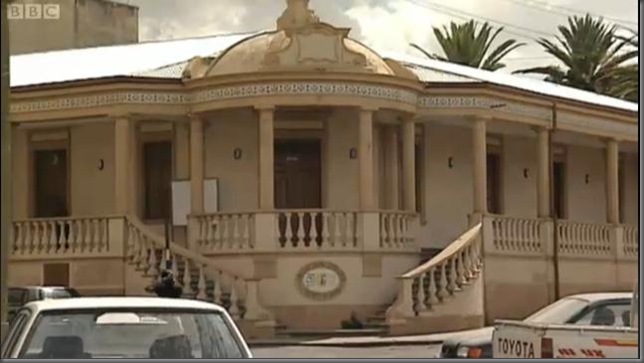
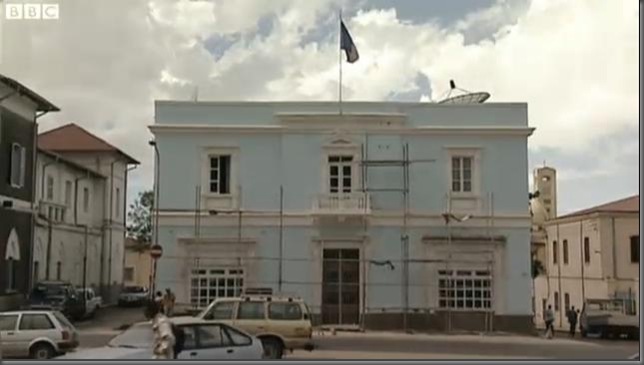
Baroque example in Asmara's Town Square Arabesque Neoclassical in Asmara's Town SquareStraight Lines in Asmara's Town Square In the early years of their rule, the Italians introduced a bewildering mixture of styles in Asmara. The city’s town square offers the perfect example of this melange. The building of the Communal Bank of Eritrea is in the neoclassical idiom; the post office building has an austere, stripped classicism with lovely colours; there is a Baroque edifice in one of the corners of the square, with its swooping stairs and strange cupola; a 1950s-style building has strong lines and punched out windows; a neoclassical building that acknowledges a sort of arabesque arcade; and there is a symmetrical palace building that completes the ensemble.

Asmara's Modernism Asmara’s mix of architectural styles defines it as the epitome of the 20th century in Afro-Italian history. But, of course, the Italian taste for the eclectic didn’t last. By the 1930s, Benito Mussolini had decided to inflict a harsh futuristic aesthetic on his colony. Like Hitler, he wanted to express his power via architecture. He decreed that the new Asmara would be done up in his favourite style, namely Modernism.
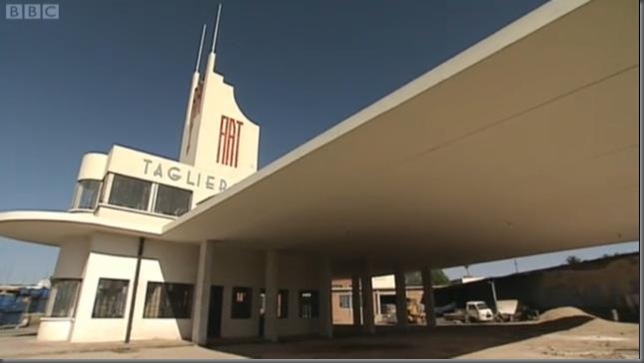
Pettazzi's Fiat Petrol Station in Asmara One of Africa’s most remarkable buildings has to be the Modernist petrol station built in the shape of an aeroplane. Designed by one of Mussolini’s favourite architects, Giuseppe Pettazzi, the 1938 Fiat gas station is a splendid example of a branch of Modernism called Futurism. It used to be said of this beautiful fossilised pterodactyl of an edifice that its design reflected the desire of homesick colonials to return to Europe.
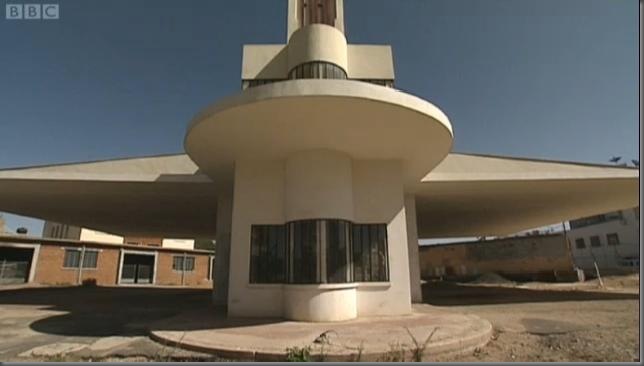
Pettazzi's Fiat Petrol Station in Asmara There’s a story about this building. Pettazzi, when he had to submit these plans to the local authority, faced a huge problem. They couldn’t believe that a concrete structure with a sixteen metre cantilever looking like this could stand up by itself. So they forced him to put lots of little columns underneath in order to support it. When the structure was built, Pettazzi was reported to have held a gun to the builder’s head, and ordered the poor man to take away all the columns. And lo and behold, it's standing up.

Residential Block in Asmara At the height of the occupation, 70,000 Italian civilians were drafted into Asmara, to build Mussolini’s model city. To keep them entertained, in 1937, the authorities built the Odeon cinema, one of five picture palaces in Asmara. Its elegant foyer appears to have been ripped out of the set of a classical movie, with subtle backlighting and sumptuous fittings. Upstairs, in its function room, the architects gave it a playfulness with its deliciously sloping ceiling.

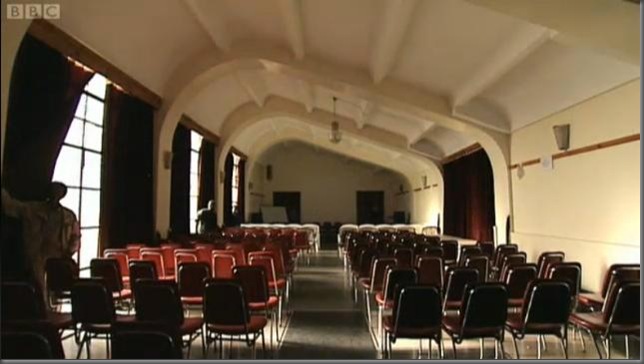
Odeon Cinema, AsmaraSloping Ceiling in the Odeon Cinema, Asmara It’s easy to fall for a place like Asmara. This is what happened to the Eritrean architect Naigzy Gebremedhin, author of Asmara: Africa's Secret Modernist City. One of his favourite buildings in the Selam Hotel, built in 1937. Its style is Rationalist, a branch of Modernism that favours the simple, the brutal and the ruthlessly functional. The Fascists, says Naigzy, adopted this style and made it their own, and the Italian architects of the time adopted both the Fascist stance and continued to work in this particular idiom.

Selam Hotel, Asmara The Casa dei Italiani in Asmara was originally the Fascist youth club, Casa dei Ballila; at the front gate, the fasces are still visible – reeds tied together, the traditional Fascist insignia, and at the capitals of the columns used to be axes, which have since been removed. It used to be a Fascist club for boys, so to speak, and now it’s the club for Italian expatriates and the Italian-speaking Eritrean community.

Of course, Mussolini’s buildings weren’t really designed for the natives at all. The Italians imposed strict social segregation, leaving most Eritreans sidelined and marginalised. Nevertheless, many Asmarinos (as they are called) retain a certain affection for Mussolini’s cultural legacy. While they would never excuse any of the terrible colonial past, Eritreans do appreciate that the Italians spared no expense in designing and constructing the city. Despite the daily reminders of their colonial subjugation, it is evident that many Asmarinos love their capital. And why not? Even an outwardly unprepossessing apartment block can hide a wonderful surprise.

Apartment Block in Asmara (with a surprise inside) Take a look at this seamlessly meshing appearance from below of the spiral staircase that serves six to seven apartments in this block.

Seamless Spiral Staircase This is by no means a unique experience in Asmara, a city that retains a wonderful charm. If nothing else, the Romans were able to donate a certain romance to the place.

Modernist building inspired by a train. Asmara. Naigzy reveals that the Fiat building was only one of several that were inspired by forms of transport. Here is one that looks like a train, led by a locomotive going down the river.
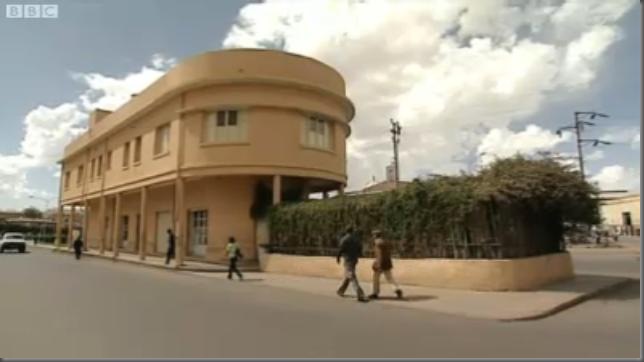
Modernist building inspired by a boat. Asmara. And when that one was finished, directly across it was built another building – which looks like a boat.

By 1941, Mussolini had turned Asmara into the most modern city in Africa. But in just six years, Il Duce’s dreams of grandeur were shattered by Allied troops, who jackbooted him out of Eritrea. As the tanks rolled into town, the soldiers must have been amazed to discover a little Italy, complete with legions of locals walking the passaggiata down the via Mussolini.

For the Italians, of course, the evening stroll had been a way to wind down the day with elegance and flair. The Eritreans continue to enjoy some of that élan in Asmara, which remains to this day one of the most charming cities in Africa.

(A loose transcript of David Adjaye’s Building Africa: The Architecture of a Continent. BBC Four.)