JOST A MON

The idle ramblings of a Jack of some trades, Master of none

Aug 29, 2010

A Dulcimer, Hammered

After bringing a rousing tune on the Santur and Daff to a close, Peyman Heydarian announced that he and his percussionist had just played a Kurdish wedding song.

"It's very popular in Tehran," he said. "It's about a girl who doesn't want to get married."

"The Tehranis don't understand the lyrics," he added. "Which is probably why it's so popular. The Kurds know what it means, and that probably explains why the Kurds don't sing it much."

Peyman Heydarian is a man with a mission - to restore the glorious santur to its rightful place in the firmament of Persian music. I suspect it is a bit of an upward struggle - the aficionados die out and the young prefer modern music, especially the sugary synth promoted by the Iranian diaspora in Los Angeles and received right back in the homeland via satellite dishes. He has been researching the scales of this ancient instrument for years, and recently recovered a style that had disappeared from the oeuvre some time in the last couple of centuries.

The santur has a wide footprint, of course. It has become an intimate part of Hindustani classical music, most notably under Pandit Shivkumar Sharma. In the early Middle Ages, it spread into China. In Europe, where, under Arab musical influence, it became known as the hammered dulcimer, and remained part of the music scene for centuries.
Classical Persian music is based on a modal system of 7 main modes and 5 derivative modes which are collectively called Dastgah: Shur, Abu'Ata, Bayat-e-Tork, Afshari, Dashti, Homayun, Bayat-e-Esfehan, Segah, Chahargah, Mahur, Rast Panjgah, and Nava. Our programme consists of pieces in Shur, Mahur and Bayat-e-Esfehan and an abandoned mode, 'Maqam Saba.' (from the programme notes.)
At a concert I attended a few weeks ago (with Rochelle), Peyman and his percussionist Emad Rajabalipour performed rollicking pieces from the Persian and Kurdish classical tradition. Then they introduced the lovely Vicky Anastasiou who sang a Kurdish song with rivetting facility. Considering she is Greek, has no knowledge of Kurdish, and had only learnt the song in the past couple of days, it was an incredible performance.

Peyman is a multi-instrumentalist, and often participates in jamming sessions and concerts with like-minded musicians in the SOAS Rebetiko band. He is expert at the tar (Persian lute), the barbat (or the ud), and the piano and the daff. What's more, he has created innovative tuning system to be able to play the Celtic, Turkish, Greek, and early European repertoire. And in the second half of his concert, he invited musicians and singers from the audience to join him in making a jolly evening of it all.

There are more concerts coming up so I'll urge you to check to go check it out.

Aug 23, 2010

Sindhis Again?

Looks like our good people of Sindh are suddenly in the news again - this time with their astute mathematical skills in the problems of optimal transport! Here's an excerpt from a recent post by Tim Gowers who was attending the International Congress of Mathematicians at Hyderabad (note: not the one in Sindh):

I’m not going to try to explain Villani’s work beyond this. Let me just mention a few random things from what Yau said, and some even more random thoughts that I had during the talk. One of the latter was that amongst the other mathematicians Yau mentioned were Cergignani, who conjectured that the decay to global equilibrium of, I think, solutions to the Boltzmann equation is exponentially fast, Toscani, who proved with Villani that this conjecture is almost always (in a certain precise sense)correct (which was interesting as there are counterexamples due to Bobylev and Cergignani himself), and Gualdani, whose role in the story I did not write down and have forgotten. Could there be a pattern here?
Okay, just kidding. It's a slow evening.

Okay, I was really not going to, but this collection and that article completely forced my hand. In this year's Miss Universe pageant there's a serious preponderance of peacocks. What does it say about the international world of fashion if there's so much (simultaneous) fascination with that bird? It must be something to do with all that strutting, and in this universe of gender neutrality, why bother with the lacklustre peahens? Look at all this glitter:

Jimena Navarrete (Miss Mexico)Ushoshi Sengupta (Miss India)Marva Wright (Miss Costa Rica)
So what's up with all the peacockery, then?

Aug 19, 2010

Fields Medals 2010

Now that the four latest Fields medallists have been announced, the popular bit of the International Congress of Mathematicians is over and the technical bits begin. Desis and women have to wait a bit longer for their first Fields awardee, but the Vietnamese must be over the moon. Ngô Bảo Châu has won, while the usual Russian and French contingent has been satisfied by Stanislav Smirnov and Cédric Villani respectively. Rounding up the quartet is Elon Lindenstrauss from Israel.

The announcer of these prizes, whose name I didn't catch, quipped weakly that Villani was a real French (as opposed to Châu who works in France), and that you could tell from his last name that Smirnov is Russian (albeit based in Switzerland).

Once again the
Langlands program comes up trumps in Ngô Bảo Châu's work; Smirnov's contributions are in mathematical physics and analysis; Lindenstrauss has applied ergodic theory to classical number theory; and Villani's work is in mass transport (which, contrary to what you might imagine, has little to do with either the London Underground or imprisonment in the Andamans), an active field contributing to plasma physics.

Congratulations to all of them.

Aug 16, 2010

Flip Turn Rotate

You know you're supposed to flip your mattress periodically, right? Sure you do. This is to enable an even amount of compression in the springs or the filling so that you don't end up in later years in an orthopaedic ward with a misaligned back. And so you do your back in today flipping the mattress around just to avoid doing your back in at a later date.

But I get ahead of myself.

Flipping or turning or rotating? Any of these actions, if carried out a sufficient number of times, results in the mattress ending up as it started. That is because the mattress, a cuboid, has only so many degrees of freedom. The set of operations you can carry out even forms a delightful mathematical object called a group; in particular, it is a non-commutative group, because combining the actions in different sequences sometimes result in different orientations of the mattress.

You can read all about it in the inestimable Brian Hayes's book Group Theory in the Bedroom, and Other Mathematical Diversions, and please get your minds out of the gutter right now.

But that's not what I want to talk about.

The wife legged it to India recently with instructions for me to procure a new mattress for our downstairs bed before she came back. Until a couple of days ago, I had the excuse that I was studying to avoid going into the store. Today, however, I ran out of procrastinatory reasons, and I went to John Lewis (who are never knowingly undersold) to check out the mattresses on offer.

For some reason, the place was seething with couples. All were intent on trying out the mattresses. Every mattress I looked at had hetero- and homo- duos canoodling or lolling about or lying back and concentrating on the ceiling. It got so bad that when I, locating a likely mattress, lay down on it myself - strictly because I was beginning to get a tad tired - I found myself next to an exasperated-looking woman.

Thinking she was exasperated at me, I leapt off the bed. She complained loudly that it was too soft.

I pottered around a bit more, studying the information tags. Some mattresses, I learned, needed to be turned. This got me thinking. What does 'turn' mean in this context? Flip? Rotate? Evidently there was an entire vocabulary here that I had to absorb. On another mattress, the flyer said that it didn't need turning. Low-maintenance, it announced. You only need to rotate periodically, it said.

Okay, so that was clear. You really don't want to flip the mattress about too much, especially if right next to the bed is your wife's centuries old ivory-inlaid side-table, and you forgot to move it aside.

Er, it was an accident, darling, honest!

What I'd really like, though, is a Tempur. Ah, a Tempur. Material with memory, moulds itself to your contours, hypoallergenic, low maintenance. Simply a delight. I plonked myself on one, and fell asleep promptly.

The problem (besides the mind-numbing expense of it) is that it really needs two people to try it out. Especially if the weight-differential between them is considerable. Furthermore, one needs to choose just the right springiness as well - too soft, and one's back is toast; too hard, and one's sleep is akin to that princess on a pea. And one person's hardness is another person's softness. It has to be a collective decision, therefore.

All in all, I figured I might as well wait for the wife's return. We'll both go and try out the mattresses, and the wife will decide which one we'll get.

PS: The side-table is fine.
PPS: No, really.

Aug 15, 2010

Dishoom

Finally, after all that noise I made about Dishoom, I went to the restaurant. It only opened three weeks ago and has already received good and bad reviews. I wanted to see what an Bombay-Irani-cafe-in-London would be like - not that I have been to a Bombay-Irani-restaurant-in-Bombay, though.

The Iranis are the younger cousins of the Parsis, I think, having arrived in India centuries after the first exodus of the Zoroastrians from Iran in the 10th century. They are as enterprising as their co-religionists, and - one hears - as laconic and dry as well. I would like to put up Nissim Ezekiel's poem, based entirely on admonitions he encountered at an Irani cafe, but it's been done before, and so I can't be asked.

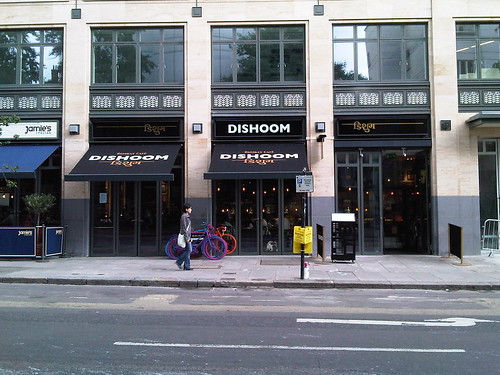
This is what I saw on approach to Dishoom:

Dishoom Irani Restaurant London

It is located not far from the tourist hell-hole that's Leicester Square and Soho, not a place you'd associate with good food. Still, as the genial proprietor informed me after allowing me to sit at a table for three (though I was alone), it helps to be close to the action when people feel a bit peckish after tramping about touristily.

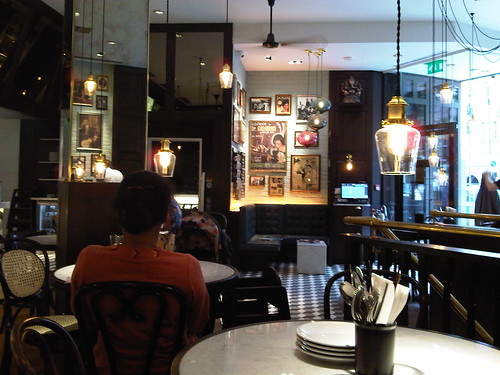
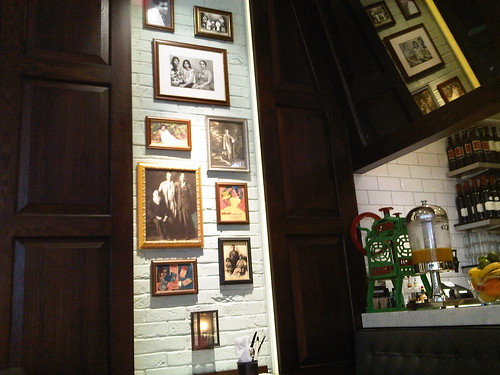
He insisted on an art deco interior, he added, because the Irani cafes in Bombay were established in the 30s. He pointed out the round tables, the brass fittings, the framed pictures of family (his wife's deceased father, his grandmother as a child and as a lovely young lady, and his aunts) and pictures from 1960s Femina and Illustrated Weekly of India. I perked up at the last. Where did he get those? Chor Bazar, he said. He even offered to let me take a few to photocopy, if I promised to return the originals.

Dishoom Interior Dishoom Interior

The nimbupani that arrived (once the proprietor had established that I was not in an alcoholic mood) was fizzy and lemony and altogether refreshing, although possibly expensive at £2.90. Shortly thereafter, I got a bunch of crisps - tangy and wafer-thin - with a selection of chutneys - tamarind, mint, and a strange garlicky concoction. The tamarind was rather good, sharp and soursweet with a crystal-sharp cut, the mint less so, and the strange garlicky concoction was spicy.

I must mention that homesick desis would be very pleased to have the Thums Up (refreshing cola!), which is also available here.

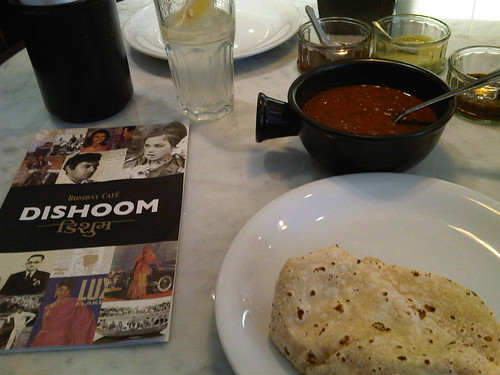
The waiters hustled about smiling broadly. They were a singularly friendly bunch. As I haven't been to an Irani cafe before, I wasn't really sure what to expect of the type of food available. Dishoom is not particularly innovative - everything on offer is available at pretty much any Indian restaurant. You know - kababs and tikka and that. But rumali roti is not widely available (the proprietor pointed out to me, adding that rumali roti (£1.70) and dal (£4.50) is the Fred Astaire & Ginger Rogers of Indian food), so I was game to try it here.

Dishoom Menu, Rumali Roti, House Dal

It wasn't half bad. The dal (despite the Guardian food critic's criticism) was very good, rich and buttery, lacking neither finesse nor depth. I polished it off in no time, and the proprietor materialised before me again.

We are striving for the 50s and 60s style, he said, including the music. (For some reason, an Atif Aslam song played soon thereafter.) You know, he said, Kabhi-Kabhi and so on. Isn't that a 70s film? I said. You are probably right, he said. What you need, I said, is jitterbug rock-and-roll from the 50s. Asha Bhonsle? he said. And Mohammed Rafi. I love Mohammed Rafi, he added, looking dreamily into the distance.

I followed his stare and realised he was non-verbally communicating with one of his staff, who hurried off to do his non-verbal bidding.

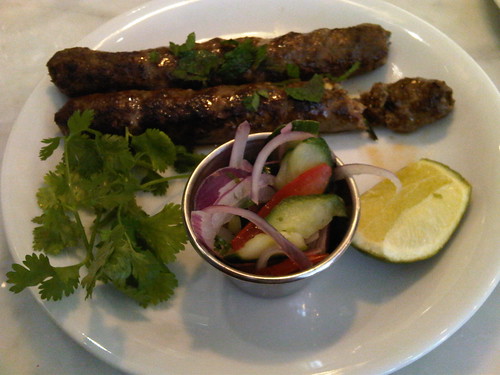
I ordered the sheekh kabab (£6.90) next, and it was very good, very tender, very juicy, and very quick to arrive at the table.

Dishoom Sheekh Kabab

Are you in the business? said the proprietor, just as I finished the last bit of the kabab. Er, I said, I work in finance? Not in the business, then, he said.

We discussed ways and means of the restaurant trade for a while as I pondered my next move.

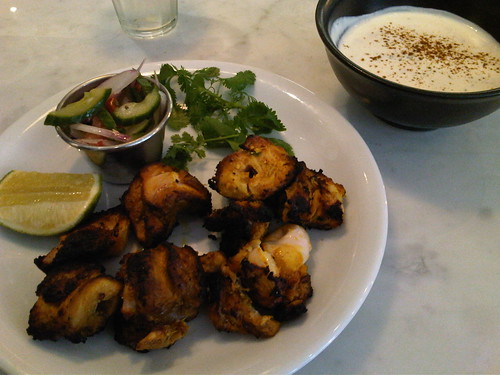
I didn't feel like having the king prawns, so I wimped out and ordered the Dishoom chicken tikka (£6.50). I was hungry, okay?

Dishoom Chicken Tikka and Raita

While I munched on the tikka, the proprietor stopped by one last time. He said he was leaving, and that it was good to meet me. I mumbled a pleasantry and he skedaddled.

The tikka was decent, and the raita (£1.90) was passable. I think a few more pieces of green chillies in it would have added that extra bit of Dishoom that I like.

I suspect I could have had a dessert, but I was running just a tad out of notches on my belt. So I paid and I split.

If they can keep the quality and cheerfulness up, I think they'll have a good run. I'll certainly be back in the near future.Dishoom on Urbanspoon

Aug 13, 2010

Whew

Right. So I just trickled out of that freakin' exam, and believe you me, it's going to be a close-run thing. Results out in a few days. Till then, nail-biting time.

Of course, a niggling voice* reminds me I'd have done well to have sat this exam months ago when doing little much at the previous job. I'm going to ignore that voice in keeping with the Japanese rule of just in time.

But it might all come back to bite me.

[*: the wife's]


What do you think of this sentence?
Ms. Ebadi is hardly afraid of jail, having spent time there, but she probably understands that what the West wants Muslim so-called moderates to say and to promote is merely a vision of a secular culture imported from the West, a vision that doesn't carry much weight with a people that is moving, albeit very slowly, to a democracy that is self-defined and that may not be recognizable to Westerners, accustomed to defining democracy as either liberal or not a democracy at all.
This is from Hooman Majd's rather good The Ayatollah Begs to Differ: The Paradox of Modern Iran.

Or how about this?
Although anonymity excuses the Persian from ta'arouf, and public speaking is the antithesis of anonymous behaviour, Ahmad Khatami and others who make such speeches are speaking on behalf of the nation (or the clerical establishment) and against another nation, and the collective 'we' makes them impersonal outbursts that some Iranian politicians today, with a sense of power that Shias haven't felt in centuries, believe appeal to the masses of their supporters who are more accustomed to being the downtrodden and oppressed majority of society than a people that can strike back against any injustice.
The book's full of sentences like this. Is it just me, or does Mr Majd expect a deep recursion stack in the brains of all his readers?

Aug 6, 2010

Heavy Sleep

One autumn, a young woman arrived in IISc from Calcutta, and handed out questionnaires to various unsuspecting students she found lazing about the campus. It consisted of rather detailed queries on the respondent's mental health, all couched in rather bland prose, and suggesting multiple-choice answers. I was one of the unsuspecting students, and - as the young woman was rather pretty - was among the earliest to hand in my answers.

Pleased with my alacrity, she told me she was investigating the incidence of suicide in the more cut-throat academic institutions in the country.

"Whoa!" I said. "Suicide? You didn't say anything about suicide."

"Well, naturally," she said, impatiently. "You understand I didn't want to bias your responses."

As she was rather pretty, I overlooked this jibe. And I sat hopefully at the same table as her in the mess hall for the next few nights. She ignored me for the most part, except to hand back the questionnaire after she was done with it.

"You'll be glad to know you don't show any suicidal tendencies," she said.

"And you know that how?" I said, huffily.

"These first few questions are designed to detect those with depressive or self-destructive thoughts," she said.

"Well, that's good to know," I said. "Can you pass me the sambar?"

"But you are prone to stress," she continued. She didn't pass me the sambar.

"Eh, what?" I said. "How?"

"You sleep a lot as exams approach. That's a classic sign of stress. Some people get insomnia. Others don't get out of bed."

"Well," I said. "Now that you know me so well, how about we go for this concert?"

Her eyes glazed over, and she turned away, and I didn't see her again.

Still, her analysis turned out to be both topical and trenchant. During my four years on campus, at least 3 or 4 people committed suicide every year; this in a population of fewer than a thousand students.

In his book, Feynman's Rainbow: A Search for Beauty in Physics and in Life, Leonard Mlodinow talks about the stress of being in Caltech, the university with the highest suicide rate in the US. IISc and the IITs are not that different. Academic pressure is a terrible thing, particularly among the brighter and more ambitious scholars. If it is not the intense competition among them, it is the stress of finding oneself caught short, or the severe insecurity that stems from fear of exposure as a fraud, or as someone who has no right to be in that academic setting. Mlodinow himself had received a fellowship to Caltech that allowed him to do whatever he wanted, and he found himself petrified with fear. He could think of nothing he wanted to investigate. He thought he'd be exposed as an impostor. Were it not for the coincidence of Richard Feynman in the office next door to him who ended up mentoring him not only in science but also in an attitude to life, Mlodinow might have burned out, or collapsed, or quit, or, worst of all, killed himself.

Fortunately for me, I was more self-satisfied than ambitious, unlike those unfortunates who took their lives. The sleep restored me from the stress, and I somehow passed the exams. But that Bengali girl's diagnosis has stayed with me. To this day, when I am under some pressure or the other, I begin to feel horribly drowsy. You'd think that knowing the cause of the drowsiness would help to mitigate it. Not on your life.

This summer, as I said, I'm busy swotting away for the IMC. And I am feeling somnolent all the time. Until Friday the 13th, therefore, you'll only hear snoring noises coming from this part of town. So keep your voices down, people.

Aug 3, 2010

Fielders To Watch?

To be invited to speak at the International Congress of Mathematicians is a great honour, and to be forty years of age or younger is doubly impressive, for it means that you might be very well in with a chance to win the Fields Medal. I thought I might scan through the list of speakers at the ICM 2010 site and see who the young guns are. In particular, I thought I'd focus on the women.

Now, at the absolute top rank of mathematics, there have been historically very few women. Think about this: between the first ICM and the first address by a woman, almost 30 years passed. Then another 60-odd years went by until Karen Uhlenbeck spoke at ICM 1990.

Fortunately, though, this is all changing. And so it is heartening indeed to see women's names pop up in this list. Even more wondrously, these young scientists are not restricted to the traditional powerhouses of mathematics - Russia, France, USA. You'll find Iranians and Spaniards and Taiwanese as well.

So here goes.

Maryam Mirzakhani: this mathematician from Iran, now based in the USA, is doubly honoured - she addresses a session in Topology as well as Dynamical Systems. Like several previous winners of the Fields Medal, she was very successful in her youth at the International Mathematics Olympiad. More recently, she was awarded the Blumenthal Award (2009), which is awarded quadrennially, and is for the best PhD thesis published in preceding four years. Her work - among others - is in the geometric structures and their deformations in all sorts of spaces, and she brings in an interdisciplinary approach to solving problems in the field, by using insights from combinatorics and mathematical physics.

Irit Dinur: is a theoretical computer scientist from Israel, where she has been working on problems in proof theory - how to establish formally that a proof is correct? In particular, by making random inspections of a formally written-out proof, is it possible to verify it? This is a deep problem in theoretical computer science, with a fundamental result (that it is, indeed, possible) established in 1992. She was able to establish a much simpler and radically new proof of this theorem in 2005, which has resulted in fresh pastures for investigation. As we know, it's not enough to solve a problem - what's better is to do so in such a way that a whole new domain of research opens up, with exciting new possibilities. Dinur has done this with aplomb. And so there's some gossip that she might win the Rolf Nevanlinna Prize (which is also awarded quadrennially at an ICM) for the applications of mathematics in the information sciences.

Sophie Morel: is from France, and her PhD thesis was an important development in the Langlands Program, solving a problem that had remained open for over twenty years. (You may recall that Laurent Lafforgue won the Fields Medal in 2002 for his contributions in this area.) This is cutting-edge work at the intersection of number theory and algebraic geometry. She was made a full professor of mathematics at Harvard last year, a notably rare and distinguished achievement made especially so when you realise that she's the first woman to be tenured in mathematics at that university! To boot, she is a skilled polyglot, conversant in French, English, Russian, German, Spanish, and now learning Korean.

Chiu-Chu Liu: is a mathematical physicist from Taiwan. She, again, is a multidisciplinarian, combining techniques from topology, differential geometry, and algebraic geometry to answer open problems in theoretical physics. In particular, her work in establishing the Marino-Vafa conjecture has been well-recognised. This has deep ramifications in string theory.

Anna Erschler: is a Russian mathematician based in France. Along with Mirzakhani, she too has two addresses at the ICM (Probability and Geometry). Her work is at the conjunction of probability and group theory.

Isabel Fernández: is a Spanish professor of mathematics at the University of Seville, and has received much attention in her native country for being the first ever Spanish woman to be invited to an ICM. Her work has been termed, loosely, soap-bubble geometry, because she investigates the geometric properties of curved objects. It is at once a classical field in mathematics, but equally cutting-edge, combining results from differential equations, complex analysis and variational calculus. Interestingly, her work has found immediate practical application in architecture, notably at the Olympic stadium in Munich, where surfaces she studied have been found to be light-weight, use little by way of materials, and are notably resilient. And, having solved one of the open major problems in the field - minimal surfaces in homogeneous spaces - the invitation to the ICM celebrates her achievement (to be sure, with her colleague Paul Mira).

Catharina Stroppel: is a German mathematician, winner of the 2007 Whitehead prize for her work in representation theory and its applications to low-dimensional topology.

Marianna Csörnyei: is Hungarian, another Whitehead prizewinner (2002), and works in geometric measure theory. "Central to her work is the analysis of viable definitions of ‘negligible’ in the context of infinite-dimensional situations, with a view to applications in non-linear geometric functional analysis. Technically difficult, the judges described her work as characterised by the ‘startling nature of many of her results’. A particularly ‘spectacular achievement’ highlighted was her proof that the three main notions of ‘negligibility’ coincide, and her revelation of delicate phenomena in the theory of Lipschitz quotients even in the finite dimensional case." (from here)

Nalini Anantharaman: is French; her work is in mathematical physics, and she attempts to answer questions about the phenomenon of dispersion: "A wave propagates in a closed cavity. It will bounce off the walls. I'm trying to understand how it will dissolve: will it remain compartmentalized, contained in a portion of the cavity or will it be dispersed throughout the cavity?" (from here) One of her major contributions is in quantum chaos, where she established some results supporting the Quantum Unique Ergodicity Conjecture.

Katrin Wendland: is German; her work is in mathematical physics, particularly in the nature of particles. Notably, she "constructed a large class of examples of mirror symmetry using orbifold methods and Kummer K3 surfaces" (from here) Her research also unfolds deep connections between non-commutative geometry and algebraic geometry, and she has many contributions in topological quantum field theories.

Dorit Aharonov: is an Israeli computer scientist. In 2005, she was profiled in Nature. One of her major achievements was to show that even in the presence of interfering noise, a quantum computer could still achieve reliable results. Because quantum computers require considerable isolation from their surroundings (the 'quantum processors' should not interact with their surroundings, or the resultant errors will rapidly degrade the computation), it was thought that these would remain theoretical curiosities. Her work in quantum error correction went a long way in establishing the domain as technologically viable. In addition, she has worked in the quantum scale problem - why do quantum effects manifest only at subatomic levels but appear to vanish at human scales? "Aharonov showed that for many noisy quantum systems, there is a level of noise above which a transition to classical behaviour is inevitable. Such transitions are much sharper than expected from other theories that predict a gradual shift away from quantum behaviour."

Hopefully, at least one of them wins the medal.

The third meeting

Venue – Independent University of Moscow. November 2002.

There were three of us in the meeting with Laurent Lafforgue, with the interpreter Darya Sisoeva helping out.

OO: Monsieur Lafforgue, you are well-known as a patriot of French culture and language. You know several languages, including Russian, and have always defended the right of mathematicians to communicate in scientific circles in their native tongues. This position – is it the result of reflection, or a fruit of family upbringing?

LL: Since childhood, books have been the most important part of my life. From early on, I began to read not only French but also Russian literature. In fact, till I was about twenty years old, my main occupation was literature. I was also interested in history, which kindled in me an interest in other cultures. I didn’t plan on taking up mathematics as a career. I had a very good education, and I had a wide ranges of choices on what to do next. But I’m Parisian, and I wanted to remain in Paris, and so at the age of 19, I joined the École Normale Supérieure– the best school for mathematics and physics, completely unaware of my future career as a researcher. Only in the second year did I realise that I was attracted so much to mathematics. I began to read the works of Grothendieck – he is a French mathematician, and founder of algebraic geometry. That’s when I began my interest in algebraic geometry, because I found in it the sort of beauty that had always appealed to me in literature. I have always thought that in mathematics there’s a deep link to literature, just as with history. After all, mathematics is a collective endeavour. And if I count for something in mathematics, then surely I count for something in the historical process as well.

OO: Is there anyone you would like to share your success with?

LL: Certainly. There are people who supported me in my most difficult moments. In addition, having spent six years at University and in graduate school, when I was unable to write my thesis, I was admitted into a research group with some fellow investigators. Still, for two years I had no serious results to show. I was getting paid, but I just couldn’t complete my dissertation. This wasn’t the best time of my life. But the head of my group, Luc Illusie, not only believed in me but also took charge of my situation, and offered to change my supervisor. Now I understand that I just wasn’t interested in working on old themes. If you don’t like what you are doing, you can’t come up with any beauty in your work. Thus I got a new supervisor, Gerard Laumon,  who then took charge of my fate.

He gave me a new topic, and things improved – I began to get good results. My supervisor, despite being a famous mathematician, took a lot of interest in me, uncaring of his own time. I owe him personally no less than I do professionally.  And the next topic, the one for which I won the prize, was one he founded. But even here, things were not simple. I worked on the subject for six years, and as my research concluded and I began to present expository lectures on my work, I realised that I had somewhere along the line committed an error.

This was a deeply tragic moment in my work, because the error cast doubt on my entire research. I have to say that at that time not only my supervisor, but also all my colleagues at University understood the gravity of the situation that I found myself in, and all of them supported me. All of them.

OO: Are you from an academic family?

LL: My grandparents were uneducated, and my parents are physicists. I have two younger brothers, both of whom are mathematicians. One is a researcher, and the other a teacher.

OO: In earlier times, during the USSR, there were widely distributed scientific family dynasties. Following a career in science didn’t bring much by way of material gain, but much honour and respect. But in the last fifteen years, the situation has changed dramatically. How does a mathematician feel about himself in France? Is there a problem of ‘brain drain’ in your country?

LL: French scientists receive good money, albeit less than in the US, but overall they do lead good lives. Importantly, in France we have very strong mathematical schools and many famous universities. There isn’t much of a brain drain because the majority of French mathematicians want to work in their own country. Nor is there much unemployment because there are lots of places open to researchers. So we have not only Russian mathematicians visiting us, but also Americans. They are happy to lose monetarily because they are attracted by the high scientific level.

Undoubtedly, France has not been unaffected by the changes that have occurred throughout the world: the undervaluing of intellectual capability. Our youth prefers to entertain itself. They prefer sport or show-business, anything other than science. And that’s a pity. Young people do not want to occupy themselves with anything intellectual because there are no guarantees of any material fortune. But I have always sought beauty. In the beginning, in literature and poetry, then in history. I realised very late that in mathematics too there is an equal beauty. If you work in the fields of scientific discovery, this is always interesting. I felt this most keenly in the university when all around me were so many bright people, all of whom were inventing, discovering something new.

OO: In Russia, we have a joke: “An American university is where Russian instructors teach mathematics to Chinese students.” Don’t you think that in coming years, Russia might stop supplying mathematical brainpower, and the arena will be left open to that other scientific superpower, namely China?

LL: Of course, having been in Beijing, I am able to assess the level of state support for science. But I think such pessimistic forecasts are premature. In Russia, despite the poor funding for science, mathematics cannot really die out – after all, for seventy years, the Russian school has been the strongest. And other countries, too, won’t let Russian mathematics die out. For example, the Independent Mathematical Institute where we are now has been financed by the US.

OO: Our interview with Vladimir Voevodsky ended with his apocalyptic predictions about the future of mathematics in general as a fundamental science. In this regard, are you an optimist or a pessimist?

LL: As you prefer… Voevodsky is a representative of the American mathematical scholarship. That is a completely different world; true, they are paid a lot, but intellect in the US has never been particularly valued. My prognosis is more optimistic. Science with such a long history cannot die, and people will continue their researches. On my own part, I have two themes that will over the next thirty years interest a lot of people.

OO: Are you ready to return to this debate in thirty years?

LL: If we live that long.

[I translated loosely from Olga Orlova's piece on Polit.Ru. It appears that in 2002, when she first wrote it up to link with the International Congress of Mathematicians at Beijing, the journal that had commissioned it, 'New Model', went out of business without publishing it. She and her editors decided that the content was still relevant in 2006, when the Perelman story was appearing in the world's press in the run-up to the ICM in Madrid. The previous parts are here and here.]