JOST A MON

The idle ramblings of a Jack of some trades, Master of none

10.31.2010

E Block

A few years ago, I wandered over to the Indian Institute of Science. It had been quite a while since my previous visit, and one thing struck me at once: E-block, the hostel that I had been allotted when I first joined the place, was now painted an absolutely disgusting brown,  reminiscent of toilet water. I could only hope that the interiors were in much better condition, in an inverse relation to the exterior. Twenty years ago, the exterior was vaguely welcoming; the inside was, frankly, dire.

As incoming M.Engg. students, we were the lowest of the heap. Research students got rooms to themselves. We had to share with a fellow Masters type. My room-mate was a particularly enthusiastic interior decorator. Unhappy with the distemper on the walls, he said we should stick brown paper on the walls. You know, the shiny sort that we used to wrap notebooks in primary school. We did this so well that our neighbours came around to admire our handiwork. Indeed, our room looked very fetching. And once I put up my poster of Rachel Reuben (wasn't that one hot woman? I think so), I was all set for my first year of engineering.

The room was spacious enough for two wooden tables, two wooden chairs, two wooden beds. I think there was an almirah as well. Or at least there were shelves built into a wall. There was a window with a view to an untended garden. There was a ceiling fan with multiple speed settings; at the highest speed, the wind generated probably came in at Force 10.

In a couple of days, the wind from the fan blew away the wall-paper. As the paper pulled off the wall, chunks of whitewash came with it. We pushed the paper back on, using thumbtacks to hold it fast. The fan then began to yank the pieces of cement from the wall. We spent our evenings studying and ducking flying thumb-tacks. Scarcely days after our decorated room had been the cynosure of all eyes, it began to look like something out of a horror film. Large gouges on the walls. Violently flapping paper. Guests cowering under the bed to avoid being blown out of the window.

But the greatest shock was the state of E-Block's bathrooms and toilets. Although cleaners washed the facilities frequently, the filth generated by a hundred uncouth men was difficult to shift. When one resident fell ill (of a urinary tract infection, as it turned out) and was admitted to the clinic, we wondered if it was because of the dirty conditions in the bathrooms. 'Unlikely,' said the examining doctor,' Unless he is in a habit of rubbing himself against the surfaces.'

We couldn't put that sort of behaviour past some of the people who inhabited E Block.

People would turn up in hostel drunk and puke in the bathrooms. One worthy even managed to seat himself on a urinal and take a dump and fall asleep on it. Another woke up in the middle of the night - for some reason on the floor of my room - and pissed into my shoes. The cleaners were a decidedly harried lot that day.

Some subhumans often left the toilets unflushed after use, the stench slowly spreading across the  two floors of the block. Pie dogs ran in and out of the hostel, as some idiot or the other fed them, after which they'd proceed to relieve themselves right by our door. 

When it rained, the floors became so slippery that walking on them was akin to ice skating. Inevitably some drain or plumbing would fail in quick order. There'd be no water for showers, so we'd have to hike to the nearby hostels. The facilities in the A, B, C, D blocks were the closest; two rows of toilets and showers for each pair of letters, situated midway between the blocks. So we called them (A + B) / 2 and (C + D) / 2. More senior students lived here in their palatial single rooms, but they weren't noticeably cleaner than the denizens of E Block.

Mosquitoes were a constant menace. Too cheap to buy the electric pad that heated the little mosquito-repellent tablets, we'd instead put the tablet on the incandescent bulb of a table-lamp. The sudden shock of the ensuing aroma would drive the little critters wild, and we'd spend a few minutes bashing them into the nearest surface. Artwork Jackson Pollock would be proud of sprouted on the walls.

One morning, I woke up with bumps all over my skin, feeling extremely itchy at that. Inspection of the bed revealed nothing untoward. Wondering what I had suddenly become allergic to, I spent the rest of the day scratching.

A friend was quick to point out the cause of the itch. 'Bed bugs!' he said happily. 'Wooden bed? There's probably civilisations of them living in it.'

'How do I get rid of them?' I said, suddenly panicked.

'You don't,' he chuckled. 'Ask the estate chaps to replace your bed.'

The Estate chaps didn't oblige. A quick call to my dad elicited a suggestion - try pouring hot water all over the bed, he said. I did, but still unconvinced, I sprayed a strong insecticide as well. It was strong enough to drop lizards off the wall, and even Rachel Reuben wilted under it.

That appeared to do the trick, and I remained bed bug-free for the rest of my stay in E-block.

Basakovich, though, had remained oblivious of the bed-bug plague throughout his four years of life in that hostel. When I mentioned to him that he might be assailed nightly by blood-suckers, he said they never bothered him. 

'What do you mean?' I said. 'Don't they bite you? Don't you wake up feeling all itchy?'

'Now that you mention it,' he said, 'I think I've occasionally felt a tickling.'

I looked at him incredulously.

'What?' he said. 'I thought that was the hair on my chest growing.'

10.28.2010

Affordable Art Fair

Twice a year in Battersea Park is held the Affordable Art Fair. This is a large exhibition of artworks for sale – paintings, sculptures, photographs, lithographs, alethiometers. It is quite popular. The wife’s been wanting to add to our notable collection of art (psst: Christie’s? Lots of good stuff here. Signed even.) for a while, and so we hied thither on Sunday.

What with the transport disruptions that are so common on weekends in London (and weekdays), it took us a little while to get to Battersea Park. The last time we were there was when the little tyke was three or so years old. We’d taken him to the Children’s Zoo there, where he was more fascinated by a parked fire engine than the meerkats and ostriches. There’s even a Pagoda of Peace there. Quite the landmark.
004
On Sunday, the place was packed. I thought the crowds were mere gawkers, but people were actually buying stuff. The Fair’s USP is that artworks cost less than £3000. Of course, the good stuff is cunningly priced at £2995. Wa-a-ay over my budget – though clearly not over many people’s.

And so there was barely enough space to move, let alone carefully appreciate the exhibits. An occasional punter fainted and was whisked away by burly watchmen, only to reappear in moments to add to the tumult. We crawled along rows and aisles gasping for breath. Every chance I could – which was all too rare in view of the fracas – when something or the other caught my eye, I wielded my camera to great effect.

The pieces - all for sale - were from as far away as North America and East Asia. Most of the productions were European, but it does appear that the appeal of this semiannual festival is spreading around the world.

There are instances of this marquee in other cities in the UK and on the Continent. My friend Ray went to the one in Paris a little while ago. Unlike the London exhibition, the French one was barely attended. He surmises that the French consider it infra dig to be seen at a venue that touts itself 'affordable.'

Anyway... I realise now I should have carried a pencil and a piece of paper to identify all the artists, eh?

001 
002
 
005007
  006
008

It turns out that the strong oral tradition of communicating knowledge in India resulted in various mnemonic tricks to keep track of large numbers in multiple ways. In Kim Plofker's Mathematics in India: 500 BCE-1800 CE is a discussion of Bhūtasaṃkhyā, a method of representing a number by an object that 'exist[s] in that number'. And so one could communicate mathematics in verse form, as Madhava of the Kerala School is said to have done:
Gods, eyes, elephants, serpents, fires, three, qualities, Vedas, nakshatras, elephants, arms: the wise have said that this is the measure of the circumference when the diameter of the circle is nine nikharvas.
There are 32 33 gods in the standard pantheon; two eyes and arms; four Vedas, eight elephants and serpents; three kinds of ritual fires; three gunas (or qualities) in the world; twenty-seven nakshatras (or constellations like the Zodiac); a nikharva is 1011; and the numbers are all indicated in increasing order of place-value.

So we can compute:


which is good to 11 decimal places.

Reference:

1. H.S.White, "Review of Kim Plofker, Mathematics in India", The Mathematical Intelligencer, Volume 32, Number 2, 2010.

10.26.2010

False Currency

Saw an interesting headline in the Zambian Post recently. 'Rupiah is a lair, Sata tells Mpulungu residents', it said. Got me thinking. Are Zambians investing in Indonesia? Does Mr Sata think that the Indonesians are up to no good? Will they, heavens above, devalue their currency? And why does he say 'lair'? Does he mean that that's where the unwary end up?

That's the problem with working in the foreign exchange markets. Everything one sees is coloured through an exchange rate prism. Fortunately, a quick perusal of the newspaper content disabused me of any foreign exchange related notions. 'Lair' was a typo. That should have read 'Rupiah is a liar.' And, of course, Rupiah is the first name of Mr Sata's opponent at the Mpulungu parliamentary by-election.

Mr Sata added, "I am younger to Rupiah Banda by only six months but I am honest."

10.25.2010

Warming

One of the advantages of working at a company with a strong bent towards sustainable and responsible investing is that we can get to hear of interesting products and innovative outfits that our company might want to invest in. We also get to listen to interesting speakers once in a while. The most recent interesting speaker was Professor Chris Rapley, chief Mugwump of the Science Museum, and head honcho of the British Antarctic Survey.

He came to talk to us about Climate Change, the facts and the interpretations, the factions and the policking. A good time was had by all.

Here's a quick summary. The good professor pointed out that

  1. the facts about global warming are not in dispute, but only (mis)interpretations by various vested interests.
  2. even those who supposedly agree with global warming, e.g. Greens, do not necessarily support the hard choices required to lessen the impact of greenhouse gases (e.g. nuclear power).
  3. both parties - Deniers and Believers - often have identical rhetoric as regards solutions, but will just not listen to each other because of fundamental biases.
  4. energy costs are roughly 5% of world GDP because gas/petroleum is so cheap; any replacement available now will require maybe 20% of world GDP to provide the same amount of energy, so unless radically cheaper methodologies appear, there's little possibility to switch out of polluting fuels.
  5. to get public attention to the problem, it's not enough for scientists to talk loudly and slowly as if to slow foreigners, but to get public figures involved in communicating the issues.
  6. people need to think outside of their own immediate experience to realise that 'average rising temperatures' doesn't mean that temperatures will be rising everywhere: last winter was colder than the average in Western Europe and the eastern seaboard of the US, but at the same time, most of the rest of the planet was having much warmer times.
I asked him if there were times in the Earth's history when global average temperatures / carbon dioxide concentrations were higher than they are today. He said shocks similar to our own effusions (about a trillion tons of CO2 since the dawn of the industrial age) have occurred before. For instance, about 65 million years ago, there was a supervolcanic eruption somewhere in Siberia that released similar amounts of greenhouse gases, resulting in spikes in global temperatures that lasted several thousand years. That fact by itself, he said, should convince anyone who denies that today's CO2 levels pose no warming threat. The recovery from those temperatures, too, took longer than human timescales, so we shouldn't expect to get out of this unscathed. The societal tensions and pressures alone will be beyond anything we've encountered before.

All in all, an intellectually enlightening and emotionally depressing presentation.

10.20.2010

Refined

There are clannish folks in India, and then there are seriously clannish folks. The Bengalis are seriously clannish. There are tales told of not only how they not only congregate and ignore all others, but also how they can sense vibrations in the space-time continuum that help them identify a fellow Bengali in the vicinity. And then they talk to each other in that most polished of tongues, and all bystanders are left to marvel at the ways of the Bengali world.

And then there are the refined Bengalis - that is, those Bengalis who didn't study in Bengal - and so acquire a sort of polish that enables them to communicate unflinchingly with non-Bengalis for more than a couple of hours at a time. My friend Ganguly, though, is a doubly refined Bengali because he grew up in Assam and went to school in Delhi, and he was able to spend weeks, nay, months, without a word of his mother-tongue escaping his lips. That is to say, he spent most of that time with us uncultured boors speaking Hindi and English and even essaying the odd expression in Kannada.

But even he would succumb to his internal Bengalishness every Dussehra, and he would repair to the Uttoro Bongoloro Bongo Somiti to accompany a Rabindra singer with a tabla, and feast on some mishti-dohi, and revel in his Bengaliment, and recharge his Bengalic batteries so that he could tolerate us for another year.

One year, though, he committed a faux-pas of such staggering proportions that it very nearly derailed the career of a stellar Bengalic singer. After having drunk far more sugarcane juice than was healthy for his bladder, he abandoned his tabla and rushed out of the hall and ran up to the front desk and panted, "Bher ij the taayilet?"

Well, actually he didn't say that, because he said the equivalent in Bengali, as shuddho Bengali as you can prefer, and the lady behind the counter reeled in shock at his staring eyes and strained expression, and drew herself haughtily, and pointed in a random direction and said, 'Obher der."

No, no, she didn't actually say that; she replied in chaste Bengali, and as Ganguly was rushing off, it dawned upon him that it was not just any lady, not even any Bengali lady, but that nightingale, that doyenne of pop, that mistress of alto, Usha Uthup, whom he had so unceremoniously inflicted with his desperation.

By the time he had drained the equivalent of the Niagara and returned to the front desk to apologise, Usha Uthup had disappeared, never to be seen again in that part of town.

Well, we say she never appeared in Bangalore again because it suits us to say so, and Ganguly was filled with remorse, especially when we pointed out to him every Dussehra that she never sang again.

I'm pleased now not only for Ganguly but also for that great diva, that she has found it in herself to recover from that terrible experience. I saw her singing with her usual gusto and customary power and panache at the Commonwealth Games closing ceremony, and by thunder it was good. 

Ganguly, my man, your sins are forgiven. You can smile again.

10.17.2010

Vegetarian Genius

In medieval Europe, the only people who were vegetarians were most likely the destitutes. It was a matter of taste and honour for everyone to eat meat, and the Catholic among them saw no point in wasting any part of an animal. On the days that the Church prohibited the consumption of meat, the populace got around it by eating fish. And there were always festivals that allowed the indigent to get their share of meat. Even the great Carnival, that great orgy of gluttony ahead of the abstinence and fasting and piety of the Lent, was named so from 'carne vale' - farewell, meat.

There were few people in other words who, of their own accord, preferred to be vegetarians.

St. Francis of Assisi was likely one of them (set caged birds free and all that). Another was Leonardo da Vinci.

By the time Leonardo was in his fifties, he had spent decades eating only fruit, nuts and vegetables. His exposure to the horrors of war rendered him extremely sympathetic to any sort of pain, and he considered it a sin to harm any living creatures. Unlike others of strong conviction, though, he didn't force the view on his followers, and he paid out enough of his hard-earned cash to keep his dependants well-fed with meat.

But his vegetarianism - as his genius - became widely known. Praise came - would you believe it - from as far away as India, from where a Florentine traveller named Andrea Corsali wrote:
a gentle people called Guzzarati who do not feed on anything that has blood, nor will they allow anyone to hurt a living thing, like our Leonardo da Vinci.
Reference

Peter Strathern, The Artist, The Philosopher and The Warrior

10.12.2010

Justice!

A friend of mine, L., was a witness to a crime a little while ago. A fellow was attempting to burgle a house, and when the owner resisted, he chased the poor man down the street, brandishing a broken bottle, intent on cutting him up. My friend made a statement to the police when they showed up, and they asked him to be a witness when the case appeared in court.

He went to the Crown Court yesterday. As he waited in the witnesses' area, a court official sidled up to him and said that they had lost his statement. A little while later, the court official sidled up again, and said that the chief witness for the prosecution - the victim of the crime - hadn't shown up.

While my pal cooled his heels wondering what would happen next, a little fracas broke out. After much shouting and swearing, a fellow was seen being led back to the cells by a couple of burly cops. It turned out that that was the son of the alleged burglar, serving in the chokey for some other crime. Quite a family, what? As he had the same name as his father, he had been mistakenly brought forth into court. The court waited while he was returned to the cell and the father was brought in.

Presently, our man L. was allowed to leave. By this time, he was heartily sick of the whole affair and wondering why he had bothered to involve himself in it.

Today he got a text from the police that the main witness had left his residence nearly four months ago. Nobody bothered to inform them, I guess, and being swamped with other cases, they probably had had no time to follow up.

I wonder what will happen next. Will the burglar be released? The police were very keen to see him behind bars - he was a known villain. They must be gnashing their teeth in baffled fury.

Surely only us Third World types have to endure such glorious messes by the prosecution? I have to say - Great Britain at this rate will not too long remain very great.

10.10.2010

Squaring the Circle

It appears that a man called Albert of Saxony wrote a little treatise in 1350 consisting of various proofs and assertions on the possibility of squaring the circle. His book was called Quaestio de quadratura circuli (Question on the Quadrature of the Circle), and he made some pithy observations such as the following:

If there could not be given a square equal to a circle, it would follow that there would take place passage from "greater" to "lesser," or from extreme to extreme, through all the means without ever arriving at "equal" or "middle." But this is false. Therefore, I prove the consequence. For let there be one square inscribed in a circle and let this square begin to be continually and uniformly increased until it becomes larger than the circle. If, therefore, it was at some time equal to the circle, we have the proposition; if not, then passage has been made from "lesser" to "greater" with respect to that circle without ever arriving at "equal."1

Now I won't claim that this is absolutely rigorous, although it's fairly clear that if you assume that a square can be stretched continuously, then a square inscribed in a circle will at some point exceed the size of circle, and a fundamental consequence of continuity is that it will do so without any sudden breaks. So, in fact, there is a square with exactly the same area as a given circle.

We know this is true. If the area of a circle with radius r is pr2, then the side of the square with the same area will be r√p. Every real number has a square root, so we are good here.

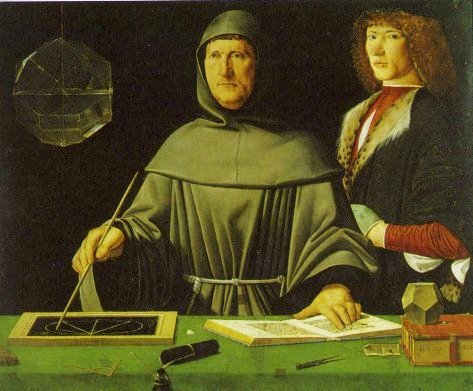
Luca PacioliThe question that Albert was hoping to answer - I suspect - was the long-standing one of if it's possible to construct the equivalent square using only a straightedge and a compass. This was one of the classical problems of mathematics, known as far as back as the Greeks (Archimedes had provided an incorrect solution), and possibly even earlier.

A century or so after Albert, Leonardo da Vinci put his fecund imagination to the problem. He had constructed very clever mechanical means for squaring the circle,  but as his friend (and math teacher) Luca Pacioli pointed out, these were mere approximations, and not true constructions. In fact, they were not even original. Stung by this criticism, Leonardo (sometime in 1503) decided to solve the problem once and for all. From his notebooks, it is evident that he had spent time before this on the issue, trying out one mechanical method after another. That night in November, however, he resolved not to get up from his desk until he had settled the question.

It is possible to trace Leonard's series of ingenious and beautiful designs, as he tried to improve upon Archimedes' faulty solution - until he finally cracked it! In the margin he records the exact time of his discovery:

“On the night of St Andrew's Day I eventually finished squaring the circle: by then my candles were finished, the night was finished, and so was the paper I was writing on. This conclusion came to me at the end of the final hour of the night.”

Alas, he was deluded.2

The reasons for his failure (and the failure of every other mathematician or charlatan who attempted it (and continue to do so to this day)) were to become apparent only 400 years later. In 1892, Lindemann proved that p is a transcendental number. In other words, there is no algebraic equation that has p as its root. Every straightedge-and-compass construction can be translated into an algebraic equation. Therefore, there is no straightedge-and-compass construction that squares a circle.

References

1. Mathematical Intelligencer, Volume 1, Number 3, 1978/79.

2. Paul Strathern, The Artist, The Philosopher and The Warrior, Vintage Books, 2010, London.

3. Tom Pastorello, Leonardo Squared The Circle! – Da Vinci’s Secret Solution in the Vitruvian Man Decoded,

Three and a half years after the little imp first went to nursery, he is firmly ensconced in the world of academia. He is surrounded by as many kids during the day as he is by himself the rest of the time. All that socialising has resulted in a tyke with as much Social Intelligence as one can want. He connives and manipulates and ingratiates with the best of the Borgias now.

Still, there are lessons to be learned. He cannot take rejection. If he finds a bunch of kids unwilling to play with him, he insists on piling on, and drops those who are happy in his company. We figure he'll get this behaviour beaten out of him in short order. The last time he tried this insinuating stunt with two little girls, they merely raised their eyebrows in magnificent disdain (which gesture eluded him completely) and proclaimed him 'irritating.' With the boys in his class, it usually ends in a lot of pushing and kicking. Boys are very direct, I find. 

We've told him not to pile on. It took me thirty years to learn this lesson, so I'd like him to benefit from my vast experience. We advised him not to play with the chaps who are not nice to him. He doesn't always listen to our advice.

At first it was all about immediate gratification: 'But I want to play with them.' 

These days it's about improving their souls: 'I want to make them better.'

Clearly we've got some sort of social progressive in our midst. An early left-wing type, if you will. I don't think little boys are particularly liberal, though. This kind of idealism will also get thrashed out of him, and we'll have a proper little conservative among us. 

Ah, yes. He'll begin life with cynicism. It's the only way.

10.02.2010

Clybourne Park

We went to see Bruce Norris's play Clybourne Park at the Jerwood Theatre Downstairs today. It is an exploration of old-time racism, and modern-day racism, and considers the meaning of 'community.' Is a community a bunch of like-minded neighbours who watch out for and support each other? Or is it a mix of suffocating mores and mutual espionage that keeps people in line and chokes back resentments?

This play in two parts deals with two time periods - the first, in the 1950s, deals with a white family moving out of their suburban home in Clybourne Park, an all-white neighbourhood. They have sold their house to a black family, and when the neighbours find out, they want to persuade them to sell it to the church instead (at least I think it's the church). The man of the house is on knife-edge, apathetic at one moment, and apoplectic with rage at the next, while his wife, a high-strung woman with a laugh that grates on every nerve ending, tries to keep him calm. It gradually emerges that their son, a Korean War veteran, had committed suicide two years earlier, and they had never quite healed from that loss. They had received no support from the 'community' during those harrowing times, and now, when that self-same community wants them to stop the black people from coming in, they can scarcely hold back their tempers.

In the second half, the same area in the present day is mainly a black neighbourhood, and a white couple wants to move in as it gentrifies, and aims to do some conversions to a derelict-looking house (which, as it turns out, is the same as the first one we saw). A black couple, representing the neighbourhood association, is not very pleased about their rebuilding plans, thinking it clashes not just with the architectural style of the area, but also its 'history' - namely that of the African Americans who had settled there in the past half-century. The argument for and against the renovation quickly ramifies into name-calling, the issue of race, and the resentments that both whites and blacks feel in modern America.

This is a play that is filled with dark and corrosive wit. There is one particular set-piece when the characters aim to show each other that they are not offended by stereotyped humour by angrily crunching out increasingly vulgar and poisonous jokes that target whites and blacks and, then, in a sudden twist, women. But it also has moments of quietude and stillness. When the father of the dead soldier realises that he can submerge his anguish by getting out of the house to work whereas his wife is always left behind at home with nothing to distract her, the incoherence of his suggestions to her starkly expose his isolation and loss of empathy. While he drowned in his grief, it never occurred to him that his wife was in equal sorrow, and that moment of realisation is one of grace. 

At other times, the rest of the characters all appear far too self-possessed and fluent in their mutual recriminations. All sorts of ill-feeling has lurked in the breasts of the residents of Clybourne Park, both in the past and in the present. Bruce Norris is skillful in revealing the divisions that pervade the intellectual discourse on race and modern life. That he does it without taking sides or being didactic is particularly satisfying.

[Catch it while you can at the Royal Court. It's moving to the West End in a couple of months, and you'll be paying twice as much for the privilege.]