JOST A MON

The idle ramblings of a Jack of some trades, Master of none

I'm pleased to report (apropos nothing) that Jerome K. Jerome, author of the utterly delicious Three Men in a Boat, to Say Nothing of the Dog!, shares his birthday with me, and that fact alone prompts me to excerpt the following passage, where the impetuous and impatient Harris is desperate for a drink.
I pointed out to him that we were miles away from a pub; and then he went on about the river, and what was the good of the river, and was everyone who came on the river to die of thirst? 
It is always best to let Harris have his head when he gets like this. Then he pumps himself out, and is quiet afterward. 
I reminded him that there was concentrated lemonade in the hamper, and a gallon jar of water in the nose of the boat, and that the two only wanted mixing to make a cool and refreshing beverage. 
Then he flew off about lemonade, and "such like Sunday-school slops," as he termed them, ginger beer, raspberry syrup, etc., etc. He said they all produced dyspepsia, and ruined body and soul alike, and were the cause of half the crime in England.
As I love this book so much, and because it's not just drink that drives people to distraction, I point out that another friend of the narrator had the following experience:
Another fellow I knew went for a week's voyage round the coast, and, before they started, the steward came to him to ask whether he would pay for each meal as he had it, or arrange beforehand for the whole series. 
The steward recommended the latter course, as it would come so much cheaper. He said they would do himfor the whole week at two pounds five. He said for breakfast there would be fish, followed by a grill. Lunchwas at one, and consisted of four courses. Dinner at six − soup, fish, entree, joint, poultry, salad, sweets,cheese, and dessert. And a light meat supper at ten. 
My friend thought he would close on the two−pound−five job (he is a hearty eater), and did so.
Lunch came just as they were off Sheerness. He didn't feel so hungry as he thought he should, and so contented himself with a bit of boiled beef, and some strawberries and cream. He pondered a good deal during the afternoon, and at one time it seemed to him that he had been eating nothing but boiled beef for weeks, and at other times it seemed that he must have been living on strawberries and cream for years. 
Neither the beef nor the strawberries and cream seemed happy, either − seemed discontented like. 
At six, they came and told him dinner was ready. The announcement aroused no enthusiasm within him, buthe felt that there was some of that two−pound−five to be worked off, and he held on to ropes and things andwent down. A pleasant odour of onions and hot ham, mingled with fried fish and greens, greeted him at thebottom of the ladder; and then the steward came up with an oily smile, and said: 
"What can I get you, sir?" 
"Get me out of this," was the feeble reply. 
And they ran him up quick, and propped him up, over to leeward, and left him. 
For the next four days he lived a simple and blameless life on thin captain's biscuits (I mean that the biscuits were thin, not the captain) and soda−water; but, towards Saturday, he got uppish, and went in for weak tea and dry toast, and on Monday he was gorging himself on chicken broth. He left the ship on Tuesday, and as it steamed away from the landing−stage he gazed after it regretfully. 
"There she goes," he said, "there she goes, with two pounds' worth of food on board that belongs to me, and that I haven't had." 
He said that if they had given him another day he thought he could have put it straight.

Yes, I miss those days of paternalism. You know, when Victorian and Edwardian do-gooders decided what was good for the common classes, and pontificated at length on ways to improve their miseries, and inveighed against their loose morals and propensity to fall into sin at the slightest provocation.

So you won't be surprised that I am all for hiding crime fiction from the riff-raff. What on earth will they do with all that sensationalism? Probably go around the bend and commit hideous crimes against moral authorities such as myself.

What could be worse? Just imagine the deleterious effect on the pillars of society. Penny dreadfuls will bring the middle-class down to the level of monkeys! Shudder. Indeed, as The Times complained in 1851 (about W.H.Smith's predilection for stocking penny thrillers in their railway station stalls):
Every addition to the stock was positively made on the assumption that persons of the better class who constitute the larger portion of railway readers lose their accustomed taste the moment they enter the station.
That high-and-mighty man Matthew Arnold himself was drawn into the argument. In 1880, he described crime (and related psychological thrillers and terror pulp) as 
cheap ... hideous and ignoble of aspect ... tawdry novels which flare in the bookshelves of our railway stations, and which seem designed, as so much else that is produced for the use of our middle-class, for people with a low standard of life.
You tell 'em, Matthew.

[You gotta read P. D. James' little gem of a book on the evolution of crime fiction, Talking About Detective Fiction, from where I got these quotes.]

James Holding's Recipe For Murder appeared in Alfred Hitchcock's Fifty Years of Crime and Suspense. First published in 1973, this short story reads somewhat strangely, as though Holding were not a native speaker of English. In it, a retired chef, world-famous for a soup called Potage François Premier, is tortured by his niece and her husband (a failed chef himself) for the recipe, which he had planned to freely bequeath to an international society of gastronomes.
"Awake, are you, Uncle?" he inquired. "Good. I give you three minutes to collect your senses and prod your memory. Then I want you to dictate the recipe for Potage François Premier to Yvonne. Or else, as the Americans say." 
"Or else what?" Fear clutched André again. He shook it off impatiently. 
"I'll bring you another small taste of death," Gustav said. "This time considerably more painful, however." 
"I see. And if I give you my recipe, how will you be sure it is genuine?" 
"I shall prepare your soup myself, here in this house, before I accept the recipe as true. Believe me, I am chef enough to recognize it. And Yvonne has tasted the original, remember. Like falling in love, I believe she said." 
André saw that Yvonne now had a pad of paper on her lap and held a ball-point pen poised above it. With difficulty he summoned a shaky laugh. "I cannot believe you are serious, Gustav." 
"I am very serious. Dictate." 
"No," André said, testing them for the last time. 
Yvonne handed Gustav her cigarette. "Here," she purred in her soft voice. "Show him, darling." 
Gustav placed the burning cigarette end under André 's left eye and pressed it against the flesh with disdainful carelessness. André bellowed with pain and squirmed on the bed like a maddened eel. 
"You see?" Gustav said, lifting the glowing coal at last and handing the cigarette back to his wife. Yvonne took an unconcerned puff upon the stub before tamping it under her heel. 
"I am ready for you to begin," she said, smiling at her uncle and gesturing with her ball-point pen.
André clenched his teeth against the pain in his cheek and thought sadly, So it is true then. They really would torture me to get my recipe ... and perhaps kill me afterward to safeguard themselves. He felt only contempt for the man Gustav, but a corrosive sense of sorrow for his niece. He said in a low voice, "You begin with chicken stock..." 
Gustav's pig-eyes glinted and Yvonne's pen began to race across her pad. 
"... made with lightly salted water, simmered for exactly five hours, strained, reheated, and allowed to cool four separate times. Carefully skim off the solidified fat after each cooling. Add half a cup of salted water to the kettle before each reheating, and each reheating should simmer for thirty-eight minutes." 
He paused until Yvonne's pen caught up with him, then resumed 
"Use five cups of the chicken stock thus obtained to boil the leanest parts of three ducklings for five hours at a slow simmer, again straining, reheating, and cooling four times, and skimming fat as before, adding for more tablespoons of the pure stock, lightly salted, to the mix before each reheating." 
Gustav hung over Yvonne's shoulder, watching the words take shape upon her pad. He scarcely breathed, he was so intent. 
André continued. "After straining the mixed poultry stock for the last time, use three cups of it to form a marinade in which you soak thinly cut cucumber slices for eight hours, after which you add the juice extracted from three small carrots before combining the cucumber-carrot liquor with the remaining poultry stock. You continue to reheat this stock and salt lightly until the vegetable taste factor of cucumber-carrot begins to dominate the poultry taste factor in the broth." He paused for breath and went on. "Taste frequently to ascertain the exact point of balance." 
André 's voice droned on, reciting a complicated formula consisting of ingredients he knew were readily available either on his own farm or in the village grocery store. From chicken stock to the final bacon crumbs, there were twenty-six ingredients. When he finished, he said, "And that's my recipe, in its entirety. Now release me."

Jan 29, 2011

The Sun is a Star

It is only fairly recently in human history that people realised that our Sun is a star. For this discovery, we have to thank Father Angelo Secchi, the Vatican’s Chief Astronomer, and his work in stellar spectroscopy.
Father Angelo Secchi
Spectroscopy involves passing light from a source through a prism to break it up into its constituent colours. If the light is absolutely ‘pure’, the spectrum observed will be continuous, with no breaks. But if the light has passed through any transparent medium (other than vacuum, of course), the medium will take out some portions of the spectrum in a very characteristic way: dark lines appear where the light was absorbed. Every element in the Universe has its own characteristic spectrum, and by studying the dark lines, we can identify the materials that the light went through.
Solar Spectrum
In the 19th century, Father Secchi used an observatory above his church in Rome to gather light from the Sun. He split the light into its components, and then magnified each portion to study it more clearly. He discovered – at the edge of the Sun – a revelation.
Secchi Observatory, Rome
Galileo, centuries earlier, had determined that the Sun was not an unblemished disc: it has spots that move, from which he inferred that the Sun rotates around its axis. But that was as far as the Sun’s imperfection went. Nobody had suspected that there were emanations from the Sun’s outer layers, prominences and flares. True, during eclipses, scientists had observed the solar corona before Secchi, but the brightness of the sunlight prevented closer study. Secchi found patterns and movement in the corona that nobody had seen before.
Edge of the Sun
With Secchi’s technique, astronomers could study not only the edges but also the body of the Sun. Galileo’s sunspots were revealed as Earth-sized tears in its surface. The surface itself bubbled before their eyes. Soon they were able to identify the chemicals that made up the Sun. Dark bands in the spectrum revealed the presence of hydrogen, calcium and iron, and also an element that had previously been unknown on Earth. It was named after the Greek Sun god Helios – helium.

In 1862, Father Secchi turned his spectroscope to the night sky to see what the stars were made of. He recognised the pattern of chemicals immediately. They were all but identical to the Sun’s.

And thus, one of the great mysteries of the heavens was resolved. Our Sun is a star.

(From Episode 5: Star of the BBC's superb 1999 series The Planets)

Jan 28, 2011

Nordic Indian

Just when I was beginning to despair of ever seeing anything foodie in a Scandinavian novel, I came across the following passage in Pernille Rygg's The Butterfly Effect. Sure, it's not Norwegian food, but something is better than nothing, I always think.
I open a carton of coconut milk and pour it over the shiny slices of onion that have sizzled for a while with a generous amount of garlic. 
"Dear God," says Tom, looking sceptically at the coconut milk. 
"You can use grated coconut, too," I say. "It's cheaper but not half so good." 
He takes a gulp of red wine and goes on chopping fresh coriander. 
He's done so many nights shifts at the hospital that he needs something with a bit of a kick to it. We decided on Indian, because he said he's tired of Mexican, and, as he's paying, I don't mind buying ingredients that cost twice the price they would be where I live. 
He puts on Bowie while we do the cooking, and seems rather grumpy because I've bought only vegetables. While I rinse the limp okra, which you can only buy in a tin, I miss Benny. Suddenly it feels obscene to be cooking dinner with another man - it's more intimate than when we were making love. 
Tomatoes, cauliflower, okra. Coriander. Curry paste dissolved in water. I draw the pan to the side while the rice is cooking. 
Tom opens another bottle of red wine. 
I taste the curry and wonder what's missing. 
A little ginger, Benny would have said. And you've used too much garlic as usual. 
I love you, I would have answered. 
Tom hasn't any ginger and nor will he notice the difference.

Jan 24, 2011

Clarksville Education

A friend of mine living in Maryland learned recently that the schools in his district, Gaithersburg, are pretty poor. Some investigation led him to conclude that, academically, nearby Clarksville is better served. Over the weekend he drove over to inspect the primary school in Clarksville and the houses in its catchment area. Million-dollar properties surrounded it, houses far larger than the fairly nondescript school building. The school facilities, at least from the outside, weren't particularly prepossessing either. Perhaps, surmised my friend, the quality is in the education, rather than in the money spent on facile uplifts.

He happened to glance at the big sign in front of the church facing the school.

'God is grayt', it announced proudly.

Now that has given him pause, it has.

In Burma Boy, Biyi Bandele's moving account of Nigerian Chindits in the Burma front during World War II, a fellow called Bloken used to swear he was protected by the amulets he had bought in his homeland before travelling to fight the Japanese. Lately, however, his faith in them has been wearing a little thin. His mates are going on an exploratory expedition, but he has to stay back because he has a terribly upset stomach.
Bloken was in tears when D-Section left White City without him...Bloken blamed his amulets for failing him. He now realised the charms had let him down because when he acquired them in Gboko, his home town in Tivland, he had gone to the snake-oil pedlar instead of going to the Great Priest whose charms cost a whopping sixpence more. It wasn't because Bloken was a miser; on the day he bought the charms he'd been drunk on sweet palm wine, and on a potent home-brewed gin which was called Push-Me-I-Push-You because a man drunk on it entered a dizzying state in which he thought he was walking forward and backward and upward and downward and to the left and to the right all at the same time when in fact he was simply swaying in one spot. 
He'd had several gallons of Burukutu, a vinegary malt beer made from fermented millet. 
Then he'd moved on to Pito, a glorious chaser which was no chaser at all. Pito, like the wonderful Burukutu, was a hallucinogenic cider made from maize and millet but fermented for only half the time. 
He'd topped up by smoking wee-wee, a fragrant medicinal herb derived from the dried flowers of top-grade, non-industrial Gboko hemp. 
It was a mind-bending cocktail which always had the curious effect of making Bloken break bottles on his bald head just to show how tough he was.

Jan 22, 2011

Sandwiched Deadly Sin

Lawrence Sanders, accountant of deadly sins, wrote that his detective, Edward X. Delaney, had two methods of eating sandwiches (Third Deadly Sin):
...Those he categorised as 'dry' sandwiches, such as roast beef on white or what he termed an interracial sandwich, ham on bagel, were eaten while seated at the kitchen table. The top was spread with the financial section of the previous day's New York Times. 
Wet sandwiches, such as potato salad and pastrami on rye, with hot English mustard, or brisling sardines with tomato and onion slices slathered with mayonnaise, were eaten while standing bent over the sink. Finished, Delaney ran the hot water and flushed the drippings away.

Jan 20, 2011

Daniel of Beccles

I first came across Daniel of Beccles, writer of the Book of the Civilised Man, a 13th century guide to manners, in Danny Danziger and John Gillingham's 1215: The Year of Magna Carta. Daniel was a man much taken by social hierarchy, the ins and outs of behaviour before one's superiors, and (naturally, in that ribald time) by matters sexual. He was also, for some reason, obsessed with ceilings. For example:
When you are a cuckold, learn to stare at the ceiling...
If you want to belch, be mindful to look at the ceiling...
I've noticed among many Englishmen a predilection to dig into their noses, and then, having carefully examined their fingernails, to pop the snot into their mouths. The sister-in-law once saw a friend do this, and, aghast, she challenged him. 'Everybody does it,' was his nonchalant reply. An ex-boss of mine, too, was wont to do the same. Valuing my job, I never excoriated him - either in private or in public. In retrospect, I should have mentioned Daniel of Beccles' admonition, which I had come across at the same time:
In front of grandees, do not openly excavate your nose, twisting your fingers.
Other notable tips included: feign illness if your lord's wife makes sexual advances to you; do not piss in the hall (unless it's your hall, in which case by all means feel free); do not fart indoors; and, for crying out loud, don't attack a man when he's taking a dump. I mean, really, where is your sense of chivalry?


[I'm on a bit of a trudge through medieval English history, and you won't believe the amount of filth and ribaldry and bodily function that was bandied about in this country. At least, I suspect you won't believe me, and hence these posts.


First: London Tales]

Mark Liberman at the Language Log has been analyzing the influence of Persia on the Hebrews, the Romans, jazz, Romani. A neat piece, from which the following extract works quite foodily.
There's a famous poem by Horace (Carmina I XXXVIII) indicating the cachet of Persian culture even in classical Rome:

Persicos odi, puer, apparatus;
displicent nexae philyra coronae;
mitte sectari rosa quo locorum
sera moretur.

Simplici myrto nihil allabores
sedulus curo: neque te ministrum
dedecet myrtus neque me sub arta
vite bibentem. 
A fairly literal translation by Owen Lee:

My lad, I hate Persian pomp,
Garlands woven on linden bark offend me.
Stop searching through all the places where
The late rose may linger.

My special care is that you add nothing,
In your labor, to simple myrtle. Myrtle disgraces
Neither you as you serve, nor me as I
Drink beneath the trellised vine. 
W.M. Thakeray rendered it this way in Punch, making the obvious analogy between the classical Roman view of Persia and the 19th-century British view of France:

Dear Lucy, you know what my wish is,–
I hate all your Frenchified fuss:
Your silly entrées and made dishes
Were never intended for us.
No footman in lace and in ruffles
Need dangle behind my arm-chair;
And never mind seeking for truffles,
Although they be ever so rare.

But a plain leg of mutton, my Lucy,
I pr'ythee get ready at three:
Have it smoking, and tender, and juicy,
And what better meat can there be?
And when it has feasted the master,
'Twill amply suffice for the maid;
Meanwhile I will smoke my canaster,
And tipple my ale in the shade.

So, it appears that the Punjabification of the Indian Army began apace in the 1870s. At that time the Russians were busy expanding their own empire. The British, having successfully quelled the rebellions of 1857 and decided that they were strong enough to suppress any new internal problems, turned their attention to the north-west frontier.

The Russians had begun their expansion into central Asia in the 1850s; by 1870, they were scarcely four hundred miles from the Punjab. British military policy became geared to keeping the Russians out of Afghanistan, or, failing that, extending British influence over it. This resulted in the disastrous second Afghan war, and showed up the deficiencies of the original native armies of India (and, of course, their incompetent British commanders).

Because most fighting by Indian troops from the mid-nineteenth century onwards was in north-west India, it was thought that troops recruited from amongst the local Kshatriya castes were best suited in those military spheres; further, recruits from the local peasantry were thought to be more impressionable and more easily commanded than the Bengalis and Tamils in the erstwhile Indian armies - higher caste folks with far too many opinions on the ways and means of the world than were good for them.

And, of course, the Sikhs looked martial in their bearing - tall, fair and sturdy on the parade ground. 1

The Commander-in-Chief at the time, Frederick Roberts averred: "no comparison can be made between the martial values of a regiment recruited amongst the Gurkhas of Nepal or the warlike races of northern India, and those recruited from the effeminate peoples of the south." 2

Between 1881 and 1893, the proportion of these martial races went up from 25% to 50% of the entire Indian infantry. Check out this table 3:

And these 3:

Of these, the overwhelming number were Punjabi Muslims and Sikhs.

With Partition, of course, the Punjabis split amongst the regiments of Pakistan and India. But the preponderance of the Punjabis continues to this day in the subcontinental armies.

References

1. Apurba Kundu, "The Indian Armed Forces' Sikh and Non-Sikh Officers' Opinions of Operation Blue Star", Pacific Affairs, Vol. 67, No. 1, 1994.
2. Field Marshal Lord Roberts of Kandahar, Forty-one Years in India: From Subaltern to COmmander-in-Chief, vol II, p. 442., 1897.
3. R. K. Mazumder, The Indian Army and the Making of Punjab, Orient Blackswan, 2003.

So! It appears that readers have been intrigued by the dishes that Precious Ramotswe and her countrymen talk about in Alexander McCall Smith's series about the Botswanan detective. Not one to lose an opportunity to promote herself, Ramotswe has decided to publish a cookbook. All of us who seek distinction in culinary matters (well, gustatory rather than culinary, in my case) should celebrate.

Check it out at Amazon: Mma Ramotswe's Cookbook.

Jan 16, 2011

Wikicycle

It’s the tenth anniversary of Wikipedia (all hail) and the net is filled with celebratory topics and adulatory commentary. I’m somewhat inspired by a recent piece I saw on the BBC News website reporting on (pseudo)random browsing through the Wikipedia site, the writer starting with Aristotle, following links for an hour, and somehow finding his way back to Aristotle. Reminds me of James Burke’s Connections, which you will be pleased to know has a Wikipedia page all to itself as well.
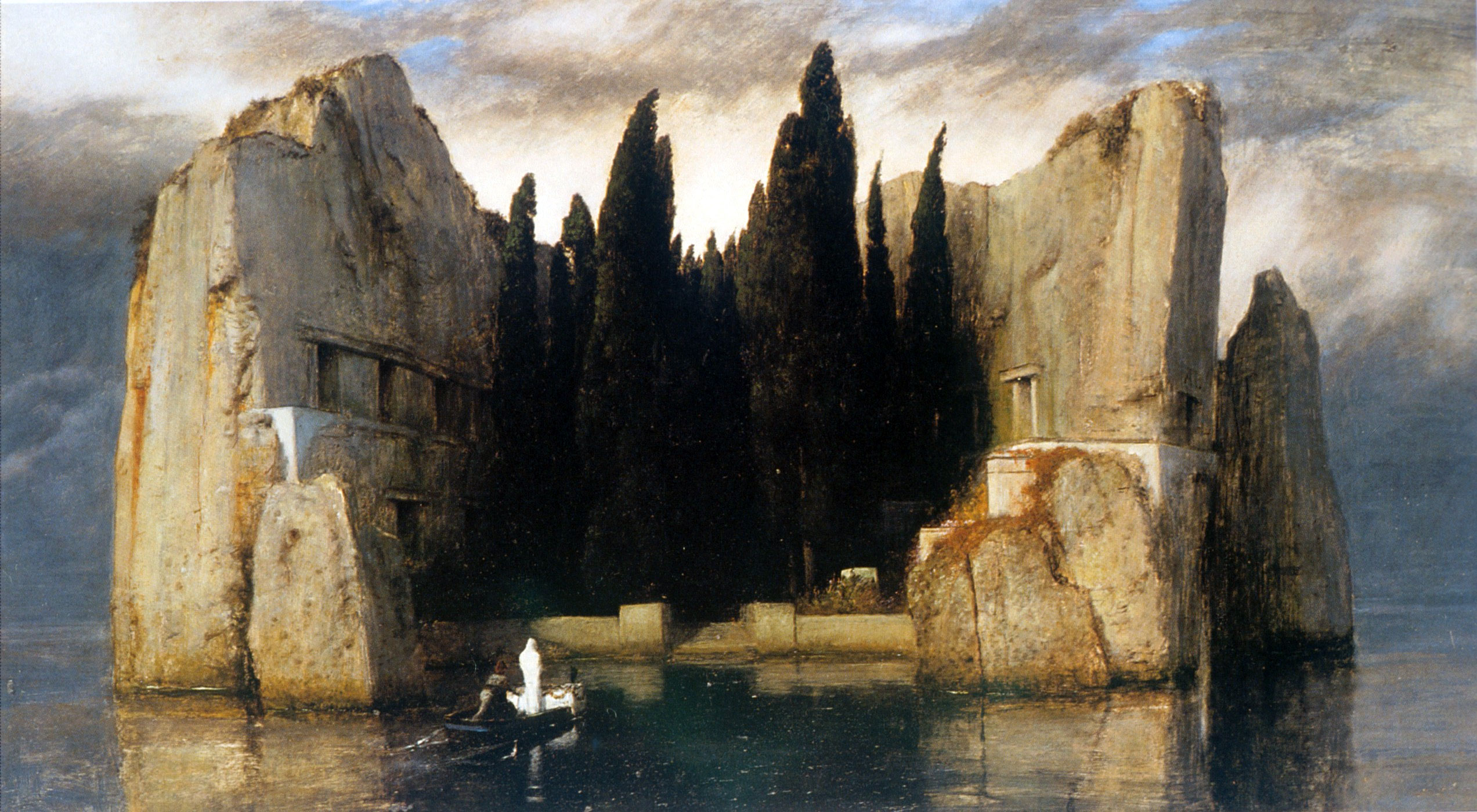
I’ll try to achieve a circular tour, but via the Russian Wikipedia, and see where that will get me. At the very top level, under the section ‘Did you know?’ appears the statement: A hundred years ago, it was a rare Berlin household that didn’t own a print of the ‘Islands of the Dead. This was a series of paintings by the Swiss symbolist artist Arnold Böcklin, who created five variations on the theme between 1880 to 1886. In all of them, a boat approaches a small island that is riven with sharp cliffs; the boat is often assumed to be that of Charon, and the waters either of the Styx or the Acheron.

Now I can either head towards ‘Symbolism’, or ‘Charon’, or even ‘Acheron’, but instead I’ll look into the Styx – and I’ll find that it disambiguates to the legendary Greek river, a small river in Perm, a communication protocol implemented in the Inferno operating system, and also a rock band of the 1970-80s.

The rockers of the first incarnation of the Styx had four successive multiplatinum albums; I only recall with affection with one song ‘Mr Roboto’, from which – nearly 20 years ago - I learned that ‘Domo Arigato’ was Japanese for ‘Thank you’. Their song Krakatoa (1974) had a spread tone – a single note that attenuates and amplifies in loudness - that is supposed to have inspired George Lucas to create the audio logo (Deep Note) for his hi-fi cinema audio standard THX.
Krakatoa, of course, is the Indonesian supervolcano that erupted in 1883, but there’s no link to it from the Styx’s page, so I’ll go instead to George Lucas (1944- ), a famous film director who equally famously gave up any artistic integrity when he created the dismal prequels to his Star Wars trilogy. As a film technologist, however, he is incomparable: besides the audiovisual standards of the THX that I mentioned above, he is also responsible for Industrial Light and Magic, a preeminent special effects house, and Pixar, an animations studio. An interesting aside available on the Russian wiki (but not on the English version) is of Lucas’s visit to Moscow in the 1990s. He asked Russian officials to introduce him to Pavel Klushantsev, a film director. The officials, of course, had no idea who Klushantsev was. Lucas replied, ‘Klushantsev is the spiritual father of Star Wars.’ The two directors never did meet.
Pavel Vladimirovich Klushantsev (1910 – 1999) was a self-taught special effects engineer who created many techniques of special effects that proved influential in cinematography worldwide, and developed an oeuvre of documentaries that blended hard science with science fiction. For example, in 1934, his film Road to the Stars had cutting-edge special effects that accurately depicted weightlessness in space, a rotating space station, and even rocket travel to the moon.
Klushantsev also wrote books popularising science, and top Soviet illustrators did the drawings for them. One among them was E. V. Voishvillo who was a fairly well-known painter of marine scenes, many of which find pride of place in St Petersburg’s Museum of the World Ocean.
 
Here is Voishvillo’s depiction of St Nicholas, one of Peter the Great’s boats, considered the grandfather of the Russian navy; I learn that Voishvillo collaborated with A. L. Larionov in reconstructing a copy of Peter’s boat.
St Nicholas, it is often said, is also Santa Claus, but there’s no link out of Voishvillo to the bearded bearer of gifts, so all I can do is use Peter the Great as a conduit to further exploration. I find that he was a prodigious drunk, a lover of all things German, and his first official mistress, Anna Mons, was either Dutch or German herself. Sadly, there don’t appear to be any extant paintings of this famous beauty, so I’ll just put up one of Mary Hamilton, another of Peter’s lovers, whom he executed on the charge of infanticide, treason, and sundry other manifestations of his jealousy.

But back to our Anna-Margrethe von Monson! From her, we can head to things Germanic either filmographically to the German actress Ulrike Kunze (who played Anna’s role in “The Youth of Peter the Great”) or musically to Johann Sebastian Bach (who is said to have written the Brandenburg Concertos for Count Keyserling, who married Anna Mons late in his life).
As I hadn’t heard of the lovely Ulrike Kunze before, I might as well head her way. Born in Dresden in 1960, she trained in the dramatic arts, worked in Berlin and Magdeburg in various dramatic roles, and ended up in television, most recently, the series Love in Berlin.
Ulrike Kunze
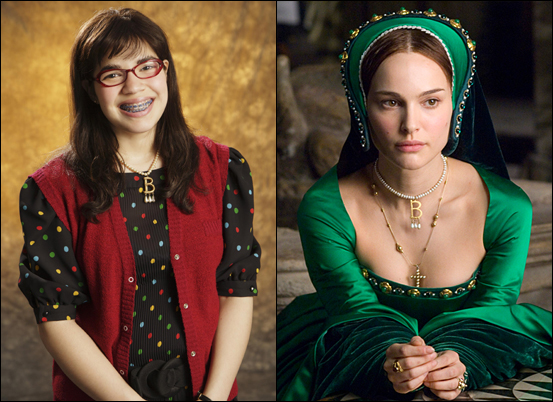
This telenovella is based on the Colombian hit series “Yo soy Betty, la fea”, which inspired, among other things, the US television series Ugly Betty. And just when you think that I’ve managed to telescope from the 18th century to the modern world (all that history was beginning to pall a bit), what do I find? The tacky ‘B’ necklace that Betty wears in the series is an exact replica of a necklace worn by Anne Boleyn.
 
(No post is complete without a picture of the lovely Natalie Portman: fortunately she has her own connection to Anne Boleyn, so this isn’t entirely gratuitous.)
Anyway, as someone said, you either have that bauble around the neck of a Queen, or of a girl from Queens.

Also from Queens is Steinway and Sons, makers of fortepianos and things since 1853. They were famous innovators in advertising and promotions, recruiting, for example, the great Russian pianist Anton Rubinstein (1829 – 1894), to play 215 concerts with their piano in 239 days in 1872. Thus began the Steinway Artists programme.

Anton Rubinstein was a friend of Alexander Glazunov (1865 – 1936), a composer in the Russian Romantic tradition, who composed the Symphony No. 4 and dedicated it to him.

I learn that the second movement of that symphony, the Scherzo, was inspired by Diana’s Chase, a painting, would you believe it, by Arnold Böcklin, with whom we started this Wikiramble.

Full circle, y’all!

Jan Morris has an imagination non-pareil, and her long years of travel and experience have informed her creation of the fictional city of Hav. Set behind a massive escarpment not far from Greece and Turkey, it is a blend of historical city-states such as Trieste or Beirut, and was a cosmopolis, a melange, a veritable fairy-tale land. It had an Arab quarter and a Chinese district, was once ruled by Russians, and today has few diplomatic relations with the rest of the world. It was once a great trading entrepot, and is now a mere fleshpot for the jet-set.

And it has food.
'But not,' said Biancheri, joining me with a gin-fizz in a corner of the room - 'not altogether the same food you are accustomed to get from Cipriani's. I think you will agree that our restaurant menu is something a little different.' He was right. Could there be such a menu, I wondered, anywhere else on earth? Not only were there the old stalwarts of classical French and Italian cooking - not only the inescapable pigeons' breasts and raw mushrooms of the cuisine nouvelle - not only roast beef for traditionalists, jellied duck for Sinophiles, bortsch for nostalgia, couscous, pumpkin pie - there was also a fascinating selection of Hav specialities.

You could eat sea-urchins grilled, meunière, baked, stewed in batter, with ginger garnish, as a pâté, in an omelette, in a soup or raw. You could eat roast kid in the escarpment style, which meant cold with a herb-flavoured mayonnaise, or barbecued over catalpa charcoal from the western hills. You could eat the legs of frogs from the salt-marshes, which are claimed to have a flavour like no others, or Hav eels, which are pickled in rosemary brine, or the pink-coloured mullet which is said to be unique to these waters, and which the Casino likes to serve smoked with dill sauce, or the tall sweet celery which grows on the island of the Greeks, or a salad made entirely, in the inexplicable absence of lettuce anywhere on the peninsula, of wild grasses and young leaves gathered every morning in the hills above Yuan Wen Kuo. You could even eat a dish, otherwise undefined, listed as ours hav faux.

This was only a joke, said Biancheri, though in the 1920s Hav bear really was eaten sometimes at the Casino. Now the false bear was no more than a bear-shaped duck terrine. 'But then,' he added, 'it is all a joke. For myself I prefer scrambled eggs.'

Jan 15, 2011

Statistical Poetry

Charles Babbage, mathematician, inventor and all round gadfly read the following lines in a poem - The Vision of Sin - written by Alfred Lord Tennyson:
"Fill the cup, and fill the can:
Have a rouse before the morn:
Every moment dies a man,
Every moment one is born.
So outraged was he by the lack of statistical accuracy in the poem that he dashed off a letter to Tennyson:
"Every minute dies a man, Every minute one is born;" I need hardly point out to you that this calculation would tend to keep the sum total of the world's population in a state of perpetual equipoise, whereas it is a well-known fact that the said sum total is constantly on the increase. I would therefore take the liberty of suggesting that in the next edition of your excellent poem the erroneous calculation to which I refer should be corrected as follows: "Every moment dies a man, And one and a sixteenth is born." I may add that the exact figures are 1.067, but something must, of course, be conceded to the laws of metre.

Jan 13, 2011

Harrowgate Chow

Whenever I'm in Delhi, I end up reading yet another book by Georgette Heyer from my sister's ever-burgeoning collection. Some good must come out of all this, and here's a bit of foodiness from Charity Girl:
Tain, relieving him of his hat and gloves, said that he had ventured to order a neat, plain dinner for him, consisting of a Cressy soup, removed with a fillet of veal, some glazed sweetbreads, and a few petit pâtés, to be followed by a second course of which prawns, peas and a gooseberry tart were the principal dishes. 'I took the precaution, my lord,' he said, 'of looking at the bill of fare, and saw that it was just as I had feared: a mere ordinary, and not at all what you are accustomed to. So I ordered what I believe you will like.'

Jan 12, 2011

London Tales

I've been quite lax with posts about London, so here's a couple to liven up (or, possibly, depress) your January. These are from London's history, and speak much about the kinds of things that amused Englishmen over the ages. None of that stiff upper lip until Victorian times, then?

Firstly is the story of Whipping Tom of Fleet Street, who - in the 1670s - dressed in black, covered his face, waylaid unsuspecting women as they went about their duties, and spanked them: he lifted their skirts and beat 'an Alarum' upon 'their Tobies' and cried, 'Spanko!'

He was never caught, and most people thought him an object of fun as his assaults were mainly on women of the night. The intensity of his spanking varied as well: he once 'swinged her tail' so hard 'that tis thought, she will not be capable of her Trade for some time' while at another time he knocked down a peas-vendor, who was so stunned by his assault that she couldn't resist, and then he proceeded to 'Tyranize her posteriors at pleasure.'

And then one day, he silently vanished, never to be seen again.

Next is a tale of gas: in Henry II's reign, a fellow from Suffolk called 'Roland the Farter' appeared at the King's court for Christmas, and performed (records say), "Unum saltum et siffletum et unum bumbulum" ('one jump, one whistle and one fart)'. For this annual performance, Henry munificently granted him a manor in Suffolk.

I mentioned this story to one of my friends, who immediately responded that her hubby was from Suffolk, and notably flatulent himself. (Too much information, I thought, but there you go.)

Clearly, said my pal, 'flatulence has been bred into the Suffolk folk from early times.'

Further Reading (if you must)

On Farting: Language and Laughter in the Middle Ages

Jason Anderson's Showbiz recounts the monomaniacal investigation by Nathan Grant, a budding journalist, into the death a quarter century earlier of a comic impersonator of John F. Kennedy, who met a fate almost as grisly as that of America's beloved president. In the passage below, he meets Danny Pantero, a famous performer idolised by all and sundry, at a wine-bar, where waitresses with nipples perked up by the refrigerated atmosphere soar through the air to deliver the tipples.
Before entering the restaurant I had decided that I was not going to be meek about ordering. My confidence would send a message to Pantero that I was not to be trifled with, that I would assert myself however I saw fit. "Can I have the, uh, jumbo lump crab gratine to start? And the lamb rôti? With the crust of truffles?" 
"Certainly." 
She was a little thrown when I didn't hand back the menu. I planned to steal it for Lance. "Can I hold onto this?" 
Her face betrayed a split-second's worth of pique. "Of course." 
"How's the monfish bisque tonight?" 
"Excellent." 
"I'll have that. Bring two bowls - I'm sure my guest here would enjoy it. Then the foie gras terrine with pineapple and mache and the medallions of fallow deer. That'll be terrific." She began to move away when Pantero touched her arm. "Oh, yes. Nearly forgot. We'll both have lobster tails." He turned back to me. "Don't get the idea that I eat like this every night. My dietician would murder me if she found out. But I say, after what happened to my poor keister, I deserve a night of indulgence. We'll keep this between us, won't we?" 
I nodded solicitously, suppressing the urge to ask what made a deer fallow.

Jan 11, 2011

Drinking Iodex

A Fernet Branca is, it appears to me, a rather poisonous tipple tasting vaguely of Iodex, and it serves admirably as the backdrop to the utterly riotously funny tale of misunderstanding, high camp, pretension and the most bizarre recipes I have yet encountered in any fiction. James Hamilton-Paterson's Cooking With Fernet Branca was longlisted for the Booker prize five years ago, and here's a description of Tuscan bread that I found particularly enticing.
There is something radically wrong with Tuscan bread. Frankly, it's a disgrace: the one thing to disfigure and otherwise classic cuisine. Even Italians from other regions make ribald remarks about it - like for instance that it's the only bread in the world to emerge from the oven already stale. This is merely a slight exaggeration. Tuscan bread is non-fattening once it is over three hours old because cutting a slice requires energy equal to the slice's calorific value. (This is henceforth known as Samper's Law.) It is a feature the Italian slimming industry should do more to promote. It now occurs to me that when Robert Graves coined his appallingly sentimental image of 'women good as bread' he may have had Tuscan bread in mind, in which case he meant the far more likely women hard as nails. 
The reason I mention this is because in the days following that first dinner with Marta I had a great craving for bland nursery food and found a good use for Tuscan bread in bread-and-milk: little bowls of pap I ate slowly with a spoon that trembled...

James Hamilton-Paterson's hilarious Cooking With Fernet Branca doesn't just skewer culinary pretensions, it makes an active effort to demolish any notion of respectability to the food of an entire region. I mean, of course, that gastronomically benighted land of the Slavs, which - in this book - is proxied by the fictional Voynovia.
'For you, Gerree, all Voynovia fooding tonight,' she said as we eventually reeled to our seats at the kitchen table, having first pitched off bundles of sheets. By then we had finished most of a bottle of Fernet Branca and even the electric light was beginning to have a brownish tinge. With a flourish she plonked before me a gross sausage the colour of rubberwear and as full of lumps as a prison mattress. It was a little larger than those things in Bavaria that just fit into bowls the size of chamber pots. 
'Is shonka,' I think she said, resting her breasts on the table on either side of her own plate. Smiling weakly, I made the good guest's obligatory 'mm' noises and gingerly poked it with the point of my knife. There was the sound of a boil being lanced. A spurt of boiling fat shot across the table and even on that late June evening my spectacles misted over. The contents of the sausage, bright red with paprika, lay there before me like an anatomy lesson. 'My sister Marja she send me from Voynovia. We eat like this, Gerree.' Cheekily she speared one of the lumps on my plate with her fork, dipped it into a pot of black treacle and held it playfully to my lips. Mechanically I opened my mouth and allowed it entry but thereafter there was nothing mechanical about my chewing. It was exactly like trying to cross a hot beach barefoot. When I say black treacle I only mean that was what it looked like, though I'm damned if it really wasn't mainly molasses. What the rest was, I cannot say, but my impressions included saffron, pickled walnuts and lavender, with perhaps a pinch of plutonium. The only missing thing, surprisingly, was Fernet Branca. 
Once one mouthful of shonka and sauce was down a kind of local anaesthesia set in and the next forkful was marginally less lethal. And you know how it is, l'appetito vien mangiando and all that, it wasn't long before I had eaten a good two inches of the thing, with a mere yard to go...

Now that I've read a couple dozen or more Scandinavian crime novels, I think I won't be lying if I say that food has little coverage in that genre. So it's pleasant to come across to occasional reference to food, even if the food is so generic, it could have been eaten even by a, umm, well, anyone. Here's the detective superintendent Irene Huss, in Helene Tursten's The Glass Devil who's being treated to a fine home-cooked meal by her loving hubby:
It was almost eight o'clock and her hunger was sharp. In her imagination, she could already see the scrumptious dishes Krister was preparing. Since they had been together when he had bought the ingredients, she knew what was on the menu. The appetizer was going to be baked goat cheese encrusted in honey, served on a bed of basil on a slice of bread. The main course was grilled cod, vegetables in wine sauce stir-fried in a wok, and home-fried potatoes. The dessert was Irene's favourite: chocolate mousse. Not exactly food for weight-watchers, but incredibly good. The wine was from South Africa and was called, oddly enough, Something Else. Intriguing, because they hadn't had it before. 
[...] 
"Sweetheart," Krister said, "this wine is far too light and dry. Shall I go to the wine cellar and get a Drosty-Hof instead?" 
Irene thought the wine they had had was good, but Krister was the expert; if he said they should drink the other wine, then it would be probably be better. 
Krister went to the laundry room and opened the top cabinet of the closet next to the drying cabinet. An almost-empty bottle of Famous Grouse was there, along with two bottles of Drosty-Hof white wine and a small Bristol cream purchased on their last short vacation to Skagen because the blue bottle looked so nice.

Jan 8, 2011

Coronation Menu

And I don't mean just chicken...

Boris Akunin's latest instalment in the Erast Fandorin series, The Coronation, has the intrepid investigator chasing after a master criminal through the revels following the crowning of Russia's last Czar. A stampede occurs, killing hundreds, marring the holy occasion. But appearances have to be kept up, and the nobility intends to fulfil its ceremonial obligations.
...And I was totally dismayed by the Moscow Illustrated Newspaper, which could think nothing better than to reproduce the artistically designed menu for the forthcoming supper for three thousand in the Faceted Palace:

LUCULLAN BOUILLON
ASSORTED PIES
COLD HAZEL GROUSE A LA SUVOROV
CHICKENS ROASTED ON THE SPIT
SALAD
WHOLE ASPARAGUS
ICE CREAM
DESSERT 
That is to say, I could see perfectly well that, owing to the sad events, the menu that had been drawn up was modest in the extreme, with no extravagances at all. Only a single salad? No sturgeon, no stuffed pheasants or even black caviar! A truly spartan meal. The highly placed individuals who had been invited to the supper would appreciate the significance of this. But why print such a thing in a newspaper that had many readers for whom 'dog's delight' sausage was a treat?

Jan 7, 2011

Maghrebi in Rome

In Amara Lakhous's lovely little novella Clash of Civilisations Over an Elevator in Piazza Vittorio, one of the characters, desperately lonely and missing his family back in the Maghreb, recalls the wondrous cuisine of his homeland and wails:
It's sad spending Ramadan far from Bagia! What's the point of giving up eating and drinking, only to eat alone? Where is the voice of the muezzin? Where is the buraq? Where is the couscous that Mama prepared with her own hands? Where is the qalb alluz? Where is the zlabia? Where is the harira? Where is the maqrout? How can I forget the nights of Ramadan in the neighbourhood, and coming home late? Mama's voice full of tenderness, the love that charmed my ears: "My son, it's time for the suhur." The month of Ramadan, the Little Feast, the Big Feast, and the other feasts fill my heart with anxiety. People say: "Why don't you go to the big mosque in Rome for the prayers for the Big Feast?" No, thank you. I don't want to see hundreds of needy people like me, needy for the odour of their loved ones.

Nii Ayikwei Parkes has created an evocative world of science clashing with magic, the modern battling the traditional, in the Ghanaian crime caper Tail of the Blue Bird, from where I excerpt the following passage of yummiferous foodiness:
Oduro laughed and stamped his feet, and Kayo noticed Esi suppressing a giggle with her hand as she reached over to take the water away. She returned, accompanied by her mother, with earthenware bowls filled with fufu and the richest, reddest palm nut soup Kayo had ever seen. 
On the surface of the soup were cuts of okro, chillies and garden eggs. Large chunks of antelope meat were submerged like vessels guarding pale cream islands of fufu. The soup was steaming hot. 
Akosua lit a torch close to them so that they cold see their food, then she put her arm around her daughter's waist and marched her back to the rear of the hut. 
Oduro poured a bit of palm wine on the floor and said, 'Our fathers, we share our meal with you.' 
The men looked at each other, nodded their heads, and then, as one, dipped their fingers into the red soup.

The expansion of the private sector in India is to be welcomed after years of dirigisme and stifling over-regulation. There is now considerable competition in most spheres of business. Still, many companies - no matter how big - are run like mom-and-pop concerns, like personal fiefdoms, with little scope for professionalism.

Of course, the private sector in India is coloured by the same prejudices and sensibilities that suffuse general society. Even the most educated managers are often unable to look beyond class or gender stereotype. Here are a few examples.

Sudha Murthy, wife of one of the founders of Infosys, and an engineering professional in her own right, wrote eloquently about being denied even the possibility of a job interview with Telco. So agitated was she that she sent a letter to JRD Tata about the 'injustice the company was perpetrating.' That letter had the requisite effect, and she was invited for an interview, where she was told that the reason women were not encouraged to apply was that they had never worked on the factory floor. Surely, though, that should change, said the lady. Otherwise how would women ever work in Telco?

She got the job. Later on, she married Narayana Murthy, helped set up Infosys, which, as we all know, went from strength to strength, and is now one of the most successful enterprises in India.

Unfortunately, though, Sudha's experience didn't transform the culture in the new organisation. A few years ago when the wife applied for a job there, one of the questions she was asked during the interview was 'How do we know you won't get married and leave?' Would the hiring cretins ever ask a man this question? No. But a woman is always fair game for this sort of condescension.

I don't know if the culture has improved any in the fifteen years since this episode. I would certainly hope it has.

*******************************

A friend applied to NDTV - again, this was about fifteen-odd years ago. He was interviewed by Prannoy Roy himself, the head honcho. Roy is an urbane and erudite man, not an insular fogey, but even he was more interested in my friend's social background than in his qualifications. I guess the fact that he was called for an interview meant that his qualifications were sufficient, and from that point on, it was a question of ascertaining his family background, his connections, 'is he one of us?' There has always been a class divide between the English and local language press in India, and this sort of interview served to confirm the divide by hiring people from Roy's own milieu.

I think NDTV has broadened its reach and approach over the ensuing years. Going by the reporters that now appear on TV, one is heartened by their different backgrounds and accents and outfits. Perhaps this is a company that has now understood the true value of diversity.

*******************************

The healthcare industry is undergoing a boom in the country with top-notch hospitals being established offering world-class medical diagnostics and care. So successful are some of the hospitals that they now want to branch out into entertainment. Reality TV and medical dramas both require the services of medics, and what better way to raise the profile of a hospital chain than by having its celebrity doctors participate? Inevitably, the egos of these star doctors rival those of the actors, as happened with a friend of mine who was the brunt of one such bigwig.

Dissatisfied with some paperwork that Tilottama had prepared, the doctor's wife (herself a doctor) phoned her in the office.

'Tilottama?' said the doctor's wife. 'This is Uttara Bhuj.'

'Yes, Uttara,' replied my friend. 'How can I help you?'

'Excuse me,' said Bhuj's wife. 'You are not my friend, I hardly know you, so I'd much prefer it if you addressed me as Dr Bhuj.'

My friend was not one to take this lying down.

'I am sorry,' she said, 'But you are not exactly my best friend either, so courtesy then demands you address me as Ms Soni.'

Bhuj's wife lost her marbles at that point and began to shriek and snarl. 'Do you know who you are talking to?' she yelled, and went on to add sundry threats and demands.

'Listen,' said Tilottama, 'If you have something official to discuss with me, we can continue to speak. But I have no interest in your threats.'

And she hung up.

Moments later, the phone rang again. It was the star husband, the main doctor himself.

'What is all this?' he thundered. 'You have been rude to my wife!'

'Mr Bhuj,' began Tilottama, and was immediately interrupted.

'Doctor Bhuj,' said the good doctor. 'Where are your manners? I'm going to the Chairman to complain about this serious lack of professionalism.'

Tilottama's patience wore even thinner.

'You can talk to the Chairman if you like,' she said. 'I hope he understands the difference between professionalism and attitude. If he doesn't, I see no reason to continue in so blinkered an organisation.'

I guess the problem is that bigwigs in a hierarchical society as India are so used to getting their own way, throwing their weight around, stomping on everybody they consider beneath them, that a mouse that turns stymies them completely. They are not sure, suddenly, if they are dealing with a mad person. Immediately Dr Bhuj was conciliation itself.

'Arrey, why fight at all?' he said, as though he were the soul of bonhomie. He then proceeded to discuss the situation calmly, and the two of them managed to sort the original matter out.

Frankly, I don't expect this enterprise to grow out of its mom-and-pop-hood.

Jan 5, 2011

High Table at Souarcy

In Andrea H. Japp's medieval crime series starring the beautiful, wise but impoverished Agnès de Souarcy, meals are important, especially when the odd guest arrives. Here's an excerpt from the first novel of the series, The Season of the Beast.
Mabile was not displeased with herself. Agnès de Souarcy had expressed her wish to thank the good chaplain and the servant had prepared a proper feast - a six-course meal, no less. Following an hors d'oeuvre of fresh fruit, whose acidity was supposed to act as an aid to digestion, there was a broth made of almond milk. For th third course the servant had plumped for roasted quail spiced with a black pepper sauce. That insufferable Agnès de Souarcy was such a sickler for table manners that the baby fowl should keep her busy for a while... 
...She must hurry. The quail would not keep them busy forever. She should be back in the kitchen helping Adeline serve the desserts: a traditional goat's milk blancmange followed by black nougat made from boiling honey and adding last year's walnuts and spices. To round off the meal she had prepared some hippocras, a mixture of red and white wine sweetened with honey and spiced with cinnamon and ginger.

Philippe Claudel has penned an absolute marvel of a novel in his Brodeck's Report, from which I excerpt this bit:
"Well?" 
"Well what?" 
"What did he say?" 
"He said he wanted a 'collation'." 
"A 'collation'? What's that?" 
"A light meal, he said." 
"What are you going to do?" 
"What he's asked me to do!" 
Everyone was curious to see what a 'collation' looked like. Most of the crowd followed Schloss into his kitchen and watched as he prepared a large tray on which he put three thick slices of bacon, a sausage, some marinated gherkins, a bowl of cooked cream pudding, a loaf of brown bread, some sweet and sour cabbage and a large piece of goat's cheese, together with a jug of wine and a mug of beer. As he passed through the crowd of his customers, he carried the tray reverently, and everyone made way for him in silence, as though for the passage of a holy relic.

In case you ever wondered what delicacies would appeal to an enhanced human far into the future, wonder no more. In The Solaris Book of New Science Fiction: v. III, appears a story called Necroflux Day by John Meaney, in which a Bone Listener and his son have a meal in celebration of the boy's birthday.
The food was good: komodo steak and buttery mashed tubers, then squealberry pie and ice cream, washed down with hot blue chocolate. But no waiters came out to sing Happy Birthday, and Carl and Dad were seated behind a heavy pillar, where entirely human diners could not see the hint of otherness in father and son as they ate.

Jan 1, 2011

A Fixed Conclave

When people go into this sort of obsessive detail about what their characters ate - without actually describing the food itself - you can't expect the book to be any good, can you? And so in S. Perone's Murder Almighty we find a rather sad thriller about a fixed papal conclave and the following passage:
Dinner at the ancient La Canonica Trattoria - a stone's throw from the residence of Cardinal Delarossa, Patriarch of Venice - had been candlelit and cozy. Because of the unusually warm October evening, Vella and Carolyn had been seated on the stone terrazza, at one of the corner wooden tables. The high-backed wooden chairs and white tablecloths provided a touch of elegance typical of Venetian outdoor dining. 
Carolyn had ordered the Grigliata di pesce, featuring salmon grilled with lemon butter, while Vella had ordered the Cannelloni Canonica, witha creamy marinara sauce. They had decided together on a light dry white wine from eastern Tuscany, Bianco Vergine Valdichiana.
I mean, come on! How trite and leaden is this?