Well, it's been a month since I came up with the plan to slash and burn through Eurocrime, and believe you me, it's been tough putting it into practice. Relentless blood, gore, bleakness does tend to get a bit monotonous after a while. You know, gory and tedious. I have half a mind to switch to Mills and Boon for the next month. But no, I'm made of stronger stuff. I shall go down fighting.
It should be admitted that I've had to change the conditions of my plan a tad. Not all authors listed at the Eurocrime site are available in my local library, and I'm hanged if I'm going to use up valuable shelf space on purchased paperbacks. So I've broadened the crime fiction spectrum to translated fiction from anywhere in the world. And so we have our first month's list here.
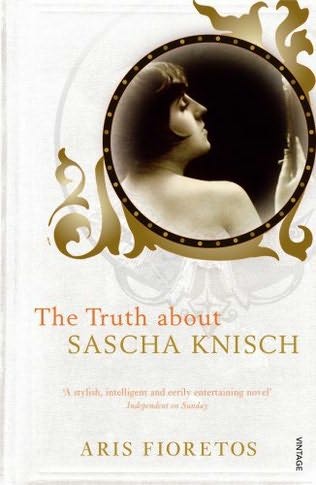 Surely Aris Fioretos should be onto a winner. Imagine: a Greek-Austrian author who writes fiction in Swedish about sexual high jinks and extravagance in Weimar Germany, and then translates it himself into English. The implied versatility is mind-boggling. His The Truth About Sascha Knisch defeated the best efforts of the Complete Review, so I'm rather smug about having blundered my way through it. It is a strange admixture of wry humour and somewhat overblown prose. Sascha Knisch is a projectionist at a theatre in Berlin in 1928, freshly arrived from Vienna. His childhood buddy is now in the Berlin underworld. He has a peculiar fetish for dressing up in elegant women's outfits, and develops a relationship with a Dora Wilms. She dominates him but they also develop an affectionate understanding, which prompts him to begin investigating her murder (it doesn't help that he was in a closet in her room changing into a fancy dress when she is killed). Several pseudo-scientific societies promoting eugenics enter the story; their clashes and struggles for political domination, and competition between homicide and vice squads in the Berlin police all blend together into a strangely atmospheric novel. It feels almost like alternative history, is overly convoluted, baroque even, and none of the characters is particularly sympathetic, and it stretches on and on, but I must say I finished it with a feeling of achievement, if not satisfaction.
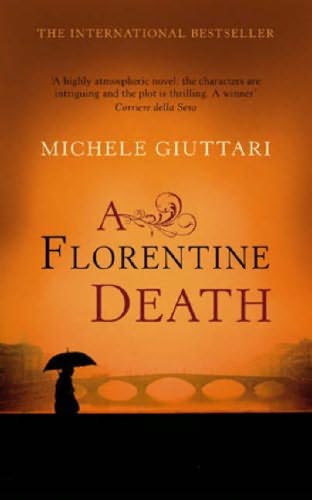 Michele Giuttari used to be a cop in Florence and he puts his experience of solving gritty crime to use in the rather formulaic police procedural A Florentine Death. Michele Ferrara is his chief detective, head of a group of investigative specialists based out of Florence, but whose remit extends across Tuscany. I'm not entirely sure if this book is based on a real-life case that Giuttari was involved in. He makes references to a well-known Tuscan serial killer whose murderous spree remains unsolved to this day, and who is being followed (fictionally) by Ferrara. But the main plot of this book is that of a person sending literary clues to Ferrara ostensibly describing the homosexual victims that pile up as the book progresses. Then there are subplots involving stolen Velazquez paintings, gratuitous inclusions of a lesbian who wants to get it on with a troubled man, and descriptions of a rather comfortable family life (all too rare for detectives, eh?) for Ferrara himself. Add political interference, bureaucratic clashes, a rather plodding and impulsive investigation, and you have it. Not the best example of Italian crime fiction that I've seen.
 Juan Gómez-Jurado has written the religio-political thriller God's Spy, set in the Vatican at the time of Pope John Paul II's death and the conclave that elected Ratzinger. In true thriller style, there are italicised passages that provide the back story for the killer and various characters. (I kept recalling Robert Ludlum's constant use of "Madness!" in the Bourne novels whenever he referred to uncovered plans for world domination.) Of course, no detective can be truly sympatico unless she has severe character flaws, and Paola Dicanti is no different. One of a few highly trained profilers in the world, but one whose knowledge is entirely theoretical, she is called in to investigate the brutal murder of a cardinal in the build-up to the conclave. Then another cardinal is butchered, and others barely escape with their lives. It's all very hush-hush, and she has to collaborate with the Vatican's secret police, unedifying characters every one of them, sexist even, and struggle with her own fatal fascination for older unsuitable men (e.g. priests and married heads of department). About the only thing that stuck in my mind after reading the book was that petrol prices in the Vatican are way lower than in Rome, so every one of the handful of fuel stations in the Papal State is crawling with cars from over the border trying to fill up - although only cars with appropriate permits (people of influence, naturally) are allowed to buy petrol in the Vatican... Clearly, Gómez-Jurado aims to write a topical novel - he manages to include both the child abuse scandals that rocked the Catholic church a few years ago, and the pious skullduggery and politicking that occurs during the election of a Pope. Not sure if the effort is worth it, though. Just like Ludlum's pulp, this can be read on a long flight and consigned quickly to the dustbin and out of one's mind upon arrival at one's destination.
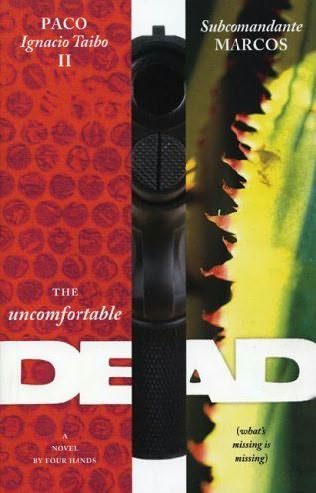 There's only so much serial killing a man can take before he wants to switch to something less grim, and he falls smack into politics. Paco Ignacio Taibo is one of Mexico's most famous writers, and in The Uncomfortable Dead, he collaborates with another famous Mexican, Insurgent Subcomandante Marcos, to produce one of the most satisfying books I've read in a while. The two authors write alternate chapters, and who would have thought that the Zapatista leader had such a deft touch, such a feeling for language? The Investigative Commission, as the Zapatistas call their main detective, Elias Contreras, is an Indio plodder, a man who worries and worries at problems until their solutions are harassed into revelation. He is uneducated and unliterary, but he has a simple intuition and a mind that can cut through obfuscation essentially because it is so simple. He spends his chapters dealing with petty crime, missing persons, and a murder in Chiapas. Meanwhile, Taibo's detective, Hector Belascoaran Shayne, is a man in Mexico City investigating one Morales, who was said to have involved himself in sundry political murders, enriched himself, and then vanished without a trace. As the book progresses, Contreras' and Shayne's investigations converge, but not before major diversions into Mexican political history, and trenchant critiques of the Americans and the Mexican conservatives. Good stuff, especially if you avoid all the political diatribes.
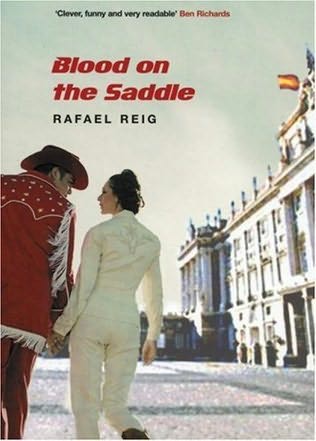 Readers of Jasper Fforde's Nursery Crime series will find much that is familiar in Rafael Reig's Blood on the Saddle. Based in a Spain where petroleum has run out and the Americans invaded, there are broken families and escaped literary characters from books. There's a company that appears to dominate the economic skyline by owning the patent on virtually every genetic modification around. There is some sad, sad, shagging. There's alcoholism, and there's some sparkling humour. This is a rather peculiar novel, not entirely crime fiction, and not quite social criticism, and not quite science fiction. The detective is a man named Clot (why Clot? I didn't quite figure that out.) is the usual laconic PI, a loner. He appears to solve crimes entirely by accident, but hey, however you do it, it's good, right? There's a novel (also called Blood on the Saddle) which cannot be finished until Clot recovers a character who has leapt right out of the pages of the book and escaped: the author is collapsing with alcohol poisoning. It's all heady and surreal and ironic, and doesn't lose much in translation. Neat stuff.
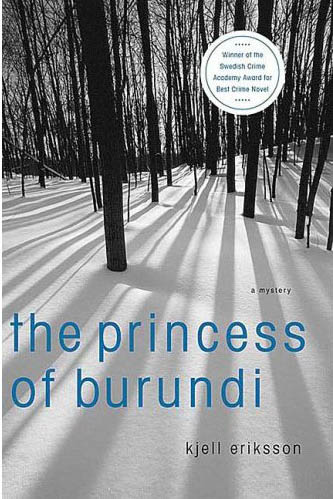 There ought to be a law against over-dramatised blurbs on books. In Kjell Eriksson's The Princess of Burundi (for some reason, several of this man's crime novels have an African reference in their titles), the blurb talks about a silent killer who holds an entire city in the grip of his terror. Bollocks. Other than the relatives of the man who is killed, nobody in Uppsala really gives a damn. His brother is out for revenge, his lovely wife is ravaged by grief, his son is falling apart as a result of it all. It is sombre and dark as almost all of Scandinavian crime fiction, and is rather good as a study of the effects of violent crime on a family. Why was the man killed? There are rumours of a large winnings at poker; although he has been on the straight-and-narrow for years, his brother (to whom he was very close) has continued a life of crime; was it revenge? The book is rather slow to take off, and the solution when it finally arrives is not very satisfying, but the book adds yet another dimension to one's understanding of Swedish life, which is all to the good, what?
Boris Akunin's last of his Pelagia trilogy - Pelagia and the Red Rooster - is out. As I have mentioned earlier,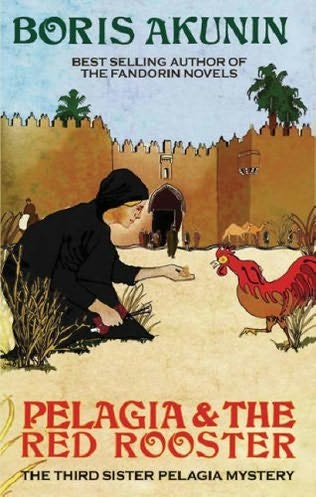 I haven't taken to this intrepid nun as much as to Erast Fandorin, Akunin's other great hero. But Akunin's declared that he is done with this series, and its ending is more bitter than sweet, for Pelagia, with her red hair and freckled face, her keen mind and impetuous enthusiasm, is a sympathetic character, and perhaps I have developed an affection for her. This book is more serious and polemic than Akunin's others, darker, and he paints a broad sweep of politics, religion, xenophobia, and the beginnings of the long war between Jews and Arabs in the Holy Land. It is written from the point of view of several characters: Pelagia, an assassin, the chief Prosecutor of Zavolsk (where Pelagia is from), and sundry other minor people who add considerable colour to the tale. Although Pelagia has been accused of betraying her spiritual vows with her constant seeking out of detective thrills, and despite her promise to desist, she is unable to give up the investigation of a series of murders that seem to be associated with a self-proclaimed messiah. An assassin, meanwhile, has been dispatched to kill both her and the messiah. True to the genre, the rot obviously starts at the top, but here it's not really corruption that's spreading across the Russian establishment but conservatism and religious fervour. Several myths combine in this tale. Pelagia makes a grand tour down the Volga and into Palestine where she finds the messiah, as one would expect of a heroine.
 Where historical crime fiction is concerned, clearly Akunin is in the stratosphere with a large tail of wannabes struggling man(or woman)fully behind him. The effort by Jean-François Parot, The Phantom of Rue Royale, is at the bottom of this long tale. I'm not sure if this is a particularly French trait, but there's so much didacticism and exposition that it appears the writer is more keen to show off his knowledge of the period than actually provide meat to the plot. The plot? Ha. It is the marriage of the Dauphin of France to Marie Antoinette in celebration of which a large fireworks is organised for the edification of the populace. It is grossly mismanaged and, tragically, many people are killed in the crush. Some unsavoury characters decide to use the general mayhem to commit a few crimes of their own, and it is the noble-bastard-who-renounced-his-title detective Nicolas Le Floch who has to sort out the mess. For all his renunciation, this man has the ear of the King and is thrilled by it; when he is not detecting, he is telling stories to the King, or eating in various taverns (obligatory description of meals padding up the already thick book). An entirely unnecessary demonic possession and exorcism is tacked on. The plot reels like a drunk. Dear God, why did such execrable stuff win positive reviews? The Independent - quite laughably, I think - said: "A little pruning might have been applied to that besetting sin of historical fiction, characters telling each other things they already know, and a supernatural element may be a genre-shift too far for some. But such is the momentum of the storytelling, few will worry." Unbelievable.
 I have ranted elsewhere about Selçuk Altun's anti-moustache tirade, but his book Songs My Mother Never Taught Me is interesting in many ways. It's not much of a crime novel, although there are several murders. The scion of a wealthy family who has been dominated by his mother all his life rejoices at her death and slowly falls into passivity and ennui. A poor man becomes a hired killer and realises by and by that the assassinations he performs, ostensibly in the service of a higher morality and in the name of the Qur'an, are nothing more than in the cause of selfish vendettas of his masters. Naturally, the paths of both protagonists converge (entirely by means of a deus ex machina, a character in the book who is often called odious and is also named Selçuk Altun). What remains at the end? A rather delicious tour around the wonderful city of Istanbul, many references to mother-hating poetry by various authors, and a state of befuddlement in yours truly's mind.
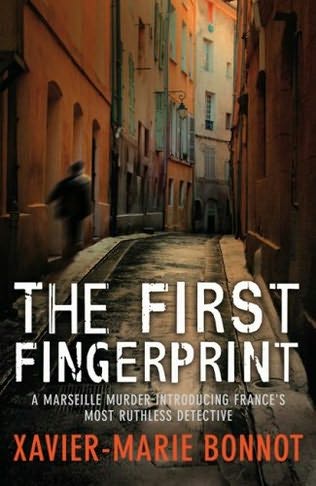 I had been worried at the outset of this grand tour through crime fiction that I would end up suffused with paedophiles, serial killers, killers of paedophiles, and other low-life, complete with graphic descriptions of the torture and bloodshed that ensues. Well, Xavier Marie Bonnot's The First Fingerprint certainly takes the cake. More than a novel with a linear plot, it is a bit of an episodic police procedural, drawing on multiple crimes (including those of children, beautiful (but cold) women, crooks and reformed criminals). Ever since the success of the Da Vinci Code, people have tried to write books that combine some age-old mystery with modern sickness, and Bonnot (a qualified anthropologist) goes farther back than most - all the way to the early Cro-Magnon man. Amidst academic politics (a small anthropological school in Aix gains prominence to the envy of the more established schools in Paris when Lascaux-like fine art is discovered underwater near Marseille), and police politics (murder squad has been sidelined by the gendarmerie), thuggish drug-smugglers and retired mafiosi, a killer is stalking is victims, killing them and ritually disembowelling them with stone-age weaponry. But there are some other murders as well, so are they all connected? The chief detective growls his way through the story assuring everyone that he is the best and that he always gets his man. Of course he does.
If bleak Scandinavian crime gets to you, switch to the Icelandic Yrsa Sigurdardottir for some black humour.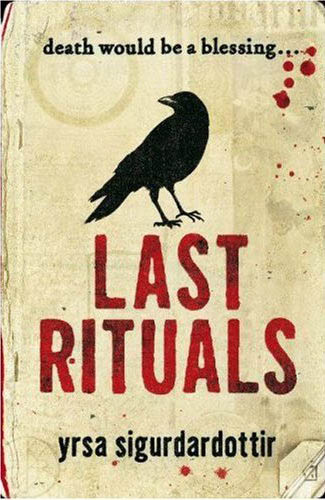 At least, she tries to inject some jocose banter among her characters in the otherwise tiresomely detailed Last Rituals. The connection with Dan Brown is not rejected at all here - again, we have medieval manuscripts and witch-hunts that somehow have a bearing on the ghoulishly mutilated death of a student at a college in Reykjavik. The author wastes no opportunity to fill us in on the history of Icelandic witch-hunts (unlike Europe where most witches burnt were women, mainly men were persecuted in Iceland for the black arts) and the conflict with the Danish imperium. Academic politics in that country seems to be no less bitchy than political politics anywhere else. Supplementing all this mayhem is an impoverished divorced lawyer Thóra Gudmundsdôttir who is recruited by the dead student's family to poke holes in the police case and possibly find the real killer. A German ex-policeman (who, the blurb - rather misleadingly - blames for putting obstacles in her way) assists in her investigation. Their relationship is the source of most of the wit. And, of course, Thora has family troubles of her own, which are 'resolved' in a wryly funny part of the book. Everything else is dark, dank, bloody. If all the medieval guff was elided, this book would have been shorter and much the better for it.
 Right. Andrea Maria Schenkel's debut novel The Murder Farm is an attempt at multiple perspective again, and it succeeds in most part. A one-time resident of a little village in Germany returns home to investigate the gruesome murder of a family. It is scarcely a decade since the end of the second world war, and the village is riven by old rivalries and hatreds. Erstwhile Nazis are still in positions of authority and brook no investigation into the past. Meanwhile, the murdered family is loathed by almost everybody in the village, and various grim rumours circulate around village of their sordid predilections. The narrative is split into straightforward narrative, offering perspectives not available to the cast of characters, and interviews of various villagers who offer their own opinions, hesitant or antagonistic, puerile or appropriate. The story unfolds spine-chillingly and the reader soon discovers the grisly truth that has eluded both the police and the neighbours. And it's a pip.
And we have one more Swede this month. Karin Alvtegen's Shame is an excellent character study marred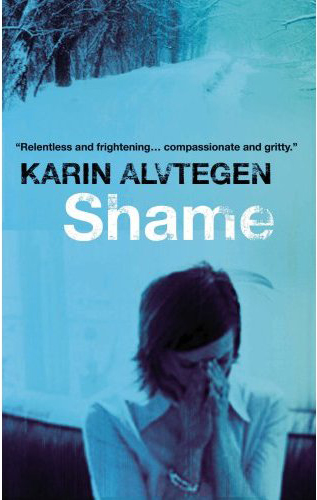 by a loose denouement. As long as the character development proceeds, it is engrossing enough, although I found it rather difficult to empathise with the motivations of the deeply flawed doctor, who is one of the two women whose lives eventually intersect in tragedy. Monika has lived under the suppurating, slowly strangling shadow of her dead brother and her mother's hatred; to compensate for the inadequacy and incompleteness she has felt, she has overachieved professionally, and run away from every relationship that could have salved her. Meanwhile, Maj-Britt, morbidly obese and curdling with poison, has been ruined by her upbringing by fundamentalist Christian parents, and sees people as nothing better than targets of her venom. Very like the guilt and grief felt by Ben Affleck's character in the film Bounce, Monika tries to make amends to the family of an acquaintance who had taken her place in a car journey and died in an accident on the way. She is unable to distinguish selfless help and interference, and gets more and more deeply involved in the victim's family. When Maj-Britt figures out Monika's motivations, she likes nothing better than to blackmail Monika, and from that point, the book begins to lose its power. Still, it was good going until that point.
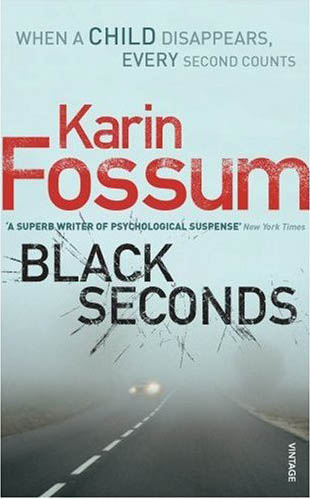 Finally, another Karin, a Norwegian - Karin Fossum - provides yet another family tragedy. In Black Seconds, a little girl loved by everybody vanishes and the family collapses in anguish and bitterness. Her cousins are marked by the sorrow and can barely cope with their own lives; the mother, whose entire life revolved completely around the girl, can scarcely breathe. The police is puzzled - why hasn't the body reappeared? Very like Jill Dawson's Watch Me Disappear, there's mentally deficient man whom people suspect, and very like in that atmospheric book, here too the eventual discovery of the criminal is heart-rending. An excellent book, very empathetic and richly nuanced.


 Now, over the past several months, payroll numbers have been plummeting in the US. It's not too surprising, then, that fitting a trend line should be a reasonably accurate forecast. Previously, I had generally chosen randomly - as far away from the average opinion as possible, so that if the result were an outlier, that is, far from the average, I'd claim the pot. Never worked, dash it. This month, I briefly considered getting fancy with my forecast. I tried this model (ARIMA) and that (linear regression). Both of them gave me numbers that were not too different from the consensus of 79 economists polled by Reuters. What was the point of using these models, then? The last time I had chosen the Reuters consensus, I had been so far away from the announced number that it was embarrassing even to admit I had participated in the sweepstakes. But perhaps now my luck was turning? After all, only two days earlier, I had won £10 on the National Lottery. (Woo-hoo. 10x returns! Take that, financial practitioners!) So I chose a number (-675,000) close but not too close to the consensus (-648,000). The rest of the punters were all over the place; some predicting a drop in employment of a million even.