JOST A MON

The idle ramblings of a Jack of some trades, Master of none

On October 8, 1937, the Times published a review of J. R. R. Tolkien's The Hobbit. Recently, the newspaper's online archive opened up the review to the general public. Here's what it says:
All who love that kind of children's book which can be read and re-read by adults should take note that a new star has appeared in this constellation. If you like the adventures of Ratty and Mole you will like THE HOBBIT, by J. R. R. Tolkien (Allen and Unwin, 7s. 6d.). If, in those adventures, you prized the solidity of the social and geographical context in which your small friends moved, you will like "The Hobbit" even better. The hobbit himself, Mr. Bilbo Baggins, is as prosaic as Mole, but fate sets him wandering among dwarfs and elves, over goblin mountains, in search of dragon-guarded gold. Every one he meets can be enjoyed in the nursery ; but to the trained eye some characters will seem almost mythopoeic - notably the lugubrious gollum the fish-man, and the ferociously benevolent Beorn, half man, half bear, in his garden buzzing with bees.

The truth is that in this book a number of good things, never before united, have come together ; a fund of humour, an understanding of children, and a happy fusion of the scholar's with the poet's grasp of mythology. On the edge of a valley one of Professor Tolkien's characters can pause and say : "It smells like elves." It may be years before we produce another author with such a nose for an elf. The Professor has the air of inventing nothing. He has studied trolls and dragons at first hand and describes them with that fidelity which is worth oceans of glib "originality." The maps (with runes) are excellent and will be found thoroughly reliable by young travellers in the same region.

Sep 27, 2009

Pi Mnemonics

Remember those peculiar constrained poems and mnemonics for π and stuff? Well, I've found a few more. Exciting, eh?

Here's one in French:

Que j'aime à faire apprendre un nombre utile aux sages!
Immortel Achimède ariste ingénieur,
Qui de ton jugement peut priser la valuer?
Pour moi, ton problème eut de pareils avantages.

And in German:

Dir, O Held, o alter Philosoph, du Riesen Genie!
Wie viele Tausende bewundern Geister,
Himmlisch wie du und göttlich!
Noch reiner in Aeonen
Wird das uns strahlen,
Wie im lichten Morgenrot!

And just when you thought to yourself - will this never end? - here's some in Greek (by N. Hatzidakis, 1924; and it's murder getting all those accents, I can tell you):

'Aεì ó Θεòσ ó Μεγασ γεωμετρεî
τò χυχλου μηχοσ ǐνα óρíση διαμετρω,
παρηγαγεν αριθμòν απεραντον,
χαì ǒν, φευ, ουδεποτε ολον θνητοì θα ευρωσι

which, in case you are wondering, means:

God the Great is the eternal Geometrician.
In order to define the perimeter of a circle using its diameter,
He has produced an infinite number,
The whole of which, alas, mortal men will never discover.

(Just count the letters of each word in each of the languages - except the English translation, of course - and you'll have a decimal expansion of π.)

- From Tefcros Michaelides' Pythagorean Crimes.

(See other mnemonics here.)

Sep 26, 2009

A Plum(b) Honour

You know how you have a good idea, and then you think about it, and then you think a bit more, and then decide that you’ll get back to that idea because there’s something else that needs doing at that moment, and a few days go by, months, possibly even years, and then you see that someone else had has that idea and, not just had the idea, but has actually gone and done what you wanted to do? And done it rather well, to boot?

So, anyway, Lt-Col N.T.P. Murphy is the man who has done what I had thought of doing (and I claim no particular originality, of course): he arranges walks around Wodehousean Mayfair every Wednesday. And he has written a book called Three Wodehouse Walks, which is available exclusively at Heywood Hill’s antiquarian bookstore till October 16.

There’s another reason to visit Heywood Hill – they’ve organised an exhibition of Wodehousiana. Everything from his personal golf putter to his typewriter is on display. Stephen Fry was there recently, and was pleased to find an enormous porker blocking the entrance.

I’ll take Colonel Murphy’s guided walk one of these days and do what I do nowadays – blog about it.

In the eighth grade, we decided to participate in an inter-class soccer tournament. To prepare, we first arranged to have team t-shirts. For some reason, the colours we ended up were orange with white sleeves. Sanjeev immediately demanded that he get the number 10 jersey. "Zico!" he said. "Maradona!" Other boys laid claims to other numbers.

I wanted the number 8. "Burgsmüller!" I said.

Everyone looked at me blankly.

Today even my German colleagues scarcely remember this stellar midfielder from Borussia Dortmund, in his bright yellow jersey with UHU emblazoned across his chest. He played for them over eight seasons, and scored at least fifteen goals in each. Towards the end of his career he moved to Werder Bremen, and scored 34 goals for them. My classmates raved about national players; few watched club football. Those that did only recognised the English premier league and possibly the occasional Italian team. But every time I turned on the TV to watch some sport (rarely, I should point out), Borussia would be playing. And there would be Manfred Burgsmüller nipping deftly in and out and around his opponents, scoring now and again.

In the first match we played, we were thumped by the seventh grade boys. Despite having the cutest girls in school baying for us from the sidelines (they were our classmates), we were comprehensively outplayed. The seventh graders put in three goals before Ahmed got one back for us. Then after half-time, they put in one more goal. Just because they could.

In the next match, against the ninth grade, we played much better. We lost by a small margin. 2-0, was it?

Against the tenth grade, Zoltan was at his magical best. He curved around one player, then another, and sped away towards the other goal. The rest of the team was caught off-guard, and - because nobody said I couldn't - I rushed off after him. In seconds I had caught up. He dodged a defender. The goalie came out to intercept. "Here!" I yelled. He passed. The goal was open before me. I tried to stop the ball to kick it stylishly into the net. It bounced off my knee and rolled over the line.

"Go-o-o-al!" shouted my team. For the first time in the tournament, we were ahead. The girls screamed and waved. After much back-thumping and mutual congratulations, we got back to our side of the field for the kickoff.

We lost 4-1, but by then I didn't care.

Sep 24, 2009

Geological Jingoism

Nationalists of every ilk and hue like to bolster their legitimacy and aggrandise their putative nations by hearkening to ancient glories. They construct legends of power, which are then used to promote contemporary ideologies. Look at the Balkans, or the Caucasus, or the Middle-East, or the Communist world – every one of the peoples of these benighted lands insists on primacy based on some or the other myth. These are propagated not only by political means, but also by radical changes in the educational curriculum, the demonisation of plurality in culture and public discourse, and, of course, by the radical rewriting of history.

We in India are no different. Consider the Tamils.

Two ideologies combine in southeast India. One is that of the independence and hoariness of Tamil language and culture as opposed to that of the Sanskritised remainder of the country. The other is a class and caste struggle against so-called Brahminical (and hence Sanskritic) domination. The curious aspect of the Tamilian wish for differentiation goes beyond the usual historical whitewash, however. The promoters of Tamil exceptionalism have co-opted pseudo-science and discredited geological theories. The researcher Sumathi Ramaswamy investigated this, and in 2004 published a book titled The Lost Land of Lemuria: Fabulous Geographies, Catastrophic Histories.

So what is the connection with geology? In 1864, Philip Sclater wrote up a putative explanation for the remarkable similarities between the lemurs of Madagascar and certain small primates as far apart as the African continent, India, and the Malay peninsula. As it was unlikely that lemurs could swim such large distances as these various landmasses, they would most likely have walked. Sclater therefore proposed a hypothetical supercontinent that he named Lemuria, which he said encompassed these disparate lands, and later collapsed and split up and separated, thereby sundering the original primate families into their descendants that we see today. Others before him had suggested similar theories, but he named this original supercontinent, and that evocative name suddenly entered popular discourse. By the 1880s, people like Friedrich Engels were talking of Lemuria as the land where anthropoid apes gained intelligence, and even H. G. Wells’ popular Outline of History in 1919 mentioned it as the possible birthplace of humankind. Lemuria became textbook fact, although by then geologists themselves had largely abandoned the idea.

Sumathi Ramaswamy points out that Lemuria attracted the attention of Tamil nationalists in the 1880s. There was a widely popular cycle of tales of Katalakol, the destruction of the ancient Tamil people by a terrible deluge. The Tamils, of course, dwelt in vastly greater splendour before the coming of the flood, suzerains of a large homeland called Kumari Kandam, a golden land of poetry and wealth that was reduced thereafter to the peninsular domains they now inhabited. Attracted by the Lemuria hypothesis, some Tamil writers conflated Kumari Kandam with Illemuria Kandam, and now, almost a century later, many commoners in Tamil Nadu believe that their myths of grandeur are corroborated by Western science, and hence even more legitimate.

While academic historians in Tamil Nadu do not give much credence to this ‘theory’, politicians have found it useful to propagate the tale, either through various faculties of Tamil Studies or, worse, in vernacular education – Tamil-medium textbooks of history and science that are taught in government-run schools across the state. Because Lemuria is supposedly the ancestral land of the first humans, the story promoted here is that the Tamils are the original, oldest people, and the Tamil language is the linguistic forefather of every language on earth, including the reviled Sanskrit that subsequently dominated most of India. In 1971, the first textbook was written to educate the little Tamilians in this story. As R. Nedunchezhian, the education minister, observed at the time: ‘When we say history, we mean from … the time of Lemuria that was seized by the ocean.’ According to this article (reviewing Sumathi Ramaswamy’s book) in the newspaper The Hindu, it appears that as late as 2005, the same story was being peddled to students in the state.

Check out Ted Nield’s Supercontinent: Ten Billion Years in the Life of Our Planet for the true story of Lemuria and our current understanding of geology.

Sep 23, 2009

Michaelis House

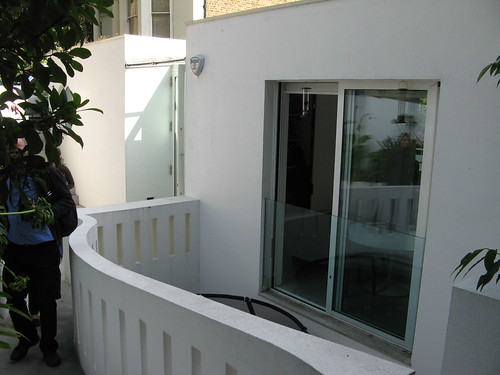
Part of this year’s London Open House was Michaelis House, 95a Oxford Gardens, London W10 6NF. This is what the documentation said of it:

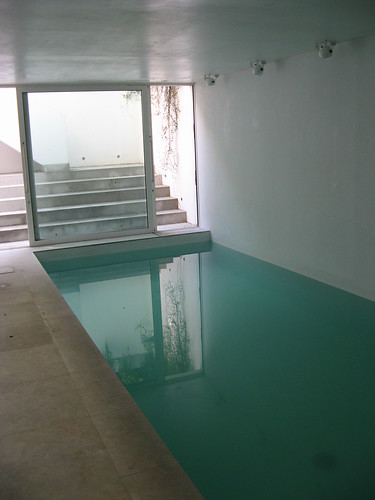
Low-build 5-bedroom house with swimming pool, incorporating grass/sedum roof, borehole/heat pump hot water/heating system with solar panels (thermal and PV) and electric car.

The wife was keen on inspecting this prize example of innovative British design and competence, so, having arranged babysitting for the imp, we headed to Ladbroke Grove on Sunday afternoon, hoping to make it to the property in time for our appointment at 13:45 hours. Just days earlier we had received a vaguely threatening email from the Open House organisers that if we were no-shows, we’d be banned for all time from any future events, and it was with a suitably cowed demeanour that we scrambled on trains and taxis to get to Oxford Gardens.

We made it there just in time and found to our disenchantment that there was no attendance record, and to our glee that Mr Alex Michaelis, who designed and built the house for himself and his family, was at hand to welcome visitors. He was casually clad in t-shirt and khakis and sandals, and murmured pleasantries to the guests. There were quite a few people around, it has to be said. The Open House is a very popular annual programme, allowing entrance to properties that are usually out of bounds to the public. Thus, various modernist schools buildings and offices and, indeed, several residences are open to visit.

I managed to take a few pics here and there to give you all a dekko into the interior decor and sensibilities of the high and mighty. Mr Michaelis is quite the star architect – he designed David Cameron’s residence, the wife tells me – and so it’s fun to examine the way his mind works.

Here’s the design description (which I got from an A4 sheet that Mr Michaelis kindly pointed us to):

The aim of this project was to build an environmentally sustainable, detached, five-bedroom town house, complete with indoor pool and children’s play area. With restrictions to build no higher than the 6 ft boundary wall to achieve invisibility from the street, this two-storey house has been driven into the ground and therefore ensures that the site remains ‘an important open space between buildings’. Although the building is sunk into the ground, the design objective was to create a light and open space. On entering, the ground floor houses a large open plan living space surrounding a stairwell. A roof light above not only floods additional light into this area, but also penetrates light down into the central area of the lower floor. Additional light punches into the lower floor via two lightwells at opposite ends of the building, working in conjunction with carefully placed light slots, to provide each room with natural light. A large glass screen runs between the pool and the central hallway, increasing the sense of space and allowing light to filter through the lower level.

It has to be said that on a sunny day such as Sunday, we found the top level well lit, and even some of the lower level was nicely bright. There were a couple of rooms that we found a bit dark. Interestingly, the stairwell had an adjacent ramp for kids to slide down – a playful touch in an otherwise minimalist decor.

The environmentally green mandate has been fulfilled by three mutually reinforcing methods. First of all, the house enjoys the natural insulation provided by the earth around it. Next, an indirect heat exchange system passively supplies filtered and heated air throughout the habitable rooms, thereby decreasing the energy footprint. Lastly, solar panels on the awning provides electricity both to the house and to the electric car – a Citroen Berlingo – that the Michaelises use. In winter, the architect claims, the house only requires minimal power from the grid; in summer, the house generates a surplus that can be returned to the grid.

Because London’s water table has been rising over time, mainly because water-hungry industries no longer function in the city, flooding is a frequent problem. The Environment Agency therefore encourages the use of bore-wells, and Mr Michaelis has installed one in this property. It is a 110 metres deep, and the extracted water is filtered for domestic use. The temperature differential is used to power the heat pump that provides both the under-floor heating and hot water in the house.

Finally, “there’s a grass roof that reinstates the garden to the surrounding houses… planted bulbs flash colour across the seasons. The house also incorporates a climbing wall … circular wall openings to create an inside-outside adventure playground for the children.”

Neat-o.

Check out floor plans and other design documentation here.

Sep 22, 2009

Weekend Shenanigans

Our lives usually progress with little volatility, you know, hardly a ripple to ruffle the placidity of our existence. And then, like the credit crunch, we are beset with a mind numbing array of simultaneous requests for socialising and culture-vulture-dom, which does all it can to wear us out spiritually and morally.

And so it happened this weekend. The boy was invited to two separate birthday parties before which he managed to ruin a perfectly decent pair of shoes by using them to brake whilst riding his bike. Recently provided new clothes by grandparents and used scarcely once were found to have enormous stains of mysterious provenance after a roll in the park. We had to take him to the shops, therefore, to get a new pair of shoes and a fresh set of trousers. Meanwhile, the wife had arranged babysitting so that we could inspect some interesting examples of modern British architecture (part of the London Open House weekend). And then it turned out that the venue of one of the parties was dependent on the vagaries of the weather – and the boy’s friend’s mum was not responding to our increasingly frantic calls to determine exactly where we were to show up.

I’m glad to say that we managed to make it to the shops, the Open House, the parties, and we didn’t get soaked either. It was all touch-and-go, though, for a while. We needed to hail taxis, jump aboard strange buses, share a train with eager Chelsea football fans. Sweaty business, it was, too.

I’m glad the weekend is over.

Sep 21, 2009

London City Quiz

At the Barbican Library, there is a spectacular collection of documents from London's history all the way back to 1722. To celebrate this fact, there has been an exhibition of a thousand tomes available to borrow on the open shelves from June 2009. And, to encourage people to learn more about this greatest of cities, the library offered the following quiz, a lucky winner of which would win the Museum of London book London: The Illustrated History:
  1. In 1941, Noel Coward sang of 'London Pride', but what exactly is 'London Pride'?
  2. How many times was Dick Whittington elected Lord Mayor of London?
  3. Including the City of London (the 'Square Mile'), how many London boroughs are there?
  4. What type of mythical creature is depicted on the City of London crest?
  5. Which infamous building once stood on the site of the Old Bailey?
  6. The Olympics were twice previously hosted in London - which years?
  7. In which year was the last public execution carried out in London?
  8. Name two films, made famous by Ealing Studios in the late 1940s and early 1950s, with areas of London in their titles.
  9. In which year did trams disappear from the streets of London?
  10. Which is the odd one out in this selection of Cockney rhyming slang: Whistle and flute / Alice bands / Almond rocks / Round the houses / Dicky dirt / Tit for tat
  11. Whose address was once known as 'No. 1, London'?
  12. 'Going west', 'One for the road', and 'On the wagon' are all associated with the trip to which part of London, a trip that many were reluctant to take?
So there you go. Eminently do-able with judicious reference to the Internet. Have fun!

[Oh and yeah, the book's already been given away.]

Sep 20, 2009

Crime - Eighth Month

I'm afraid this month is a little less than prodigious in my reading. You see, Camomile Street Library has six books on order for me, none of which arrived for my eighth month of reading translated crime fiction. I hope that the ninth month will prove a bit more numerous.

Anyway, we have good stuff this time. I start with the absolutely superb Brodeck's Report by Philippe Claudel. I mean, this is absolutely superb. It is the tale of outsiders in an isolated village, and how no matter how many decades an outsider spends in such a village, he will always be an outsider, and when push comes to shove, the outsider is the first to go. So what do we have here? Brodeck is the one educated man in this village somewhere in the Alsace region of France, in the period between the world wars. He had arrived there as a child and the villagers, recognising his academic potential, paid for his post-school education. When the German army marched into the village in 1940, the villagers denounced him as an outsider and he was dispatched into the concentration camps, where by means of sheer will and self-abnegation he survives and returns to the village, to find that his family has been raped and ruined. For some reason he continues to live in the village, and all the guilt and sins of the villagers are somehow buried into their subconscious. But of course this doesn't last long - when a colourful visitor appears in their midst and settles down amongst them and reflects the poisons in their natures back to them in a series of innocent paintings, the villagers kill him. As an educated man, it's Brodeck (who had nothing to do with it) tasked with writing up an account of events to the judicial authorities to exonerate the villagers' action. Brodeck complies but also writes up a separate account for his own sanity, and that is what the readers see. All manner of sickness dwells in the hearts of men, and no amount of goodness can keep it at bay. Eventually, the wicked and the strong tend to win. This is a powerful work.

From France to Bolivia, and we have Juan de Recacochea's Andean Express. This is not a traditional crime caper in the oeuvre of Agatha Christie's Murder on the Orient Express, but owes much to that great book for its inspiration. Sometime in the 1950s, a motley bunch of people board the train bound for Chile and one of them is murdered. It's fairly clear that most people aboard the train wish the victim ill, and it's quite clear why as well - he is not a particularly nice fellow. But de Recacochea's intent is not to analyse the crime; there's no eureka moment when all becomes clear - there's nothing, really, to make clear; rather, he spins a left-wing rhetoric which is slightly offset by the viewpoint of a young, upper class high-school student, who, of course, sees events through the prism of his own wealth and status and inveterate horniness. It's funny in many ways; all in all, a slim, easy read.

Now if you pick up Andrea H. Japp's The Season of the Beast: The Agnes De Souarcy Chronicles 1 thinking that it is a self-contained work, you will be, as I was, horribly disappointed. This is historical fiction set in the 13th century with the usual suspects - papal ideology, kingly intrigues, and Templars. You can't have medieval fiction without the freakin' Templars, it looks like. All right, so Japp throws in a super-smart Hospitaller into the mix, emphasising this order over the soon-to-be destroyed militant Knights. And there's mention of some document that purports to show evidence of the New World. Very spooky. Oooh. But that's all part of a papal grand game. What concerns the author more is the goings-on in a little feudal estate run by an insanely beautiful and terribly impoverished Agnes de Souarcy, who is managing by the skin of her teeth to avoid being ravished by her pedophile brother (who also has an eye on her 11-year old daughter). There's also a cross-dressing mini-genius child who is investigating anything even remotely suspicious that happens in the Souarcy fiefdom. Nearby, in the woods, a series of monks are found brutally murdered. It becomes quite clear at about 75% of the way through the book that there is no way in hell all the various strands of the tale will be resolved, and so it proves. This is only the first part of a long chronicle! There are two sequels to this and I'm not sure I have the puff to read them to find out what happens to the benighted (and beddable) Agnes or the ultra-smart Hospitaller.

And then we have Akashic Press's latest in their Capital Crime series - Paris Noir (Akashic Noir), edited by Aurelien Masson. (Such a nice name, Aurelien, eh? When the French pronounce it, it sounds exactly like Orleans. At least to my ear. I met a chap called Aurelien once. A student at Rutgers. No, I don't think it's the same as this Masson fellow.) In many ways this is a much better collection of crime shorts than the previous one edited by Maxim Jakubowski, also called Paris Noir, which I reviewed here. Many of the stories here are really hard noir, brutal and unforgiving in their characterisation and the milieus. Indeed, the stories range into parts of Paris I'd never heard of, although some of them are set in the usual red-light areas of Pigalle. Chantal Pelletier's The Chinese Guy is disturbing, written from the point of view of a psychotic woman who likes to cook for her victims. The story by Salim Bachi called Big Brother is another one that throws quite a wallop - an erudite Arab man turns out to have hidden depths of violence in him. The one I liked for its twist at the end was Precious by DOA, all about heists and torture and deflecting the reader's attention. The book is, I've got to say, a nice-time pass.

And, finally, after this preponderance of French fiction, we put in Sebastian Fitzek's Therapy, a German thriller with misdirection following misdirection, and dealing with particularly beastly crimes. A psychiatrist collapses after his daughter is kidnapped and retires, abandoned by his wife as well, to a remote island in the North Sea to recoup and recuperate. He cannot believe that his daughter is dead, and he has hired a detective who has been keeping the case alive for the past four years. Of course, there's a storm that cuts off communications, and the psychiatrist finds himself stalked by a schizophrenic woman who claims that her characters are coming alive. One of these characters turns out to be a 12-year old girl in every way identical to the psychiatrist's daughter, and despite himself he is drawn to psychoanalyze the woman. And then the twists in the tale begin, and what twists! Nothing is as it seems. Even the story is less psychological than about psychology itself. There's entry-points into the subconscious that are later revealed to be real events, and events apparently real that are only figments of imagination. The denouement is startling and affecting in equal measure. This was a smash hit in Germany on its release in 2006, and is well worth a read.

And that's it for the Eighth Month, folks.

Woo-hoo. New Scientist has a special issue out on Science Fiction, which is always heartening, especially to those of us nonplussed by such nonsense as the Sci-Fi television channel renaming itself to SyFy, and by the general disdain exhibited by aficionados of 'literary' fiction against 'genre' fiction.

Sep 14, 2009

Monday Fun

Ever wondered why Space Bar is so chipper? Well, there's an application entirely in her honour.


I'm sure budding tabalchis will probably ace this. My own record - I cunningly managed to beat everyone who tried it at work - was 48 beats in five seconds.

How well did you do?

Sep 13, 2009

Reservationists

On our trip back from Gloucester over the weekend, we had to change trains at Swindon. Proudly bearing our seat reservations, we marched up to Coach D, and found a middle-aged couple sitting on our seats.

"Ahem," I said. "I think you're on our seats?"

The man shook his head. So did the woman.

"No reservations on this train," he said. "We've been on it since Cardiff."

I was so taken aback by this riposte that I wordlessly moved my jaw for a couple of minutes.

"But I have a reservation!" I then wailed, brandishing the tickets in his face.

"Go and sit somewhere else," said the woman, not unkindly, but not too politely either.

By now the boy was getting restless.

"Can we sit here?" he said.

"No," I said, and yet another illusion in his mind of his dad's almightiness was silently shattered.

I buttonholed the guard, who admitted that there were no reservations on this train.

"But I have a reservation!" I muttered.

"You can sit in First Class," he said helpfully.

So that's what we did.

Good to see that British railways, like their most prodigious scions, the Indian railways, are no less cavalier in their treatment of reservations. Still, First Class. That's something, innit?

Sep 10, 2009

For Horton Was A Hoo

John Horton Conway, mathematician extraordinaire, is a man of so many parts that for all practical purposes he might as well be a god. Well, a demi-god, at least. Computer scientists adore him for the Game of Life; magicians revere him for his card tricks; gamesters love him for his wicked puzzles. His brain is a computer all in itself - he can tell you on which day any given date falls, and he can do so in less than a couple of seconds.

Women love him because he can rattle out the names of every visible star in the sky - and in alphabetical order, pointing at each star in question.

His finest achievement, however, has to do with his tongue. One in four people is able to roll their tongue to form a valley in the middle. So can John Horton Conway. One in 40 can form a clover, three valleys, with their tongue. So can John Horton Conway. One in 400 people can invert their tongues. And, indeed, John Horton Conway can twist his upside down. And one in 4000 can make their tongues go thick or thin. We do not hesitate to point out that John Horton Conway can do this as well.

He has only known one other person able to do all this - a woman he once met at a party. When he suggested that this meant that they were meant for each other, she shook her head and retreated fearfully.

He is fairly certain, though, that he has her beat at his last tongue trick. He can undulate his tongue in a continuous sine wave.

John Horton Conway is a much married man. With his first wife he had four kids. With his second, he had two. He has moved on to his third wife now, with whom he has one kid. He doesn't think he will ever have a fourth. It's not just that he is old. With his passion for patterns, he would need to have half a kid with her.

And that, we fear, is an achievement even beyond John Horton Conway.

[Check out Marcus du Sautoy's Finding Moonshine for these and other tales of great group theorists.]

In 1722, Daniel Defoe published his A Journal of the Plague Year (Dover Thrift), a document of the Great Plague that had ravaged London fifty-seven years earlier. Astute readers would immediately have noted that Defoe would have only been five years old when the Plague struck. Defoe was offering his readership a copiously researched yet fictionalised account of that terrible time. With his journalistic background, he was perfectly suited for this task.

Alice Ford-Smith led a guided walk in the shadow of Defoe's great novel. Starting at Tower Hill and ending two-and-a-half hours later at Bunhill Fields, this was a well-organised affair under the auspices of the Guildhall Library. Alice interspersed a slightly energetic walk about the City of London with breaks where she discussed Defoe's life and times, the Plague years themselves, and recounted stories of the common people affected by the last pestilence in the City. Defoe, she said, narrated his tale through the voice of a single businessman H.F., who watched events unfold and tried to document them to the best of his ability.

Tower Hill to Muscovy Street (past Trinity House) to Seething Lane Garden where one finds a bust of Samuel Pepys, who himself had survived the Plague of 1665.

Defoe's narrator, H.F., discussed the symptoms of the infection, noting that it affected different people differently.
And here I must observe also that the plague, as I suppose all distempers do, operated in a different manner on differing constitutions; some were immediately overwhelmed with it, and it came to violent fevers, vomitings, insufferable headaches, pains in the back, and so up to ravings and ragings with those pains; others with swellings and tumours in the neck or groin, or armpits, which till they could be broke put them into insufferable agonies and torment; while others, as I have observed, were silently infected, the fever preying upon their spirits insensibly, and they seeing little of it till they fell into swooning, and faintings, and death without pain. 1
He was not to know, of course, (for the uncovering of the causes and types of the plague would take another couple of hundred years), but there were indeed three types of the pestilence: bubonic, pneumonic, and almost completely fatal septicaemic, and he described all three.

Seething Lane Garden to St. Olave's Church
This was Pepys' "Our own church", and centre of a parish that suffered terribly during the plague. Victims were initially buried with the usual ceremony, but the church grounds quickly ran out of space, and by then there were few people willing to stick around to minister to the dying. To their lasting shame, Church of England priests escaped the city at the first sign of the disease, abandoning their flocks to spiritual blackness. Defoe himself was of Dissenter stock, people who did not accept the Church of England, and who had been expelled in 1662. Seeing how the priesthood gave up their duties when the plague arrived, the Church recalled Dissenter preachers to provide succour to the masses, only to expel them once again when, after the plague died down, the cowardly mainstream priests returned. One can discern remnants of the bitterness that remained with Defoe and his fellow Dissenters at this base treachery.

Defoe as a Dissenter, then, would not have worshipped at St. Olave's. But it is in this parish that the first recorded death - of a Mary Ramsey - occurs. Today visitors stand on the covered graves of the victims, a fact that becomes obvious when they observe the steps that lead down to the front door of the church.

Left onto Crutched Friars to Hart Street to St Mark Lane to Star Alley to the Tower of All-Hallows Staining

The Church of All-Hallows Staining was one of the very few to survive the Great Fire of London, but only a few years later it collapsed, its foundations having been undermined by the pressure of all the dead bodies buried in the yard around it. Here in 1664 and 1665, as on other churches in the City, a helpful and hopeful administration put up bills of advice to the panicking Londoners.

What was the advice given to the citizens? At first, it was to evacuate the City. Two hundred thousand Londoners legged it to nearby villages such as Dulwich and Greenwich, and farther afield to Norwich. Of course, they carried the plague with them as well. Those who could not leave the city faced official measures to control the outbreak. Theatre was banned, no congregations were allowed, streets were cleaned of animal dung and fruit and vegetable remains on a daily basis. Pubs were allowed to stay open, but only till nine o'clock at night. These measures were no different from those enforced during previous outbreaks; they had been ineffective then and continued to be useless now, a sad reflection on the lack of progress in understanding the causes of this epidemic in the intervening decades.

H.F. reported that a man locked himself up in Charterhouse for seven months and survived; he himself had considered doing the same, and had amassed enough provisions to be able to do so. But his curiosity overcame his caution, and he ranged abroad and studied and observed.
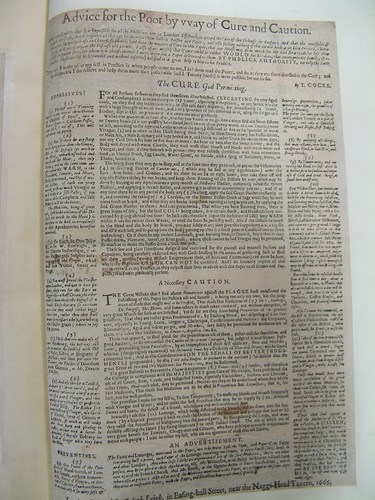
Civil measures were 'enhanced' by pseudo-medical advice. "Certain Necessary Directions for the Preservation and Cure of the Plague", these advice sheets were called. People were urged to smoke. At Eton College, school-boys were punished severely if they didn't. People were urged to eschew cucumbers and melons and cherries. They were encouraged to consume garlic. H.F. talks about a husband who sucked on garlic and smoked all day, while the wife bathed herself in vinegar. It may not have been pleasant to be in their company, but they might very well have survived.

People were encouraged to contract syphilis! Rumours abounded that exposure to this sexually transmitted disease would ameliorate the effects of the plague. Some doctors scoffed at this thought, wondering why anyone would endanger their body and soul with such recklessness. But there may have been an element of fatalism in the face of so virulent a pestilence. If one is bound to die, perhaps one might as well do so after some hearty bonking?

Left onto Fenchurch Street to Lime Street through Leadenhall Market onto Cornhill past St. Michael's Church into St. Michael's Alley

People who lived separated from their neighbours by wide streets tended to have, on average, a lower mortality rate than those who lived in narrow bylanes (such as St. Michael's Alley). The former's mortality was approximately one person per household; in the crowded little streets, three people on average perished in a household. Quarantine was rigidly enforced - a large painted cross on a front door marked a house where a case of plague had been detected; the family of the sufferer were barricaded in, the front door locked and a guard posted in front. For forty days, they would be imprisoned. The feeling was that at the end of that period, they would either have survived the plague, or died from it, and were no longer a danger.
That if any House be Infected, the sick person or persons be forthwith removed to the said pest-house, sheds, or huts, for the preservation of the rest of the Family: And that such house (though none be dead therein) be shut up for fourty days, and have a Red Cross, and Lord have mercy upon us, in Capital Letters affixed on the door, and Warders appointed, as well to find them necessaries, as to keep them from conversing with the sound. That at the opening of each Infected house (after the expiration of the said Fourty Days) a White Cross be affixed on the said door, there to remain Twenty days more; during which time, or at least before any stranger be suffered to lodge therein, That the said house be well Fumed, Washed and Whited all over within with Lime; And that no Clothes, or Householdstuff be removed out of the said house into any other house, for at least Three months after, unless the persons so Infected have occasion to change their habitation. 2
Most households were unprepared for this incarceration; their lack of free movement meant that they were dependent on their neighbours for provisions and medical help, neither of which, in the panic, might be forthcoming. The stifling atmosphere no doubt engendered despair and desperation. People tried to get around their difficulties by attempting to bribe the guard, or sneaking out by way of the roof or backyards. One family, incensed by the guard's lack of cooperation, blew him up and absconded.

But people who escaped might have been infected, and would perish nonetheless. They would do so isolated, for nobody would come near them. They would collapse on the streets and die, and the infection would continue to spread. Meanwhile, it became more and more expensive to maintain the quarantines (would-be guards were more and more terrified of dying themselves and were reluctant to oblige); eventually, the policy of locking-up was rescinded.

Through Castle Court to Ball Court back to Cornhill to the Royal Exchange

Daniel Defoe was no stranger to the commercial heart of London, now occupied by the Royal Exchange. He was, for about forty years, a merchant of hosiery, and not too successful either. He was easily led into speculative ventures and spurious possibilities for profit, and tried to expand into horses and wine and even a diving machine that would supposedly make him wealthy. He was ruined and declared bankrupt in 1692, owing £17,000, a staggering sum. Despite being thrown into Newgate prison and paying off some of his debt, he was never entirely free from his creditors. A second bankruptcy in the early 1700s meant that they were to pursue him for the rest of his life.

To supplement his income, Defoe began to write, and he did so copiously. Nearly 350 manuscripts are known, from pamphlets to essays to books. In 1702, he wrote an anonymous satirical piece titled "Shortest Way With the Dissenters", in which he suggested that the best way to get rid of the Dissenters, who at the time were looked upon with suspicion and loathing by the general church-going populace, was not to pass laws against them, but to kill them all. Unfortunately for him, the note was taken seriously by hot-headed Anglican conservatives in office, and - when he was outed as the author 3 - even his co-religionists became upset with him. The satire was entirely missed. Defoe was arrested and convicted of seditious libel, fined heavily, and sentenced to three hours in three different stocks in the City.

Now this was a serious punishment - the convict's head and hands would be locked in place between wooden boards in public, and he would remain at the mercy of the passers-by. There had been cases of stoning resulting in the blinding or even death of prisoners. Defoe, faced with this terrible possibility, did not panic. He wrote a "Hymn to the Pillory", in which he claimed to be a champion of the downtrodden citizenry campaigning for their right to free speech.
"Actions receive their tincture from the times,
And as they change are virtues made of crimes."
This became so popular that, far from smashing his head in when he was put in the stock, the citizens of London crowded around him, casting flowers upon him, selling his pamphlet in large numbers, and protecting him from the violent elements.

Defoe, despite the brisk sale of his oeuvre, still didn't have enough money to pay the fine, so he was whisked off to Newgate prison once again. This time, however, Queen Anne came to his rescue. She paid his fine, and offered some monies to his family so that they might not want. So taken with him was the Queen that he was offered a post in the government offices. He even became a spy, which just goes to show that in Defoe's case at least, fact was more fabulous than any fiction.

Royal Exchange to Lothbury to Basinghall Street to the Guildhall
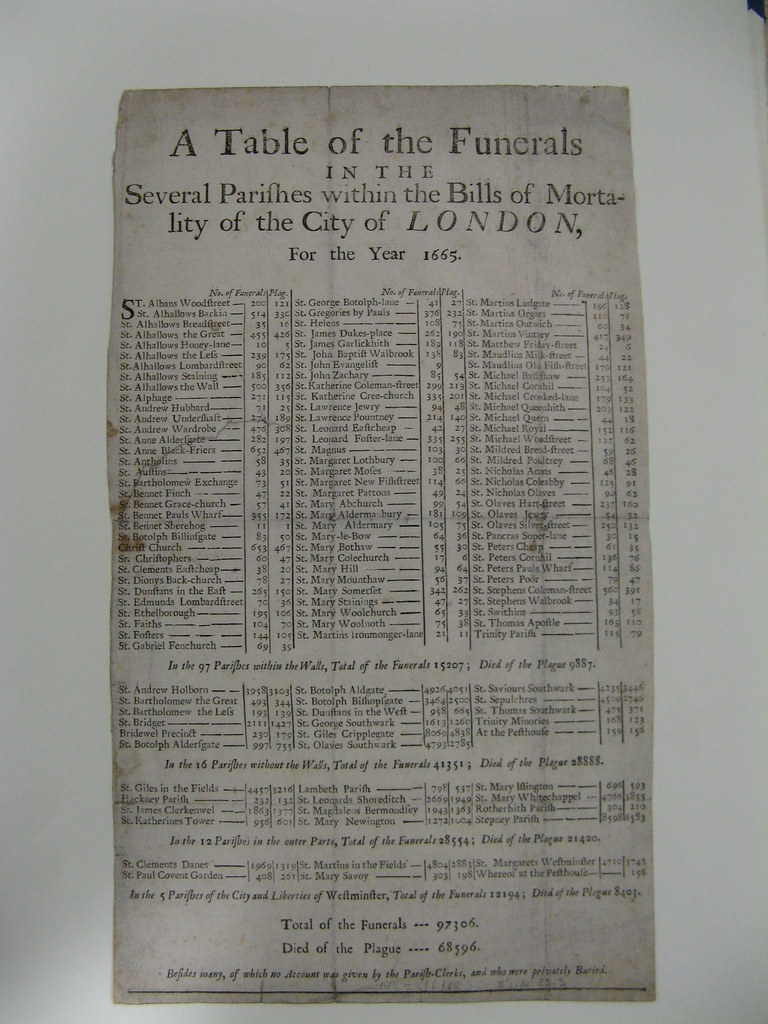
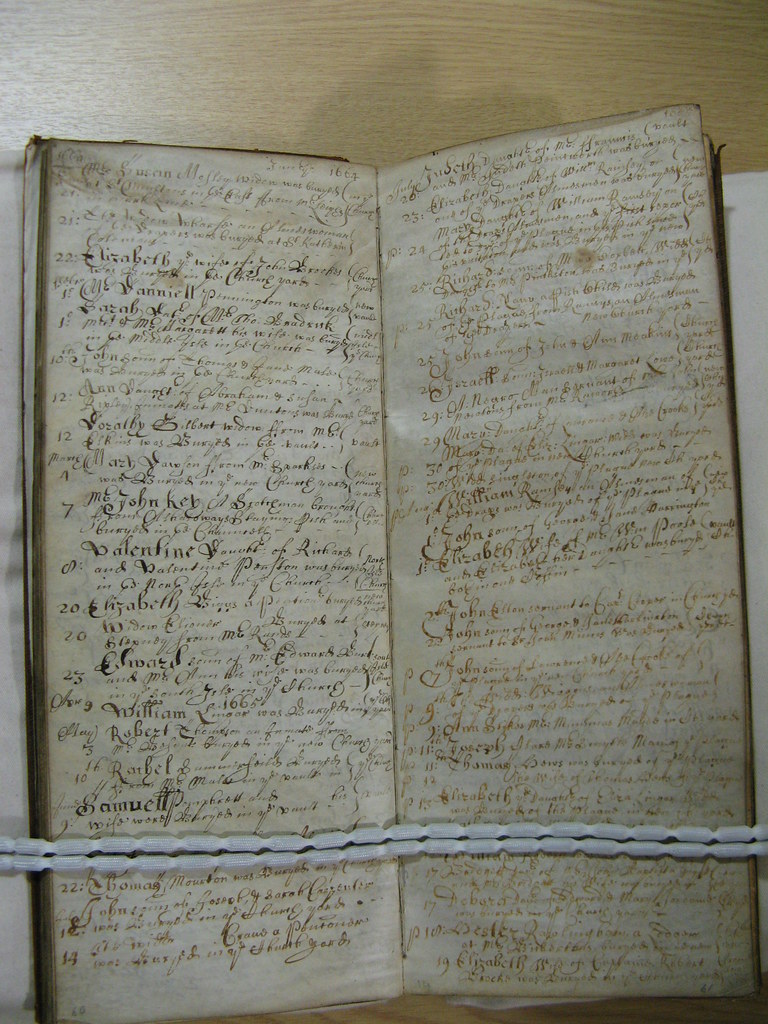
In the archives of the Guildhall, one can find the plague records meticulously maintained by the various parishes of the City. St Olave's parish provides an example of the staggering casualties during that terrible year. In August 1664, when the plague began to seethe first, two pages of the church death register were filled with the names of the dead. A year later, ninety-eight pages were filled with the names of the victims. There are about 30 names to a page; evidently, nearly three thousand people perished in just one parish in a single month.

Turn from Gresham Street right onto St Martin le Grand through Postman's Park and Watt's Memorial right onto King Edward Street to Little Britain through Smithfield Market right onto Charterhouse Street and onto Sutton's Hospital at Charterhouse Square

It was estimated that ten percent of London's population of half a million died in the first two months of the plague. By the time it died down, nearly a fifth of the population had been wiped out. People were dying so fast and the survivors so panicked that burials and spiritual support pretty much collapsed. The great plague pits that had been covered up after the previous visitation of the disease were reopened. One of them lies underneath the private garden in the middle of Charterhouse Square. Every night, plague carts plied the streets of the City carting the dead off to be tossed into the pits. During the day, the pits would be covered with lime. Upon hearing the carters' cry "Bring out your dead! Bring out your dead!", families would wrap their dead in cloth and put them on the alleys outside their homes; carcasses of people who died on the street were picked up by the carters. The near and dear of the victims were banned from coming anywhere near the plague pits: many, in their despair, wanted to throw themselves into them and end their misery, but suicide of course was a deadly sin.

There is a story of a merry piper who fell asleep, completely drunk, in a street one day, and was picked up by a plague cart. The tale doesn't end unhappily for him, however, as he revived before he was tossed into a pit and avoided the terror of being buried alive and suffocation.

Left onto Carthusian Street and past the Sutton Arms pub (dating from 1611) to Aldersgate Street through the Barbican past Defoe House and Speed House and Bunhill Row into Bunhill Cemetery

What prompted Defoe to write about the Great Plague nearly sixty years after the events he described? It might have been the news of an epidemic raging in France in 1720 that concentrated his mind, fully aware as he was of the extreme contagiousness of the dread disease. As it happened, the plague of 1665 was the last major outbreak of the pestilence in London. Defoe's book remains, however, a superbly detailed and rich account of those terrible times.

Bunhill Cemetery was one of the burial grounds in London for the Dissenters. Daniel Defoe was interred there, as was William Blake. He died a deeply unhappy impoverished man (facing, he wrote, insupportable sorrow) for he was hounded to the end by his creditors. He was buried under another name, possibly to put the creditors off track: they were known to dig up a debtor's body and ransom it for repayment from the grieving family. A collection from the children of London to honour their much-loved writer of Robinson Crusoe raised enough money for a grand obelisk to be erected in his name. Visitors to Bunhill cemetery can still see it today.

References

1. Daniel Defoe, A Journal of the Plague Year
2. Rules and Orders ... for prevention of the spreading of the Infection of the PLAGUE.
3. Ashley Marshall, The Generic Context of Defoe's The Shortest-Way With the Dissenters and the Problem of Irony, The Review of English Studies, August 4, 2009.

[Continued paraphrase of Allan Chapman’s Gods in the Sky, episode 2, from Channel 4.]

008 almagest For all the brilliance of Hipparchus, the best of classical astronomy was yet to come. For this, we must turn to the greatest astronomer of antiquity, whose greatest achievement was also his greatest mistake. The crowning glory of ancient astronomy lay in the work of Claudius Ptolemy. He lived around 150 AD, and we know little about his life in detail, apart from that he spent most of his glittering career in the city of Alexandria. He wrote the book that was to change the subsequent course of astronomical history. He brought together the best of the ancient Greek astronomers into one work. We call it the Great Compilation; the ancients called it the Magna Syntaxis; but it has become famous under the title the Arabs gave it: the Almagest.

The Almagest contains hundreds of papers of astronomical observations, diagrams, theorems and hypotheses, all aimed at explaining the movements of the stars and planets. It demonstrates the eccentric orbits of Mars and Mercury, it charts the retrograde movements of Saturn, Jupiter and other planets, it describes the fixed rotations of the stars around the 009 geocentric poles of the ecliptic. This is truly a scientific work of staggering complexity. But for all of Ptolemy’s genius, there was one fundamental flaw at the heart of his system: his working model of the Universe was geocentric.

Unfortunately, from our viewpoint, the planets do not seem to move at regular speeds or regular directions, as we might expect from simple planetary orbits around us. They speed up, slow down, go forwards, backwards, and generally misbehave. Today, we know that is because they are not revolving around the Earth at all, but rather the Sun. Nevertheless, without discarding his geocentric hypothesis, Ptolemy tried to construct a logical structural argument for the movement of the planets. The resulting system was ingenious, so much so that it persisted for centuries after him, becoming both religious and scientific dogma.

The geometric notion at the heart of Ptolemy’s theory is known as an epicycle. This can be demonstrated using 010 epicyclea bicycle wheel, a few cogs, a small light bulb, and some sturdy knicker elastic (see figure: as you rotate the cycle wheel, the cogs move the bulb attached to the pedal in a circular motion of its own; this motion of a point moving in a circle around another point moving in a circle is an epicycle.) Imagine, therefore, that the centre of the Universe is the Earth, and every planet moves around a point that itself is moving around the Earth. Although the planet is moving at a constant speed about its orbital centre, from the Earth it would appear to move at a variety of different speeds, and indeed backwards and forwards over time. By building several such epicycles upon epicycles, Ptolemy was able to come up with a remarkably accurate picture of the Universe – accurate insofar as it was able to predict the appearance and location of the planets into the future.

But where did this leave the Greek gods in the sky? The explosion of knowledge from astronomers like Hipparchus and Ptolemy was unlike anything seen before. The older astronomical observations encoded in the form of myths had been developed over hundreds of years. But the astronomy of classical Greece was developed very quickly indeed, by philosophers rather than priests, and was far too complex to be encapsulated in simple tales. What is more, the same freedom that allowed the Greeks to speculate about the cosmos allowed them to question the existence of the gods. One philosopher – Alcmere - claimed that there weren’t twelve gods on Olympus, but only three, representing the Sun, the Moon, and one for the stars. Another – Parmenides - argued that there was only god, who lived in the Sun. And Strabo argued that there were no gods at all, but merely nature.

Greeks continued to worship their gods, but the deities began to be taken less and less seriously by scholars. Instead, they tended to explain ideas using poetry and philosophy, and at the centre of this understanding, we see morality and reason intermingled in a new and potent way. To the Greeks, reason and logic were inextricably linked to love and morality. Indeed, together, they formed the divine purpose of the cosmos. One of the most important themes in Greek philosophy was the relation between love and truth, and the Greeks who believed passionately in reason, declared that you couldn’t have one without the other. The connection between the love of truth and the truth of love was illustrated in the tale of Aphrodite and Hermes.

Hermes was the god of reason and truth. Like the Egyptian deity Thoth, Hermes was the giver of the word, the inventor of the alphabet, and language. He was the god of astronomy, of logic and mathematics, and of music, and time. And so he played the heavenly lyre with seven strings, corresponding to the sacred planetary week. We are told that Hermes was deeply in love with the beautiful Aphrodite, goddess of love. We are told that Aphrodite, flattered by the attentions of Hermes, agreed to be his lover, and from their union came the double-sexed being, sometimes called Hermaphroditus, and sometimes, the lovely Eros, the self-reproducing creator of the Universe. In this strange romantic relationship between the two divinities, we find a mythical poem which underlies the Greek love of reason.

For the Greeks, geometry was far more than a mere tool for making maps and charting the heavens. Their studies had revealed to them that there was an internal logic and absolute truth written into the very fabric of the cosmos. For them, there was nothing more beautiful than this truth, nothing more perfect than this, or more lovely. They called it the logos. The Christian astronomers who came afterwards called it God.

11 was a racehorse
12 was 12
1111 race
12112

(from Marcus du Sautoy's Finding Moonshine)

[We continue the paraphrased transcript of Allan Chapman’s Gods in the Sky, episode 2, from Channel 4]

The Ancient Greeks were by far the finest astronomers of the ancient world. This was because they were free. And because they were sailors. To see why, we have to understand the country’s geography. It is a mixture of islands, bays, inlets and headlands. It’s a country of boats, of sailors. Think of Jason and the Argonauts, the Odyssean voyages. The way the Greeks tackled the sea from the earliest times made them a free people.

As well as being farmers, the Greeks were merchants who enjoyed the limitless independence of the seas, an independence that comes from trade. It is here in Greece that one finds the first real concept of Law, a set of rational rules governing society and constructed by its own people who formed a democracy. This Law guaranteed freedom and the rights of the individual. Here Law was used not as a tool of oppression, but as a tool of freedom. In the courts, people could guarantee their own rights and see to justice. The Greeks had the right to be politically incorrect, to follow their own argument, and if they said something that someone else disagreed with, they had the right to argue the others down. They couldn’t be muzzled. That is one of the greatest contributions of the Greeks to the modern world.

The Greeks were free to disagree about the structure of the heavens; their disagreements were to be resolved not by reference to sacred texts, but by disputation and reasoned analysis. Greek astronomy was dominated not by priests but by philosophers, whose names resound through the ages. Anaximander argued, for example, that the universe was not created by a god at all, but was eternal and infinite, and that our own world was one among many. Aristarchus suggested long before Copernicus that the Earth moved around the Sun, and not the other way.

The sea not only gave the Greeks the freedom to think but also a freedom to think in a completely different way. Because they were a maritime people, they were the first in the ancient world to realise that the Earth was round, a sphere. It was Pythagoras in the fifth century BC who first put forward a systematic argument for why our planet was shaped like a ball. After all, if you were sailing away from land in a ship, you noticed that the beach vanished from sight first, then the headland, and finally everything dips below the horizon. But if you climb to the top of the mast, you can see the beach vanish again, and then the headland, and everything else disappeared again. You realised that you were sailing around a great curve.

So it wasn’t Columbus who discovered that the Earth was round: it was ancient Greek traders lugging their olive oil around the Aegean. And as they set off on their voyages, they needed to know where they were going, how to get there, and how to get back. And so it was that in the sixth century BC, the philosopher Anaximander produced the world’s first ever map. To construct this map, the Greeks needed to develop a set of intellectual tools with which to compute distance and direction. So a new science was born to map the world, but which could be used as well to chart the heavens. The Greeks called it Geometry.

The power of Greek Geometry is best demonstrated by Pythagoras. It was he who realised that there are eternal properties in shapes. If you take the radius of a circle, you will find that it will always divide the circumference exactly six times. And if you take the angles of a triangle, you will find that they always add up to 180 degrees, which happens to be as well the number of degrees in a semicircle. Now these are absolute truths, not subject to opinion or fiat. You can’t disagree with them; they are as perfect as laws can ever be, and that recognition was one of the supreme achievements of the human mind.

The sea-faring Greeks already knew with remarkable accuracy the distances between the great cities of the ancient world. With their knowledge of angles and circles, they were able to develop their knowledge in an extraordinary way. An example: Eratosthenes, a mathematician of the 3rd century, made a fascinating discovery when looking into a well. In one particular place in North Africa, he noted that the sun shone right down to the bottom of the well. At the same time, in Alexandria, the sun cast a shadow. Since it was the same sun that shone on both places, there was no reason not to use the angle between the two places to compute the size of the Earth. If you measured the distance between the two spots – one where there was a shadow and one there wasn’t – you realised that the line from the well and the line from the shadow both coincide at the centre of the earth; by knowing that distance as a fraction of a circle, you could calculate the diameter and then the circumference of the rest of the circle, and thereby obtain the exact size of our planet.

Geometry means to measure earth, but the Greeks soon realised that to make maps and chart the seas, they also needed to measure the heavens… We know very little about the astronomers of ancient Greece, except their names and the discoveries that are forever attached to those names. One of the greatest of these astronomers was a man from Rhodes – Hipparchus. He developed the modern constellations that we use today. Aries the Ram; Taurus the Bull; Gemini the Twins… He related particular stars to particular geometric points in the sky to create a science of astronomic measurement. He discovered that astronomical measurements taken centuries ago were not accurate today. The reason 005 tricutumis the Precession of the Equinoxes, which makes the position of the so-called fixed stars move ever so slightly each year, the result, we know now, of a small wobble in the rotation of the Earth. Hipparchus gave us an astonishingly accurate value for the length of the year: he said it was 365 days and 1/300th part of a day long. (He was wrong – it is actually 365 days and 1/128th part of a day long. But how astonishingly close!) He effected this computation from detailed perusal of old Babylonian records, and from study of the movement of the Sun among the stars.

But how did Hipparchus make his observations? Although the Greeks had no telescopes, they were able to make remarkably detailed observations of the movement of astronomical bodies by using a number of ingenious instruments. To make measurements of angles, they used three rulers that were hinged together and worked like a rifle-sight. 006 armillaryIt was called a tricutum, meaning ‘three rods.’ They wouldn’t look at the sun directly, but would let its rays shine through the top sight into the bottom sight, moving the lower rod till the sun’s rays were in exact alignment through the sights. They could then work out basic facts about the year: when was the longest day or the shortest day.

Measurements taken with instruments such as this could be used to chart the movements of heavenly bodies. Another ingenious device was an armillary sphere. This consisted of a spherical (!) Earth placed within a number of spheres of heaven, and a north and a south polar axis. And from wherever you were on the Earth’s surface, you could tilt the instrument such that it represented your local latitude. The outermost ring, called a meridian ring, would be ninety degrees to the horizon; you could then track particular astronomical bodies rising in the east, ascend to their greatest height in the south, and set in the west. You thus had the basic coordinates for the universe, and you can model the rotations of the heavens.

007 hipparchus earth moon dist Indeed, Hipparchus managed to calculate the distance from the Earth to the Moon. He did this by bringing together a number of observations of the shadows cast during eclipses at different parts of the world. He realised that there were times when the Sun, the Moon, and the Earth were all lined up. If you stood in the centre of the shadow, the Sun would be completely obscured by the moon. Now in 129 BC, if you were on the Hellespont near Athens, you would be in total darkness as you were in the middle of the shadow. Hipparchus found out that in Alexandria, people were only seeing a 4/5ths partial eclipse. Of course, Hipparchus knew the distance between Athens and Alexandria. He also knew that the moon orbited the earth in 28 days, and that the earth cast a shadow into space. He knew that at certain times the moon moved through this shadow, causing a lunar eclipse, and that this eclipse takes about six hours. Finally, thanks to Eratosthenes, Hipparchus also knew the radius of the earth. Using geometry, he was able to calculate that the moon was 67-and-a-third earth radii from our world. This is amazingly accurate, and marked the first time that geometry was used to measure distances between heavenly bodies.

[To be continued.]

[We continue the paraphrase of Allan Chapman’s Gods in the Sky, episode 2, from Channel 4]

So what was the point of the bizarre calendars we discussed in the first part of this post?

The primary function of the astronomical religions was to allow farmers to predict the seasons (as we have also seen from our exploration of Ancient Egyptian myth and faith). Indeed, it is the writer Hesiod who gives us the first documentary evidence of how the gods in the sky were used in farming:

But when Orion and Sirius are come into mid-heaven, and rosy-fingered Dawn sees Arcturus (30), then cut off all the grape-clusters, Perses, and bring them home. Show them to the sun ten days and ten nights: then cover them over for five, and on the sixth day draw off into vessels the gifts of joyful Dionysus. But when the Pleiades and Hyades and strong Orion begin to set (31), then remember to plough in season: and so the completed year (32) will fitly pass beneath the earth.

Like the peasants of Egypt and Babylon, Greek farmers used their myths to tell the time, but their myths were a lot more complicated than those of the other ancient peoples. And here lies a clue for why it was that the Greeks became by far the greatest astronomers of the ancient world.

In Greek legend, the Moon was held in special reverence, and worshipped as a beautiful and fertile goddess. She was a fertile goddess because her phases corresponded to the menstrual cycle of women, and she was so adored because she was so incredibly useful: her cycle lasted 28 days, dividing the month into 4 weeks. So, the adoration is understandable. But why did the Greeks have so many moon goddesses? Artemis was one, wielding her crescent bow; but so was Athena, who was known as ‘One who shines by night’; Hera, the wife of Zeus, was a moon goddess, as was the virgin Amalthea, and the orgiastic nymph, Io; and Nemesis, Andromeda, Danae, Selene, Helen, Persephone, Adrastea.

In Ancient Greece, you could hardly hurl a discus without hitting a moon goddess. The Sun was no slouch in multiplicity of godheads either. Take the Orion myth: Helios was the Sun. So was Apollo. And Zeus. And Hephaistos. Some Greeks worshipped the Cyclops as a one-eyed Sun god.

Why is Greek myth so complicated? Why all these multitudes of divinities? The answer lies in geography. Greece003 delphi comprises many small islands, and each island contained its own community often worshipping its own astronomical gods. As the Greeks were unified, all these various gods and myths became combined, making their legends very complicated, for they now consisted of multiple overlapping stories of astronomy and timekeeping. What’s more, the myths also began to reflect political relationships between the Greek states. The battles between the Greeks were recorded as squabbles between their various gods. And the fact that the Greeks lived in separate communities meant as well that there were differences in the ways they worshipped their pantheons.

This was to be crucial in the development of scientific astronomy. When the Greeks wished to talk to their gods, they would travel to the great temple at Delphi to meet the priests who would intermediate between them and the deities. At Delphi, they would ask questions of Apollo. But unlike the faithful of other peoples such as the Babylonians and the Chinese, the Greeks sought not instruction from their gods, but advice. And they could choose whether to accept or reject that advice. The Greeks, you see, were free.

Of all the peoples of the ancient world, only the Greeks enjoyed freedom, and this made a big difference to their view of the Universe. To see why, we can examine the despotic regimes of the ancient Orient. Unlike the Classical Greeks who lived in independent and democratic city-states, the Orientals lived under the heel of mighty monarchs, absolute kings, ruling by divine right in the names of their gods in the sky. 004 japan In Japan, it was said that the rule of the Mikado was by direct right from the Sun Goddess, and since he was the earthly representative of the divinity, he accompanied his court astrologers when they were taking astronomical readings of the shadow cast by the sun. Like the rulers of Ancient Egypt, the Orientals believed that the order they imposed on earth was a direct consequence and mirror of the order in the heavens. And just as the earthly emperor ruled on earth, so a Heavenly Emperor ruled in the skies. In China this was the Jade Emperor who lived in a cloud palace in a pearl star, and was so mighty he controlled the movements of the stars and the planets. To illustrate, we have the myth of the ox-herd.

The Jade Emperor’s daughter, we are told, is a beautiful princess called Chi Nu, the celestial goddess of weaving, associated with the star Vega, and who formed the constellation of Aquarius. Chi Nu was said to have made the clouds, and worn magical garments that changed colour with the seasons. One day she came down to Earth, and approached the bank of a silver river. She took off her magic coat and stepped into the flow in order to bathe. But while she was bathing, she was spotted and abducted by a common ox-herd (who was later to be associated with the star Altair, and whose ox was the constellation Capricorn). Much to the displeasure of the Jade Emperor, the two were happily married and had children. But one day, Chi Nu rediscovered her magic coat, and flew back into the heavens. To prevent the oxherd from following her, the Jade Emperor threw up the silver river into the heavens where it became the Milky Way.

Now this story which pertains to two stars belonging to what is now called the Summer Triangle is quite unlike the myths of the Greeks, for here we do not find a bunch of squabbling gods. Instead there was one supreme ruler, the Jade Empeoror, and it was in the name of this heavenly monarch that China’s rulers governed. So to challenge the earthly ruler would be to challenge the heavens themselves. You can see this in the myth of Monkey.

The story of Monkey is a satirical creation. Like other creation myths, it begins with an egg, which is fertilized by the wind. From the egg, there emerges a rebellious monkey who refuses to obey the laws of any human king, and declares himself a monkey king, and tries to become immortal like the heavenly ruler, to live forever among the people of the sky. This insolence angers the Jade Emperor and he summons the heavens themselves to attack Monkey. First, Monkey had to battle with the stars, and then with the planets, and if these weren’t enough, the Jade Emperor sends Time itself in the form of the twelve hours to attack the rebel.

Because the rulers of the ancient despotic lands claimed to govern as a divine right, the development of astronomy was seriously stymied, for anyone who speculated about the nature of the heavenly bodies was condemned as a blasphemer and a traitor. People were not free to question the official view of the heavens. What’s more, this way of linking the affairs of heaven with those of earth was deeply astrological, and a disturbance above would immediately suggest to a soothsayer something amiss down below. As a result, emperors were keen to keep astronomical data a closely guarded secret, terrified as they were of adverse astrological predictions, which they thought would reflect badly upon their rule. Astronomy, then, became a closed system. Although the Chinese collected a stupendous amount of astronomical data, they were unable to develop a truly scientific astronomy.

Today we might imagine that scientific astronomy began with Galileo and Copernicus. In truth, though, it was the Ancient Greeks who created the science of star-gazing. To understand how and why, we must look down from heaven and out to sea.

[To be continued.]

Sep 4, 2009

Like a Greek God

[From Allan Chapman’s series God in the Sky (Episode 2) on Channel 4]

In the beginning, according to the Ancient Greeks, there was no Heaven, no Earth, only Chaos. The only thing that existed in the midst of Chaos was a beautiful mighty goddess. She was black-winged Night. As black-winged Night danced, she set in motion Wind, which was something other than herself, with which she could begin the work of Creation. Night danced more and more wildly, arousing the sensual pleasure of the Wind, which coiled itself around her divine limbs and mated with her. And she became pregnant.

In the bosom of the infinite depths, black Night laid a silvery egg. We are told that after long revolutions over the ages, out of this egg, was born graceful Eros, the double-sexed goddess of sexual passion. And Eros brought out with her the Universe itself, the starry firmament set in motion. And to the stars, she added the Sun, the Earth, the Moon, and the planets.

According to the Greeks, the Universe was populated by a curious collection of gods and goddesses, whose adventures were recounted in the most bizarre stories. For example, we are told that after Eros set the cosmos in motion, mother Earth mated with Uranus, the sky god, and gave birth to the seven Titans, including the gigantic Atlas, whose job it was to guard the planets. But mother Earth became angry with her husband Uranus, and she persuaded her son Chronos to castrate his father. Chronos, whose name means time, stole into the royal bedchamber, and holding his sickle in one hand, crept up to Uranus; finding him asleep, he lifted Uranus’s tunic to reveal his father’s genitals, and he grabbed Uranus and castrated him. Chronos hurled the genitals into the sea, and from the foam they created, emerged the lovely Aphrodite, lovely and fatal.

Chronos then married his sister Rhea, who was also an Earth goddess. But it was prophesied that he would be overthrown by one of his own children, so every year that Rhea brought forth a child, Chronos would snatch it and swallow it. But Rhea grew tired of this and stole off one night to give birth in a place that Chronos could not reach. Thus Zeus was born, who in turn fathered two more planetary deities, warlike Ares and the swift Hermes, the speedy messenger of the gods.

001 What to make of all this? First of all, we should recognise that this creation myth shares a lot in common with creation myths of other peoples. These tales begin with primeval Chaos, out of which emerges the cosmic order of the gods in the sky, whose adventures often conceal important astronomical references. But the character of the Greek gods also reflects the nature of the planets. Saturn, the slowest and dimmest of the planets, was represented by the slow-witted Chronos, father of Time. Mercury, which whizzes around the Sun in only 88 days, was personified by Hermes. Jupiter, which is visible for most of the year, was represented by Zeus, King of the gods. Angry Mars, the red planet, was the warlike Ares. And Venus, which mysteriously appears and disappears, was the fickle Aphrodite, goddess of love.

But why did the Ancient Greeks worship the stars and the planets? Just like the Ancient Egyptians, the astronomical worship of gods in the sky had a practical application. The preoccupation here is with the understanding of Time, and this conundrum lies at the heart of many Greek myths. Take for example the story of Nemesis. She was a nymph goddess who always carried a wheel in one hand. We are told that Zeus fell in love with her and pursued her many months, eventually catching her and ravishing her. But we are also told that Nemesis pursued Zeus over many months, until she captured him and devoured him. This is a classic calendar myth, with the wheel of fortune representing the progress of the seasons, Zeus represents the Sun whose fortunes rise and fall as the year moves on. As the days lengthen and the fertile days of spring and summer dawn, so does Zeus enjoy good fortune. At the summer solstice, as the year moves to dreary autumn and bitter winter, Zeus is enfeebled and Nemesis devours him.

002 orion Different myths like this described the various phases of the solar year, and are found in a number of primitive societies. The Greek tales, however, went deeper, and a detailed examination of them reveals a close understanding of the movement of the planets and the stars. Take for example the myth of Orion. We are told that he fell in love with the lovely Merope, daughter of the King of Chios. Orion was the handsomest and cleverest hunter alive, but despite many attempts, he failed in his effort to marry Merope. When he was drunk in desperation, the cruel king of Chios crept up and put out his eyes. An oracle prophesied to Orion that he would regain his sight if he travelled to the east and showed his eye sockets to Helios. Although he couldn’t see, he was guided by the sound of hammering, which came from the workshop of the god Hephaistos, the smith of the pantheon, who made golden tables with the help of the one-eyed Cyclops. When Orion arrived in the east, it is said that the goddess of the dawn fell in love with him and persuaded her brother Helios to restore his eyesight. But then, we are told, Orion fell in love with the virgin Artemis, goddess of the silver bow. But her jealous brother Apollo sent a monstrous scorpion to pursue the hunter. Orion attacked the scorpion with arrows, but the scorpion’s armour protected it. Orion then attacked it with his sword, and failed again. He was forced to flee by diving into the sea. Apollo then persuaded Artemis that the figure bobbing up and down in the sea was some impudent mortal who had insulted her priestesses. And so Artemis was tricked into attacking and killing Orion. Upon realising her error, in her grief, Artemis set Orion and the scorpion into the heavens as constellations.

This myth is rife with astronomical references. Orion and Scorpio were names used by the Greeks to describe constellations as they are today. Helios was the Greek sun-god, whose chariot was built in the smithy of the crippled Hephaistos, who also built golden tables supported by three legs representing the three Greek seasons. Even the Cyclops was linked with the Sun, his single eye being an ancient solar symbol, as it had been for the Egyptians. Apollo, too, was associated with the Sun, while his sister Artemis, with her silver crescent bow, was the moon goddess.

The Orion myth contains important astronomical observations for time-keeping, in this case marking the beginning and end of summer. The Greeks noticed that the constellation Orion sank below the horizon for two months during spring, but rose up to mark the beginning of summer. His blindness represents his temporary absence from the heavens during spring, whilst the restoration of his sight by Helios, which 3000 years ago, would have coincided with the beginning of summer’s heat.

The Greeks also noted that at the end of summer, the sun rose in the constellation of Scorpio. In the myth, therefore, Orion gets chased off by the scorpion.

But was the point of these bizarre calendars? Well, (in KM’s honour) you’ll have to wait for part 2 of this post.

Please someone explain why trousers have an even number of belt loops, while jeans have an odd number?

And why are the top buttons on some shirts so high that the collar button is redundant, while on others they are low enough to expose the sternum bush?